
A complete issue · 16 pages · 1908
Judge — September 19, 1908
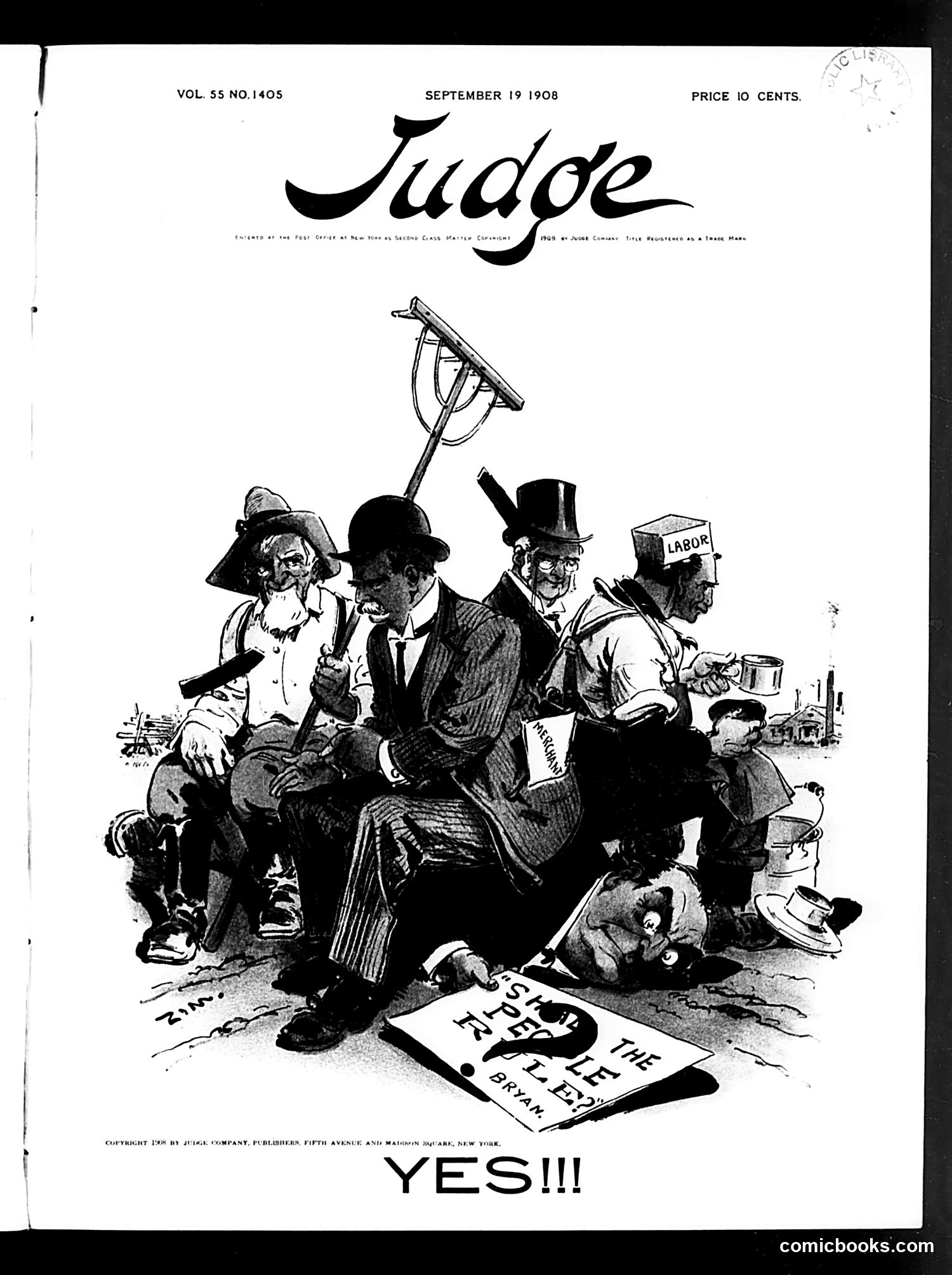
This political cartoon satirizes support for William Jennings Bryan's 1908 presidential campaign. The central figure (likely representing Bryan or his political movement) sits surrounded by various supporters—a farmer, laborer, industrialist, and others—all holding him up with implements like a pitchfork. A document labeled "STUDY THE PLATFORM BRYAN" lies at their feet, with "YES!!!" as the emphatic caption. The satire appears to mock the diverse, sometimes contradictory coalition backing Bryan, suggesting these different interest groups were uncritically supporting him without carefully reading his actual platform. The cartoon implies Bryan's appeal was emotional rather than substantive, uniting disparate factions through enthusiasm rather than policy coherence.
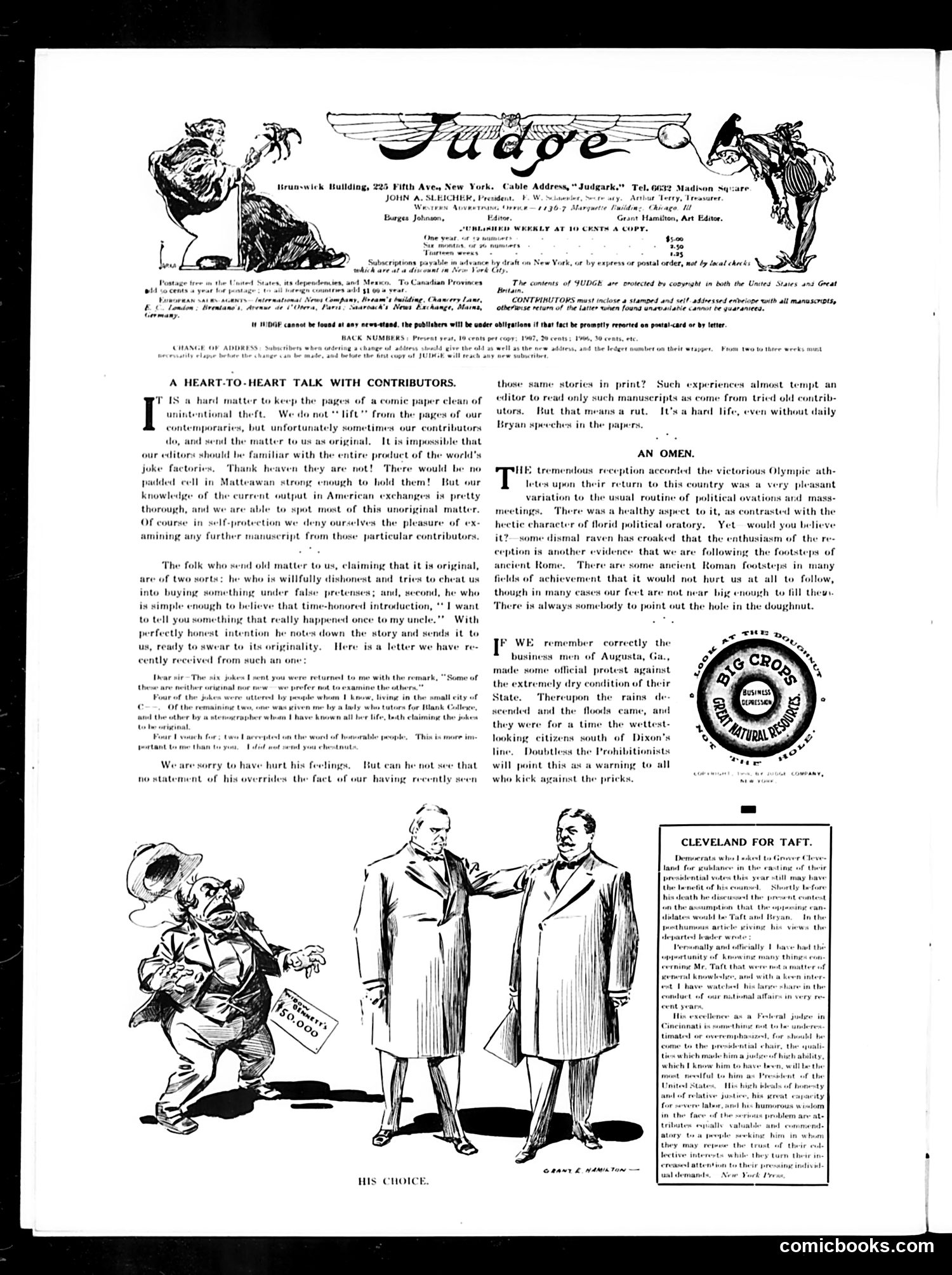
This page from Judge magazine contains editorial commentary and political cartoons. The main cartoon titled "His Choice" (credited to Grant Hamilton) depicts a figure labeled "ROOSEVELT'S SHADOW" being presented with two suited men—likely representing political choices or candidates. The text includes "A Heart-to-Heart Talk with Contributors," discussing manuscript submissions, and "An Omen," which references the return of Olympic athletes and uses this as a metaphor for political enthusiasm, comparing it to ancient Rome. A sidebar titled "Cleveland for Taft" advocates for William Howard Taft's presidency, praising his judicial experience and character as suitable for high office. The page criticizes political figures and explores themes of American political leadership, though without a specific date visible, the exact election or event remains unclear from this image alone.
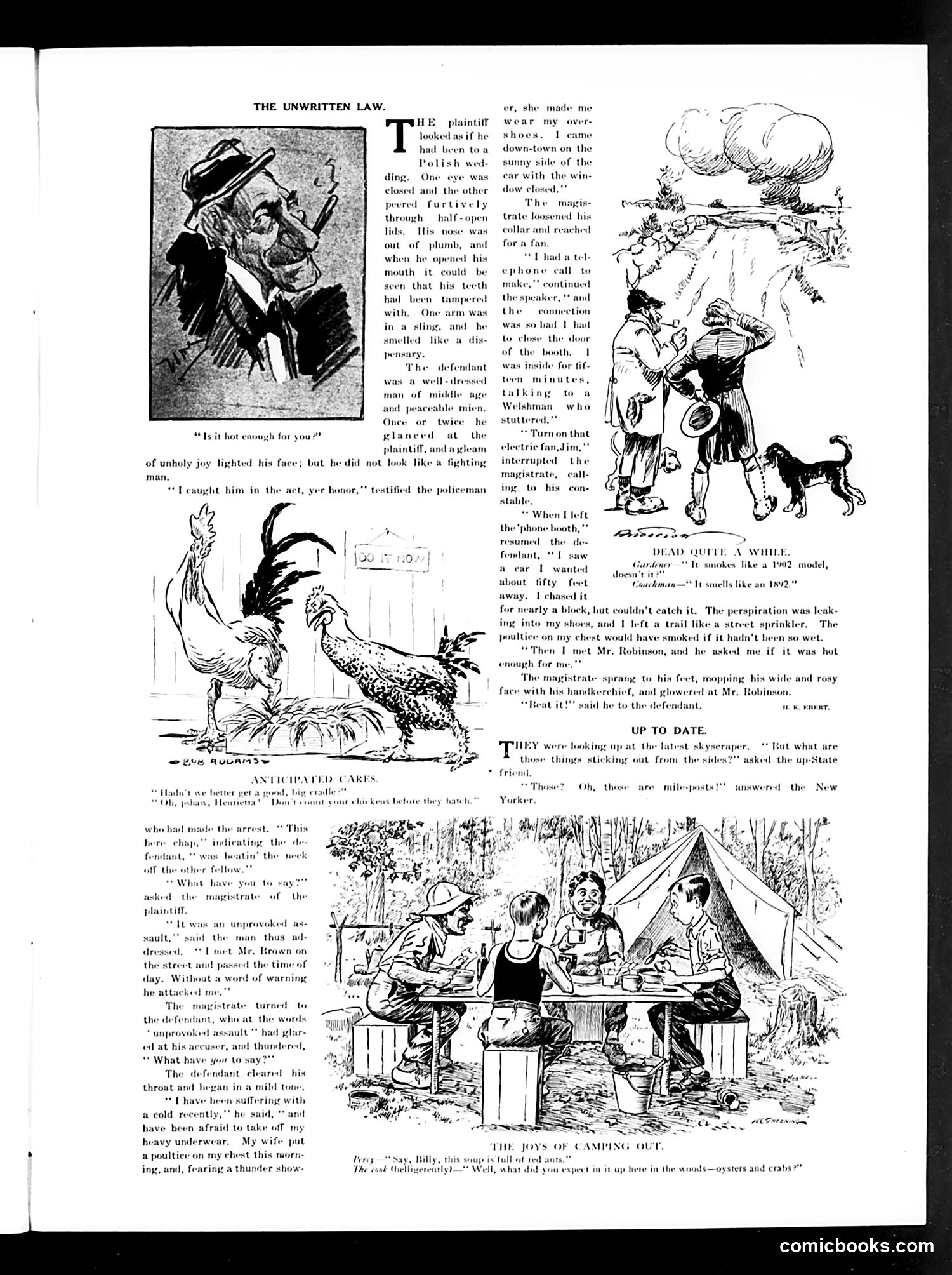
This page satirizes a contemporary legal case involving a man defending himself against assault charges. The story references a plaintiff who caught a defendant with his wife, leading to a physical confrontation. The central satire concerns the "unwritten law"—an informal code where a husband could assault another man without legal consequences if that man had relations with his wife. The defendant claims this unwritten law justified his actions, but the magistrate rejects this defense, calling the argument insufficient ("Beat it!"). The cartoons mock how men invoked personal honor and marital jealousy to escape legal responsibility. Judge ridicules this logic, suggesting proper law should govern behavior, not mob justice or vigilantism dressed up as defense of family honor.
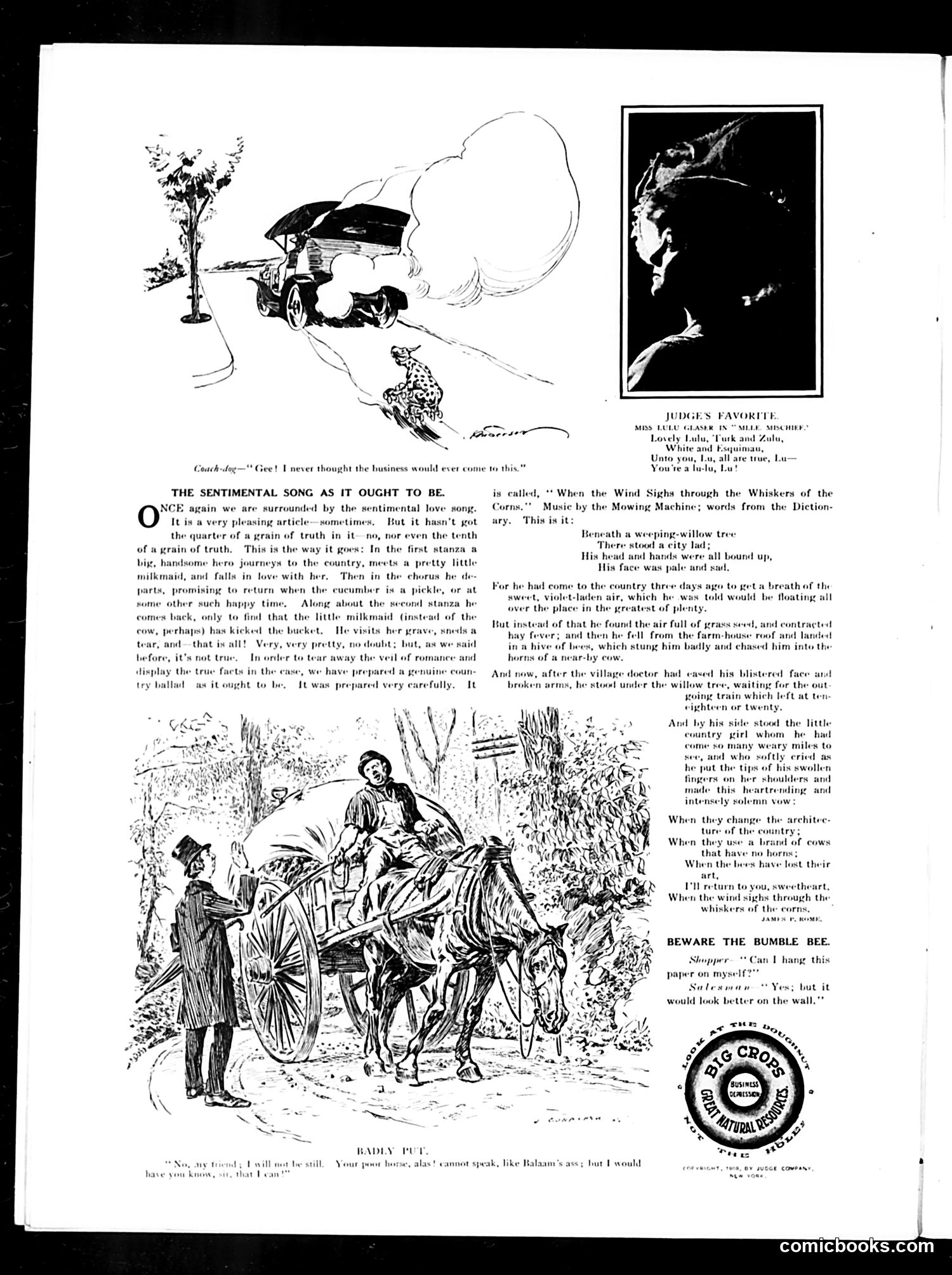
This page combines humor with advertising. The top cartoon shows a car hitting a lamppost with the caption "Gee! I never thought the business would ever come to this" — satirizing early automobile dangers and the novelty of motorized vehicles causing accidents. The main illustrated story, "The Sentimental Song as It Ought to Be," mocks overly romantic poetry by contrasting flowery Victorian sentimentality with crude rural reality: a lover expecting pastoral romance instead finds "a full of grass seed" and "contracted hay fever," ending in a comic collision with a cow. "Beware the Bumble Bee" appears to be another humorous anecdote about household mishaps. The Big Crop Fertilizer advertisement occupies the lower right, typical of Judge's mixed editorial-commercial format.
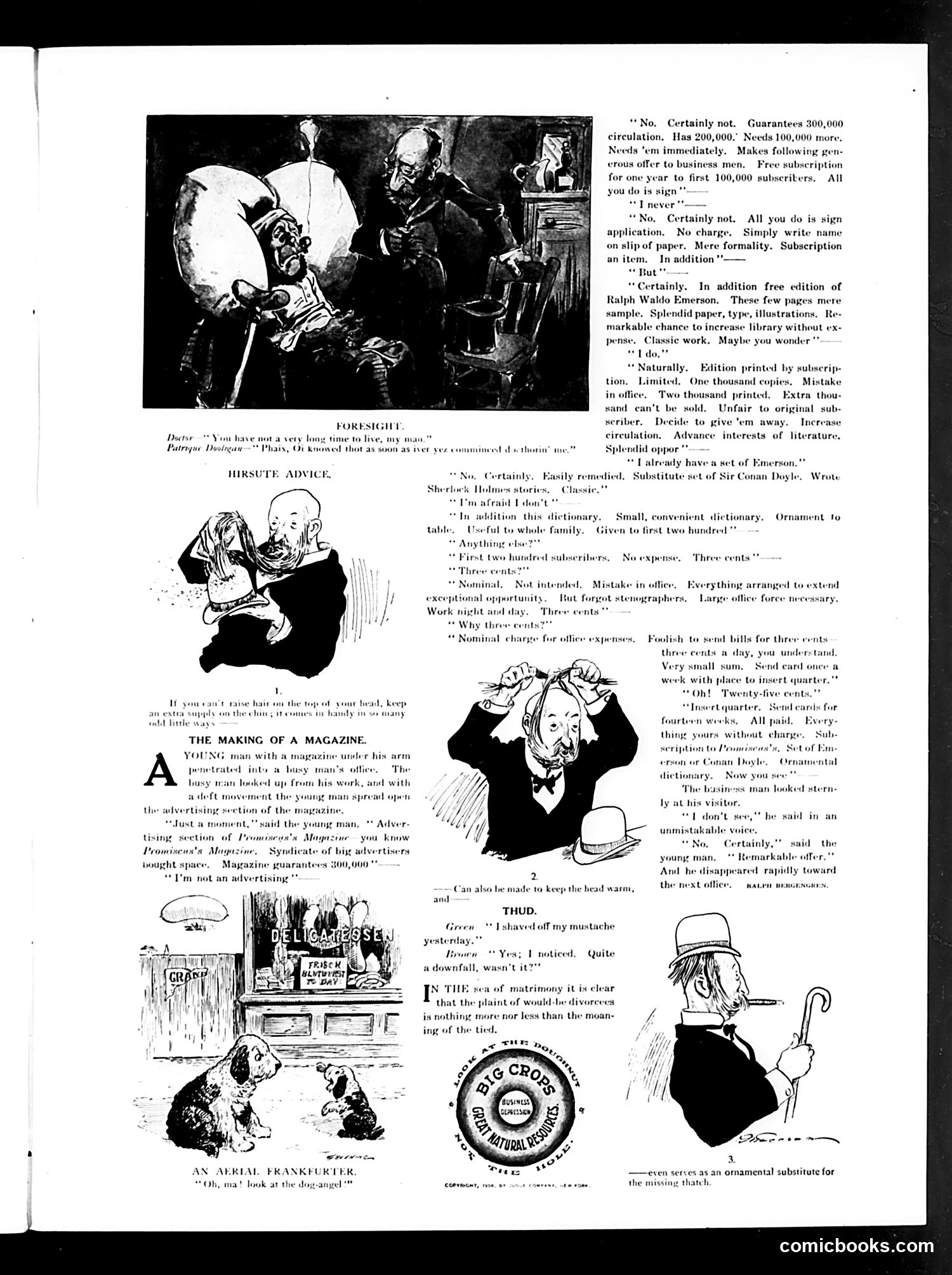
This page contains several satirical pieces mocking magazine publishing and subscription schemes. The main cartoon "Foresight" depicts a doctor and Euripides discussing how long one must live to see a subscription offer materialize. "Hirsute Advice" features exchanges between a business man and various figures about magazine circulation tactics—particularly the aggressive promotion of cheap subscriptions (three cents) to artificially inflate numbers and impress advertisers. The satire targets the deceptive business practices of publishers who prioritize appearing successful over genuine readership. "The Making of a Magazine" shows how advertising revenue, not editorial quality, drives publishing decisions. The smaller sketches mock related absurdities like mustache-shaving testimonials. The overall point: Judge criticizes the fraudulent circulation claims and mercenary advertising tactics dominating magazine publishing of the era.
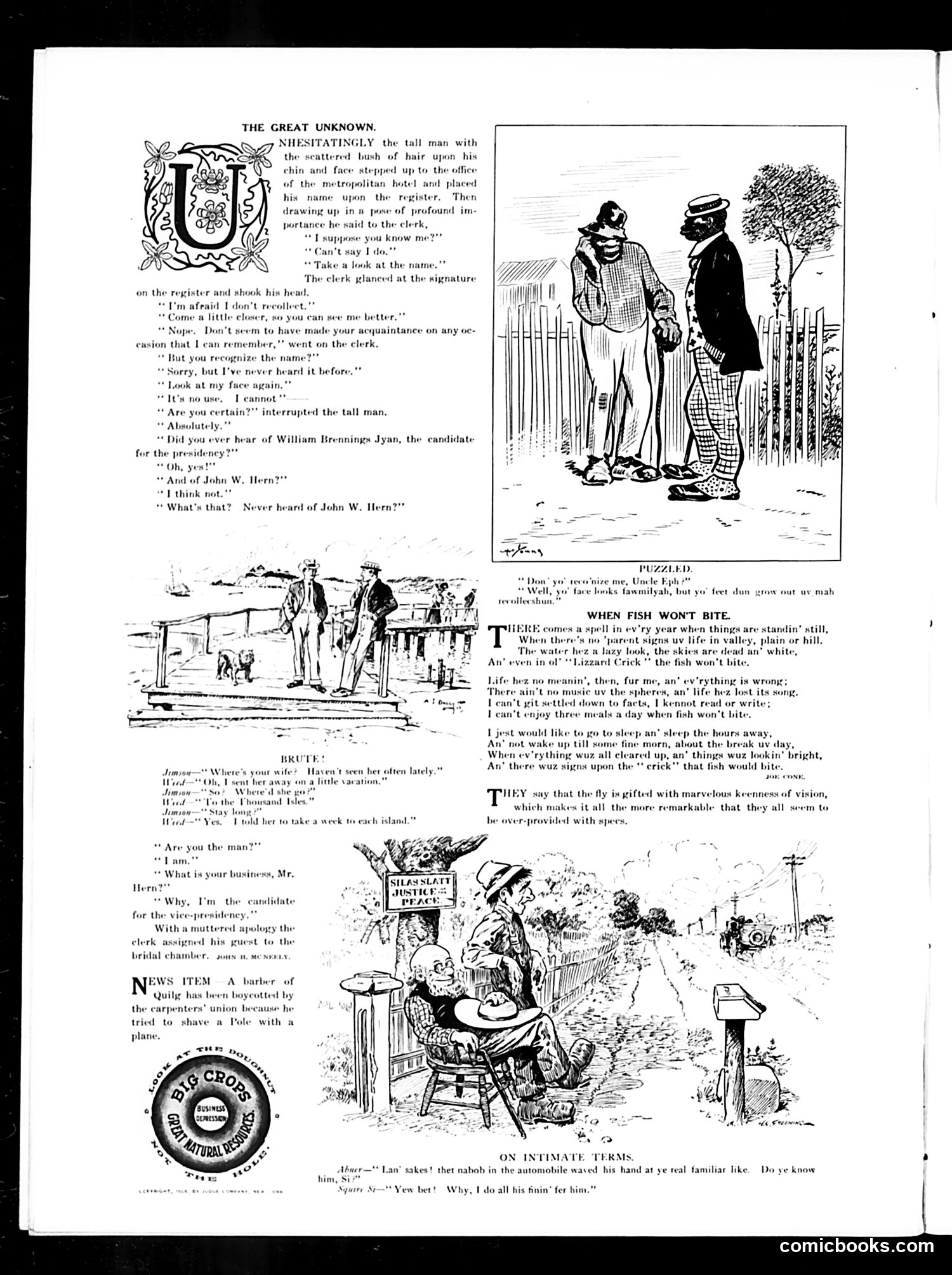
This page contains multiple satirical pieces from Judge magazine, likely from the early 1900s based on style. **"The Great Unknown"** (top): A tall man attempts to register at a metropolitan hotel but cannot be identified. The clerk doesn't recognize his name, face, or signature. The punchline reveals he's "William Brennings Jyan, the candidate for the presidency"—satirizing an obscure or forgotten political candidate. The joke mocks either a real minor candidate or the absurdity of unknown politicians seeking high office. **Lower sections**: Include rural dialect humor ("When Fish Won't Bite," "On Intimate Terms") typical of Judge's comedy, plus scattered social commentary. A "NEWS ITEM" mentions a barber boycotted by carpenters' union—likely satirizing labor disputes of the era. The cartoons use exaggerated illustration styles and vernacular speech to lampoon American politics, rural life, and contemporary social conflicts. Without specific dates or named candidates, the exact political reference remains unclear, but the satire targets political obscurity and labor tensions.
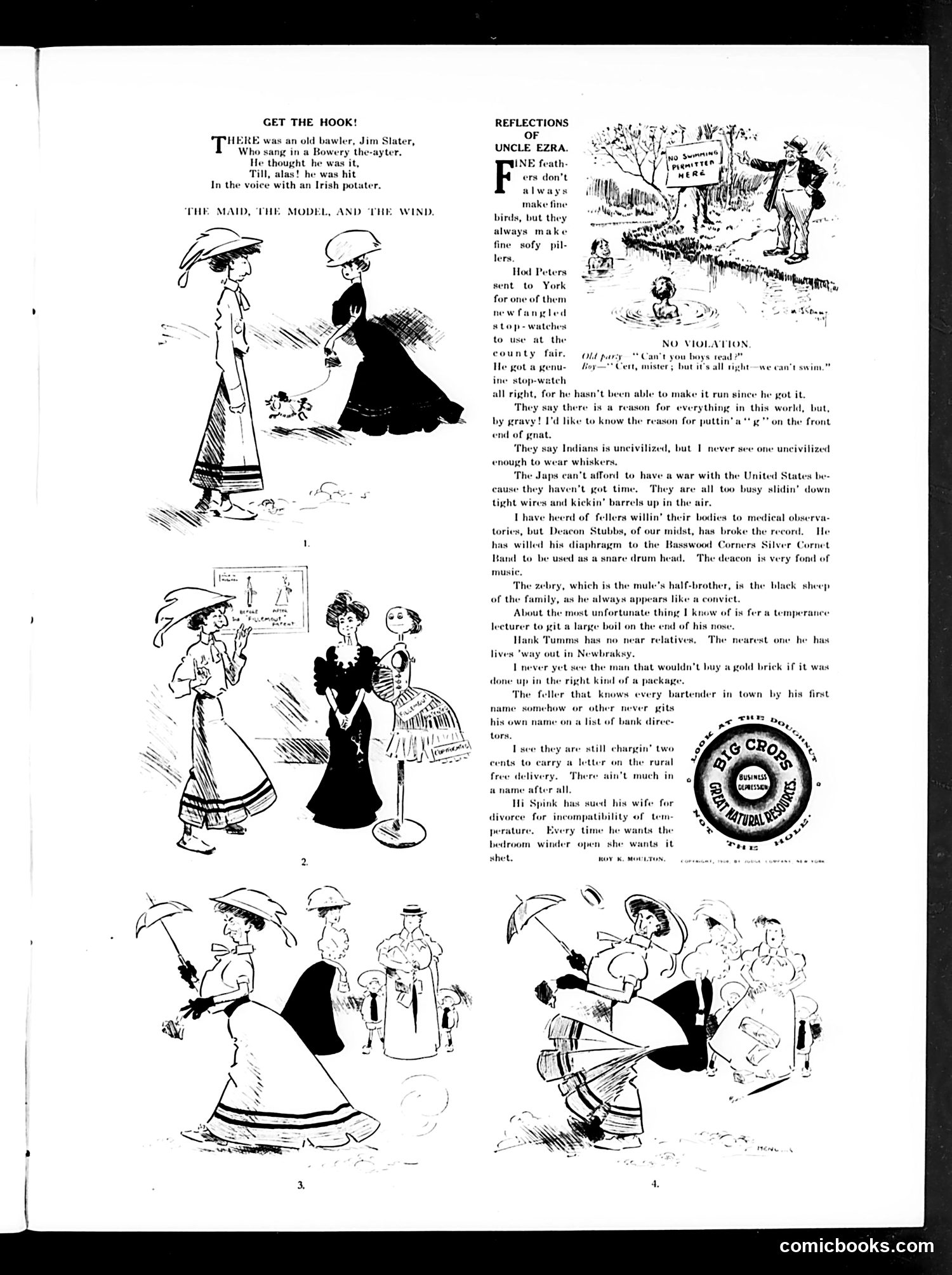
This page contains theatrical and social humor typical of early 20th-century Judge magazine. **"Get the Hook"** mocks Jim Slater, a poor singer performing in a Bowery theater (a working-class NYC venue). The title references the vaudeville practice of using a hook to yank bad performers offstage. The joke: he's so terrible he deserves this fate. **"The Maid, the Model, and the Wind"** is a visual gag showing women's skirts blown upward—a common comic subject playing on Victorian modesty concerns. **"Reflections of Uncle Ezra"** is homespun rural philosophy offering folksy observations: feathers make good pillows; Indians are uncivilized but don't wear whiskers; Japanese can't afford war with America; a temperance lecturer getting a nosebleed; a man suing for divorce over bedroom window disputes. These are gentle, exaggerated stereotypes and domestic absurdities meant as humorous commentary on contemporary life. The overall tone is lighthearted satire rather than pointed political critique.
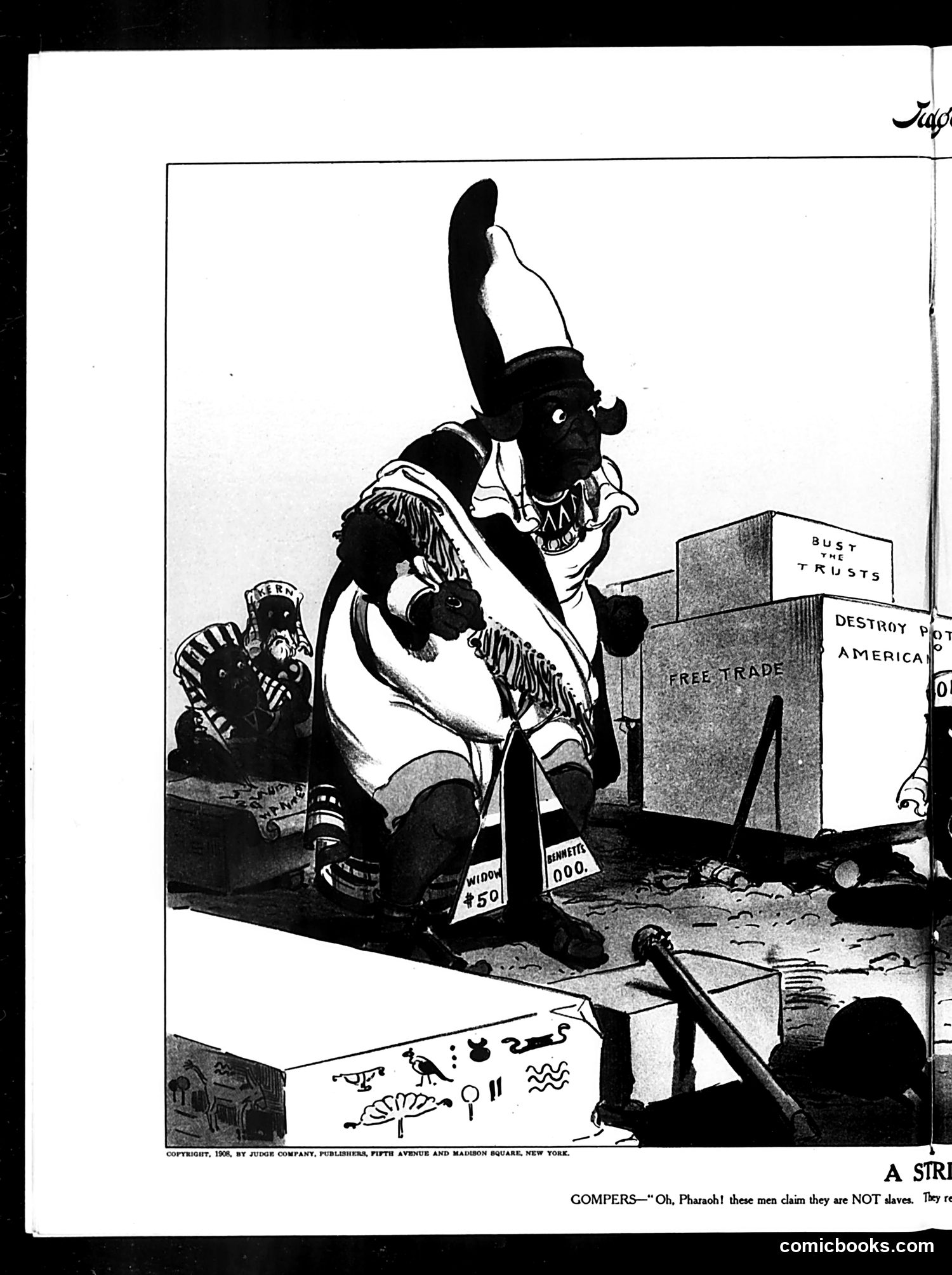
This 1908 Judge cartoon satirizes Samuel Gompers, head of the American Federation of Labor (AFL), depicted as an Egyptian pharaoh. The caricature uses racist imagery common to the era, showing Gompers in exaggerated form overseeing workers. The satire criticizes labor unions by comparing Gompers to a tyrannical pharaoh, suggesting he enslaves workers despite their claims of freedom. The backdrop includes signs referencing trusts and free trade—contemporary economic debates. The cartoon's point: labor leaders like Gompers exploit workers under the guise of protection, making them "slaves" in practice despite rhetoric of liberation. This reflects anti-union sentiment prevalent among Judge magazine's business-oriented readership during the Progressive Era.
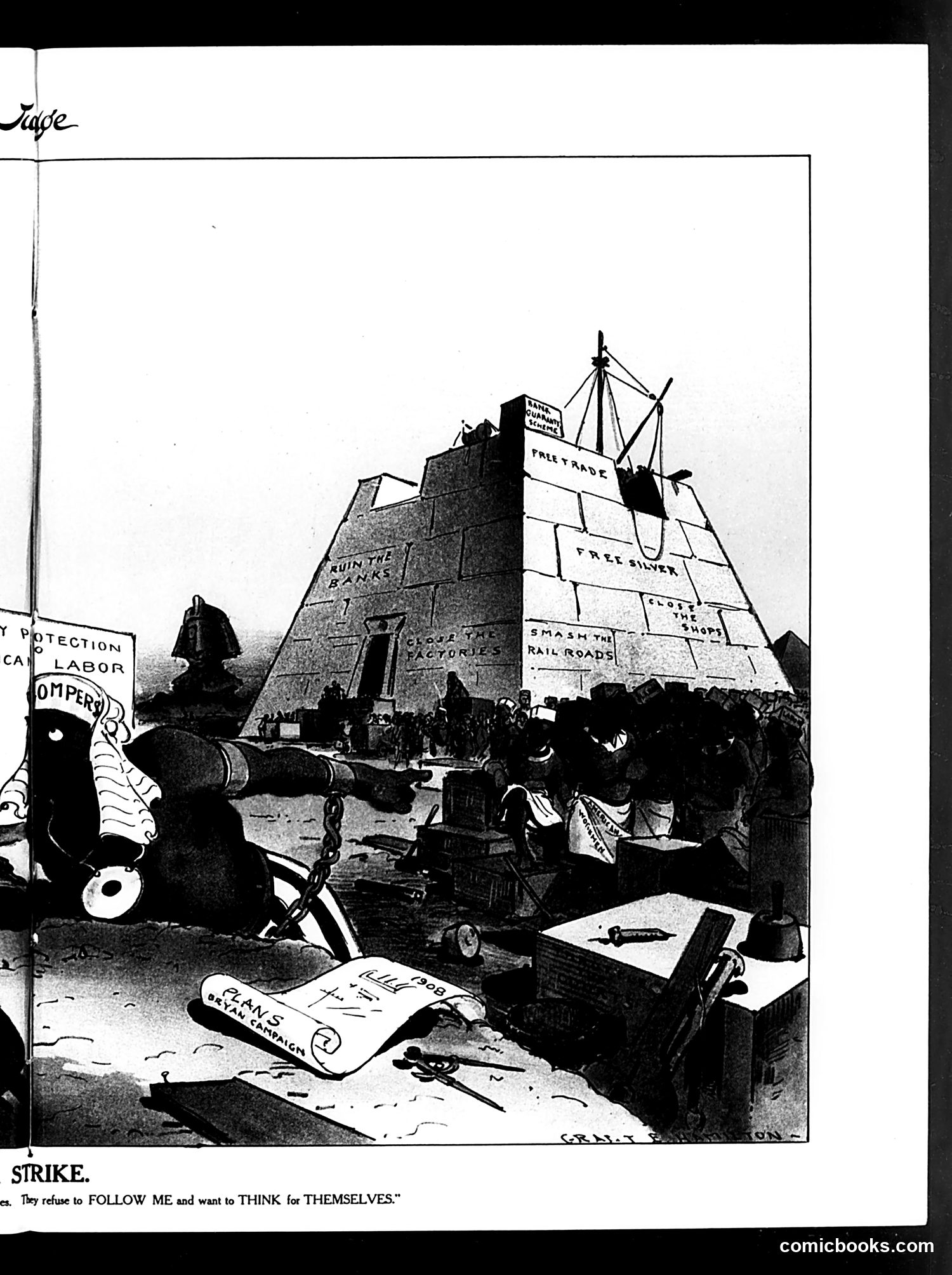
This Judge cartoon satirizes labor strike leadership and worker autonomy. A large pyramidal structure labeled with various grievances ("RUIN THE BANKS," "FREE SILVER," "SMASH THE RAIL ROADS," etc.) represents a strike movement or protest. A commanding figure in military dress stands before a crowd of workers who appear to be ignoring his authority. The caption—"They refuse to FOLLOW ME and want to THINK for THEMSELVES"—mocks the strike leader's complaint that workers won't blindly obey orders. The satire cuts both ways: it criticizes authoritarian leadership while potentially questioning whether workers' independent thinking produces coherent strategy, given the pyramidal structure's chaotic labeling of multiple unrelated demands. The context appears to be late 19th-century labor unrest, likely referencing populist or radical movements of that era.
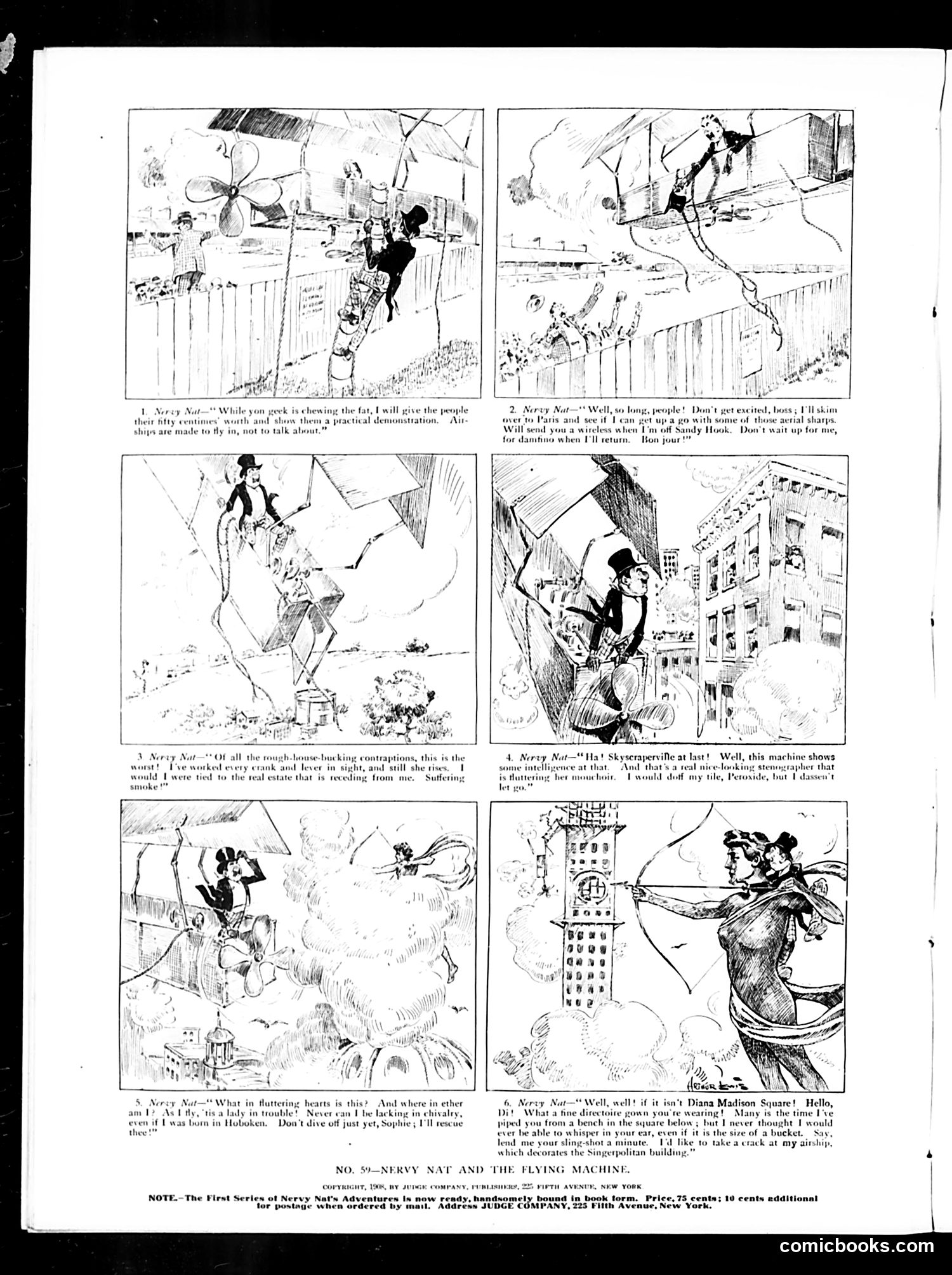
This is a comic strip featuring "Nervy Nat," a character who appears to be a daring, reckless adventurer testing an experimental flying machine. The six-panel story shows him demonstrating the contraption to skeptical onlookers in what appears to be an early 1900s urban setting. The humor centers on Nat's bold (foolhardy) confidence despite obvious dangers. He makes grandiose claims about his flying abilities while the machine appears jury-rigged and unreliable. References to specific New York locations—including the Woolworth Building and "Diana Madison Square"—ground the satire in contemporary urban America. The strip satirizes the era's obsession with technological innovation and the showmen who promoted untested inventions. Nat represents the confident charlatan or entrepreneur of the period, making impossible promises to impress crowds. The joke is that his reckless bravado far outpaces the actual capability of his machine.
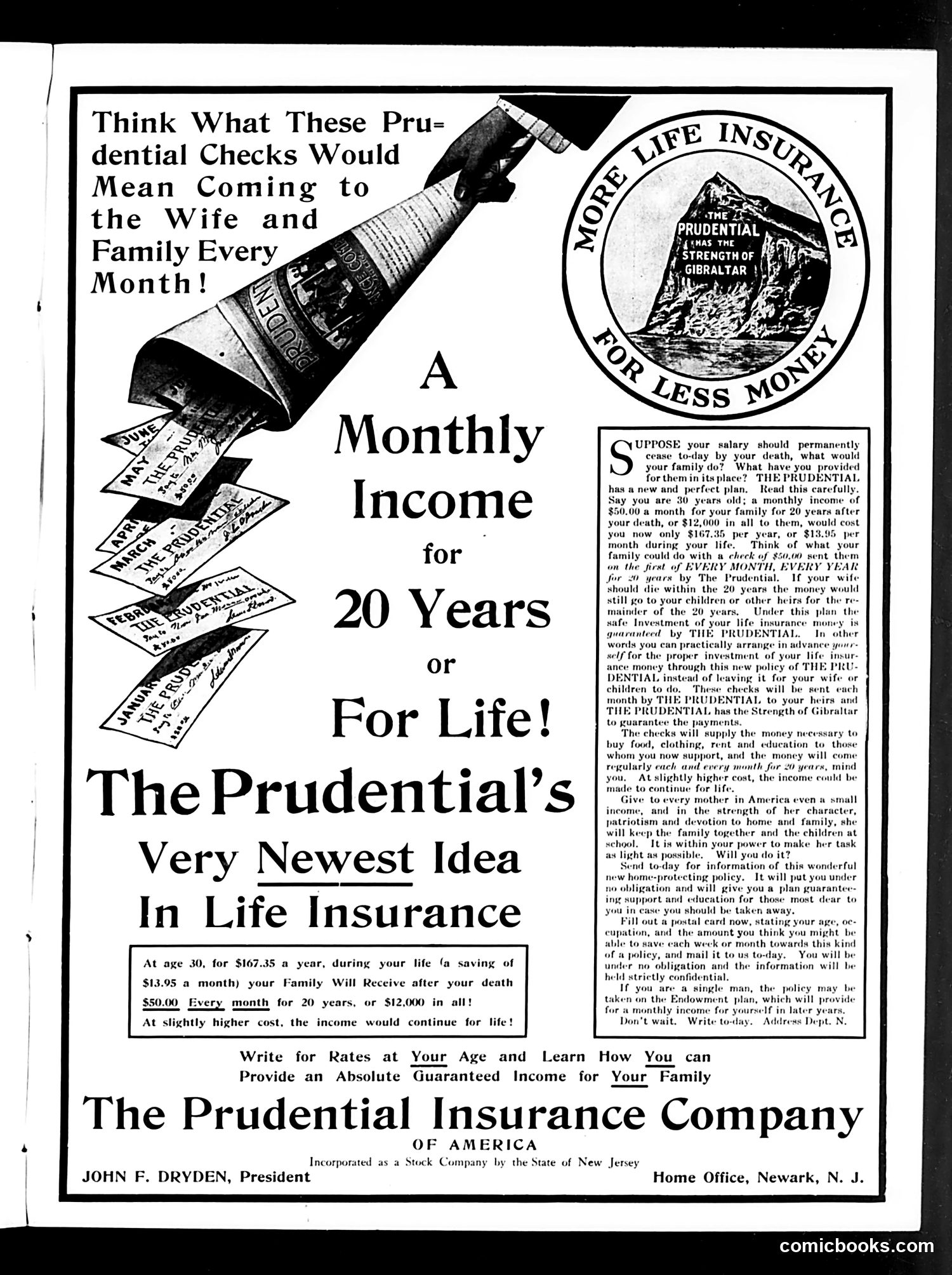
This is primarily a **life insurance advertisement**, not satire. The Prudential Insurance Company uses this Judge magazine page to market a novel product: monthly income checks to families after the policyholder's death. The pitch targets breadwinners anxious about their families' financial security. A 30-year-old pays $167.35 annually; his widow receives $50 monthly for 20 years ($12,000 total). The advertisement emphasizes emotional appeal—the widow's burden, children's education, the family's survival—rather than typical insurance language. The visual shows money literally pouring from a bottle, symbolizing continuous income flow. The "Gibraltar" reference (the company's logo) suggests unshakeable strength and reliability. This reflects early 20th-century concerns: high male mortality rates, women's economic dependence, and the vulnerability of families without social safety nets. The advertisement is straightforward marketing, not a joke—Judge accepted such ads from major corporations despite being a satirical publication.
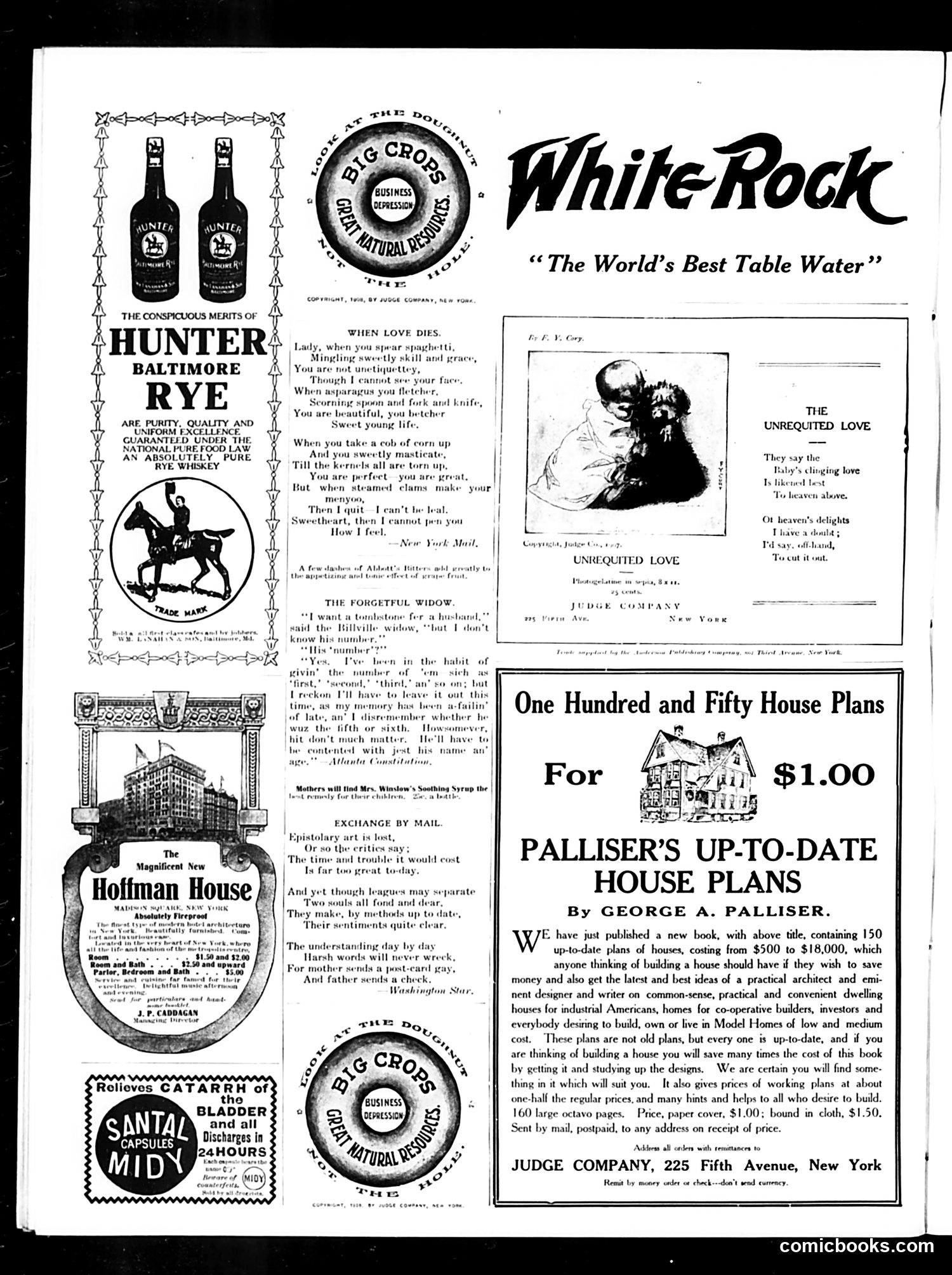
This is primarily an **advertising page** from Judge magazine, not a satirical cartoon page. The dominant content comprises commercial advertisements for various products and services popular in the early 1900s. The visible advertisements include: - **Hunter Baltimore Rye whiskey** (featuring romantic poetry about love) - **White Rock water** ("The World's Best Table Water") - **Hoffman House hotel** in New York - **Palliser's Up-to-Date House Plans** (architectural designs) - **Santal product** (appears to be a pharmaceutical or personal care item) The page also contains two brief humorous pieces: "When Love Dies" and "The Forgetful Widow" (from the Atlanta Constitution), depicting sentimental and folksy scenarios typical of period humor. The **satirical content is minimal**—the page functions mainly as a revenue vehicle through paid advertisements, which were common in Judge's business model. No specific political satire or notable caricatures are evident.
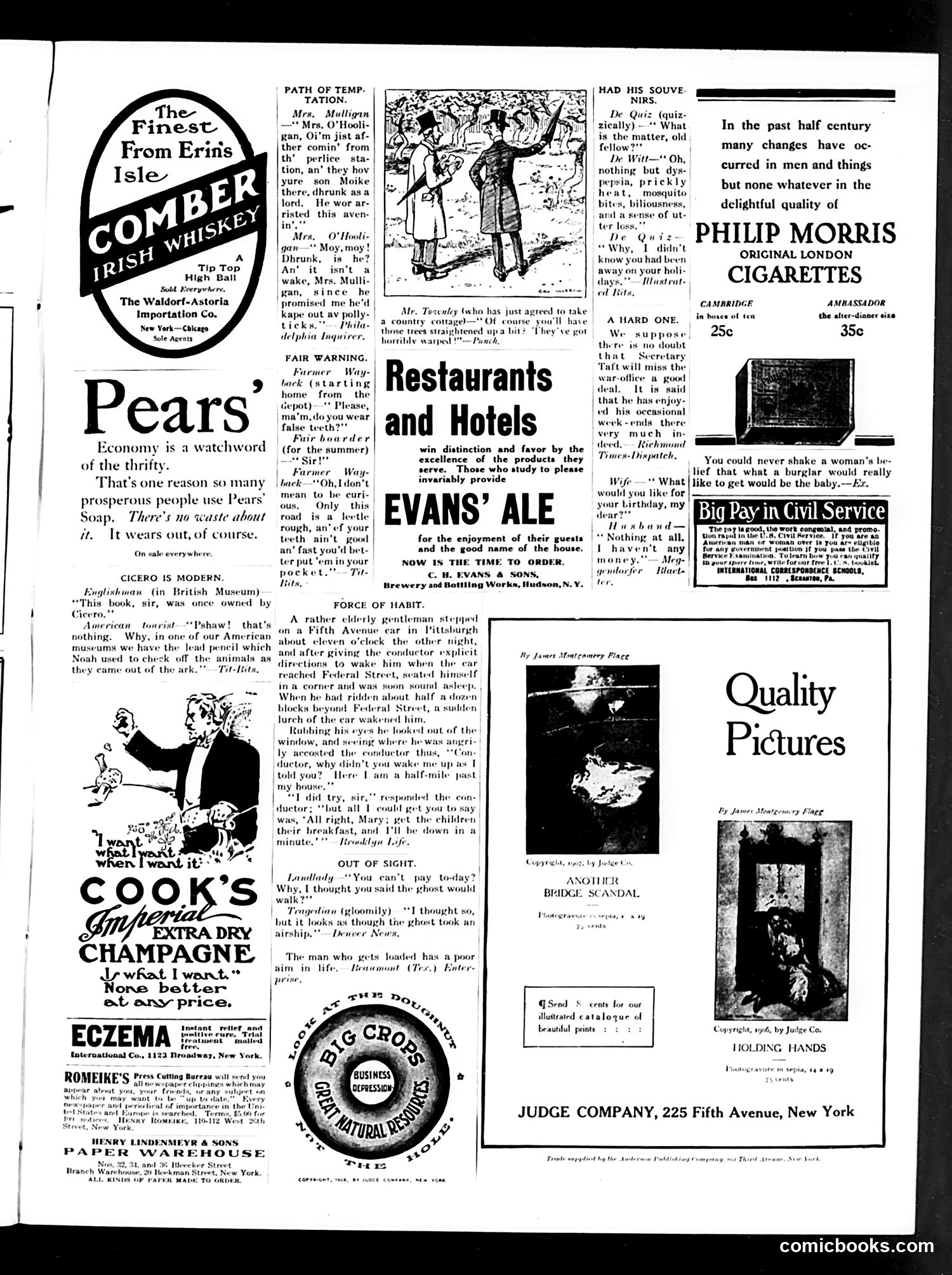
This page contains multiple brief satirical cartoons typical of Judge magazine's style: **"Path of Temptation"** (top left): Irish immigrant dialogue where Mrs. O'Hooligan reports her son Mike was arrested drunk at the police station, contradicting his promise to stay out of "politics" (likely slang for trouble). The satire mocks Irish stereotypes and working-class drinking culture. **"Force of Habit"** (center): An elderly gentleman, after giving explicit conductor directions, falls asleep mid-journey—satirizing absentmindedness or the force of habitual behavior overriding intention. **"Out of Sight"** (lower center): A brief quip about a man getting drunk having "a poor aim in life"—moralizing about alcoholism's consequences. The remaining content is primarily **advertisements** for products like Pears' Soap, Cook's Champagne, Evans' Ale, Philip Morris Cigarettes, and various services, reflecting the magazine's revenue model. The cartoons serve as filler between ads rather than sustained narratives.
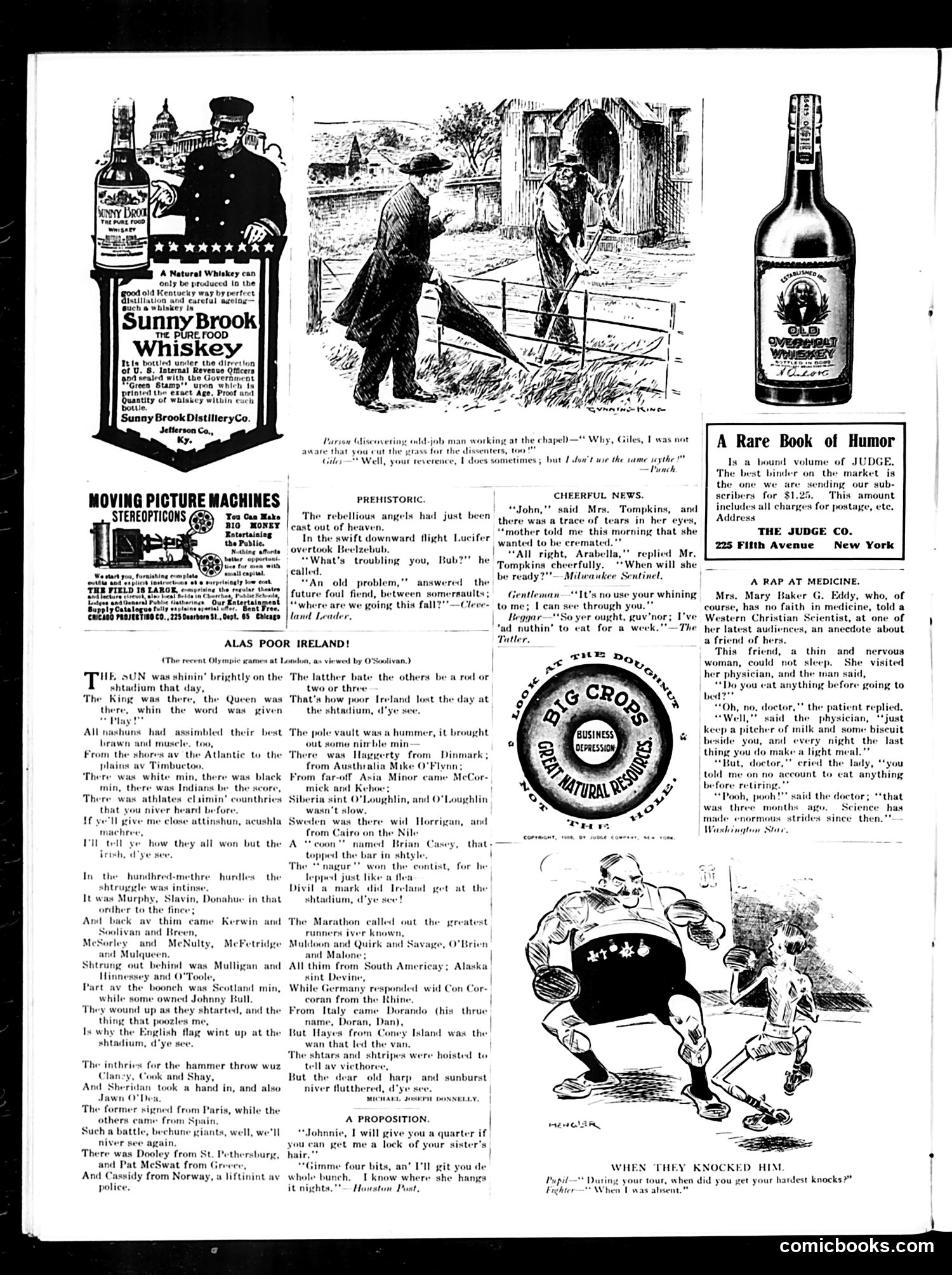
This page contains **whiskey advertisements** and **humorous satirical content** typical of early 20th-century Judge magazine. **Key elements:** The **Sunny Brook Whiskey ad** emphasizes "natural" production via "old Kentucky way"—likely responding to Pure Food and Drug Act regulations (1906) requiring age/proof labeling, suggesting competitors used artificial methods. The **"Alas Poor Ireland"** poem is ethnic humor common to the era, depicting Irish immigrants through stereotypical dialect and names (Murphy, Slavin, O'Loughlin). It recounts Olympic competition with comic malapropisms, climaxing in bewilderment that "the English flag wint up at the shtadium"—playing on Irish-English tensions. **"A Rap at Medicine"** satirizes **Mary Baker Eddy** and Christian Science, mocking faith-healing over medical treatment. The anecdote's punchline suggests Eddy's teachings harm patients. The page reflects **early 1900s prejudices**: ethnic stereotyping, consumer regulation anxieties, and religious skepticism toward new movements.
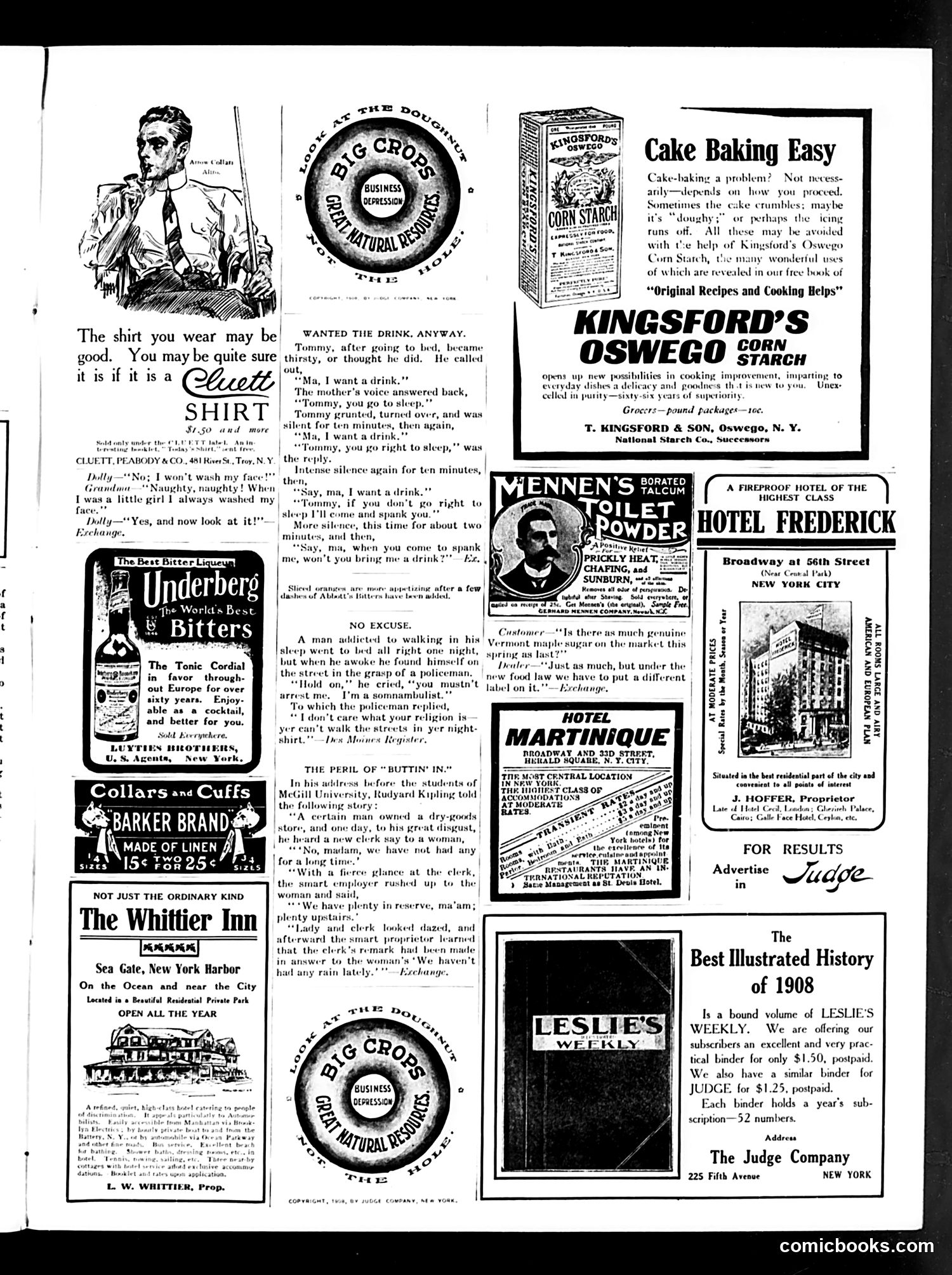
This is primarily an **advertising page** from Judge magazine, with minimal editorial cartoon content. The page contains numerous product advertisements (shirts, bitters, hotels, corn starch) interspersed with brief humorous anecdotes rather than political satire. The few jokes present are domestic comedies with no political dimension: - A dialogue between "Dolly" and her grandmother about face-washing, suggesting aging affects appearance - "Tommy" repeatedly interrupting bedtime to request drinks, culminating in a joke about wanting a spanking accompanied by refreshment - A sleepwalker stopped by police, claiming religious exemption ("somnambulist") - A dry-goods clerk's gaffe about inventory None of these reference specific political figures, events, or social movements. They're gentle, family-oriented humor typical of the era's general-interest magazines. The page primarily serves as a revenue vehicle through advertising rather than as a platform for satirical commentary.
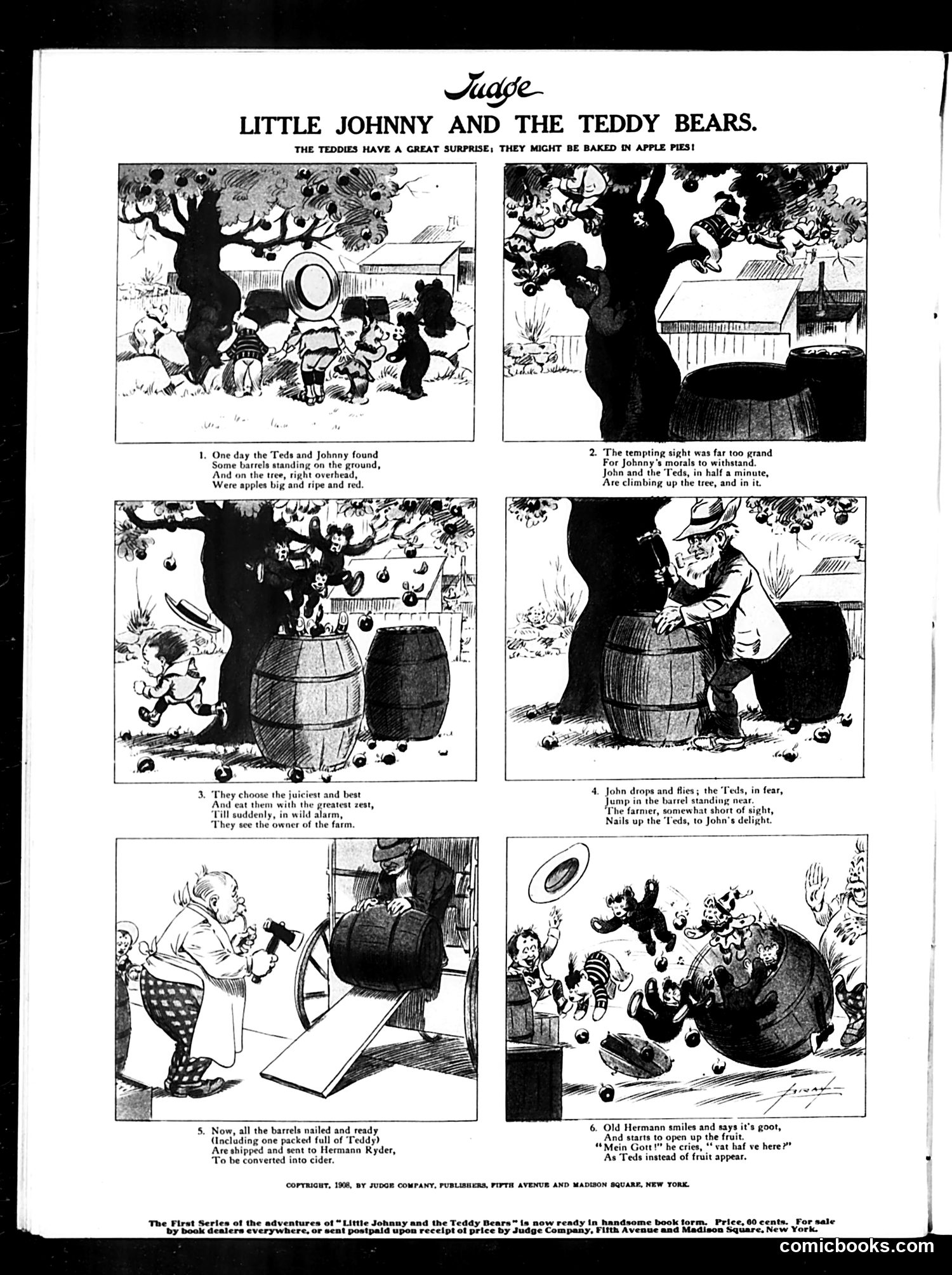
This is a children's comic story, not political satire. It depicts young Johnny and anthropomorphic teddy bears discovering barrels beneath an apple tree. Tempted by the fruit, they climb up and accidentally end up inside barrels, which a nearsighted farmer seals shut. The barrels are shipped to a German-American farmer named Hermann Ryder, who plans to convert them to cider. When he opens them, he's shocked to find teddy bears instead of apples. The humor relies on slapstick mishap and the absurdist surprise ending. The German character "Hermann Ryder" with his dialect ("Mein Gott!") reflects early 1900s American popular culture's casual use of ethnic caricature for comedic effect. This appears to be promotional material for an upcoming children's book series by Judge Company, priced at 60 cents.