
A complete issue · 16 pages · 1908
Judge — September 12, 1908
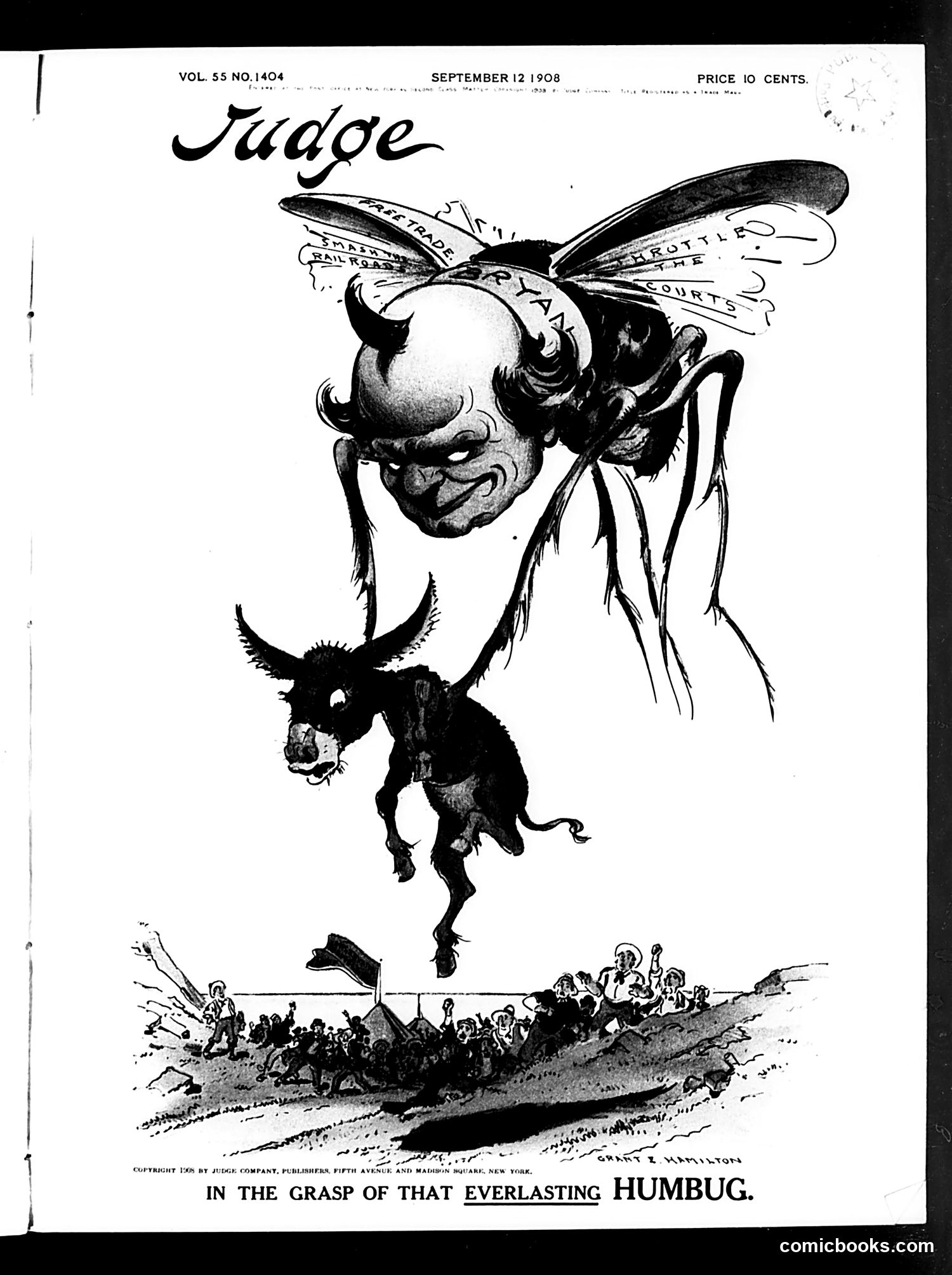
This political cartoon depicts a grotesque demon or devil figure with wings labeled with what appear to be railroad company names ("ANTHRACITE," "SHORTLINE," "COURTS") carrying away a small horned devil or imp toward a crowd of observers below. The title and imagery suggest criticism of railroad monopolies or fraudulent business practices ("humbug") that Judge's editors viewed as predatory and inescapable. The flying demon likely represents a railroad magnate or the railroad industry itself as a malevolent force preying on the public. The labeling on the wings indicates specific companies or corrupt practices involved in this perceived scheme. The cartoon reflects early 20th-century Progressive-era anxieties about corporate power and trustbusting.
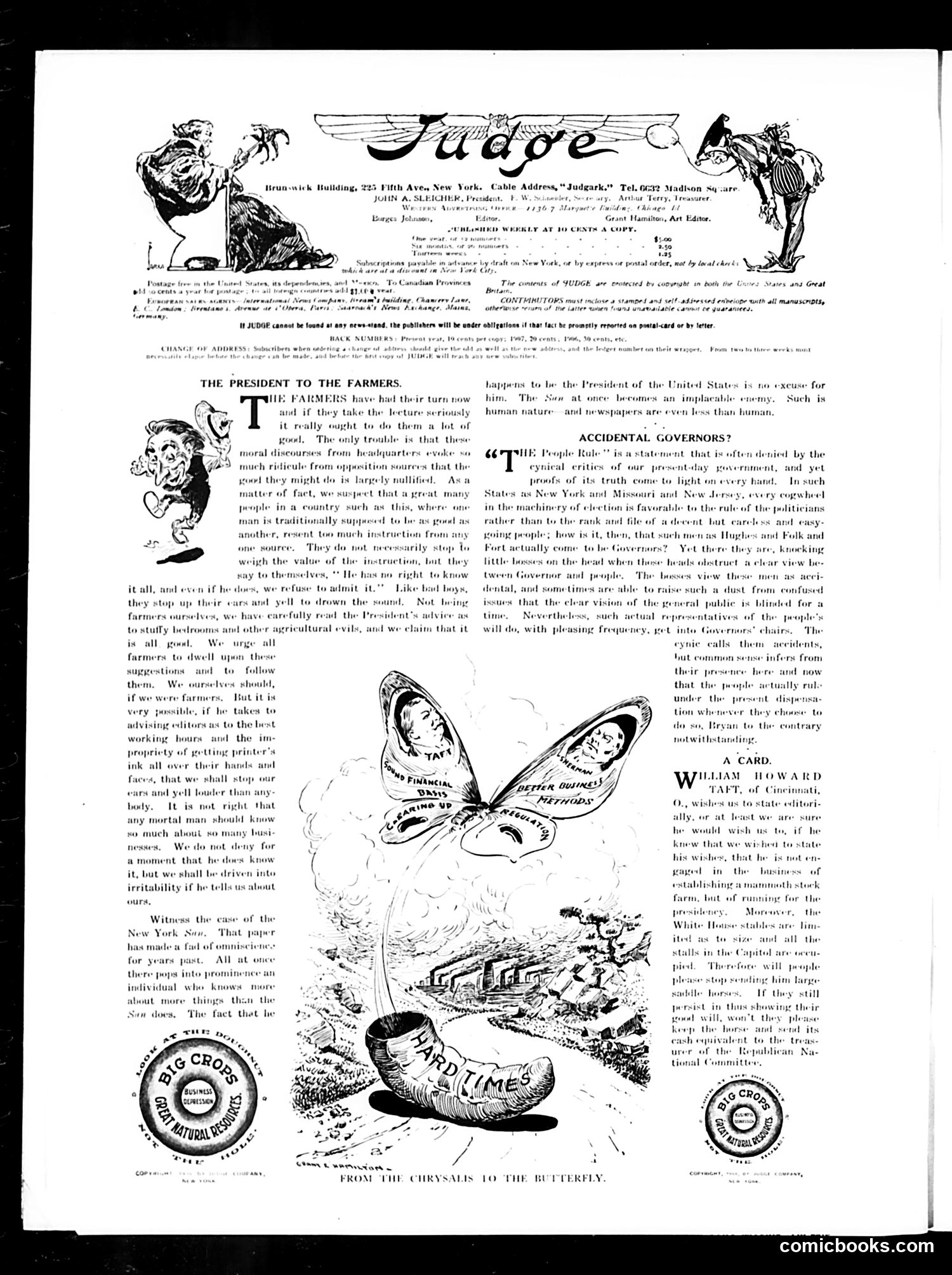
This page contains two distinct pieces: **"The President to the Farmers"** (left): A lengthy editorial argues farmers shouldn't blame President Cleveland for agricultural difficulties, claiming moral discourse from "headquarters" caused problems. It urges farmers to stop complaining and accept the situation. **"Accidental Governors?"** (right): Commentary on New York and Missouri elections, questioning whether politicians accidentally become governors. It suggests the public doesn't truly control elections—politicians manipulate outcomes—and criticizes the notion that voters actually rule. **Main Cartoon** (center): A large caterpillar-butterfly metamorphosis labeled "From the Chrysalis to the Butterfly" and "Hard Times" suggests economic transformation or false promises of improvement. The satire criticizes both agricultural hardship dismissal and electoral manipulation, reflecting late-19th-century political cynicism about democratic governance.
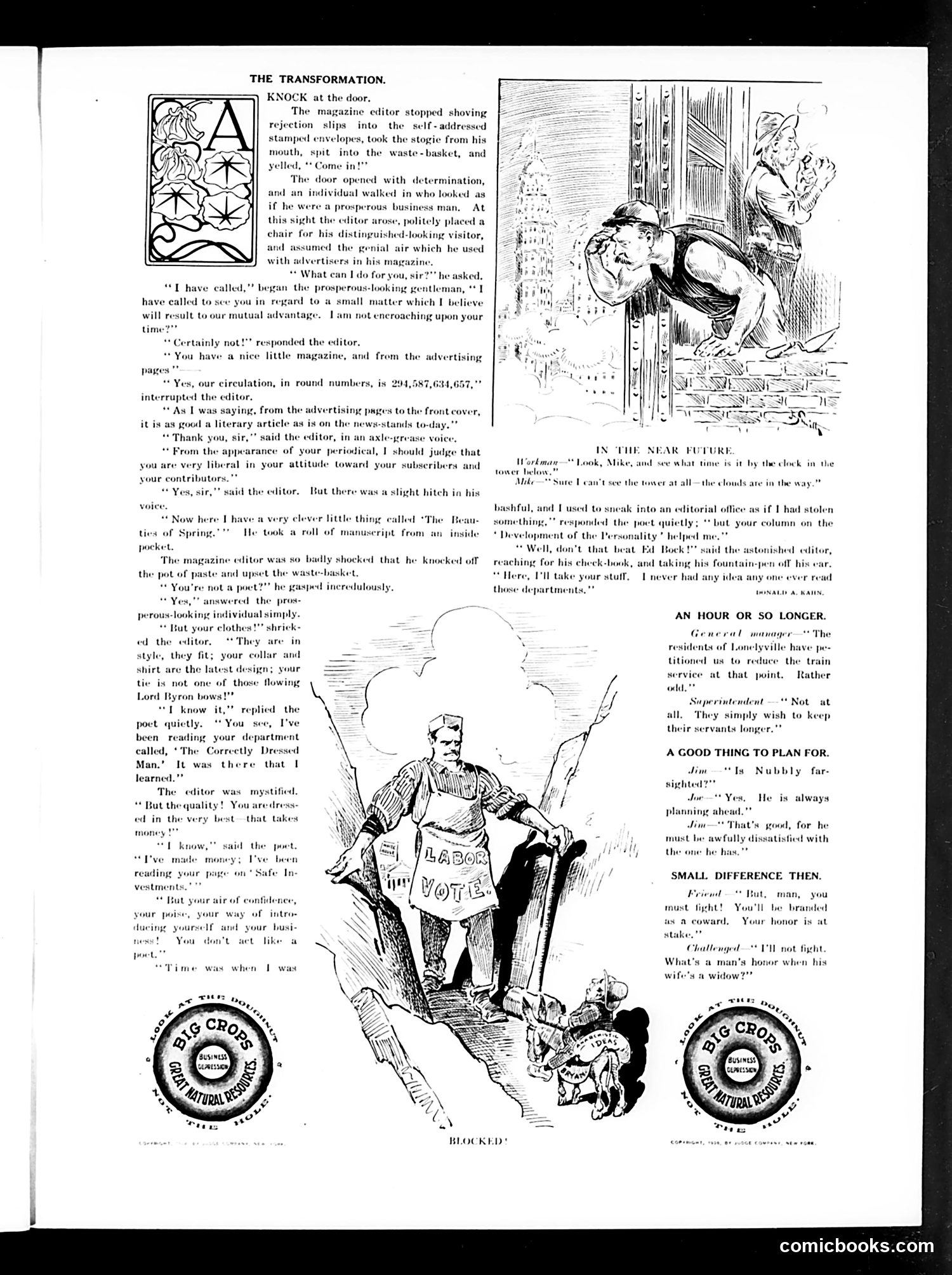
This page contains satirical editorial content about magazine publishing and advertising. The main cartoon shows a figure labeled "BLOCKED" - appearing to depict someone (likely representing labor or reform) trapped between tree trunks, suggesting obstruction or impediment. The text discusses a magazine editor receiving a visitor who pitches "The Beauties of Spring" manuscript. The editor explains the magazine's value lies in its advertising pages, not editorial content - satirizing how commercial interests dominated periodicals. The dialogue sections mock various social issues: reduced train service, servants leaving employment, and a man losing honor when his wife becomes a widow. The "Big Crops" circular logos advertise natural recipes, a common period advertisement. Overall, the page satirizes both publishing commercialism and various contemporary social anxieties, though specific historical references remain unclear without additional context.
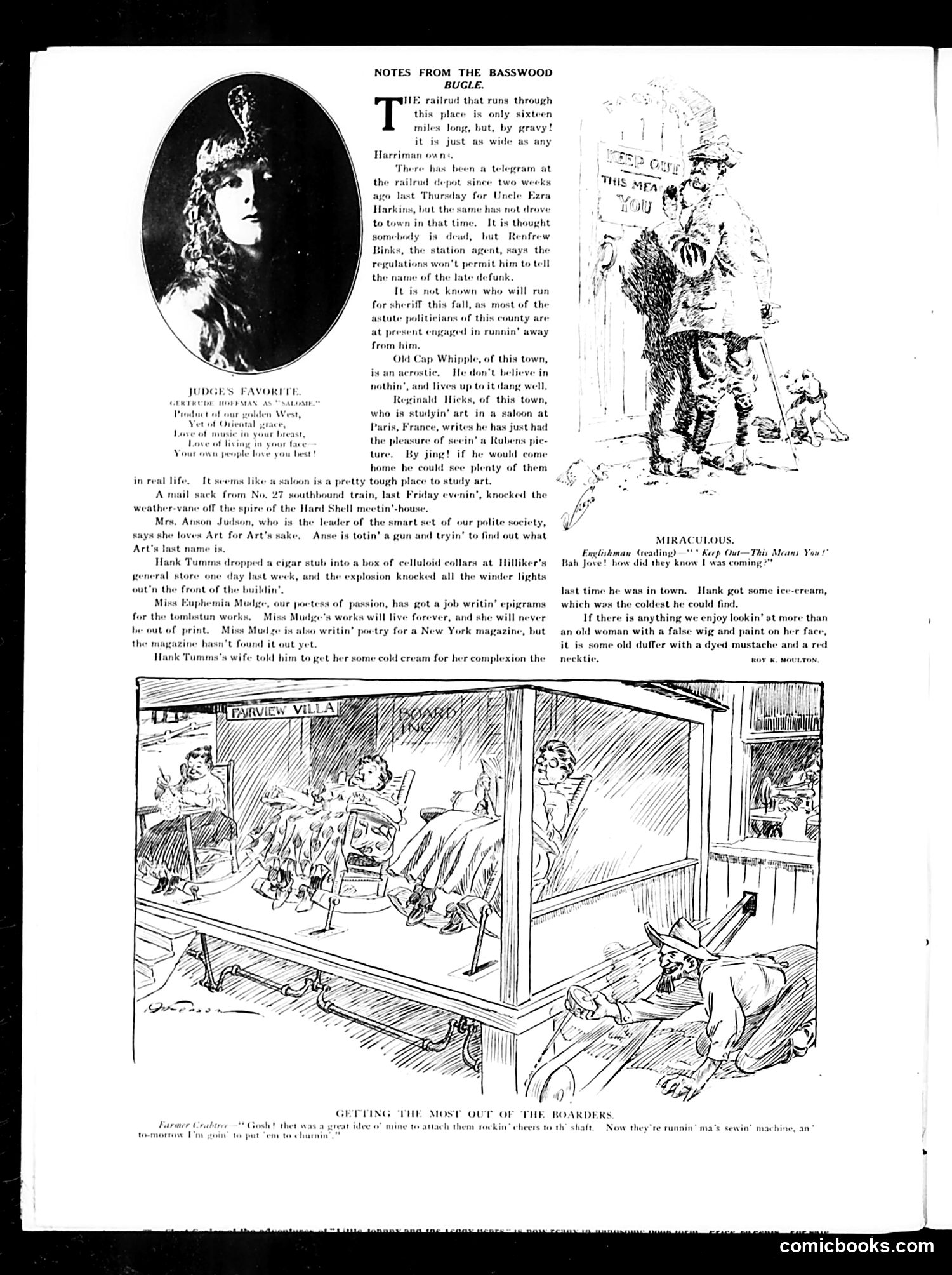
This page satirizes small-town American life through fictional rural characters and gossip. The top section features a portrait alongside commentary about local figures: "Old Cap Whipple," an atheist; "Reginald Hicks," an art student in Paris; and various townspeople engaged in petty scandals (failed marriages, ice-cream consumption, mustaches). The lower cartoon, "Getting the Most Out of the Boarders," depicts a boarding house where the landlady exploits lodgers for labor—they're apparently forced to operate machinery or perform work to offset their rent. The humor targets rural provincialism, social pretension, and economic exploitation of working-class boarders. It's gentle mockery of small-town gossip culture and landlord-tenant dynamics typical of early 20th-century American satirical comedy.
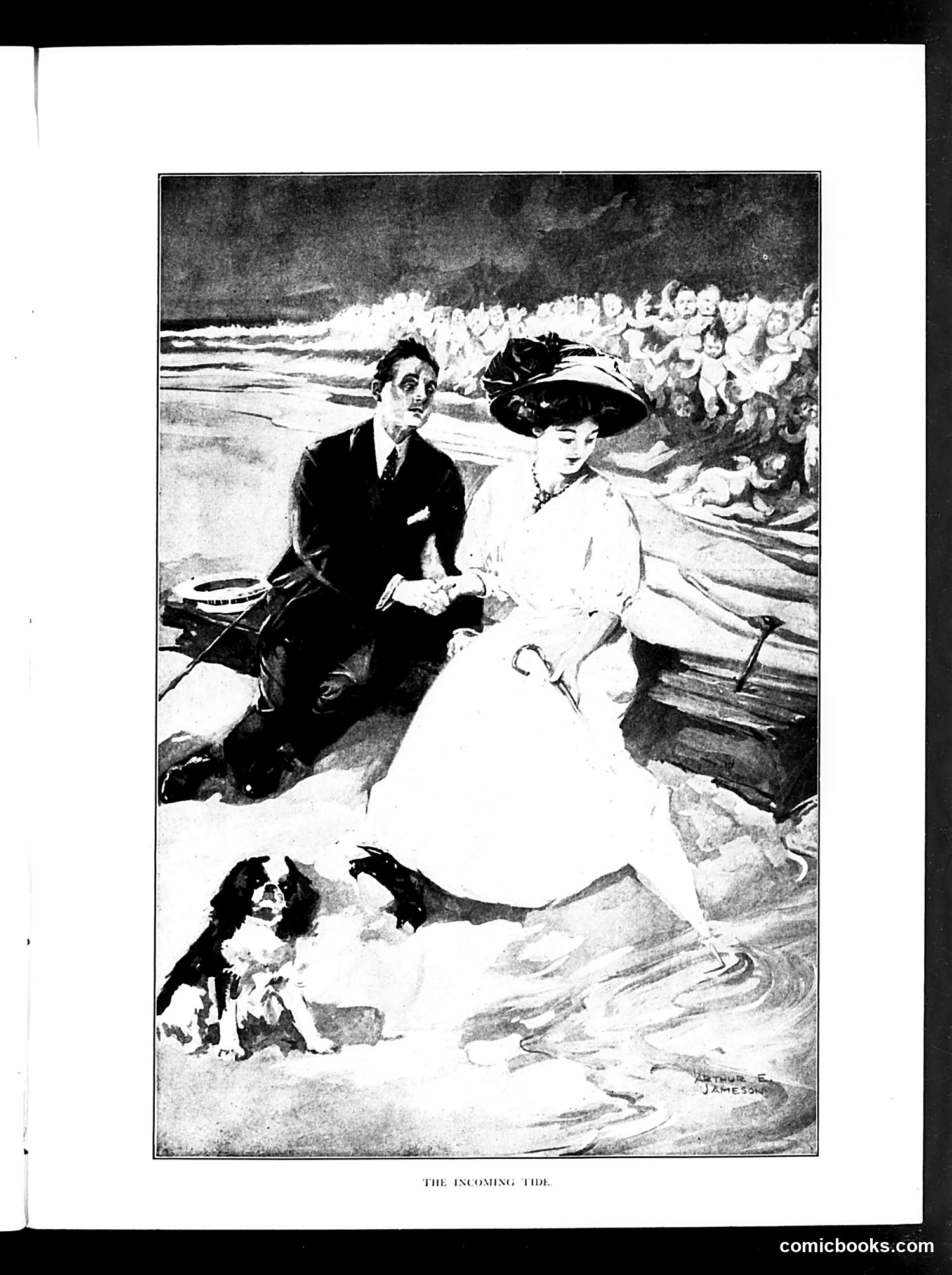
This appears to be a romantic or social commentary illustration titled "The Incoming Tide," showing a couple at the beach with a small dog. The man in dark formal attire sits beside a woman in white Edwardian dress and an elaborate hat, watching the incoming ocean waves. The satire likely plays on the phrase "incoming tide" as a metaphor—possibly commenting on social change, romantic inevitability, or contemporary concerns about shifting circumstances. The couple's formal beach attire and composed posture contrast with the dramatic seascape, suggesting either optimism or irony about their situation. Without additional context about Judge magazine's 1900s-1910s political climate, the specific satirical target remains unclear, though it may reference social anxieties of the era.
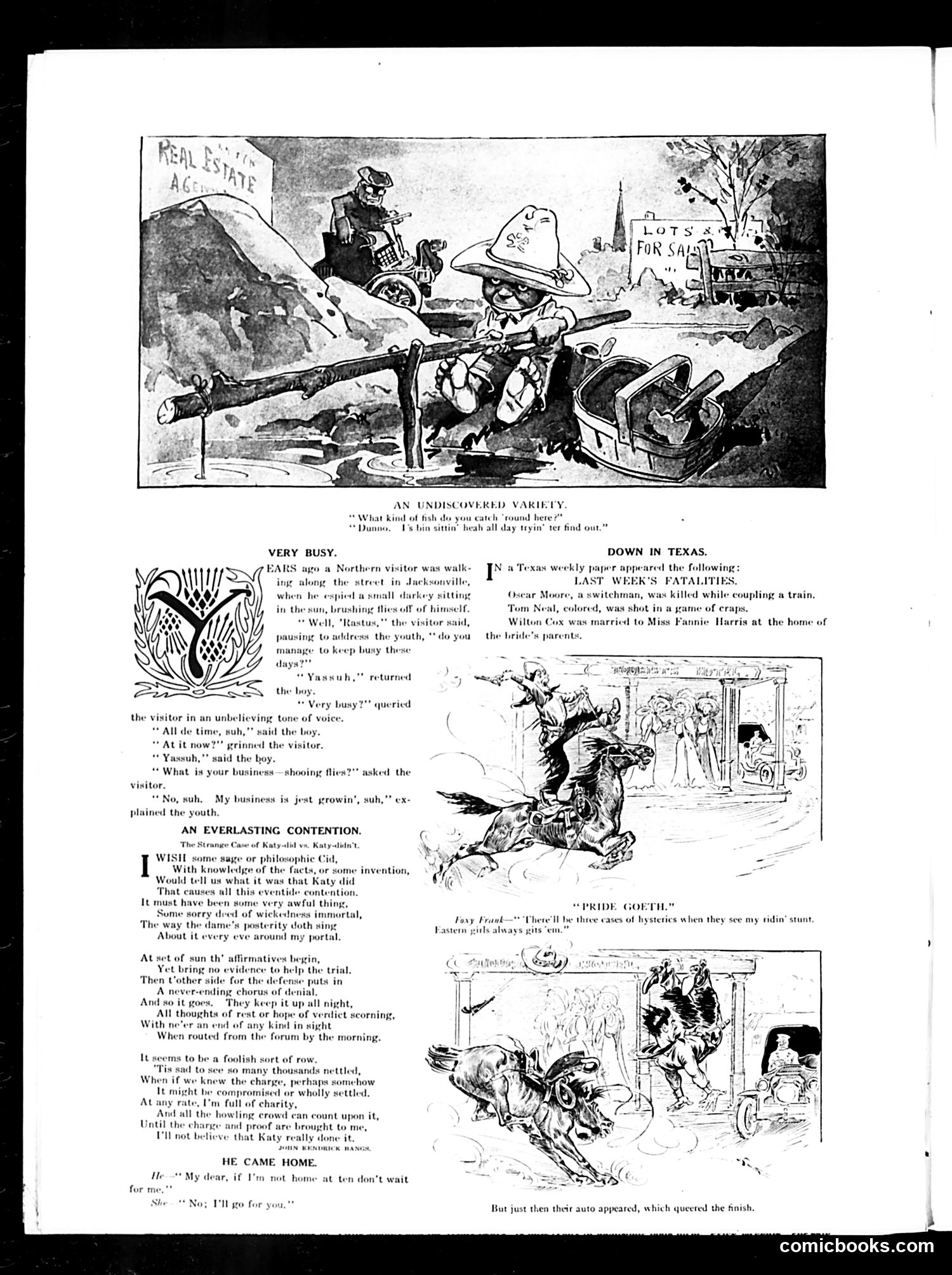
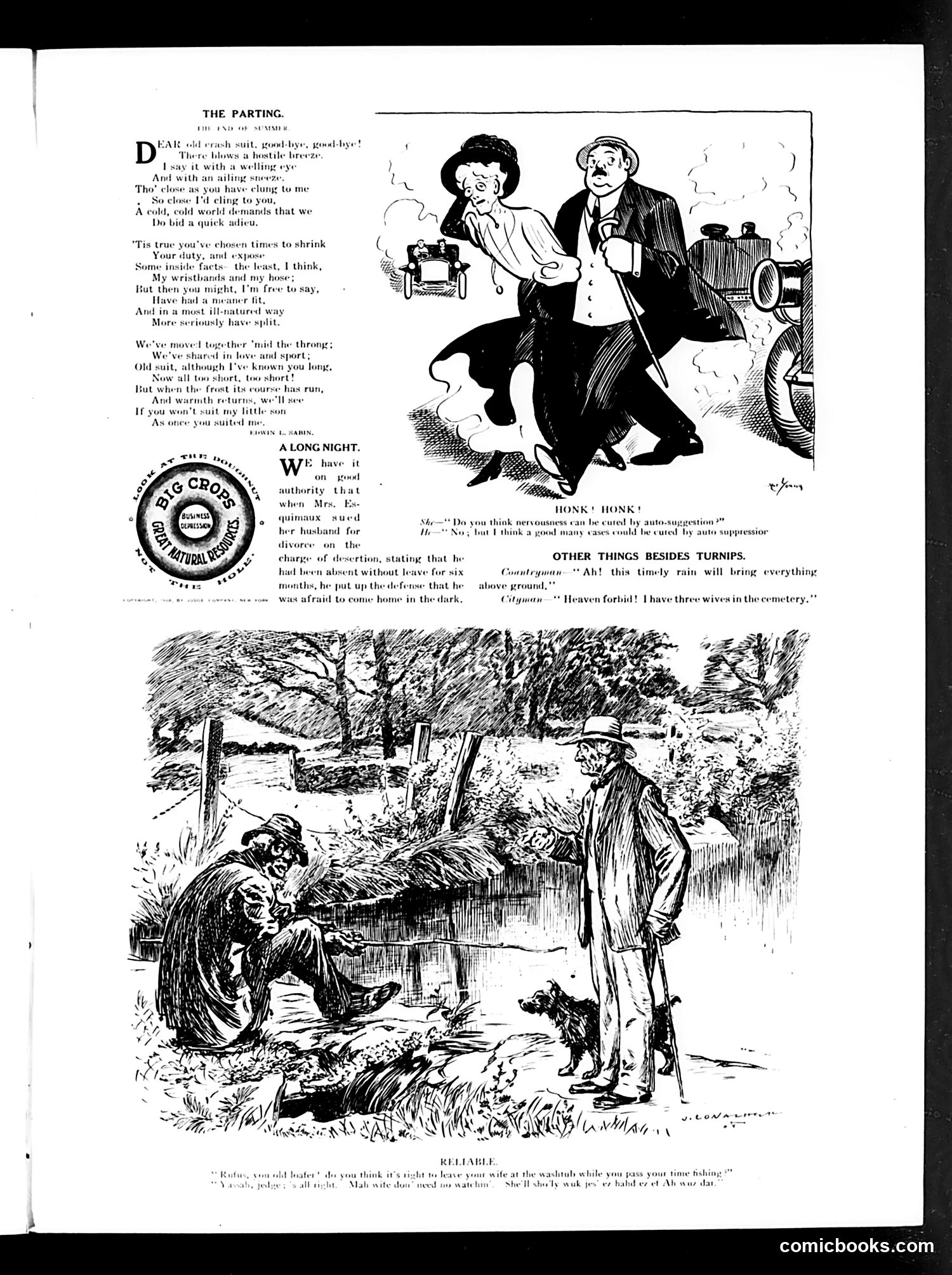
This page contains three separate satirical pieces from Judge magazine: **"The Parting"** (top): A poem about a couple's breakup, illustrated with a man and woman at a telephone. The satire mocks sentimental farewell speeches. **"Honk! Honk!"** (middle): A brief joke about nervousness and automobiles, reflecting early 20th-century anxiety about the new technology. "Auto-suggestion" (psychological treatment) is humorously contrasted with automobile-related nervousness. **"A Long Night"** and **"Reliable"** (bottom): Two separate cartoons satirizing working-class domestic life. One depicts a woman suing for divorce because her husband feared walking home in darkness. The other shows a rural man defending his fishing trips while his wife does laundry, with thick dialect humor typical of period class satire. The humor relies on class stereotypes, marital discord, and early automobile culture—concerns resonant to Judge's educated, urban readership.
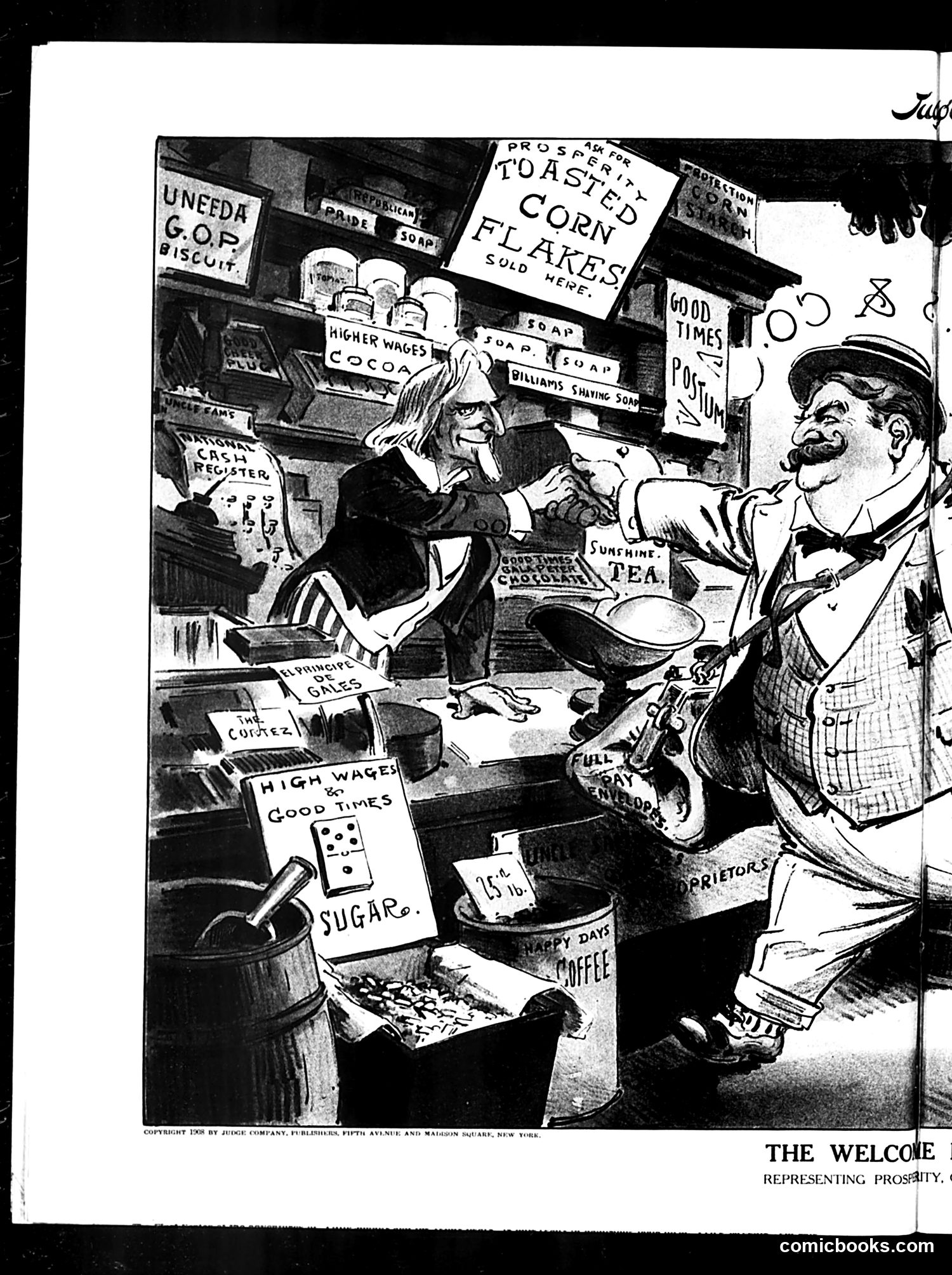
This Judge magazine cartoon satirizes American prosperity and consumerism in the early 20th century. A well-dressed, mustachioed businessman (representing "Prosperity," as labeled) welcomes a thin, ragged figure—likely representing the working class or common laborer. The cartoon is crowded with product advertisements and commercial signs (soaps, cocoa, tea, sugar, biscuits), suggesting that "prosperity" is defined by consumer goods and商business rather than actual worker welfare. The contrast between the prosperous businessman and the shabby visitor highlights economic inequality despite claims of widespread prosperity. The satire suggests that advertised abundance benefits business owners far more than ordinary workers, mocking the era's rhetoric of shared prosperity.
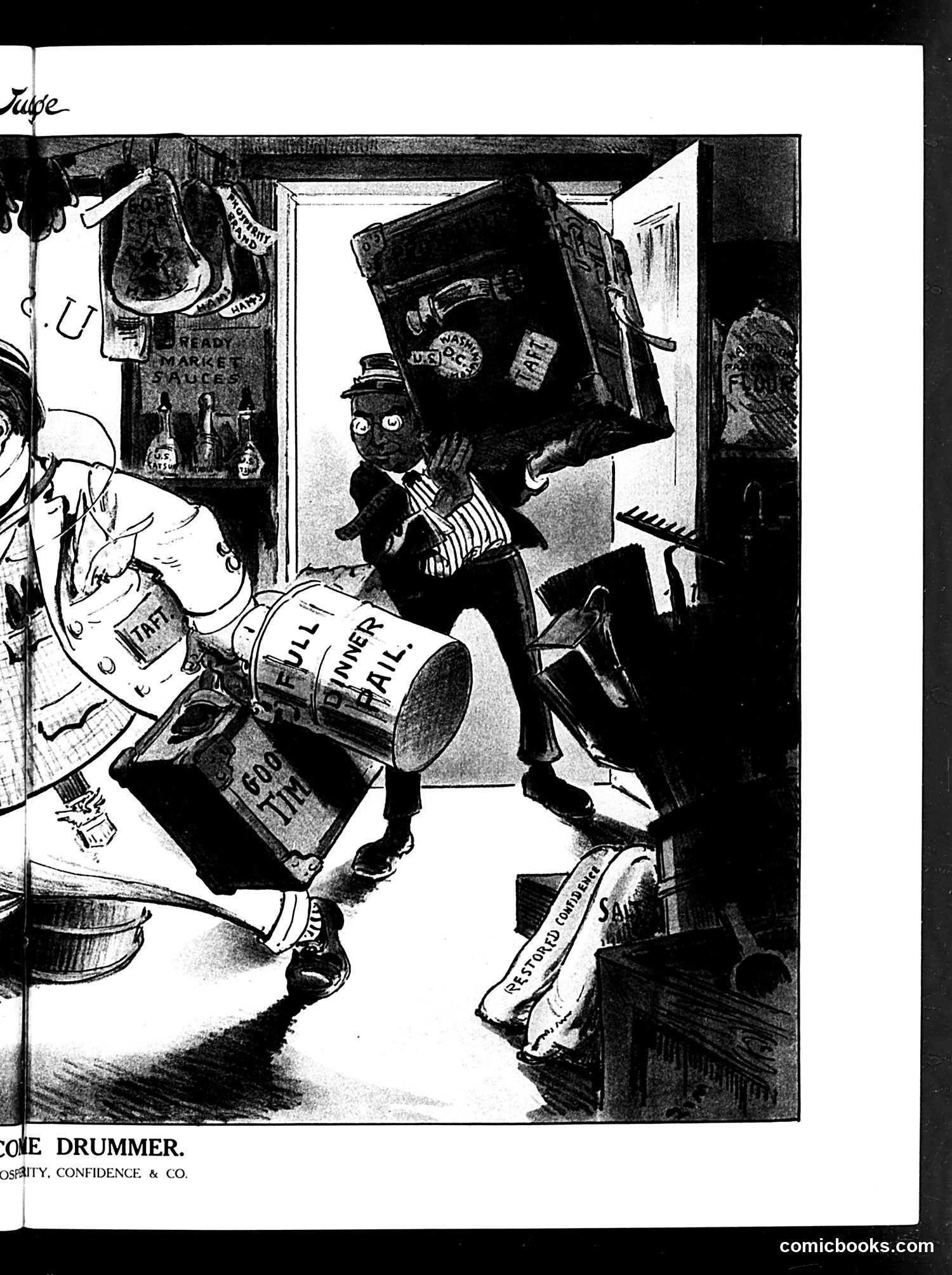
This political cartoon depicts a figure in formal attire and hat—rendered with exaggerated features typical of early 20th-century caricature—struggling to carry an oversized suitcase labeled "PROSPERITY, CONFIDENCE & CO." while juggling various drums and containers labeled what appear to be financial or commercial terms ("HARD NAIL," others unclear). The satire likely comments on a politician or public figure attempting to maintain confidence in economic prosperity during uncertain times, struggling under the weight of commercial/financial pressures. The "one drummer" title suggests irony about beating a single drum or message while chaos surrounds the effort. Without clearer visibility of all labels and lacking the publication date, the specific political target remains unclear, though the cartoon critiques the difficulty of maintaining public confidence during economic turbulence.
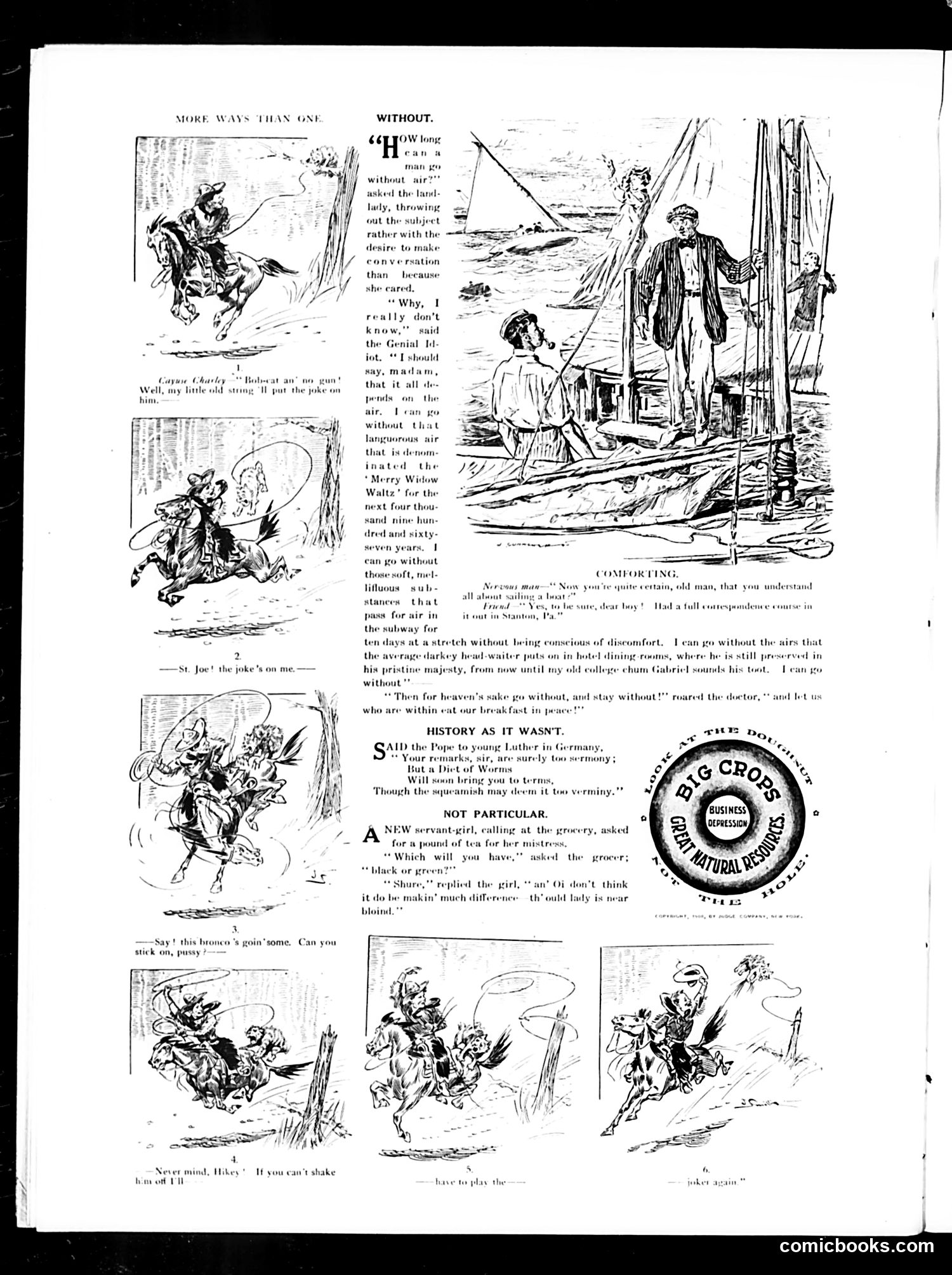
This page contains several humorous sketches mocking pretension and affectation in everyday life. The top section, "WITHOUT," satirizes someone (likely a society lady) who affects superiority by claiming she can manage without basic comforts—air, servants, luxuries—while actually depending on them entirely. The joke is her hypocrisy. "HISTORY AS IT WASN'T" mocks inaccurate historical anecdotes, referencing Martin Luther with fabricated, ridiculous dialogue. "NOT PARTICULAR" ridicules a servant girl's indifference about tea quality, suggesting her employer's class pretensions don't matter when the help shows no respect for such distinctions. The illustrated vignettes below show slapstick domestic chaos—people being thrown about, kicked, and generally roughhoused—suggesting working-class disorder and incompetence, likely meant as humorous commentary on servant problems or domestic help. The satirical target appears to be false gentility and the gap between upper-class pretense and reality.
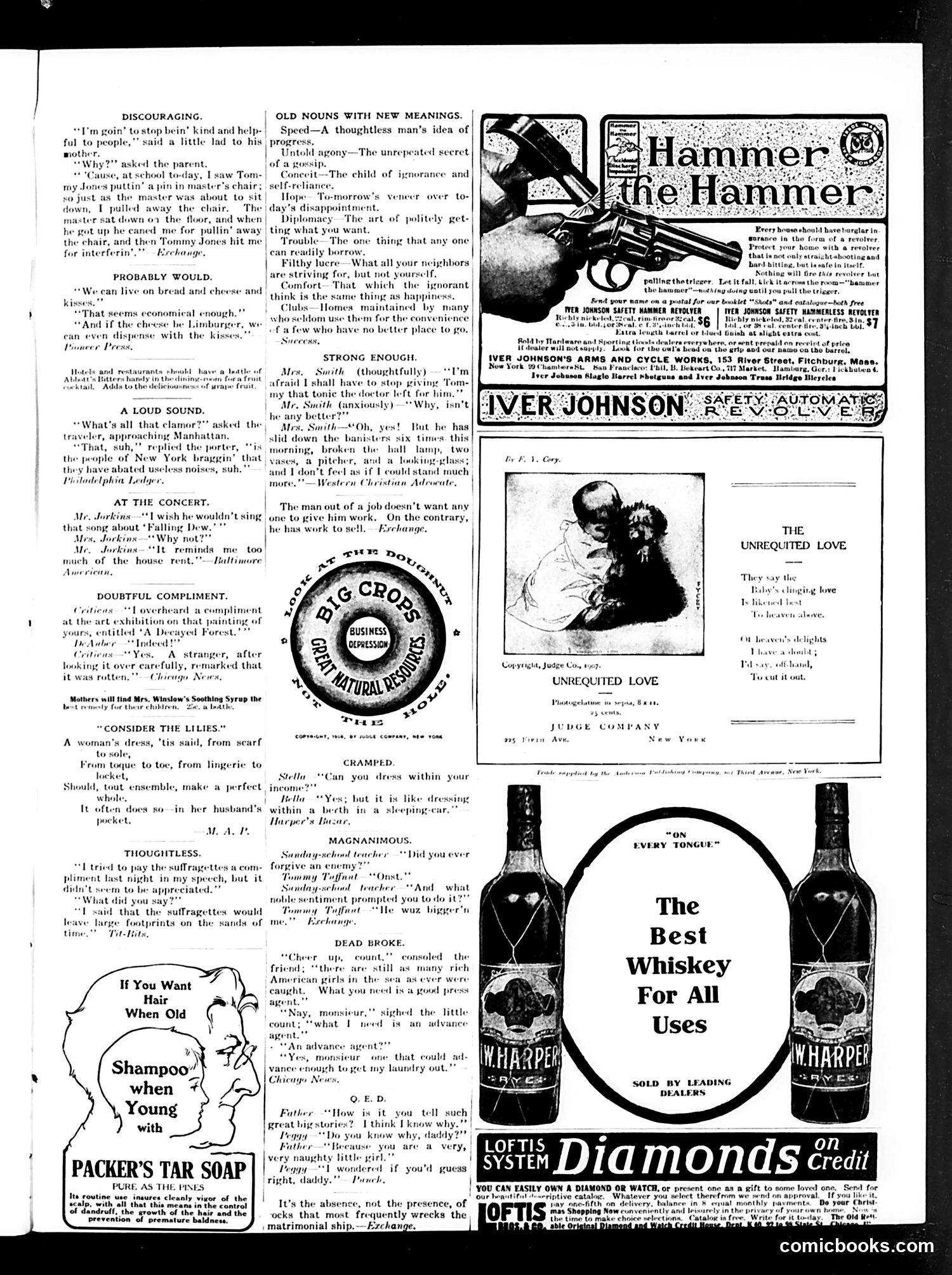
This page from *Judge* magazine comprises primarily **short humorous anecdotes** (called "jokes" or "quips") typical of early 20th-century satirical publications, interspersed with advertisements. The humor reflects period concerns: a child punished for pranks ("Discouraging"), working-class financial struggle ("Probably Would," referencing cheap Limburger cheese), marital dynamics ("Consider the Lilies"—wives' expensive clothing), and gender politics. One quip mocks suffragettes as heavy-footed ("Thoughtless"), reflecting anti-suffrage sentiment common before women's voting rights. Other jokes target contemporary anxieties: unemployment ("Dead Broke"), class pretension, and domestic disappointment. The tone is lighthearted domestic satire aimed at middle-class readers. The advertisements—for Iver Johnson revolvers, whiskey, shampoo, and diamonds—represent typical *Judge* revenue sources and suggest the magazine's affluent readership. No single major political cartoon dominates; rather, this is a miscellaneous humor collection showcasing *Judge*'s satirical style.
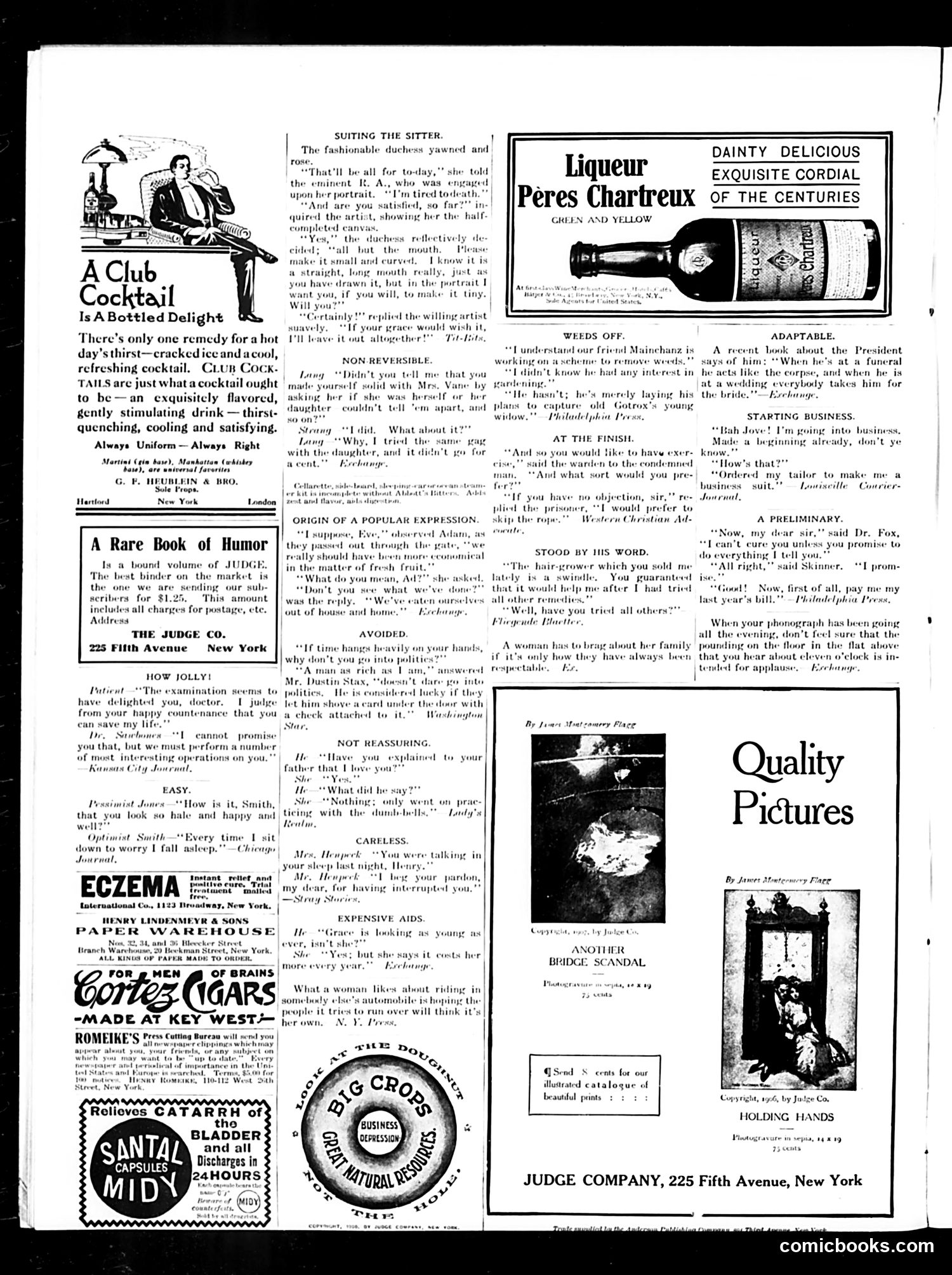
This page is primarily **advertising with scattered comic vignettes** rather than a cohesive political cartoon. The main content consists of brief, unrelated joke snippets typical of Judge's satirical humor—mostly about domestic life and social situations. Notable examples: a duchess complaining to a portrait artist ("Suiting the Sitter"), a doctor's consultation joke, and office/business humor ("Starting Business"). The advertisements dominate the layout, promoting liqueurs, cigars, eczema remedies, paper products, and other goods—typical of early 20th-century magazine monetization. **Political/social context**: The jokes reflect contemporary class dynamics (titled ladies, servants), gender relations, and consumer culture. References to "Mainchanz" and various unnamed characters suggest light society gossip rather than pointed political satire. The page lacks the sharp editorial cartooning one might expect from Judge's heyday, instead resembling a miscellaneous humor collection with heavy commercial messaging. No specific historical figures or events are identifiable.
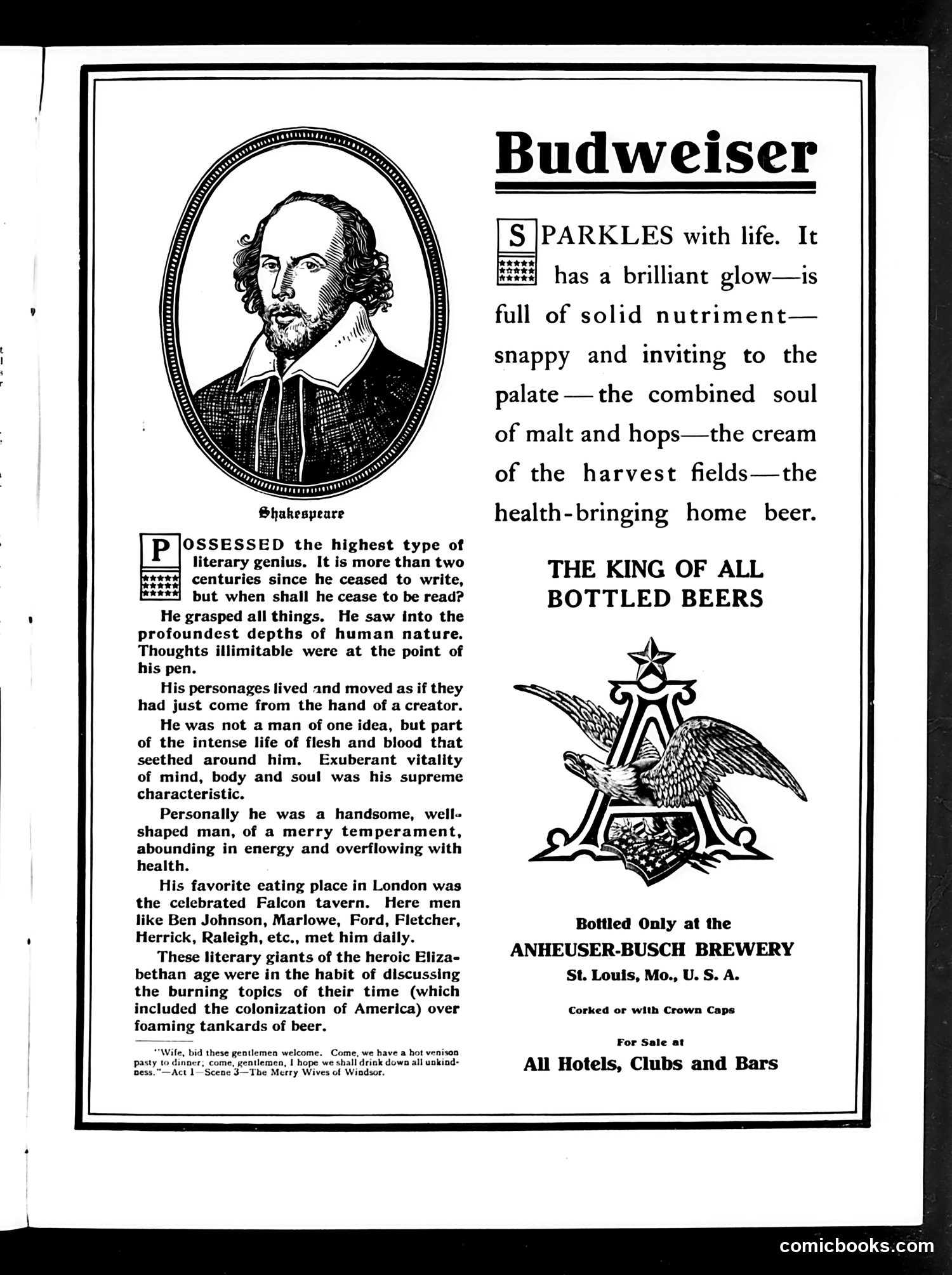
This is primarily a **beer advertisement**, not political satire. It uses Shakespeare as a marketing hook, drawing a parallel between the playwright's literary genius and Budweiser's claimed superiority. The ad describes Shakespeare's brilliance and his habit of frequenting London's Falcon Tavern, where he and other Elizabethan literary figures (Ben Jonson, Marlowe, Raleigh) discussed important topics "over foaming tankards of beer." This establishes drinking as compatible with intellectual achievement. The right side then pivots to Budweiser, calling it "THE KING OF ALL BOTTLED BEERS" and describing it in elevated language mirroring Shakespeare's genius—"sparkles with life," "solid nutriment," "health-bringing." The implicit message: quality beer belongs alongside quality literature and accomplished people. The advertisement is clearly pre-Prohibition (Anheuser-Busch, St. Louis) and uses cultural prestige and historical association to sell a consumer product.
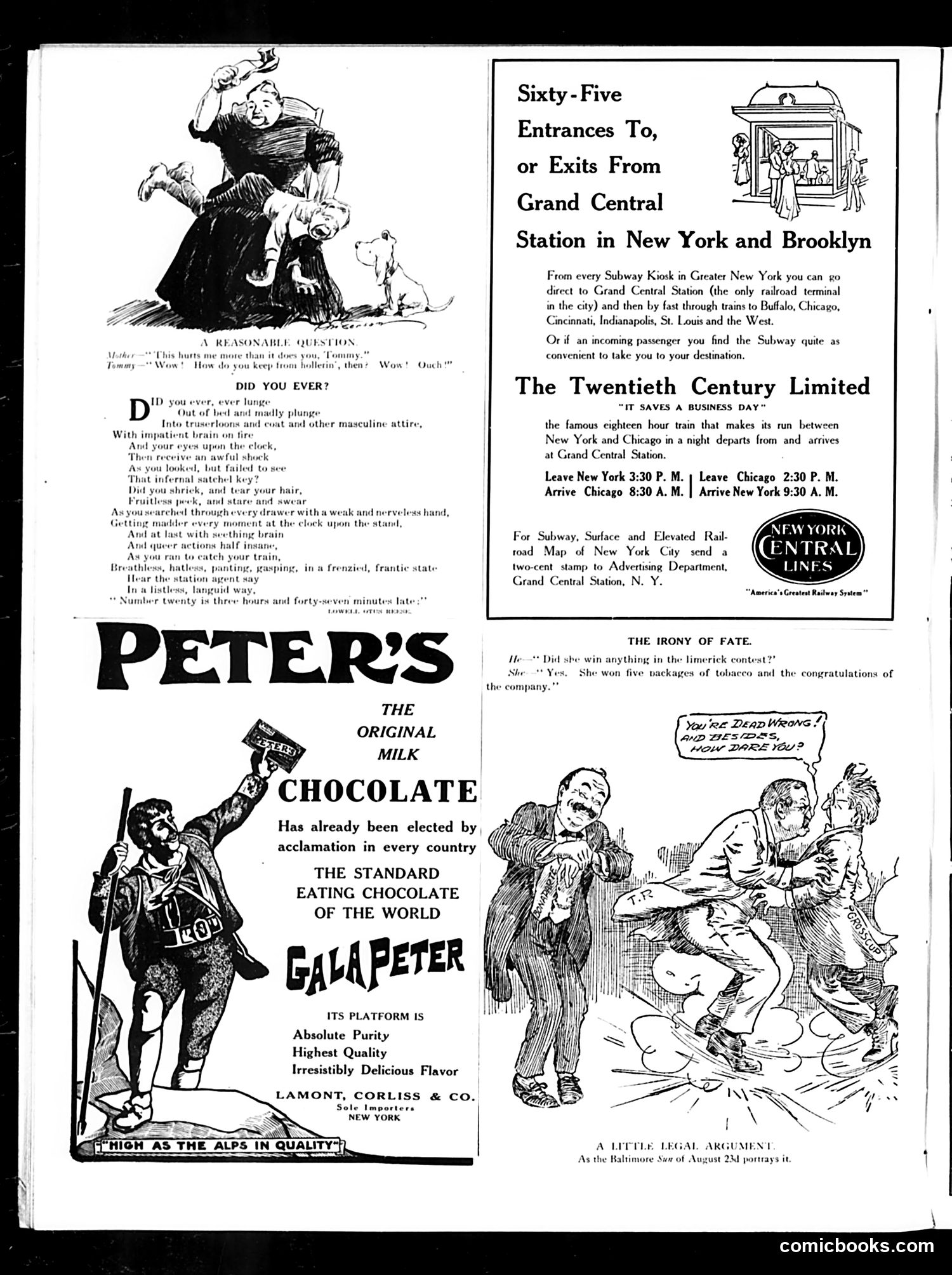
This page mixes advertisements with satirical cartoons typical of Judge magazine's format. **Top left cartoon ("A Reasonable Question"):** A mother scolds her child for rough play, asking how she can keep him from hurting himself. The boy responds "Wow! How do you keep from hurting yourself then?" It's gentle satire on parental hypocrisy—adults engage in the same reckless behavior they forbid children. **"Did You Ever?" poem:** Satirizes the chaos of catching trains, listing the frantic, undignified behavior people display while rushing—losing keys, forgetting belongings, appearing disheveled. It mocks the indignity modern train travel inflicts on passengers. **Bottom right cartoon ("A Little Legal Argument"):** Two figures argue about winning a limerick contest. One won tobacco packages and company congratulations—apparently a trivial prize. The humor stems from the absurdity of such a modest "victory." **Advertisements:** Grand Central Station, the "Twentieth Century Limited" train service, Peter's chocolate, and Gala Peter chocolate fill remaining space—standard period advertising using illustrated mascots and promotional claims.
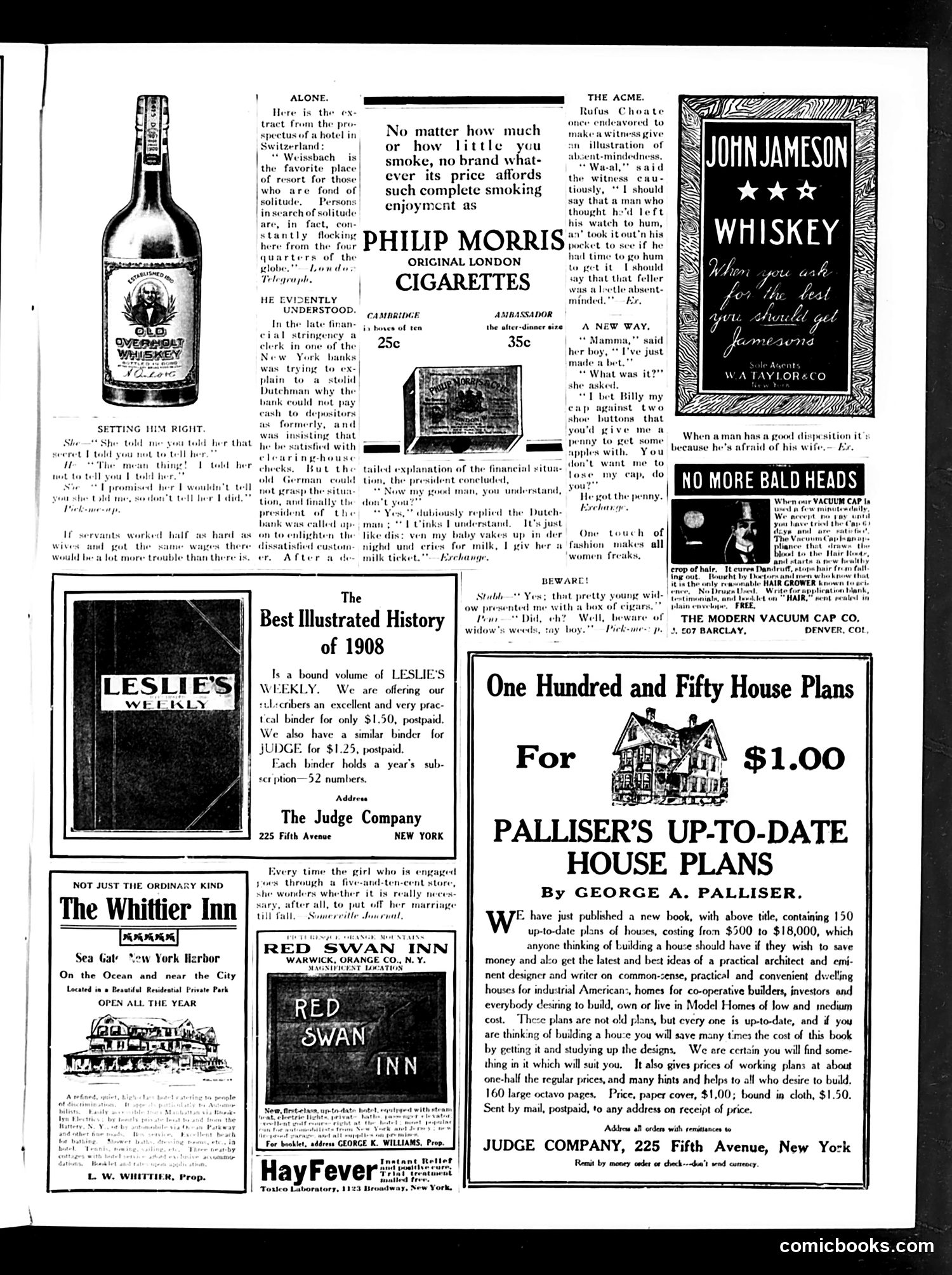
This page is primarily **advertisements and filler content** rather than satirical cartoons. The visible content includes: **"Setting Him Right"** (top left): A brief humorous dialogue—likely satirizing marital miscommunication. A husband learns his wife told her friend something he'd supposedly kept secret, creating domestic irony about gossip and trust. **Prominent Advertisements:** - Philip Morris cigarettes - John Jameson whiskey - Leslie's Weekly binder (offering bound volumes of 1908 news) - The Whittier Inn (resort hotel) - Palliser's House Plans ($1.00 for 150 designs) - Red Swan Inn - HayFever remedy The page reflects **early-1900s consumer culture**, showcasing luxury goods (whiskey, cigarettes) and practical items (house plans). The scattered dialogue snippets appear to be filler humor rather than cohesive political satire. Without clearer image resolution or complete text, identifying specific satirical intent or political references is difficult.
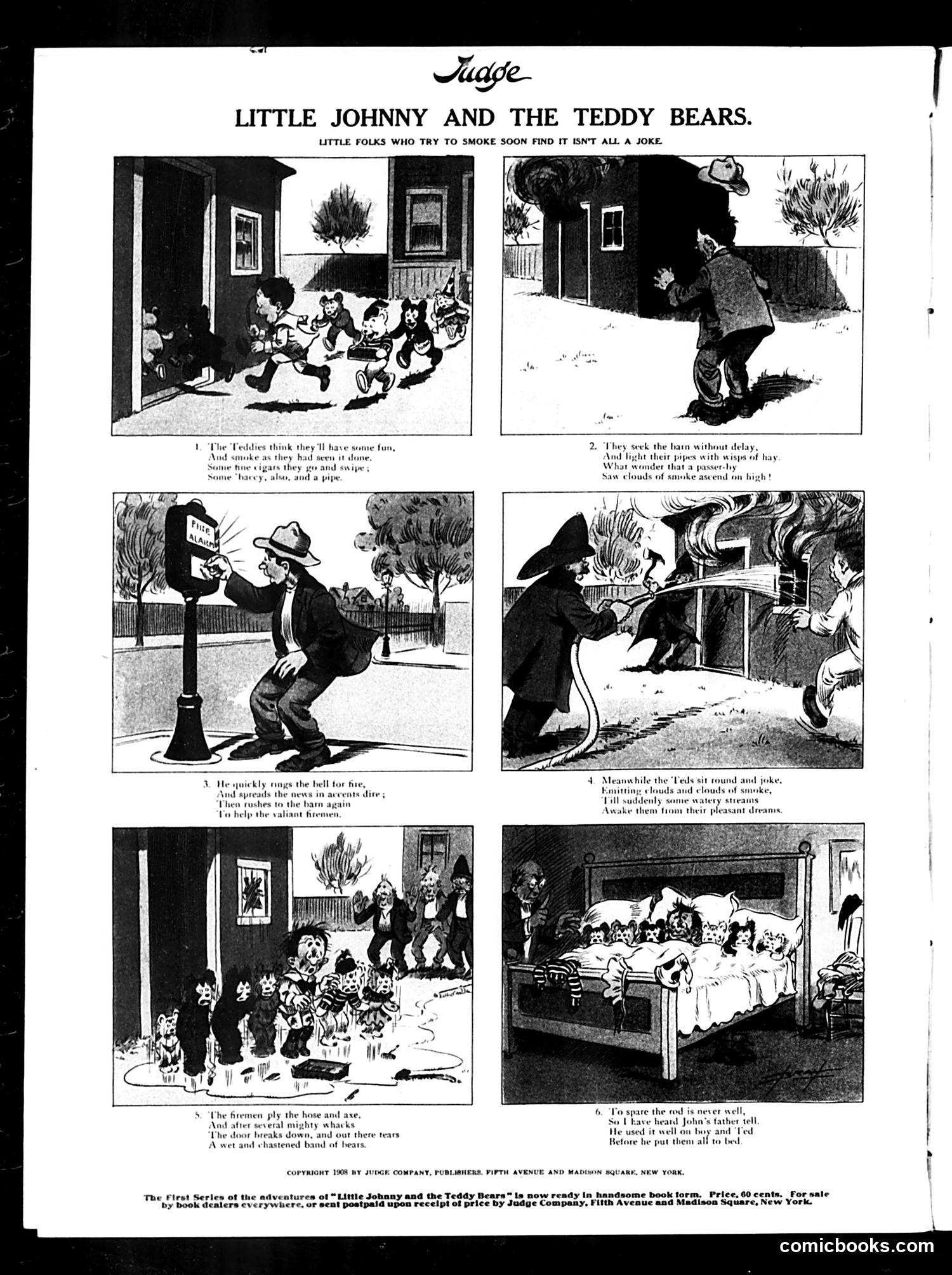
This is a moralizing children's comic strip warning against smoking. The narrative follows "Little Johnny" attempting to smoke cigarettes with teddy bears, experiencing increasingly dire consequences. The strip's message is explicit in its subtitle: "Little folks who try to smoke soon find it isn't all a joke." Panel 1 shows children smoking indoors; subsequent panels escalate to a fire alarm, firefighters responding with hoses, and the house catching fire. The final panels show the children in bed, apparently ill or traumatized. This reflects early-1900s public health attitudes targeting youth smoking—a common concern of the Progressive Era. The "Teddy Bears" reference likely trades on the popularity of teddy bear toys (named after President Theodore Roosevelt), making the characters relatable to contemporary children. The strip functioned as didactic entertainment, using humor and escalating chaos to discourage dangerous behavior in young readers.