
A complete issue · 16 pages · 1908
Judge — September 5, 1908
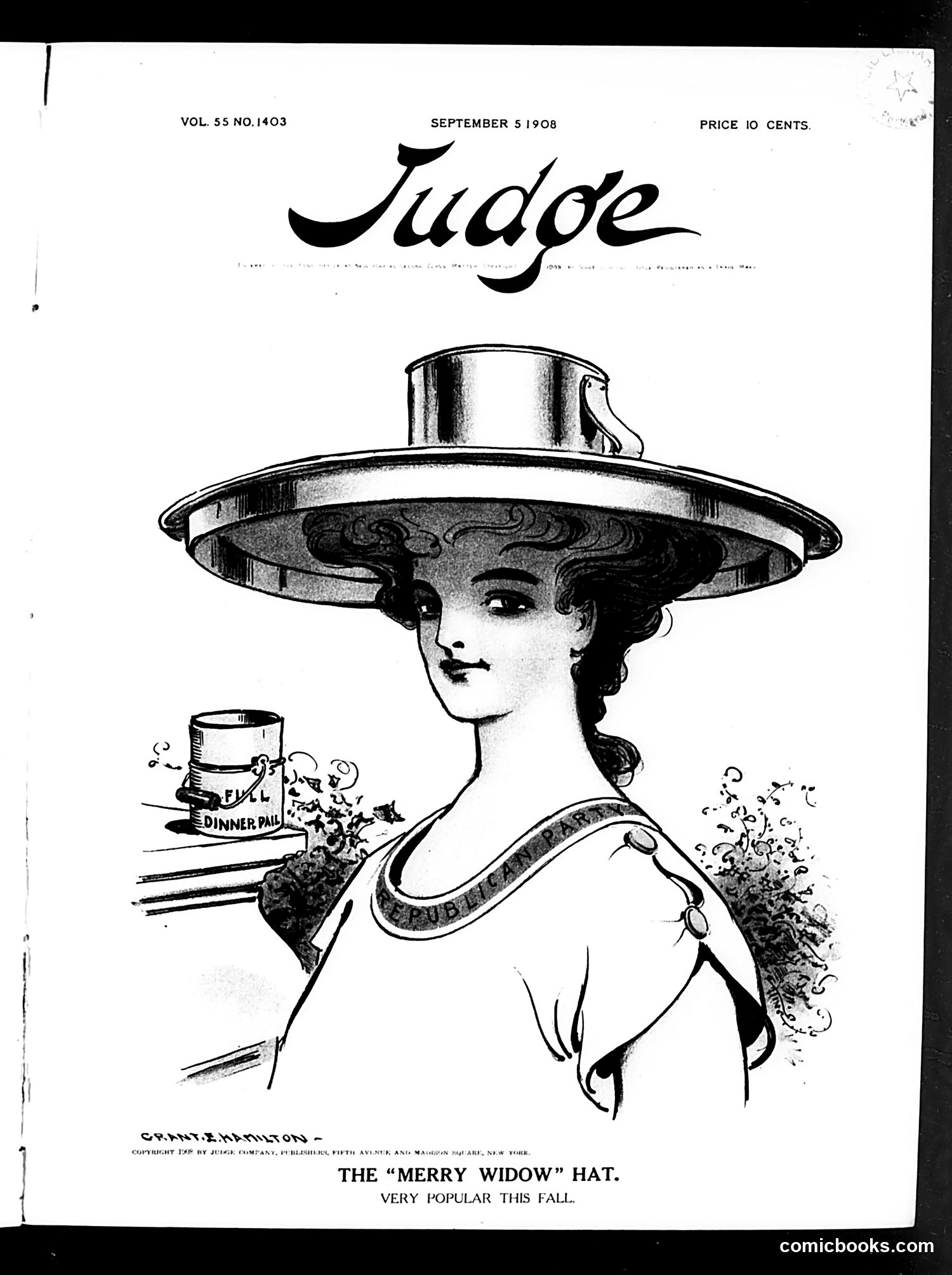
This page is primarily a **fashion advertisement**, not political satire. It depicts and promotes the "Merry Widow" hat, described as "very popular this fall." The illustration shows an elegantly dressed woman wearing an extremely wide, flat-brimmed hat—a style that was fashionable in 1908. The hat's exaggerated proportions are the humor: so enormous it dwarfs her head, with decorative elements including flowers and what appears to be a feathered band. A small inset shows a dinner pail for scale comparison, emphasizing the hat's absurd size. The artist credit reads "Grant E. Hamilton." This reflects early 20th-century women's fashion trends toward oversized, heavily decorated hats, likely referenced after the operetta "The Merry Widow" (1905).
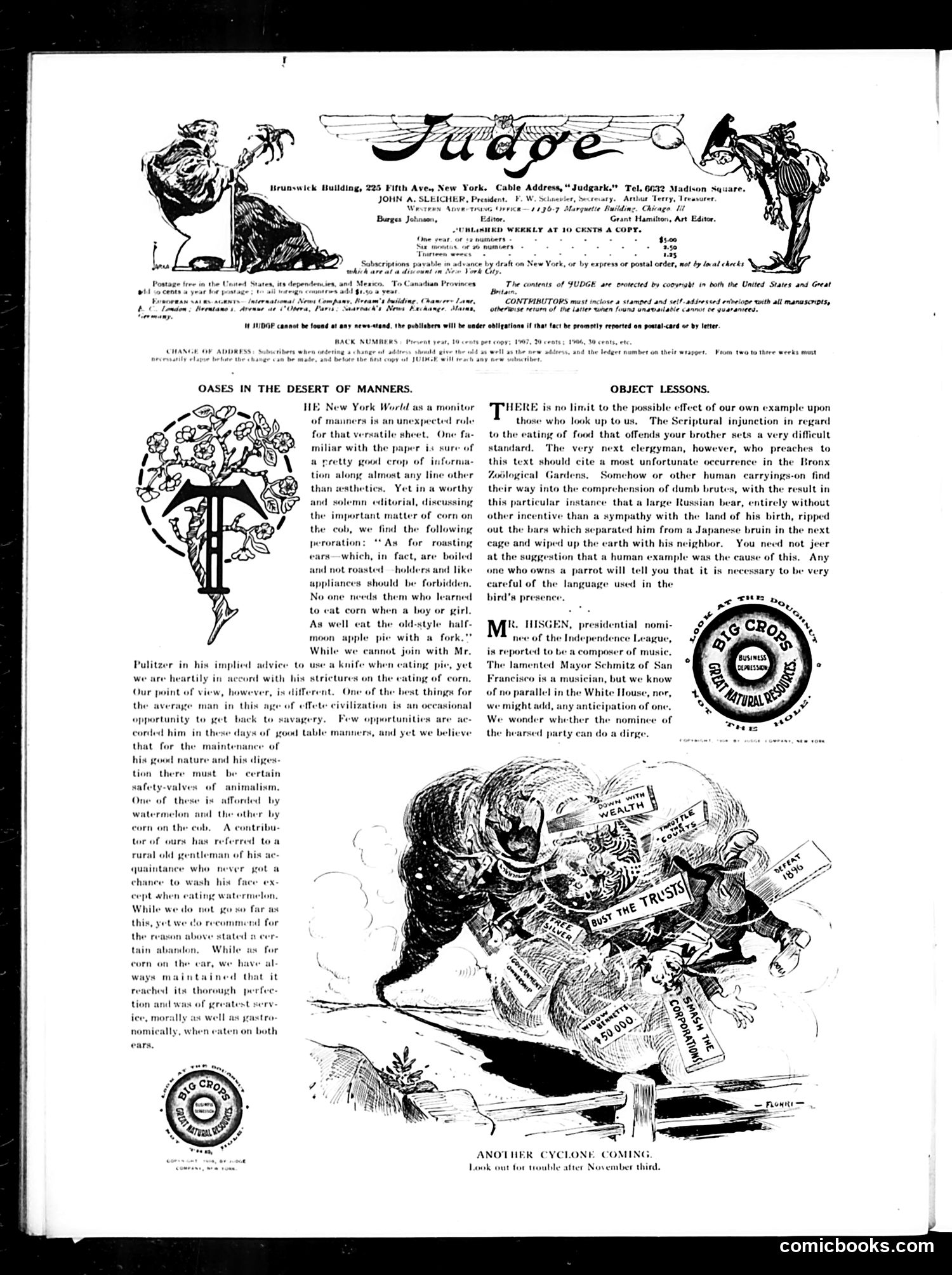
This appears to be a satirical commentary on American dining etiquette and manners circa early 1900s. The main article "Oases in the Desert of Manners" criticizes poor table behavior, particularly Americans' eating habits—specifically their eating corn on the cob and watermelon with forks rather than hands. The central cartoon "Another Cyclone Coming" depicts a figure (possibly representing a political opponent or social figure) being blown about by various labeled documents or notices, suggesting they're caught in chaotic circumstances or scandal. The "Object Lessons" section provides moral instruction about proper behavior and decorum, referencing scriptural authority to reinforce etiquette standards. The overall tone satirizes American society's struggles with refinement and proper conduct during the Gilded Age.
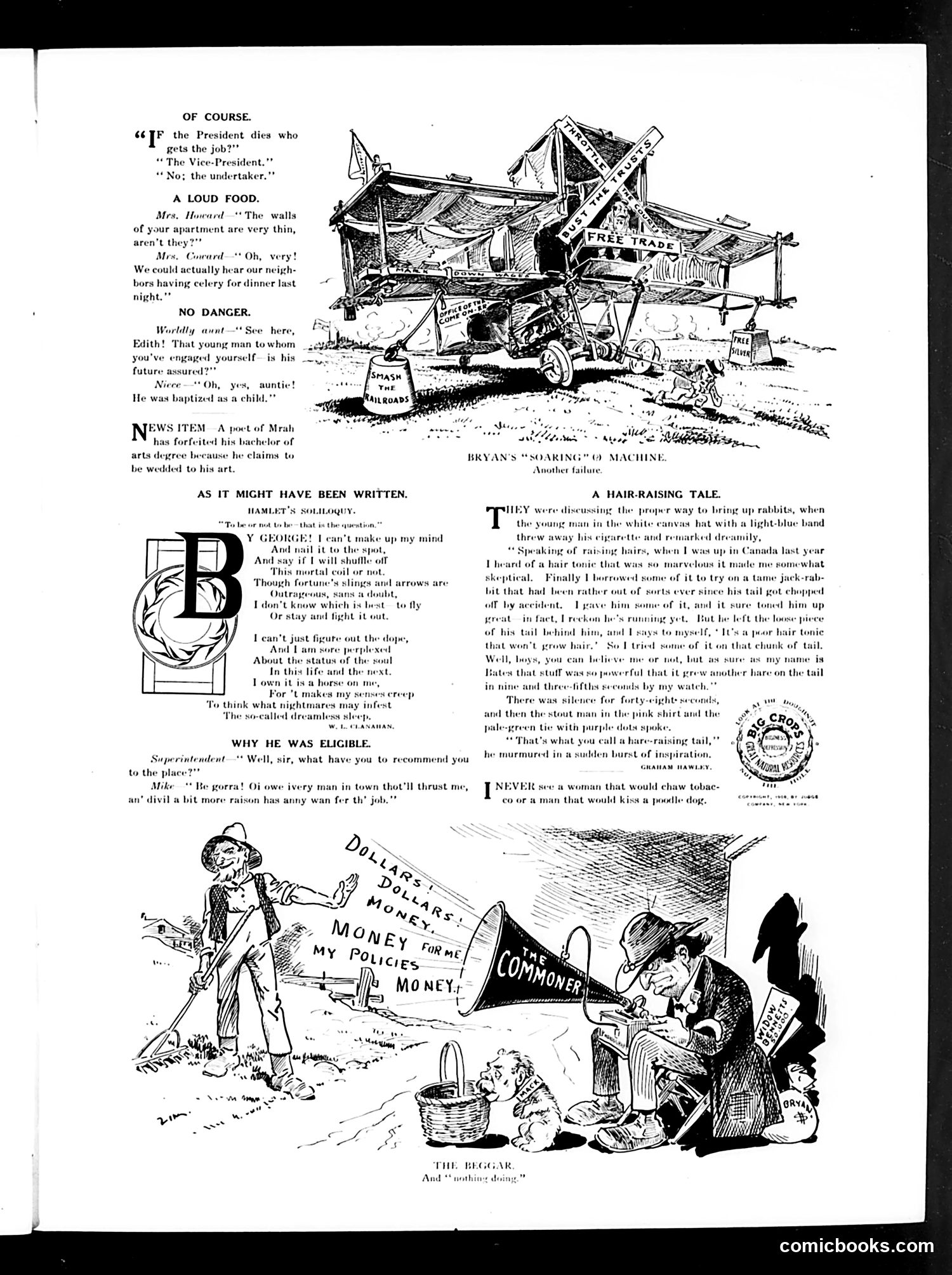
This page contains several unrelated satirical pieces typical of early 20th-century Judge magazine: **"Bryan's Soaring Machine"** (top right) mocks William Jennings Bryan with a contraption combining "Free Trade" symbolism—suggesting his political platform was impractical or crash-prone. **"The Beggar"** (bottom) depicts a beggar surrounded by signs reading "Dollars," "Money for Me," and "My Policies"—likely satirizing a political figure (possibly a Populist or reform candidate) perceived as obsessed with wealth redistribution or self-enrichment. The smaller dialogue pieces ("A Loud Food," "No Danger," "As It Might Have Been Written") appear to be humorous exchanges mocking contemporary speech and situations. The cartoons use visual exaggeration and wordplay typical of Judge's satirical style, targeting political movements and figures of that era.
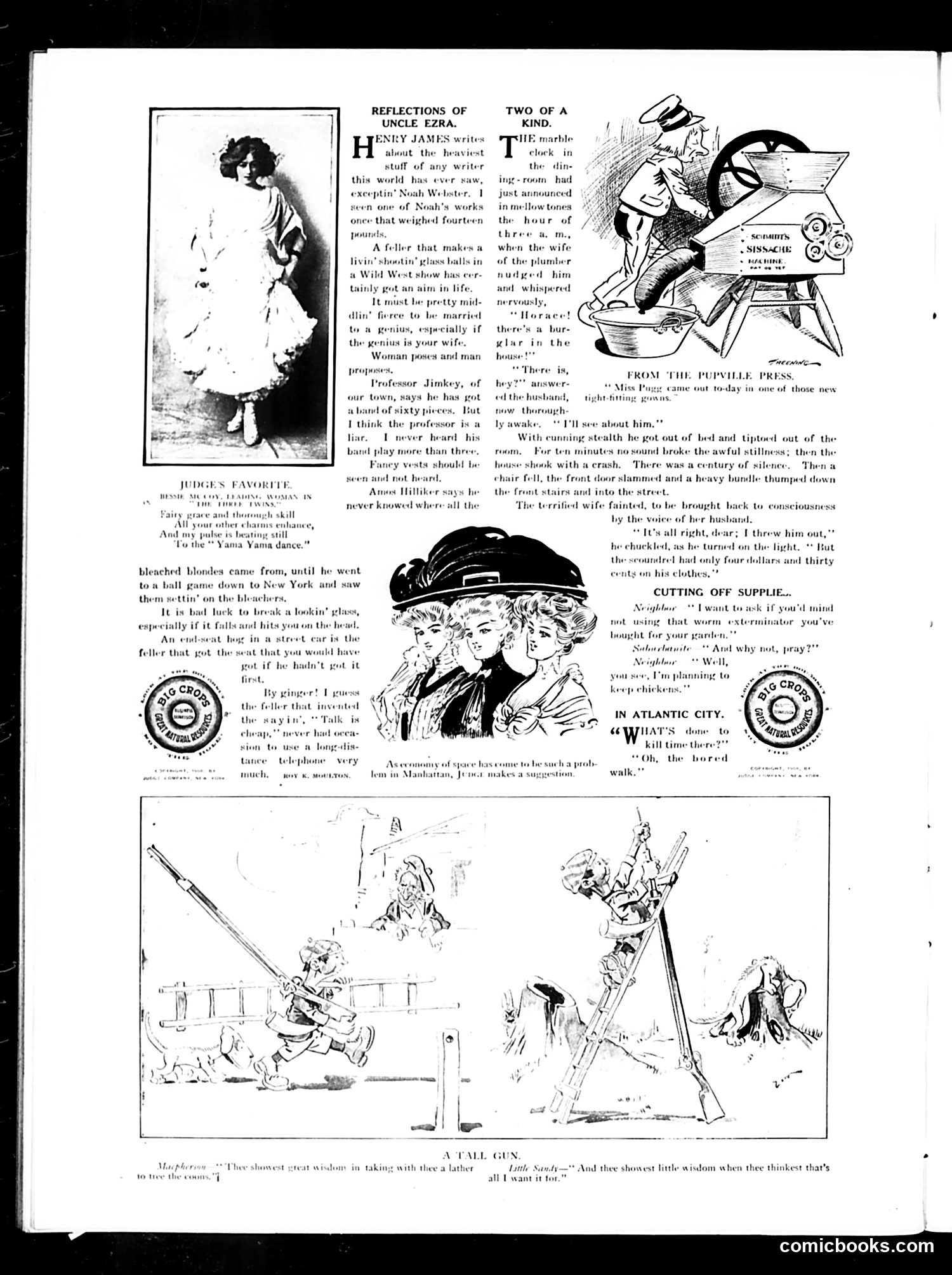
This page contains several unrelated satirical pieces typical of early 20th-century Judge magazine: **"Reflections of Uncle Ezra"** and **"Two of a Kind"** appear to be humorous domestic sketches about marriage and household life, with no clear political content. **"Judge's Favorite"** presents a poem about a woman—likely praising feminine grace and beauty in the sentimental style common to the era. **"Cutting Off Supplies"** and **"In Atlantic City"** are brief comedic dialogues about domestic situations (pest control and boredom, respectively). **"A Tall Gun"** is a cartoon about someone taking a rifle to a tall tree or pole, with commentary on parental wisdom—essentially a visual gag without broader political meaning. The page is primarily entertainment-focused rather than political satire, mixing light domestic humor with period-appropriate gender stereotypes.
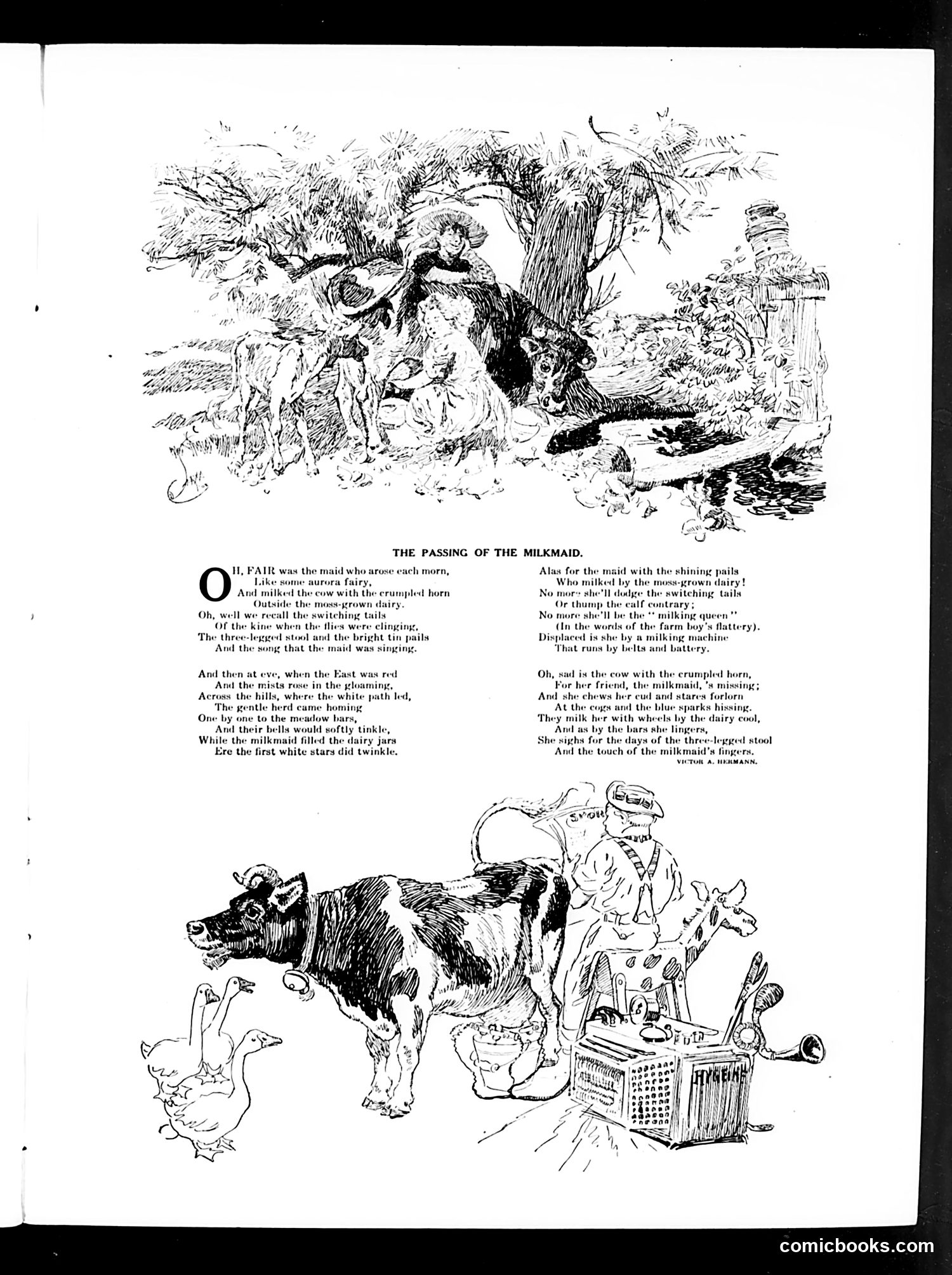
This page contains a poem by Victor A. Hermann lamenting the disappearance of the traditional milkmaid. The illustrated narrative shows a rural milkmaid being displaced by modern industrial dairy technology—specifically a milking machine operated by a farmer. The satire targets industrialization's effects on pastoral labor and rural life. Where once a "fair" milkmaid performed her work in idyllic countryside settings, her role is now "displaced" by mechanical "bells and battery." The poem expresses nostalgia for pre-industrial agricultural work while mocking the inevitable march of mechanization. The bottom cartoon reinforces this theme: a farmer operates modern milking equipment while geese scatter—visualizing technology's disruption of traditional farm life and the worker's obsolescence.
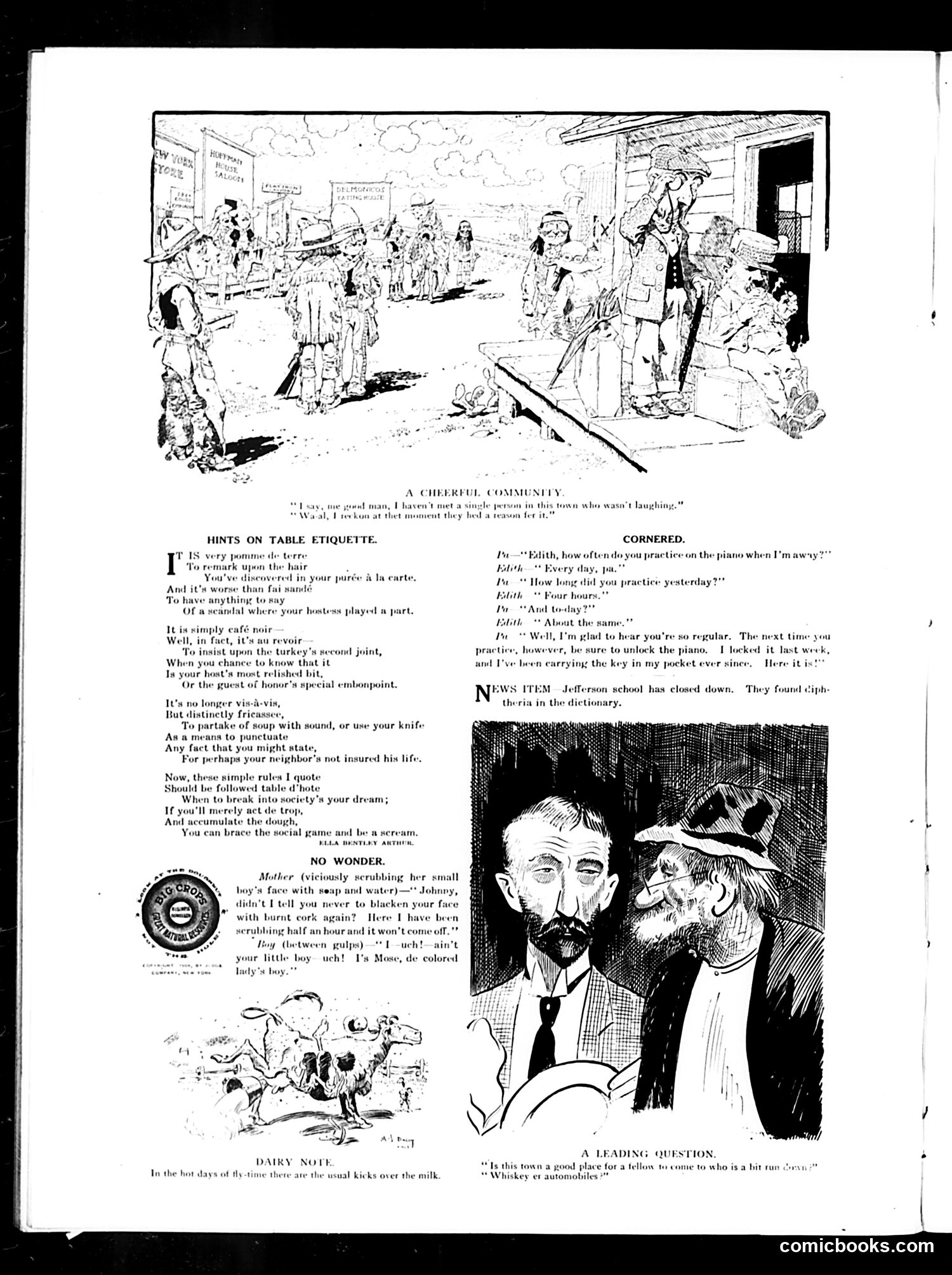
This page contains several satirical pieces typical of early 20th-century American humor: **"A Cheerful Community"** (top cartoon) depicts a small town street scene where everyone is laughing, with the caption suggesting residents find amusement in others' misfortunes—a gentle jab at provincial gossip culture. **"Hints on Table Etiquette"** offers mock-serious dining advice, satirizing social pretension by exaggerating concern over trivial matters (turkey joints, knife usage) while ignoring genuine rudeness—commentary on arbitrary class anxieties. **"No Wonder"** shows a mother scrubbing her son's blackened face, complaining the burnt cork won't wash off. This references minstrel show makeup, with the joke being the boy's claim to be "Mose, de colored lady's boy"—reflecting period racial caricature humor (now offensive). **"Cornered"** and other pieces use wordplay and domestic scenarios for light comedy. **"A Leading Question"** jokes about a town's reputation, asking whether it's "good for a fellow...run down" due to whiskey or automobiles—satirizing modern vice concerns. The overall tone reflects genteel Edwardian-era satire targeting middle-class social conventions.
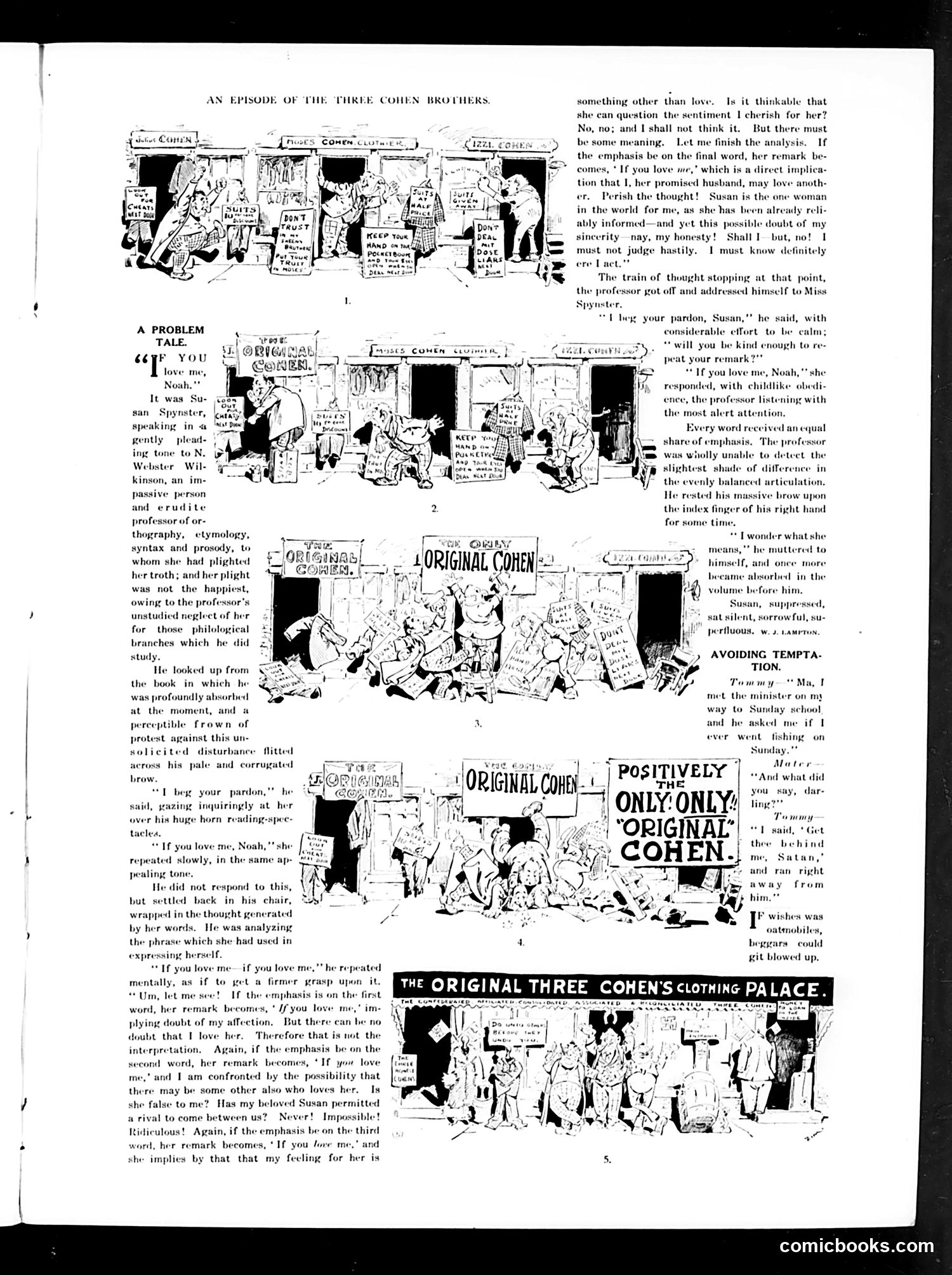
This page satirizes Jewish immigrant characters through ethnic caricature—a common (though offensive by modern standards) Judge magazine practice. The comic strips feature the "Cohen Brothers," clearly identified Jewish characters involved in domestic situations. The main narrative, "A Problem Tale," depicts Professor Cohen engaging in obsessive linguistic analysis of his girlfriend Susan's phrase "If you love me"—parsing which word carries emphasis to divine her true meaning. The satire targets intellectual pretension: the professor, despite his learning in etymology and philology, absurdly overthinks a simple romantic declaration rather than simply responding to it emotionally. The accompanying domestic vignettes mock Jewish family life through exaggerated scenarios. "The Original Three Cohen's Clothing Palace" (bottom) appears to be an advertisement. The humor relies on ethnic stereotyping combined with mockery of pedantic over-analysis—the professor's erudition becomes a liability rather than an asset.
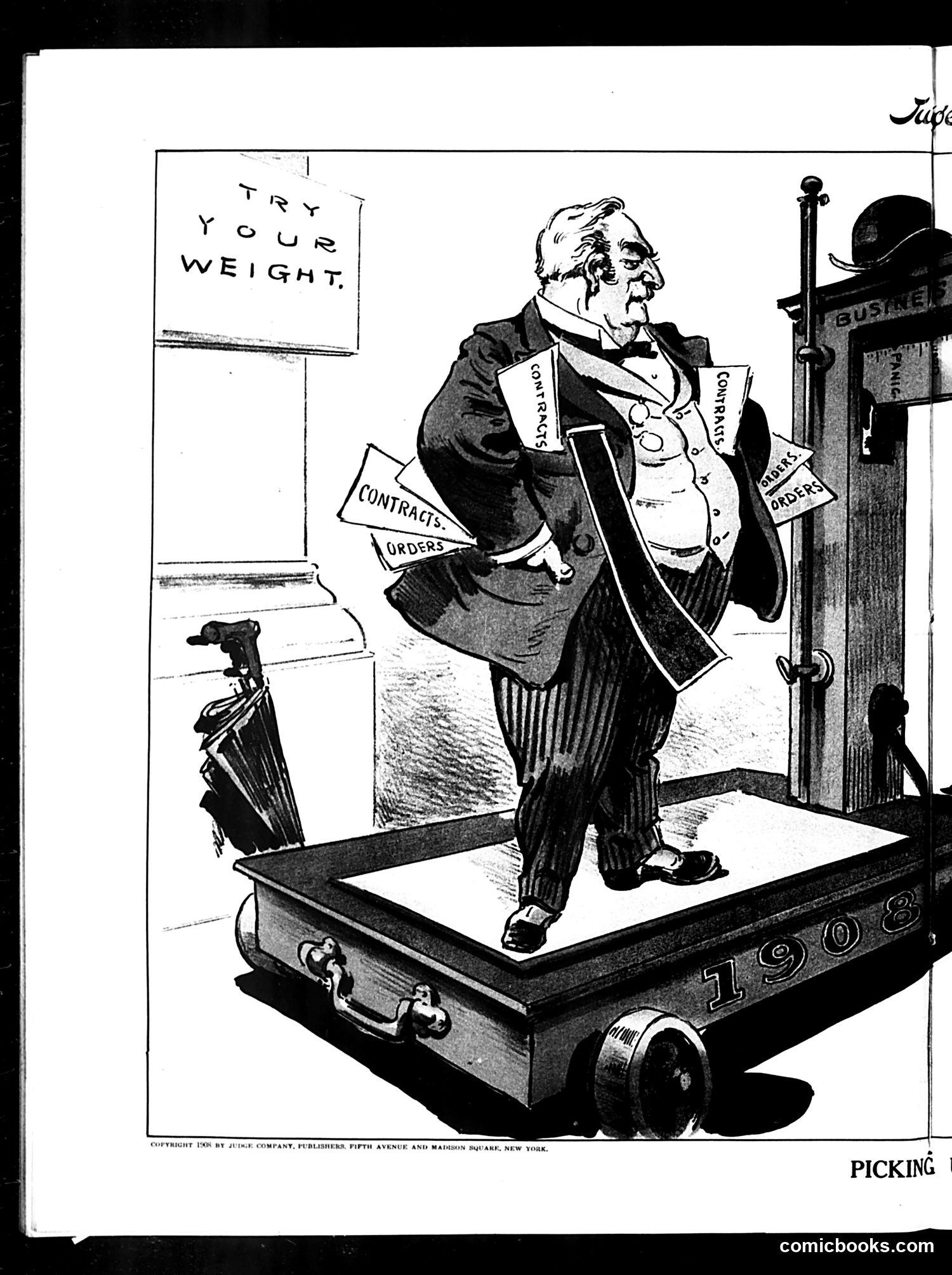
This 1908 Judge magazine cartoon depicts a bloated government official standing on a platform labeled "1908," weighed down by documents labeled "Contracts," "Orders," and "Corruption." A sign reads "Try Your Weight," sarcastically suggesting the measurement of governmental burden. The figure appears to represent corruption in government procurement and contracting during the Theodore Roosevelt administration. The excessive papers stuffed in his clothing symbolize the accumulation of questionable deals and orders. An umbrella at his feet suggests he's prepared to weather the storm of public scrutiny. The cartoon critiques how government contracts had become vehicles for corruption and favoritism—a common Progressive Era concern. The "1908" dating suggests commentary on that election year's political climate and concerns about executive overreach.
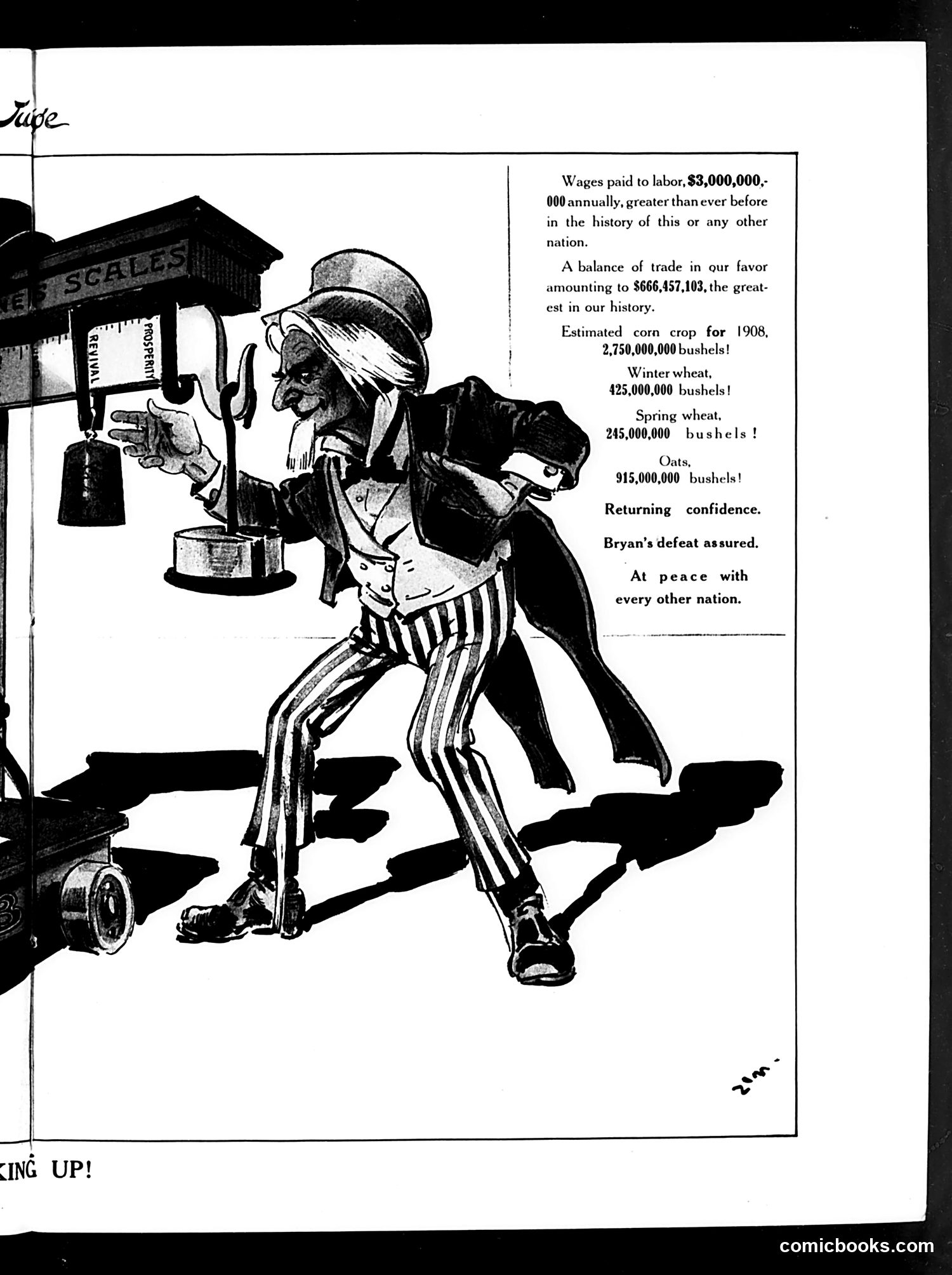
This cartoon depicts **Uncle Sam** (identifiable by his characteristic striped pants and top hat) triumphantly ringing a large bell labeled "Scales," celebrating American economic prosperity. The text lists economic achievements: record wages ($3 billion annually), favorable trade balance, and massive crop yields. The political context: this appears to support **Theodore Roosevelt's Republican administration** against **William Jennings Bryan's** anticipated Democratic presidential challenge (the text explicitly states "Bryan's defeat assured"). The satire presents booming American prosperity as evidence of Republican economic competence, using concrete statistics to argue voters should reject Bryan's alternative vision. The "returning confidence" and peace references suggest stability under current leadership. This likely dates to **1908**, before that year's election, using economic data as political ammunition.
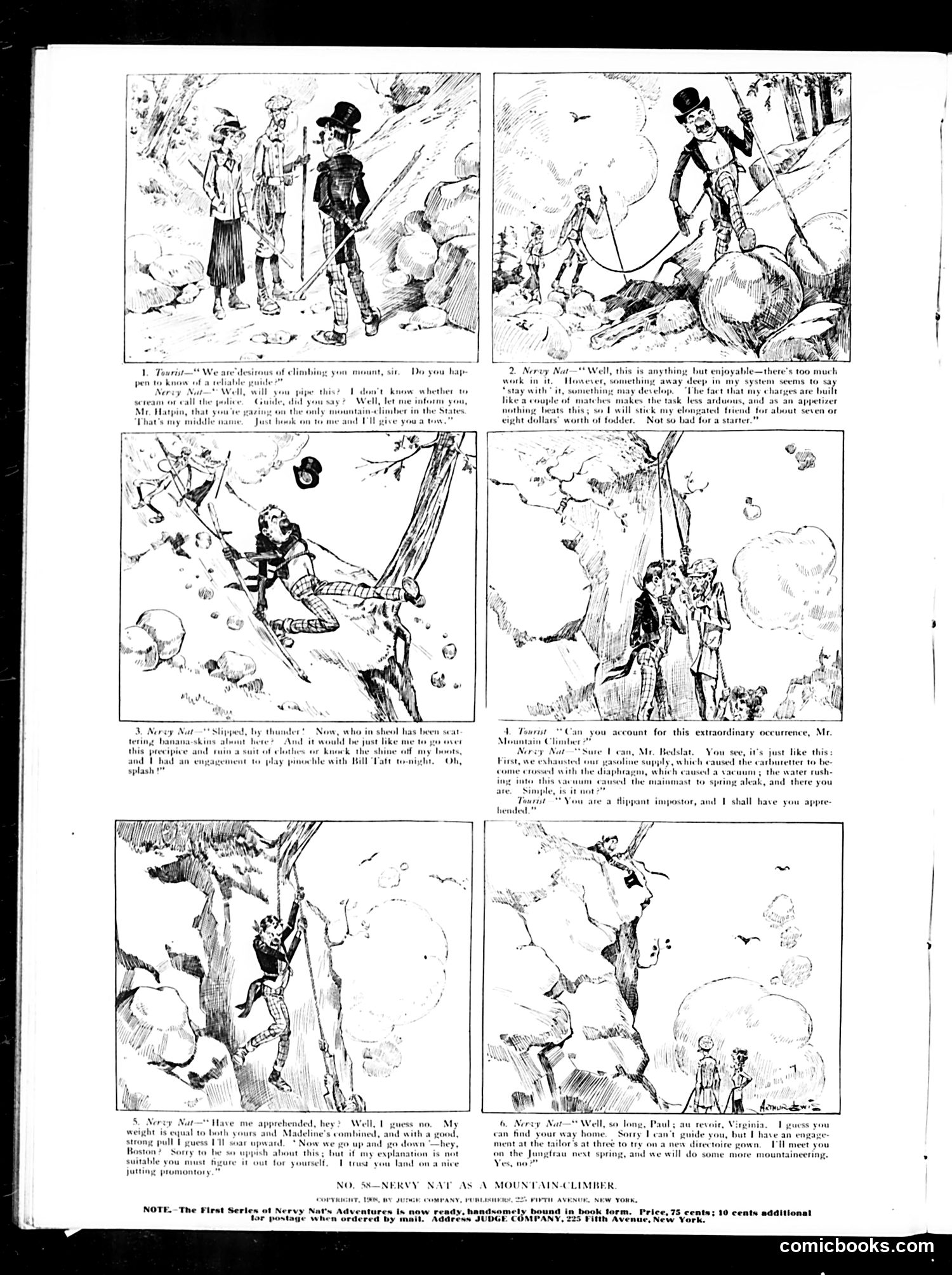
This is a six-panel comic strip following a character named "Nervy Nat" attempting to climb a mountain. The narrative shows Nat encountering officials who try to stop him due to safety concerns and lack of proper supplies. Nat repeatedly dismisses their warnings with characteristic nerve/audacity, insisting he'll proceed anyway. The humor derives from Nat's stubborn, reckless determination against reasonable authority figures. The "nervy" title refers to his brazen disregard for consequences. This appears to be promotional material advertising that Nat's adventure series is now available in bound book form for 75 cents. The satire gently mocks American individualism and the "can-do" attitude that ignores expert advice—a recurring character type in early 20th-century humor magazines.
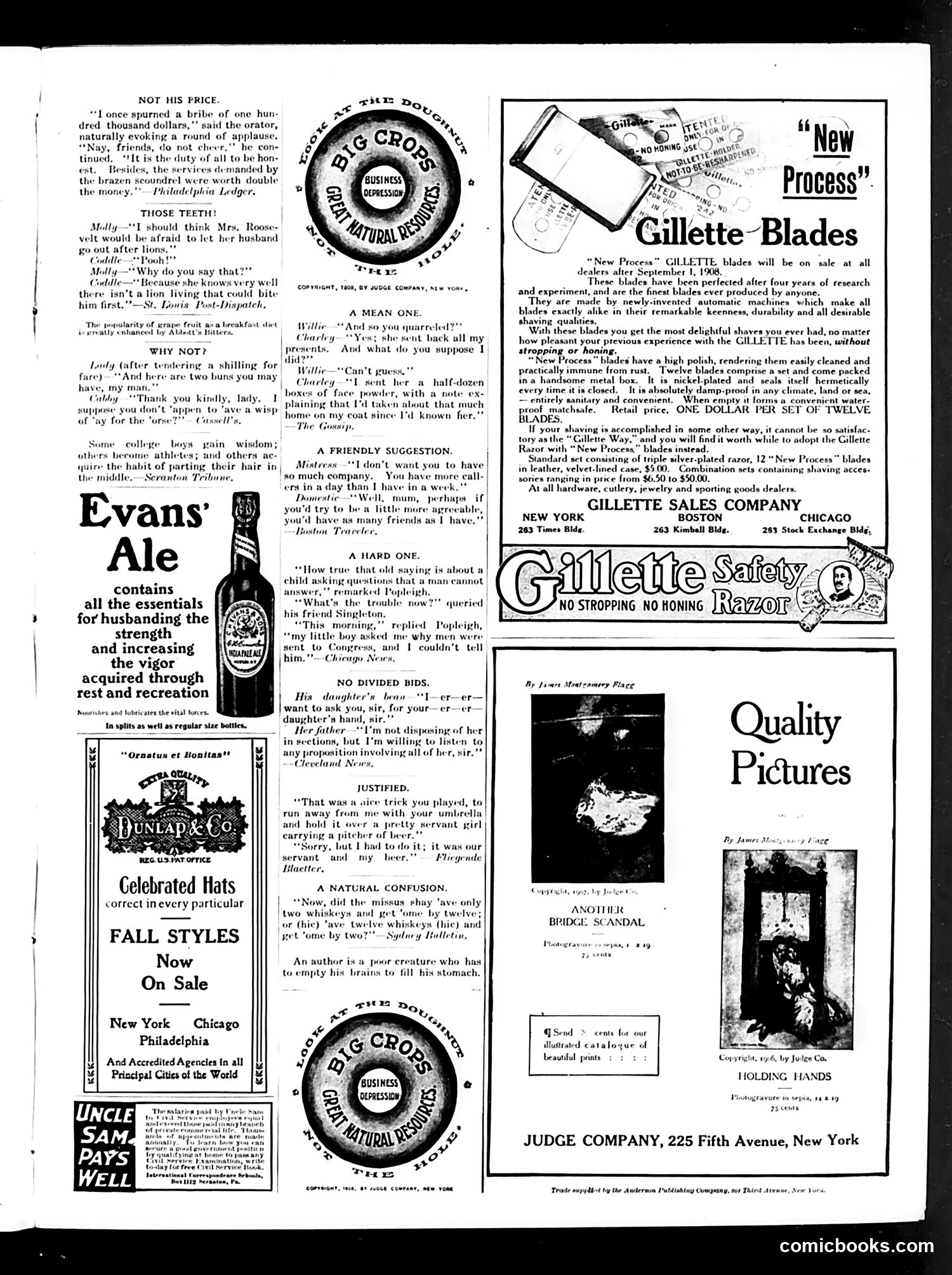
This page contains primarily **advertisements and humorous anecdotes** rather than political cartoons. The main content includes: **Humorous Dialogue Snippets:** Short jokes about everyday topics—a woman praising Theodore Roosevelt's teeth, a servant complaining about her employer's social life, a man unable to answer his child's questions about why men wear hats. These are gentle domestic humor typical of the era. **Major Advertisements:** - **Evans' Ale** - marketed to laborers as providing strength and vigor - **Dunlap & Co. Celebrated Hats** - fall styles advertised in major cities - **Gillette Safety Razor** - promoting new "New Process" blades launching September 1, 1908, emphasizing durability and cleanliness - **Judge Company's Quality Pictures** - photographic prints for sale The page reflects **early 20th-century consumer culture** and middle-class domestic concerns. No significant political satire is evident; the humor is apolitical and situational rather than topical.
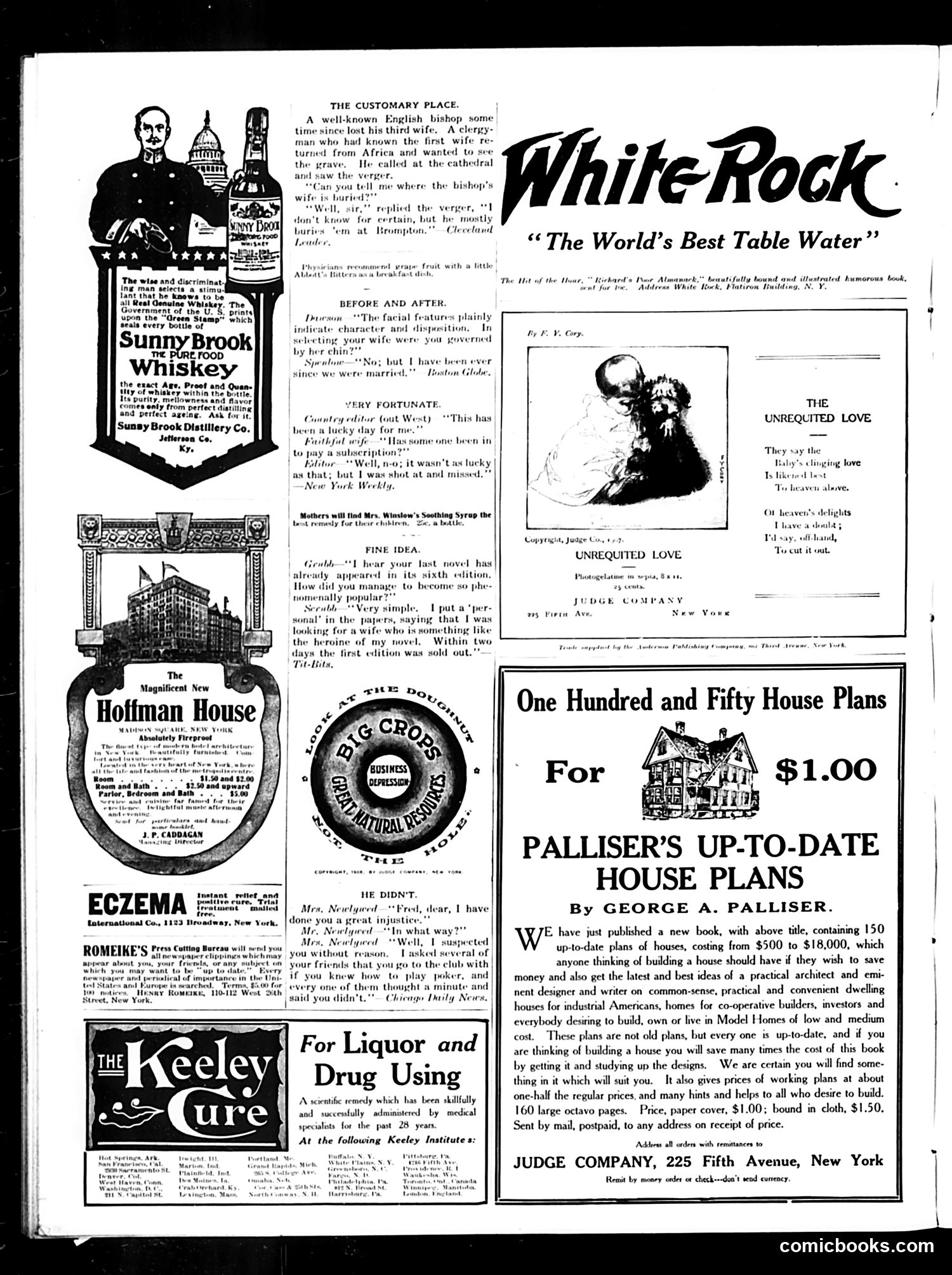
This page is primarily **advertisements and humor pieces** rather than political satire. The main content includes: **"The Customary Place"** — A brief joke about an English bishop and clergyman, playing on the double meaning of burial locations (the cathedral vs. Brompton Cemetery, where most burials occur). **"Before and After" / "Fine Idea"** — Short domestic humor pieces about marriage and novel-writing, using mild marital discord and literary vanity as punchlines. **"The Unrequited Love"** — A sentimental poem about the pain of unreturned affection. **"He Didn't"** — A newlywed joke about miscommunication. The page is dominated by **product advertisements**: Sunny Brook Whiskey, the Hoffman House hotel, Eczema remedies, Keeley Institute (addiction treatment), White Rock water, and most prominently, **Palliser's House Plans** ($1.00 for 150 designs). There is **no significant political or social satire** here—this is a typical commercial magazine page mixing light humor with commercial pitches aimed at early 20th-century readers.
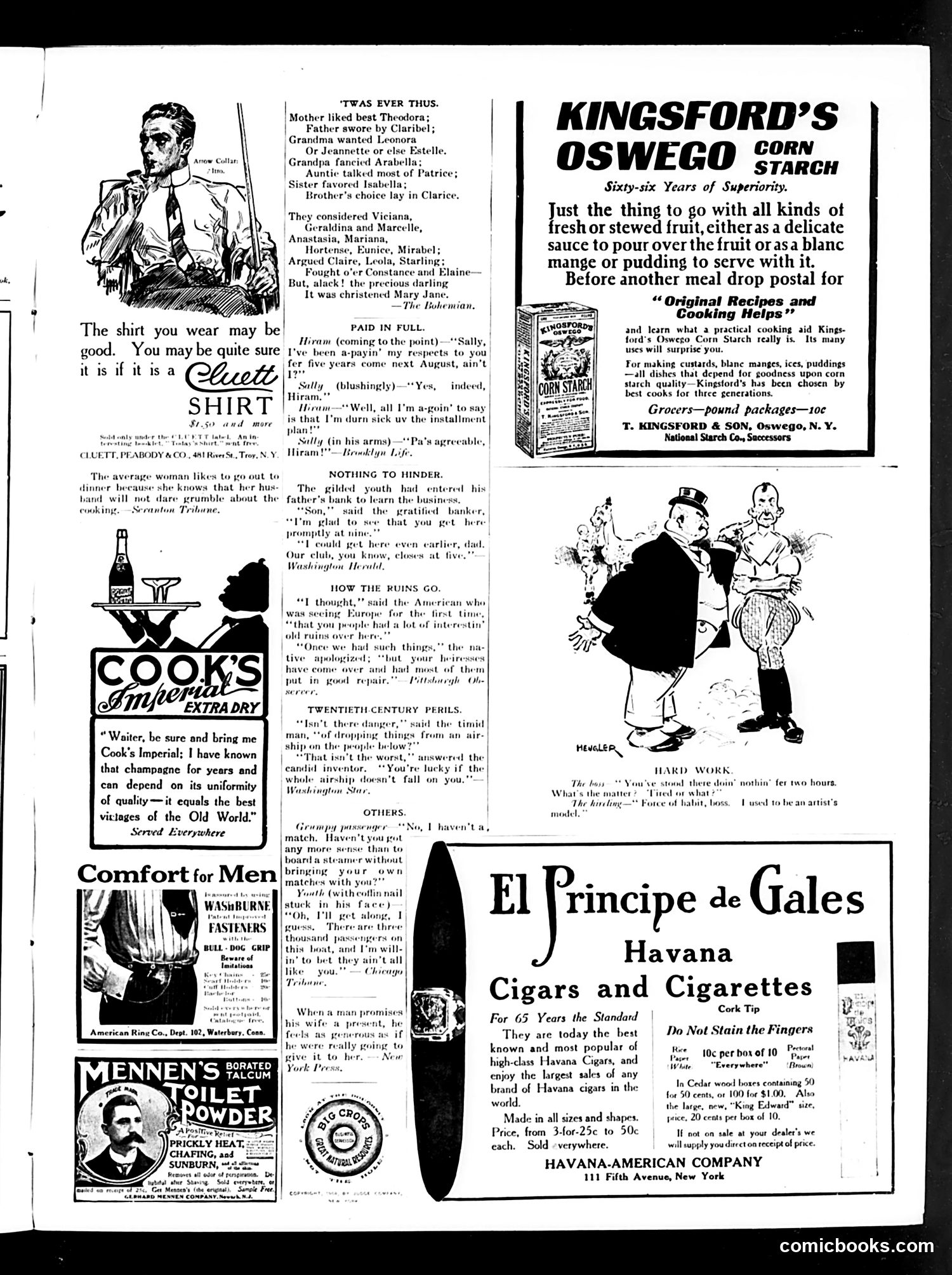
This page is primarily **advertisements** with small comic sketches interspersed. The main satirical content includes: **"'Twas Ever Thus"** — A humorous poem about how parents debate baby names endlessly (Theodora, Claribel, Leonora, etc.) only to name the child "Mary Jane"—a plain, ordinary name. The satire mocks overcomplication and pretension. **"Paid in Full"** — A rural romance sketch where a suitor (Hiram) proposes to Sally, complaining he's tired of the "installment plan" of courtship. The humor lies in treating romance like a financial transaction. **"Hard Work"** — A brief boss-and-worker exchange where the worker admits he's been standing idle out of habit from his former life as an artist. The joke satirizes workplace laziness and the loss of ambition. The page otherwise consists of period advertising for shirts, champagne, talcum powder, corn starch, cigars, and other products—typical of Judge magazine's revenue model.
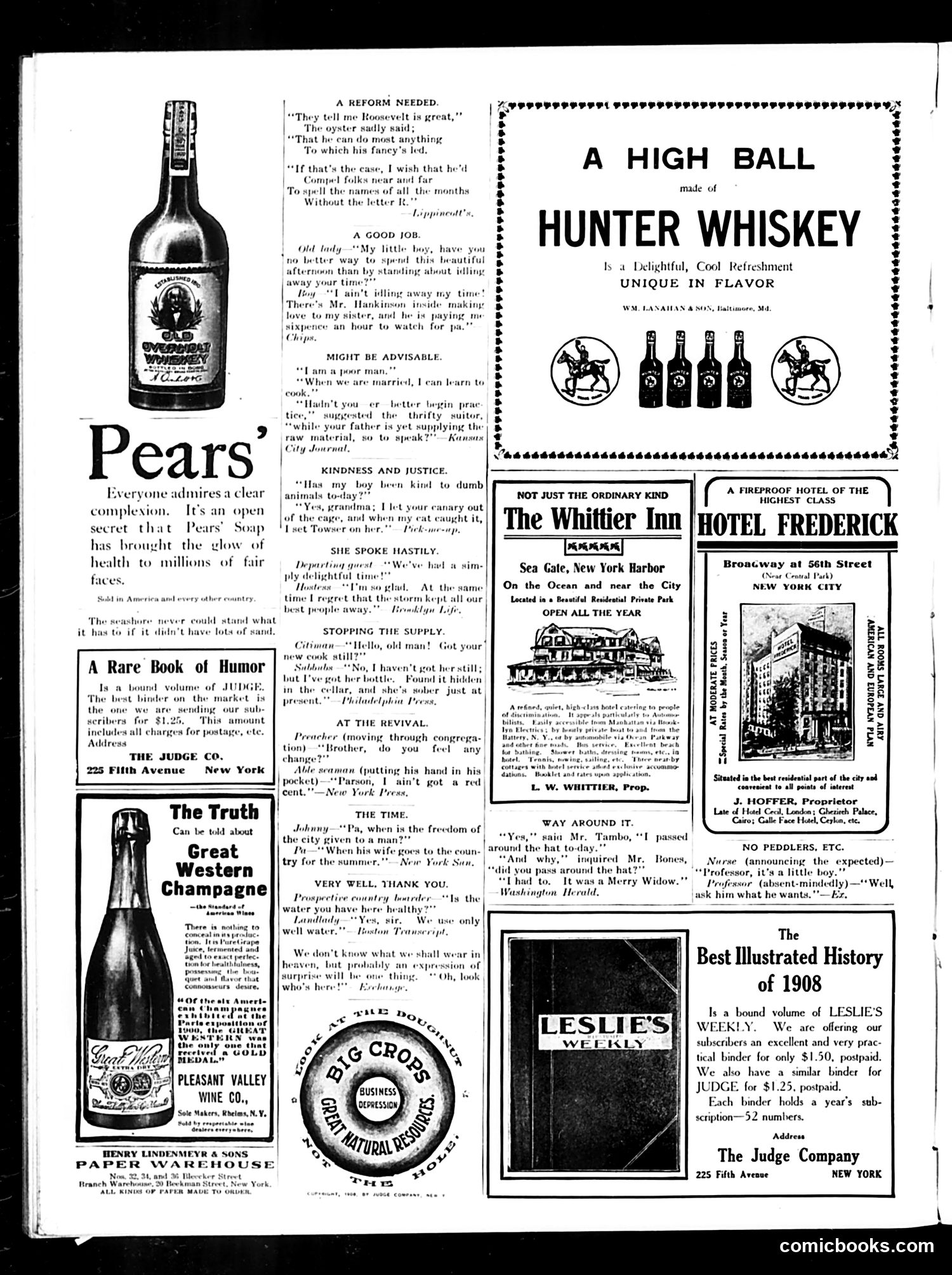
This page is primarily **advertising** with brief comedic vignettes interspersed. The ads dominate—promoting Hunter Whiskey, Pears' soap, Hotel Frederick, The Whittier Inn, and champagne. The small satirical pieces include: **"A Reform Needed"**: An oyster complains about Roosevelt being called "great," sardonically noting he can't do anything without spelling all month-names without the letter "R"—a play on Roosevelt's name. **"Might Be Advisable"**: A suitor suggests his fiancée learn to cook while her father still supplies materials—mocking working-class courtship customs. **"She Spoke Hastily"**: A departing guest's compliment backfires when the hostess realizes she was praising the simple time because "we've had simply delightful time" (implying the visit felt long). The humor relies on wordplay, class-based domestic comedy, and gentle jabs at contemporary figures like Theodore Roosevelt. Most content serves as filler between advertisements rather than substantive political satire.
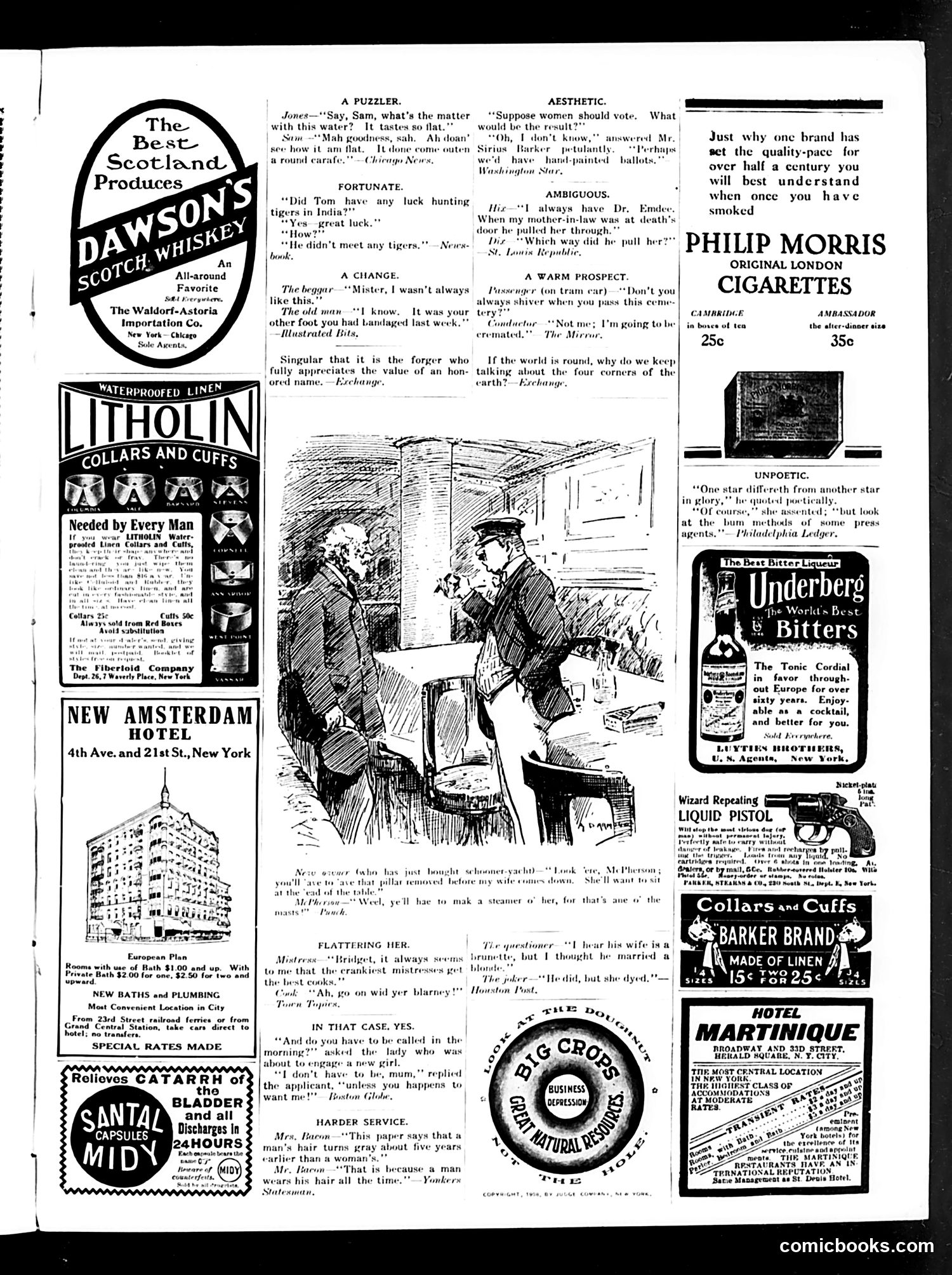
This page is primarily **advertising** with small humorous filler jokes scattered throughout—typical of early 20th-century satirical magazines. The small jokes employ period stereotypes: one features a Black character speaking in dialect about flat water; another uses a beggar's backstory; several rely on puns and domestic humor (a wife's hair color change, a mistress's complaints, a man's graying hair). The advertisements dominate, promoting whiskey (Dawson's), linens (Litholin collars), hotels (New Amsterdam, Martinique), cigarettes (Philip Morris), digestive bitters (Underberg), and other period products. The cartoon illustration shows what appears to be a domestic or servant scene with two figures in period dress. **No specific political satire or caricature of identifiable figures is evident.** The humor is gentle, class-conscious (servants, beggars, mistresses), and relies on the casual ethnic stereotyping common to early Judge issues. The page reflects advertising-heavy magazine economics of the era more than satirical commentary.
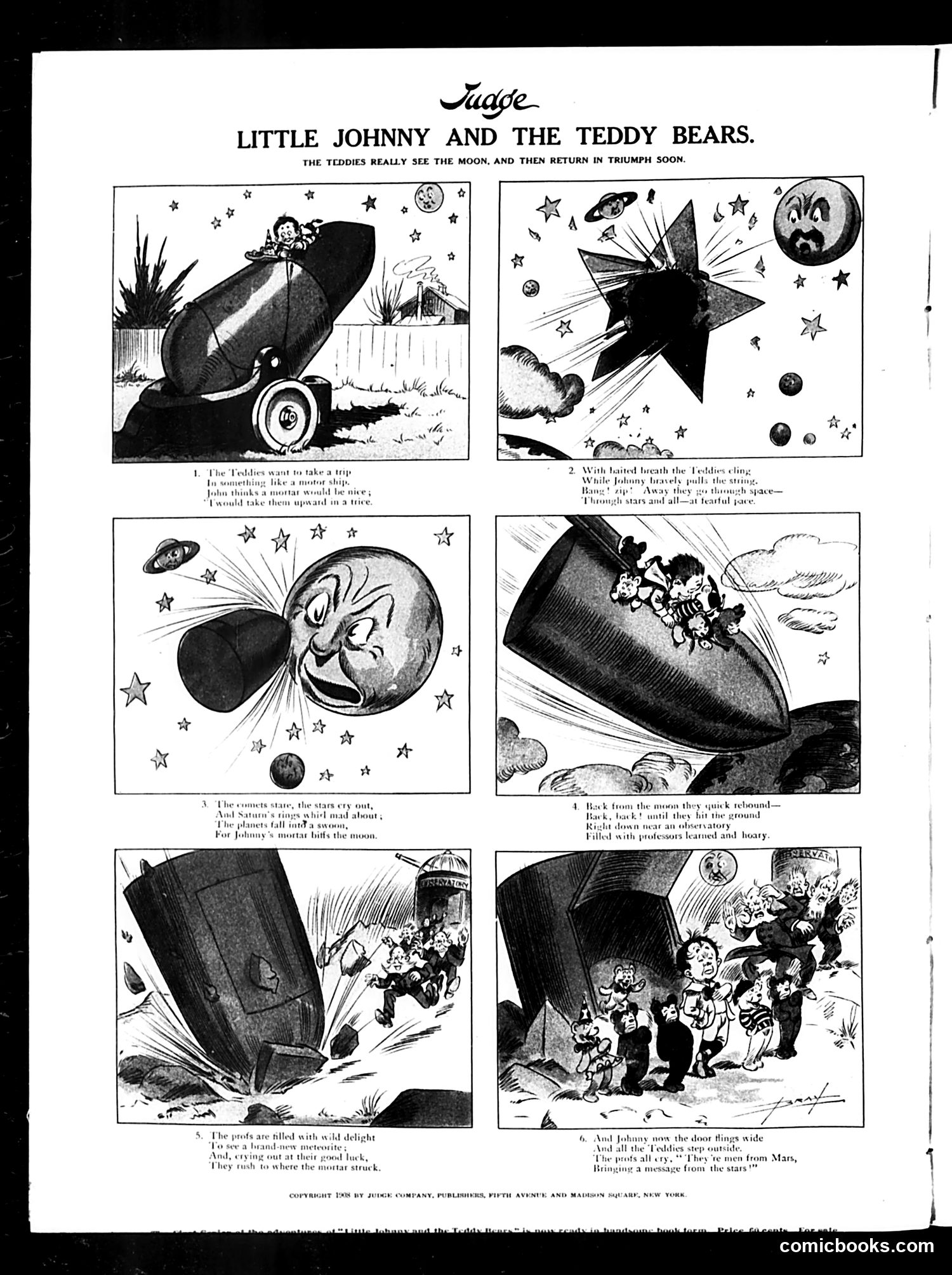
This is a whimsical children's fantasy story, not political satire. The narrative follows Little Johnny and toy teddy bears on an imaginative space journey to the moon. Panel progression shows: Johnny launching a "motor ship" rocket; the bears floating through space encountering celestial objects; a comet causing chaos; the group crash-landing back to Earth near an observatory; and finally, triumphant return home where the bears are celebrated as heroes who've traveled from Mars. The "teddy bears" reference likely alludes to President Theodore Roosevelt's popularity and the "teddy bear" craze of the early 1900s, making this a playful, patriotic adventure tale for young readers rather than political commentary. The humor derives from the fantastical premise and the bears' unexpected cosmic adventure.