
A complete issue · 16 pages · 1908
Judge — August 22, 1908
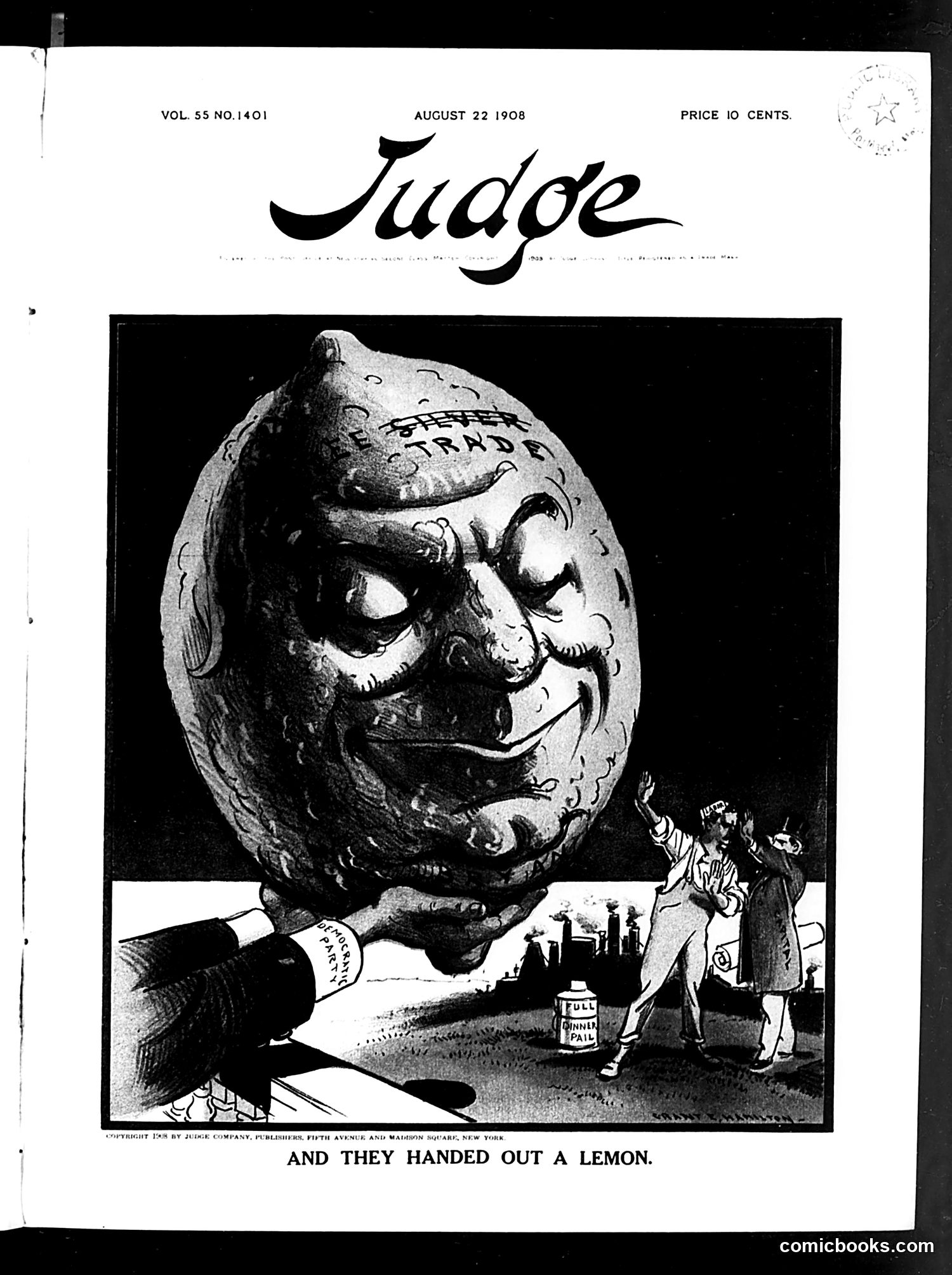
This satirical cartoon depicts a giant, grotesque face with exaggerated features—appearing to represent a political figure or outcome—being handed to small figures below, presumably representing the public or electorate. The phrase "handed out a lemon" was contemporary slang meaning to give someone something worthless or defective. The 1908 date suggests this references that year's presidential election. The imagery likely satirizes the Republican Party's choice of successor to Theodore Roosevelt—William Howard Taft—suggesting the party "handed" voters an unsatisfactory candidate or that Taft's presidency would prove disappointing. The caricatured face and dismissive tone convey Judge magazine's skepticism toward the nomination.
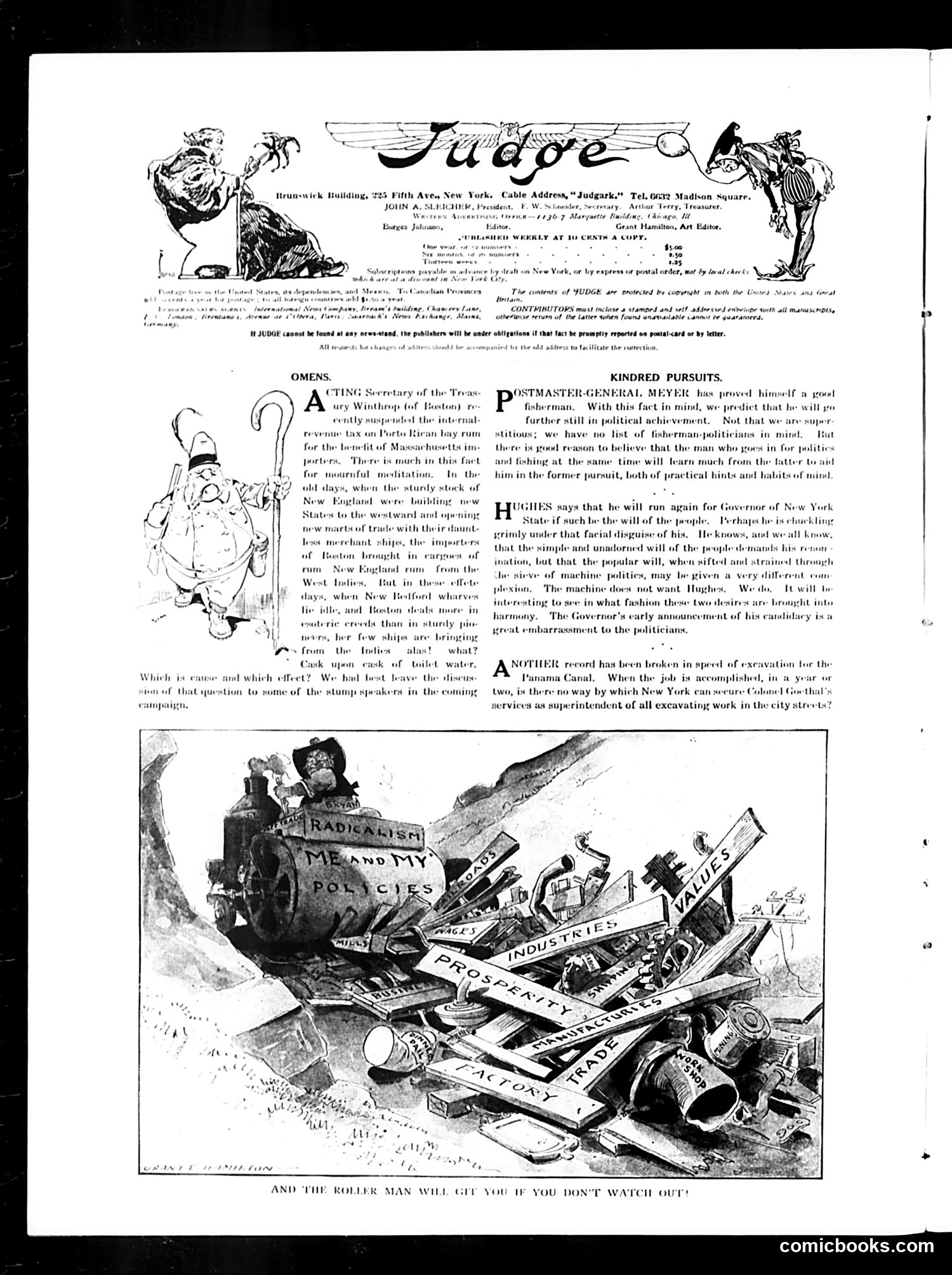
This page contains three distinct sections: a masthead with ornamental figures, two opinion columns titled "OMENS" and "KINDRED PURSUITS," and a large political cartoon below. The cartoon depicts a steam roller labeled "RADICALISM" crushing various American institutions and values—including "INDUSTRIES," "TRADE," "PROSPERITY," "FACTORY," and "ME AND MY POLICIES." The roller is operated by a radical figure, with the caption warning readers to "WATCH OUT!" The columns discuss political figures, including references to New York gubernatorial politics and the Panama Canal excavation project. The satire criticizes what the magazine frames as dangerous radical political movements threatening American capitalism, industry, and traditional governance. The overall message warns against left-wing political activism threatening established economic and political order.
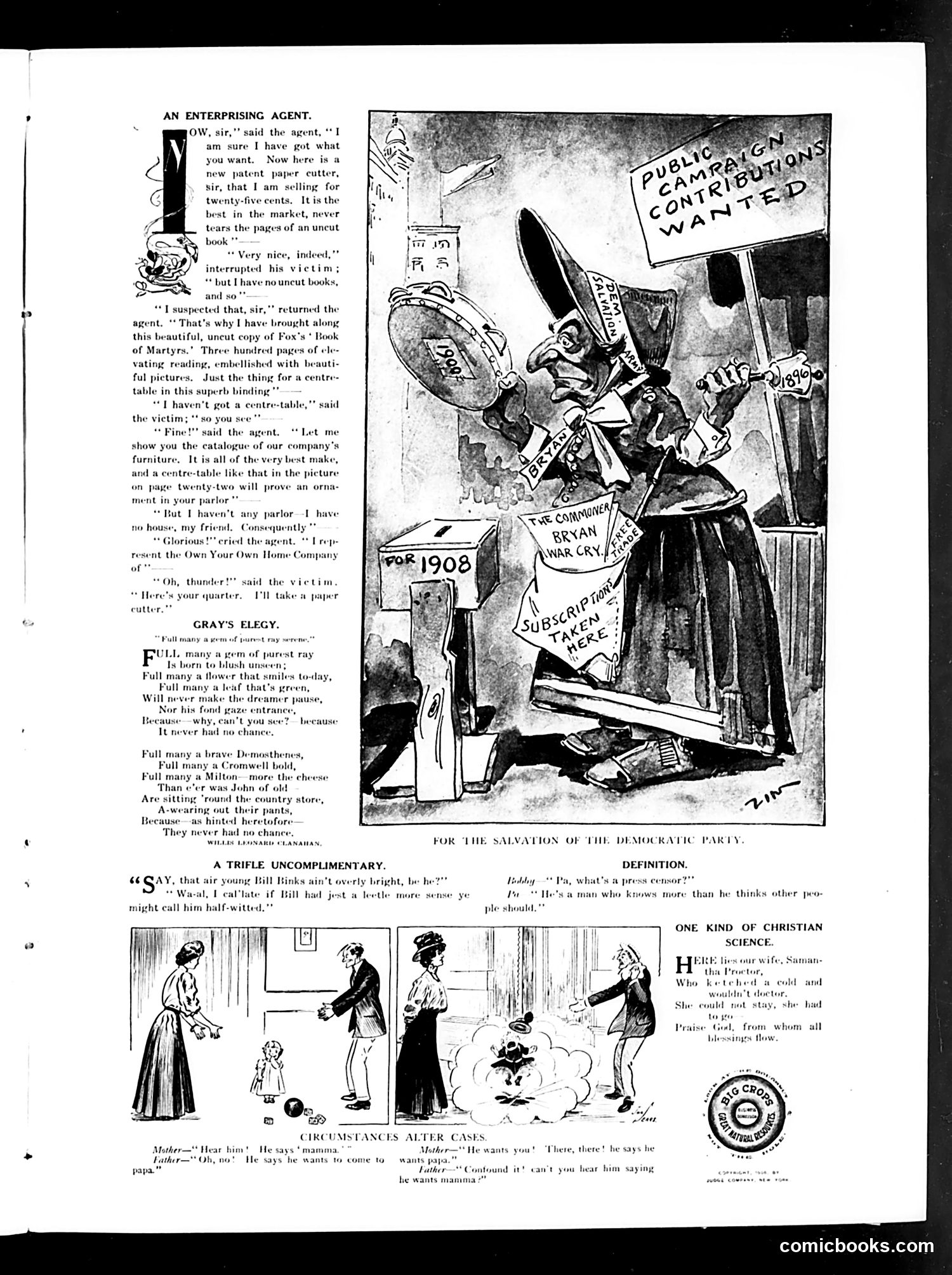
The main cartoon titled "FOR THE SALVATION OF THE DEMOCRATIC PARTY" shows a figure (likely representing a Democratic politician or party leader) juggling multiple controversial issues labeled "BRYAN," "CONTRIBUTIONS WANTED," "SUBSCRIPTIONS TAKEN HERE," and other political matters. The sign reading "PUBLIC CAMPAIGN CONTRIBUTIONS WANTED" suggests satire about party fundraising scandals or financial impropriety. The cartoon appears to mock Democratic Party struggles—possibly referencing William Jennings Bryan's repeated presidential campaigns and associated controversies. The juggling metaphor suggests the party was precariously balancing competing interests and financial pressures. The surrounding page contains unrelated humorous domestic sketches and a poem ("Gray's Elegy"), typical of Judge's mixed satirical content format.
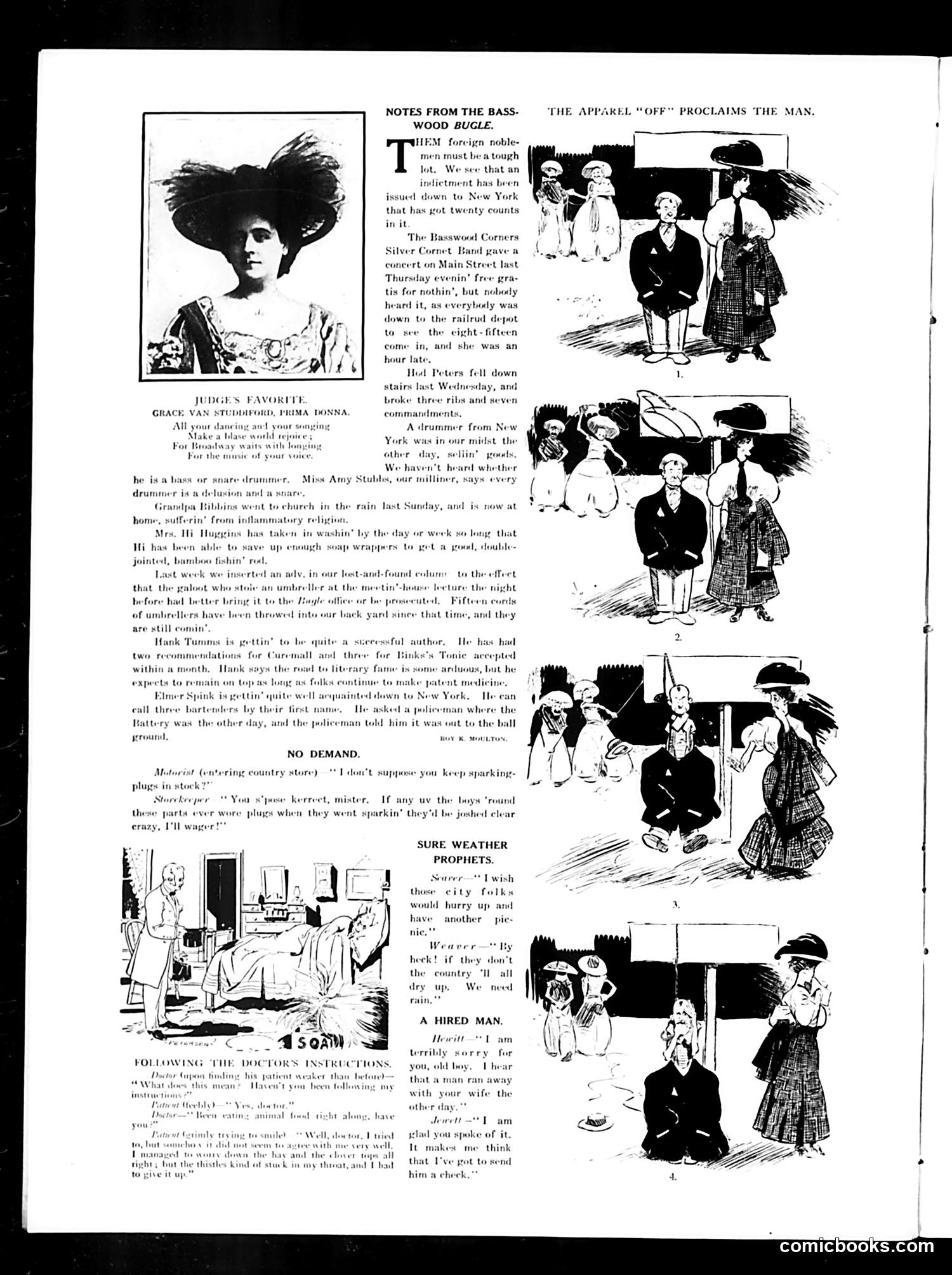
This page contains miscellaneous humor pieces rather than political cartoons. The main content includes: **"Notes from the Basswood Bugle"** — local gossip column featuring Grace Yad Beighton (Henna Donna), with a photograph of a fashionable woman in an elaborate feathered hat, typical of Edwardian-era millinery. **"The Apparel 'Off' Proclaims the Man"** — a four-panel comic strip showing misunderstandings between characters about clothing and social situations. **Additional short humor pieces** ("No Demand," "Sure Weather Prophets," "A Hired Man," "Foolish Fishing Instructions") — conversational jokes and anecdotes about everyday life. The page reflects early 20th-century American humor focused on fashion, domestic situations, and rural/urban social commentary rather than partisan politics.
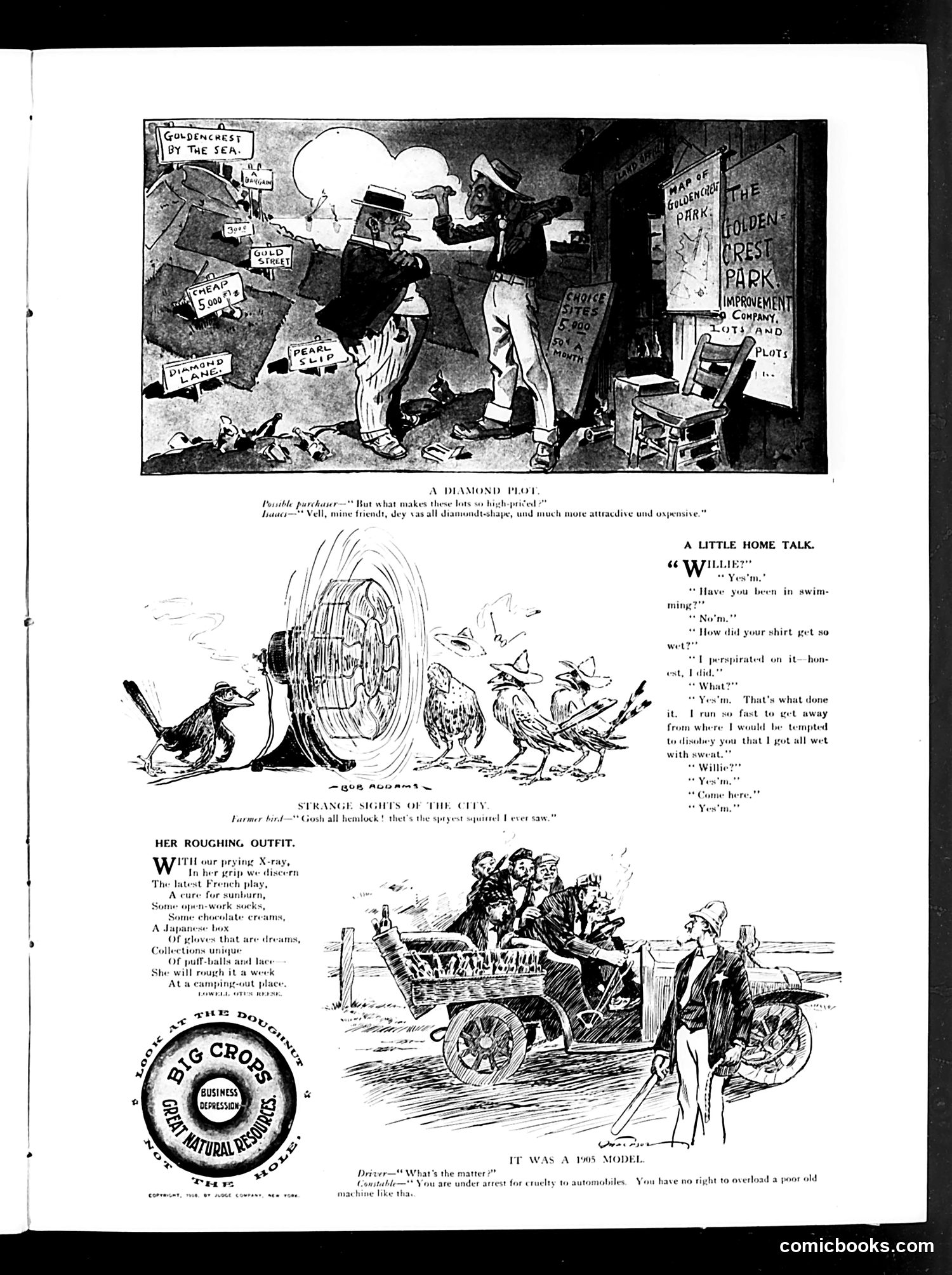
This page contains several humorous illustrations from an early 1900s issue: **"A Diamond Plot"** (top) satirizes land speculation, showing con artists promoting overpriced lots in "Golden Crest Park" to a gullible investor. The joke mocks the real estate boom mentality of the era. **"A Little Home Talk"** presents domestic comedy about a boy named Willie getting his shirt wet, with his mother's exasperated response—typical household humor. **"Strange Sights of the City"** features a bird surprised by a garden sprinkler—gentle urban observation comedy. **"Her Roughing Outfit"** and **"It Was a 1905 Model"** satirize women's camping fashion and early automobiles, mocking both the impracticality of women's clothing and the unreliability of primitive cars. The **"Big Crop" business card** appears to be advertising matter.
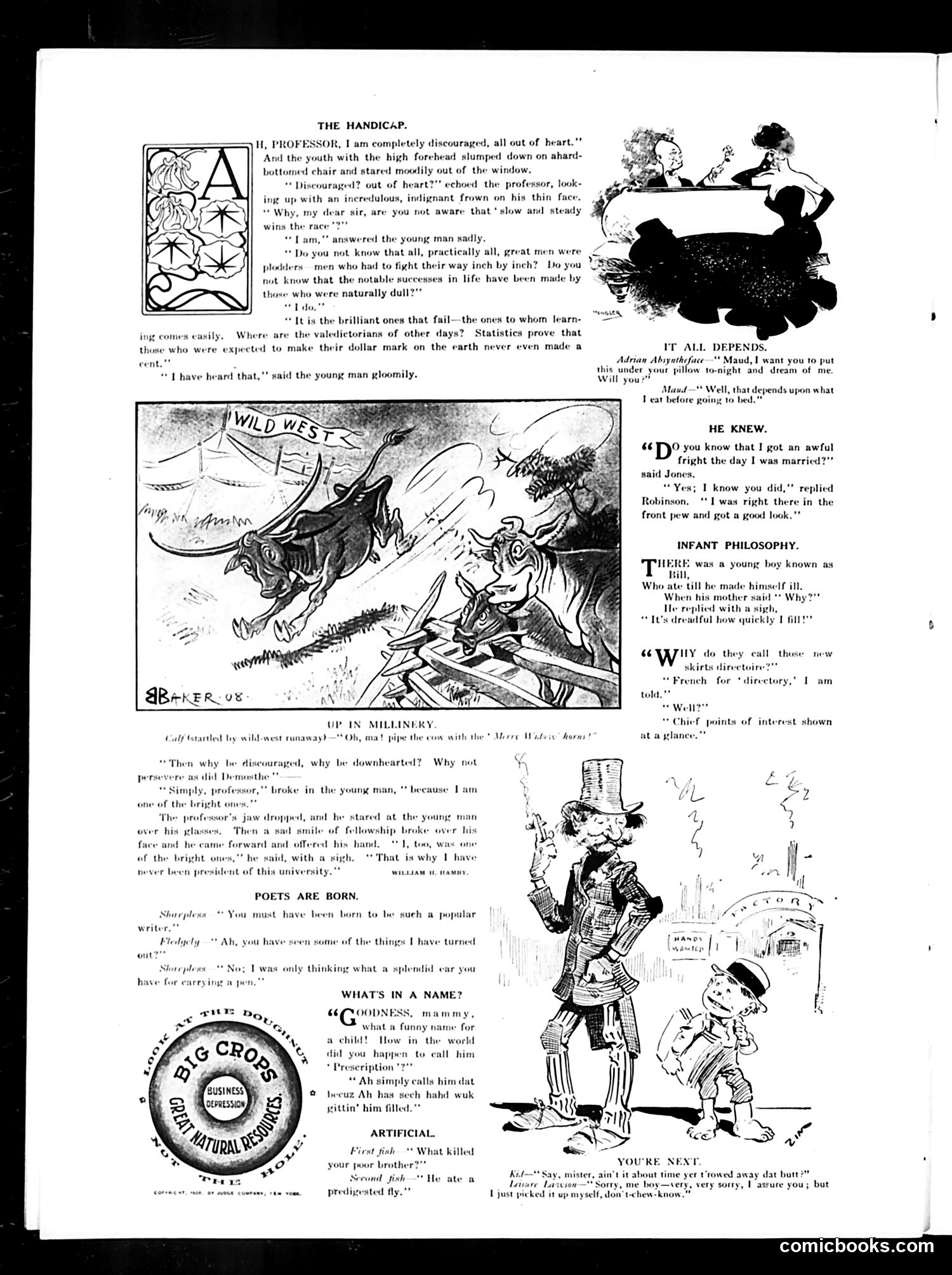
This page contains multiple brief comic sketches typical of *Judge* magazine's satirical format. **"The Handicap"** (main story): A discouraged young man complains to a professor about lacking natural talent. The professor counters with a motivational argument: great men weren't born brilliant—statistics show that naturally dull people succeed through determination, while brilliant minds often fail. The professor's own confession—that he's never been university president despite his intellect—undercuts his advice with ironic self-awareness, suggesting raw talent matters less than perseverance and luck. The remaining sections are brief humorous vignettes about naming conventions, poetry, fish humor, and fashion terminology ("directoire" skirts)—typical filler content reflecting early 20th-century sensibilities and dialect humor common to the era. The social message emphasizes meritocratic bootstrapping ideology popular in American magazines of this period.
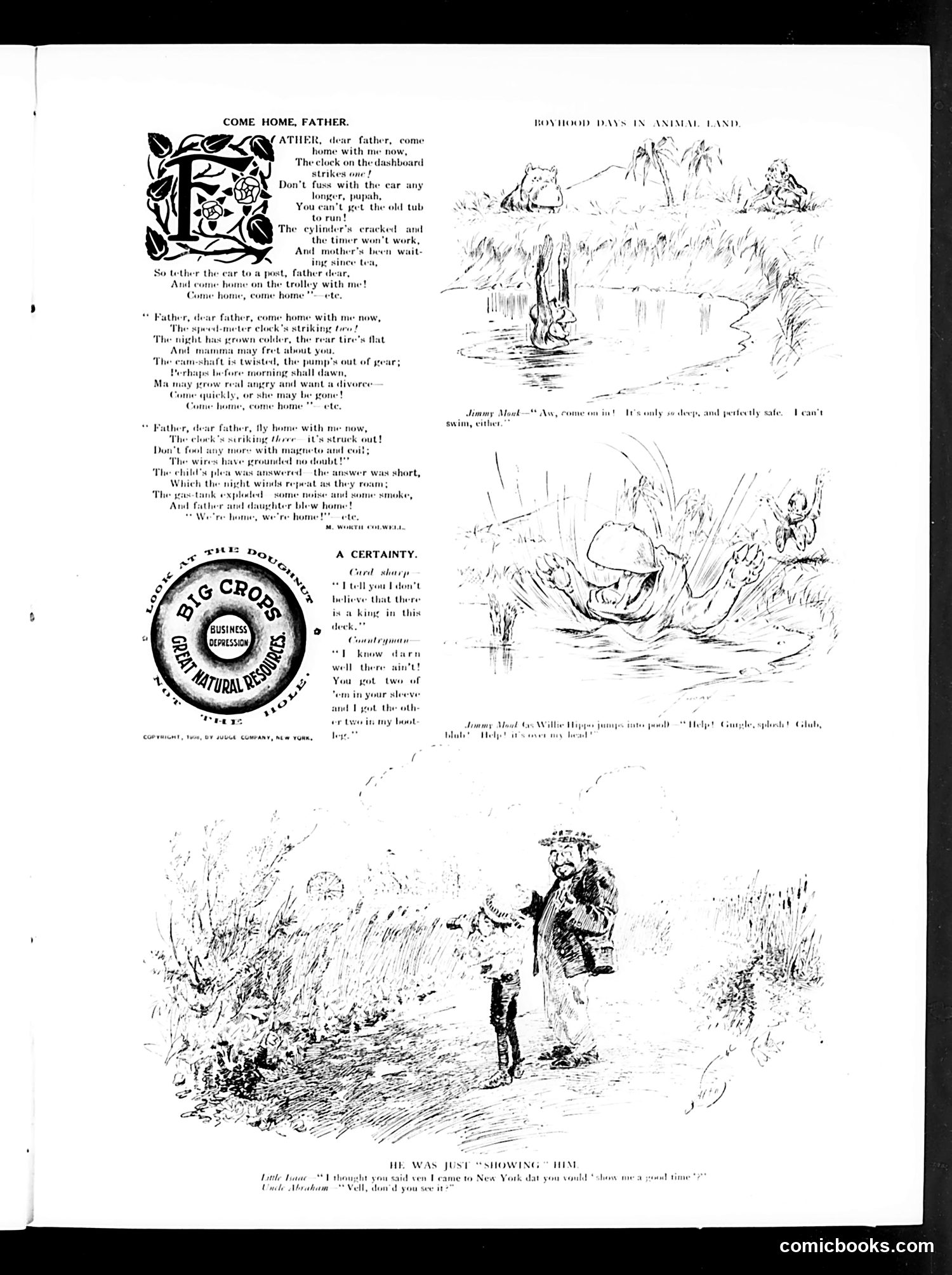
This page contains multiple satirical pieces typical of early-20th-century Judge magazine: **"Come Home, Father"** (top left) parodies the temperance-movement song of the same name, but applies it to mechanical/automotive problems instead of drunkenness—a humorous inversion of the original's serious moral message. **"Boyhood Days in Animal Land"** (right side) appears to be an illustrated children's story featuring animals in naturalistic scenarios, likely satirizing the then-popular genre of animal fables and their moral lessons. **"A Certainty"** (center) depicts a card-sharp (con artist) and a naive countryman, with dialogue suggesting the con man is about to fleece the country fellow—a classic satire on urban sophistication versus rural gullibility. **Bottom illustration** shows a figure apparently deceiving a young man about showing him "a good time" in New York—satirizing predatory urban con men targeting naive visitors. The overall theme appears to be exposing various forms of deception and manipulation in American life.
This appears to be a satirical cartoon from *Judge* magazine showing a figure with an exaggerated, grotesque face operating or manipulating what looks like mechanical or industrial equipment labeled "A SOUND-DELAYED ALLOWANCE" (the text is partially unclear in the image). The cartoon seems to critique some form of financial or governmental mechanism—possibly relating to wage controls, allowances, or delayed payments. The caricatured figure suggests mockery of a political or industrial leader attempting to control economic distribution through mechanical means. Without clearer text and publication date context, the specific political target remains uncertain. The grotesque facial features indicate this person was meant as a figure of ridicule or criticism within the satirical tradition of *Judge* magazine's commentary on contemporary politics and industry.
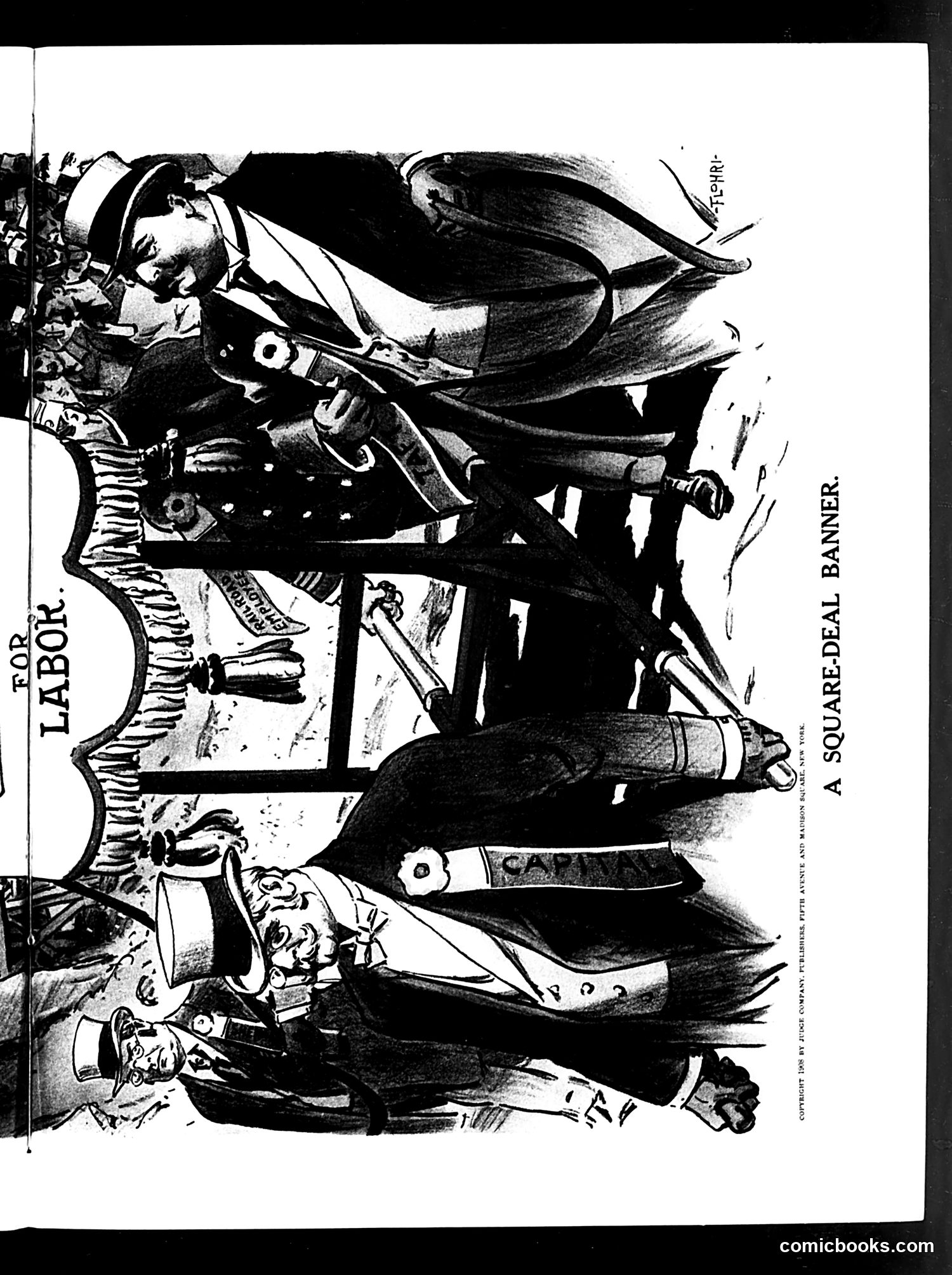
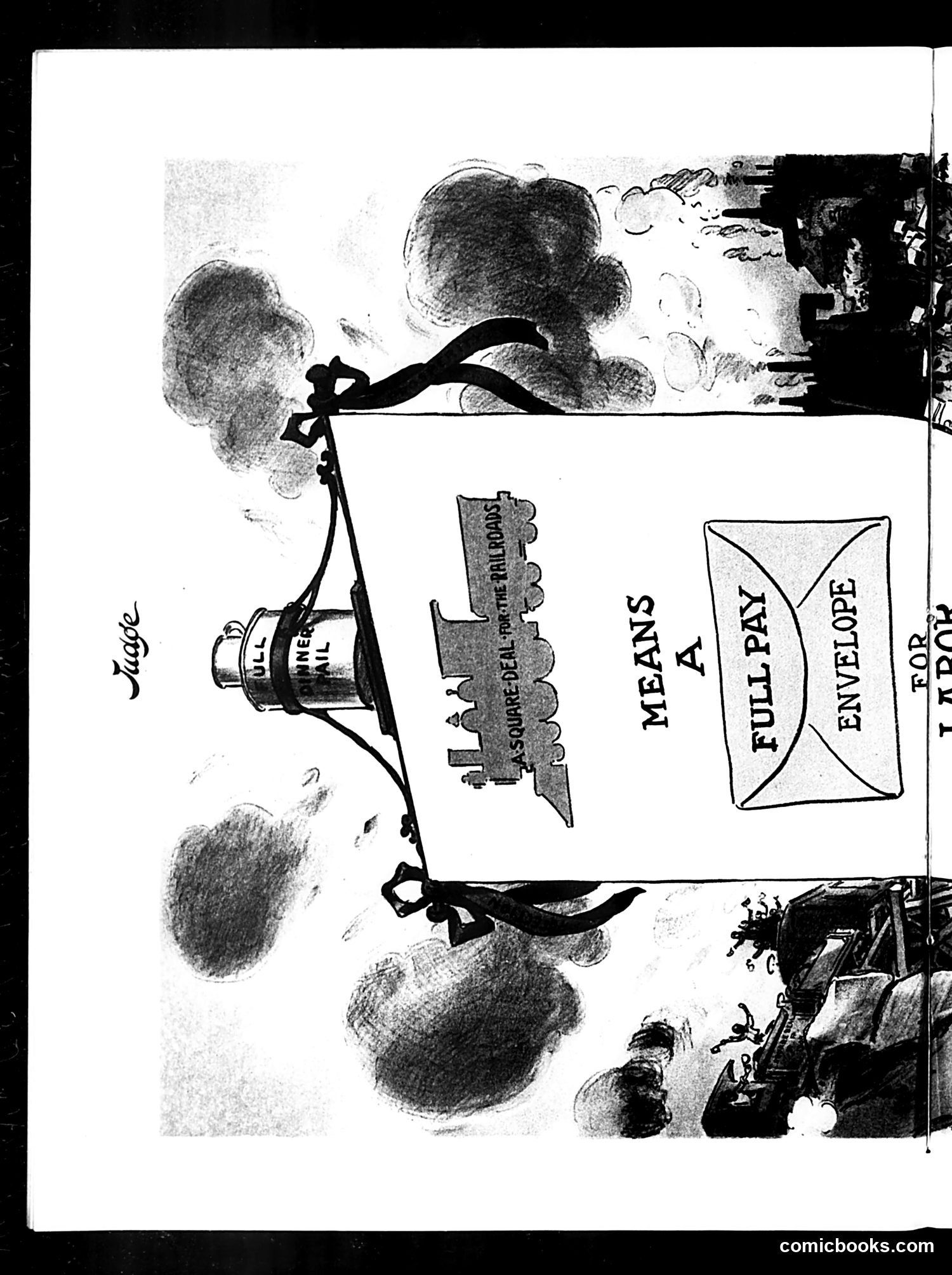
This political cartoon appears to critique labor conditions and workers' rights, likely from the Progressive Era. The title "A Square-Deal Banner" references President Theodore Roosevelt's "Square Deal" domestic policy platform. The image shows workers or laborers beneath a banner, depicted in a satirical manner suggesting their conditions fall short of the promised "square deal." The figures appear caricatured, and the composition suggests irony—the banner's promise contrasts with the reality of working conditions depicted below it. Without clearer visibility of specific details, the exact labor dispute or legislation being targeted remains unclear, but the satire clearly questions whether Roosevelt's progressive labor reforms actually benefited workers as advertised.
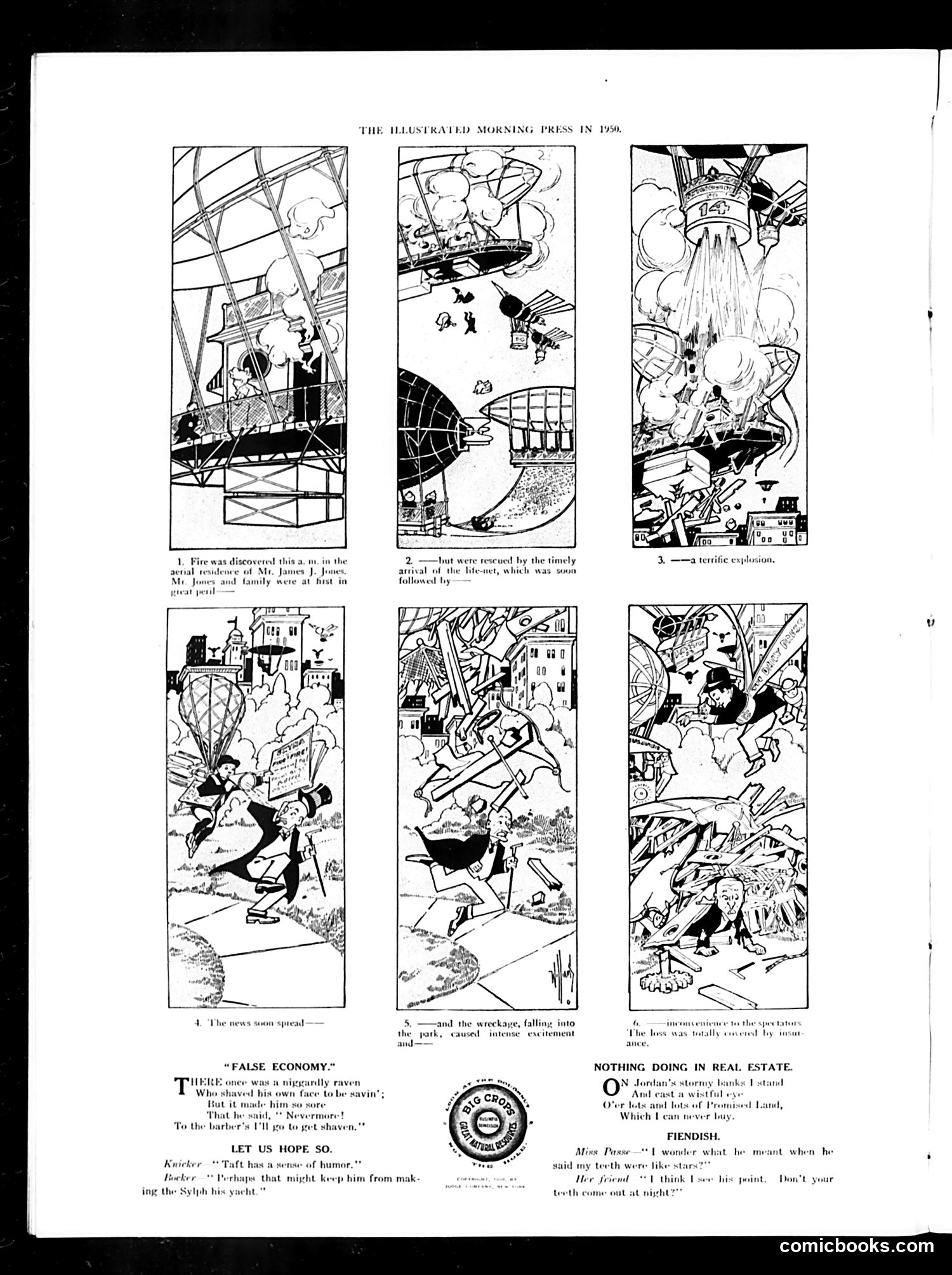
This page from *Judge* magazine presents a futuristic comic strip imagining "The Illustrated Morning Press in 1950"—depicting sensationalized news coverage of dramatic aerial disasters involving balloons and airships. The six-panel narrative shows escalating chaos: a discovery in a balloon, a rescue, an explosion, spreading news, a wreckage falling into a park, and crowds witnessing the spectacle. The satire critiques **yellow journalism and sensationalism**—mocking how newspapers of the era dramatized and illustrated catastrophes to sell papers. By imagining an exaggerated 1950 future, the cartoonist warns that this trend toward lurid, illustrated disaster reporting will intensify. The jokes below ("Let Us Hope So," "False Economy," "Nothing Doing in Real Estate") appear unrelated to the main strip—typical *Judge* format mixing multiple comedic items. The reference to "Taft" likely alludes to President William Howard Taft, suggesting contemporary political context.
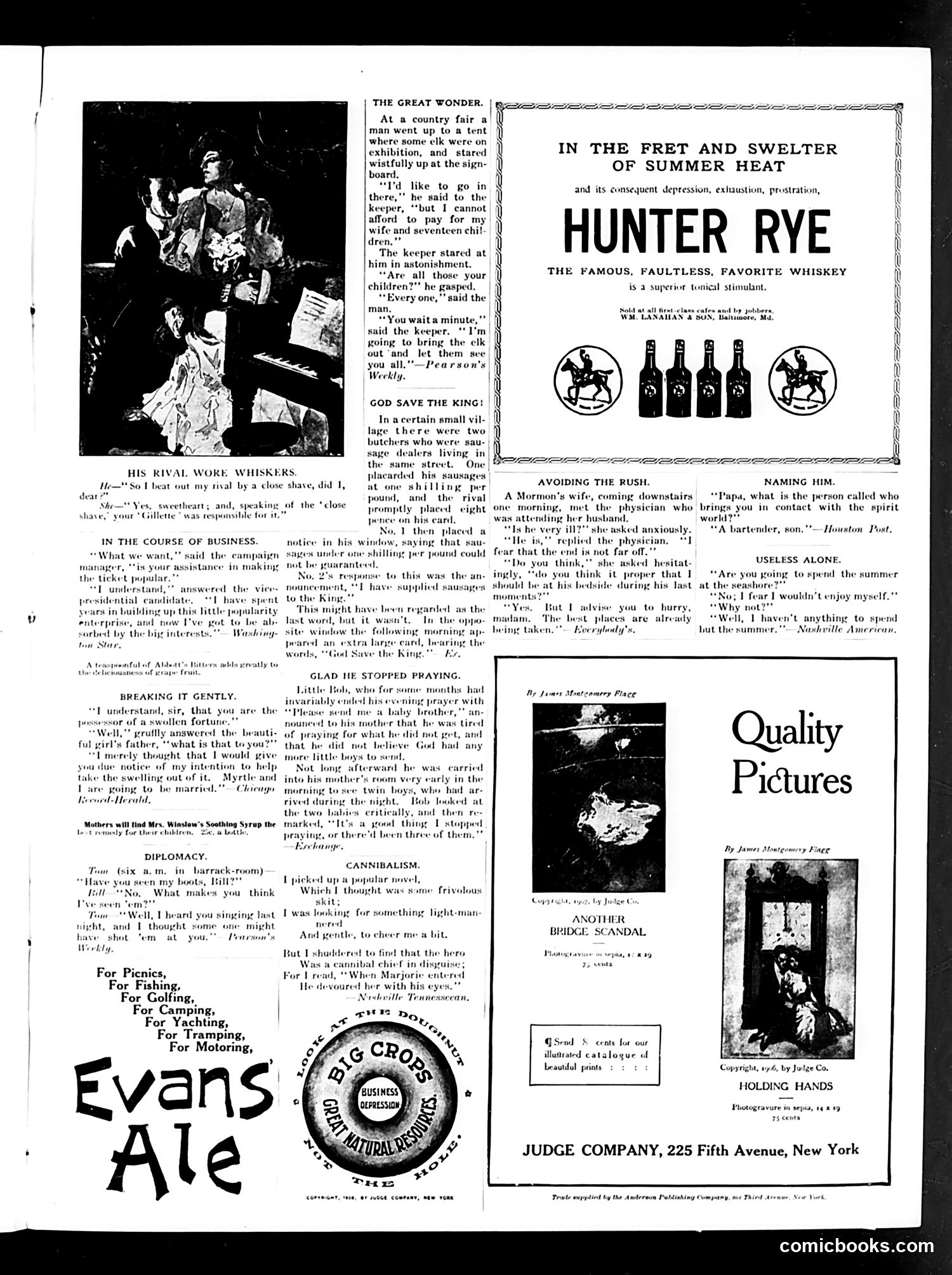
This is a humor and advertising page from *Judge* magazine. The main cartoons are brief, text-heavy jokes typical of early-20th-century publications: **"His Rival Wore Whiskers"** jokes about competition between two butchers using puns on "close shave" and barber products. **"The Great Wonder"** satirizes large families—a man with 17 children wants to see elk, and the keeper sardonically offers to show the elk the man's family instead. This reflects period anxieties about overpopulation and poverty among working-class families. **"Glad He Stopped Praying"** presents dark humor: a boy prays for a baby brother but stops after twins arrive, joking he prevented a third birth. Other brief jokes involve business consolidation, courtship, and romantic mishaps. The page is heavily laden with period **advertisements** for whiskey, ale, and other products—the real revenue source for such magazines. The cartoons are relatively simple moralizing humor, now somewhat difficult to parse without historical context about family size anxieties and advertising culture.
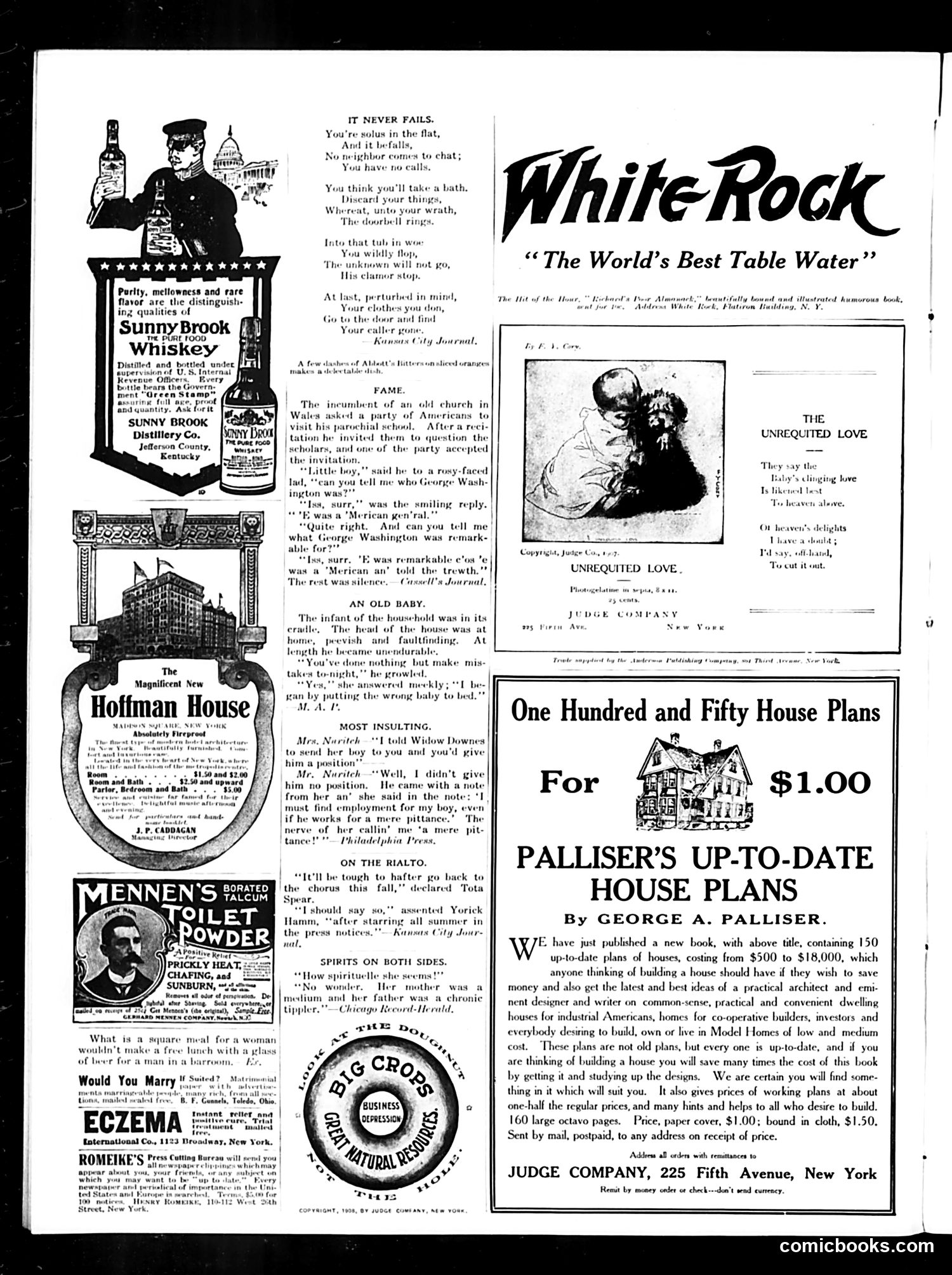
This page is primarily **advertising and light humor**, not political satire. The layout consists of: **Main Content:** Short humorous anecdotes and jokes typical of Judge magazine's "Life"-style humor—domestic situations (a doorbell interrupting a bath), confused babies, workplace awkwardness on theater productions. These are gentle, topical jokes about everyday inconveniences rather than political commentary. **Advertisements:** The page features multiple product ads (Sunny Brook Whiskey, Hoffman House hotel, Mennen's talcum powder, house plans) typical of early 1900s magazines. These ads occupy substantial space and represent the magazine's primary revenue. **Notable Element:** A sentimental illustration titled "Unrequited Love" showing romantic melancholy—reflecting the period's fascination with emotional drama. There is **no identifiable political cartoon or specific political/social satire** on this page. It represents Judge as a general-interest humor and lifestyle magazine, not primarily a vehicle for political commentary despite its satirical reputation.
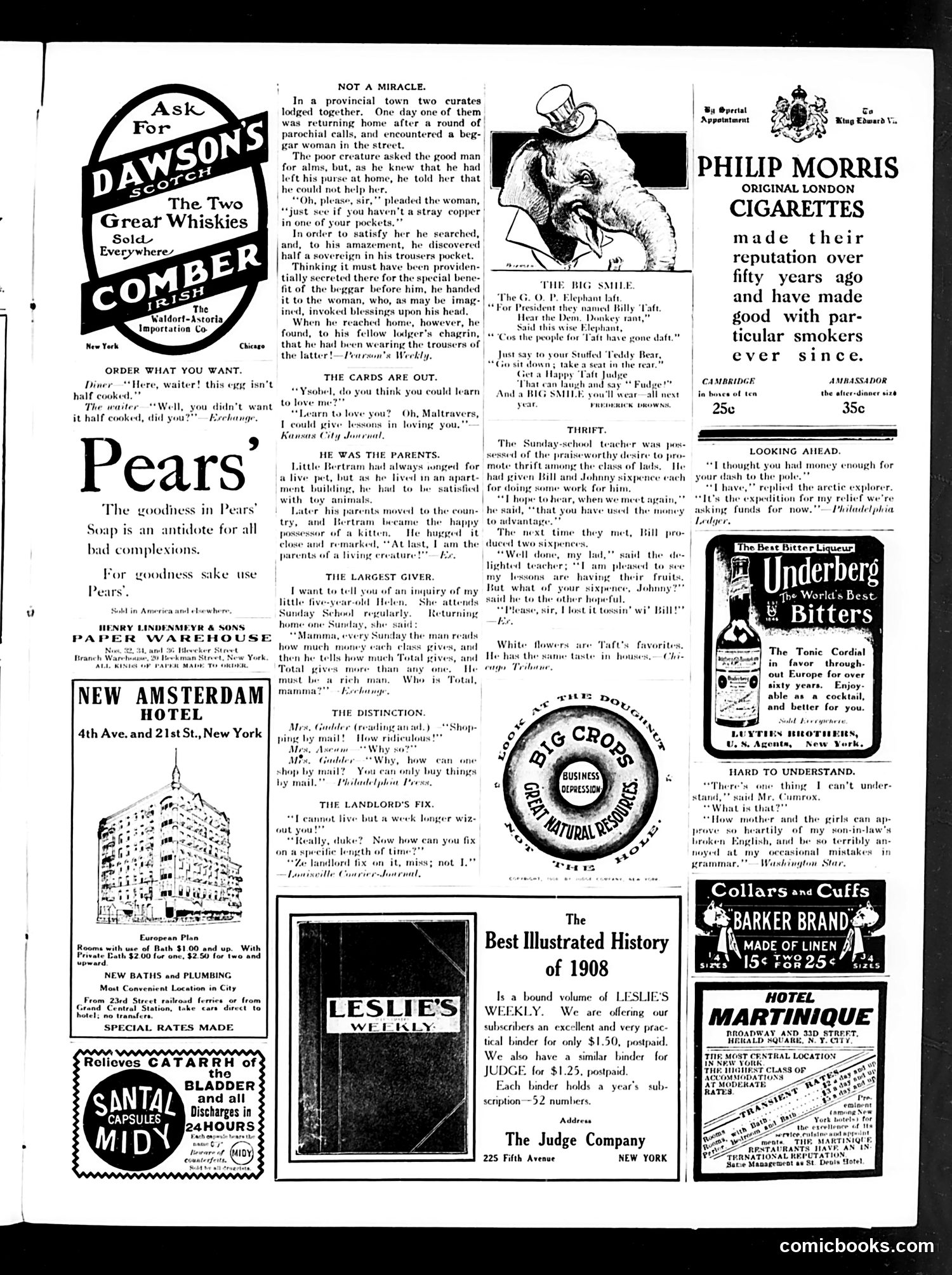
This page contains several humorous short stories and advertisements typical of Judge magazine's satirical approach. The main cartoons mock everyday social situations: **"Not a Miracle"** depicts a clergyman's embarrassment when a beggar woman's suggestion that he search his pockets yields money he'd forgotten—undermining his pious claim of poverty. **"The Big Smile"** satirizes Theodore Roosevelt and William Howard Taft during the 1908 election. The elephant (Republican mascot) and references to "Taft" and "Donkey" suggest political commentary on campaign enthusiasm. **"He Was the Parents"** mocks middle-class parenting—a boy gets toy animals instead of live pets due to apartment living constraints. Other vignettes ridicule landlords, naive charity-givers, and linguistic pretension. The advertisements (Dawson's whiskey, Philip Morris cigarettes, hotels) represent period consumer culture. The overall tone reflects Judge's middle-class, somewhat conservative sensibility—gently mocking social pretension, foolishness, and misadventure rather than attacking systemic issues.
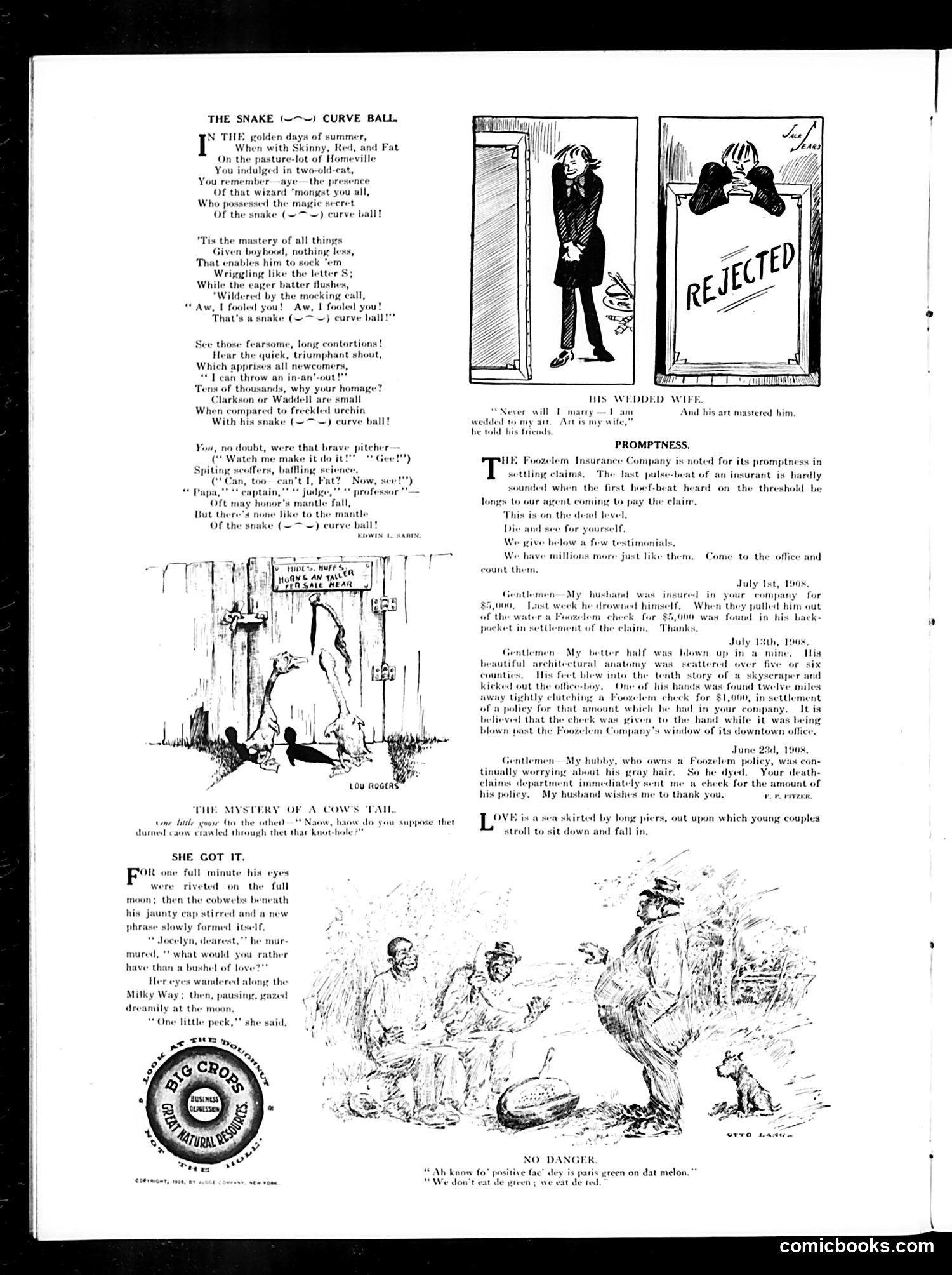
This page from Judge (circa 1908) contains nostalgic humor and insurance company satire. **"The Snake Curve Ball"** is a lengthy poem celebrating a childhood baseball pitch—the curveball, represented as "~~~"—thrown by talented neighborhood boys. It romanticizes small-town American boyhood, where mastering this deceptive pitch made a young player a local hero. The accompanying illustrations show a dejected batter and a "rejected" love letter, suggesting the curveball's power to humble rivals and illustrate life's disappointments. **"Promptness"** satirizes the Foozelem Insurance Company through exaggerated testimonials. The humor lies in claims being settled *so quickly* that agents arrive before the policyholder even dies—one arrives as the man drowns, another finds a check in the deceased's pocket after a mining explosion. This absurdist satire mocks insurance companies' advertising claims of speedy service by taking them to literal, darkly comic extremes. Lower content includes minor rural dialect humor about cows and melons.
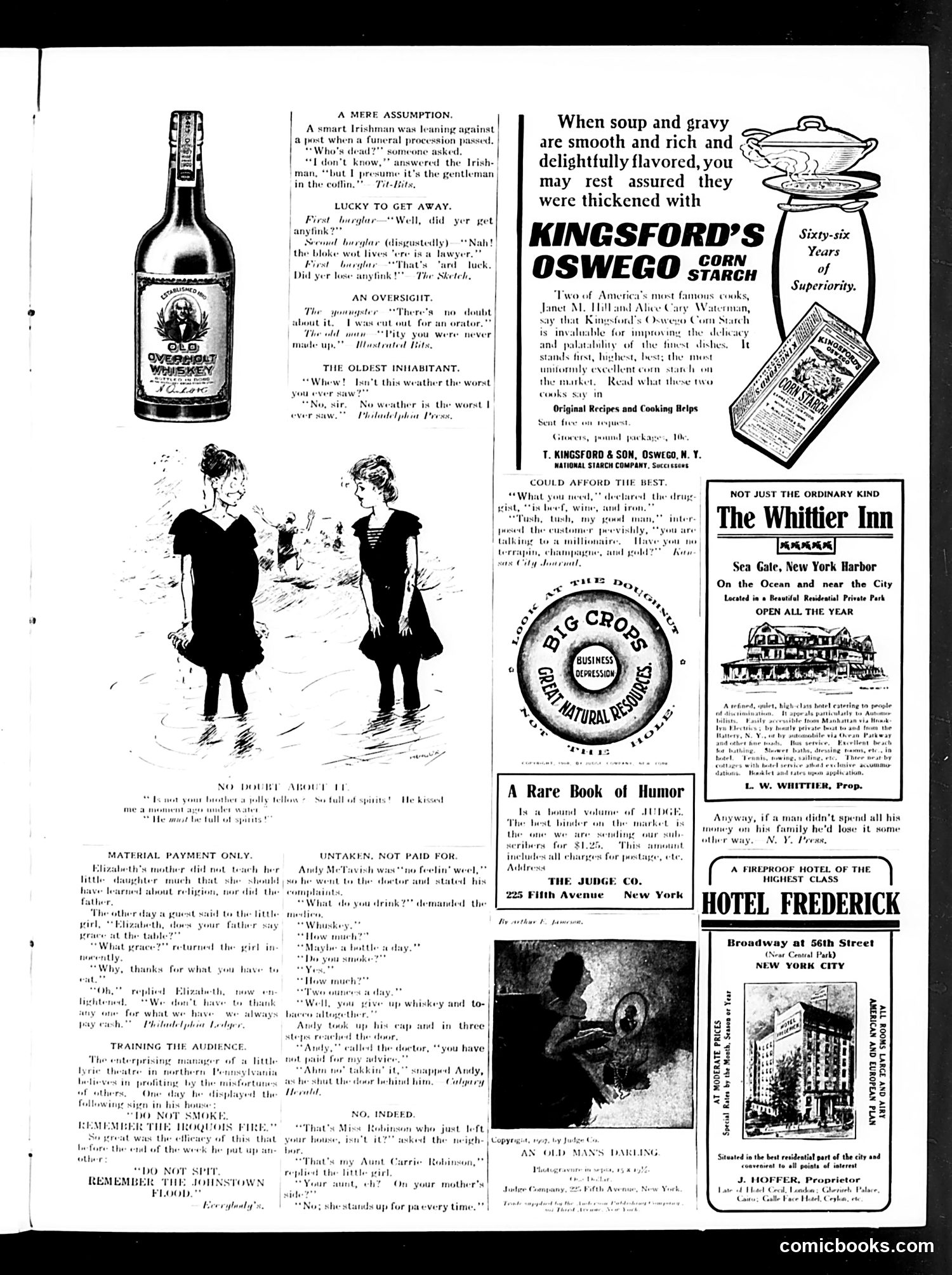
This page is primarily **advertisements and short humorous anecdotes** rather than political satire. The cartoons depict brief comedic scenarios: - A burglar assumes his target is a lawyer (implying lawyers are targets for theft—a dig at the profession) - A father assumes his son will become an orator, but the son turns out mute (ironic reversal joke) - An elderly man complains about weather (the "oldest inhabitant" trope of tedious conversation) The page also features advertising for **Kingsford's Oswego Corn Starch** (endorsing quality cooking), **The Whittier Inn** (seaside hotel), **Hotel Frederick** (Broadway lodging), and **The Judge Company** (selling a bound humor collection for $1.25). The remaining anecdotes mock working-class characters (particularly Scottish dialect humor with "Andy McTavish") and domestic situations. The humor is genteel, relying on wordplay and situation reversals rather than topical political commentary. This appears to be a typical Judge interior page mixing light satire with commercial content.
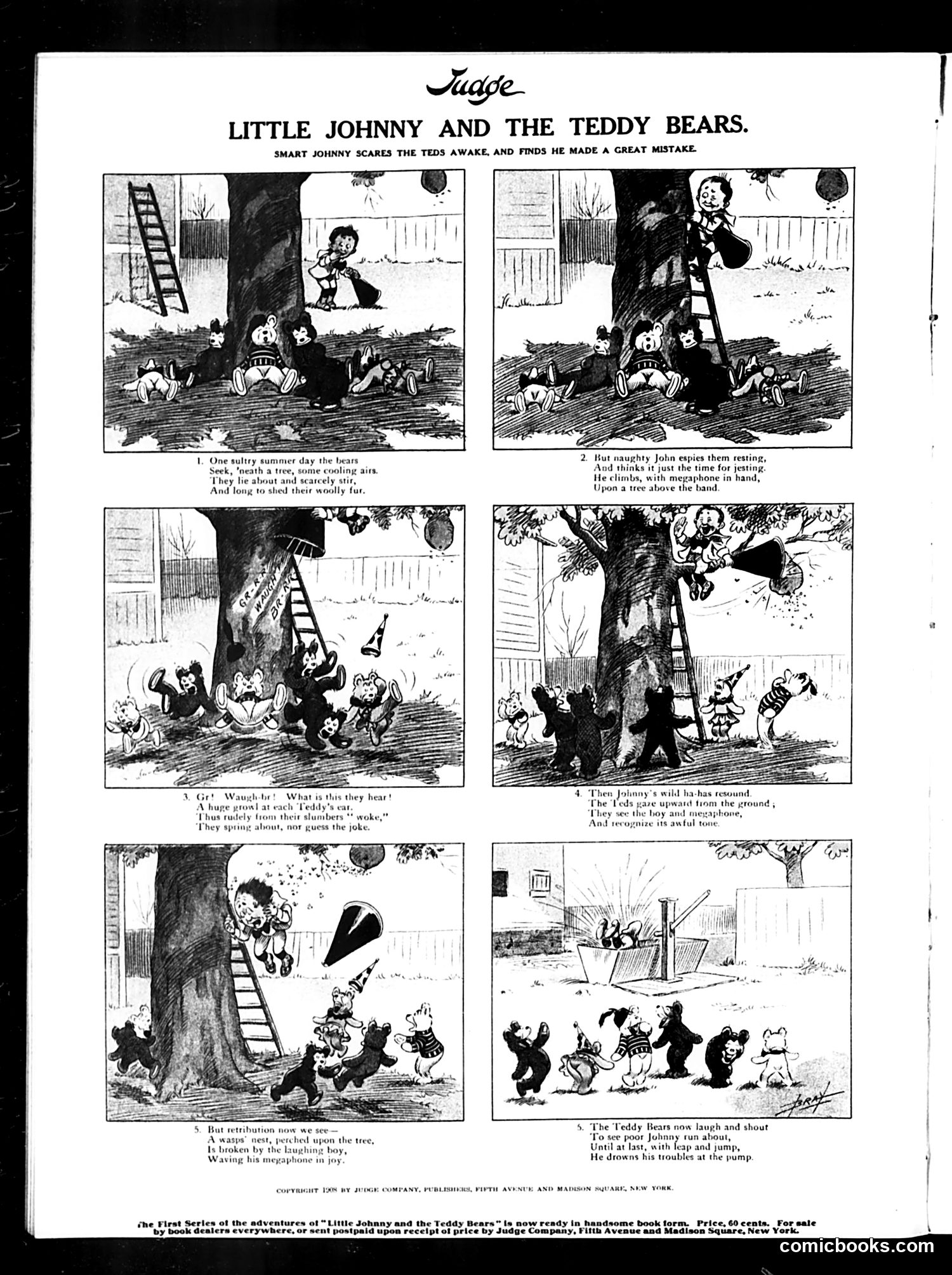
This is a children's comic strip with no political satire. The narrative follows a mischievous boy ("Smart Johnny") who discovers sleeping teddy bears beneath a tree. Finding them at rest, Johnny climbs a tree with a megaphone and startles them awake—intending to prank them. The bears, however, turn the tables: they chase Johnny, who flees in panic and ultimately ends up jumping into a water pump to escape. The joke is a simple comeuppance tale: Johnny's prank backfires when the bears pursue him in retaliation. The strip appears designed as light entertainment, promoting a book collection available for purchase through Judge Company. "Teddy Bears" references the popular stuffed toy trend, which had emerged following President Theodore Roosevelt's association with the animals around 1902-1903.