
A complete issue · 14 pages · 1908
Judge — July 18, 1908
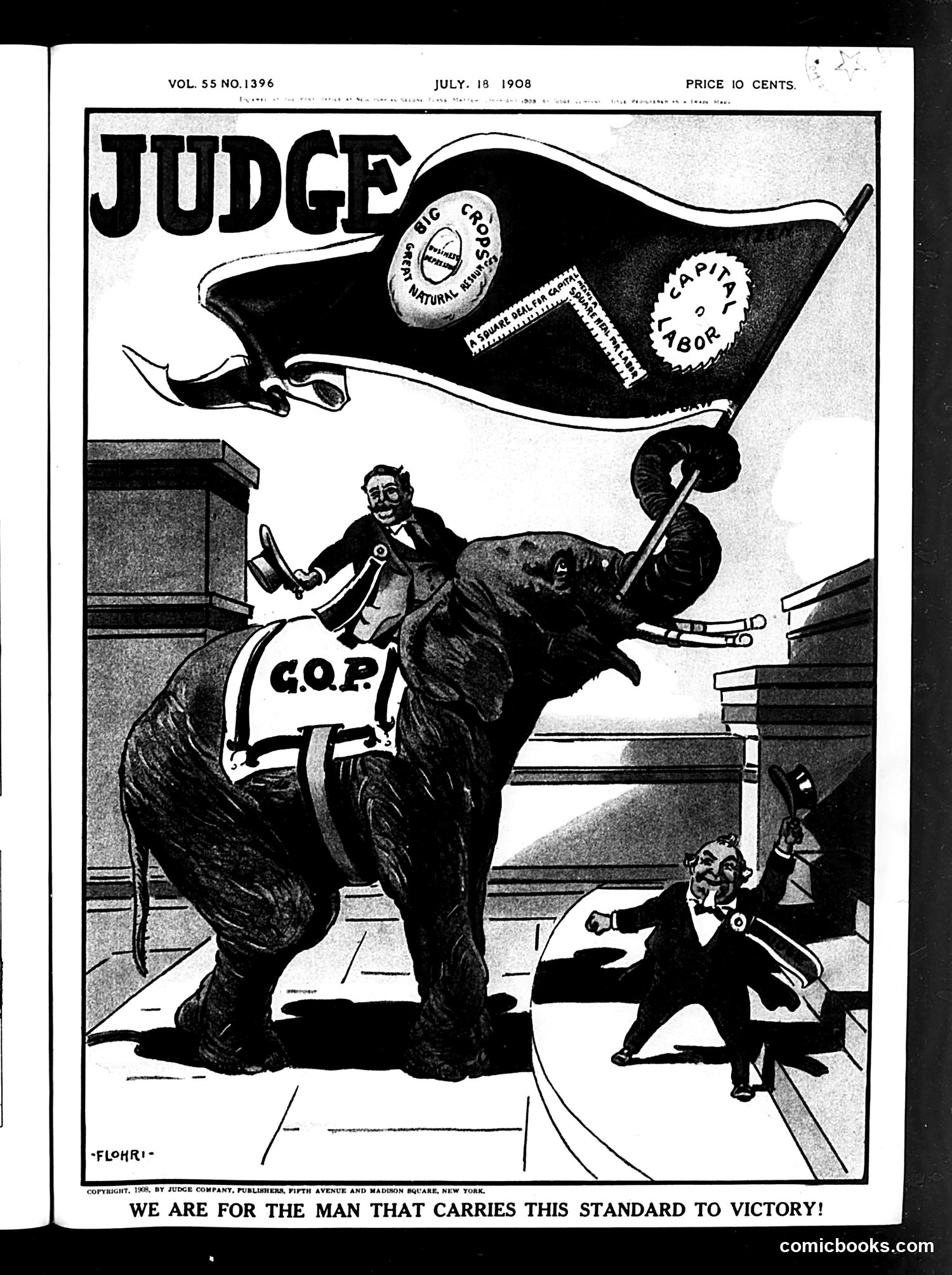
This political cartoon depicts the 1908 presidential election. The elephant labeled "G.O.P" (Republican Party) carries a man on its back beneath a flag bearing labels including "Natural Rubber" and "Capital Labor." A smaller figure runs alongside, appearing distressed or struggling to keep pace. The caption reads: "WE ARE FOR THE MAN THAT CARRIES THIS STANDARD TO VICTORY!" The cartoon satirizes the Republican Party's platform and candidate—likely William Howard Taft, President Theodore Roosevelt's chosen successor. The imagery suggests Republicans would carry their nominee to victory through economic policies favoring capital and labor. The struggling figure possibly represents the working class or Democratic opposition struggling against Republican dominance. The cartoonist criticizes the GOP's confidence in their electoral dominance during this period.
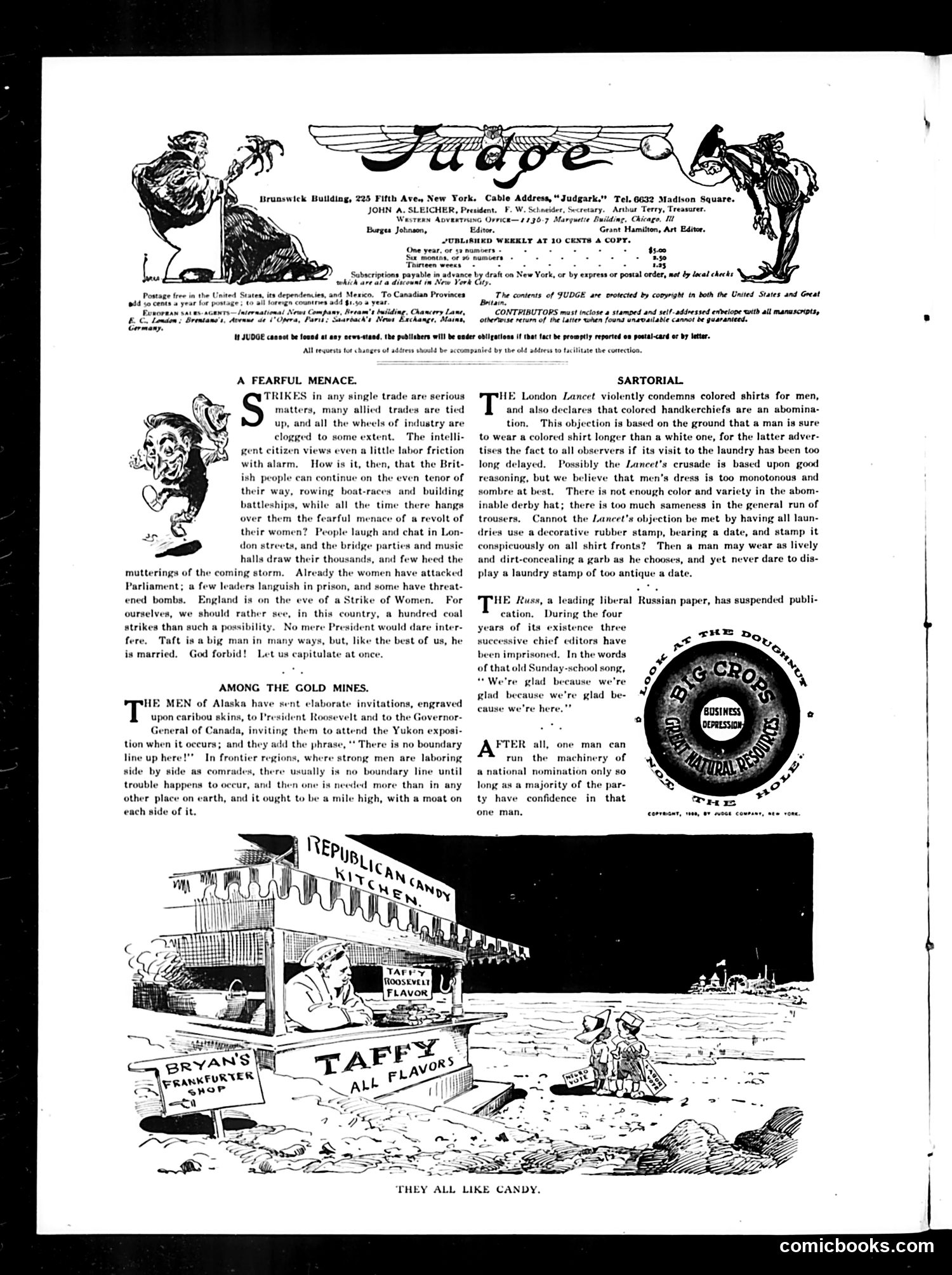
This page contains three distinct sections: **"A Fearful Menace"** critiques British labor strikes, arguing they threaten industry and national stability. The cartoonist warns that repeated strikes by workers embolden more radical action, referencing recent unrest in England and threats against Parliament members. **"Among the Gold Mines"** discusses Yukon expeditions and territorial boundary disputes between American and Canadian frontier regions, highlighting the lawlessness of unregulated mining territories. **"Sartorial"** mocks the London *Lancet* medical journal's criticism of colored dress shirts for men, arguing the objection is prudish and outdated. The bottom half features a **Taffy candy advertisement** showing a Republican campaign stand, using the slogan "They All Like Candy"—likely political commentary on voter manipulation or campaign tactics.
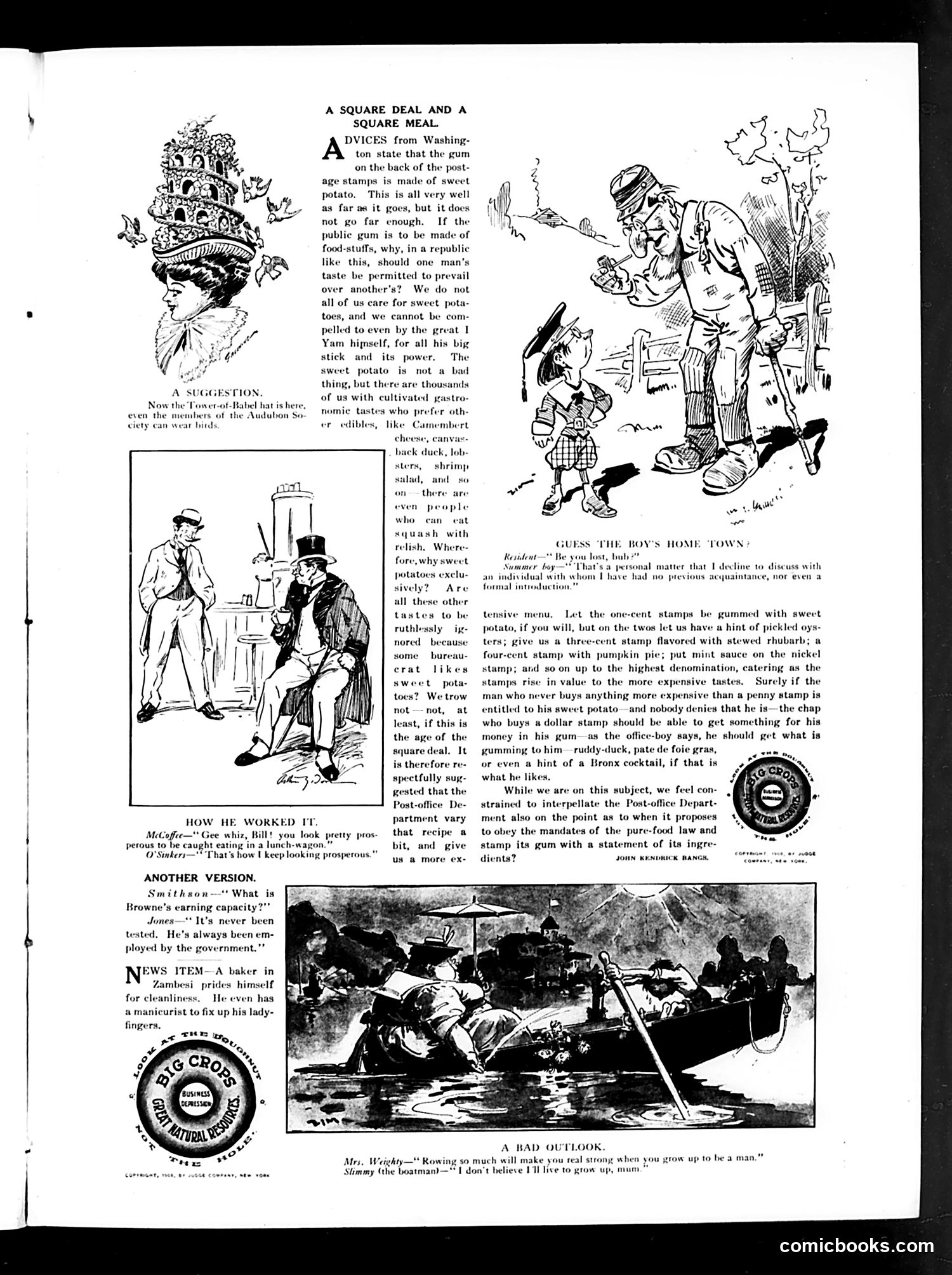
This page satirizes President Theodore Roosevelt's "Square Deal" domestic policy platform. The top article mocks Washington state's requirement that postage stamps be made from sweet potato gum—a bizarre regulation the author argues contradicts Roosevelt's principles about sensible food standards. The cartoon "How He Worked It" depicts two men discussing how to "catch eating in a lunch-wagon"—likely satirizing Roosevelt's trust-busting regulatory efforts and their unintended consequences for ordinary commerce. The bottom illustration appears to show a boating accident, captioned with dialogue about growing up to "be a man," possibly referencing Roosevelt's celebrated persona as a rugged outdoorsman. Overall, the page uses absurdist humor to critique Progressive Era regulations as overreaching and impractical.
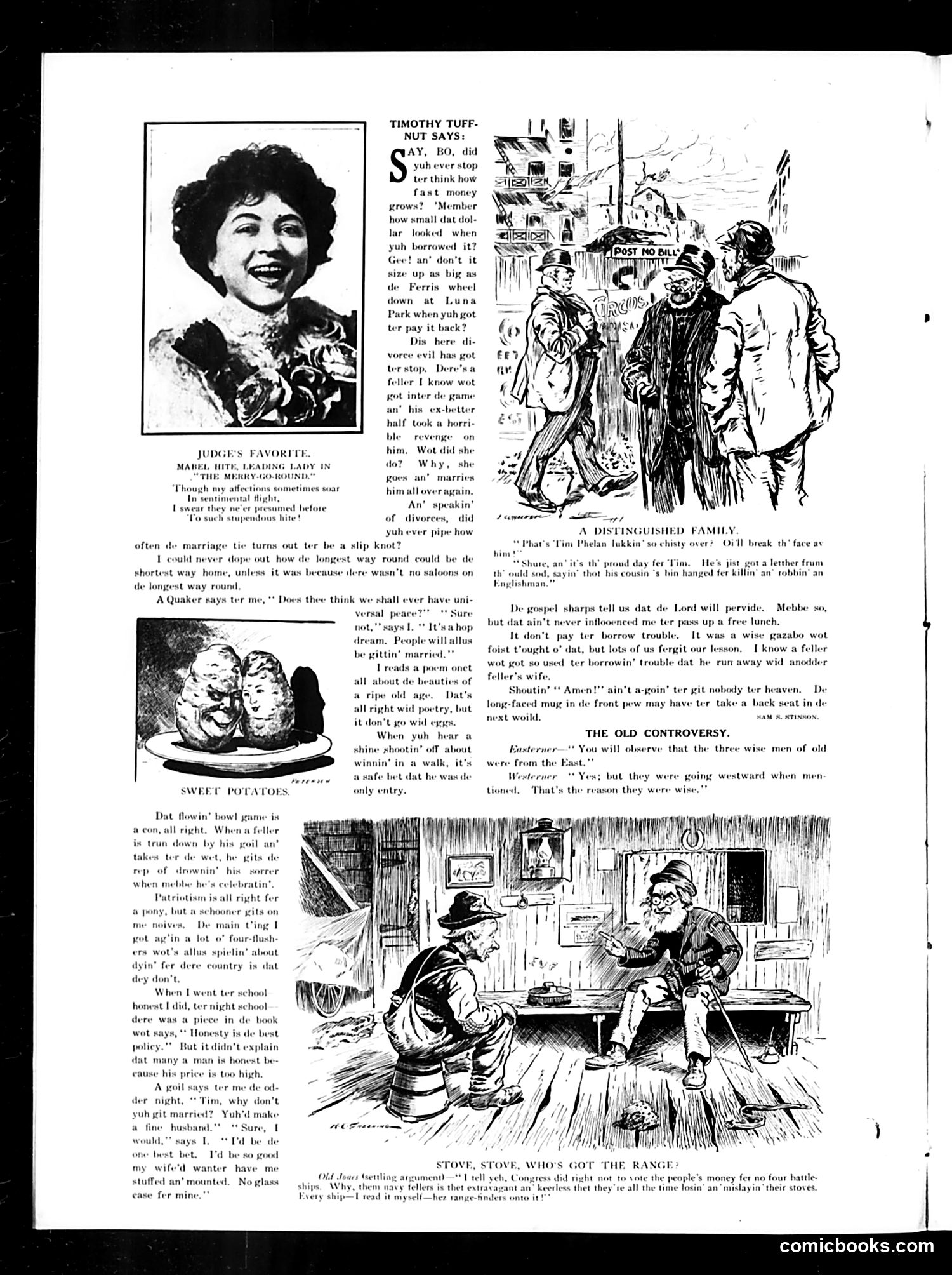
This page contains several humor pieces from Judge magazine. The top features "Timothy Tuff-Nut Says," advice column humor about money and marriage. "A Distinguished Family" depicts working-class characters discussing borrowing and church attendance—social satire of working poor respectability. The "Sweet Potatoes" section uses food imagery for unclear social commentary. "The Old Controversy" references three wise men from the East traveling westward, apparently satirizing directional assumptions or travel narratives. The bottom cartoon, "Stove, Stove, Who's Got the Range," shows two men in what appears to be domestic or political dispute over a stove—likely satirizing resource disputes or domestic politics, though the specific reference is unclear without additional context about Judge's publication date. Overall, the page mixes domestic humor with social class satire typical of turn-of-century American humor magazines.
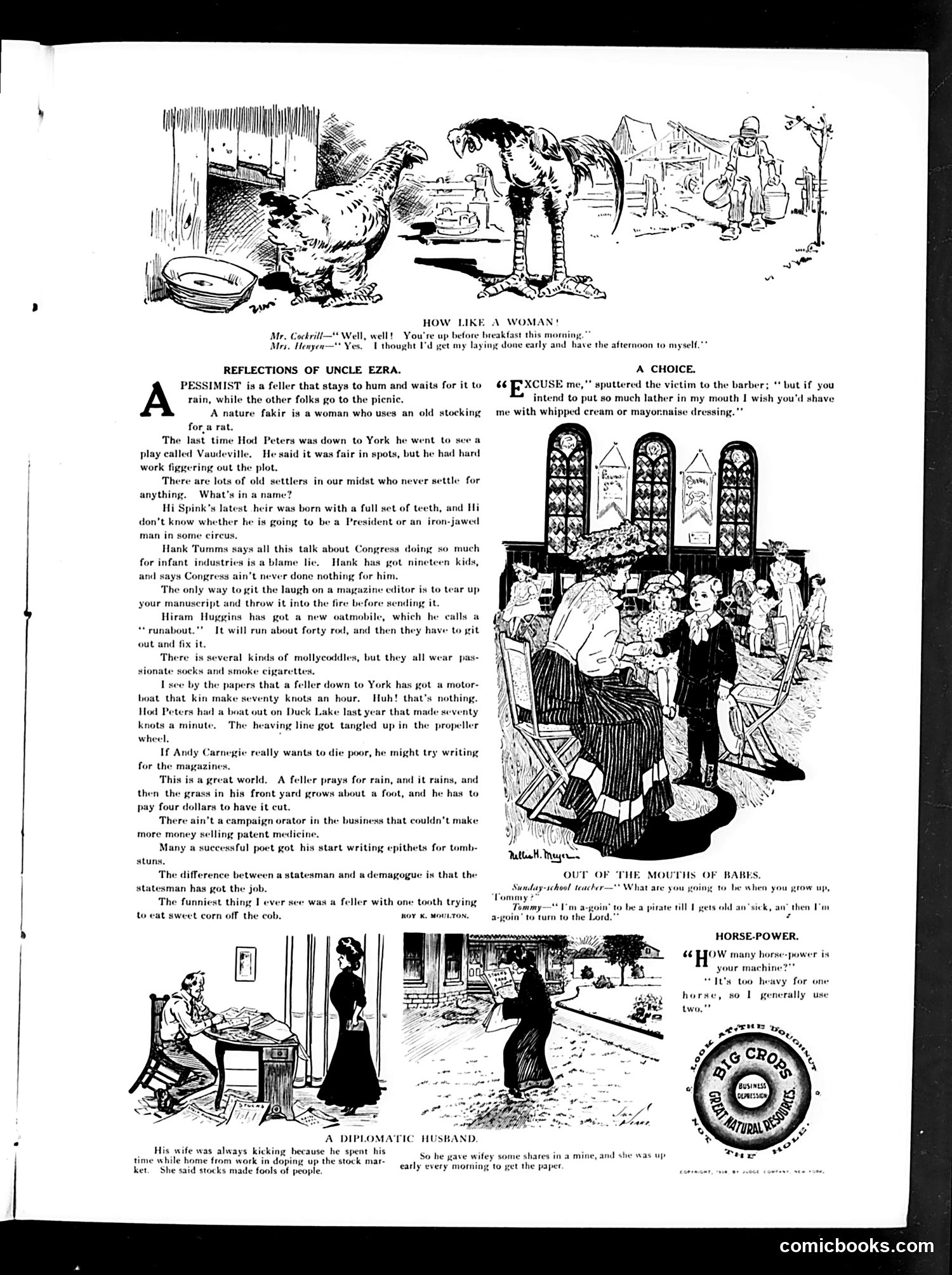
This page contains several unrelated satirical pieces typical of late 19th/early 20th-century humor magazines: **"How Like a Woman"** (top): A domestic comedy about a wife complaining her husband is up before breakfast, expecting him to have finished chores. **"Reflections of Uncle Ezra"** (left): Rambling anecdotes about rural characters and small-town life—common filler content mocking country folk and their eccentricities. **"Out of the Mouths of Babes"** (right): A child's innocent religious misinterpretation, a recurring joke format. **"A Diplomatic Husband"** (bottom): Shows a husband managing his wife's demands by giving her mining shares—satirizing marital negotiation and women's newfound financial interests. The cartoons reflect turn-of-century attitudes toward gender roles, rural simplicity, and emerging women's economic participation, presented through gentle domestic humor rather than sharp political satire.
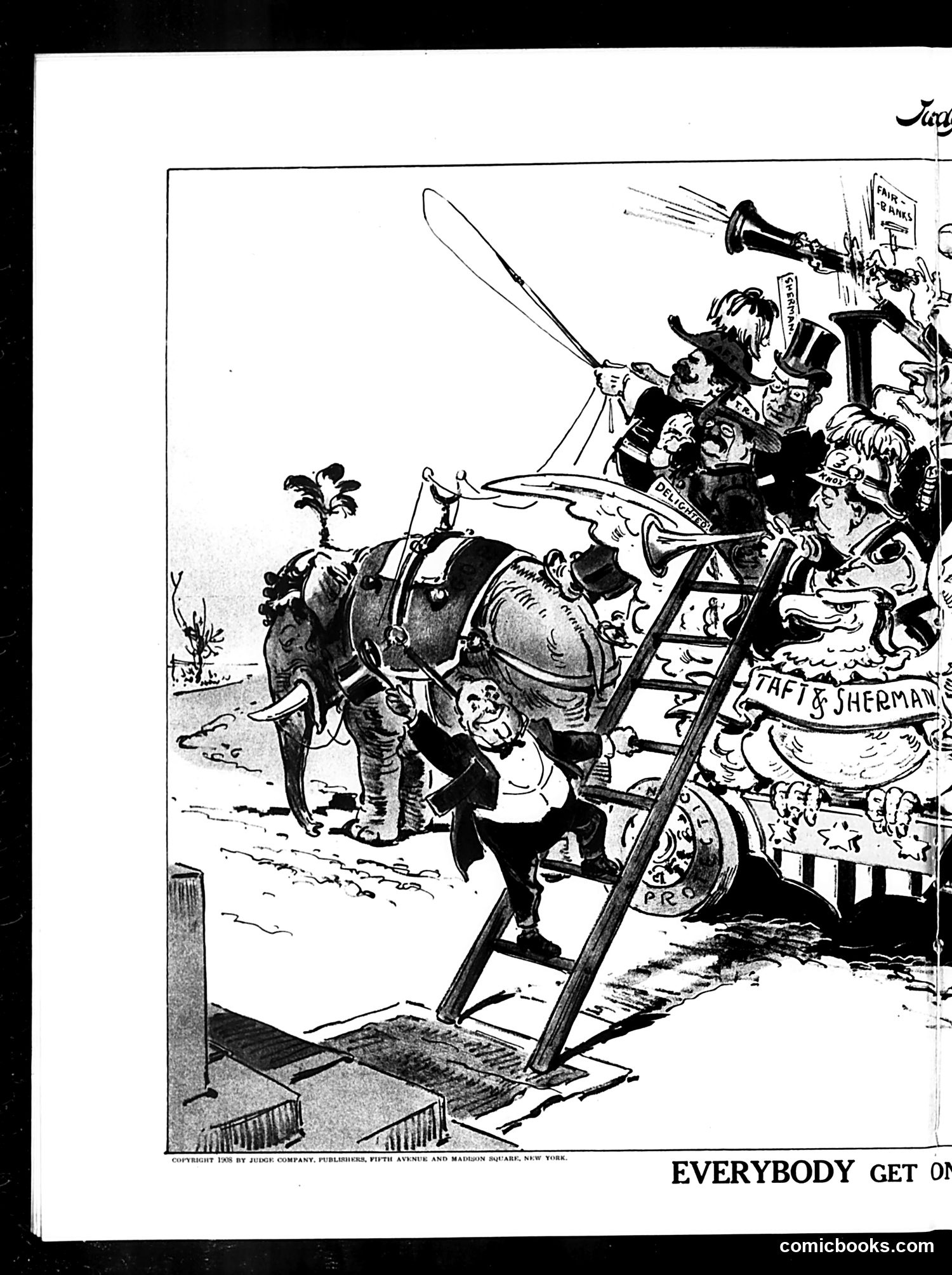
This appears to be an early 20th-century Judge magazine satirical cartoon titled "Everybody Get On" (partially visible). The image depicts a large elephant being loaded with numerous figures climbing aboard a ladder—a common metaphor in political cartoons where the elephant represents the Republican Party. The figures appear to represent various political figures and factions attempting to board or gain access to Republican power or the party platform. One figure is labeled "Taft's Sherman," likely referencing President William Howard Taft and his political allies. The satire likely comments on political opportunism, faction-fighting within the Republican Party, or the scramble for power and influence during the Taft administration (1909-1913). The crowded, chaotic scene emphasizes the competing interests seeking to control or ride Republican political machinery.
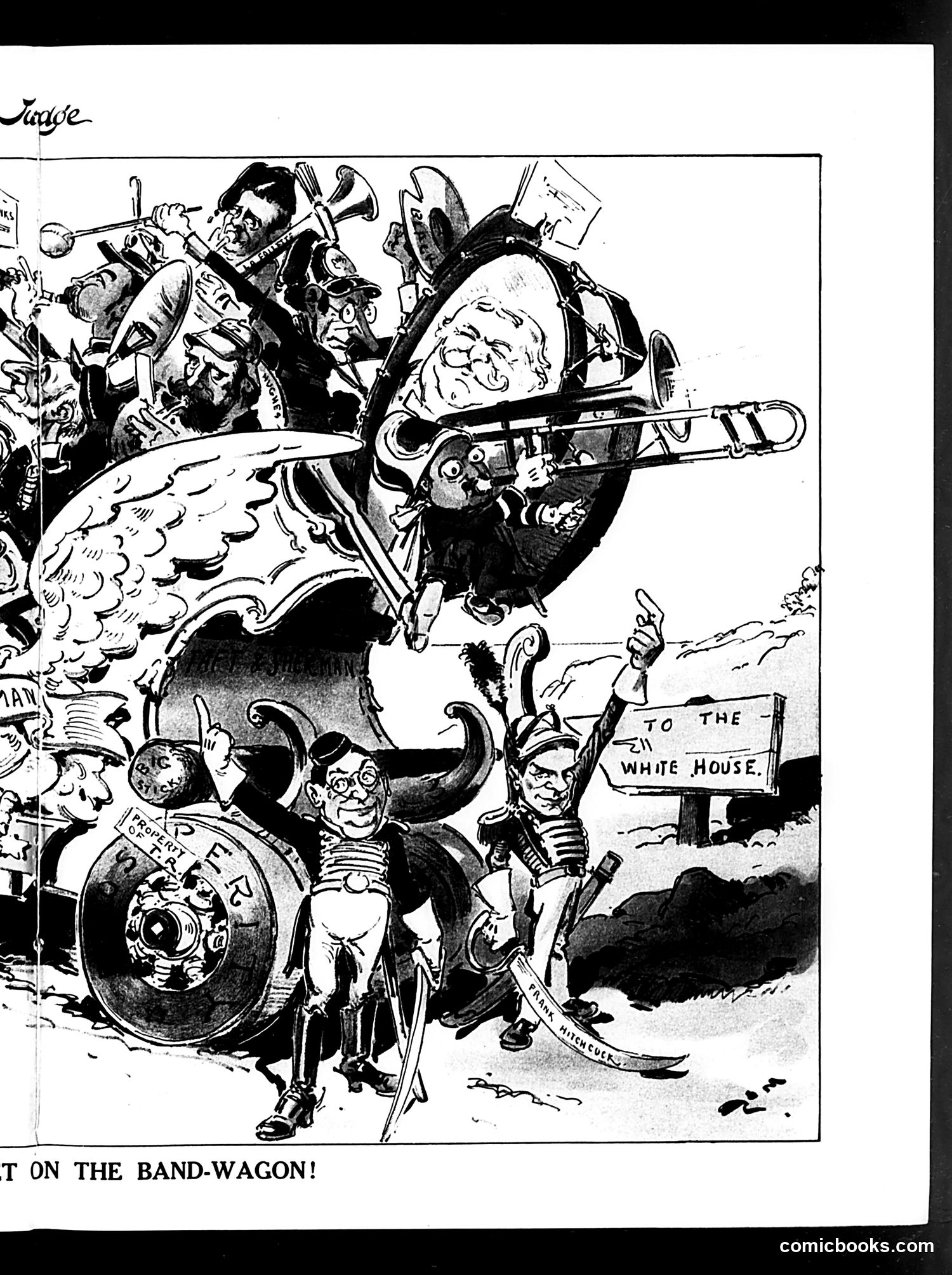
This Judge magazine cartoon depicts political figures literally climbing aboard a decorative band-wagon headed "TO THE WHITE HOUSE," satirizing opportunistic politicians jumping on a bandwagon—adopting a popular cause for political gain. The central figure with a telescope appears to be a prominent politician of the era (likely early 20th century, based on style). Smaller demonic or devil-like figures below represent competing political interests or rival politicians also seeking power. The elaborate costume and exaggerated features are typical Judge magazine caricature style. The satire mocks how politicians opportunistically align themselves with popular movements or causes, abandoning principles for electoral advantage. The "band-wagon" metaphor—suggesting noise, spectacle, and herd mentality—criticizes this behavior as inauthentic political posturing rather than genuine leadership.
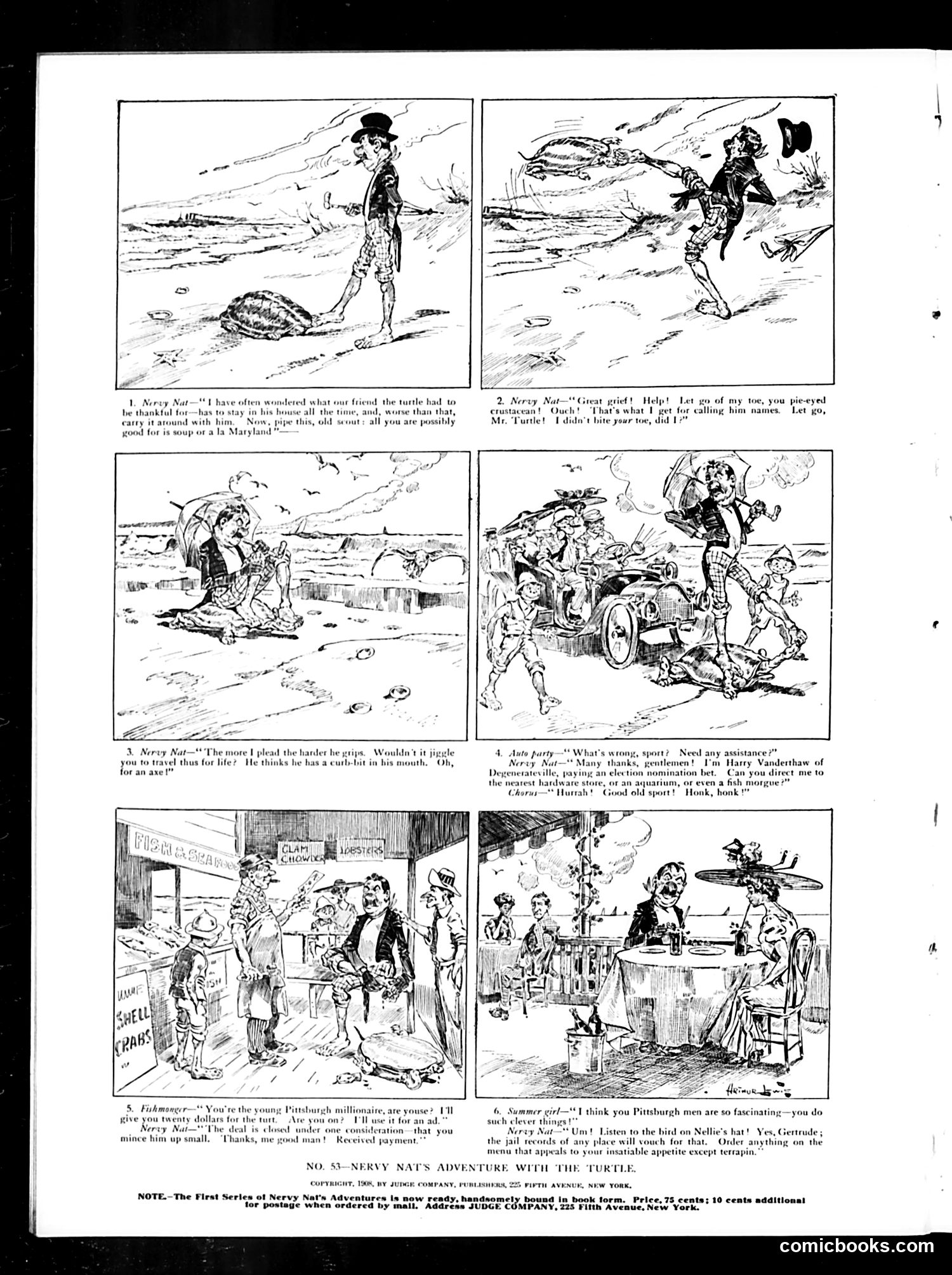
This is a humorous serial comic strip titled "Nervy Nat's Adventure with the Turtle" (Issue No. 53). The narrative follows a scheming character named Nervy Nat who encounters a turtle on a beach. In the opening panels, Nat mistreats the turtle, calling it names. The turtle retaliates by biting his toe, leading to slapstick chaos. The story then shifts to Nat attempting to use the turtle as a transportation scheme—apparently trying to convince a wealthy "Pittsburgh millionaire" to finance travel using the creature. Various characters become involved in increasingly absurd situations, including what appears to be a motorized contraption and visits to shops and restaurants. The humor relies on physical comedy, Nat's con-artist schemes backfiring, and the recurring gag of animal retaliation. This appears to be lighthearted entertainment rather than political satire, typical of Judge magazine's comedic content from this era.
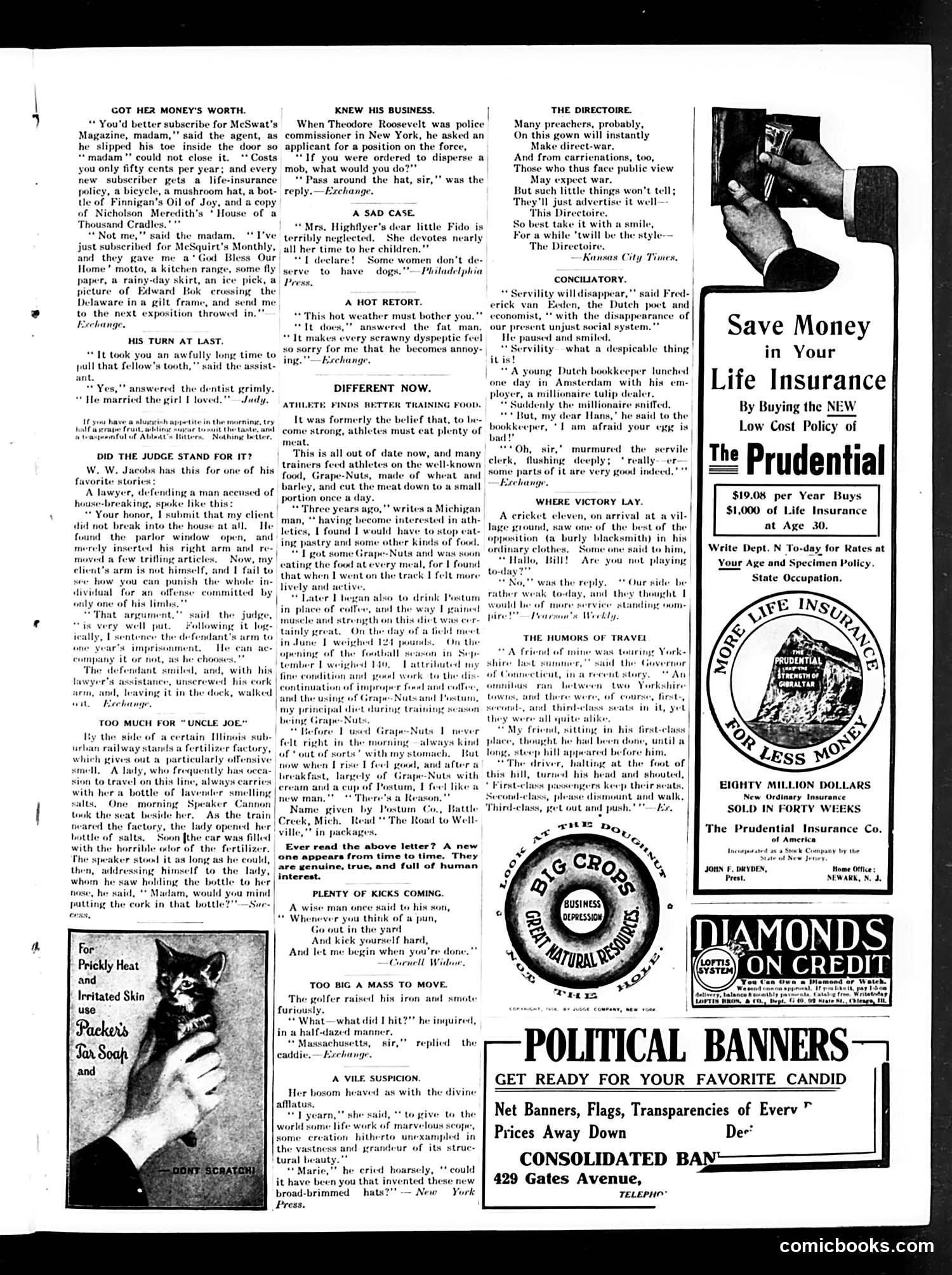
This page from *Judge* magazine contains several short humorous anecdotes and advertisements rather than a single political cartoon. The main content includes: 1. **"Got Her Money's Worth"** and **"Knew His Business"** — Brief jokes about aggressive door-to-door salesmen and Theodore Roosevelt's tenure as NYC police commissioner, playing on his reputation for tough action. 2. **"The Directoire"** — A poem mocking the directoire dress style (high-waisted, popular around 1910s), suggesting women wearing it expect romantic attention. 3. **Various comic anecdotes** about overzealous dentists, neglectful dog owners, and athletes' diets — typical period humor. 4. **Advertisements** dominate the page: life insurance policies, Prickly Heat soap, and diamond credit sales. The page lacks sustained political satire; instead it reflects early 20th-century American magazine humor focused on domestic situations, social etiquette, and consumer goods.
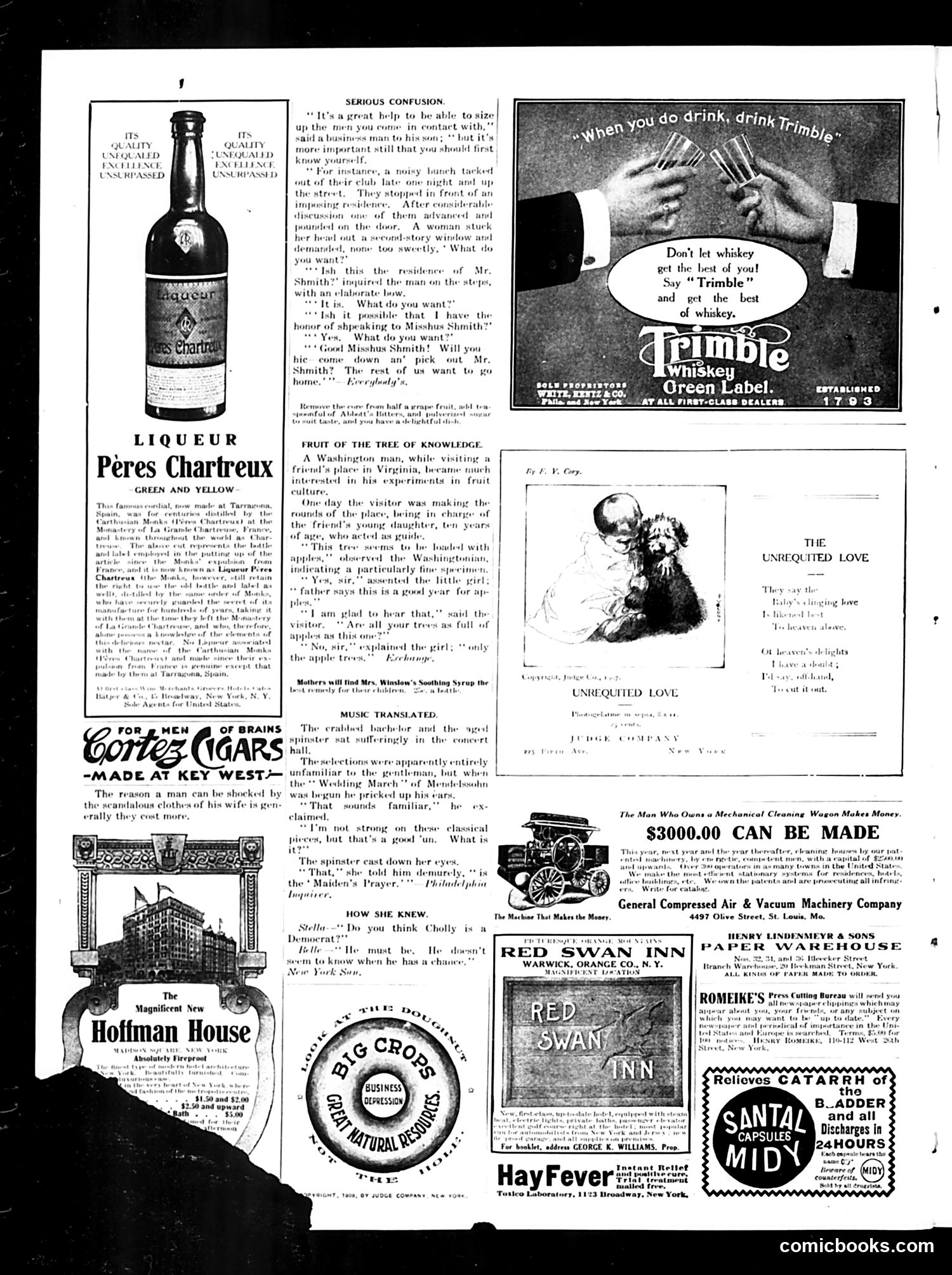
This page is primarily **advertising** with minimal editorial content. The advertisements dominate, promoting liqueurs (Pères Chartreux, Trimble Whiskey), cigars, hotels, and machinery. The few editorial pieces present are brief anecdotes: 1. **"Serious Confusion"**: A drunk man mistakes which house belongs to "Mr. Smith," depicting alcohol-fueled confusion as humor. 2. **"Fruit of the Tree of Knowledge"**: A lighthearted story about a visitor to Virginia asking a young girl about apple trees—a gentle, family-friendly joke. 3. **"The Unrequited Love"** and **"How She Knew"**: Short romantic/domestic humor pieces typical of period comic magazines. The page reflects early 20th-century *Judge* content: satirical advertising mixed with mild domestic comedy rather than sharp political satire. The whiskey ad's tagline "Don't let whiskey get the best of you" is ironic—*Judge* simultaneously mocked and promoted alcohol consumption, reflecting the pre-Prohibition era's ambivalent attitudes toward drinking.
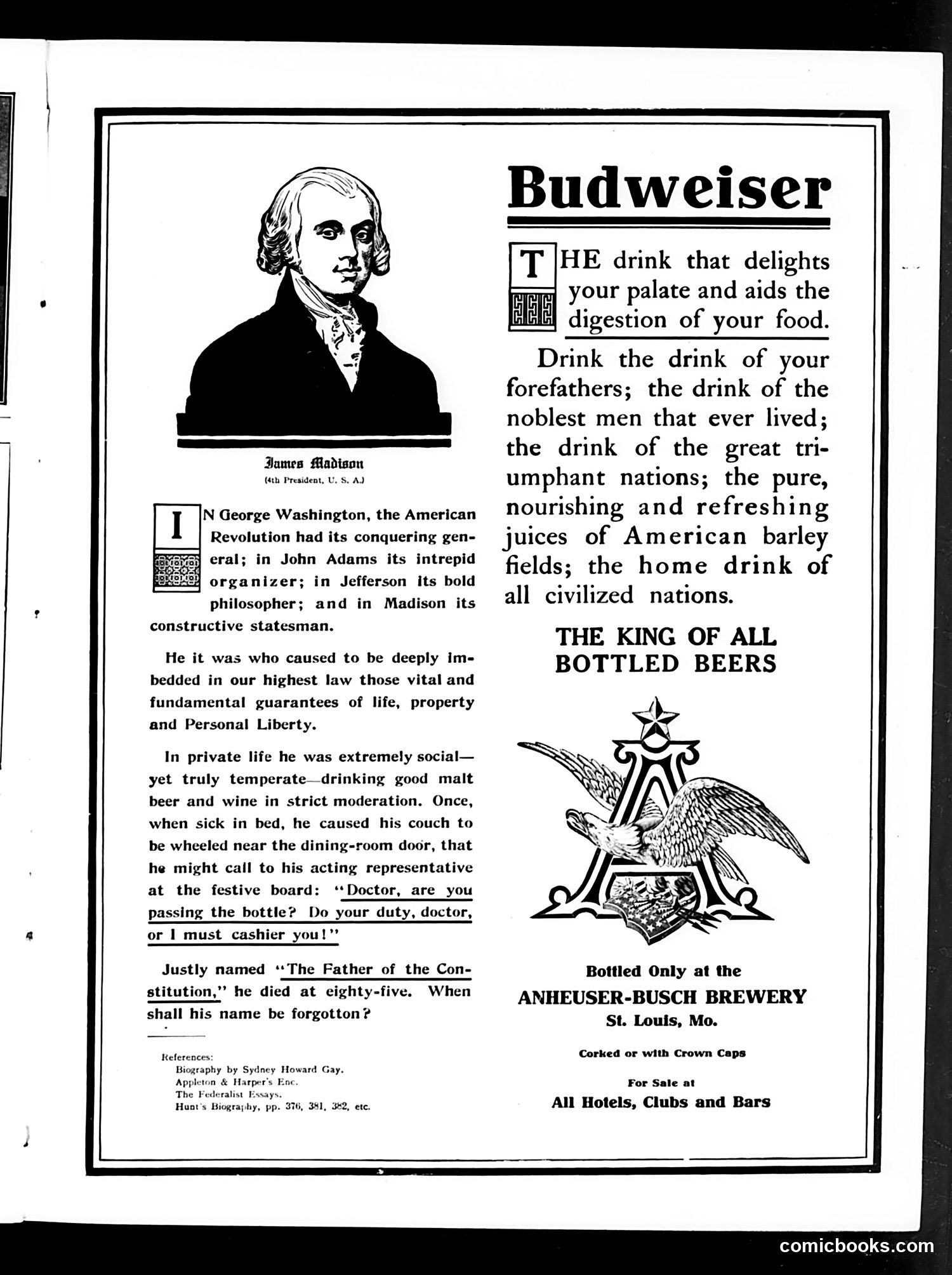
This is primarily a **Budweiser beer advertisement** disguised as a Judge magazine editorial tribute to James Madison, the fourth U.S. President. The left side presents a biographical sketch of Madison as "Father of the Constitution," emphasizing his role in establishing American liberty and property rights. The key satirical point appears in the anecdote: while sick in bed, Madison demands his doctor keep "passing the bottle" at dinner—a humorous claim that even the nation's most serious statesman prioritized beer. This setup allows the right-hand column to pivot to the actual advertisement: Budweiser beer is positioned as "the drink of your forefathers" and "the noblest men that ever lived"—literally associating the product with America's founding fathers and constitutional ideals. The tactic exploits nationalist pride and historical reverence to sell beer. By 1910s-era standards, this blending of patriotic editorial with commercial pitch was acceptable advertising practice, though transparent to modern readers as propaganda.
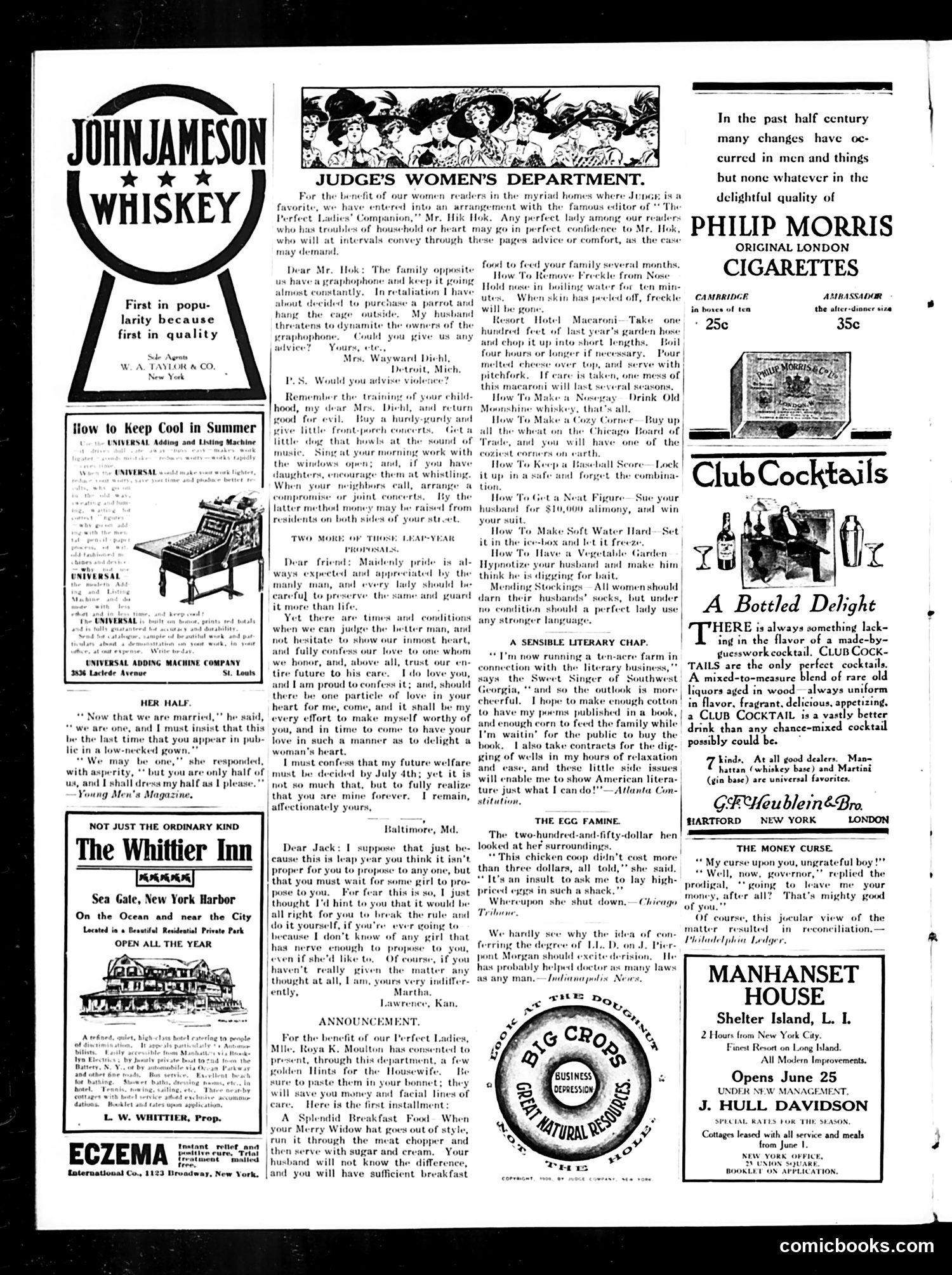
This page is primarily **advertising and advice columns**, not political satire. Judge magazine here functions as a lifestyle publication rather than a political cartoon vehicle. The content includes: - **"Judge's Women's Department"** advice column addressing domestic complaints (neighbors' phonograph noise, household hints) - **Leap year proposals**: Letters about women proposing to men, reflecting early-1900s gender role anxieties during leap year tradition - **Household tips**: Practical advice on cooking, beauty, and home management - **Commercial advertisements**: Whiskey, cigarettes, hotels, adding machines The satirical edge is mild and social rather than political—it gently mocks domestic frustrations (wanting to buy a parrot to retaliate against neighbors' noise) and gender conventions (women hesitantly proposing to men). No identifiable political figures or events appear. This represents Judge's evolution from pure political satire toward a general-interest magazine mixing humor, advice, and advertising for affluent readers.
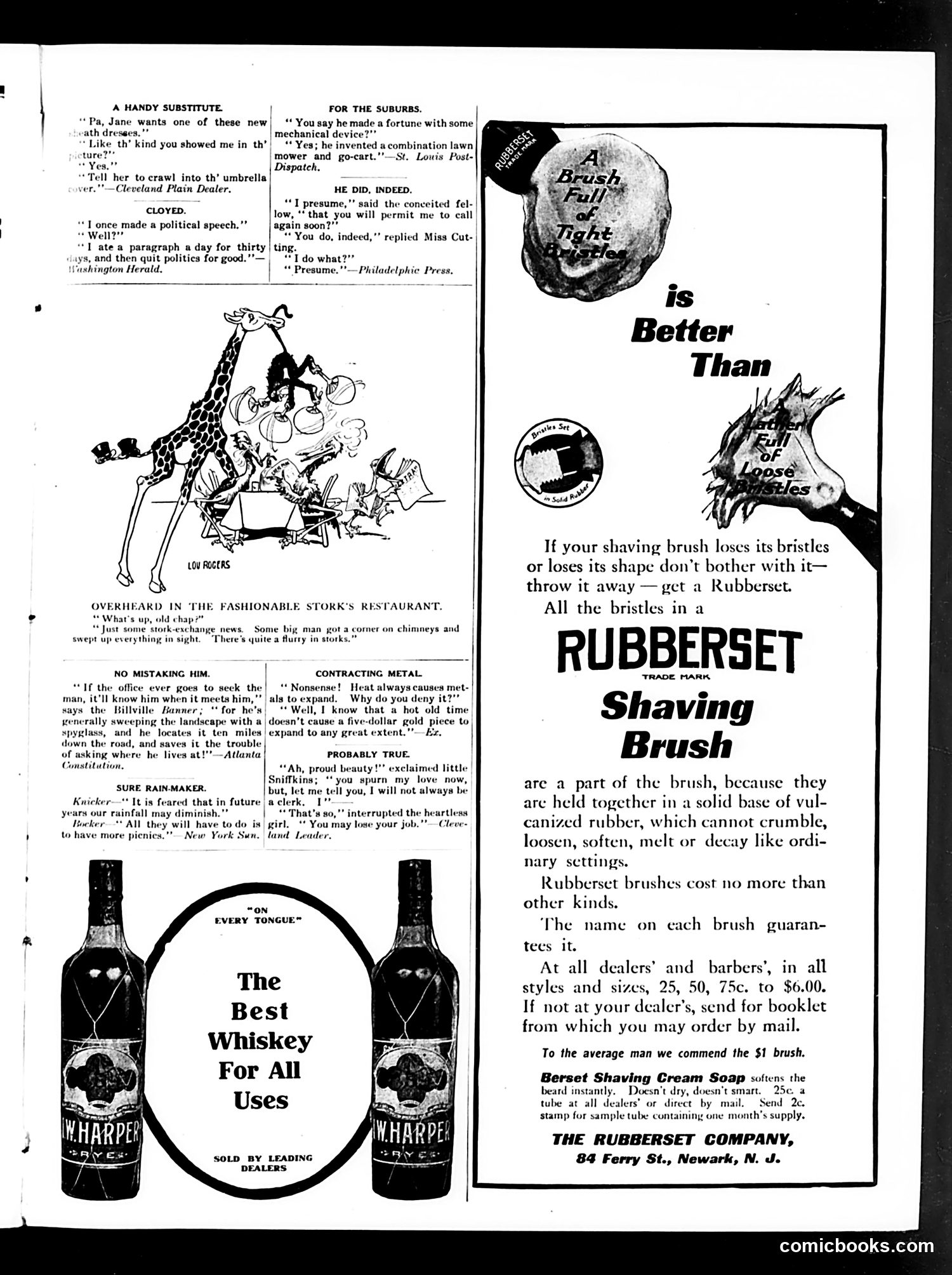
This page combines short humorous quips with advertisements, typical of Judge's format. **The Cartoons/Jokes:** The page features several brief, one-panel satirical observations rather than narrative cartoons. They mock everyday situations: a father's outdated gift suggestions, a fashionable restaurant's artificial concern with luxury commodities (storks), political speechmaking as tedious obligation, and romantic rejection. One cartoon by Lou Rogers shows a giraffe at a fancy restaurant, likely commenting on absurd dining pretensions. The humor relies on wordplay and social observation rather than political commentary. **The Advertisements:** The bulk of the page advertises consumer products: Rubberset shaving brushes and Harper whiskey. These ads are period-typical, emphasizing product durability and practical superiority—the brush's vulcanized rubber base won't deteriorate like ordinary bristles. **Overall Context:** This represents Judge's characteristic blend of light social satire targeting middle-class manners and consumerism, alongside commercial sponsorship. The magazine's humor assumes familiarity with contemporary urban leisure culture and consumer goods.
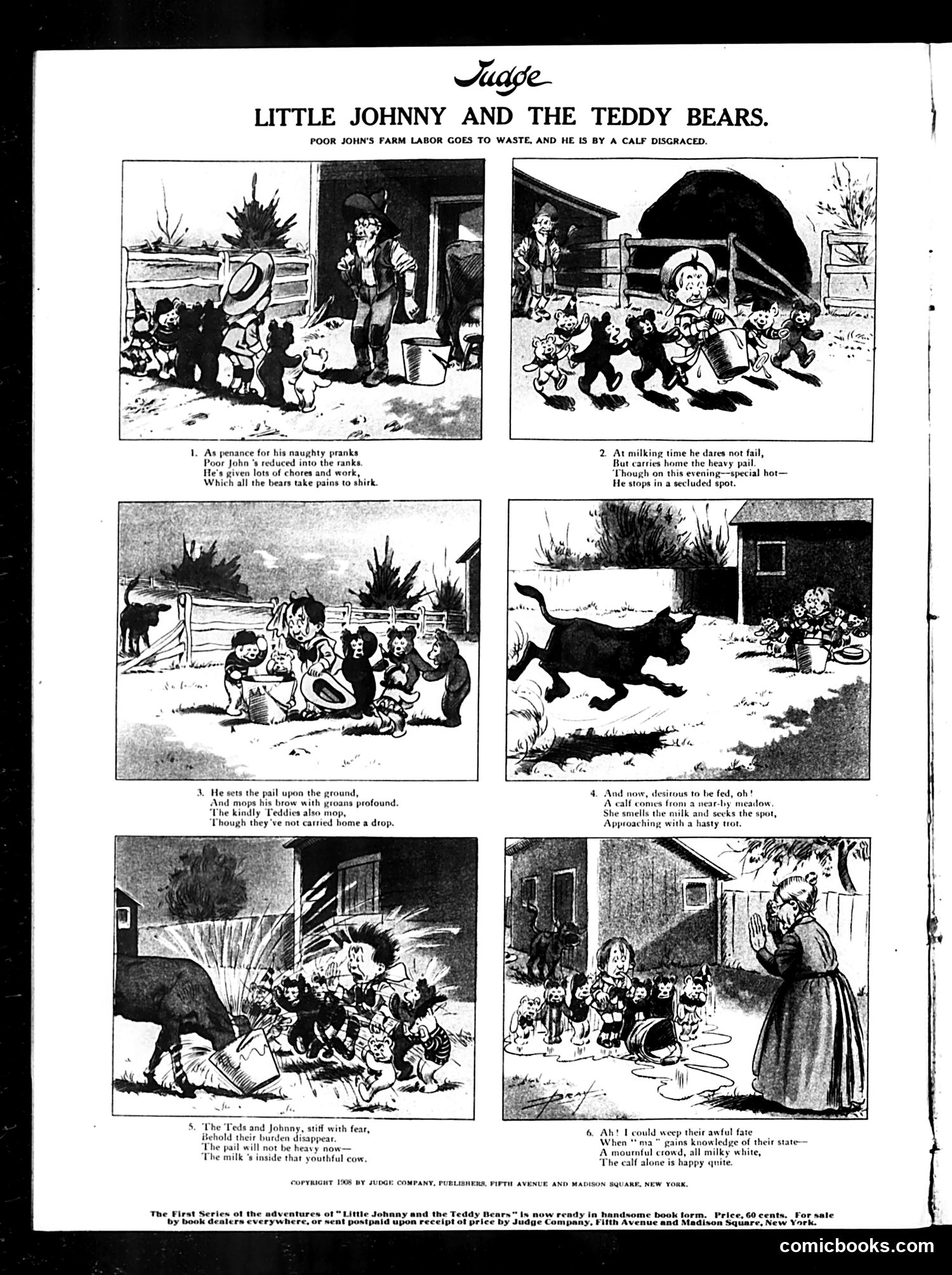
This is a children's comic strip morality tale, not political satire. "Little Johnny" is punished for mischief by being assigned farm chores alongside anthropomorphic "Teddy Bears"—stuffed toys brought to life, likely referencing the popular "teddy bear" craze of the early 1900s (named after President Theodore Roosevelt). The narrative follows Johnny's humiliation: reduced to child labor alongside the bears who shirk their duties, he attempts to milk a cow but is thwarted when a calf scatters the milk, leaving all the bears soaked and ridiculous. The moral message warns against pranks and laziness, with consequences affecting innocent companions. The strip is sentimental rather than satirical—typical of Judge's lighter fare alongside its political content. It's advertising a 60-cent book collection of the series.