
A complete issue · 24 pages · 1908
Judge — April 25, 1908
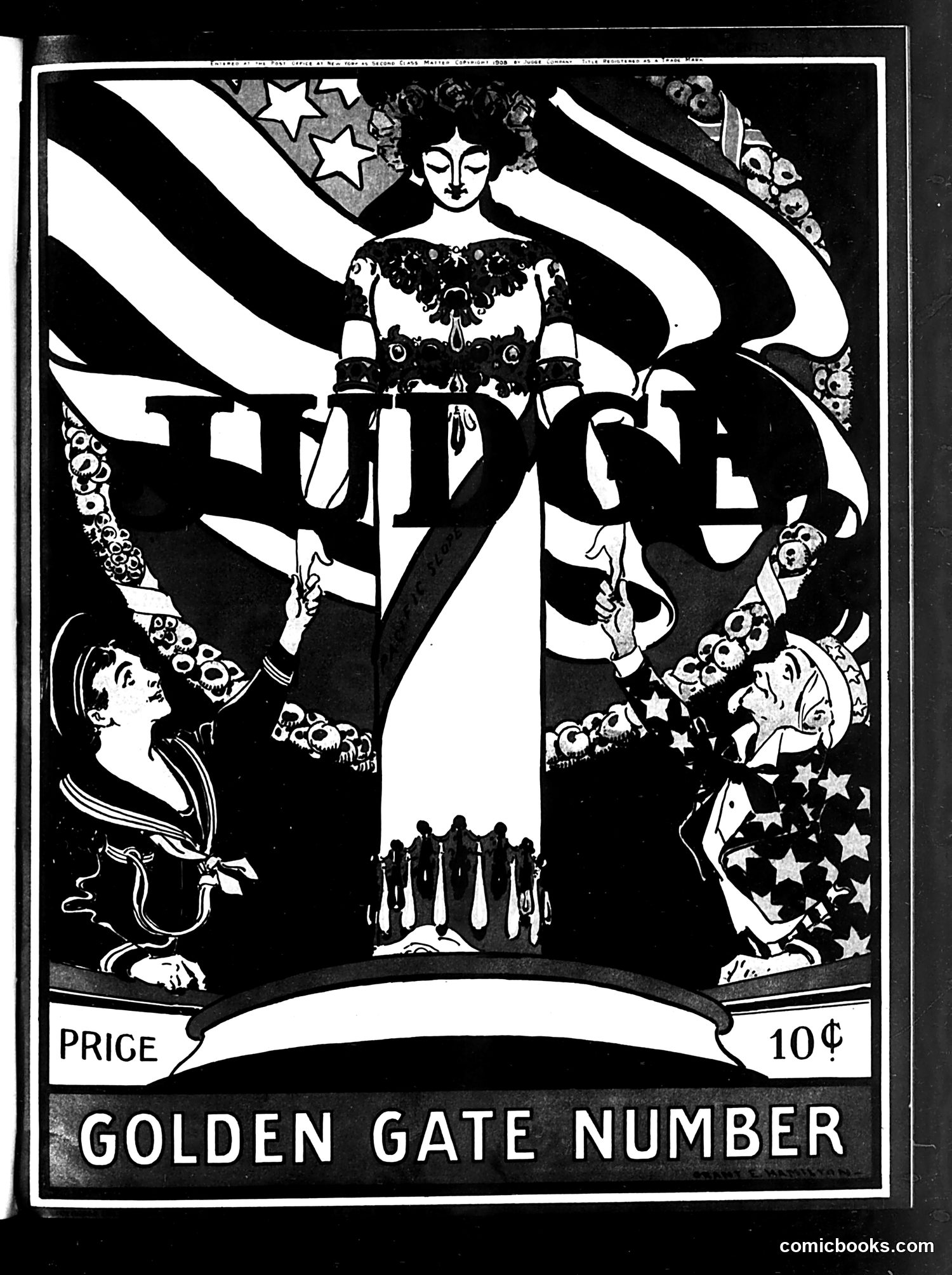
This is a Judge magazine cover from the early 20th century (price 10¢) featuring an art nouveau-style illustration titled "Tides." The central female figure represents Liberty or America, depicted as a classical goddess in flowing robes. She looms over two caricatured male figures positioned on either side—likely representing political or social forces of the era. The swirling, wave-like patterns and the "tides" motif suggest the passage of time and cyclical change. The composition implies America as a majestic force commanding over smaller political actors or interests beneath her. Without additional context, the specific political figures or events referenced remain unclear, though the imagery suggests commentary on American political power dynamics during this period.
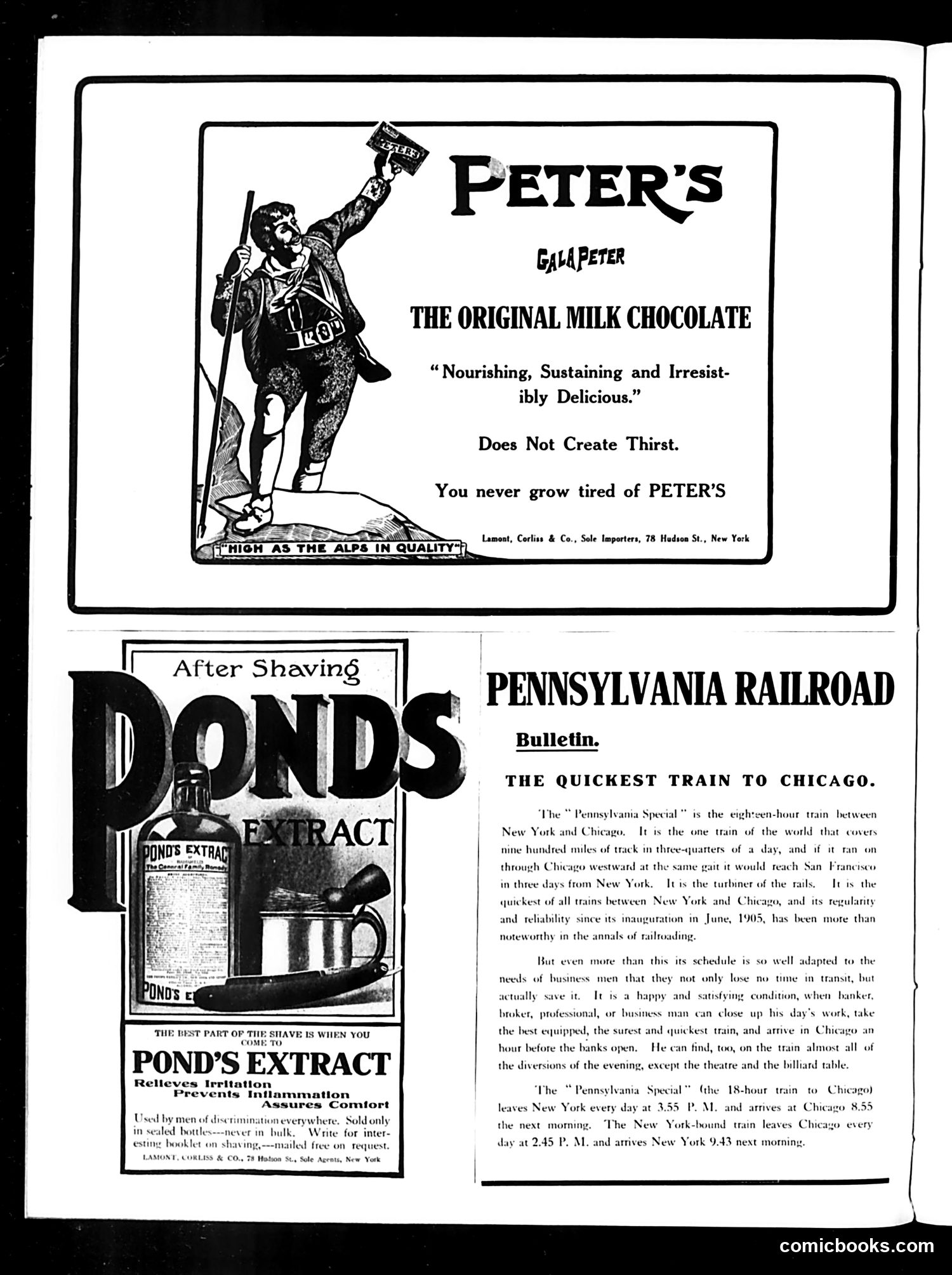
This page is primarily **advertising rather than satirical content**. It contains three advertisements: 1. **Peter's Gala Peter Milk Chocolate** - Features an Alpine climber holding a product box, claiming the chocolate is "nourishing" and "does not create thirst." 2. **Pond's Extract** - A shaving product ad showing aftershave benefits, emphasizing relief from irritation and inflammation. 3. **Pennsylvania Railroad Bulletin** - Promotional text about "The Pennsylvania Special," an 18-hour express train to Chicago, touted as the fastest route and convenient for businessmen who need evening leisure time. The page reflects early 20th-century advertising conventions and consumer products of the era. No political satire or social commentary is evident—this is a typical commercial page from *Judge* magazine's advertising section.
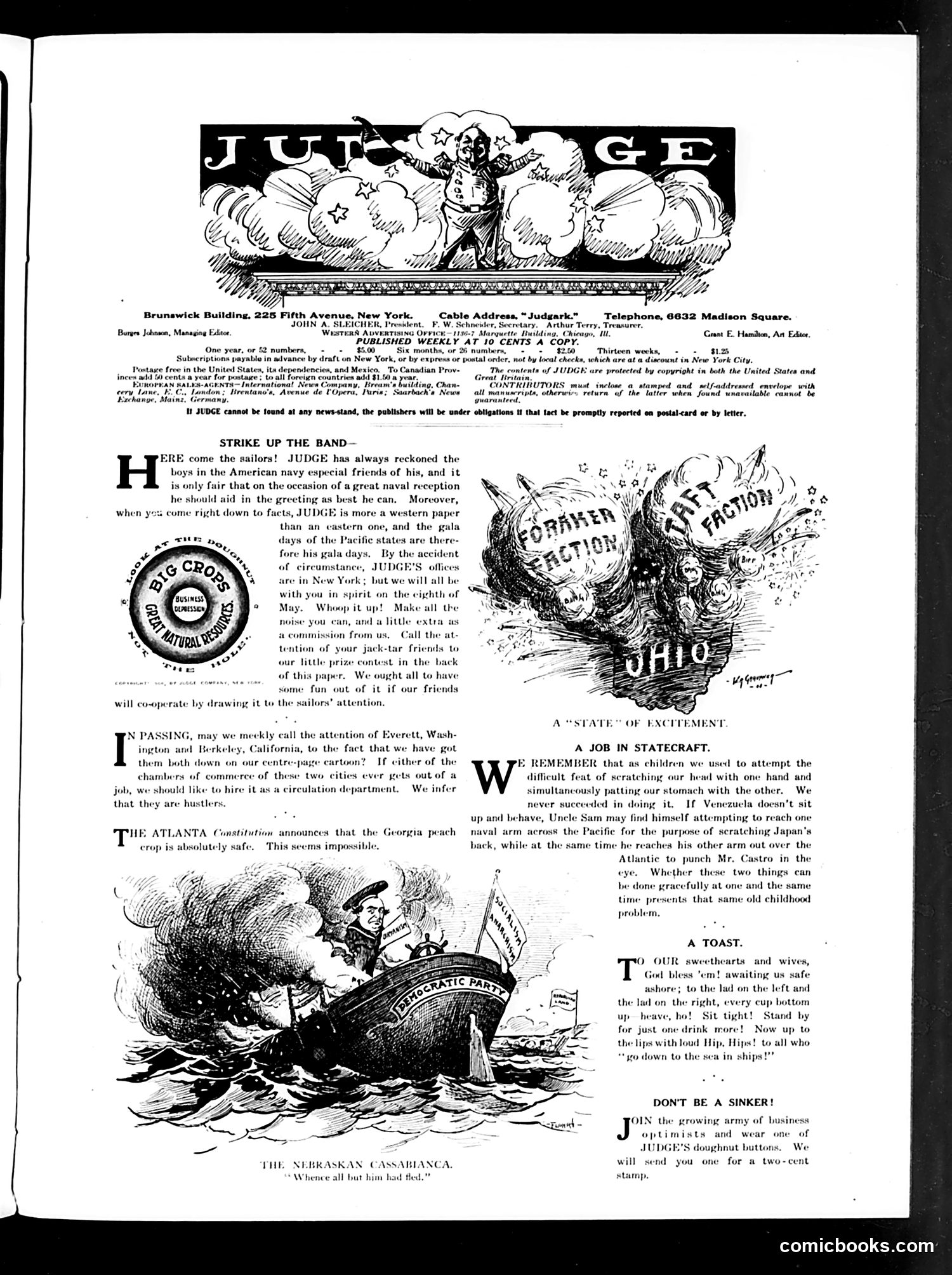
This page contains several political cartoons and commentary, likely from the early 1900s: **"Strike of the Band"** - The opening editorial celebrates Judge's naval reception, inviting readers to spread word about the magazine. **"The Nebraskan Cassabianca"** - This cartoon depicts a figure labeled "Democratic Party" clinging to a sinking ship, with the caption "Whence all but him had fled." This appears to satirize the Democratic Party's weak political position, comparing it to a sinking vessel where supporters have abandoned ship. **"A State of Excitement" and "A Job in Statecraft"** - These sections contain satirical commentary on contemporary political matters, though specific references are unclear without additional historical context. The overall tone is pro-Republican/anti-Democratic, typical of Judge magazine's editorial stance during this period.
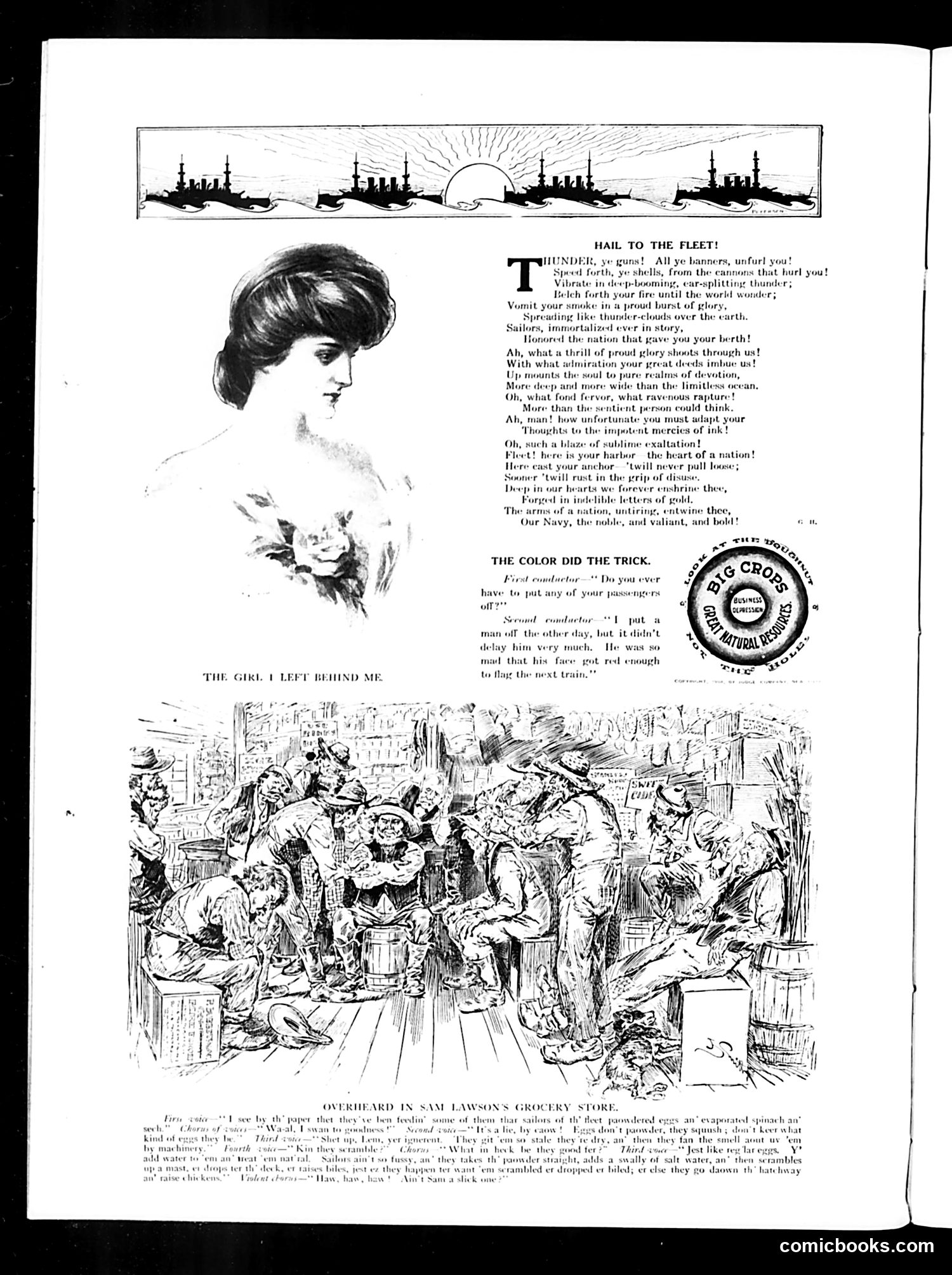
This page contains patriotic and humorous content from an early 20th-century American magazine. "Hail to the Fleet!" is a lengthy poem celebrating the U.S. Navy with dramatic imagery of warships and sailors' valor. "The Girl I Left Behind Me" shows a portrait of a woman, likely referencing the popular WWI-era song about soldiers departing for war. "The Color Did the Trick" is a brief anecdote about a railroad conductor who removed an angry passenger by mentioning the man's red face—a pun on "color" and temperament. The lower illustration, "Overheard in Sam Lawson's Grocery Store," depicts a chaotic market scene with multiple figures in conversation, appearing to satirize small-town gossip and commercial life. The overall page reflects early 1900s American patriotism and domestic humor.
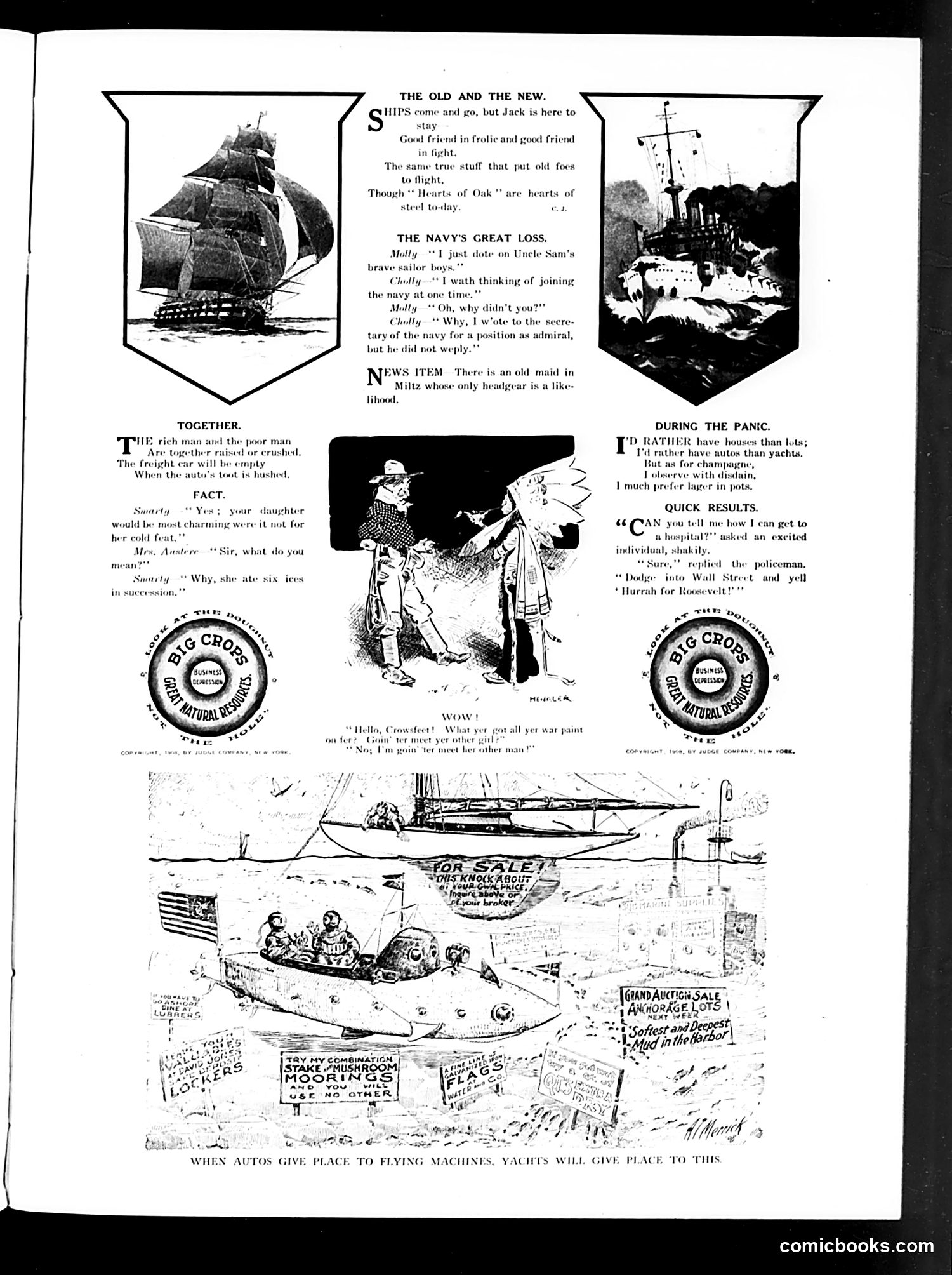
This page contains several satirical pieces reflecting early 20th-century American attitudes: **"The Old and the New"** contrasts sailing ships with modern naval vessels, celebrating technological progress while nostalgically referencing maritime tradition ("Hearts of Oak"). **"The Navy's Great Loss"** depicts dialogue between characters named Molly and Cholly about joining the Navy, using humor about romantic disappointment. **"Together"** and **"Fact"** present brief satirical exchanges about class differences and social pretension. **"Quick Results"** jokes about police efficiency regarding hospitalization. The large bottom cartoon satirizes urban congestion, showing boats and various maritime vessels displaced onto land alongside automobiles—suggesting future transportation chaos when vehicles proliferate. The caption warns that yachts will eventually replace cars in cramped cities. Overall, the page reflects Progressive-era anxieties about modernization and urban overcrowding.
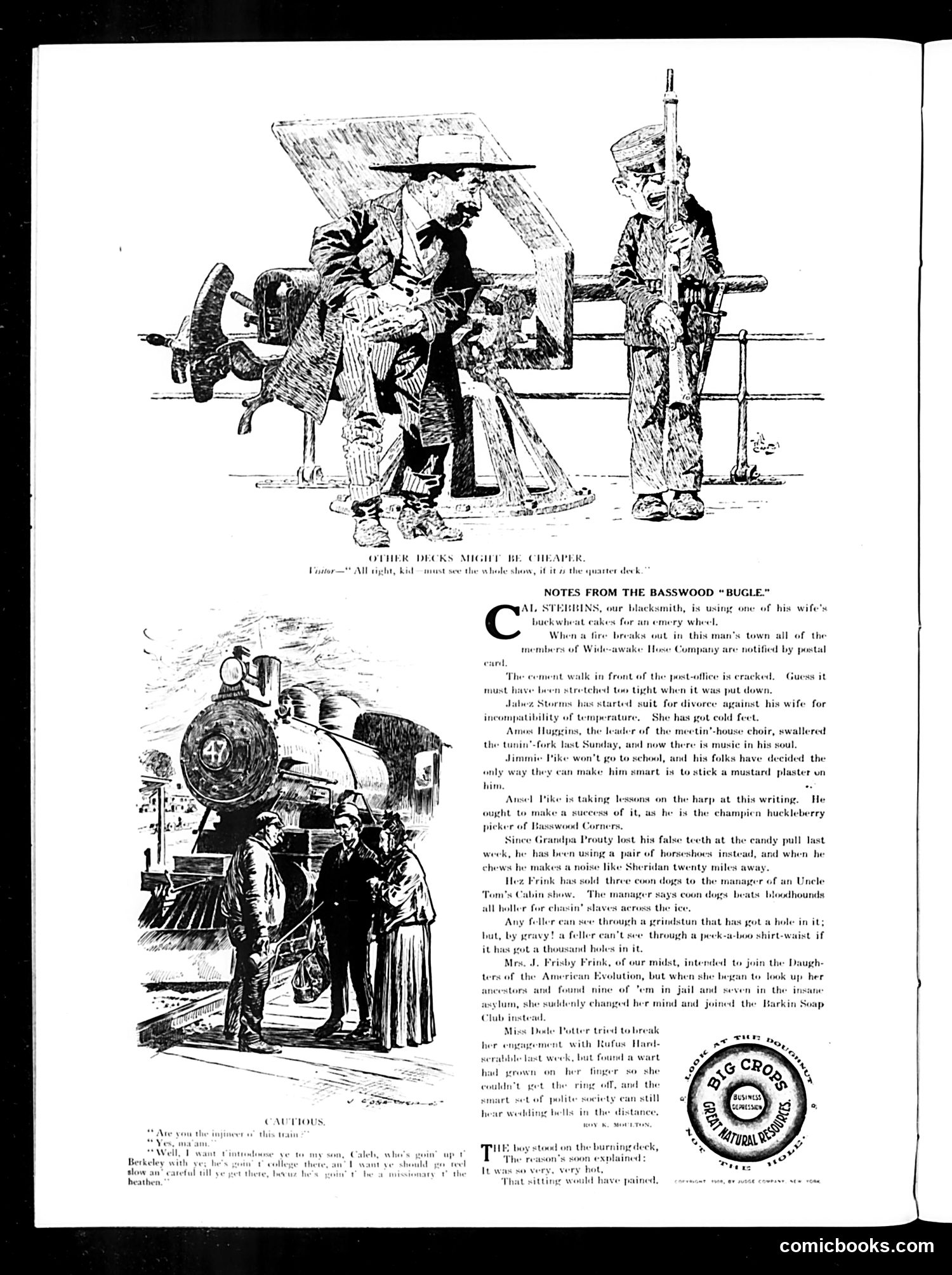
This page contains two cartoons satirizing rural/small-town American life, likely from the early 1900s. **Top cartoon**: Two men at a fence discuss "cheaper decks" (likely ships' officers or supervisory positions). The humor appears to mock pretension or class aspirations in a rural setting. **Bottom cartoon**: Depicts a train station scene with the caption "Cautious," showing figures in conversation. The joke seems to play on cautious behavior, though the exact reference is unclear from the image alone. **"Notes from Basswood Bugle"**: This column satirizes small-town gossip and quirky rural characters—a blacksmith misusing his wife's equipment, false teeth lost at a candy pull, a woman discovering jailed ancestors, mishaps with engagement rings. The satire gently mocks small-town eccentricity and social drama as fodder for entertainment. The overall tone is affectionate ridicule of rural American life rather than harsh political commentary.
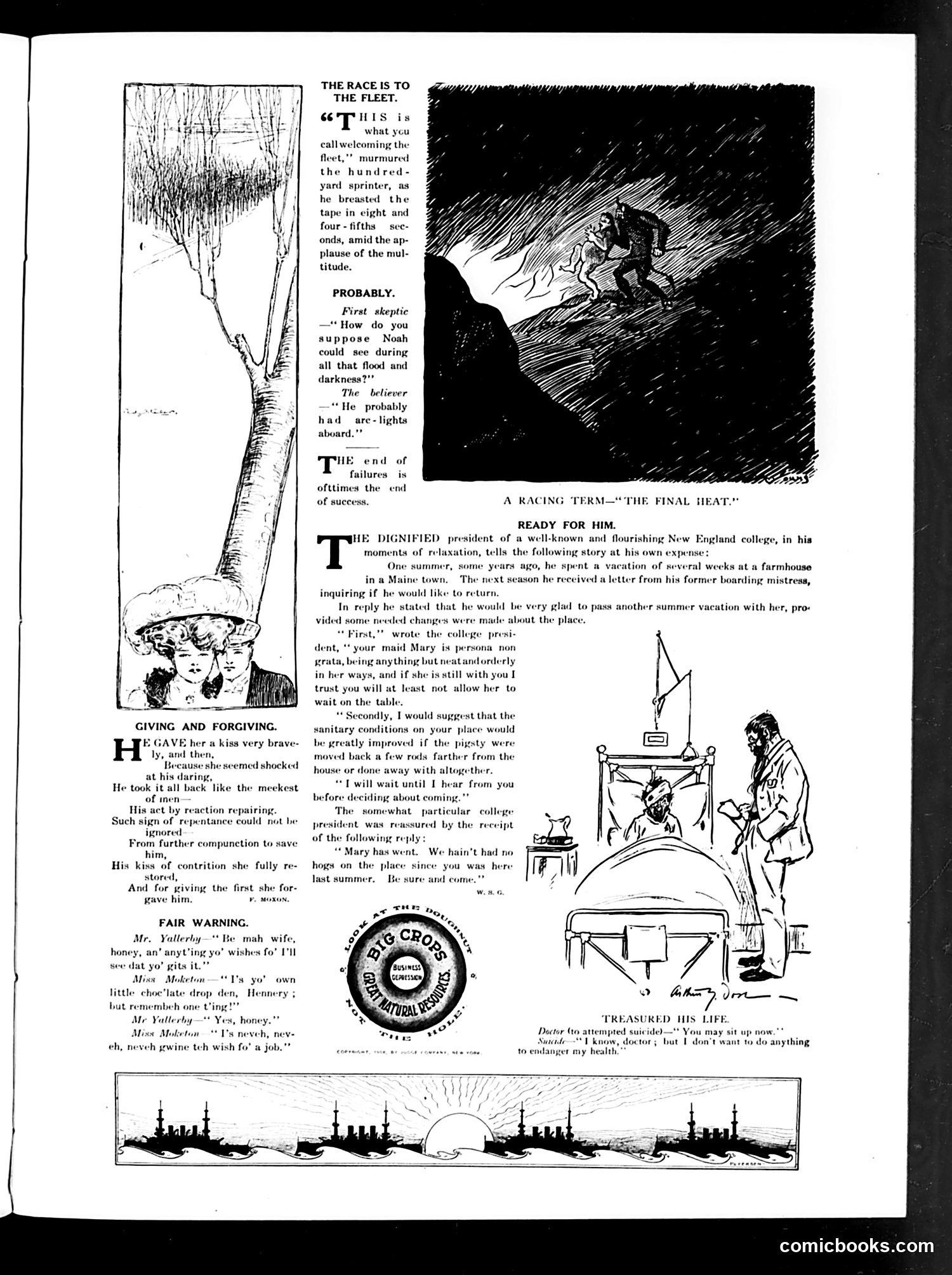
This Judge magazine page contains several unrelated humorous pieces typical of early 20th-century American satire: **"Giving and Forgiving"** depicts a romantic couple's kiss-and-make-up exchange—lighthearted social commentary on courtship rituals and gender dynamics of the era. **"Fair Warning"** appears to be dialect humor featuring African American characters (rendered in period stereotypes), joking about marriage expectations—reflecting the offensive comedic conventions of that time. **"The Race is to the Fleet"** references a hundred-yard sprint athlete welcoming a naval fleet's arrival, likely alluding to a specific historical naval visit or patriotic event, though the exact context is unclear without additional information. **"Ready for Him"** tells of a New England college president corresponding with his Maine farmhouse landlady about returning for vacation, with her removing pigs and dismissing a problematic maid—gentle humor about rural hospitality and social pretension. The page also includes unrelated brief jokes about Noah's flood and medical care. No clear political satire dominates; instead, it reflects period attitudes toward romance, class, and rural life.
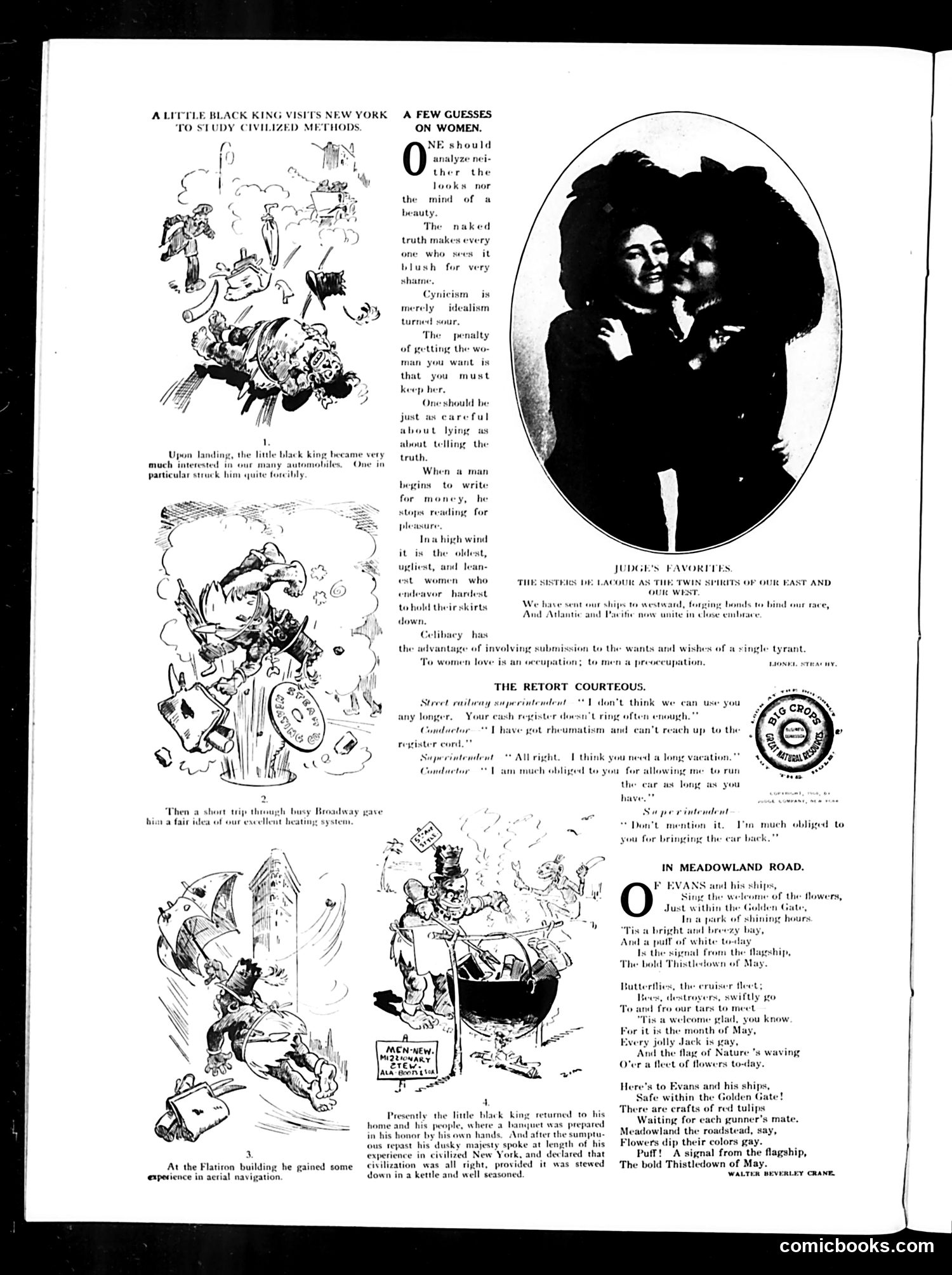
This page from *Judge* combines two satirical features: **"A Little Black King Visits New York"** (left): A humorous travelogue about an African ruler touring American civilization. The cartoons mock both the "exotic" visitor and American society—depicting the king's confusion with urban technology (automobiles, the Flatiron Building) while satirizing American pretensions to "civilization." The premise itself reflects period-typical racial stereotyping common to early 1900s American humor. **"A Few Guesses on Women"** (center-right): Cynical observations about female behavior and psychology. The text presents misogynistic generalizations presented as witty aphorisms—women are vain, materialistic, deceptive. This reflects common satirical targets of the era mocking women's supposed character flaws. **Right side**: "Judge's Favorites" features the De Lacour sisters and poetry about "Evans and his ships" in flowery, patriotic language. The page exemplifies early-1900s *Judge* humor: racial caricature, gender satire, and lighthearted mockery of contemporary American society presented as sophisticated commentary.
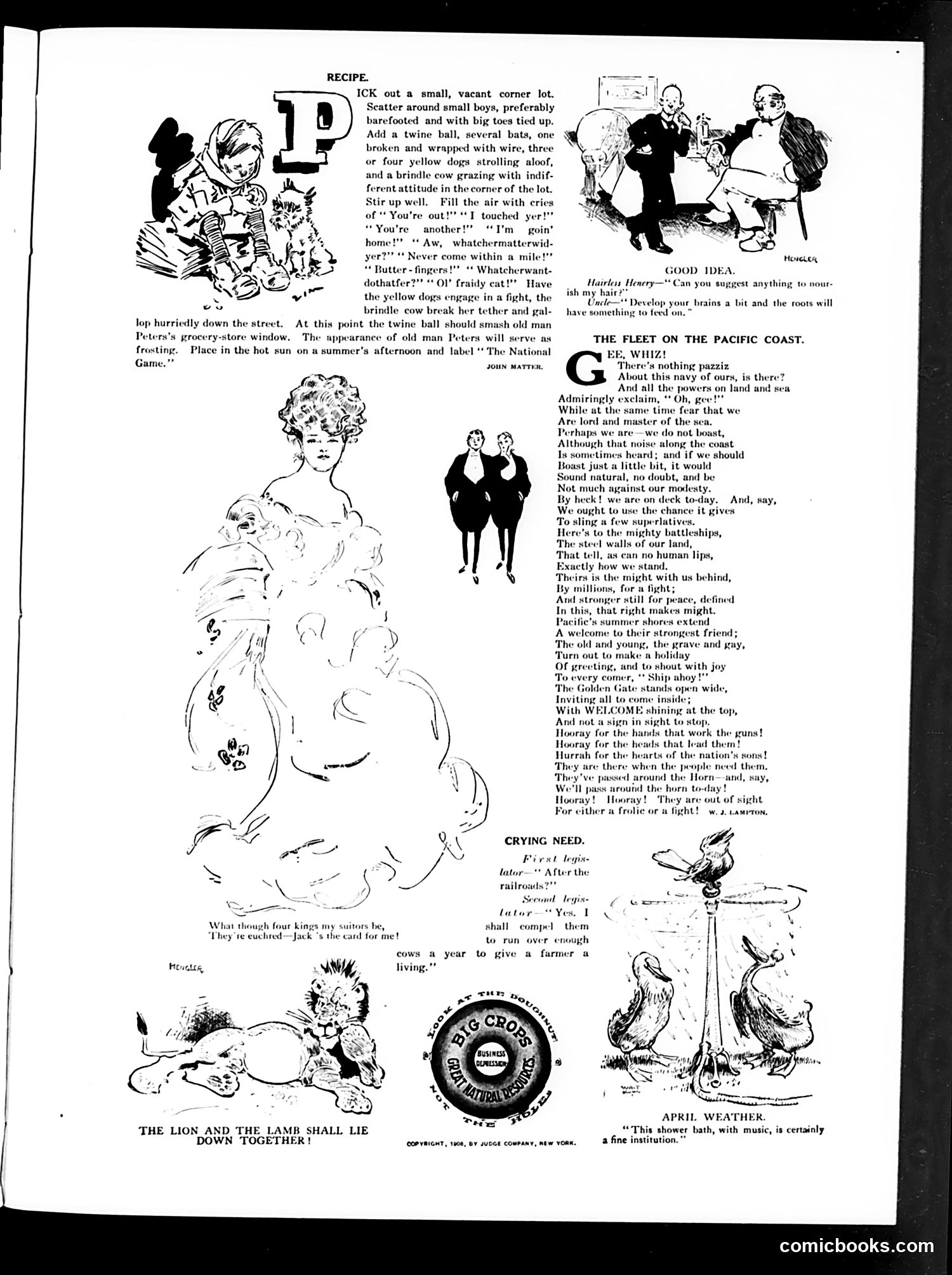
This Judge magazine page contains satirical pieces about American life and politics: **"Recipe"** (top left): A humorous "recipe" for a chaotic street baseball game—mixing barefoot boys, stray dogs, a loose cow, and broken equipment. It mocks the rowdy, unsupervised nature of turn-of-the-century urban childhood play. **"The Fleet on the Pacific Coast"** (right): A patriotic poem celebrating the U.S. Navy's Pacific presence, likely referencing Theodore Roosevelt's naval expansion policies. The verse praises battleships and American military might while maintaining it's purely defensive ("right makes might"). **"Good Idea"** (top right): A brief joke where "Hairless Henry" asks for hair restoration advice; Uncle suggests developing his brain instead—implying his empty head would provide better "soil" for roots. **"Crying Need"** and **"The Lion and the Lamb"** (bottom): These appear to be separate satirical dialogues, though text is fragmentary. The overall tone is lighthearted, pro-American military, and focused on contemporary social observations rather than sharp political critique.
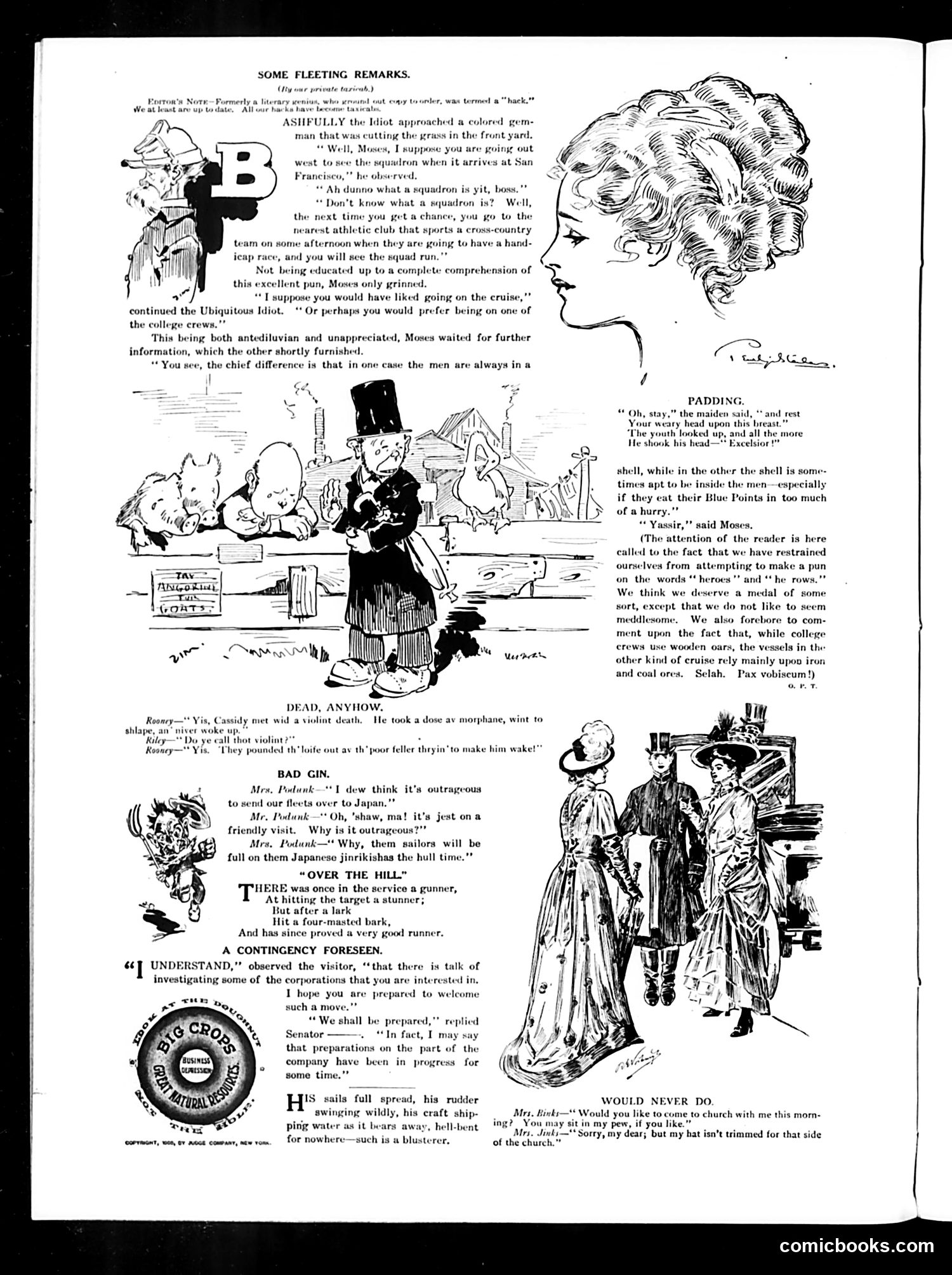
This page contains several brief comic vignettes mocking American society and customs circa early 1900s. The main piece features "the Ubiquitous Idiot" (a recurring character) condescendingly explaining athletic clubs and rowing to a Black groundskeeper named Moses. The joke relies on a racial stereotype: the idiot makes a crude pun comparing rowing crews to shells containing men, implying Black people are intellectually slow. The magazine's parenthetical note claiming they "restrained ourselves" from making puns on "heroes" and "he-rows" suggests the editors were aware the humor was forced and in poor taste. Other brief jokes include: a drunk who takes morphine instead of medicine ("Dead, Anyhow"); Mrs. Podunk's concern that American naval visits to Japan will cause sailors to overturn Japanese rickshaws; and a naval gunner who accidentally hits a ship while intoxicated. The final item shows Mrs. Jinks refusing church because her hat isn't "trimmed for that side"—a vanity joke. The humor is primarily class-based and relies on ethnic caricature.
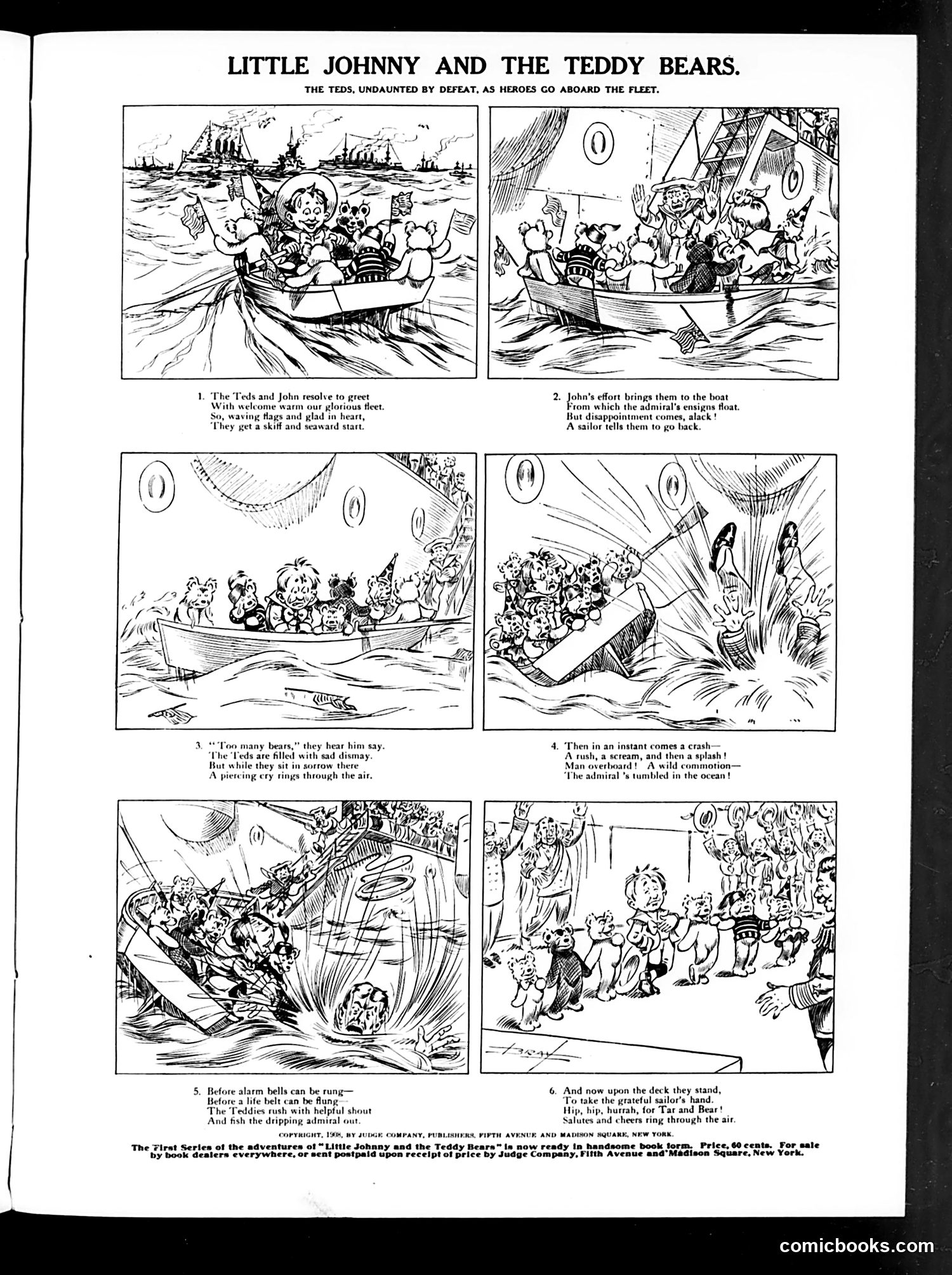
This six-panel comic from *Judge* (circa 1906) celebrates the "Teddy Bear" craze—stuffed animals named after President Theodore Roosevelt. The story follows Little Johnny and his teddy bears attempting to greet the American fleet with patriotic enthusiasm. The satire is gentle and promotional: the bears are portrayed as patriotic mascots whose bumbling antics (too many bears cramming the boat, accidentally knocking an admiral overboard) ultimately endear them to sailors. The "crash" and admiral's tumble become an opportunity for the bears to heroically help rescue him, earning the sailors' gratitude. The humor relies on absurdist slapstick—anthropomorphized bears treated as legitimate naval participants—while the underlying message promotes both the teddy bear merchandise and American naval pride during Roosevelt's presidency. The final text advertises the story collection, confirming this is partly advertising disguised as entertainment.
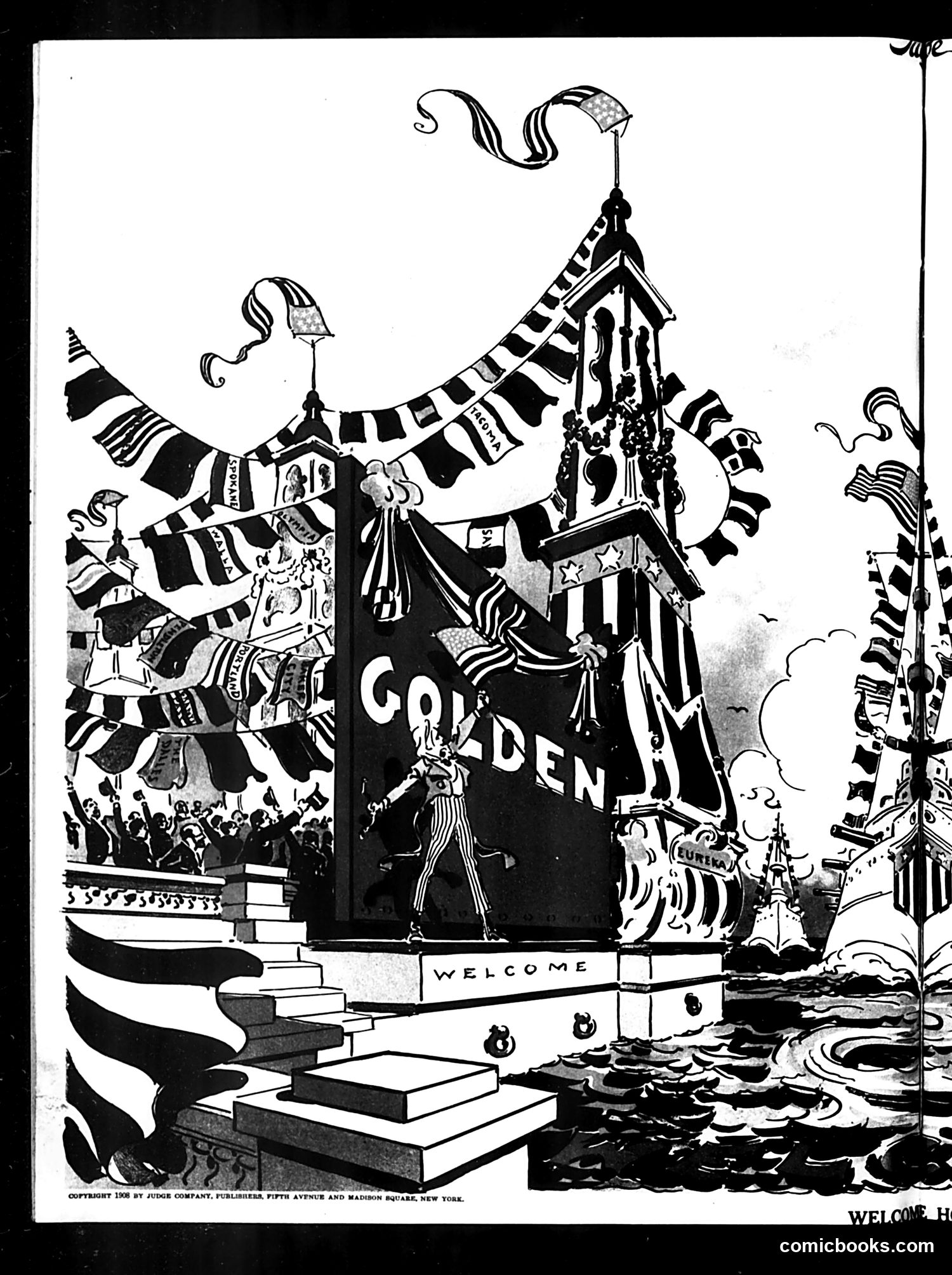
This appears to be a satirical illustration welcoming someone or something to America, likely from the early 20th century based on the art style. The central structure is a decorative "Welcome" arch adorned with American flags, patriotic bunting, and classical architectural elements. A figure in striped patriotic clothing stands at the base. The OCR text is too corrupted to read clearly, making precise identification of the specific political figure or event difficult. However, the elaborate "welcome" apparatus suggests this satirizes an important arrival or event—possibly a visiting dignitary, political figure, or abstract concept being celebrated or critiqued by American society. The ornate, somewhat overwrought design may itself be the joke, mocking excessive patriotic display or insincere welcomes. Without clearer text, the exact satirical target remains unclear.
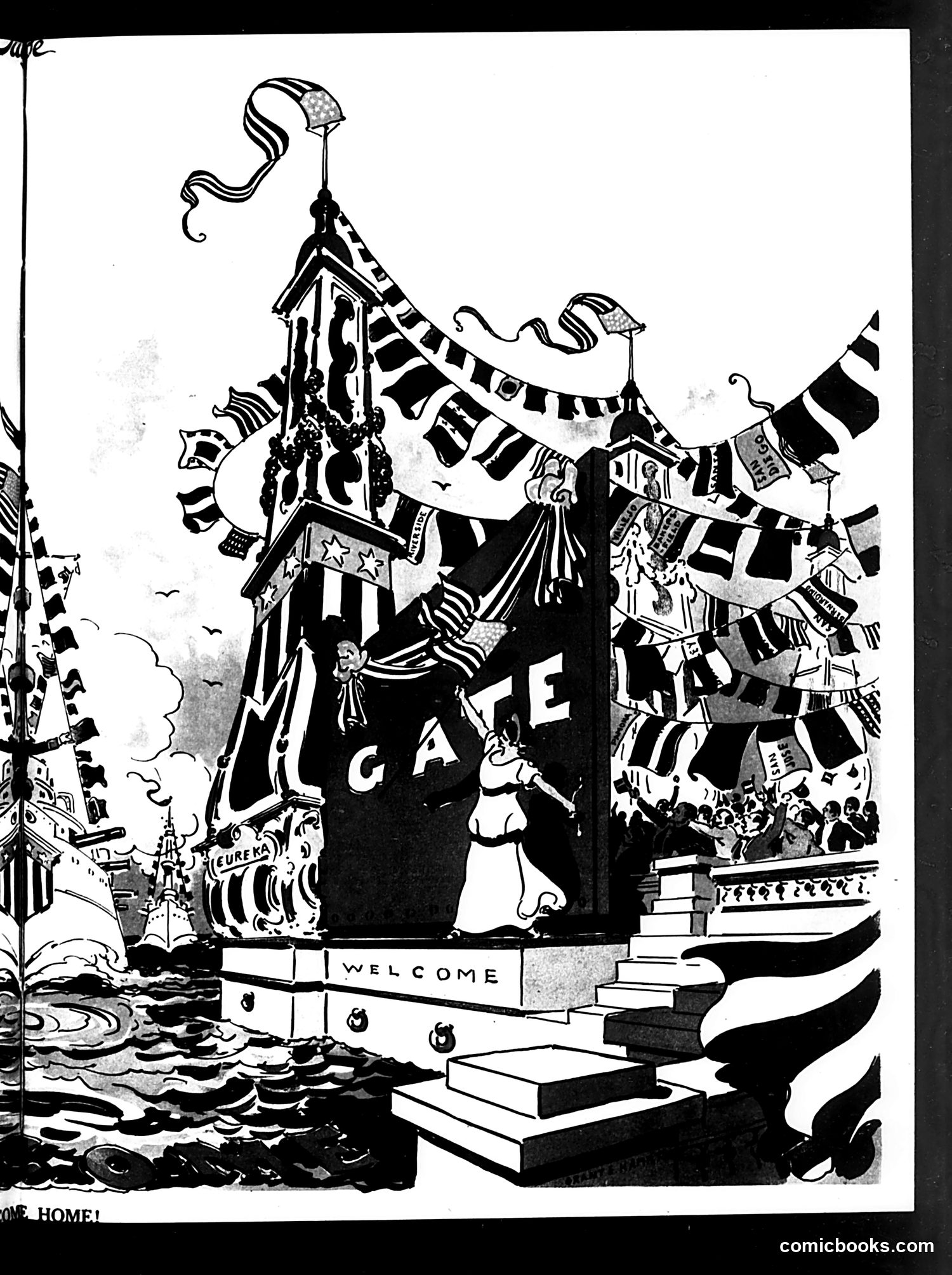
This cartoon depicts an elaborate, ornate structure labeled "WELCOME" and "COME HOME!" with patriotic bunting and flags. A female figure stands at the entrance greeting what appears to be a returning soldier or serviceman. The elaborate, fantastical architecture—with its multiple spires, decorative elements, and festive decorations—satirizes the grand public receptions organized to welcome troops returning from military service, likely from World War I or the Spanish-American War era. The cartoon appears to mock the contrast between the extravagant, over-the-top civic celebrations built for homecoming ceremonies versus the actual conditions soldiers faced. The satirical point seems to be critiquing either the expense of such monuments or the gap between patriotic fanfare and genuine support for veterans. The OCR text is largely unreadable, preventing fuller context identification.
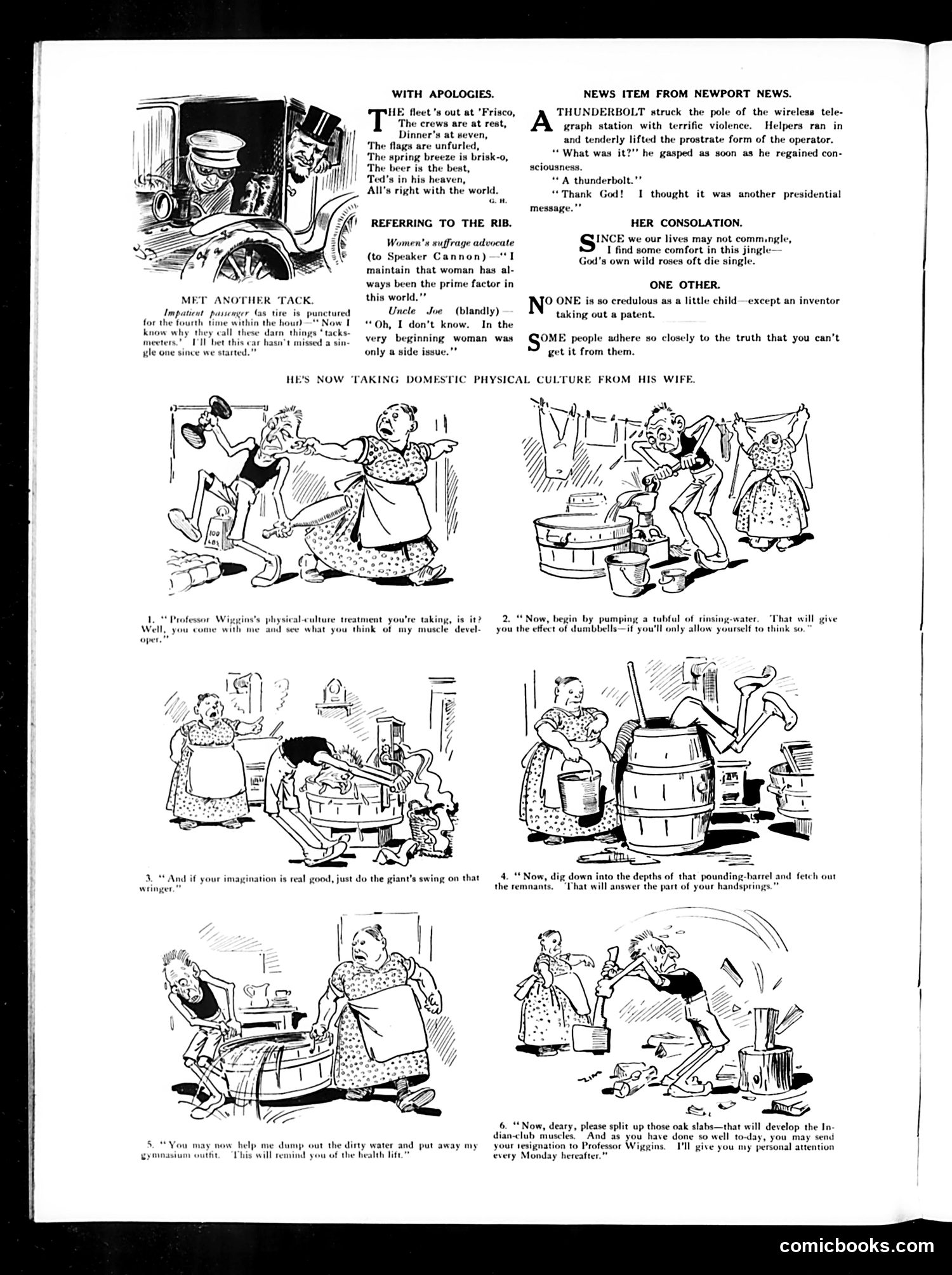
This Judge magazine page contains several satirical items: **Main Cartoon ("He's Now Taking Domestic Physical Culture From His Wife"):** A husband is subjected to vigorous "physical culture" exercises—a popular fitness trend of the era—but his wife assigns him domestic labor disguised as exercise (pumping water, digging, splitting wood, dumping dirty water). The satire mocks both the fitness craze and role reversal, suggesting wives could enforce domestic work by framing it as health improvement. **Political Jokes:** References to Speaker Cannon (a real congressional figure) and a jab at presidential communications suggest frequent, unwanted messages from the administration. A wireless operator struck by lightning prefers that to "another presidential message"—mocking the sitting president's constant communications. **Minor Items:** Brief quips about women's suffrage, patents, and human nature round out the page's satirical content. The humor relies on early-1900s anxieties about gender roles, fitness fads, and presidential overreach.
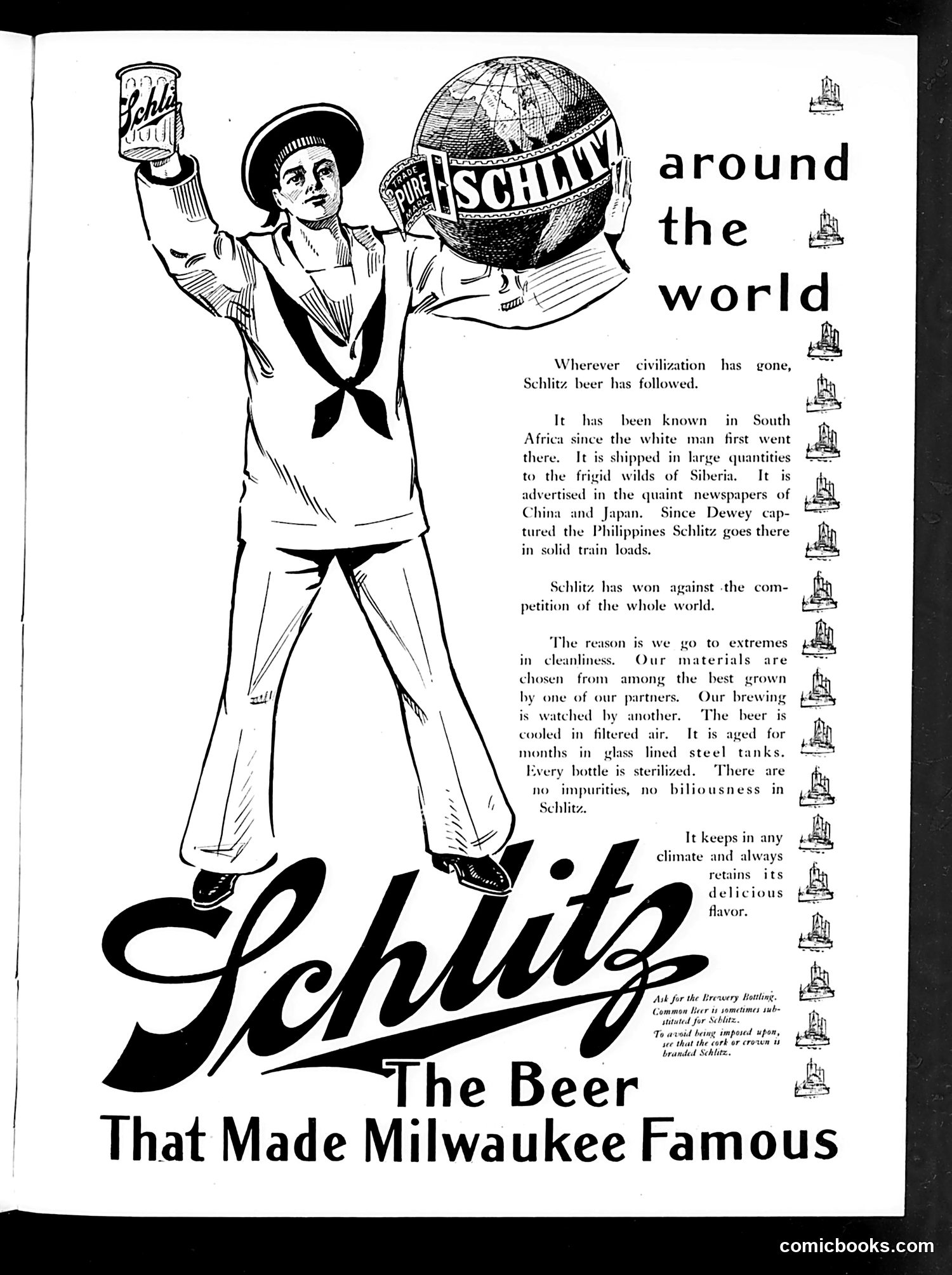
This is primarily a **Schlitz beer advertisement**, not a political cartoon, though it employs satirical rhetoric common to early 20th-century advertising. The illustration shows a sailor figure triumphantly holding aloft a globe and a Schlitz bottle, celebrating the beer's global reach. The ad's copy boasts that Schlitz has followed "civilization" worldwide—from South Africa to Siberia to China and Japan. It notably references the Philippines following the Spanish-American War (mentioning "Dewey captured the Philippines"), positioning American beer as an export of American imperial expansion. The satire lies in the grandiose claim that beer represents civilization itself, and that commercial success proves superiority. The text emphasizes cleanliness and quality control as competitive advantages, reflecting turn-of-the-century manufacturing pride and anxieties about product purity. For modern readers: this exemplifies how corporate advertising borrowed nationalist and imperialist rhetoric to market consumer goods during America's imperial period.
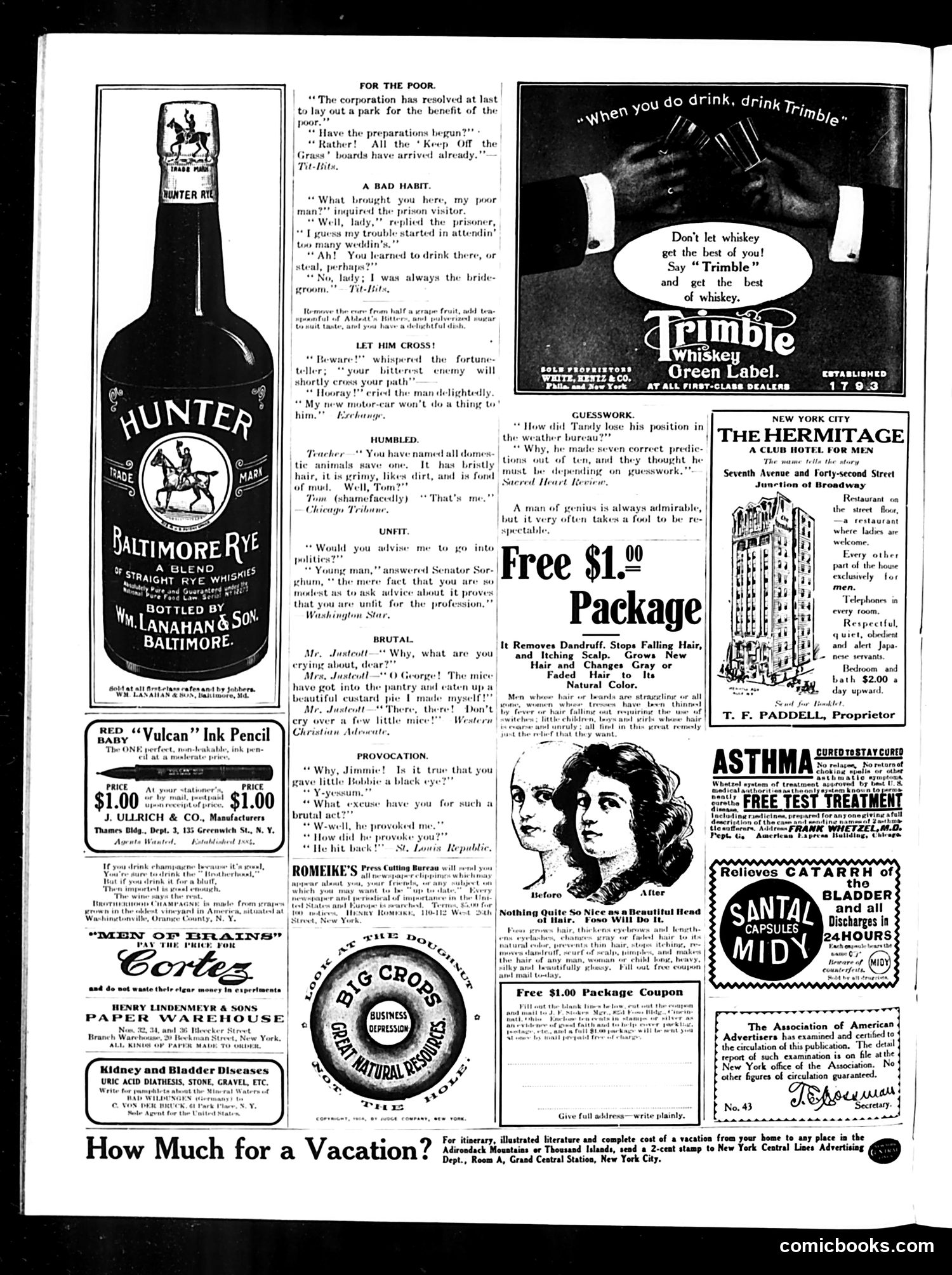
This page is primarily **advertising**, not political satire. It's from *Judge* magazine and contains multiple product advertisements typical of early 20th-century publications. The main content includes: - **Hunter Baltimore Rye whiskey** advertisement (left side) - **Trimble Whiskey** ad (top right) with the slogan "When you do drink, drink Trimble" - **The Hermitage hotel** for men in New York City - Various patent medicine ads, including treatments for asthma, hair loss, and kidney disease - Miscellaneous product endorsements The few brief **satirical snippets** ("For the Poor," "A Bad Habit," "Humbled," etc.) are short comedic anecdotes—not political cartoons—poking fun at social situations like drinking, marriage, and class differences. The page reflects early 1900s advertising conventions where dubious health claims and alcohol promotion were standard. The humor is gentle social commentary rather than pointed political satire.
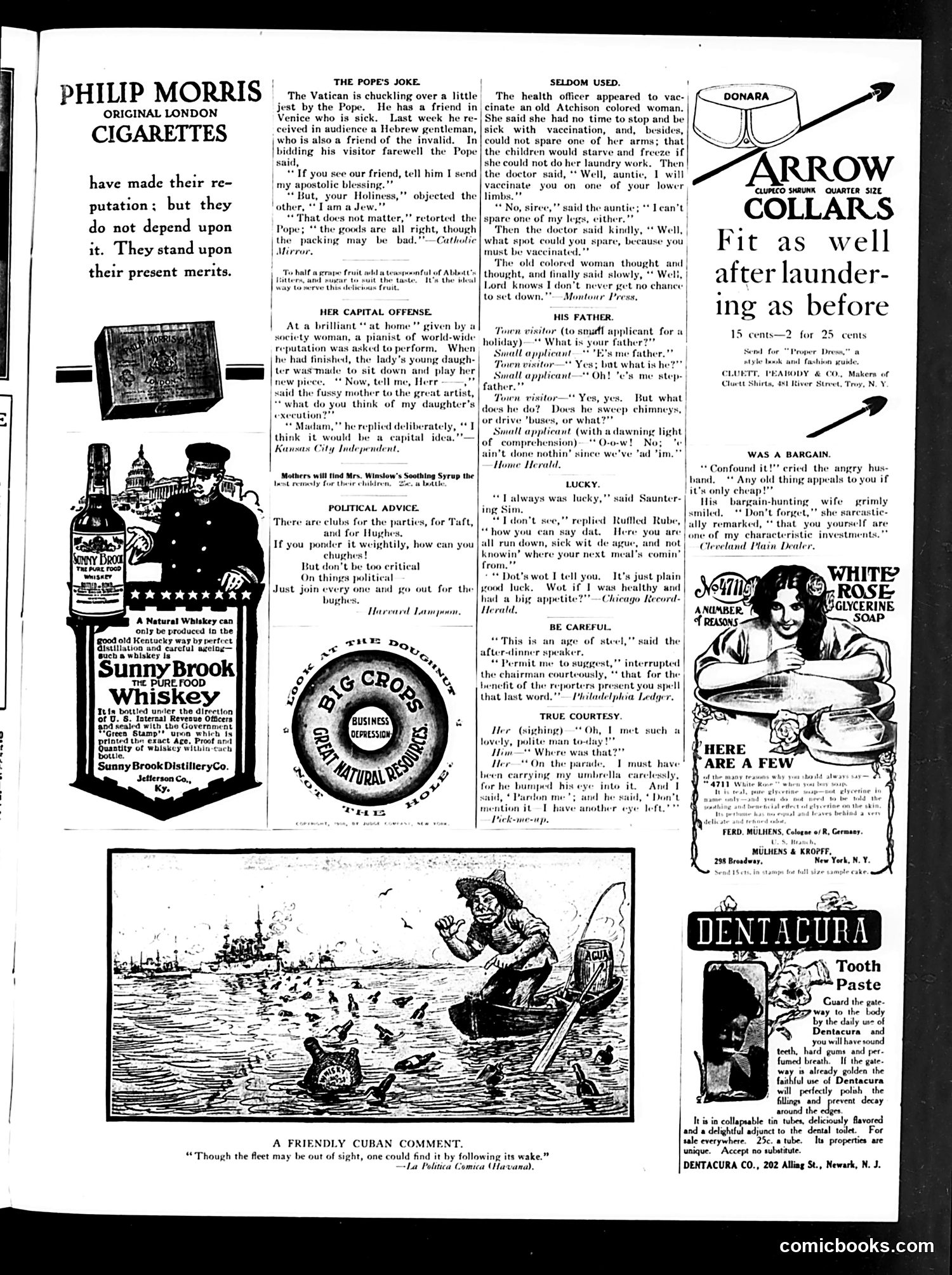
This page is primarily **advertising** interspersed with short humorous anecdotes typical of Judge magazine's format. **The cartoons/jokes include:** - **"The Pope's Joke"**: A lighthearted anecdote about the Pope sending apostolic blessing through a Jewish visitor, with the humor that the Pope doesn't care the messenger is Jewish—the blessing's validity doesn't depend on the carrier's religion. - **"Political Advice"**: A quip suggesting people should join clubs supporting all presidential candidates (Taft, Hughes) rather than debate politics—satirizing political apathy or pragmatism. - **"A Friendly Cuban Comment"**: A naval reference (possibly WWI-era) with an illustration showing a soldier in water, captioned with a Cuban proverb about tracking ships by their wake—likely patriotic commentary. The remaining content consists of **period advertisements** for cigarettes, whiskey, shirt collars, toothpaste, and coffee—typical of early 20th-century magazine pages. No major political figures are caricatured on this particular page.
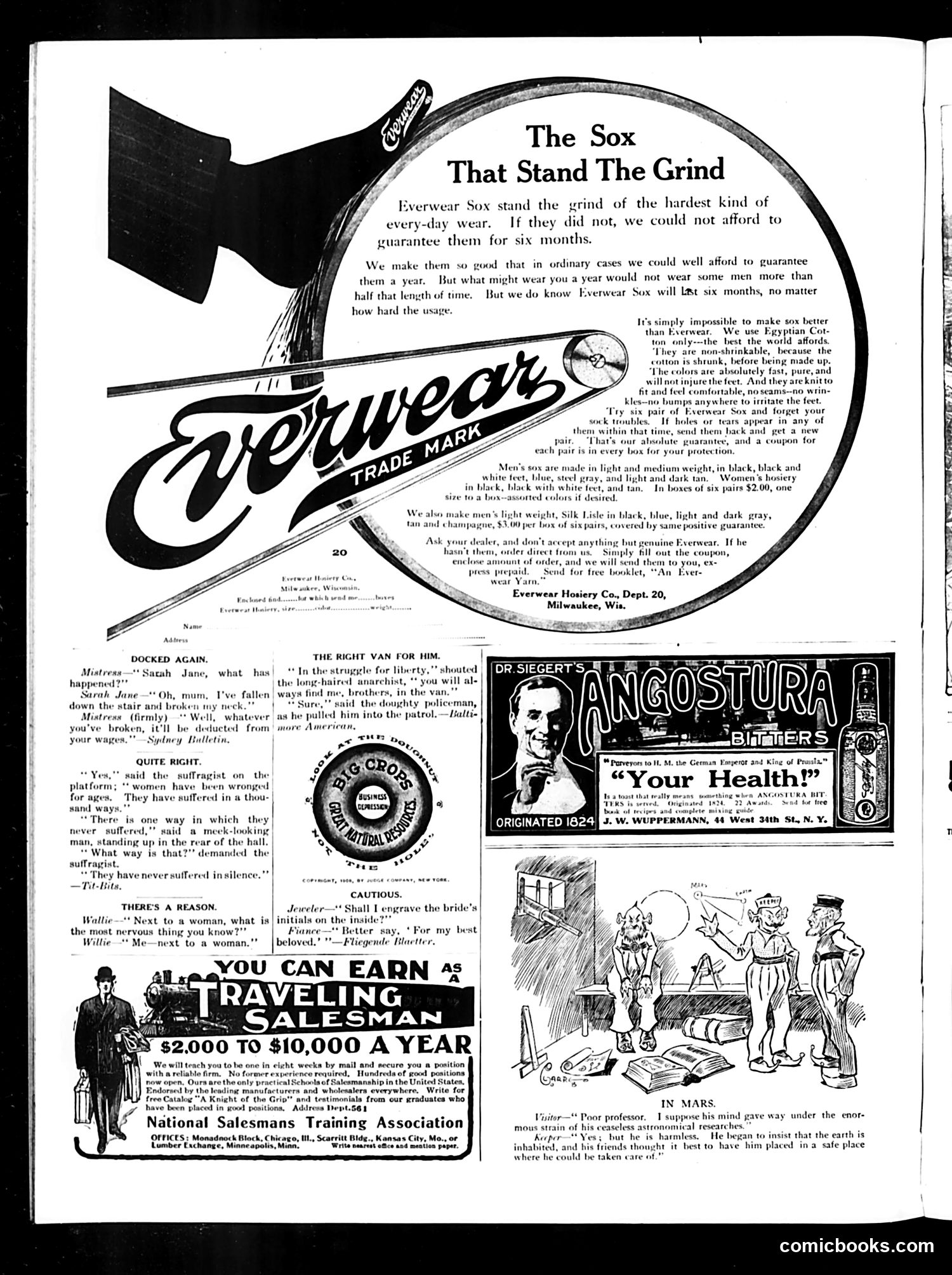
This page contains primarily **advertisements and brief comic vignettes** rather than political cartoons. The main content is an Everwear hosiery ad emphasizing durability through product claims and guarantee language. The small comics scattered throughout are period workplace and domestic humor: - **"Docked Again"**: A servant (Sarah Jane) breaks her neck falling downstairs; her employer deducts it from wages—dark humor about class exploitation and employer callousness. - **"Quite Right"**: A suffragist argues women deserve equal treatment; a man dismissively agrees women "never suffer insolence"—satire of anti-suffrage attitudes. - **"There's a Reason"**: A nervous man admits his wife makes him more anxious than any other woman—conventional marital humor. - **"In Mars"**: An asylum keeper explains a professor has gone mad insisting Earth is inhabited—absurdist humor playing on early-20th-century space speculation. The page reflects Judge's mixture of consumer advertising and light social satire typical of 1920s American magazines.
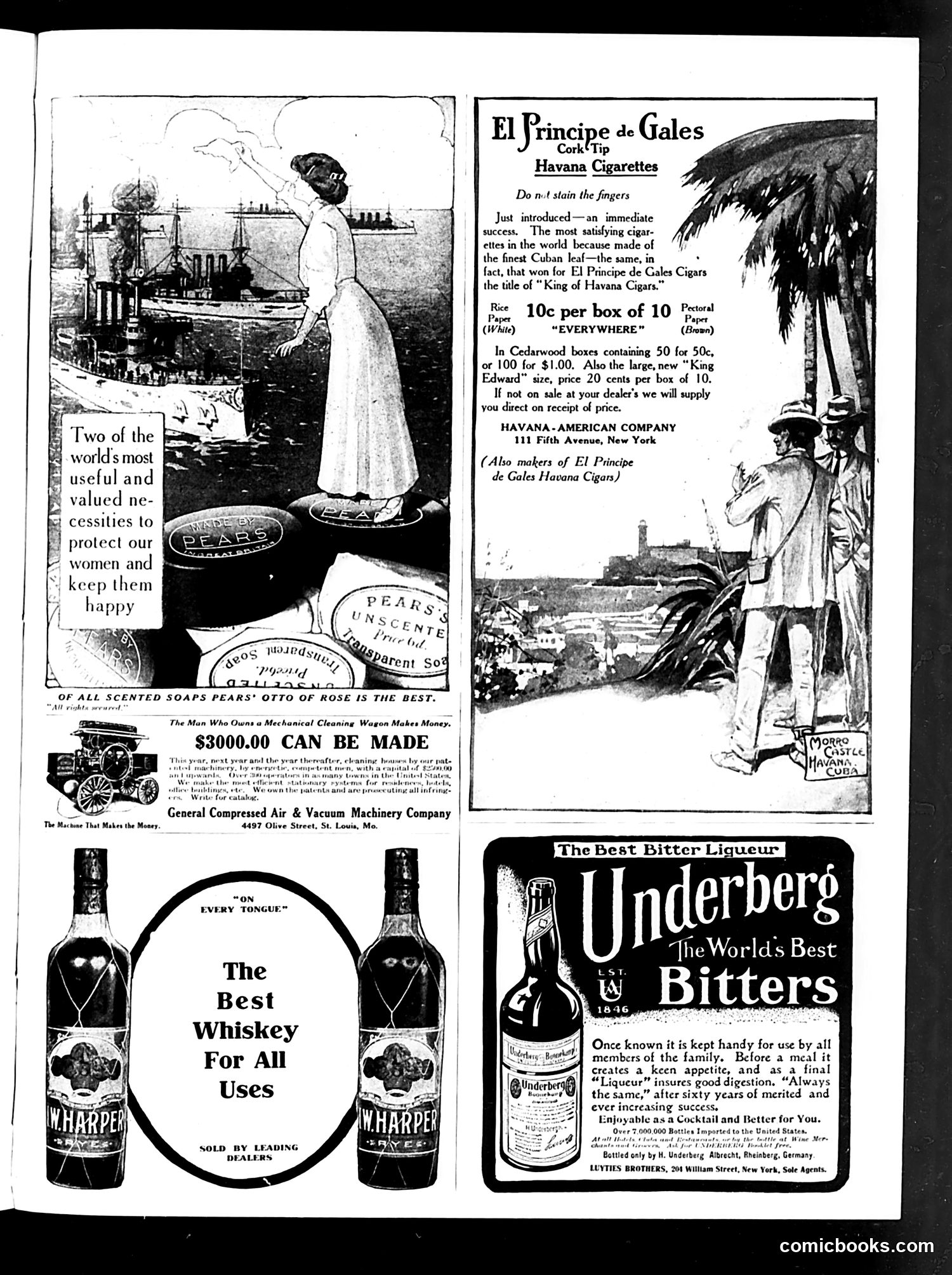
This page is primarily **advertising**, not political satire. It contains four product advertisements typical of early 20th-century magazines: 1. **Pears' Soap** (top left): Features a woman overlooking industrial harbor scenes, marketing soap as protecting women's health and happiness—reflecting Victorian gender ideology. 2. **El Príncipe de Gales Cigarettes** (top right): Cuban cigars advertised with tropical imagery, capitalizing on Cuban products' prestige before trade restrictions. 3. **General Compressed Air & Vacuum Machinery** (center): Promotes a cleaning machine as a money-making opportunity, targeting entrepreneurs. 4. **W. Harpe Whiskey & Underberg Bitters** (bottom): Spirits marketed for medicinal and digestive purposes, common before Prohibition restricted alcohol advertising. The ads reveal period attitudes: women as consumers needing protection, foreign luxury goods as desirable, and alcohol/tobacco as health products. No political cartoons or satire are present.
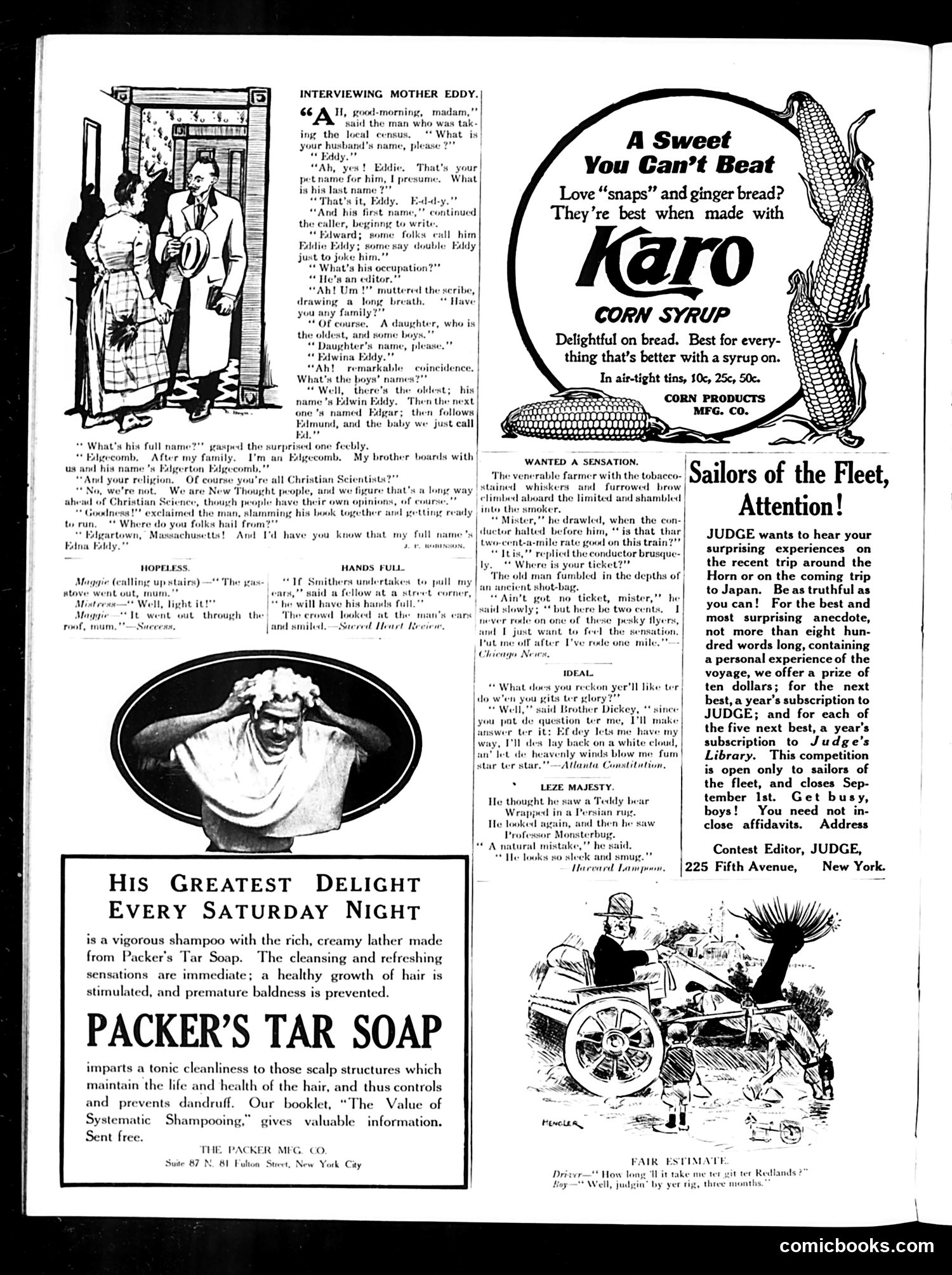
This page from *Judge* magazine consists primarily of **advertisements** interspersed with brief satirical humor pieces rather than a cohesive political cartoon. The main content includes: **"Interviewing Mother Eddy"** — A brief satirical dialogue apparently mocking **Mary Baker Eddy**, founder of Christian Science. The joke seems to play on confusion about family names and religious identity, though the text is fragmentary and unclear in places. **Other short humor pieces** ("Hopeless," "Hands Full") — These are brief, disconnected comedic anecdotes about everyday domestic or street situations, without obvious political intent. **Advertisements** dominate the page: Karo Corn Syrup, Packer's Tar Soap, and a *Judge* magazine contest for sailors describing experiences around Cape Horn or to Japan. The page lacks a unified satirical theme or clear political commentary. The "Mother Eddy" piece appears to be the only potentially pointed social satire, but its specific target and humor are difficult to discern from the fragmented OCR text and small illustration.
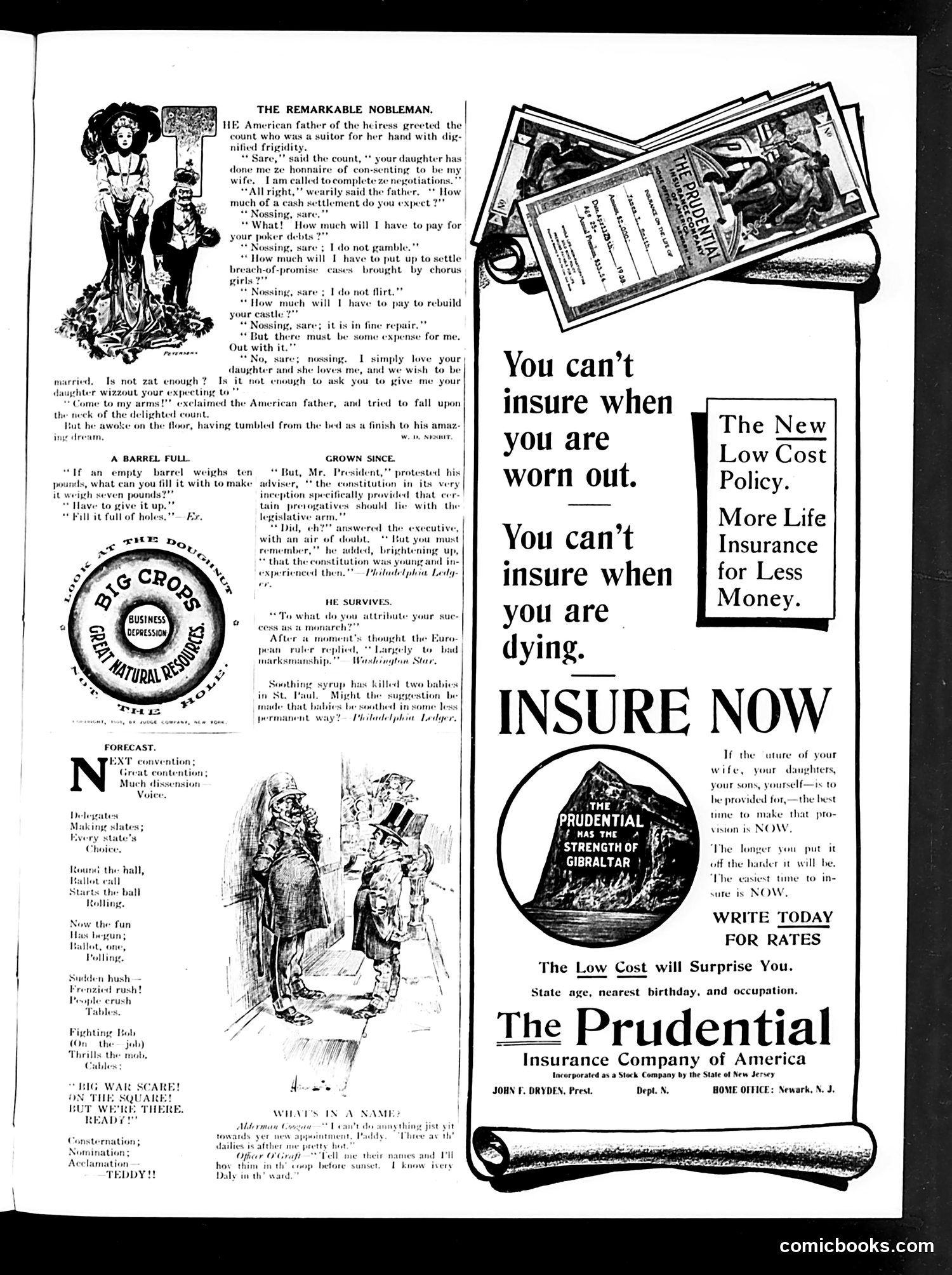
This page satirizes the common scenario of wealthy American heiresses marrying impoverished European aristocrats. The main cartoon depicts an American father negotiating with a foreign "count" seeking to marry his daughter. The count claims to want nothing ("nossing"), but the father—suspicious of fortune-hunting—demands to know what settlement he expects. When the count insists his love is genuine, the outraged American father literally falls out of bed in disbelief at such presumption. The satire targets both the European nobility's mercenary approach to transatlantic marriages and the American nouveau-riche's anxiety about being duped. The exaggerated accent and clichéd protestations of disinterested love mock the transparent charade of such unions. The page also contains unrelated puzzle jokes and a Prudential Insurance advertisement.
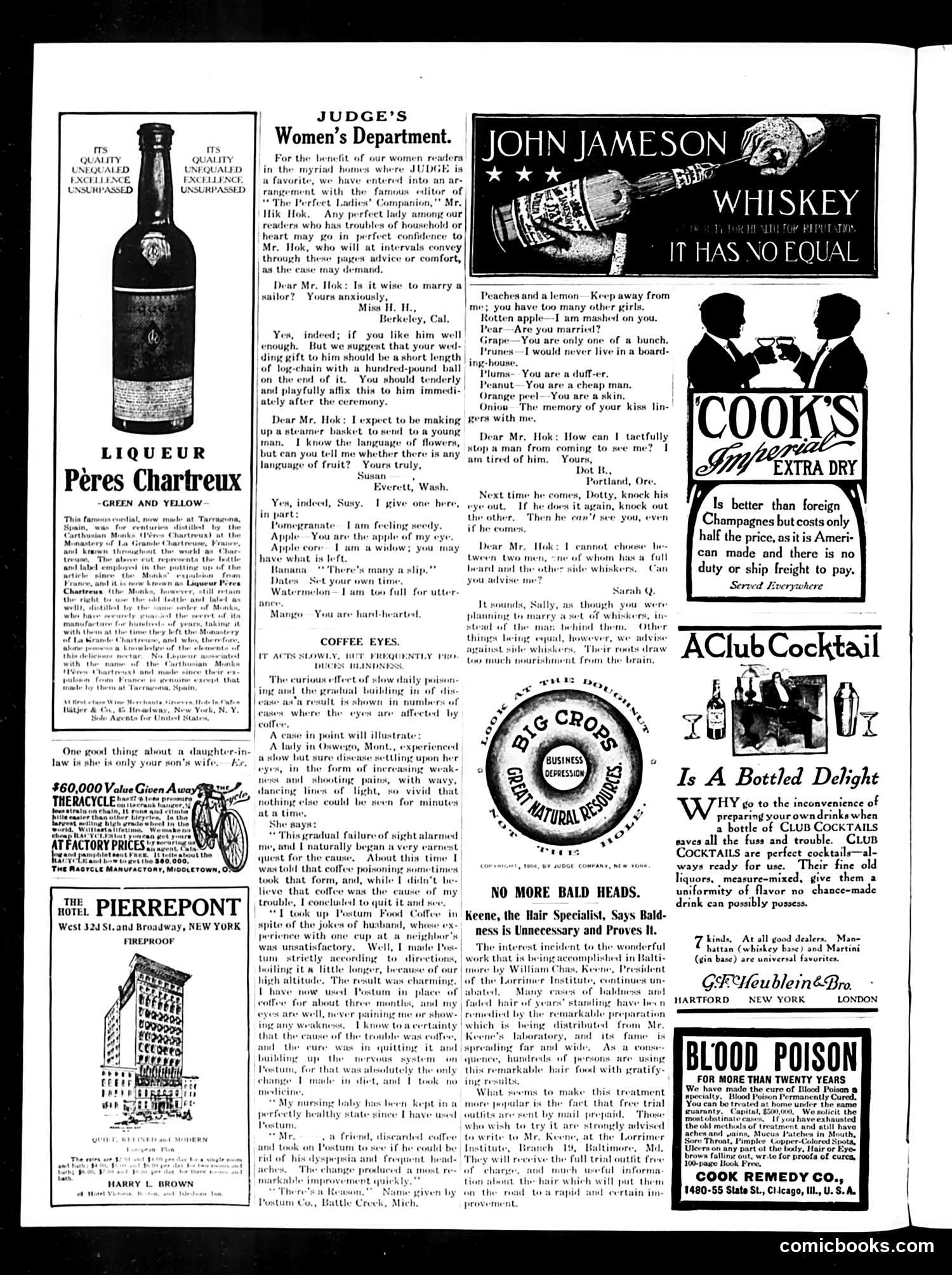
This is primarily an **advice column and advertisements page**, not a political cartoon page. The main content is Judge's "Women's Department," an advice column where "Mr. Hok" responds to women's questions about courtship and marriage with satirical, sometimes crude humor. For example, when asked if she should marry a sailor, he jokingly suggests giving her fiancé "a short length of log-chain with a hundred-pound ball" as a wedding gift. The column uses dated gender stereotypes and fruit/vegetable metaphors as romantic insults (calling women "apple core," "watermelon," "pear," etc.). This reflects early 1900s satirical humor mocking both romantic advice-seeking and women themselves. The surrounding advertisements promote liqueur, whiskey, cocktail mixers, hair treatments, and a coffee substitute—typical commercial content for a men's magazine of this era. The page offers little political satire, focusing instead on lifestyle advertising and domestic humor.
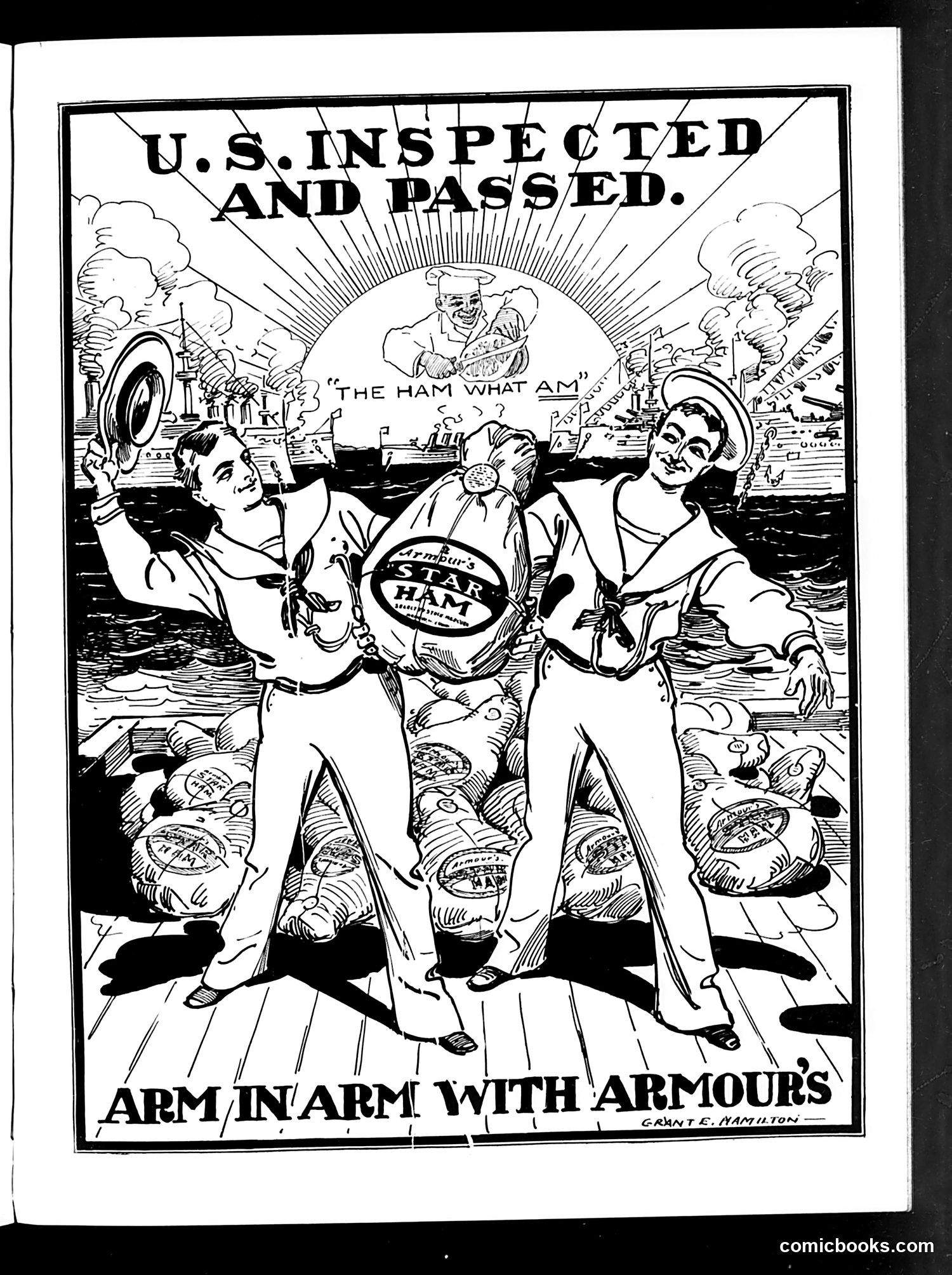
This appears to be a vintage advertisement rather than political satire. Three sailors are prominently displaying canned ham products labeled "Armour's Star Ham," with the tagline "The Ham What Am." The illustration celebrates U.S. government inspection and approval ("U.S. Inspected and Passed"), using this seal as a mark of quality and safety. The visual joke plays on the sailors' confident poses and the pun in "The Ham What Am," using colloquial speech for humor. The naval setting emphasizes the product's reliability for shipboard provisions. The artist is credited as Grant E. Hamilton. This represents early 20th-century product advertising that leveraged government approval as a selling point, particularly important for canned meat products following food safety scandals of that era.
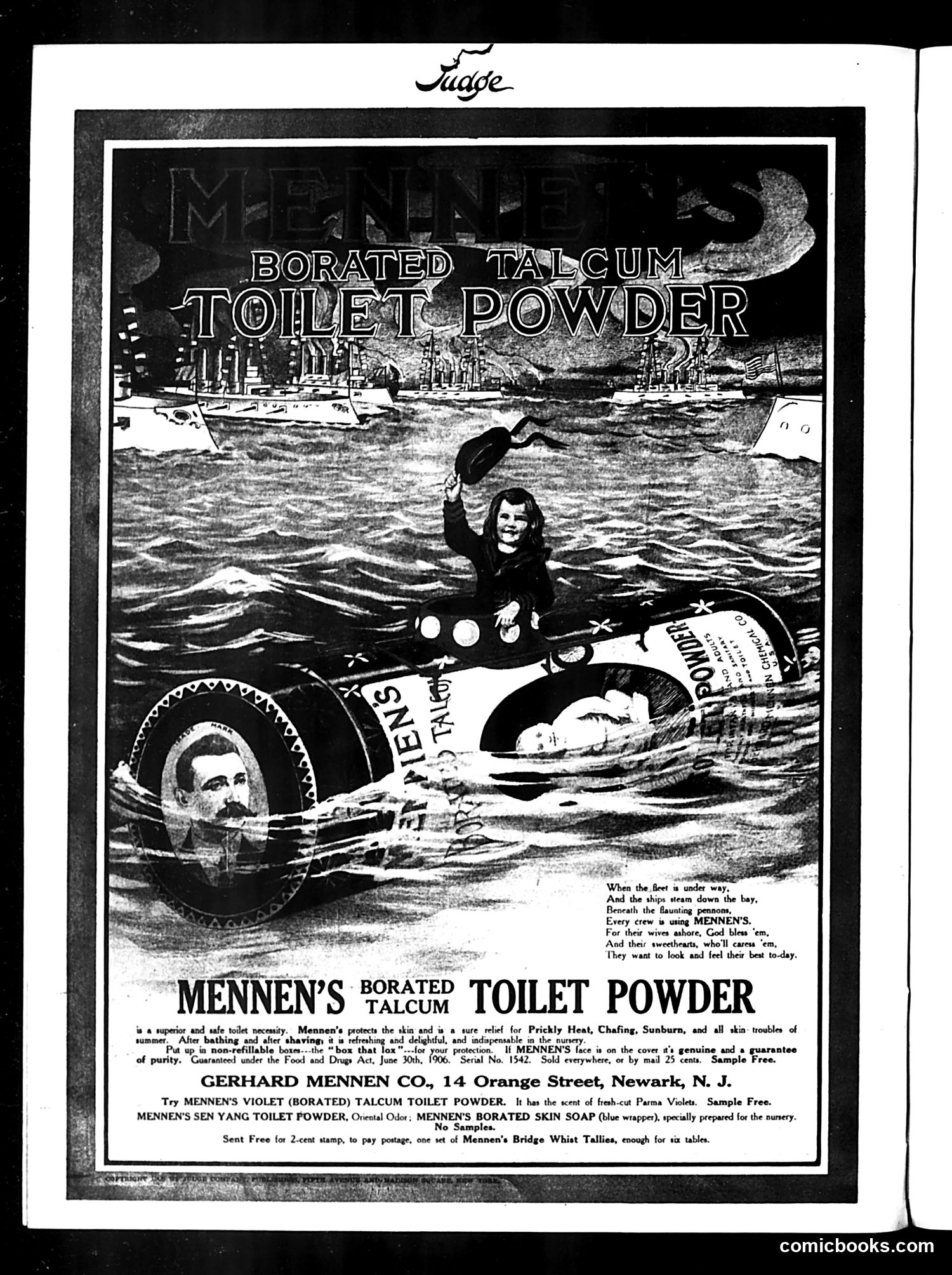
This is a **product advertisement**, not political satire. It promotes Mennen's Borated Talcum Toilet Powder using patriotic imagery appealing to American sailors and their families. The illustration depicts a woman in the ocean, apparently rescued or supported by large talcum powder containers bearing portraits of men (likely sailors). The accompanying poem romanticizes naval life, suggesting sailors use the powder to look and feel their best for wives and sweethearts waiting ashore. This reflects early-20th-century marketing that associated personal grooming products with masculine virtue and domestic devotion. The patriotic naval theme capitalizes on American military pride while the product targets both male sailors and female consumers managing household hygiene. The "Food and Drugs Act" reference indicates post-1906 regulatory compliance labeling.