
A complete issue · 16 pages · 1908
Judge — March 21, 1908
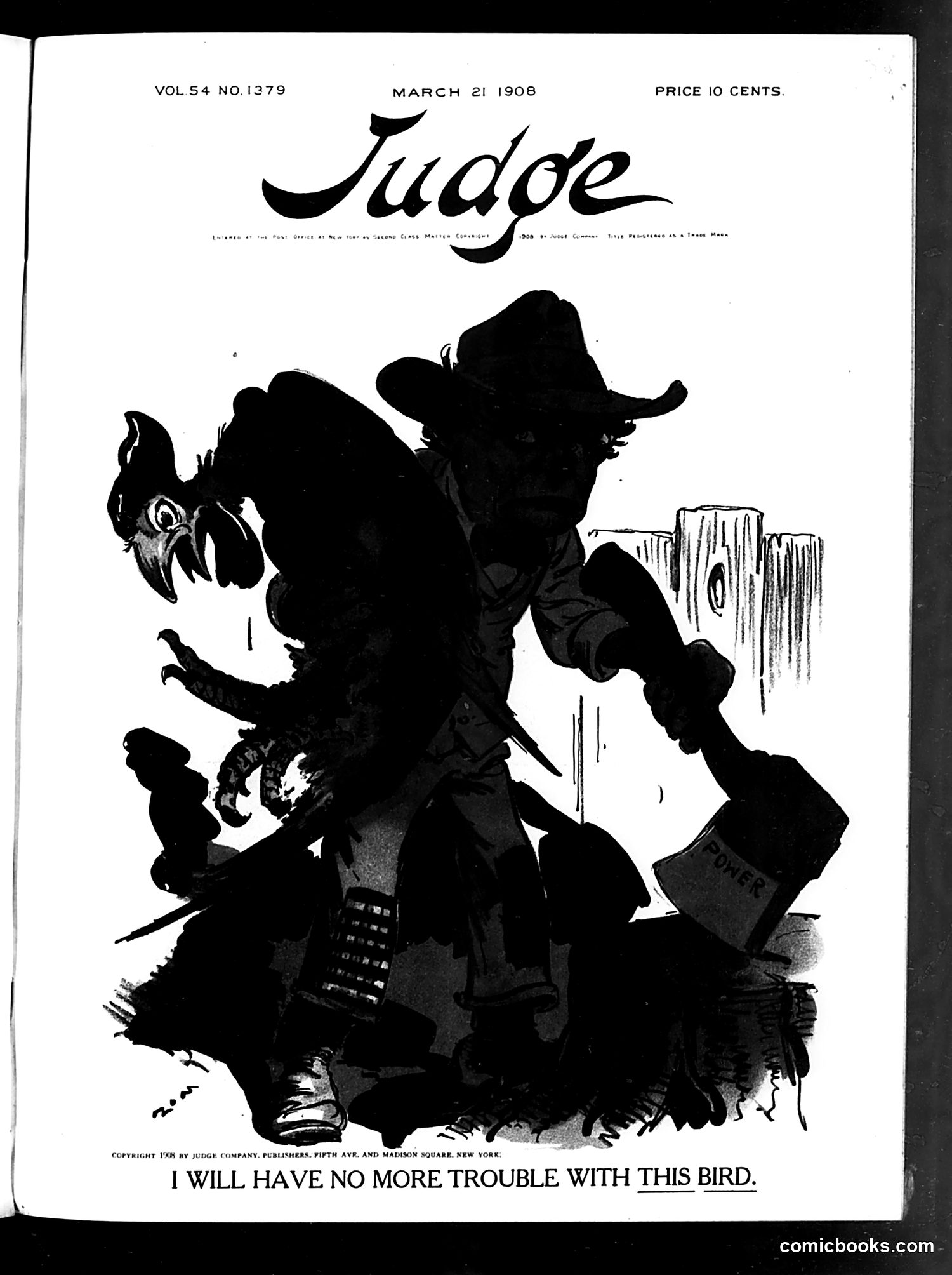
This silhouette cartoon depicts a cowboy or frontiersman wrestling with a large rooster, with smaller figures (appearing to be Native Americans or frontier characters) positioned around him. The caption reads: "I WILL HAVE NO MORE TROUBLE WITH THIS BIRD." The rooster likely represents a persistent political problem or opponent—possibly Theodore Roosevelt, who was known as the "rough rider" and associated with frontier imagery. The caption suggests the figure's determination to decisively end a recurring issue or rival. The smaller silhouettes surrounding the main figure appear to represent various consequences or complications arising from this conflict. Without additional context from the magazine's text, the specific political reference remains unclear, though it likely relates to 1908 political developments.
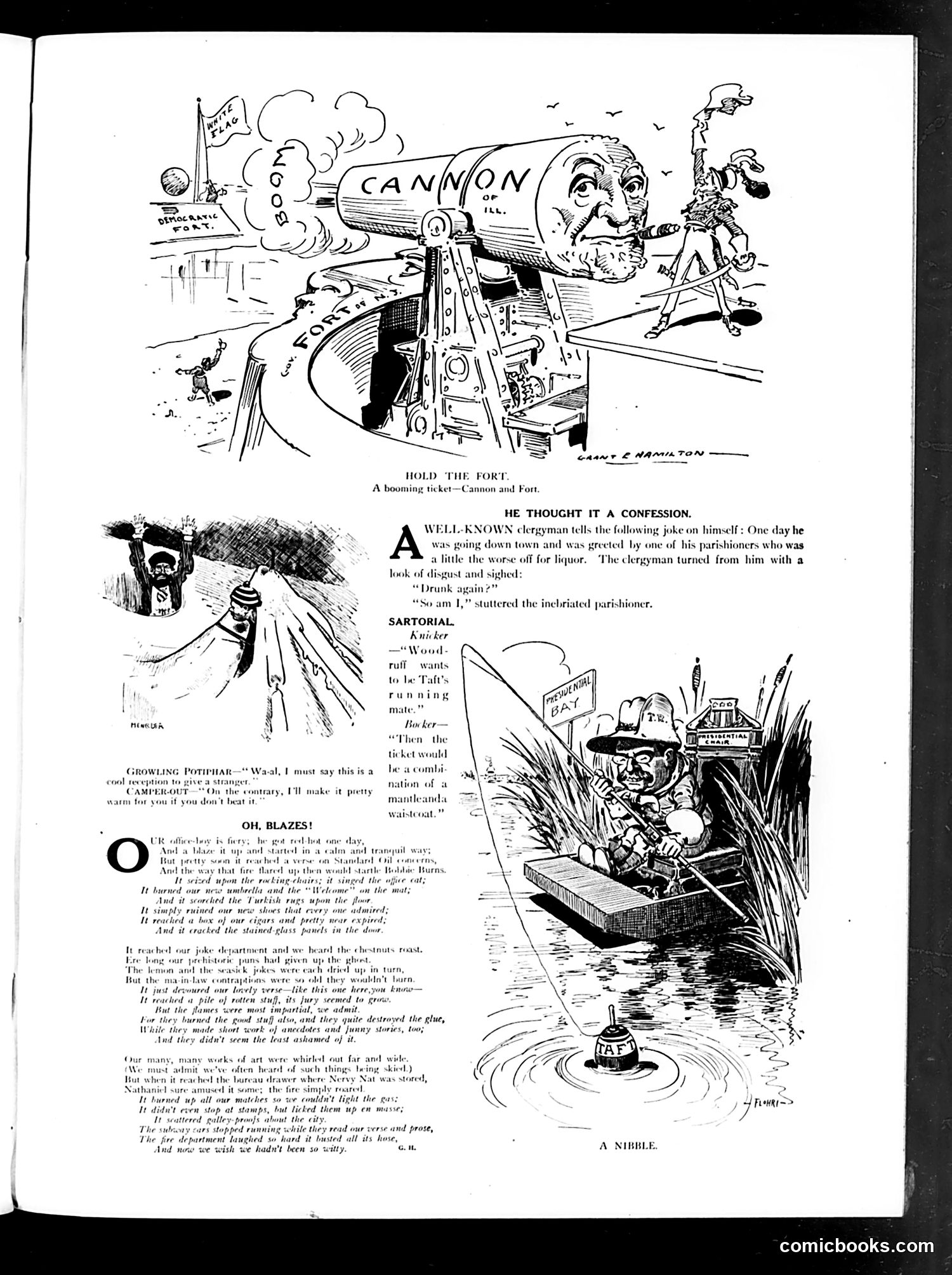
**Top Cartoon ("Hold the Fort"):** Depicts a cannon labeled "Cannon of Ill." firing at a fort, with the cannon's barrel formed into a caricatured face. This appears to be political satire about Illinois politics, though the specific reference is unclear without additional context. **Middle Section:** Contains a joke about a clergyman and a parishioner discussing drinking, followed by a sartorial column and a poem titled "Oh, Blazes!" describing what appears to be a domestic fire incident. **Bottom Cartoon ("A Nibble"):** Shows a figure in water next to what appears to be industrial or urban structures in a swamp-like setting, likely satirizing corruption or "nibbling away" at resources or standards. The overall page mixes political commentary with humor and domestic satire typical of Judge's satirical approach.
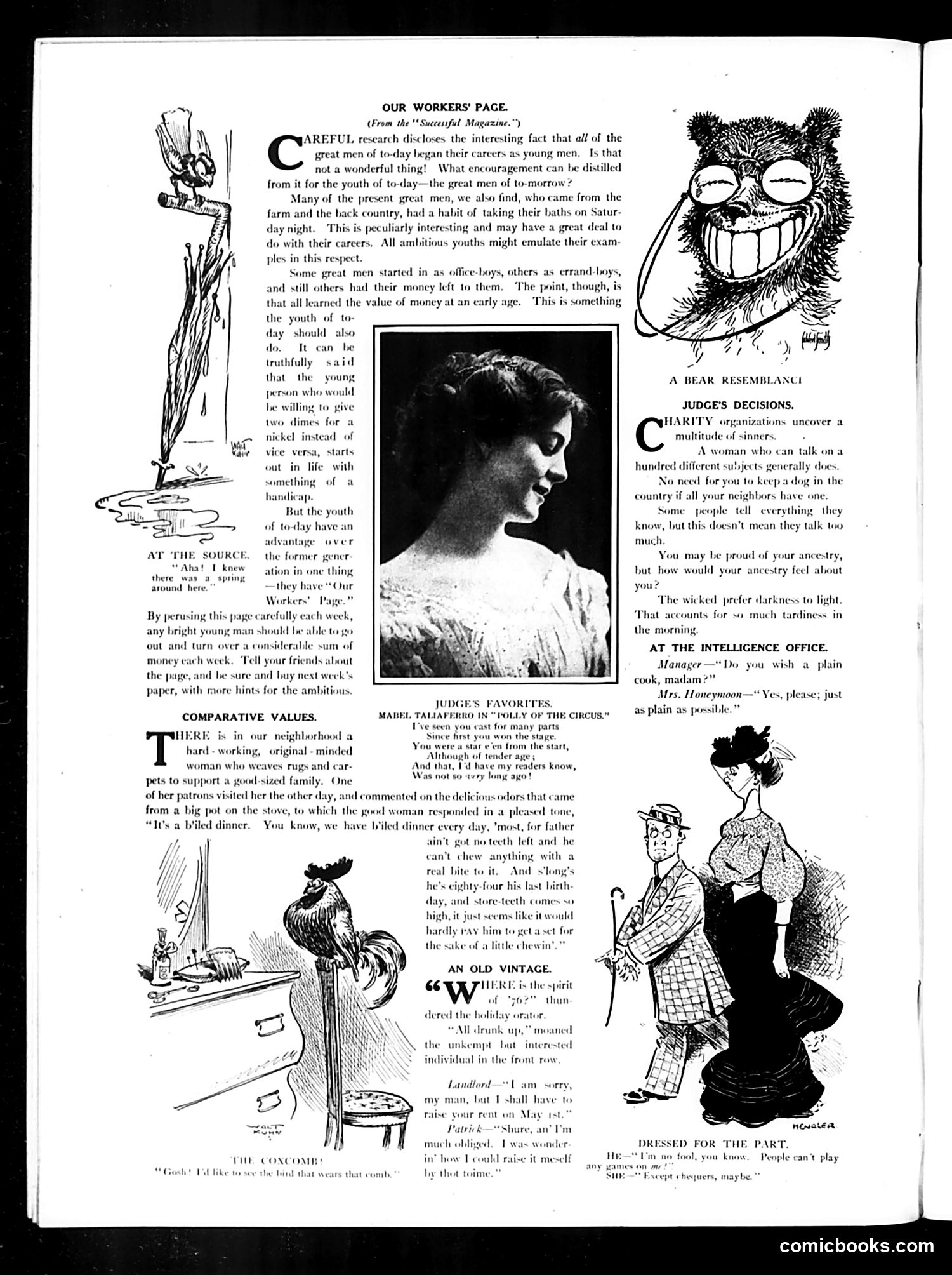
This page from *Judge* magazine features satirical commentary on working-class life and social observations. The main sections include: **"At the Source"** - A cartoon about workers and wages, with dialogue suggesting workplace economics and labor conditions. **"Comparative Values"** - Commentary on a hardworking woman who supports her family through weaving, praising her domestic labor against material wealth. **"Judge's Decisions"** - Humorous moral observations about society, including comments on charity organizations and ancestry. **"At the Intelligence Office"** - A joke about hiring a plain cook. **"An Old Vintage"** - A comedic dialogue between a landlord and tenant about rent increases. The page reflects early 20th-century class attitudes, satirizing both working-class struggles and upper-class assumptions about labor and domestic service.
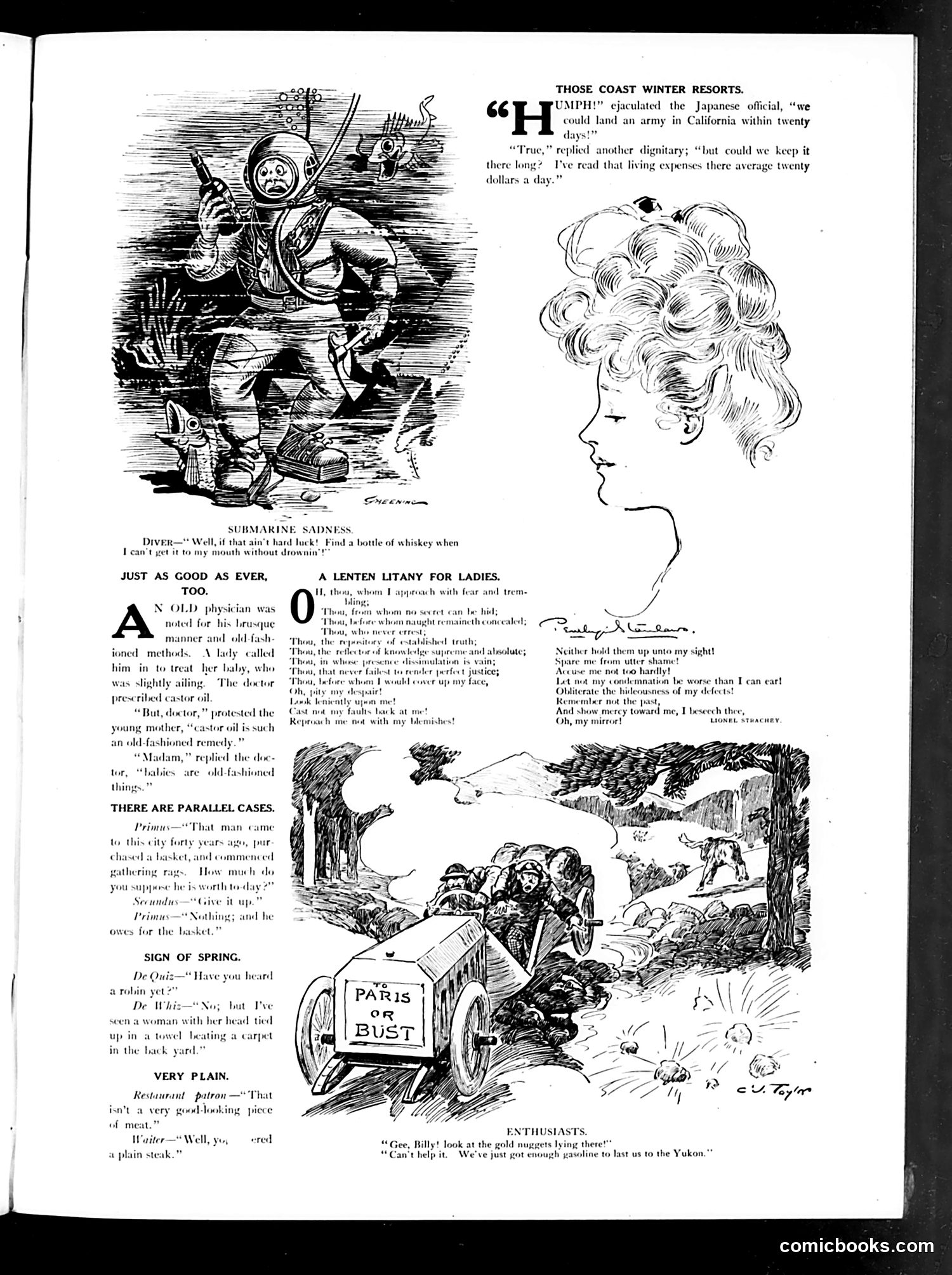
This page from *Judge* magazine contains several disconnected humor pieces rather than unified political satire. **Top cartoon ("Submarine Sadness")**: A diver struggling underwater, apparently representing WWI submarine warfare concerns—a contemporary anxiety given submarine attacks on merchant vessels and passenger ships during the war era. **"Just as Good as Ever, Too"**: A physician using outdated folk remedies (castor oil), satirizing old-fashioned or ineffective medical practices. **"A Lenten Litany for Ladies"**: Religious satire mocking women's frivolous concerns during Lenten season. **"Paris or Bust"**: An automobile cartoon about travel aspirations, seemingly mocking either unrealistic vacation dreams or automobile reliability. The page primarily offers social humor about contemporary life rather than partisan political commentary. The specific historical moment remains unclear without publication date context.
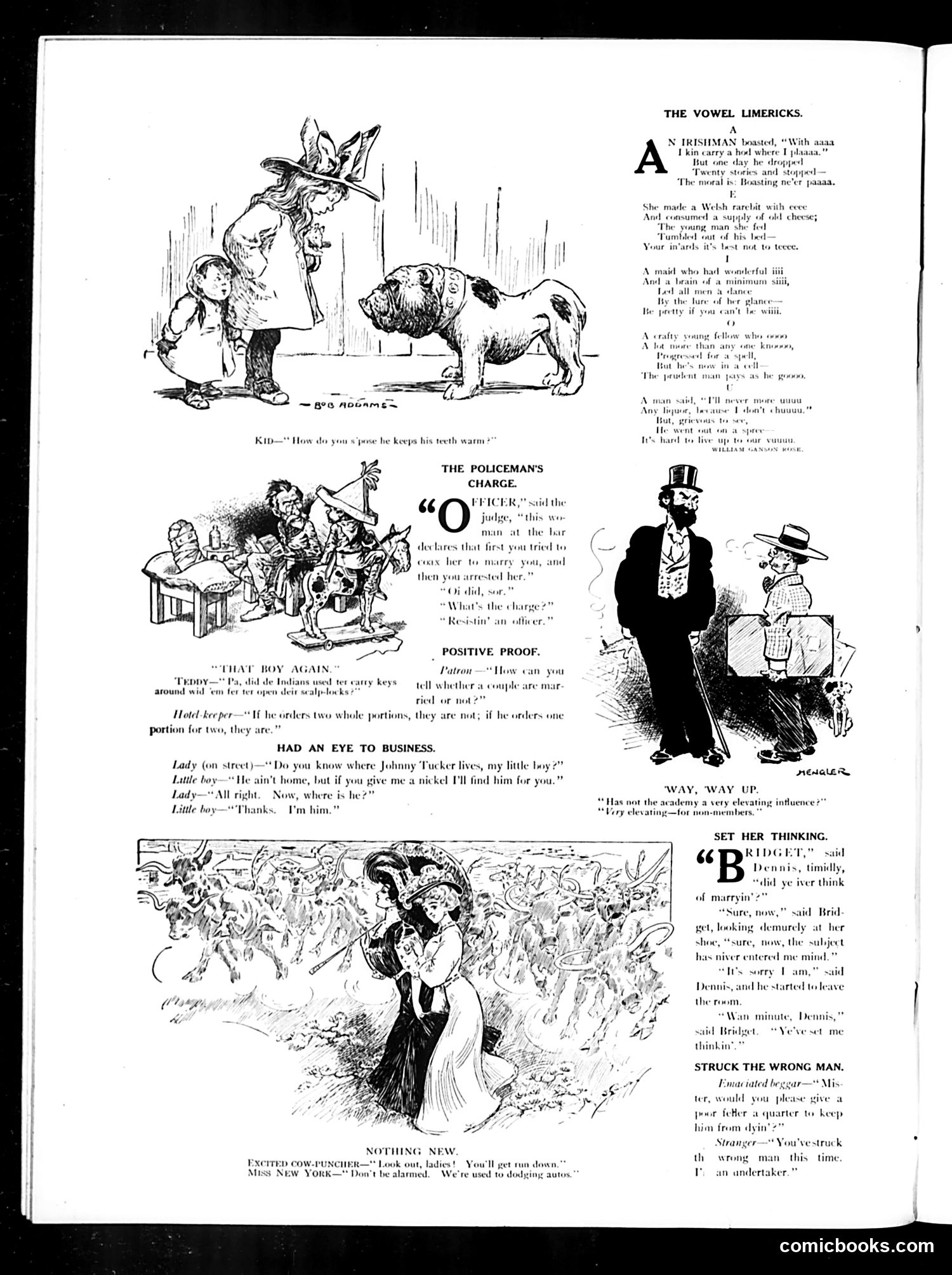
This page collects several brief humorous pieces typical of Judge's satirical humor: **"The Vowel Limericks"** presents Irish dialect humor featuring an Irishman bragging about carrying a bed (likely sexual innuendo common to period comedy). The subsequent limericks mock various character types with stereotypical observations—a vain man, a miser, etc. **"The Policeman's Charge"** jokes about an officer arresting a woman for "resisting" his romantic advances, with the judge's ironic commentary on the absurdity. **Other shorts** include standard period humor: a hotel-keeper's crude method for detecting married couples, a street urchin's business acumen, romantic misunderstandings with Irish dialect, and a beggar accidentally approaching an undertaker. The comedy relies on ethnic stereotypes (Irish accents), class humor, sexual innuendo, and situational irony—common Judge fare targeting educated urban readers. The cartoons illustrate these brief gags with exaggerated character types rather than commenting on specific political events.
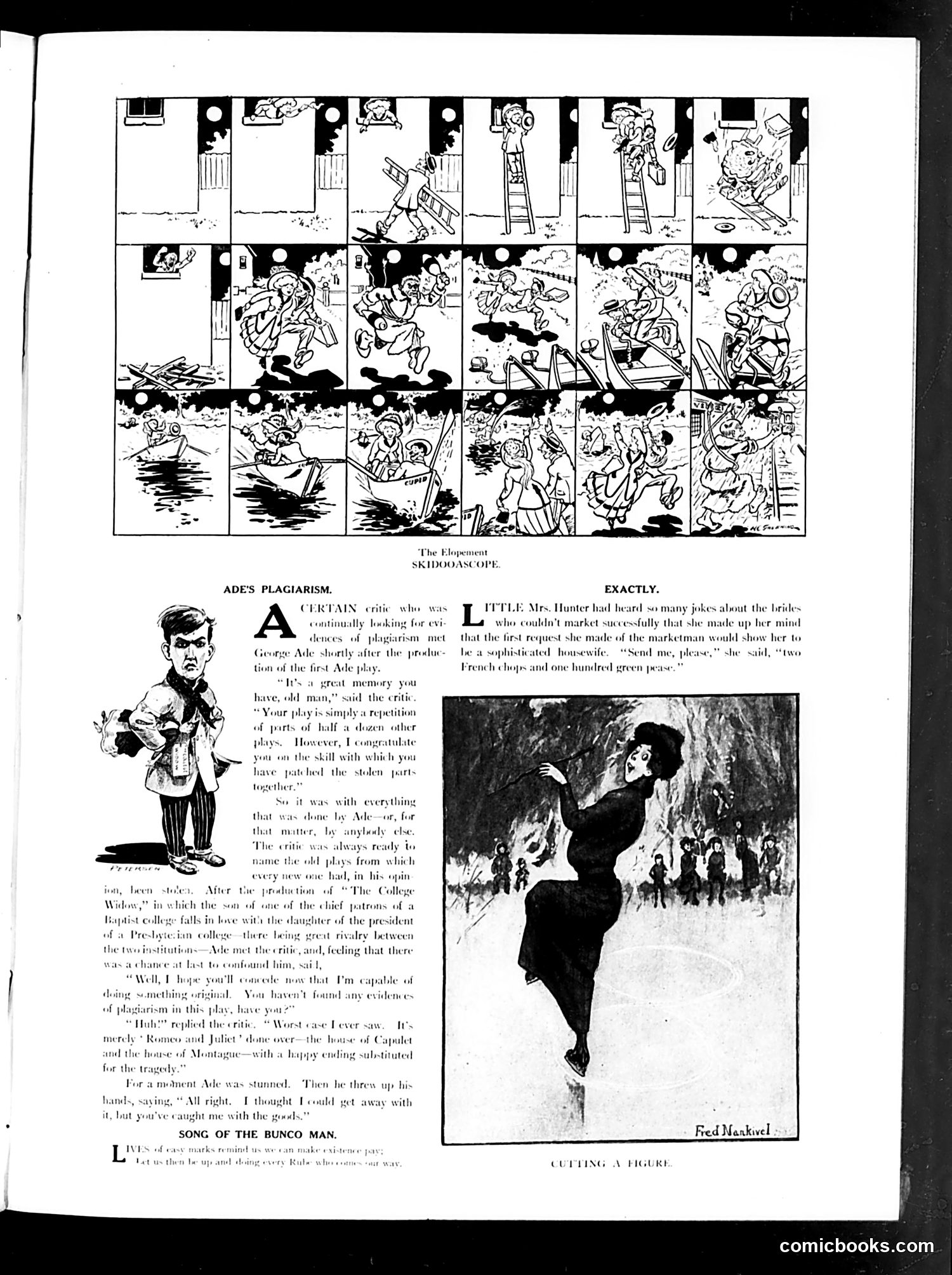
This page contains three distinct items: **Top: "The Elopement - Skidooascope"** — A sequential comic strip showing slapstick chaos, likely depicting an elopement scene with physical comedy and domestic disorder. **Left: "Ade's Plagiarism"** — A satirical anecdote about playwright George Ade being accused of plagiarism by a critic. The critic claims Ade merely assembled borrowed parts from existing plays. Ade's response ("All right, I thought I could get away with it, but you've caught me with the goods") is humorous self-deprecation that ironically validates the critic's complaint. The illustration shows Ade as a somewhat theatrical figure. **Right: "Exactly"** — A brief joke about a bride requesting "French chops and one hundred green peas" from a marketman, implying she's pretentiously trying to appear sophisticated as a new housewife. **Bottom right:** An illustration titled "Cutting a Figure" by Fred Nankivel (unclear context). The page is primarily satirical commentary on theater, playwrights, and domestic life—typical Judge magazine content mixing theater criticism with domestic humor.
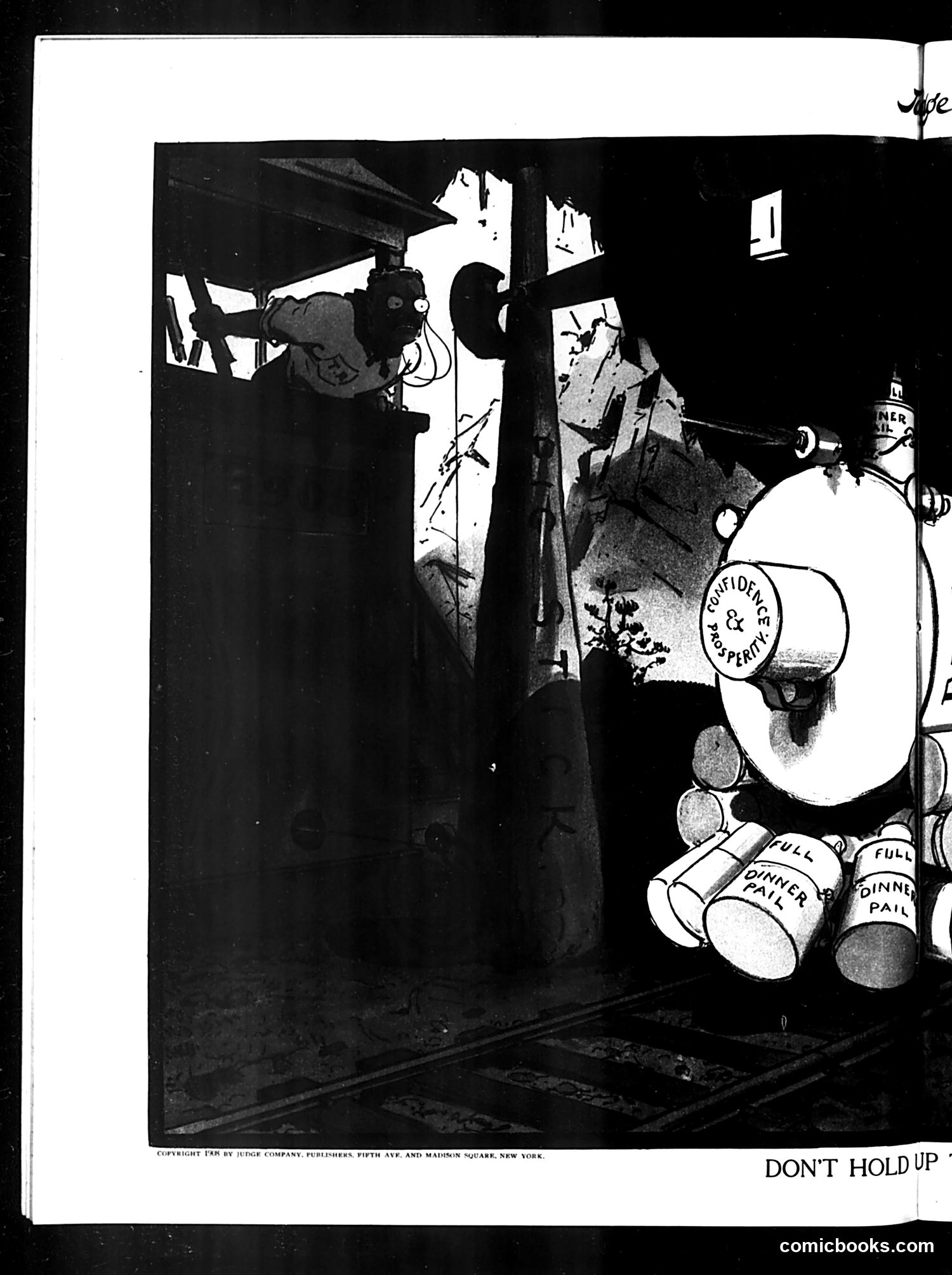
This page shows a black and white cartoon depicting what appears to be a robbery or holdup scene. A figure on the left (partially visible in shadow) is confronting someone inside what looks like a storage room or pantry. On the right side, there are labeled containers marked "FULL DINNER PAIL" and what appears to be a company label reading "PROSPERITY & ESPERANTO." The partial text "DON'T HOLD UP" at the bottom suggests the cartoon is a visual pun or commentary, likely political in nature given Judge magazine's satirical focus. The "full dinner pail" reference was a common political slogan (associated with Republican campaigns), suggesting this may be commenting on economic conditions or political promises. The exact meaning remains unclear without the complete caption and full context of the issue.
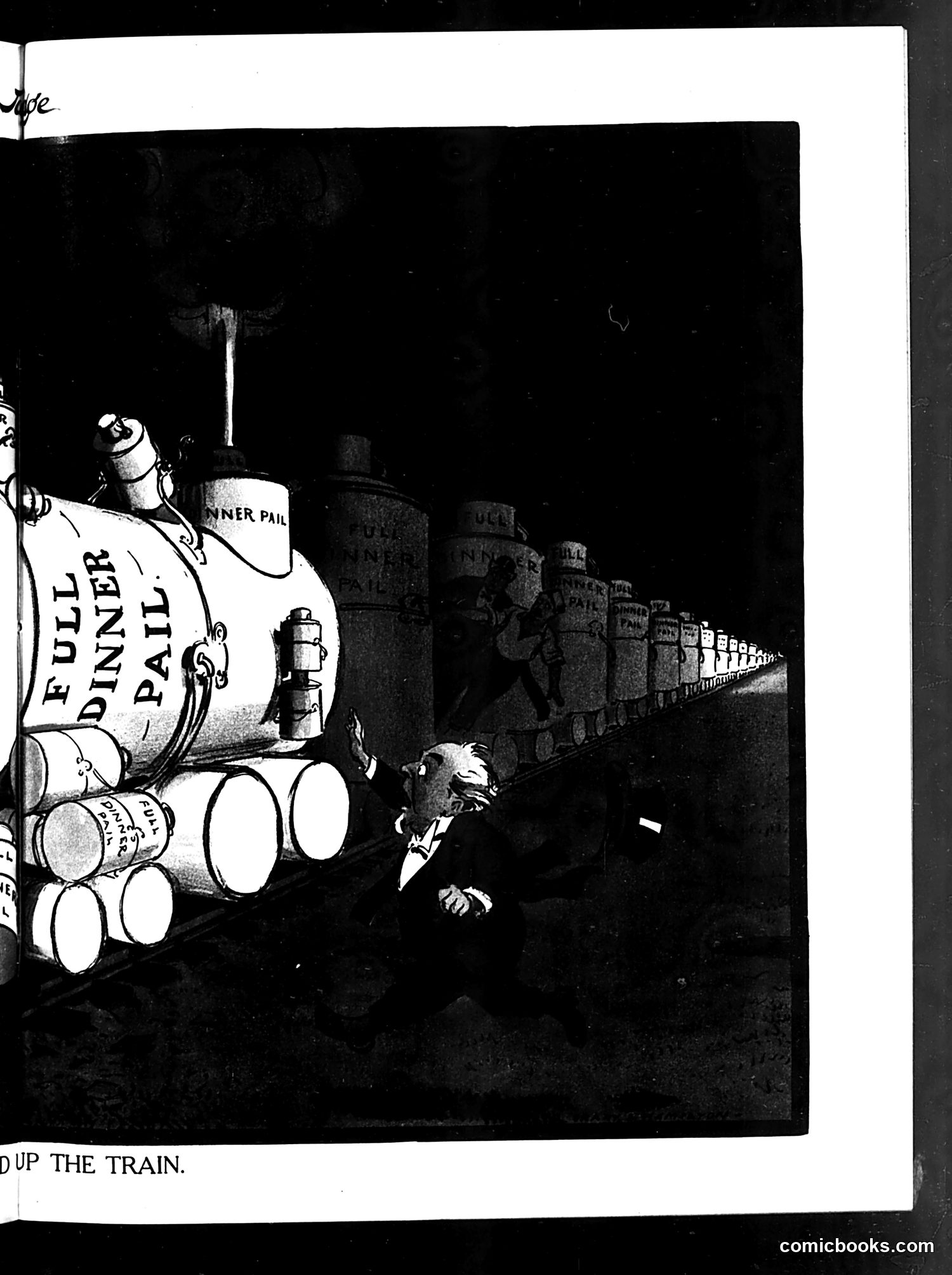
This Judge magazine cartoon satirizes railroad industry practices, likely from the early 20th century. The image shows a caricatured figure (possibly representing a railroad magnate or industrialist) standing before an enormous train composed entirely of cylindrical tanks labeled "FULL DINNER PAIL" — a phrase referencing Republican campaign promises of prosperity and worker abundance. The satire appears to mock the contrast between railroad executives' grand promises of worker prosperity versus the actual conditions. The figure gazes at this impressive "train" of rhetoric, suggesting the gap between what industry leaders claim to provide and material reality for workers. The page title "UP THE TRAIN" (partially visible) likely completes a phrase commenting on this deception or the direction of industry priorities.
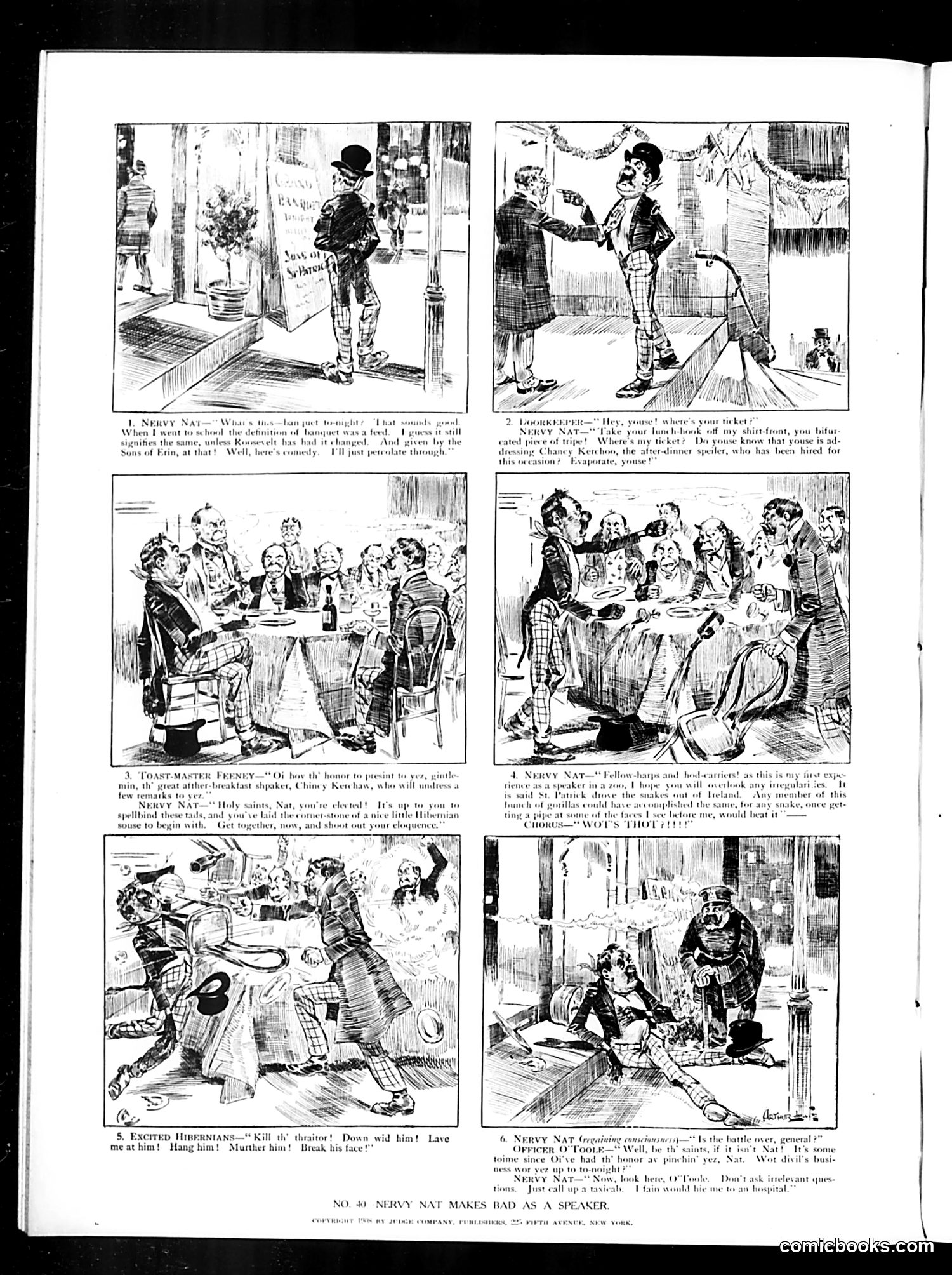
This is a six-panel satirical comic strip mocking an Irish character named "Nervy Nat." The humor centers on ethnic stereotyping common to late 19th/early 20th-century American satire. The strip depicts Nat attempting to give a speech at what appears to be an Irish-American gathering, but his presence provokes violent reactions from the audience—they demand he be killed, hanged, and beaten. The final panels show physical chaos erupting. The satire appears to target Irish-Americans broadly through exaggerated caricature: thick accents (rendered in dialect), volatile temperaments, and association with violence and drunkenness. The title suggests Nat's attempt at public speaking ends in disaster, fitting the era's crude comedic formula of mocking immigrant communities.
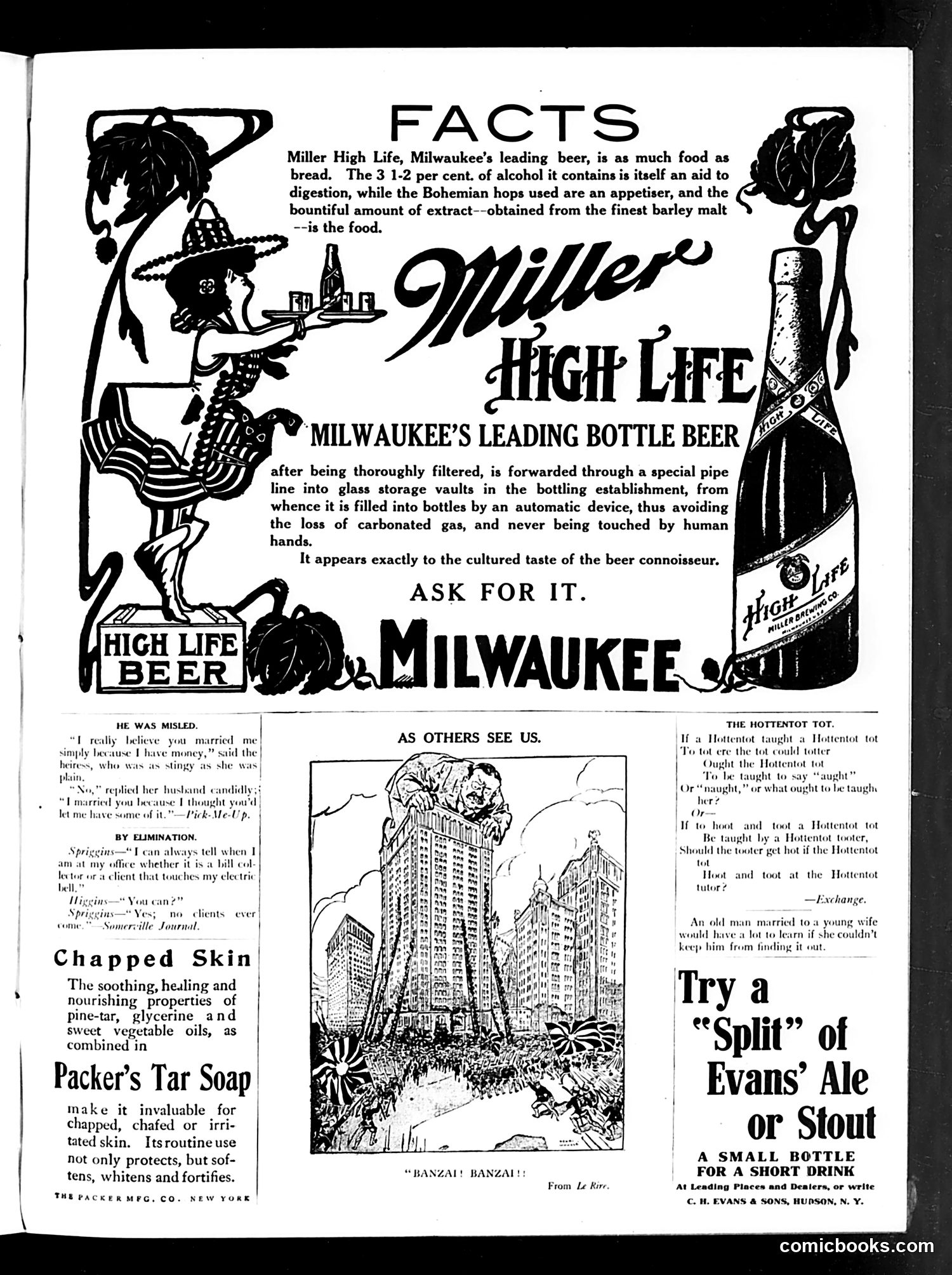
This is primarily an **advertising page** from an early 20th-century American satirical magazine, with minimal actual satire. The main content features **Miller High Life beer advertisements** emphasizing the product's nutritional value and manufacturing process—claims typical of beer marketing from this era, when beverages were promoted as "food" and aids to digestion. The page includes several **short humorous anecdotes** unrelated to beer: jokes about marital misunderstandings, office life, and a tongue-twister about "Hottentots" (a dated, derogatory term for indigenous African people). These represent period humor. A **central cartoon labeled "Banzai! Banzai!!"** (credited to *Le Rire*, a French publication) depicts tall urban buildings, likely satirizing either American urban development or—given the Japanese exclamation—possibly Japanese commercial ambition. The exact meaning is unclear without more context. The page also advertises **Packer's Tar Soap** and **Evans' Ale**, filling space typical of Judge's revenue model. There is **no coherent political satire** unifying this page—it's primarily a commercial space with filler content.
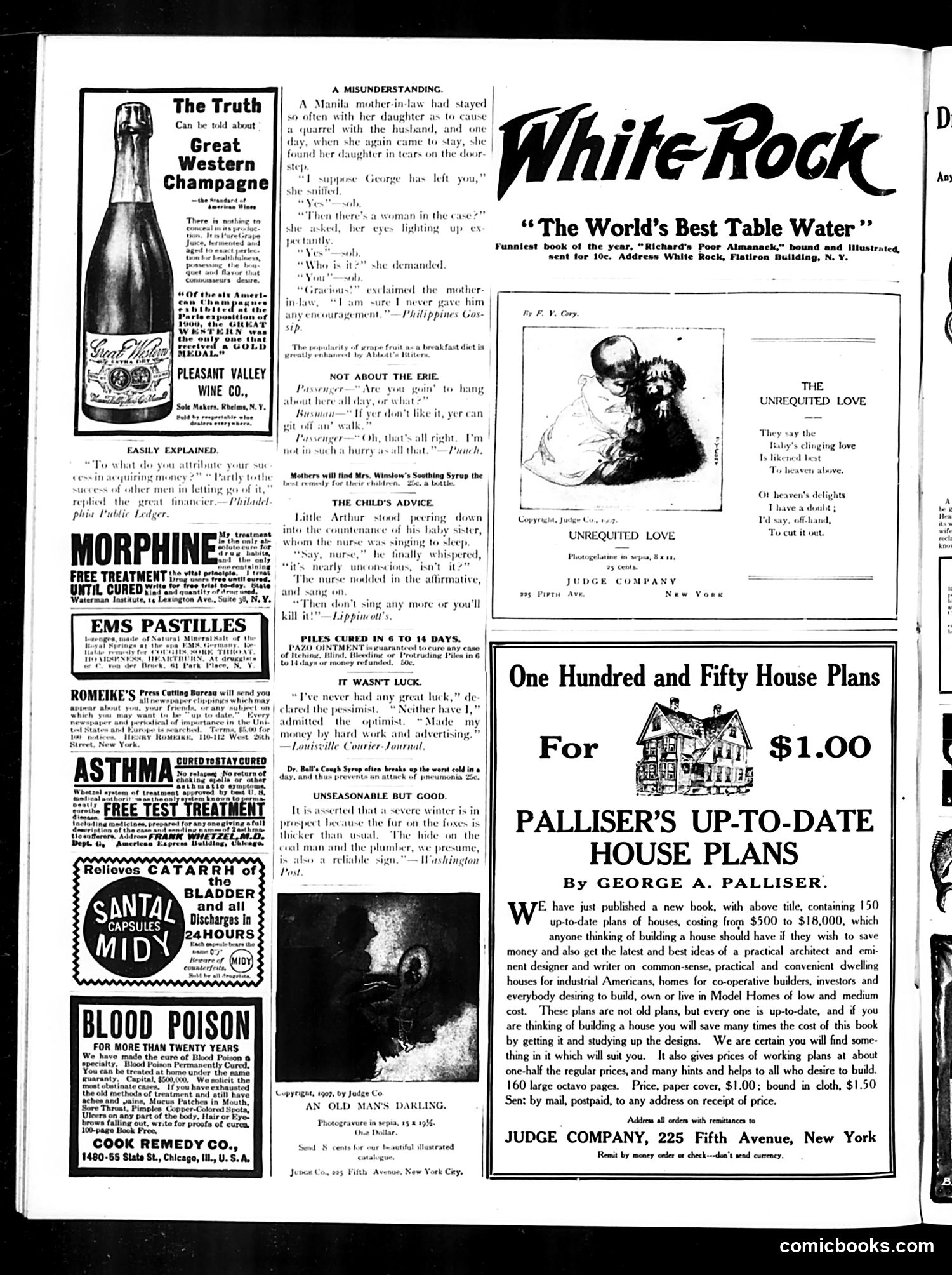
This page is primarily **advertising and light humor**, typical of early 1900s Judge magazine. The main editorial content consists of brief comic anecdotes rather than political satire: **"A Misunderstanding"** depicts a mother-in-law discovering her daughter in tears, expecting dramatic news but learning only that George has left—unclear if this means abandonment or a minor departure. **"The Child's Advice"** presents a child telling a nurse to stop singing because she's putting the baby to sleep—gentle, domestic humor. **"It Wasn't Luck"** contrasts a pessimist and optimist's views on success through hard work. The page is dominated by patent medicine ads (morphine treatments, blood poison cures, asthma remedies—all legal then) and real estate advertising for Palliser's house plans. The **White Rock water ad** and **Pleasant Valley Wine Company advertisement** occupy prominent space. **Overall:** This reflects turn-of-the-century American magazine culture mixing light domestic humor with unregulated medical and commercial advertising, absent significant political commentary.
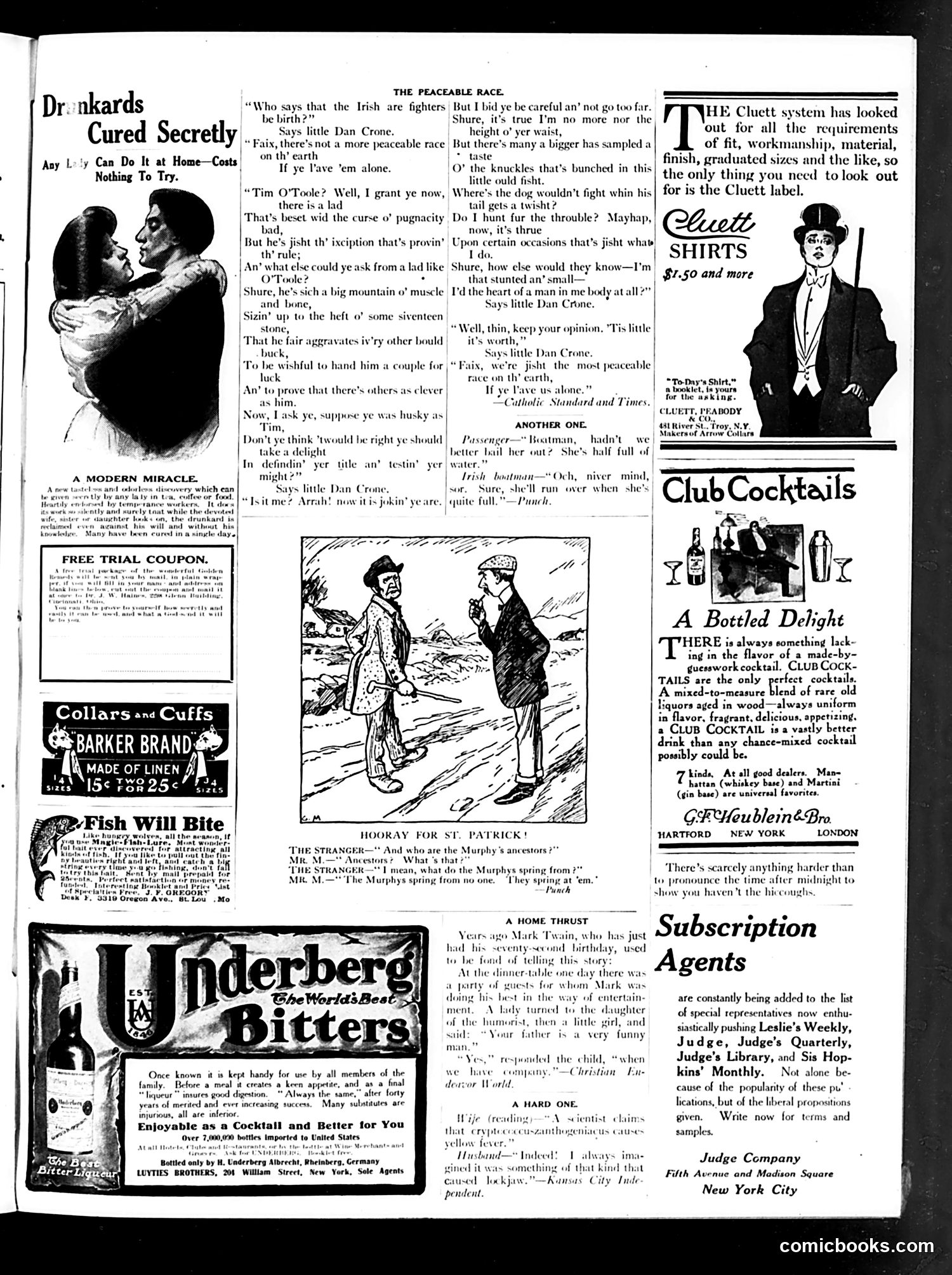
This page contains satirical Irish-American stereotypes typical of early 20th-century American humor. The main feature, "The Peaceable Race," presents a dialogue between Irish characters (Dan Crone and Tim O'Toole) discussing whether Irish people are inherently violent or peaceful. The satire relies on ethnic caricatures—depicting Irish immigrants with exaggerated speech patterns and stereotypical personality traits. The central joke appears to be ironic: characters claim Irish are peaceful, yet simultaneously boast about fighting ability and physical prowess. A secondary cartoon labeled "HOORAY FOR ST. PATRICK!" shows two figures in conversation about the Murphys' ancestry, with a punchline about them "springing" at things. The page is primarily **advertising-driven**, featuring product promotions (Cluett Shirts, Underberg Bitters, Barker Brand Collars) alongside these humor pieces. The humor reflects period attitudes toward Irish-American communities that modern readers would recognize as ethnic stereotyping.
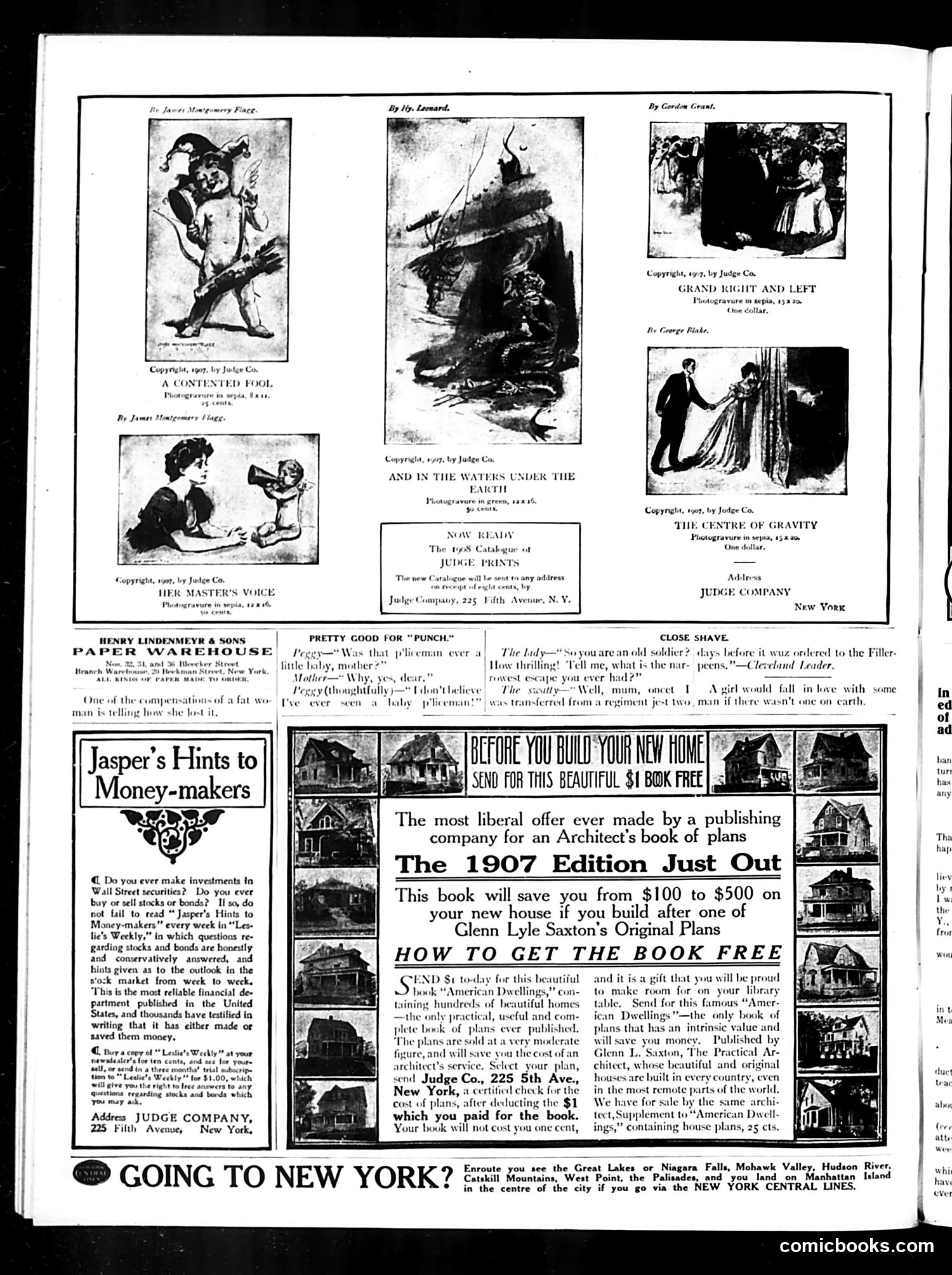
This page is primarily **advertising and filler content** rather than editorial cartoons requiring political interpretation. The top section contains three small illustrations by Judge contributors (Flagg, Blake, Grant) with captions—brief, lighthearted domestic humor typical of the era. "A Contented Fool" shows a woman with a baby; "Her Master's Voice" depicts a woman admiring a doll; "Grand Right and Left" and "The Centre of Gravity" appear to be dance or social scene illustrations. These are gentle, apolitical observations about gender, vanity, and social situations. The bulk of the page consists of advertisements: Henry Lindenmeyer's paper warehouse, "Jasper's Hints to Money-makers" (promoting Leslie's Weekly's investment advice column), and a prominent real estate promotion for Glenn Lyle Saxton's architectural plan book, offering a free $1 volume of house designs. A New York Central Lines railroad ad occupies the bottom. **No significant political satire is present.** This is a commercial page using Judge's masthead to sell products and services to its readership.
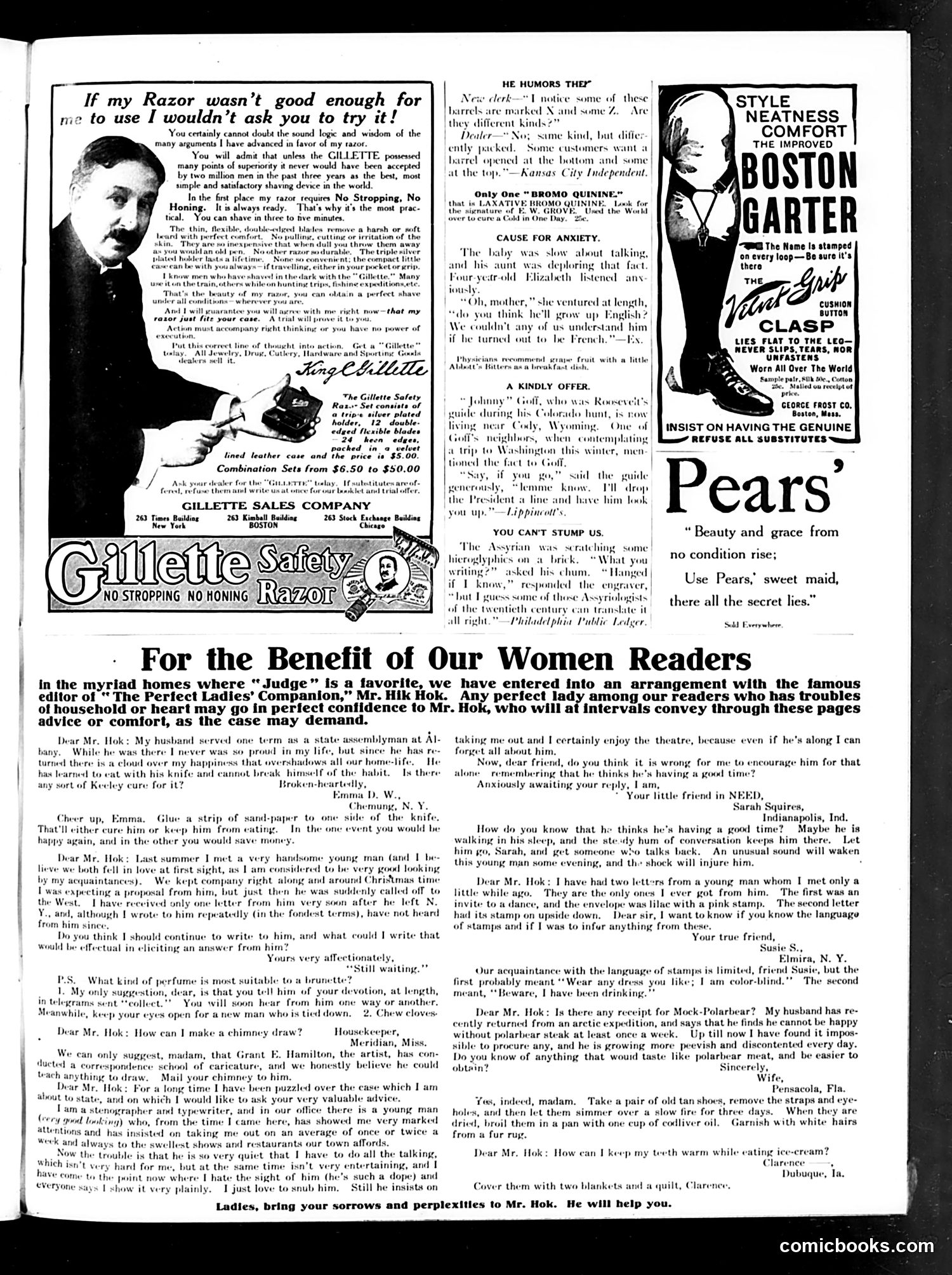
This page is primarily **advertising and advice columns**, not political satire. **Main Content:** 1. **Gillette Safety Razor advertisement** (top left): A testimonial from King C. Gillette himself, emphasizing the razor's superiority—no stropping or honing required, ready to use, and adopted by "two million men." The ad positions the product as logically superior and convenient. 2. **"For the Benefit of Our Women Readers"** (bottom half): An advice column called "The Perfect Ladies' Companion" by "Mr. Hok Hok," addressing domestic and romantic problems from female readers. Topics include: a husband eating with his knife, a woman's unrequited feelings for a young man, keeping teeth warm while eating ice cream, and how to discourage an overeager male coworker. 3. **Side advertisements** for Boston Garter shoes and Pears' soap, using period beauty/fashion messaging. **Historical Context:** This reflects early 1900s gender norms—women readers seeking advice on domestic etiquette, romance, and appearance from a male "expert."
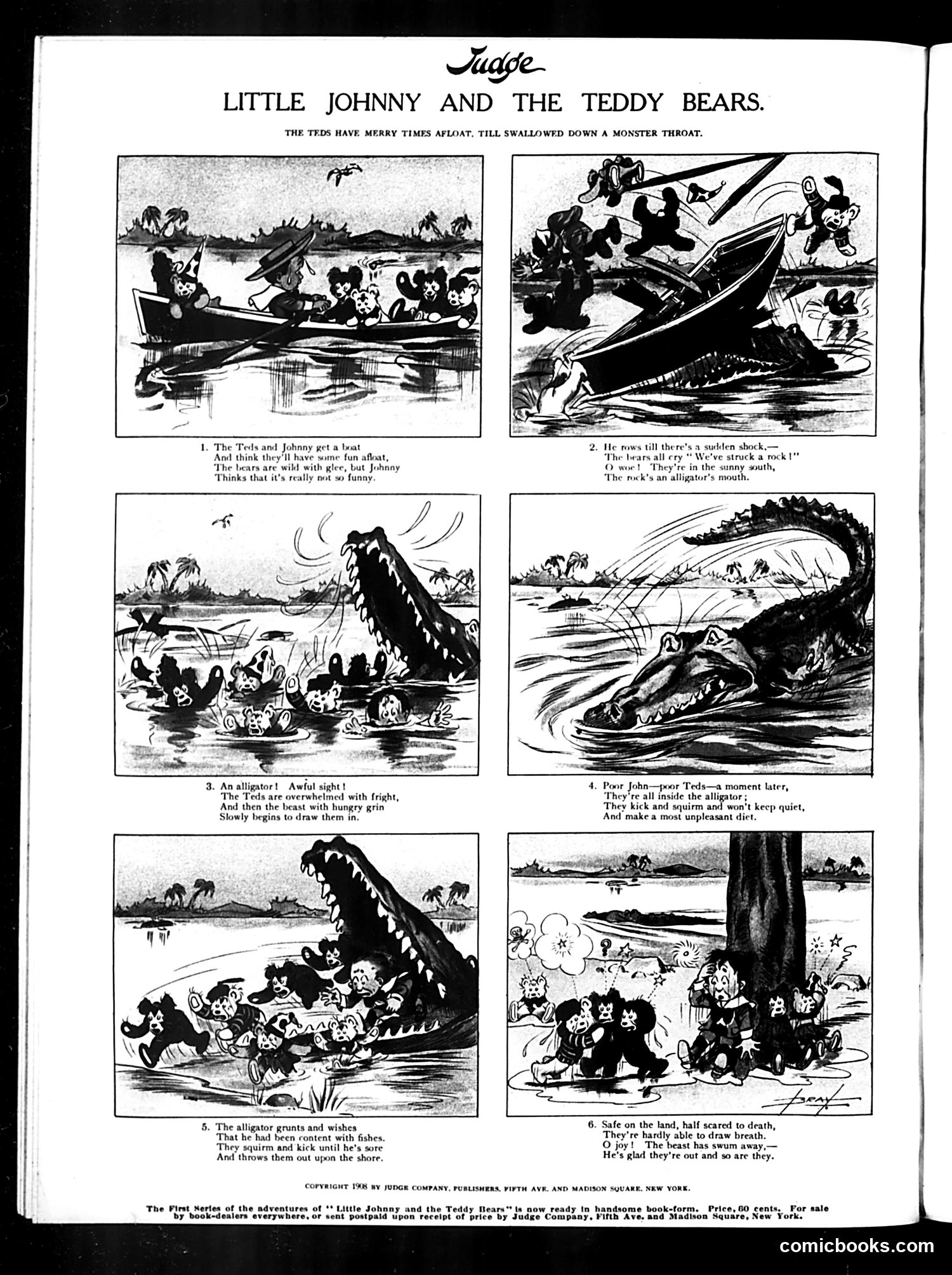
This is a children's adventure comic strip, not political satire. It tells a straightforward narrative: Little Johnny and toy teddy bears go boating, encounter a giant alligator that swallows them, experience discomfort inside (their squirming causes the alligator indigestion), and are expelled back onto shore unharmed. The "Teddy Bears" reference likely alludes to the popular "teddy bear" toy craze of the early 1900s, named after President Theodore Roosevelt. The strip appears designed as family entertainment—a lighthearted adventure story with anthropomorphized stuffed animals and exaggerated peril. The page advertises that this is the first series in a book collection, suggesting Judge magazine was promoting a companion publication. The copyright dates to 1908.