
A complete issue · 16 pages · 1908
Judge — March 14, 1908
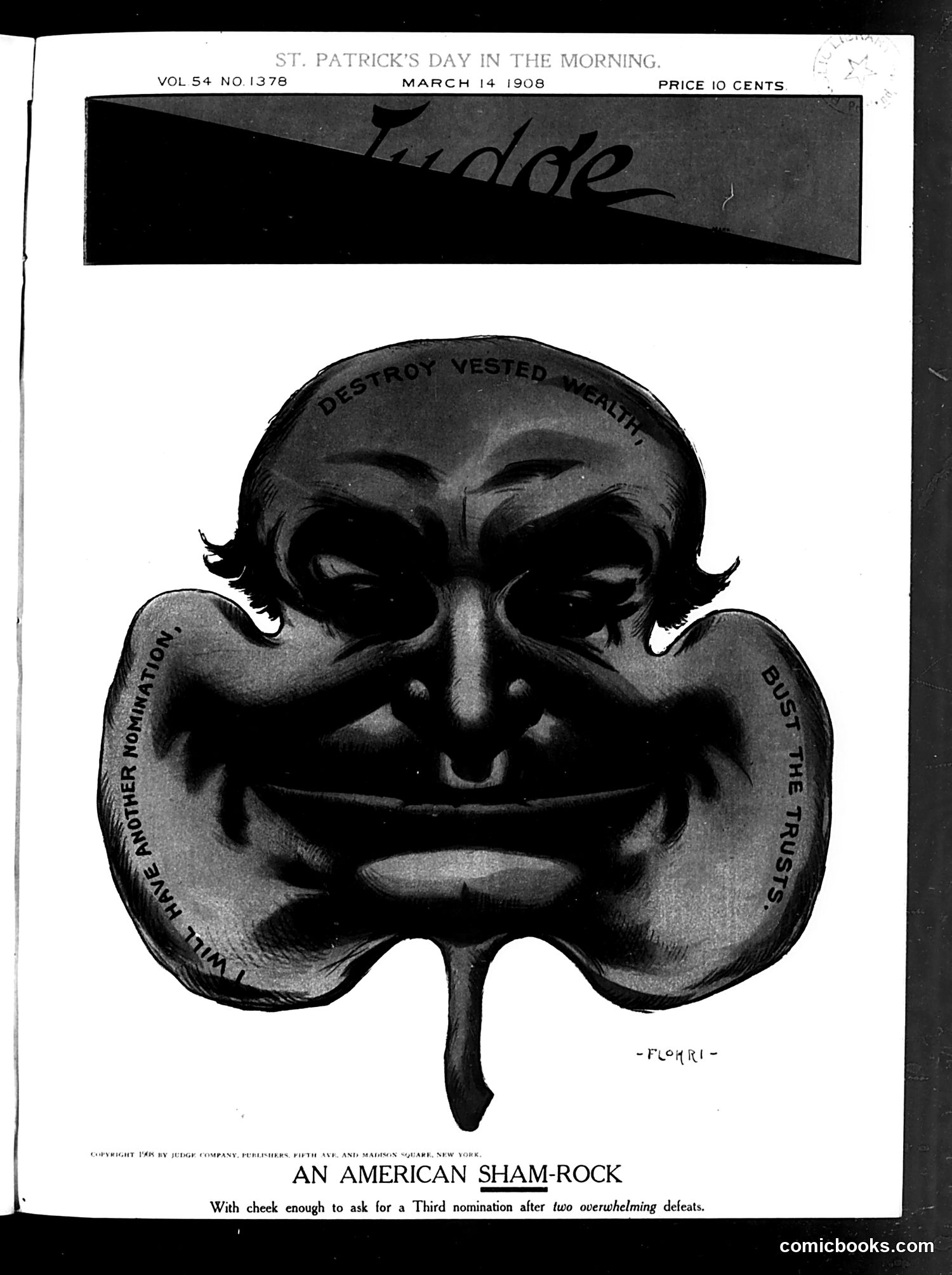
This is a St. Patrick's Day political cartoon from March 14, 1908. The grotesque face—labeled "DESTROY VESTED WEALTH" across the forehead and "BUST THE TRUSTS" on the cheeks—represents a caricatured Irish-American identity being used as a rhetorical weapon. The "sham-rock" pun references how radical economic rhetoric (trust-busting, wealth destruction) was being cynically deployed, likely during Theodore Roosevelt's presidency or the 1908 election. The cartoon suggests that anti-monopoly populism appealing to Irish-American voters was itself a fake or hollow performance—political posturing rather than genuine reform. The subtitle mocks candidates seeking a "Third nomination" despite "two overwhelming defeats," suggesting opportunistic political manipulation of immigrant voters.
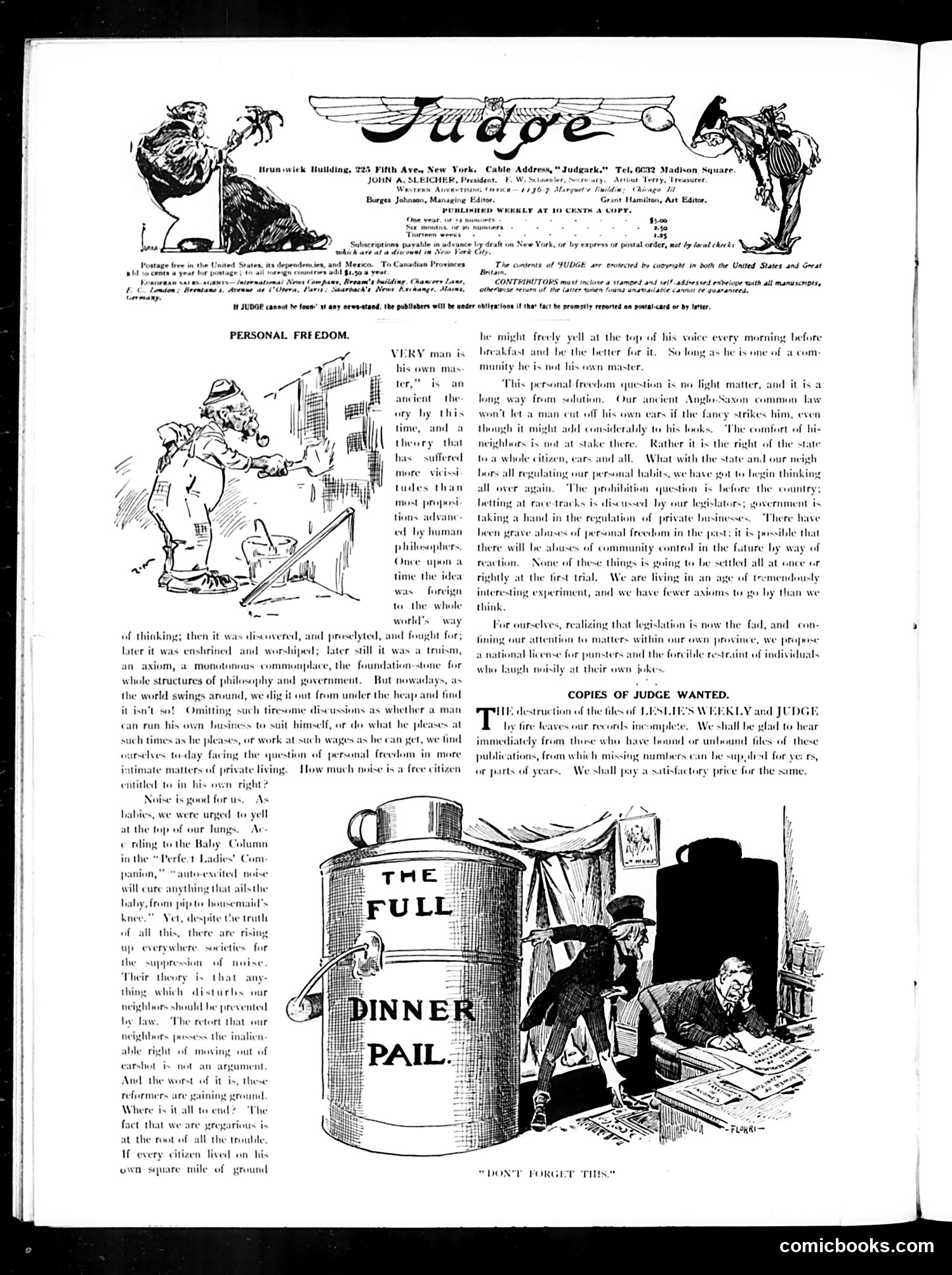
This page from Judge magazine contains an article titled "Personal Freedom" alongside two political cartoons. The main cartoon shows a figure emerging from what appears to be a large "dinner pail" labeled "THE FULL DINNER PAIL" — a reference to the Republican campaign slogan from the McKinley era promoting prosperity. A well-dressed man in a top hat (likely representing business interests or political authority) stands nearby. The caption reads "DON'T FORGET THIS," suggesting the cartoonist is warning against complacency or false promises of economic security. The article discusses personal liberty and government regulation of private businesses, arguing against excessive legislative control. The cartoon satirizes the gap between promised prosperity and actual conditions faced by ordinary citizens, critiquing both political promises and wealthy interests during the Progressive Era.
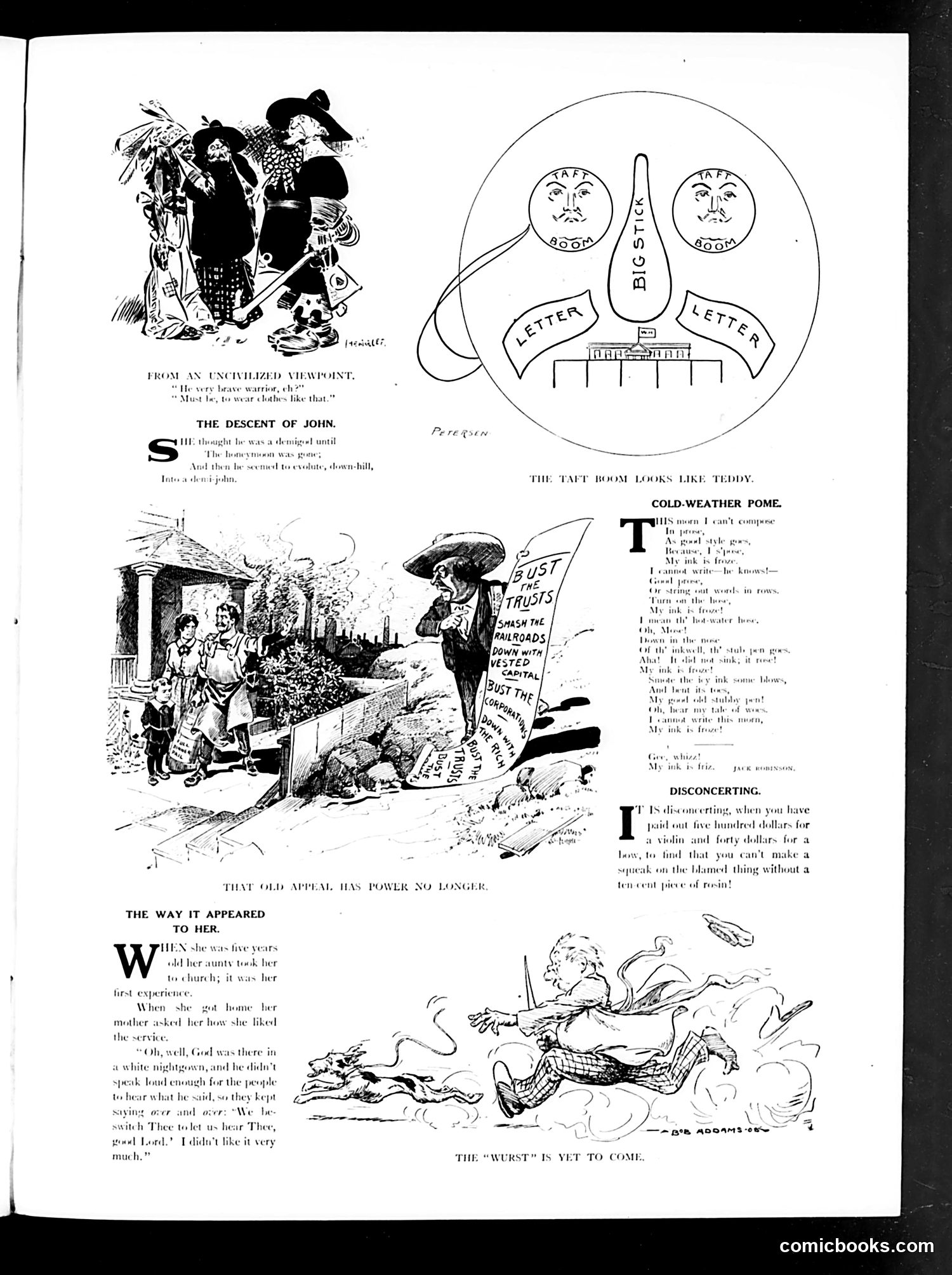
This page contains early 20th-century American satirical content. The cartoons address social and political themes: **"From an Uncivilized Viewpoint"** mocks contemporary fashion, suggesting wealthy people dress absurdly—likely critiquing Edwardian excess. **"The Descent of John"** appears to be verse satire, though the specific reference is unclear without additional context. **"That Old Appeal Has Power No Longer"** satirizes failed political rhetoric, showing a figure with reform placards unable to persuade. This likely comments on progressive-era politics losing effectiveness. **"The Taft Room Looks Like Teddy"** references President Taft's administration, possibly comparing it unfavorably to Theodore Roosevelt's. **"Cold-Weather Pome"** and **"Disconcerting"** are humorous literary pieces about seasonal complaints and domestic frustrations. The overall tone suggests middle-class anxieties about wealth, politics, and social change during the Progressive Era.
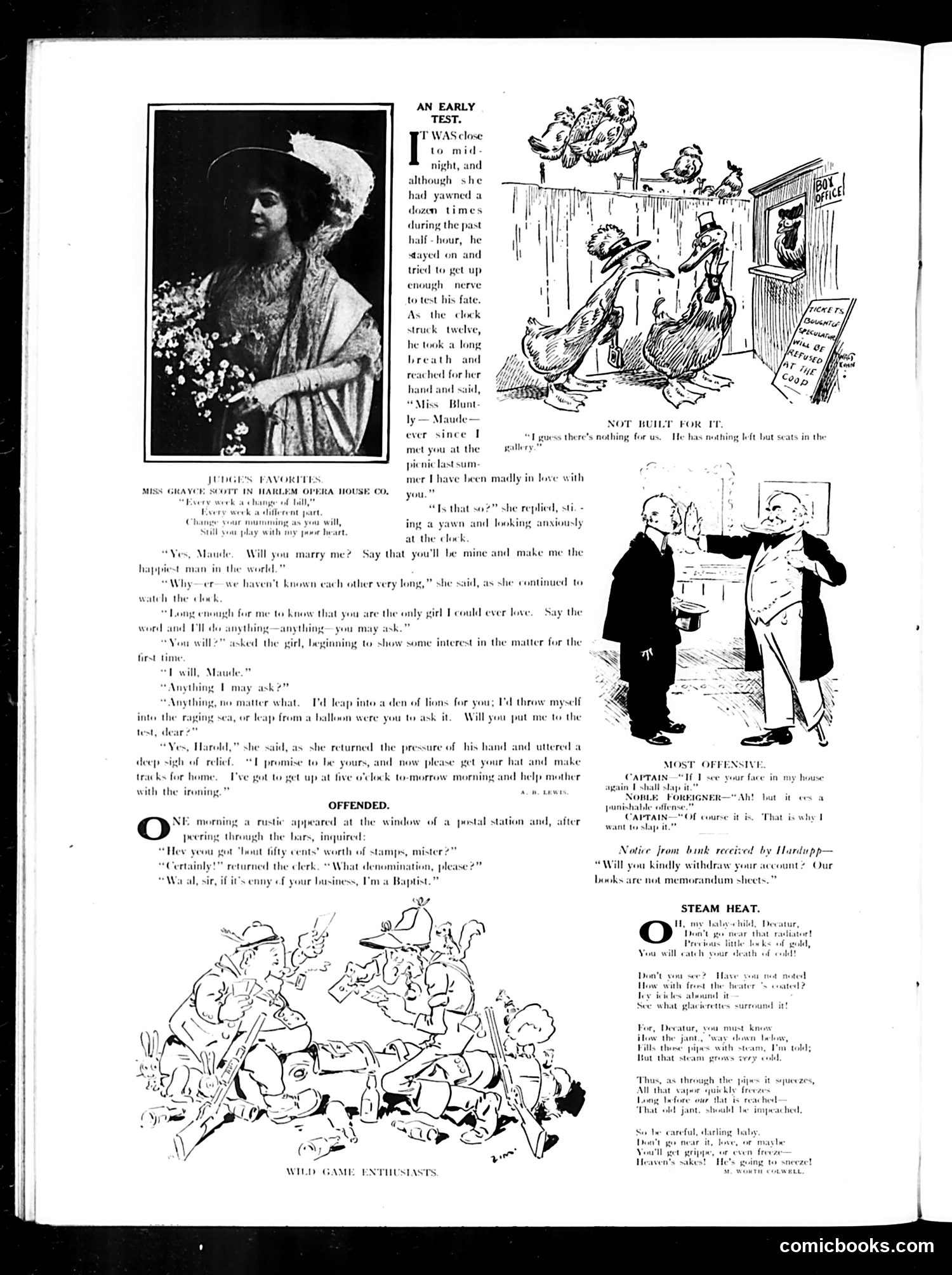
This page contains multiple unrelated satirical pieces typical of Judge magazine's format: **"An Early Test"** depicts a romantic scenario where a man tests his fiancée's devotion by asking her to marry him despite his poverty. The satire mocks both sentimental courtship rituals and women's expected financial dependence on marriage. **"Not Built for It"** jokes about theater seating and etiquette—likely referencing overcrowded venues or unsuitable accommodations. **"Offended"** satirizes postal service confusion regarding denomination or Baptist religious affiliation. **"Most Offensive"** and **"Steam Heat"** appear to be brief humor pieces about domestic/household complaints. **"Wild Game Enthusiasts"** shows a chaotic cartoon of hunters, mocking amateur sportsmen. The page exemplifies Judge's mix of social satire, domestic humor, and visual comedy targeting early 20th-century American middle-class experiences and pretensions.
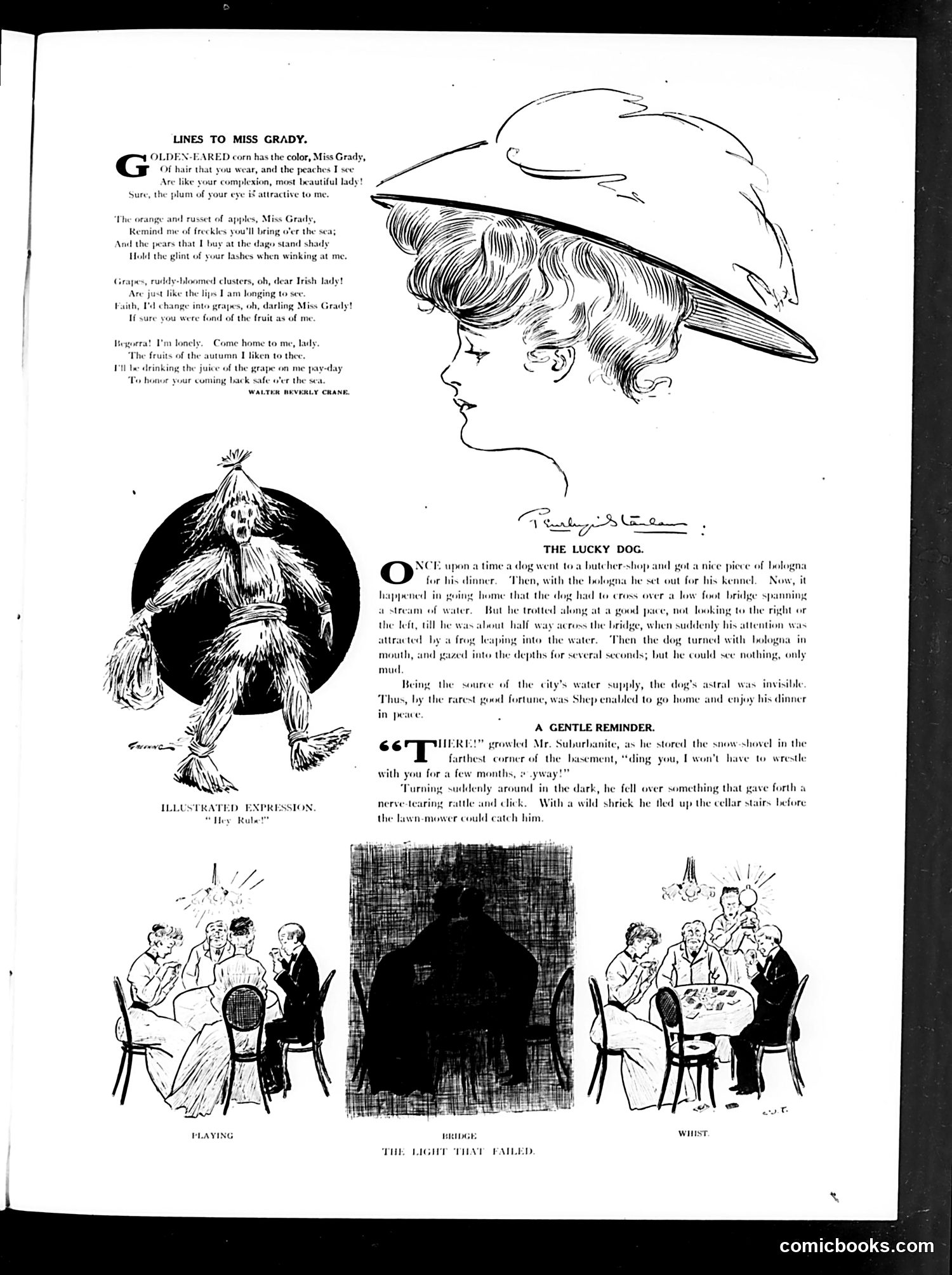
This page contains three unrelated pieces: 1. **"Lines to Miss Grady"** - A poem by Walter Beverly Crane praising an Irish woman named Miss Grady, focusing on her appearance and charm. No political satire is evident. 2. **"The Lucky Dog"** - A humorous anecdote about a dog that nearly drowns crossing a bridge with bologna in its mouth, then has an encounter with a lawn mower. This is lighthearted fiction with no satirical intent. 3. **"The Light That Failed"** - Three cartoon panels showing people playing cards and bridge. The title appears to reference a Rudyard Kipling novel, but the specific satirical meaning is unclear from the image alone. The middle panel shows a darkened room, possibly commenting on failed illumination or ambition. The page mixes poetry, short humor, and comics without obvious unified political commentary.
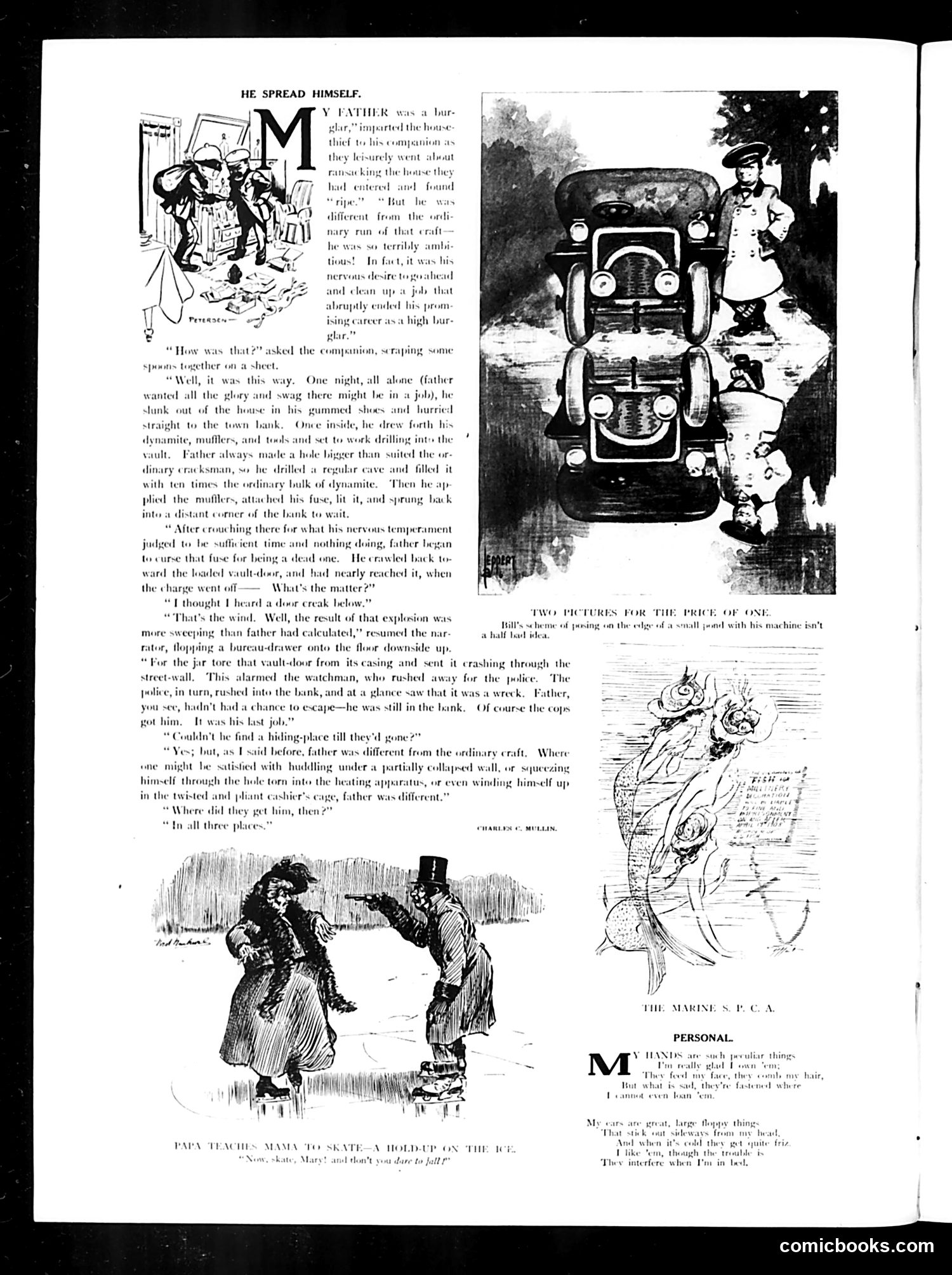
This page contains a humorous story about an ambitious burglar whose father was also a criminal. The satire mocks the son's attempt to outdo his father's accomplishments through excessive ambition—he "spread himself" too thin. The joke: The father, wanting all the glory from a bank job, uses **ten times the normal amount of dynamite** in the vault. The explosion is so powerful it destroys the entire bank, traps him inside, and he's immediately caught by police. His over-ambition defeats him entirely. The accompanying cartoons offer lighter humor: one shows a man demonstrating ice-skating to a woman (with predictably chaotic results), and another depicts marine life, labeled "The Marine S.P.C.A." The satire reflects early 20th-century attitudes toward crime fiction and the "ambitious criminal" archetype—poking fun at the notion that excessive zeal, even in criminal enterprise, leads to failure.
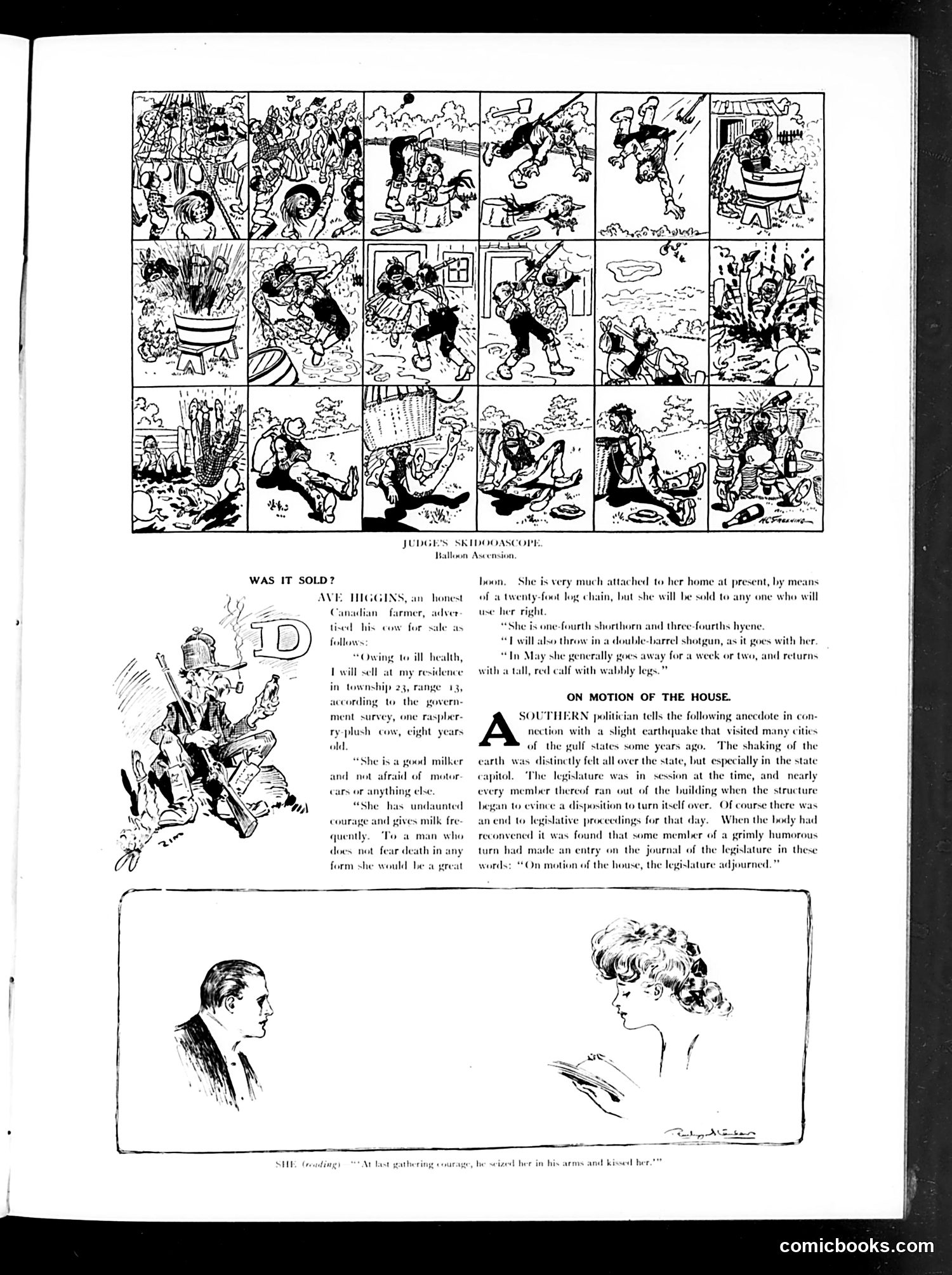
This page contains two satirical pieces typical of early-20th-century American humor: **"Judge's Skidooascope"** (top comic strip): A wordless 18-panel visual gag about balloon ascension, showing slapstick chaos as figures interact with a hot-air balloon—typical vaudeville-style physical comedy of the era. **"Was It Sold?"** (middle section): Mocks rural classified ads by exaggerating a humorous cow advertisement, poking fun at farmers' matter-of-fact descriptions of livestock quirks (the animal goes missing in May, returns with unexplained calves). **"On Motion of the House"** (bottom): An anecdote satirizing Southern legislators' composure during an earthquake. The joke: when the statehouse shook, lawmakers fled, then humorously recorded their panicked departure as an official adjournment motion—mocking both regional political pretension and bureaucratic absurdity. The bottom illustration shows two profile sketches accompanying the anecdote. All three pieces employ gentle, absurdist humor characteristic of *Judge*'s satirical approach to American life and politics.
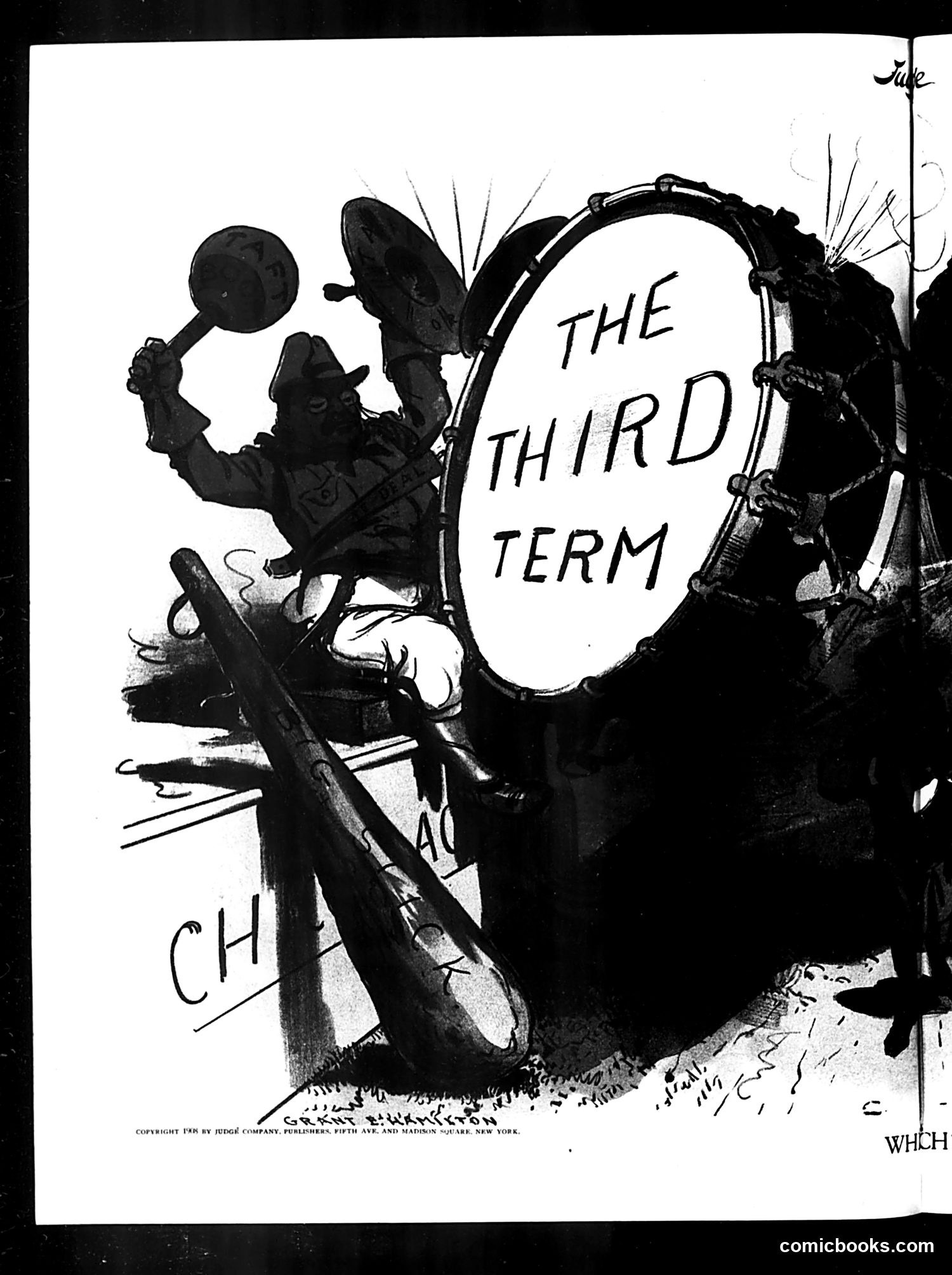
This political cartoon satirizes a presidential candidate's pursuit of a third consecutive term—likely referencing Theodore Roosevelt or Franklin D. Roosevelt, both of whom faced this controversy. The drum labeled "THE THIRD TERM" is being beaten by a caricatured figure, suggesting aggressive campaigning or relentless promotion of this unprecedented ambition. The imagery—with the large drum and energetic figure—emphasizes how loudly and persistently the third-term bid is being promoted. The cartoon critiques what many Americans viewed as antidemocratic, as the two-term presidency tradition (later codified in the 22nd Amendment in 1951) was considered a constitutional safeguard against executive overreach. The satire mocks the campaign's intensity and the breaking of established precedent.
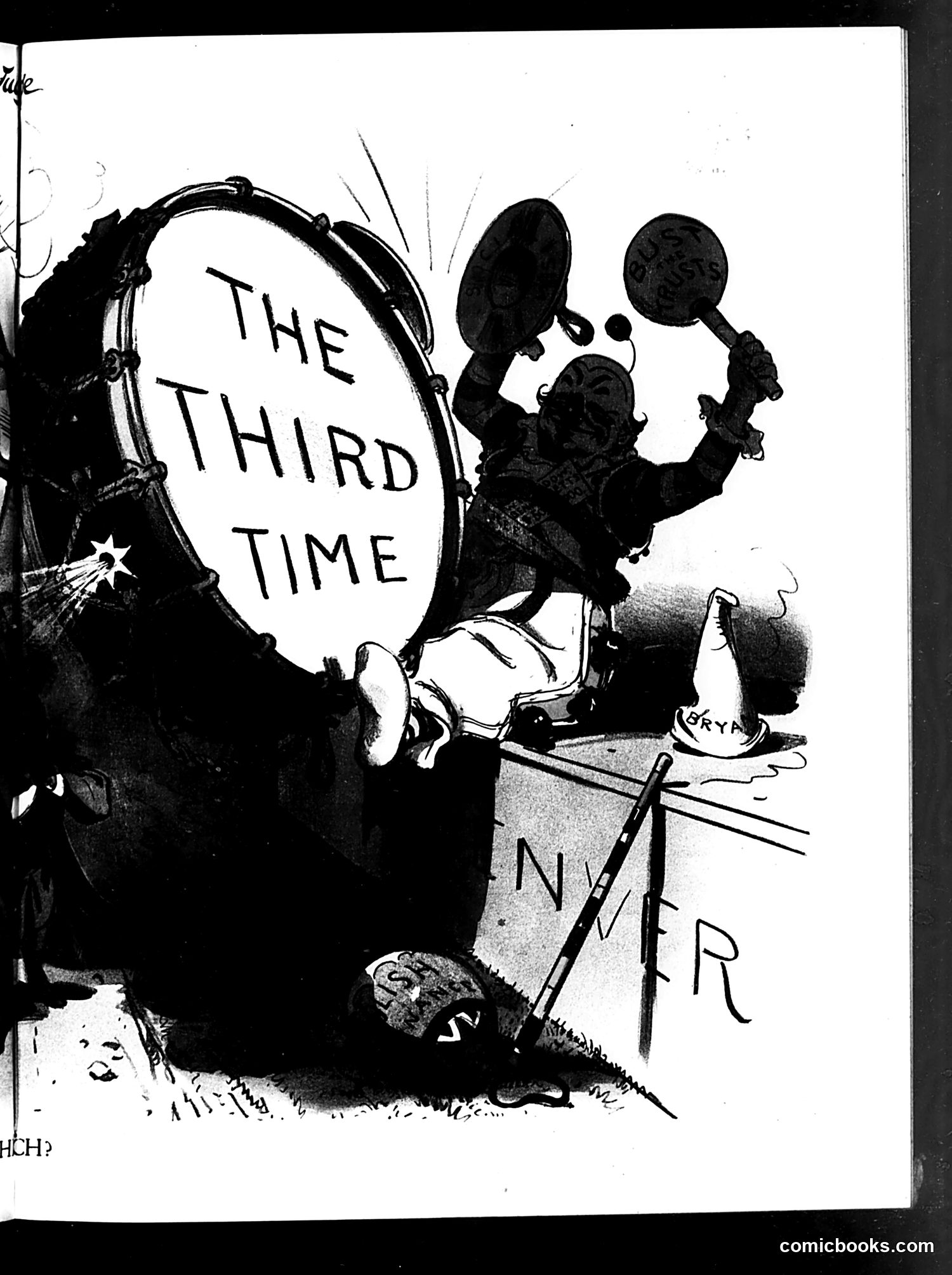
This political cartoon depicts a drummer or percussionist labeled "THE THIRD TIME," beating large bass drums while marching. The figure appears to be a caricatured entertainer or public performer. The text "N W E R" is partially visible at the bottom, likely part of a longer word. The satire likely references a repeated occurrence or cyclical event happening for a "third time"—a common structure in political humor suggesting patterns or inevitable repetition. Without clearer context about the publication date or visible identifying text, I cannot specify which particular historical event or political situation this cartoon satirizes. The energetic percussion imagery suggests either enthusiasm being repeatedly generated or, conversely, a tiresome repetition of propaganda or performance.
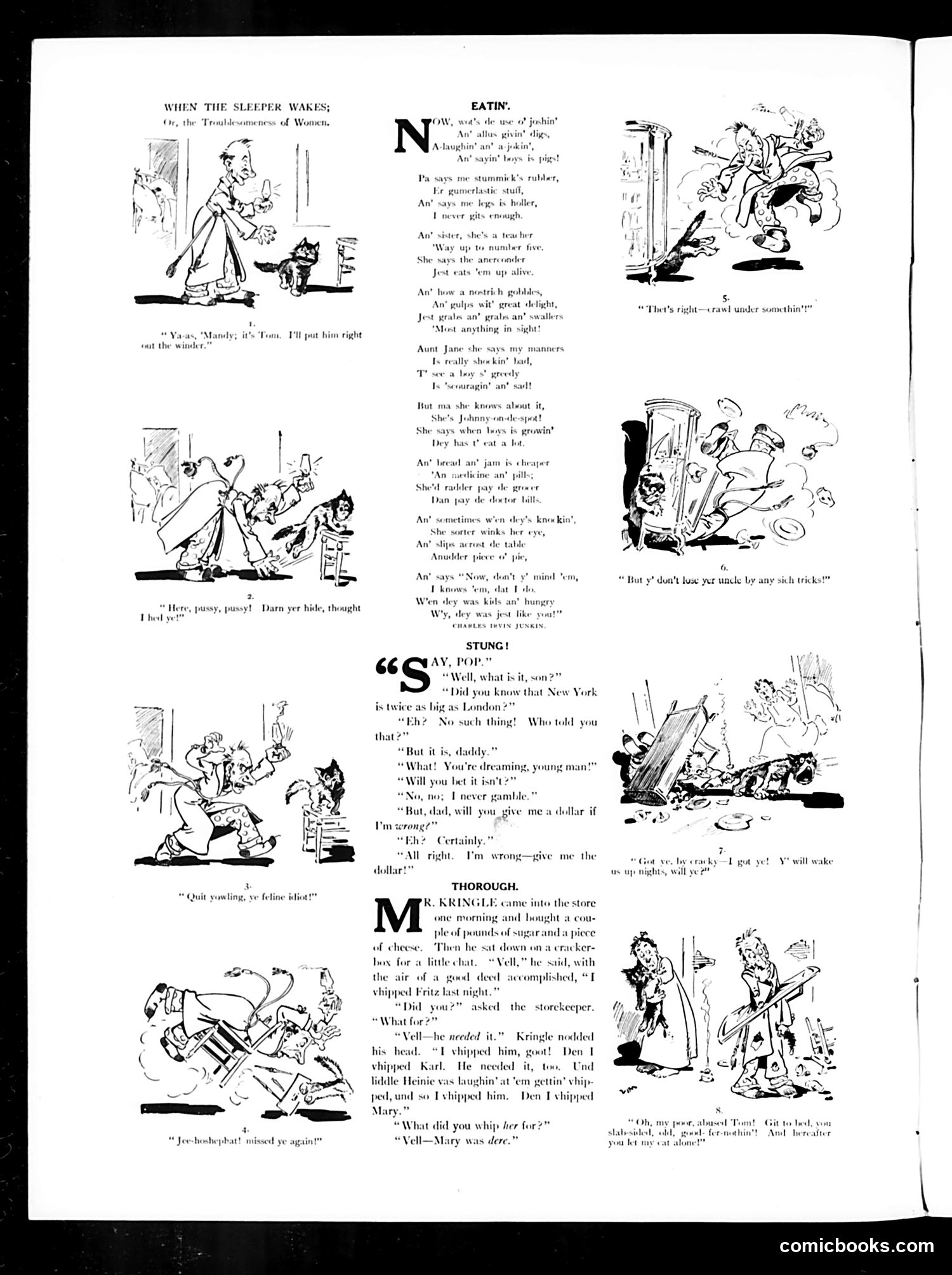
This page contains three satirical pieces about domestic life and parenting: **"When the Sleeper Wakes"** mocks the contradictory complaints of growing boys—fathers grumble about their appetites and behavior while mothers indulge them, creating confusion about expectations. **"Stung!"** satirizes a child's attempt to trick his father with a false claim that New York is twice the size of London, betting for a dollar. The joke is on naive parental gullibility. **"Thorough"** features a German immigrant character (Kringle, indicated by dialect spelling like "vhipped" for "whipped") who describes indiscriminately whipping his children—Fritz, Karl, Heinie, and Mary—claiming each "needed it." The satire critiques harsh, unthinking parental discipline presented matter-of-factly. The character's casual brutality and immigrant dialect suggest period stereotyping about European child-rearing practices. All three pieces use humor to critique parenting inconsistency and excess.
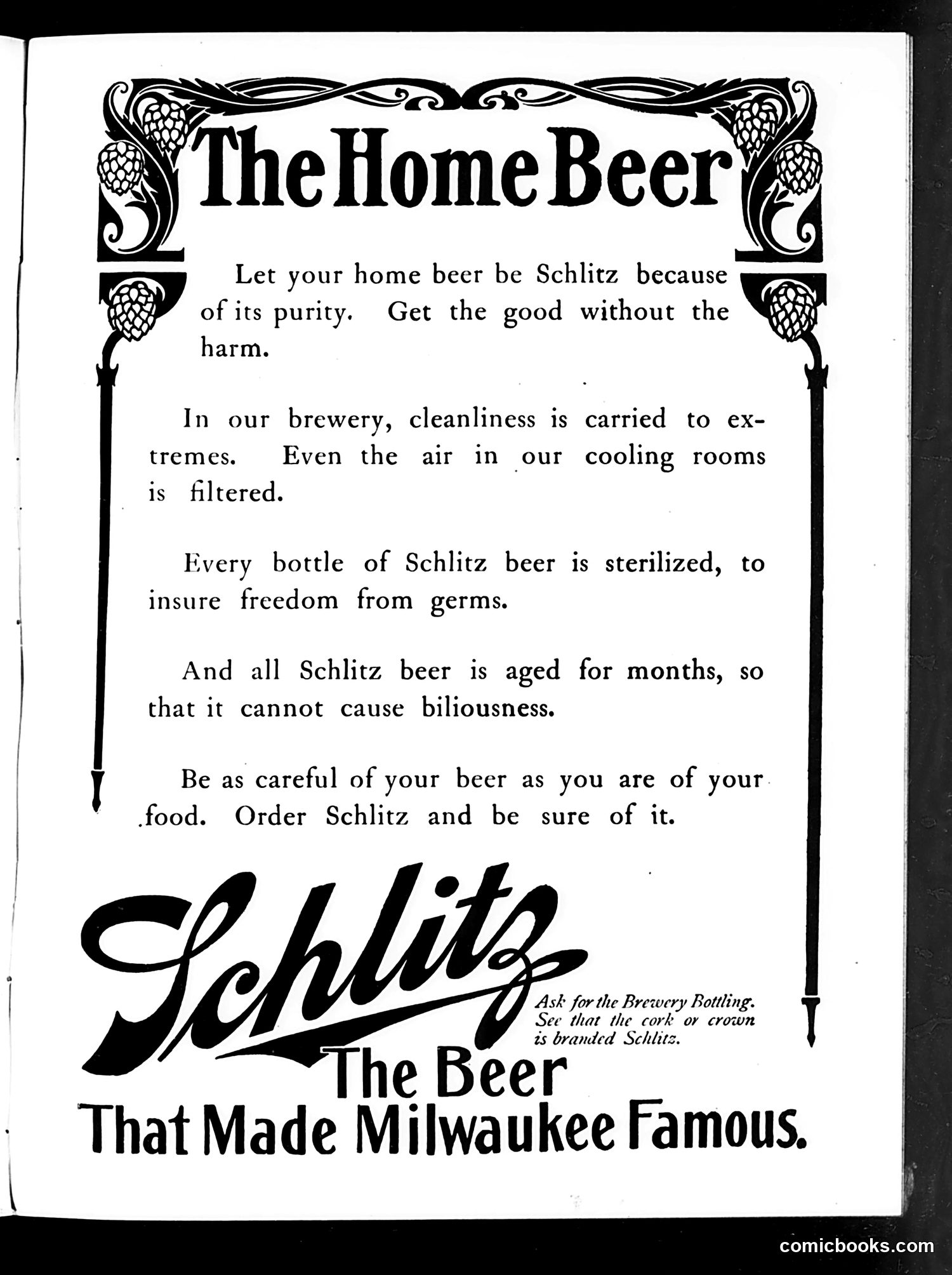
This is a **Schlitz beer advertisement**, not a political cartoon. It appeared in *Judge*, a satirical magazine, but functions as straightforward commercial promotion rather than satire. The ad emphasizes **health and safety claims** — purity, sterilization, filtered air, and aging to prevent "biliousness" (digestive upset). This messaging reflects early 20th-century marketing that positioned beer as a safe, controlled product comparable to food safety. The decorative hop motifs frame the text. The tagline "The Beer That Made Milwaukee Famous" references Milwaukee's prominence as a beer-brewing hub. For modern readers, the health claims appear quaint; today's beer marketing focuses on taste and lifestyle rather than medical benefits. The emphasis on germfree production reflects pre-refrigeration anxieties about contamination.
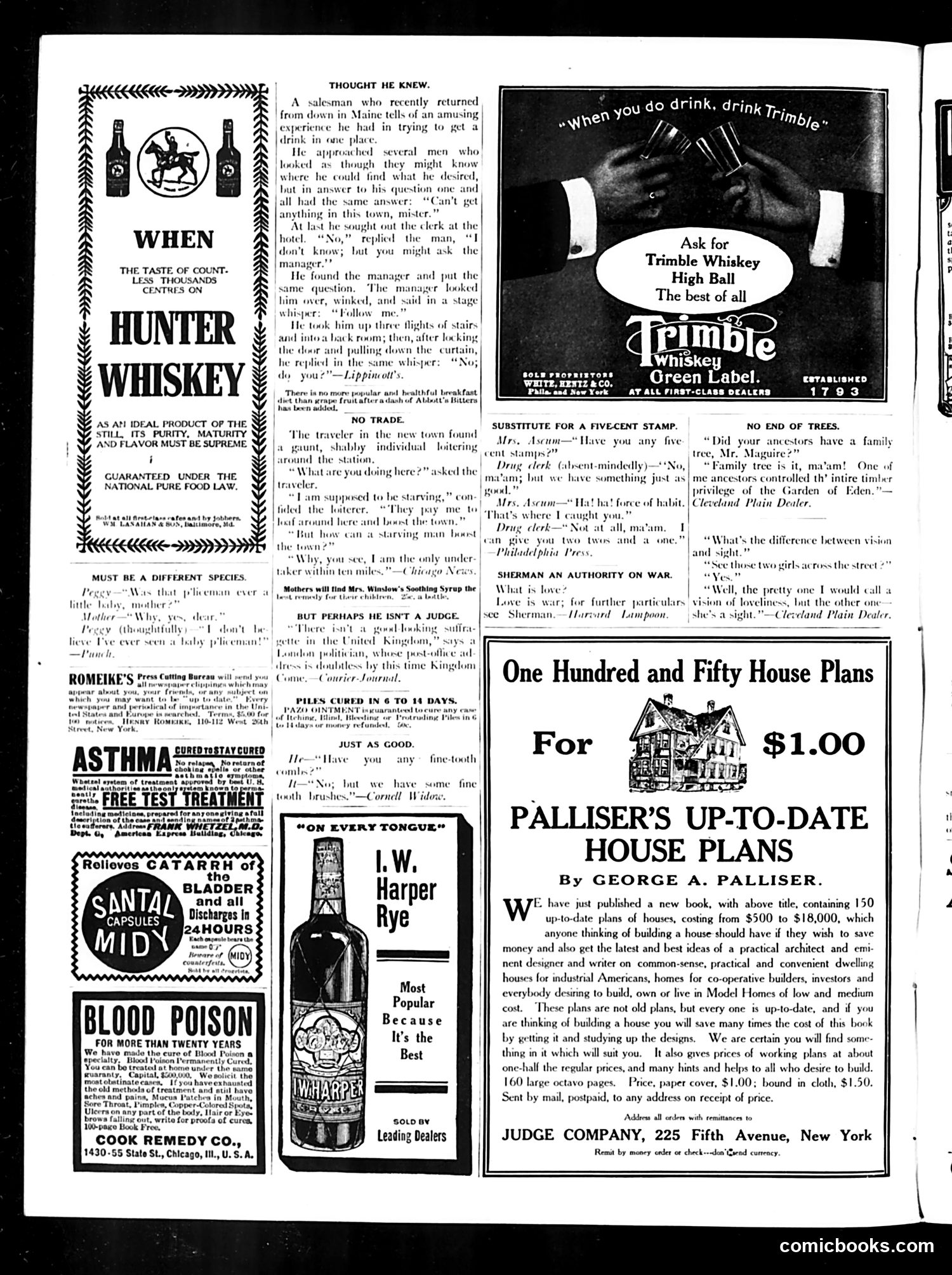
This page from *Judge* magazine contains several brief humorous anecdotes rather than political cartoons: **"Thought He Knew"** satirizes Prohibition-era hypocrisy. A traveling salesman searches for an illegal drink in Maine. Everyone claims nothing is available, but the hotel manager winks and secretly leads him upstairs—suggesting widespread underground drinking despite legal prohibition. **"Must Be a Different Species"** jokes about economic hardship. A starving man in a new town is paid to appear destitute (as the town's only undertaker, he needs to look poor to attract business). The absurdist humor mocks small-town economics and desperation. **Other brief jokes** include wordplay about toothbrushes as drink substitutes and light observations about relationships. The page is predominantly **advertisements** for whiskey, house plans, patent medicines (asthma treatments, blood poison cures), and other products—typical of early 20th-century magazine advertising. The editorial content serves mainly to fill space between ads rather than deliver serious satire.
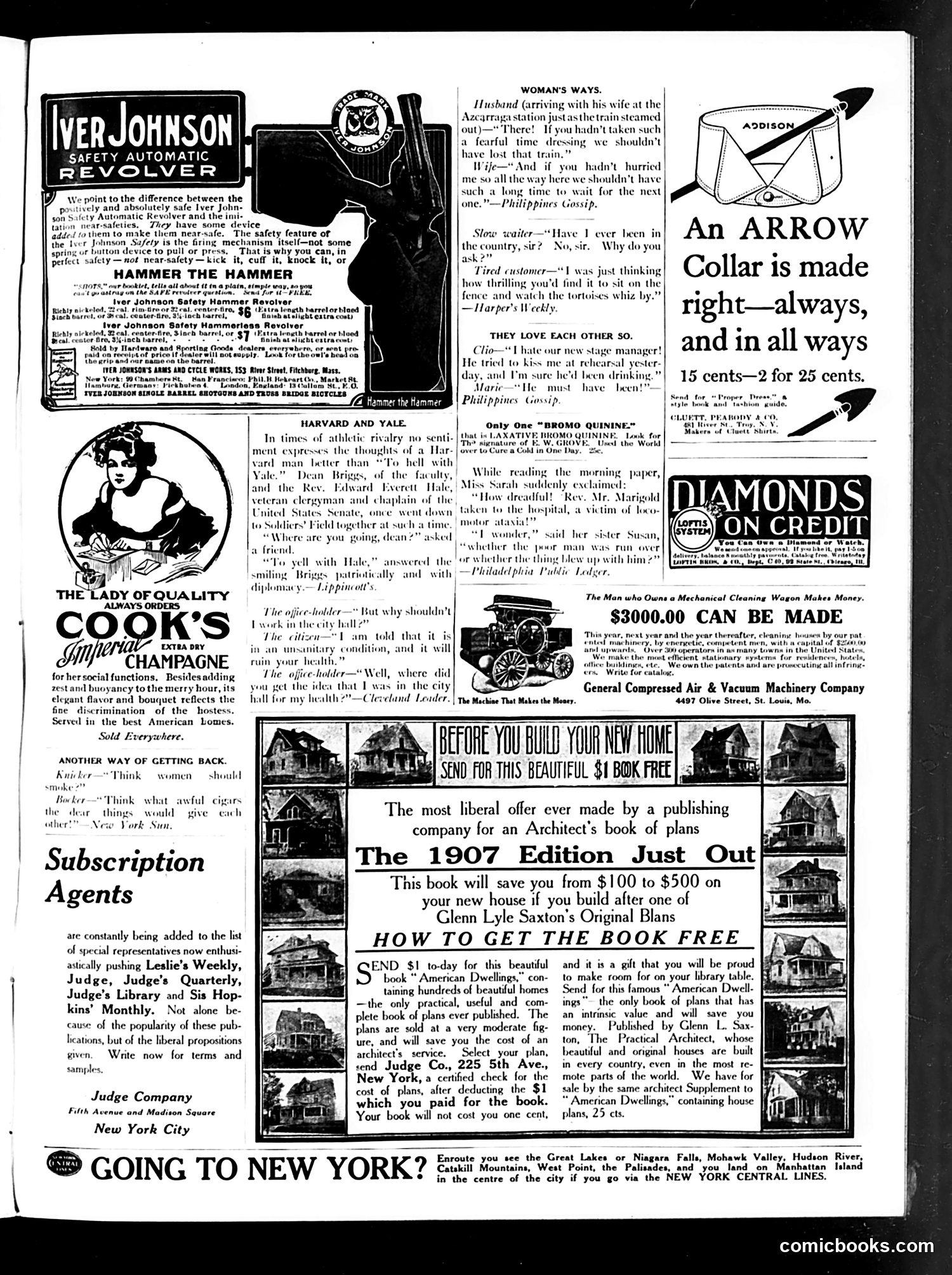
This page from Judge magazine (circa early 1900s) contains primarily **advertisements and humor columns** rather than political cartoons. The humor pieces are short, domestic jokes reflecting period gender attitudes: - "Woman's Ways" depicts spouses blaming each other for missing a train - "They Love Each Other So" presents backstage theater gossip - A Harvard-Yale rivalry anecdote shows collegial religious irreverence - Office and workplace humor about sanitary conditions and romance **Notable advertisements** include: - Iver Johnson Safety Revolvers (emphasizing mechanical safety) - Arrow Collars (15 cents) - Cook's Champagne (marketed as a quality hostess beverage) - A mechanical cleaning wagon business opportunity ($3,000 potential income) - A free 1907 architectural house-plans book The page reflects **early 20th-century commercial culture and social norms**: emphasis on product safety features, gendered domestic roles, workplace flirtation, and entrepreneurial opportunity. The humor is gentle, workplace-focused, and lacks sharp political satire.
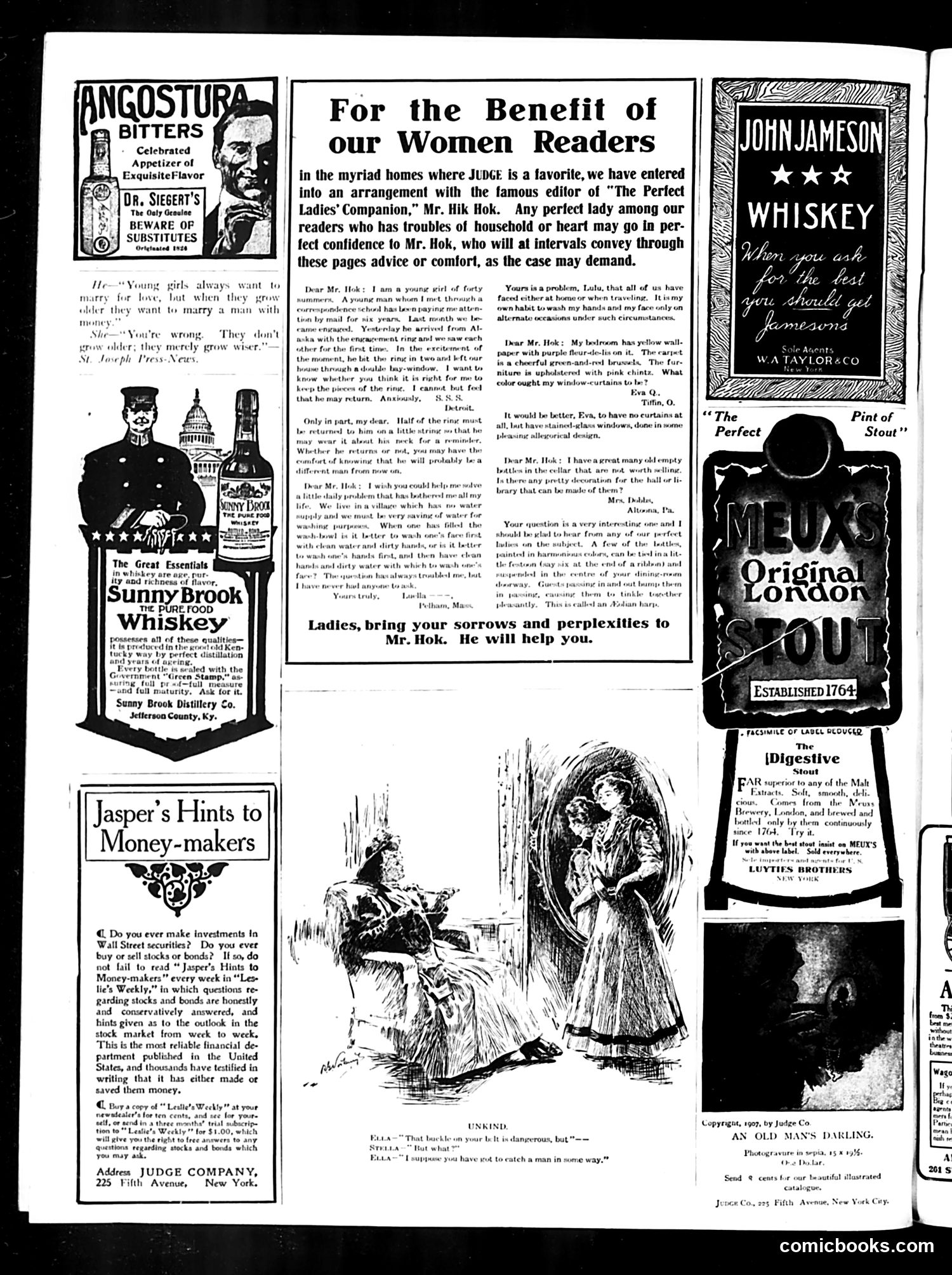
This page is primarily **advertising and advice columns** rather than political satire. It contains: **Main Content:** - A fake advice column titled "For the Benefit of our Women Readers," where "Mr. Hik Hok" (likely a name playing on "how-to" advice) answers household and domestic questions from female readers about cleaning, decoration, and life problems. **Advertisements:** Multiple liquor ads dominate the page—Angostura Bitters, Sunny Brook Whiskey, John Jameson Whiskey, and Original London Stout—each marketing their products with claims of quality or health benefits (typical of early 1900s advertising before pure food regulations). **Other Content:** - A brief joke about women's marriage preferences - "Jasper's Hints to Money-makers," promoting financial advice in *Leslie's Weekly* - An illustration titled "Unkind" showing two women in period dress **Historical Context:** This reflects early-20th-century gender assumptions: advice columns patronizingly addressed women's "domestic troubles," while the heavy alcohol advertising was still legal and common in mainstream publications.
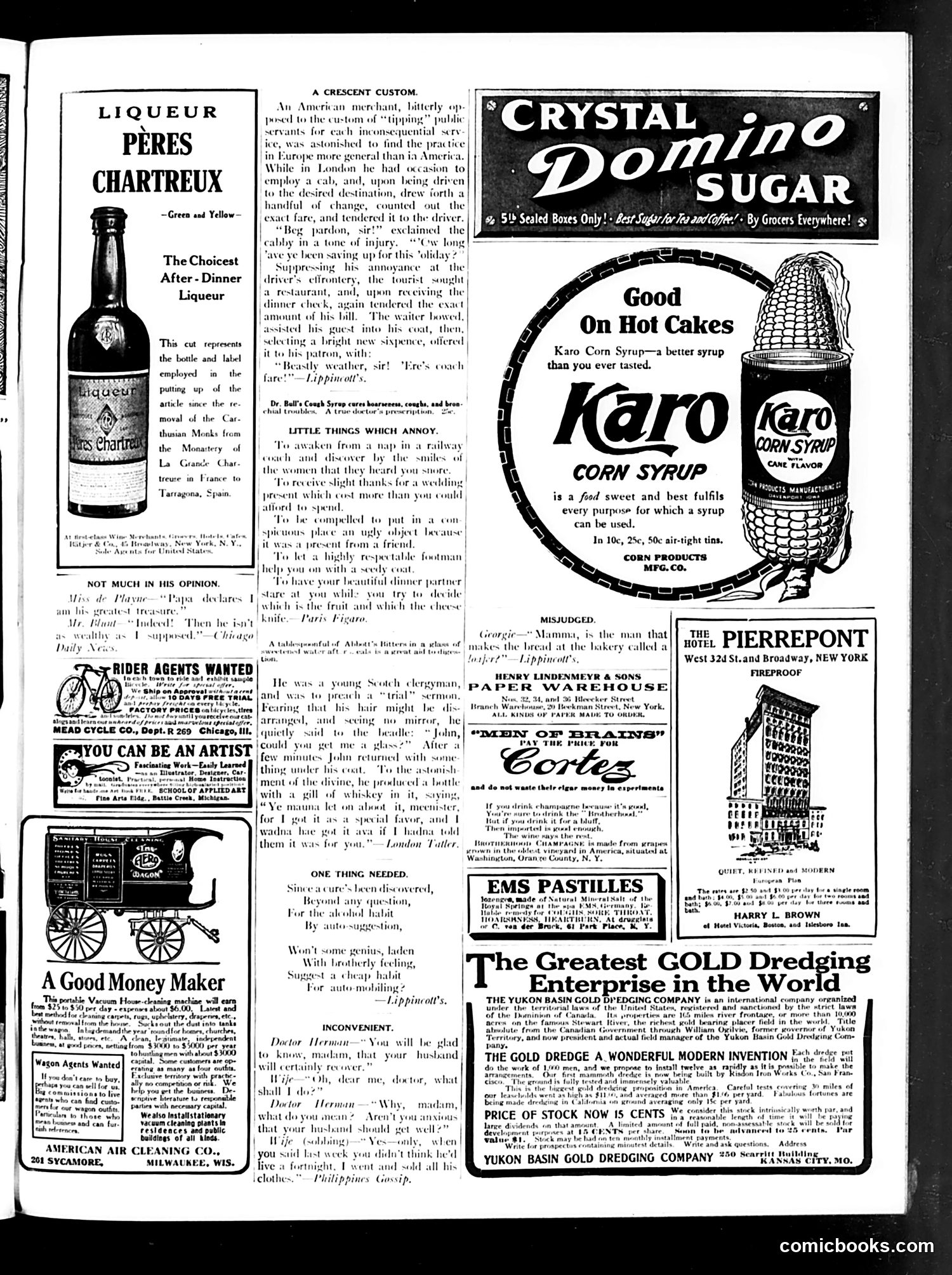
This page is primarily **advertisements and humor columns** rather than political cartoons. The main content includes: **"A Crescent Custom"** (top): A satirical anecdote mocking American tourists abroad. An American businessman in London refuses to tip a cab driver the expected sixpence, offending him. The joke illustrates American unfamiliarity with British tipping customs—portrayed as stingy and culturally ignorant compared to European service expectations. **"Little Things Which Annoy"**: A humor column listing minor social irritations (railway naps, wedding gifts, dinner etiquette). **Other sections**: Brief comic dialogues about doctor-patient misunderstandings and clerical mishaps. The page is otherwise dominated by **period product advertisements** (liqueur, corn syrup, bicycles, paper warehouse) typical of early-20th-century magazines. No clear political satire or significant caricatures are present—the humor is gentle, domestic, and class-conscious rather than partisan.
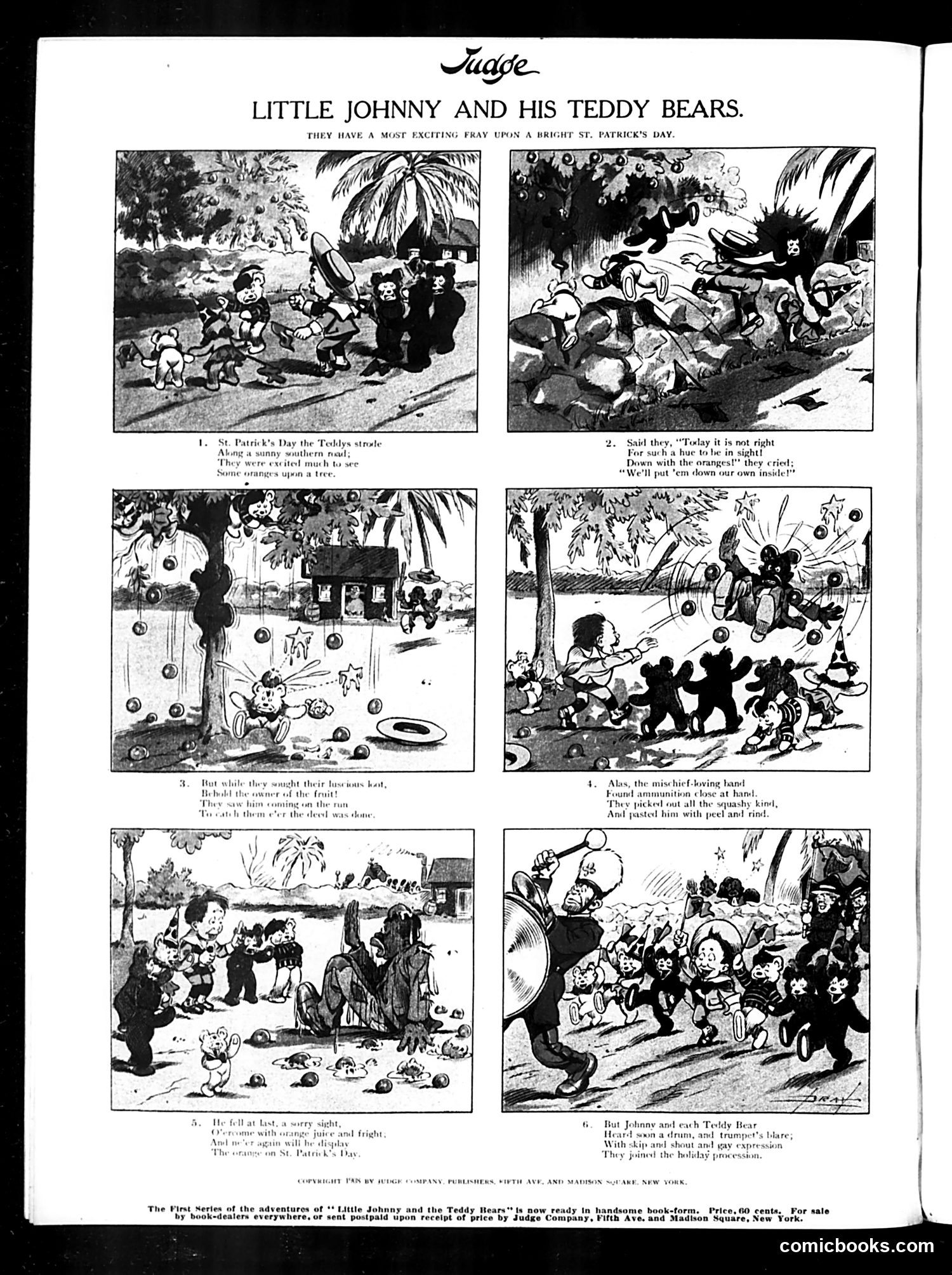
This is a six-panel children's comic strip depicting Little Johnny and anthropomorphic teddy bears celebrating St. Patrick's Day. The narrative follows a chaotic parade or street celebration where the bears encounter what appears to be an orange (a symbol of Protestant/Irish Unionist identity) and react with alarm—"Today it is not right / For such a bug to be in sight!" The bears then pursue and destroy the orange with various weapons and explosives, ultimately capturing and punishing its owner with "peel and rust." The strip appears to be **satirizing Irish-American Catholic identity and sectarian tensions** of the early 20th century, specifically the Protestant-Catholic divide in Ireland. The orange represents Protestant/Orange Order symbols. The joke for Judge's audience would have been the exaggerated ethnic stereotyping of Irish immigrants' St. Patrick's Day celebrations and their anti-Protestant sentiment. The advertisement at bottom indicates this was part of a serialized book series being marketed to readers.