
A complete issue · 16 pages · 1908
Judge — January 11, 1908
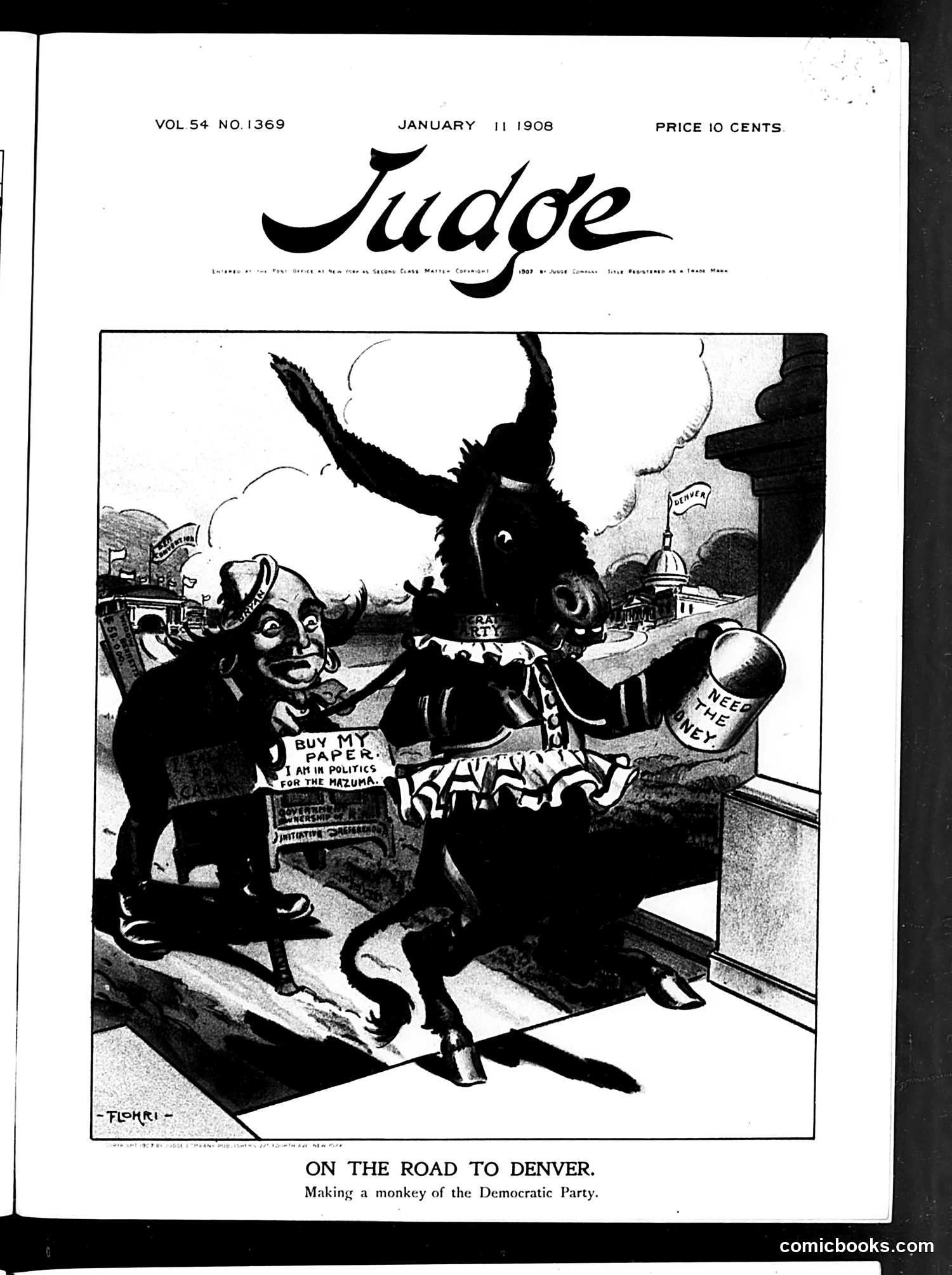
This January 1908 *Judge* cartoon satirizes the Democratic Party ahead of their national convention in Denver. The central figure is a donkey wearing horns and a jester's costume—the donkey being the Democratic Party's symbol. A monkey on the left holds a sign reading "BUY MY PAPER, I AM IN POLITICS FOR THE ARIZONA" (text partially unclear), while another figure labeled "NEED THE MONEY" appears on the right. The cartoon criticizes Democratic politicians for their self-serving behavior and sensationalism, suggesting they're making fools of themselves through mercenary politics and dishonest journalism. The setting appears to be Washington D.C., with Capitol building visible in the background.
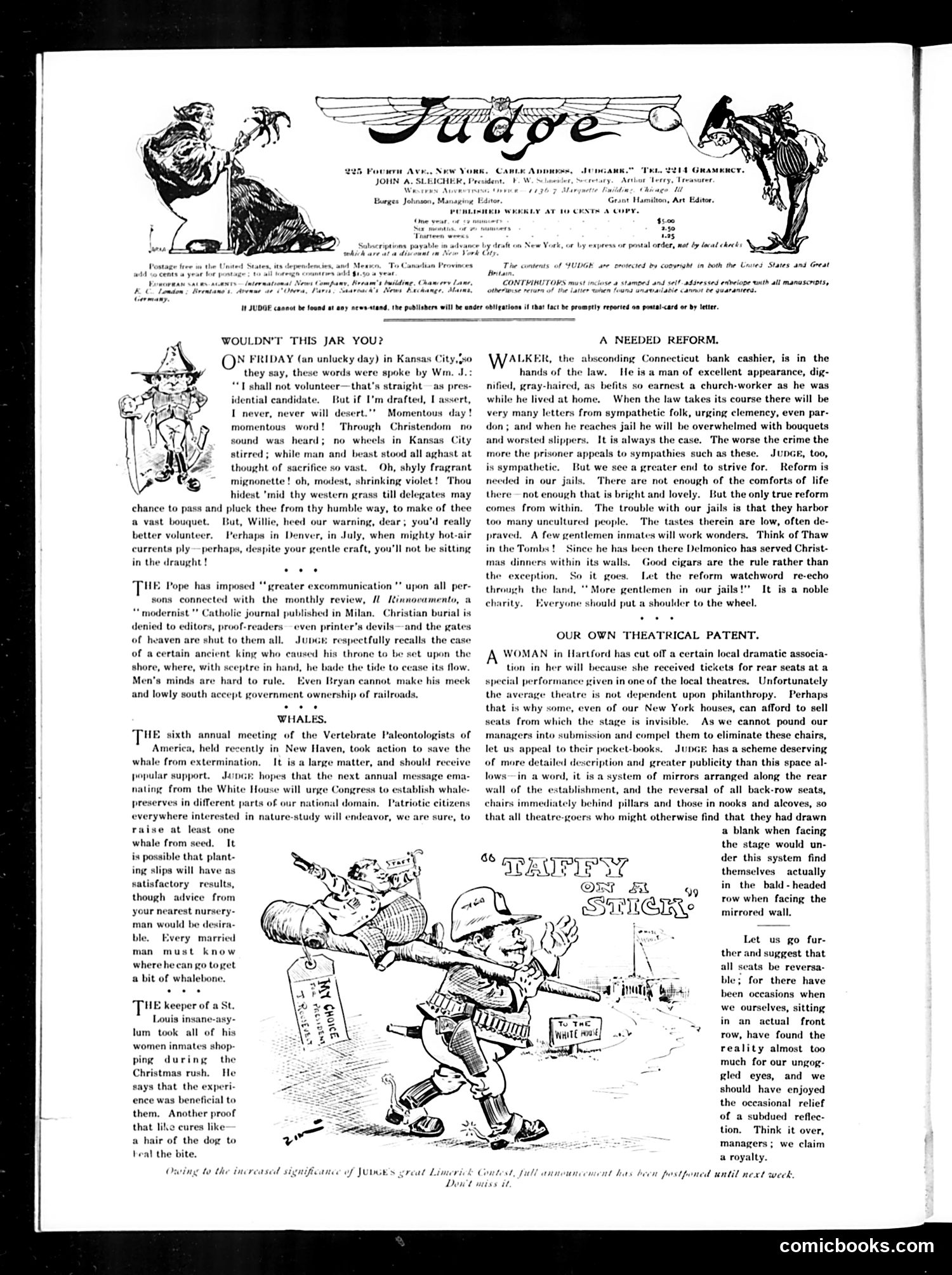
This page contains three separate satirical pieces: 1. **"Wouldn't This Jar You?"** - A commentary on Kansas City politics, mocking a presidential candidate's volunteer efforts during Christmastime. The cartoon ridicules their shallow civic participation as insufficient compared to real service. 2. **"A Needed Reform"** - Criticizes Walker, a Connecticut bank cashier currently jailed, arguing that prisons harbor too many "uncultured people." The piece sarcastically advocates for prison reform and "gentlemen inmates," mocking both the prisoner's self-pity and society's class prejudices. 3. **"Our Own Theatrical Gaunt"** - Attacks New York theaters for obstructed sightlines due to ornate front-row seating, proposing reversible seats and elimination of structural obstacles to improve audience views. All pieces employ satire to critique social hypocrisy and institutional failures of the era.
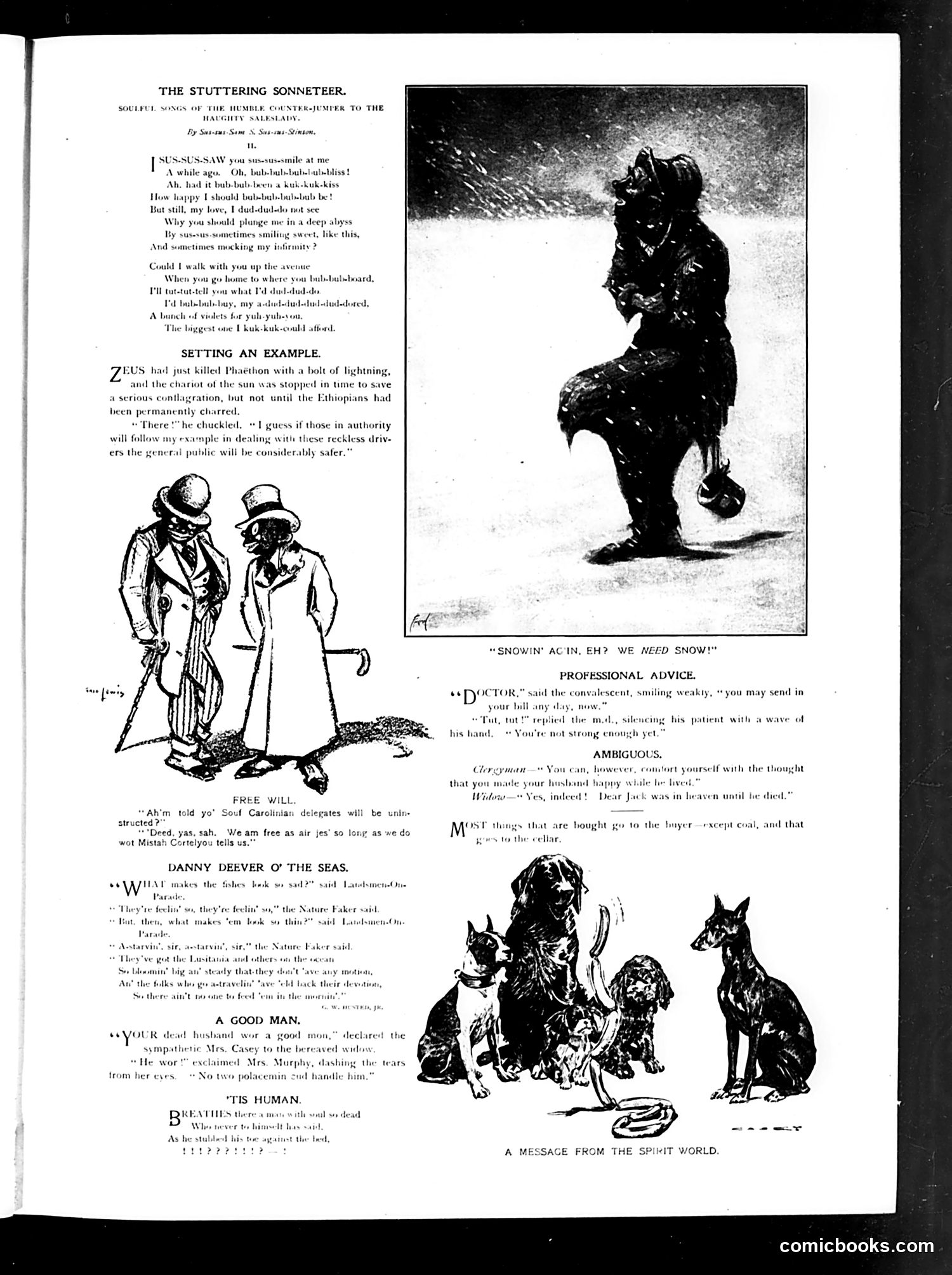
This page contains several satirical sketches and humorous poems typical of Judge magazine's editorial content. The central cartoon titled "Setting an Example" depicts two well-dressed men in conversation, likely satirizing hypocrisy among authority figures who set poor examples for the public. The accompanying text references "Zeus" killing "Pharaoh" and "Ethiopians," suggesting commentary on military or political leadership and consequences of reckless decision-making. The bottom illustration labeled "A Message from the Spirit World" shows a woman with multiple dogs, appearing to mock spiritualism—a popular but widely ridiculed phenomenon in early 20th-century America. Other sections include brief satirical poems ("Danny Deever of the Seas," "A Good Man," "'Tis Human") targeting various social hypocrisies and human failings of the era.
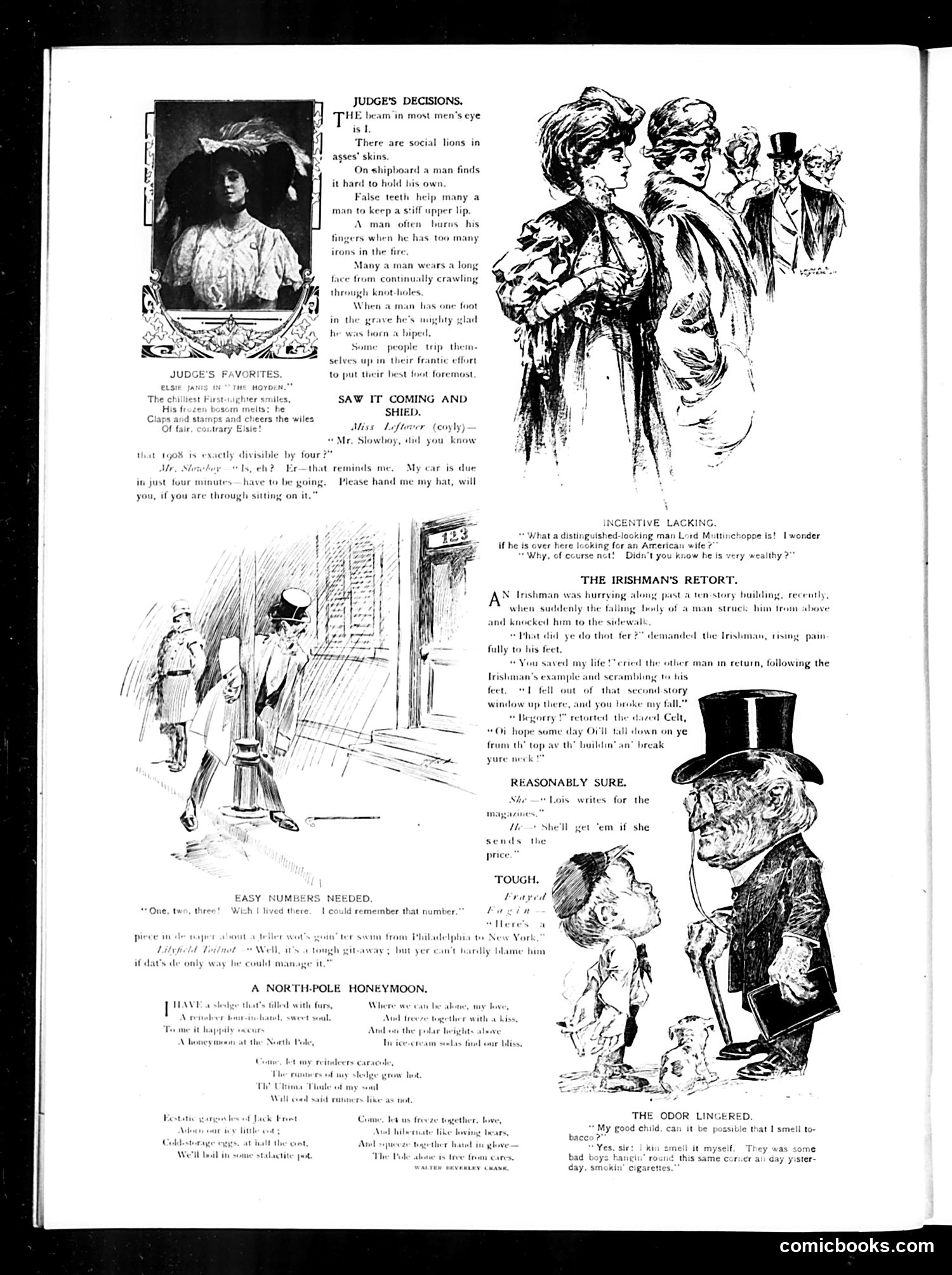
This page contains several short humorous pieces and illustrations typical of Judge's satirical style: **"Judge's Favorites"** features a portrait labeled celebrating a "first-fighter" and their qualities. **"Saw It Coming and Shied"** is a brief anecdote about a man (Mr. Slowboy) hurrying to leave because his car is arriving—a joke about automotive anxiety or escape. **"The Irishman's Retort"** recounts a confrontation where an Irishman falls from a building, is rescued, then verbally spars with his rescuer about the rescue itself—classic Irish humor based on contrarian wit. **Other pieces** include "Incentive Lacking," "Reasonably Sure," "Tough," and "A North Pole Honeymoon" (a poem about Arctic newlyweds), showcasing the magazine's mix of jokes, light verse, and social observation without targeting specific contemporary political events visible here.
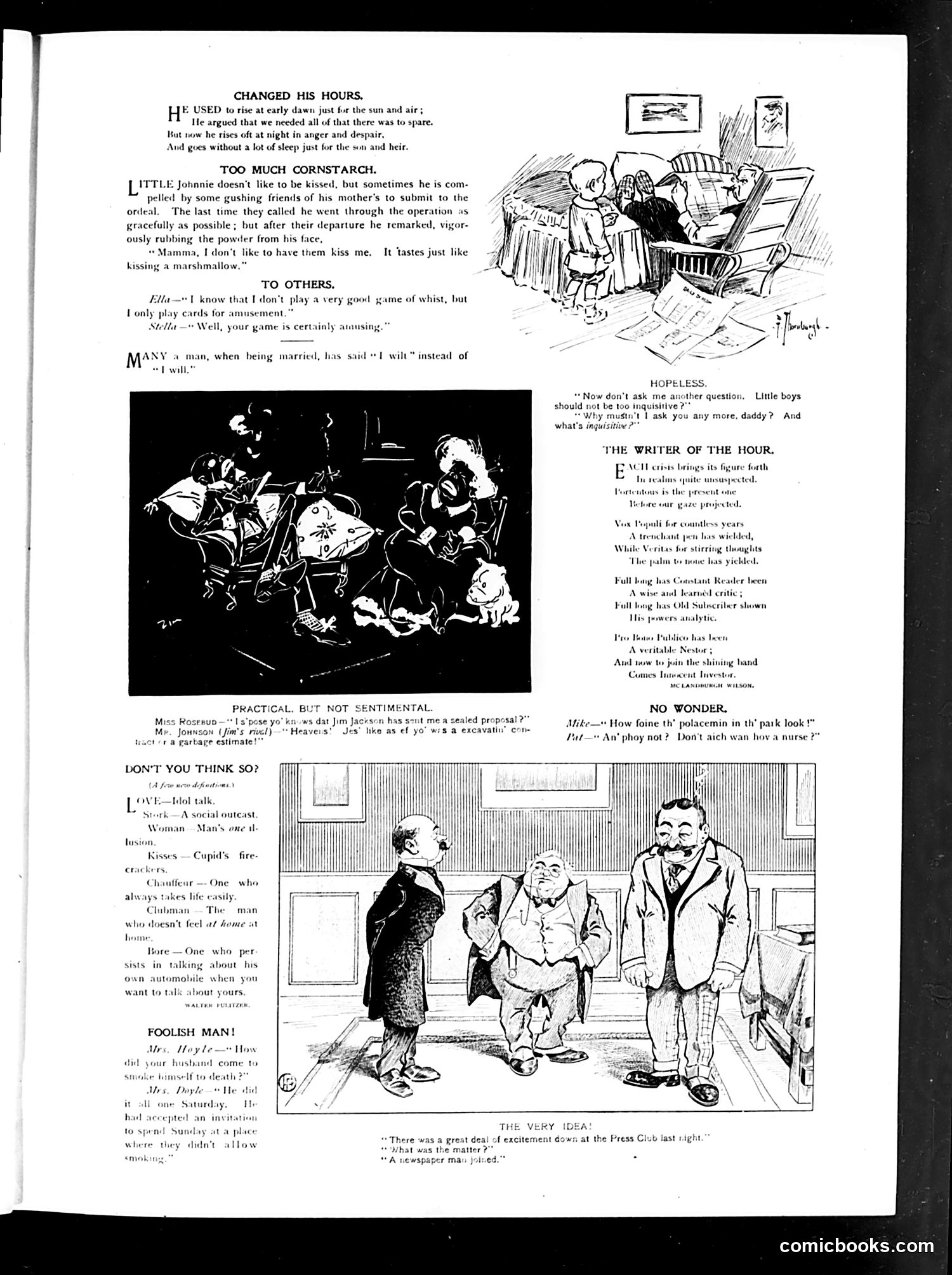
This page contains several short humor pieces and cartoons typical of early 20th-century satirical magazines. **"Changed His Hours"** mocks a man who altered work schedules to avoid his wife's complaints—satirizing marital discord. **"Too Much Cornstarch"** jokes about a mother forcing her son through an uncomfortable medical procedure, with the punchline comparing it to kissing a marshmallow. **"The Writer of the Hour"** is a poem mocking various types of writers and critics—suggesting literary pretension. **"Don't You Think So?"** contains brief definitions of social types (snobs, bores, hypocrites). **"Foolish Men"** depicts husbands making excuses to wives about weekend activities. The bottom cartoon, **"The Very Idea,"** shows men at what appears to be a Press Club, discussing excitement over a newspaper matter—likely satirizing journalistic pomposity or office gossip.
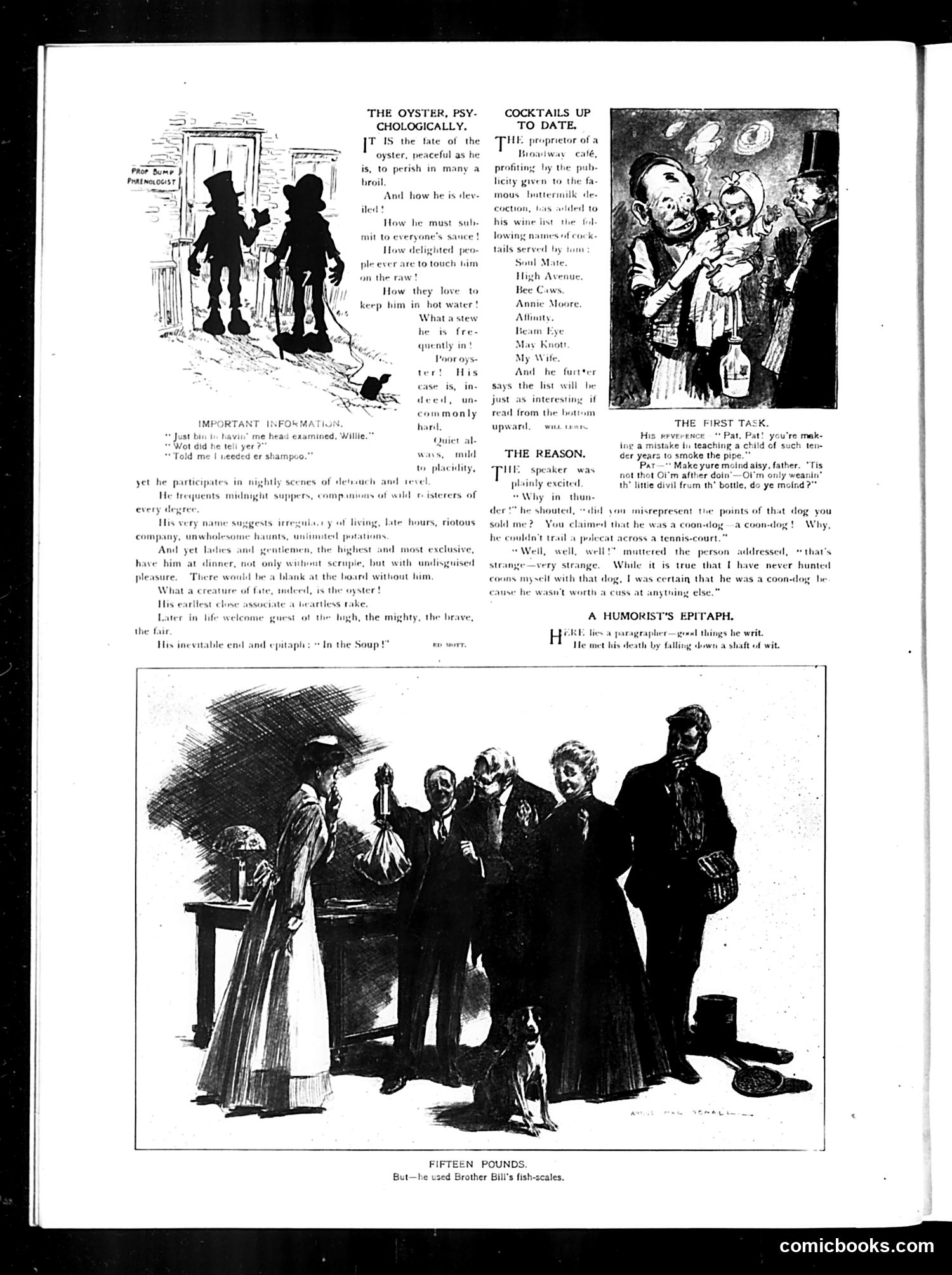
This Judge magazine page contains several satirical pieces: **"The Oyster, Psychologically"** (top left): A mock-philosophical meditation on the oyster's fate. The joke plays on the oyster's passivity—it's tossed around, eaten raw, served in hot water, and ends "in the soup." It's social commentary disguised as psychology: the oyster represents anyone (likely the working class) who suffers indignities while being welcomed into polite society at dinner tables. **"Cocktails Up to Date"** (top right): The cartoon mocks Prohibition-era buttermilk as a substitute for alcohol. A Broadway café owner has added buttermilk cocktails with humorous names to his wine list, suggesting they're "just as interesting read from the bottom upward"—implying the list reads like a joke either direction. **"The Reason"** (middle): A dialogue where someone complains a dog seller misrepresented a hunting dog that couldn't hunt. The seller admits he never hunted with the dog himself—unclear satirical target. **"Fifteen Pounds"** (bottom): Appears to reference someone's weight using "Brother Bill's fish-scales." Overall: early 20th-century social satire with Prohibition references.
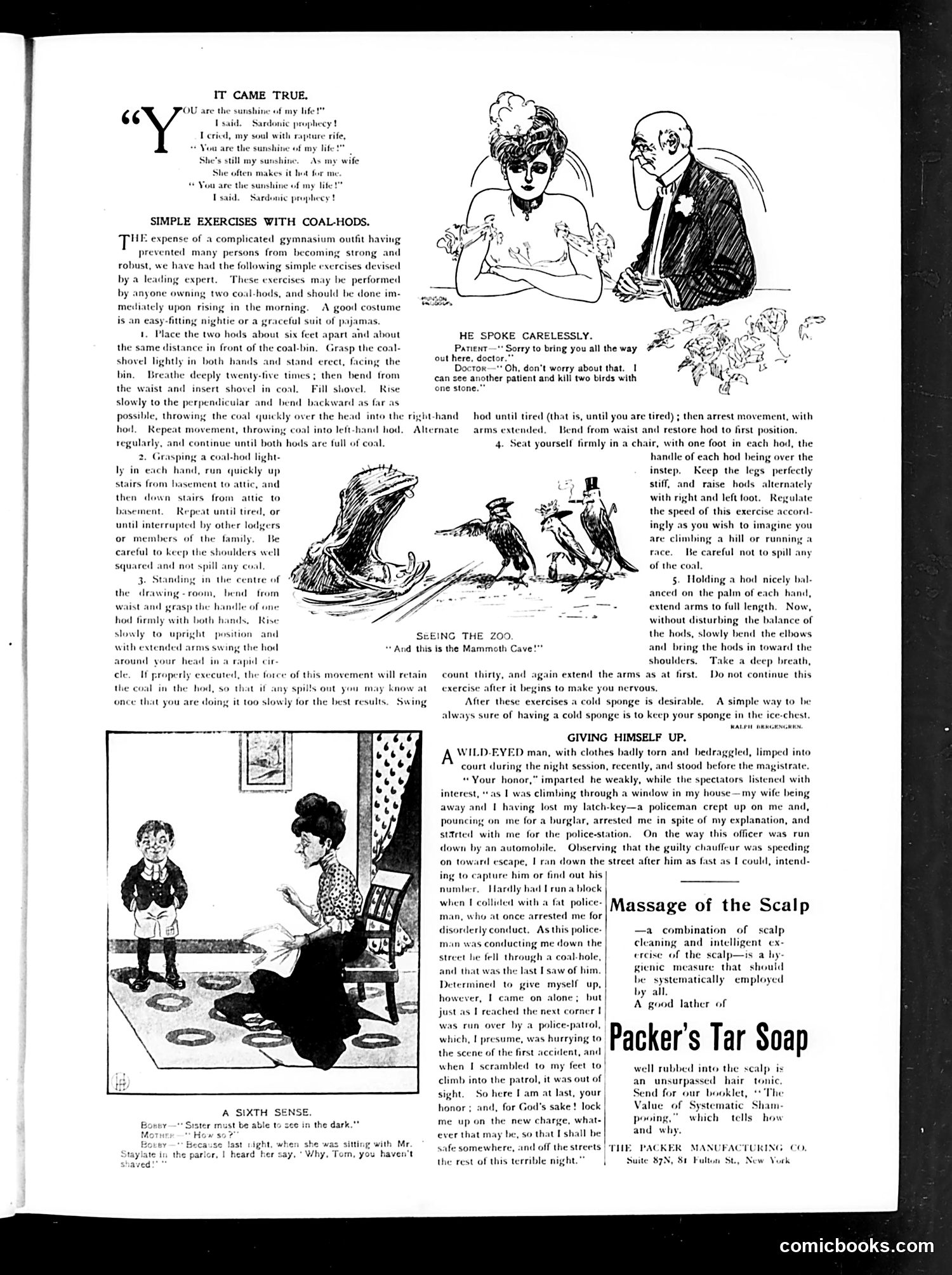
This page contains satirical humor typical of early-20th-century Judge magazine: **"It Came True"** (top): A cynical marriage joke. A man's romantic declaration—"You are the sunshine of my life"—becomes literal when his wife's presence makes him uncomfortably hot, turning his poetic prophecy into domestic complaint. **"Simple Exercises with Coal-Hods"** (center): Satirizes the gymnasium craze by proposing absurdly impractical "exercises" using coal-hods (heavy containers for heating fuel). The joke mocks both the obsession with fitness equipment and the ridiculousness of using household items for workouts—clearly not genuine health advice but comedic parody of contemporary fitness trends. **"He Spoke Carelessly"** (right): A doctor admits he doesn't care about making a house call because he can see another patient simultaneously—dark satire on medical indifference and efficiency. **"Giving Himself Up"** (bottom): A man confesses to attempted burglary after being hit by a car, suggesting he'd rather face arrest than continue evading police. Social commentary on urban dangers and desperation.
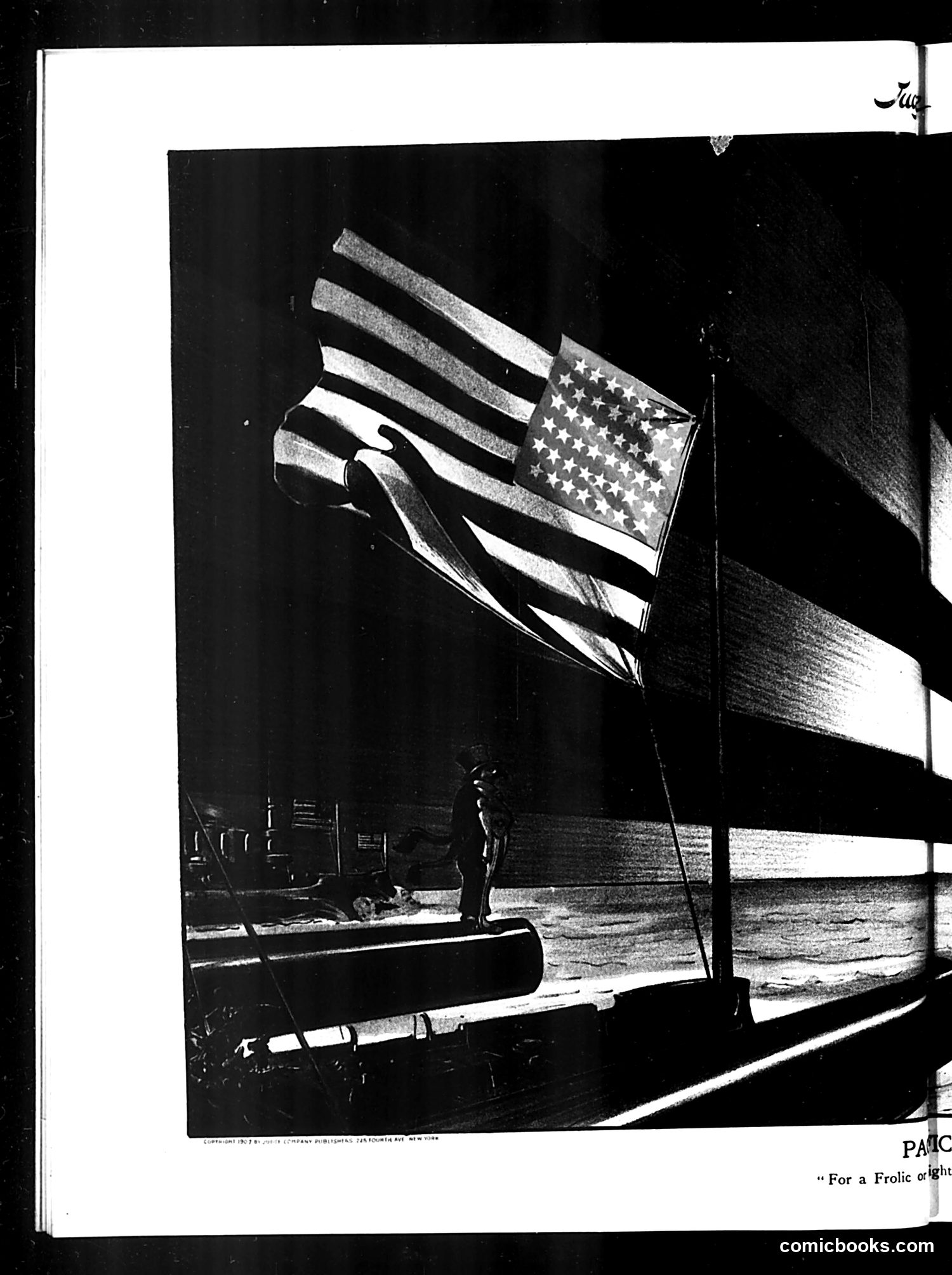
This black-and-white photograph shows an American flag being held aloft, photographed against dramatic lighting that creates strong shadows. A figure appears to be holding or positioning the flag. The page text fragment reads "For a Frolic of" (incomplete), suggesting this image accompanies a satirical caption or article in *Judge* magazine, though the full context is cut off. Without the complete caption or surrounding text, the specific satirical message is unclear. The dramatic, heroic photography of the flag could be either celebrating American patriotism or—more likely for a satire publication—**mocking jingoism, flag-waving rhetoric, or nationalist excess** during whatever historical period this appeared. The "frolic" reference suggests frivolous or performative patriotism may be the target of ridicule.
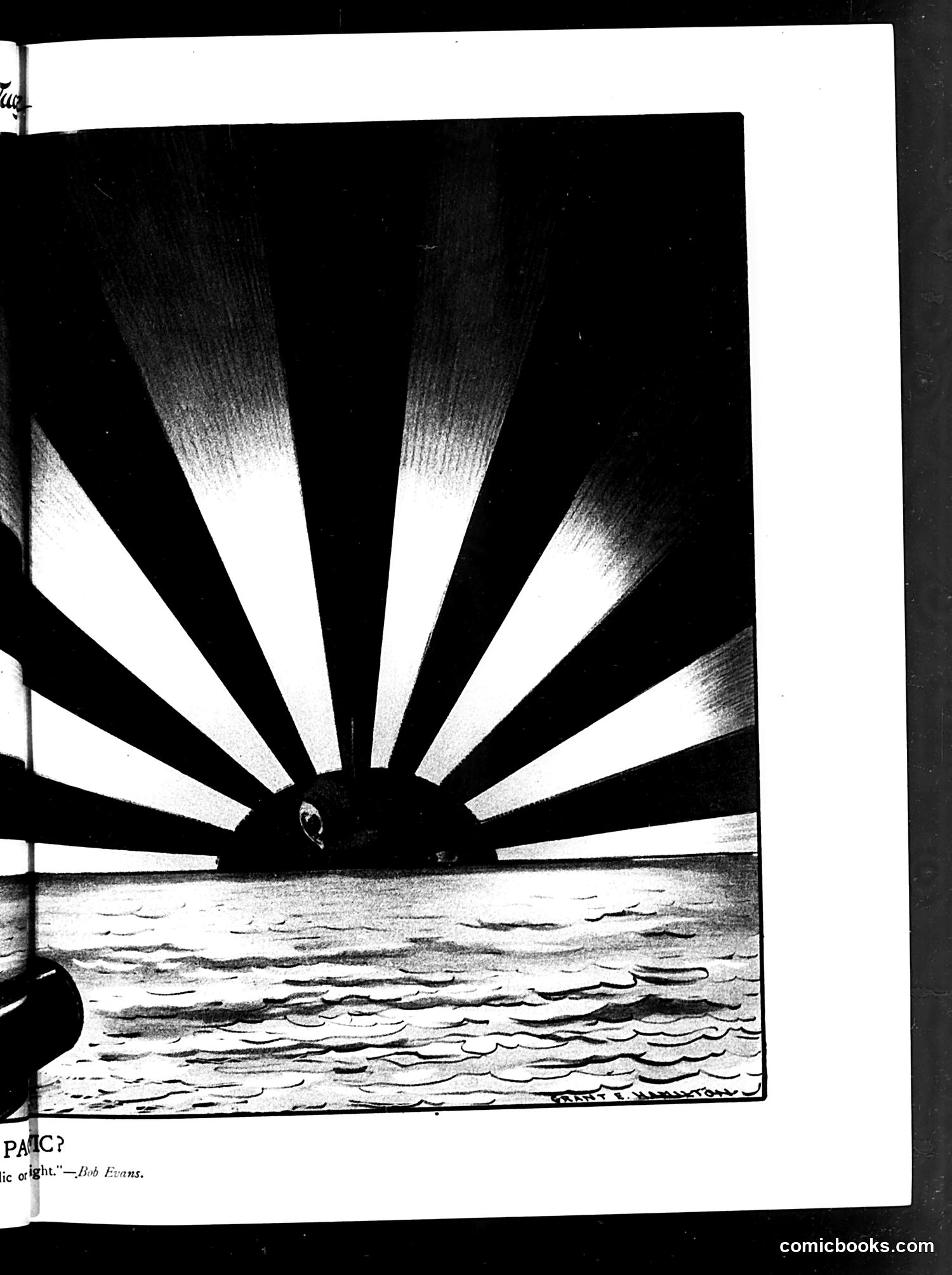
This appears to be a dramatic illustration rather than a traditional political cartoon. The image shows a large sun or celestial body on the horizon with dramatic rays of light radiating outward across a dark sky, with rippling water or waves in the foreground. The style is stark, high-contrast black and white. The OCR text is fragmentary and unclear—"pac?" and "ic ot Bht" don't form coherent phrases, suggesting scanning errors. The attribution to "Bob Evans" is partially visible but cannot be confirmed from the text. Without clearer text or context identifying specific political figures or events, I cannot definitively explain what social or political commentary this illustration intended to convey. The apocalyptic or dramatic tone might suggest commentary on contemporary concerns, but determining the specific reference requires additional context not fully legible here.
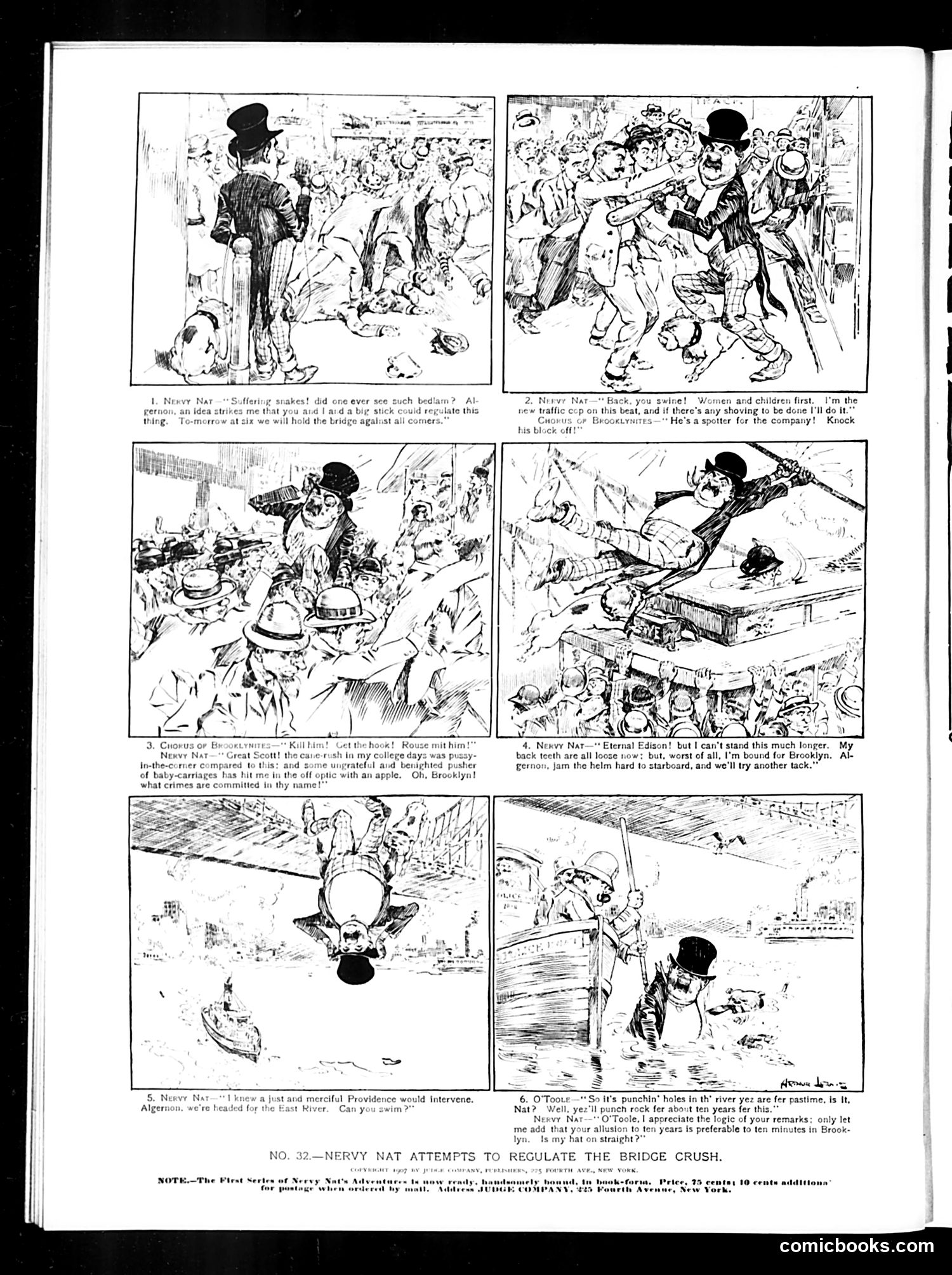
This is a satirical comic strip about crowd management on what appears to be the Brooklyn Bridge. The protagonist "Nervy Nat" attempts various schemes to control dangerous pedestrian congestion—a real public safety problem in early 20th-century New York. The sequence shows Nat's escalating, absurd solutions: stopping traffic, physically pushing crowds, even considering drowning people in the East River as population control. His companion Algernon questions each increasingly outlandish idea. The satire targets both urban overcrowding and incompetent civic management. The joke is that Nat's "solutions" are comically worse than the original problem, mocking how authorities might bungle public safety issues. The dialogue reveals the desperation of dealing with Brooklyn-bound commuter traffic, suggesting genuine frustration with New York's infrastructure challenges masked in dark humor typical of Judge magazine's satirical style.
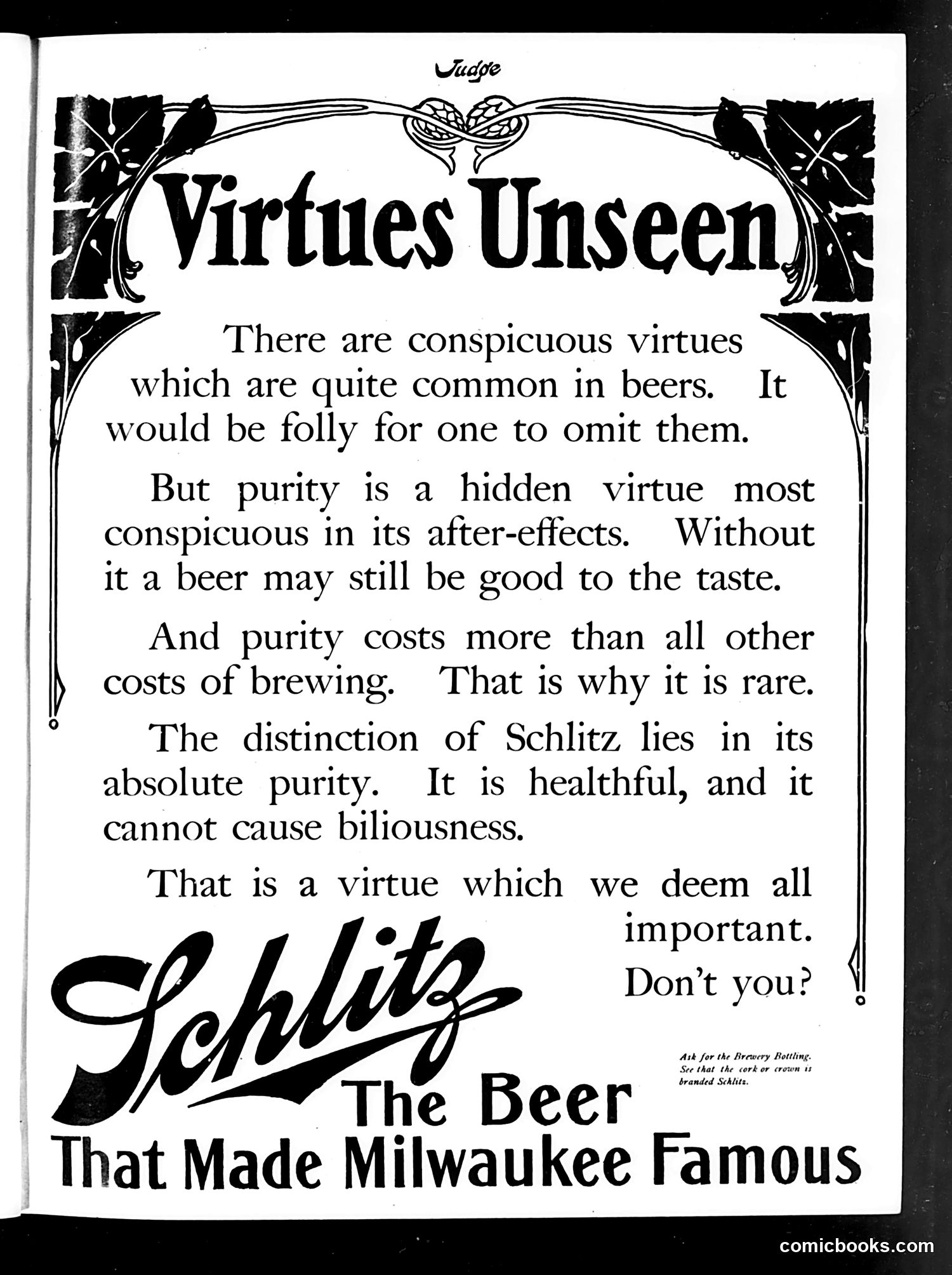
This is a **Schlitz beer advertisement**, not satire. The page uses the header "Virtues Unseen" as a philosophical framing device to market beer purity as a desirable but invisible quality. The ad argues that while visible brewing virtues are common, **purity is uniquely valuable** because it prevents illness ("biliousness") and costs more to achieve. Schlitz positions itself as superior by claiming "absolute purity"—making health claims that were common in early 20th-century beer advertising. The tagline "The Beer That Made Milwaukee Famous" reinforces Schlitz's market dominance during an era when Milwaukee was America's brewing center. **Context for modern readers**: This predates FDA regulations. Brewers could freely claim health benefits. The emphasis on purity likely references actual contamination problems in competing beers and earlier brewing methods.
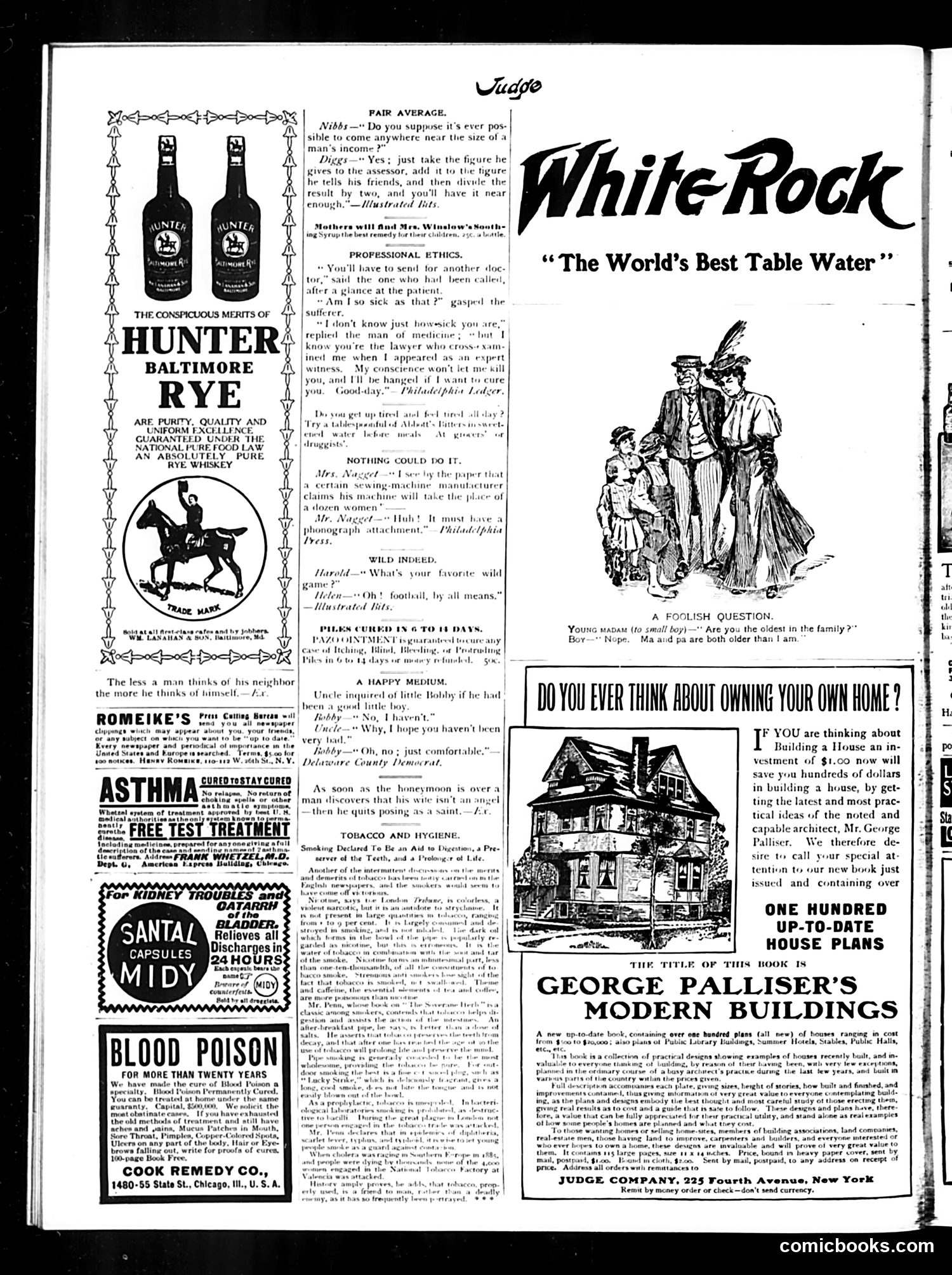
This page from *Judge* magazine contains primarily **short humorous anecdotes and advertisements** rather than political cartoons. The jokes satirize familiar domestic and professional scenarios: a husband's inflated income claims; a lawyer-turned-patient discovering his adversary as his doctor; a wife's actual expenses versus claimed budget; and children's literal interpretations of questions. The **advertising** dominates: Hunter Baltimore Rye whiskey emphasizes purity; White Rock water markets itself as "The World's Best Table Water"; various patent medicines (Santal Capsules for kidney troubles, blood poison treatments) were common in this era; and a prominent real estate advertisement for George Palliser's architectural house-plan book. **Social context**: The page reflects early 20th-century anxieties—financial pretense among the middle class, the expansion of professional services (lawyers, doctors), and the ubiquity of dubious medicinal products before FDA regulation. The humor is gentle domestic satire rather than hard-edged political commentary.
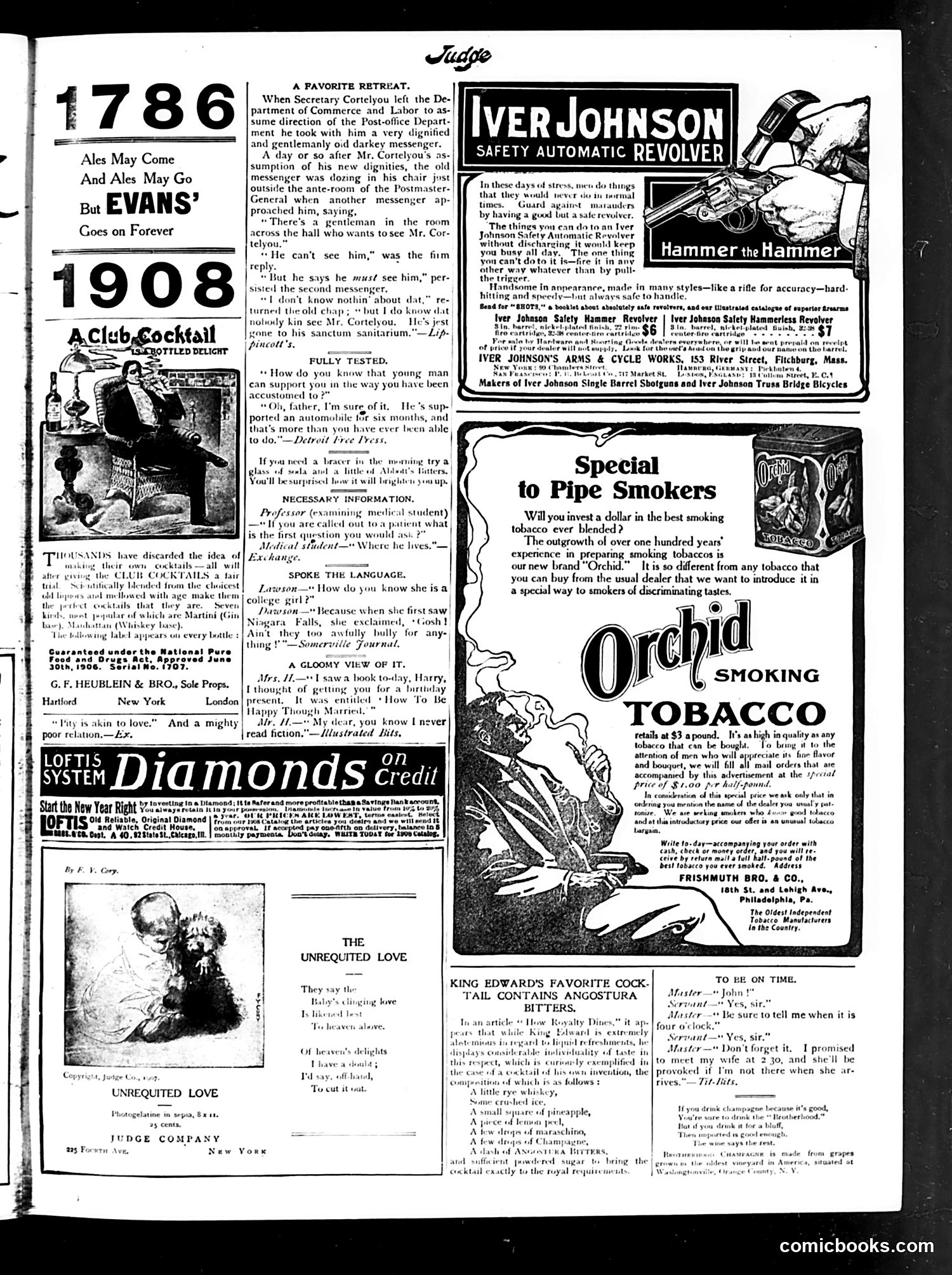
This is primarily an **advertising and humor page** from an early 1900s satirical magazine. The main cartoon, titled "A Favorite Retreat," satirizes **Secretary Cortelyou's staff transition**. When Cortelyou moved from the Department of Commerce and Labor to lead the Post Office, he brought along an elderly Black messenger. The joke depicts this man sleeping in the Postmaster General's anteroom—a commentary on bureaucratic inefficiency or the messenger's privileged position despite Cortelyou's elevated status. The racial caricature ("old darkey") reflects common period stereotyping in Judge. The page is dominated by **product advertisements**: Iver Johnson Safety Automatic Revolvers (emphasizing their safe design), Orchid Smoking Tobacco, and Loftis Diamonds on credit. Other small humor pieces fill space, including jokes about courtship, medical students, and domestic banter. The "Unrequited Love" poem at bottom left is literary filler typical of magazine layout from this era.
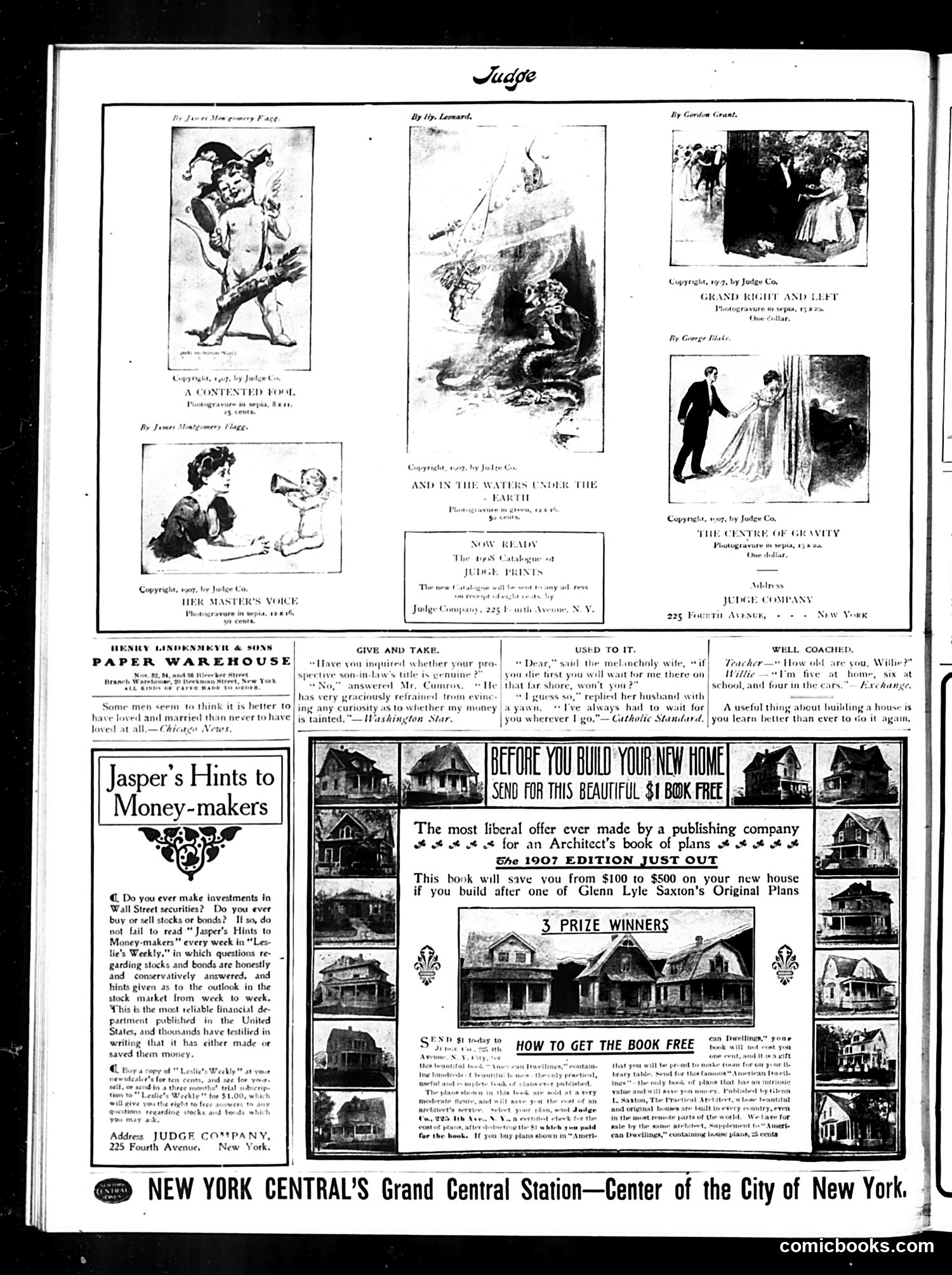
This is primarily an **advertising and humor page** from Judge magazine, circa 1907. The top section contains three cartoon panels by different artists depicting domestic/romantic situations—a "contented fool," a couple in nature, and what appears to be an evening scene. These are standard Judge humor cartoons with mild social commentary about marriage and relationships. The page is dominated by **advertisements**: Jasper's investment advice column for stock market tips, a major promotion for Glenn Lyle Saxton's architectural house-plan book (offering $100-$500 in savings), and smaller ads about financial advice and domestic humor ("Well Coached" jokes about a child's age varying by location, for instance). The New York Central Railroad advertisement appears at the bottom. Overall, this reflects **early 20th-century magazine economics**—mixing light satirical content with commercial pitches targeting middle-class readers interested in investments, home-building, and domestic life advice.
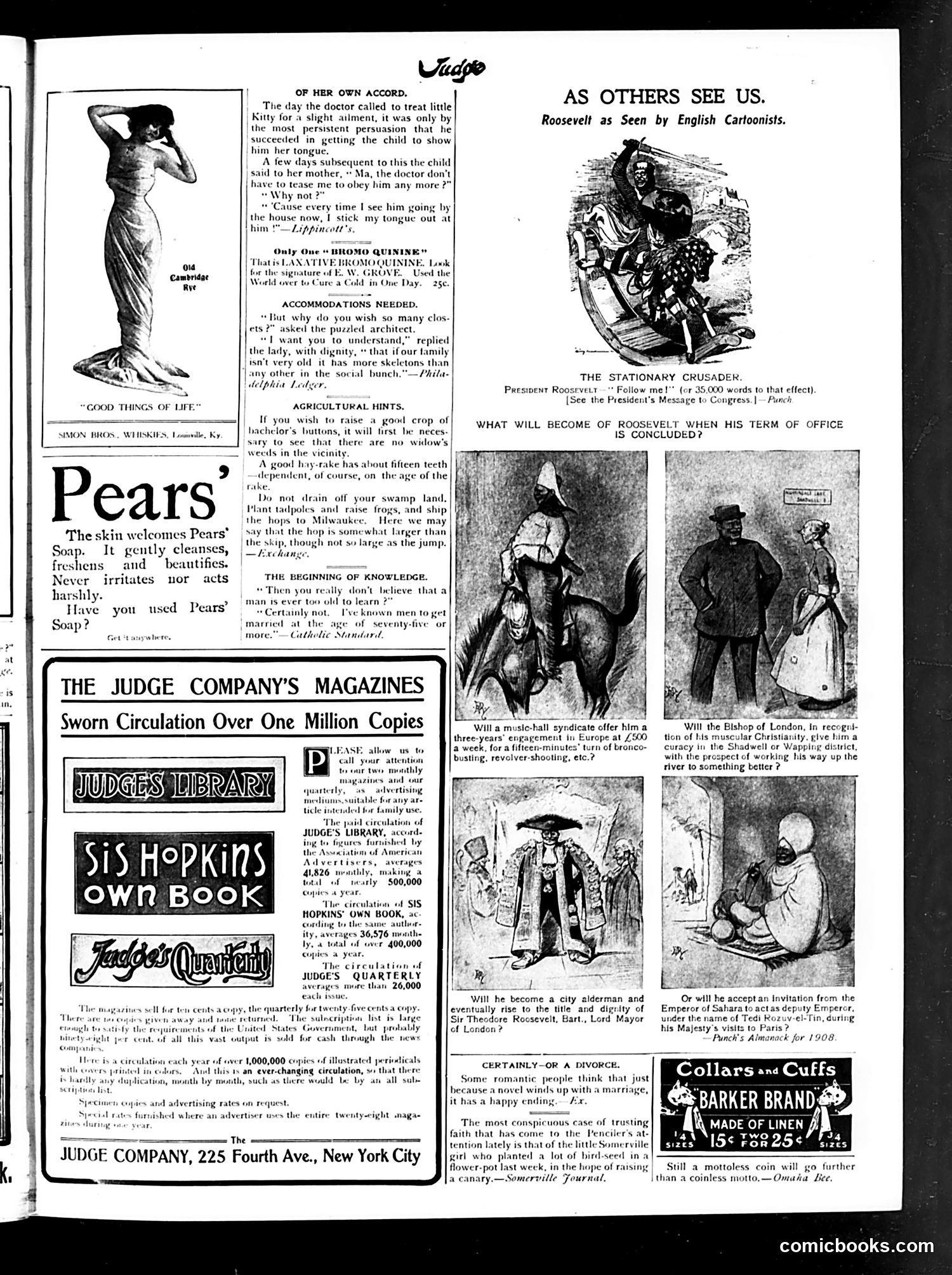
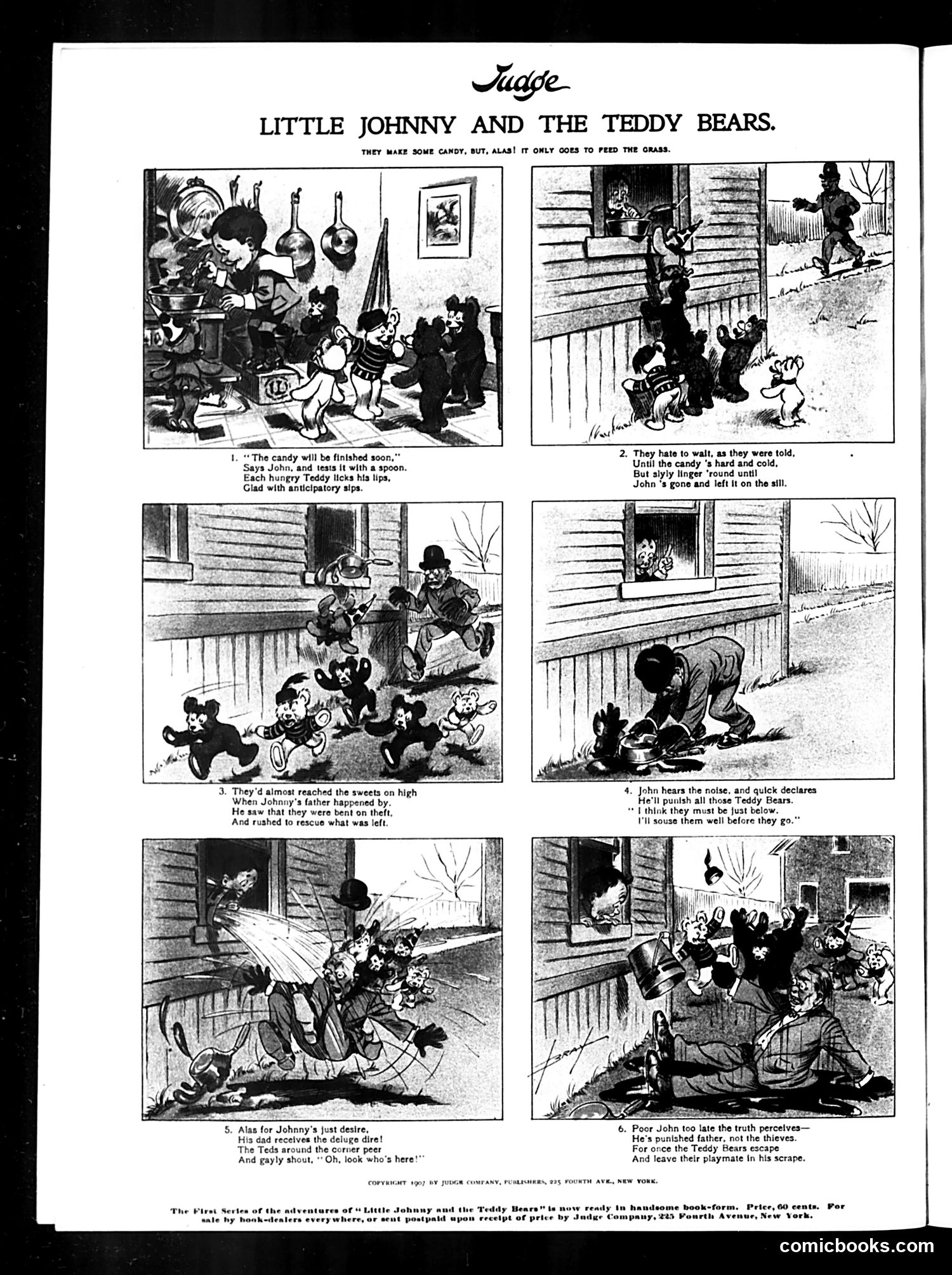
This is a six-panel children's comic strip (not political satire) about a boy named Johnny and his toy teddy bears. The plot: Johnny makes candy that hardens on a windowsill. The teddy bears steal it while he's away. When Johnny's father hears noise and assumes burglars are present, he douses the area with water to chase them off—accidentally soaking his son instead of the bears, who escape around the corner. The "joke" is slapstick irony: the father's attempt to protect his son's belongings backfires, punishing the wrong target. The bears' anthropomorphic mischief and escape add whimsy. This reflects early-20th-century Judge magazine's mix of satirical political content and lighter children's entertainment. The strip advertises a forthcoming book collection at the bottom.