
A complete issue · 16 pages · 1905
Judge — April 15, 1905
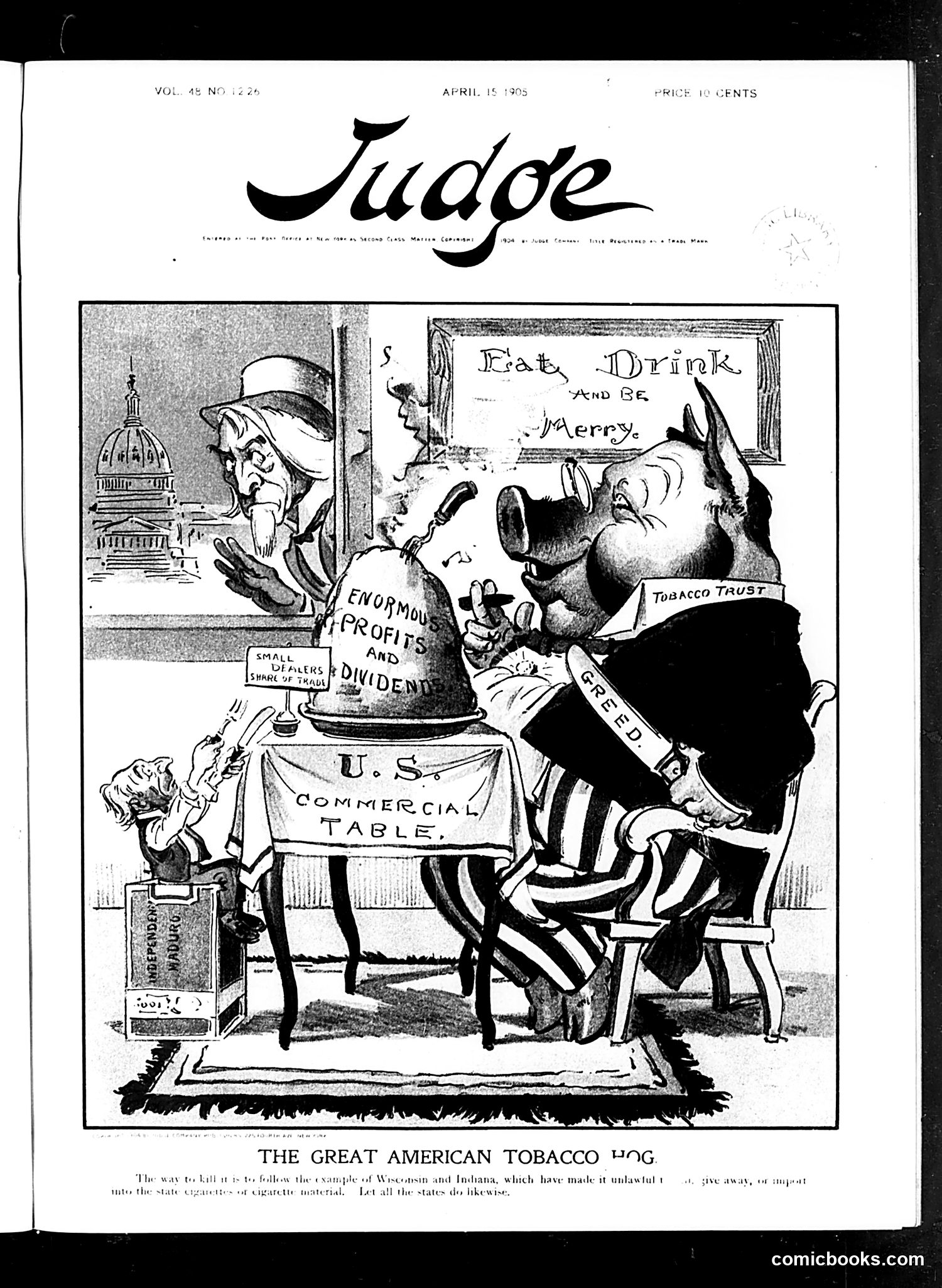
This 1905 political cartoon satirizes corporate greed in the tobacco industry. The central figure—labeled "Tobacco Trust"—is depicted as a grotesque hog seated at the "U.S. Commercial Table," gorging itself while displaying "Enormous Profits and Dividends." The caption warns against trusts controlling state cigarette and tobacco material imports. At left, Uncle Sam (representing government) watches disapprovingly from the Capitol dome. The hog clutches a megaphone labeled "Greed" while feasting, with a sign reading "Eat, Drink and Be Merry"—mocking corporate excess. The cartoon criticizes monopolistic business practices and advocates for states like Wisconsin and Indiana to restrict tobacco trusts, suggesting citizens should follow their regulatory example rather than allow unchecked corporate consolidation.
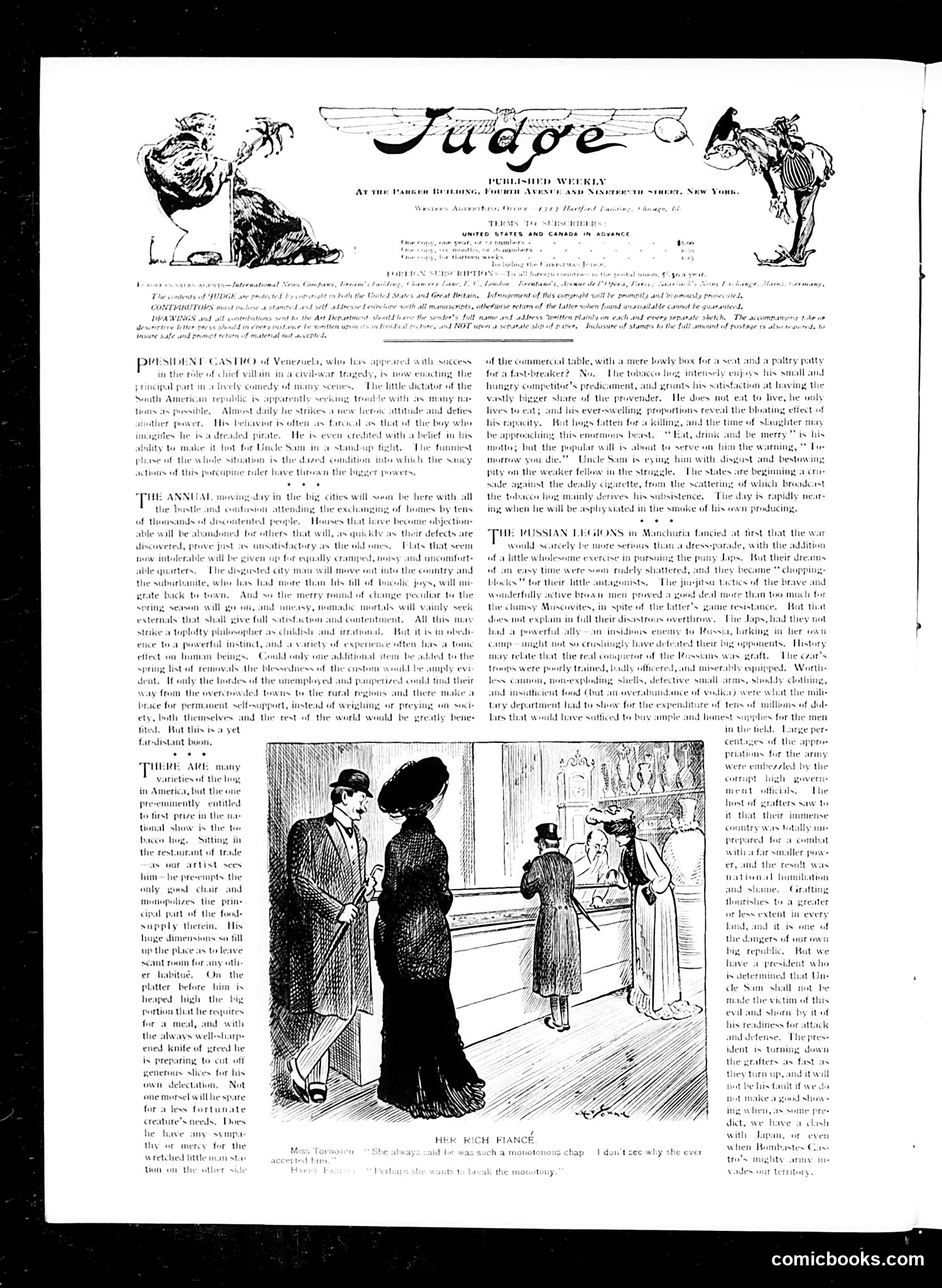
This page from Judge magazine contains two main articles with satirical commentary on contemporary issues. The first article, "Plain Sam Swindling," appears to critique a figure called "Plain Sam" engaging in dishonest dealing—likely a political or business figure known for fraud or deception. The second article, "The Russian Legions at Manchuria," discusses Russian military involvement in Manchuria, suggesting anxiety about Russian imperial expansion in East Asia (appearing to reference the Russo-Japanese War era, early 1900s). The central illustration titled "Her Rich Fiancé" depicts a wealthy suitor with a woman, satirizing class-based courtship dynamics—a common Judge theme mocking marriage motivated by money rather than affection. Without clearer context on specific identities, the overall thrust criticizes dishonesty, imperial overreach, and mercenary social climbing.
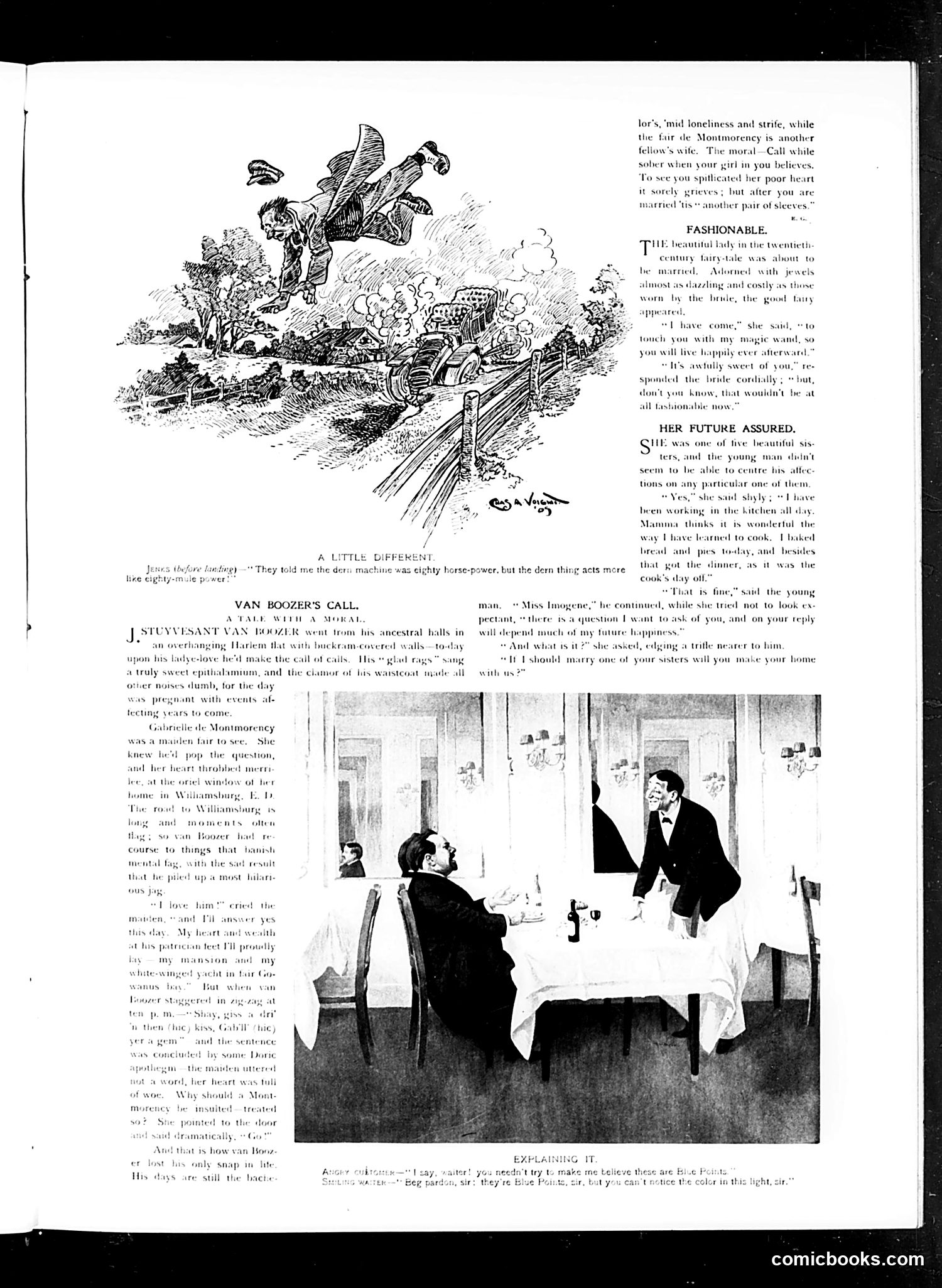
This page contains two distinct pieces: 1. **Top illustration ("Van Boozer's Call")**: A humorous sketch depicting a man being thrown from a horse, illustrating a story about a suitor's visit to impress a potential bride's family. The narrative emphasizes social pretense and courtship customs of the era. 2. **Bottom photograph and caption ("Explaining It")**: Shows two men at a dining table with a waiter. The caption references "Blue Points" (oysters) and color perception in different lighting—appearing to be a visual gag about how restaurant lighting affects perception of food quality or appearance. Both pieces target upper-class social conventions and romantic courtship rituals typical of early 20th-century American humor, emphasizing the gap between appearance and reality in genteel society.
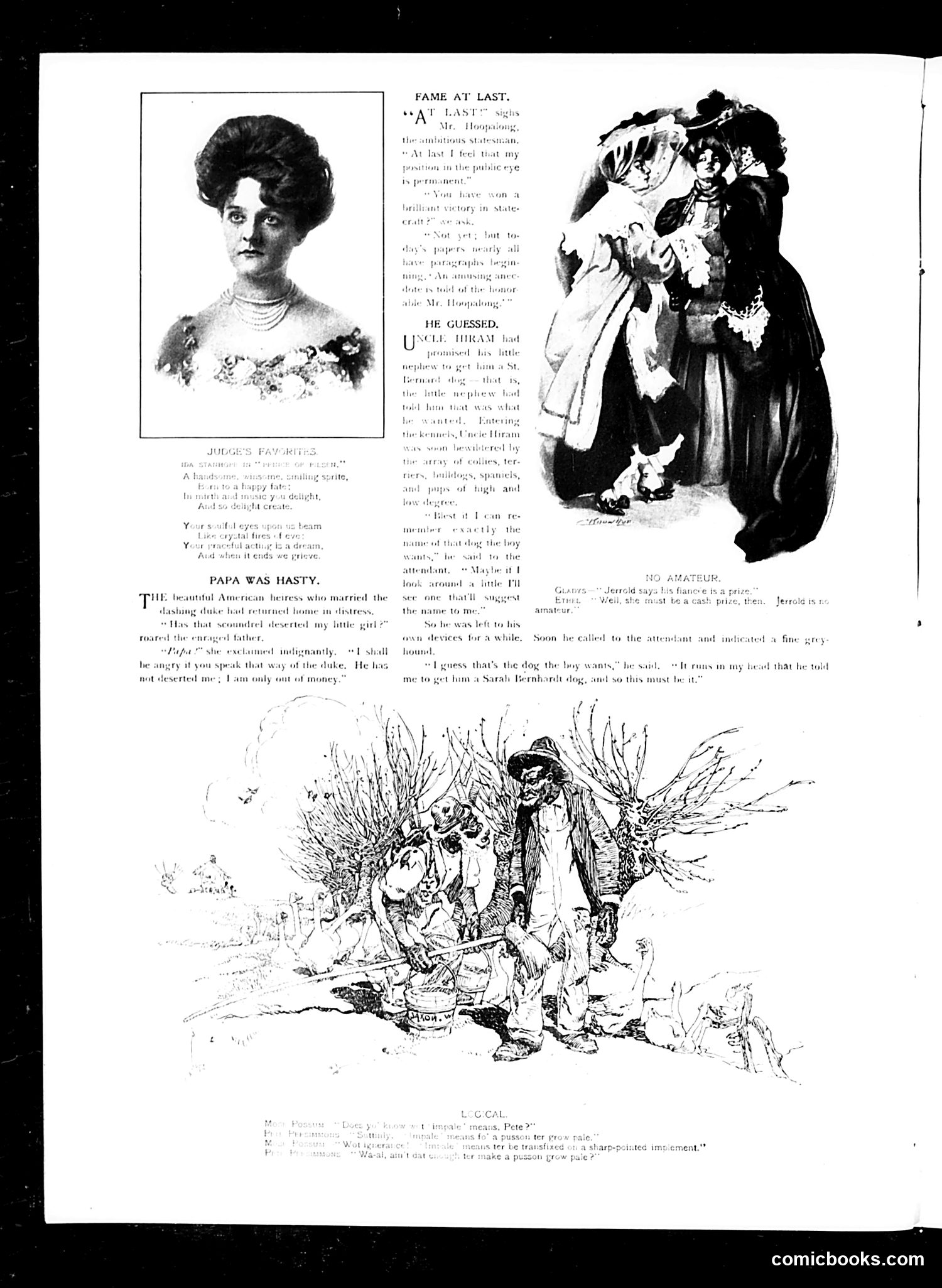
This page contains three sections with satirical commentary on American society. "Fame at Last" and "He Guessed" appear to mock social pretension and wealth-seeking behavior—likely commentary on nouveau riche or social climbers of the Gilded Age. "Papa Was Hasty" presents a narrative about a "beautiful American heiress" who married a wealthy European nobleman, then divorced him. The satire targets transatlantic marriages of convenience between American wealth and European titles—a common practice and frequent target of American satirists during this era. "No Amateur" and "Local" sections contain additional brief satirical quips. The overall tone suggests Judge magazine's typical critique of marriage for money, social aspiration, and the clash between American and European values.
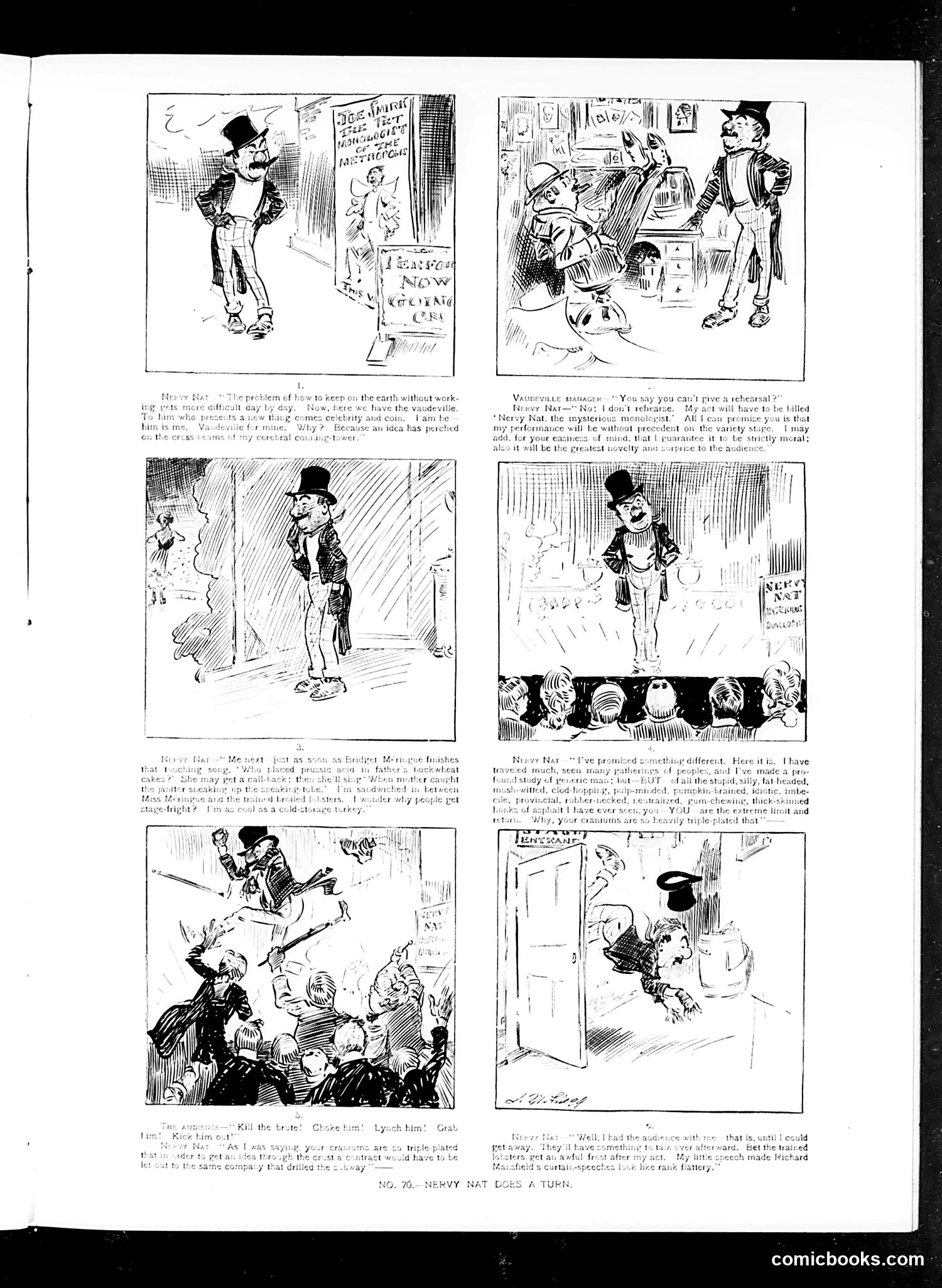
This comic strip satirizes a theatrical performer called "Newsy Nat" who appears to be a vaudeville or stage entertainer. The narrative shows Nat pitching himself to a theater manager, who initially refuses to give him a reference due to past performance issues. The manager cites concerns about Nat's reliability and professional conduct—mentioning he's "highly irregular" and that previous engagements ended poorly. Nat argues he's improved, but the manager remains skeptical, eventually having him physically removed from the office. The satire targets unreliable performers and their attempts to rehabilitate their reputations in the competitive entertainment industry. The final panels show Nat being ejected, emphasizing the manager's decisive rejection and the performer's inability to overcome his damaged credibility.
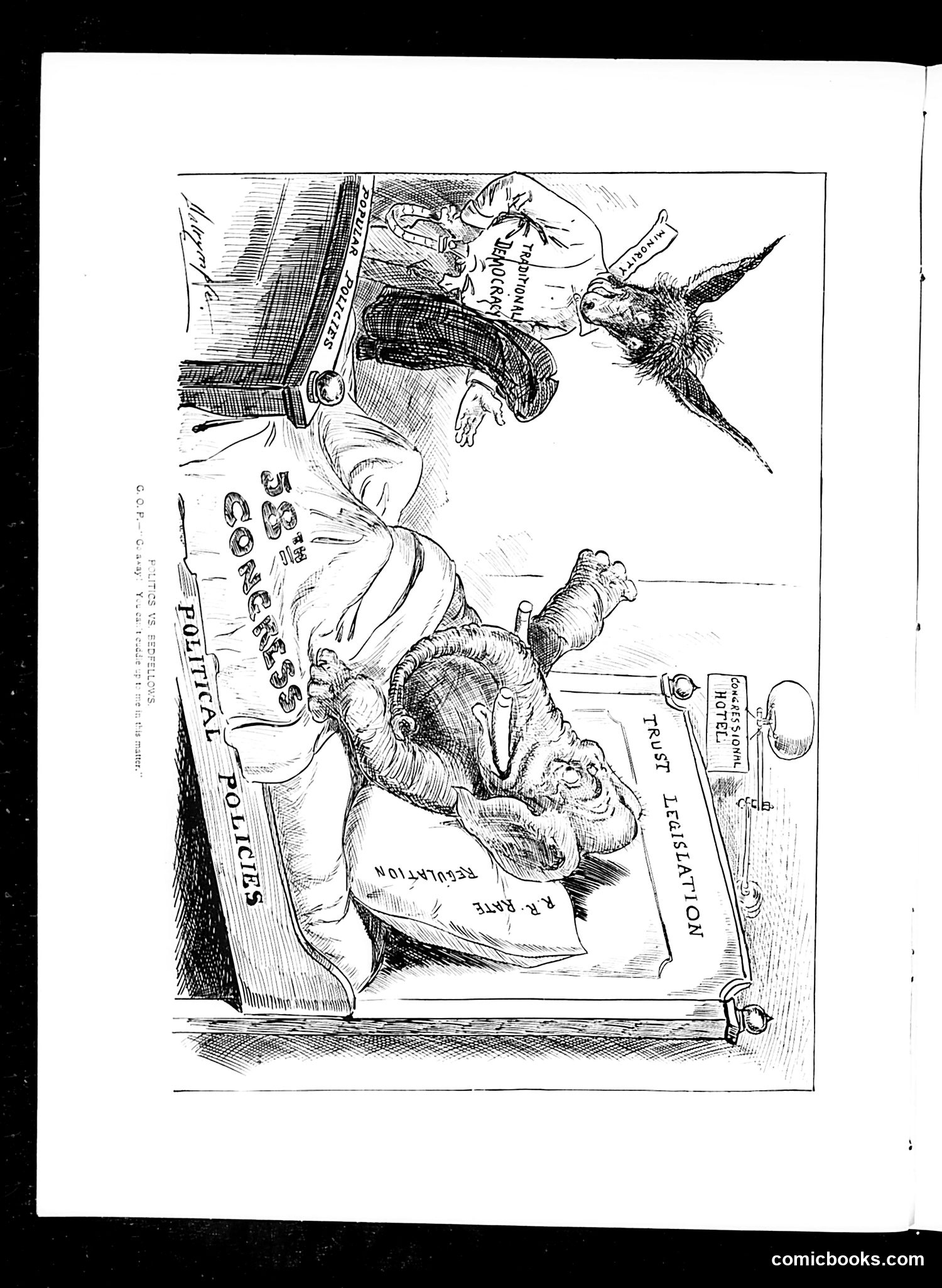
This appears to be a satirical cartoon from *Judge* magazine depicting a confrontation involving political figures. The image shows a rotund man labeled "TRUST LEGISLATION" being kicked or pushed, while another figure labeled "POLITICAL POPULISTS" attacks from above. A sign reading "CONGRESSIONAL HOTEL" is visible. The cartoon likely satirizes debates over trust-busting and antitrust legislation—a major political issue in the early 20th century. The "populists" attacking "trust legislation" suggests mockery of politicians who opposed or weakly enforced regulations meant to break up monopolies. The chaotic scene ridicules what the cartoonist viewed as either inadequate legislative efforts or hypocritical political posturing regarding corporate monopolies. However, without clearer identification of specific figures, the exact context remains uncertain.
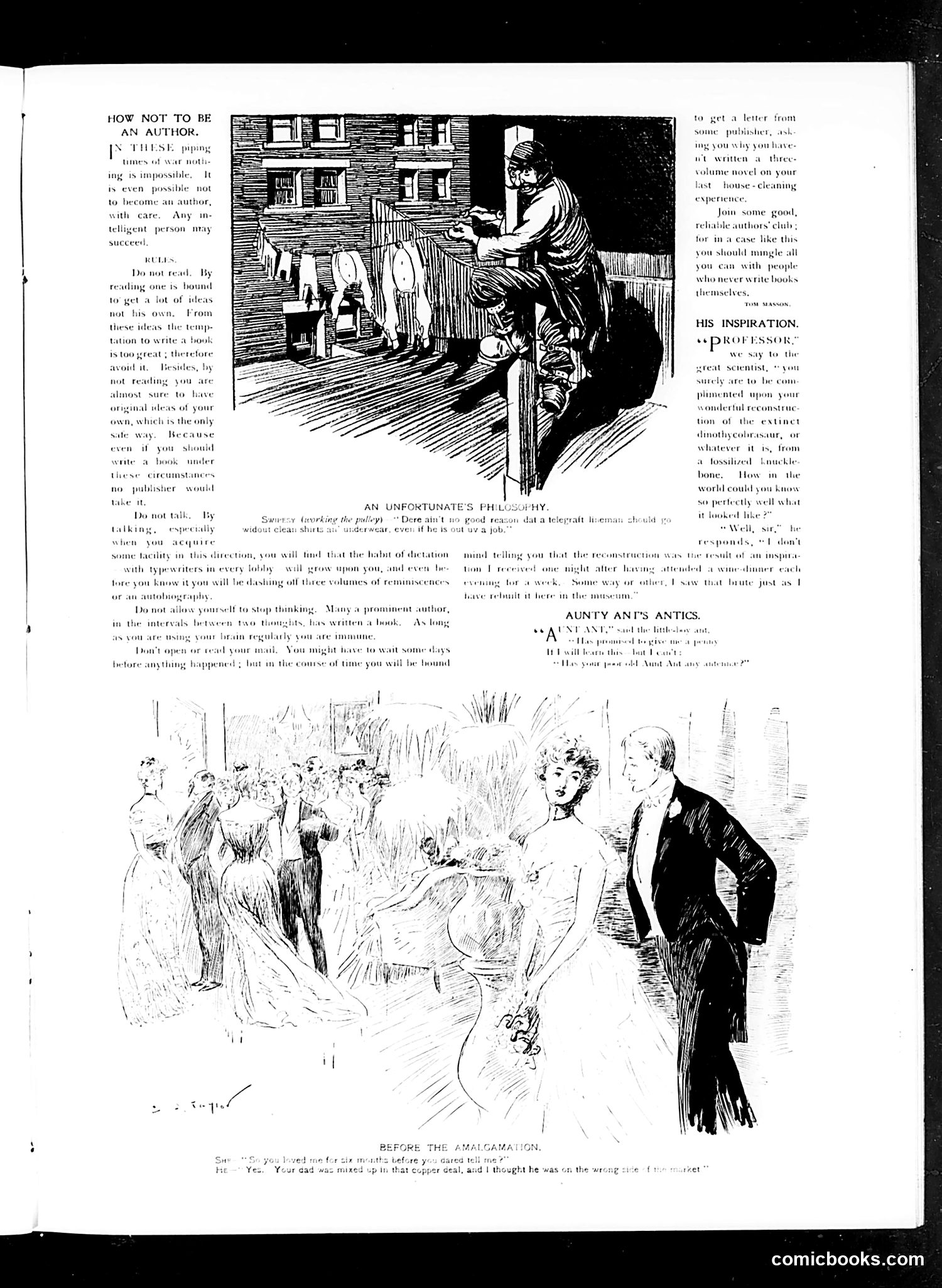
This page from *Judge* magazine satirizes aspiring authors and the publishing industry. The top section, "How Not to Be an Author," mocks people who attempt writing without proper preparation or reading—suggesting that to succeed as an author, one must actually read books, join legitimate author's clubs, and avoid lazy shortcuts. The middle illustration depicts "An Unfortunate Philosophy"—a writer struggling with their craft while observing life around them, likely critiquing the romantic notion that mere observation of human nature suffices for writing quality fiction. The bottom illustration, "Before the Consultation," shows a social gathering where a man confronts a woman, with text suggesting domestic or marital miscommunication—possibly satirizing how amateur writers mishandle character interactions or dramatic scenarios. Overall, the page mocks pretentious would-be authors and the disconnect between literary ambition and actual talent or preparation required for professional success.
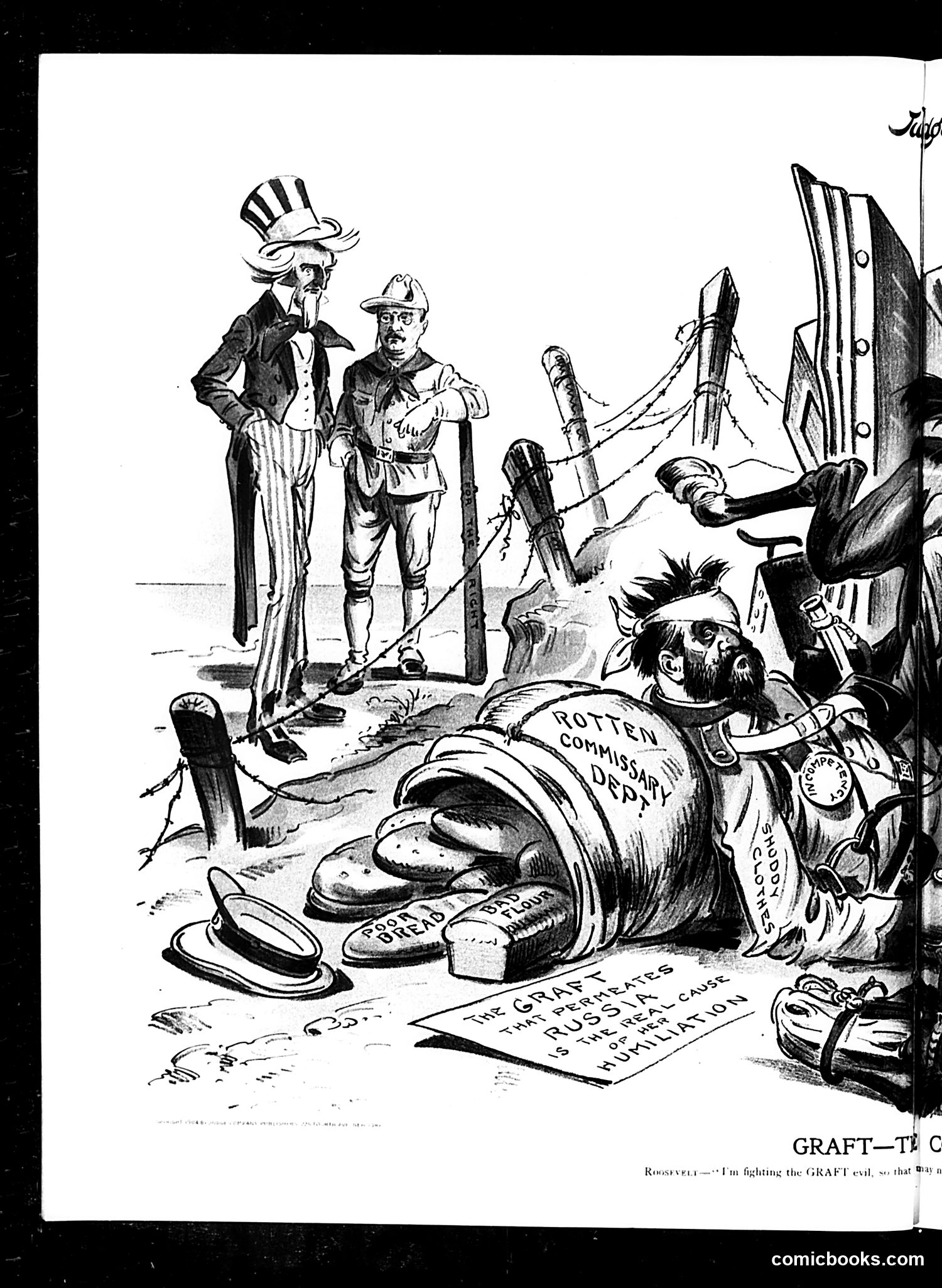
This satirical cartoon depicts President Roosevelt (identified by the caption referencing him fighting "the GRAFT evil") confronting corruption. The figure lying prone, labeled "ROTTEN COMMISSARY DEPT," spills bread and supplies—suggesting embezzlement or misappropriation of military provisions. Two military officers observe Roosevelt's action, appearing to approve his anti-corruption efforts. The scattered supplies and the characterization of the commissary as "rotten" symbolize waste and dishonesty in government administration. The cartoon celebrates Roosevelt's progressive crusade against institutional graft—a major political issue of the early 1900s. It portrays him as an aggressive reformer rooting out the "evil" of corruption in federal departments, particularly military supply chains.
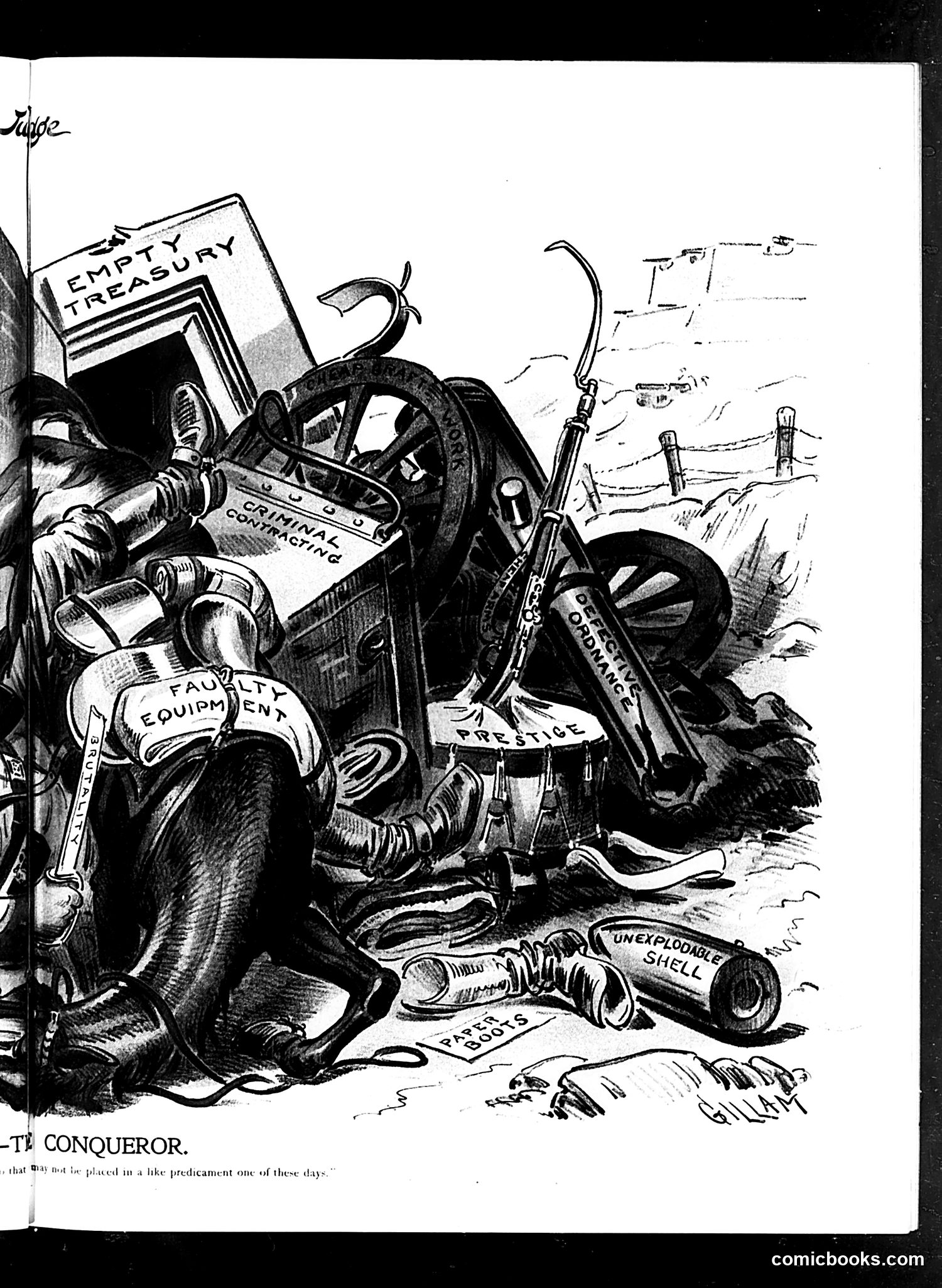
This political cartoon depicts a large figure labeled "The Conqueror" surrounded by debris of failed conquest: an "Empty Treasury," equipment labeled "Criminal Contracting" and "Ordering Prestige," unexploded ordnance, and other military/administrative failures. The satire criticizes a military leader or imperialist power whose aggressive expansionism has depleted resources and created scandals (criminal contracting, wasteful spending on prestige projects). The scattered bombs and wreckage suggest costly, destructive campaigns. The caption warns that such overreach may eventually backfire—"what may not be placed in a like predicament one of these days"—predicting the conqueror's own downfall through the same mechanisms of hubris and mismanagement. Without a visible date or clearer identification, the specific historical reference remains uncertain, though the imagery suggests early 20th-century American commentary on imperial ambitions.
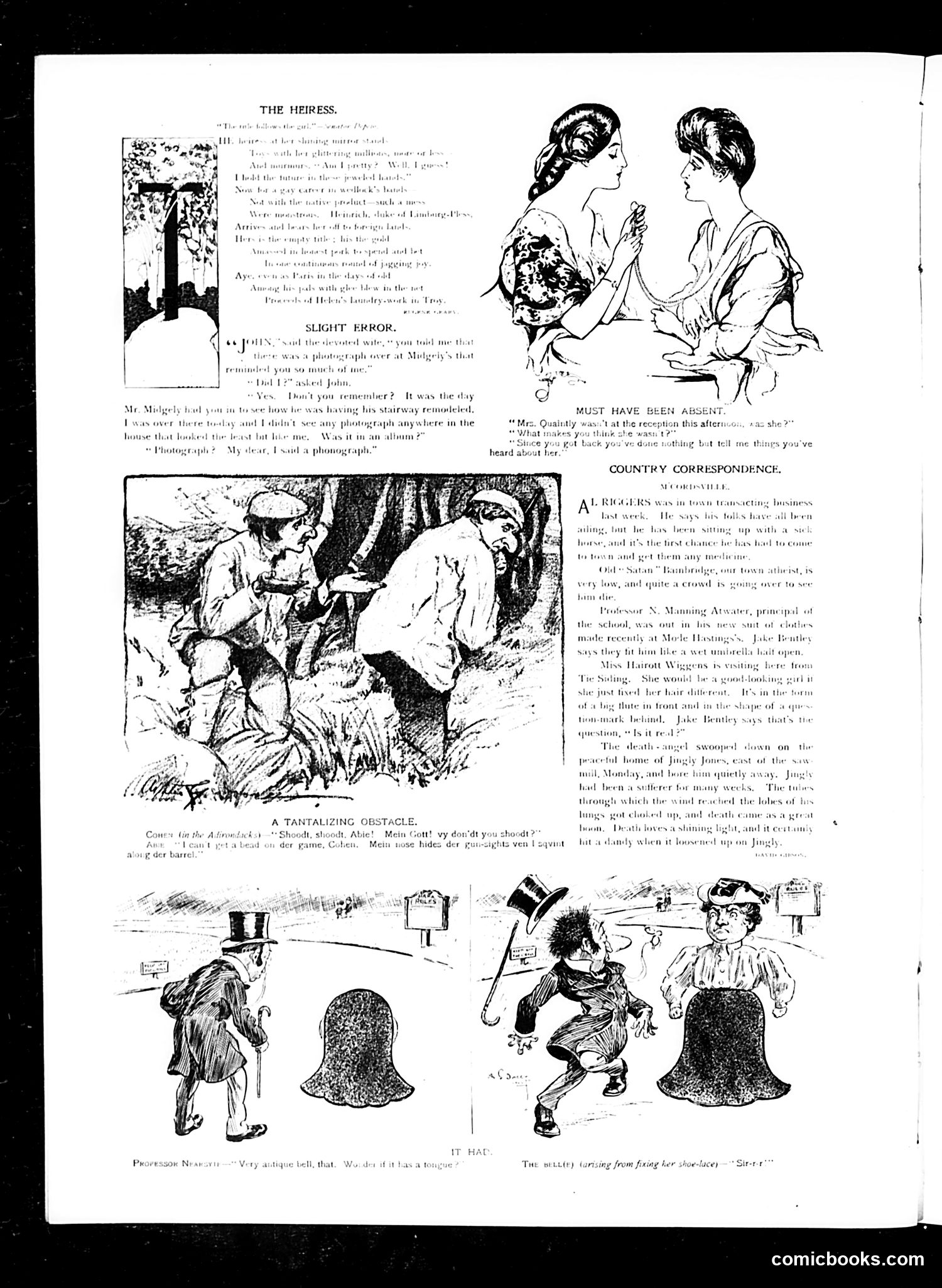
This Judge magazine page contains three distinct satirical pieces: **"The Heiress"** (top): A narrative comic about a wealthy woman and a photograph mix-up. The joke concerns mistaken identity—a woman assumes her husband was photographed with another woman, but it was actually just a misunderstanding about a portrait. **"Slight Error"**: A brief dialogue joke about a similar domestic confusion. **"Country Correspondence"**: A section mocking small-town gossip, featuring exaggerated accounts of local happenings (a businessman's new house, school fashion, someone's illness). The satire targets the breathless, trivial nature of provincial chitchat. **Lower cartoons**: Include visual gags about hats and fashion (one shows a professor with an absurdly tall hat; another depicts someone losing their hat), poking fun at contemporary dress conventions. The overall theme is domestic/social confusion and the pretensions of both high society and small-town life—typical Judge magazine fare mixing marital comedy with class satire.
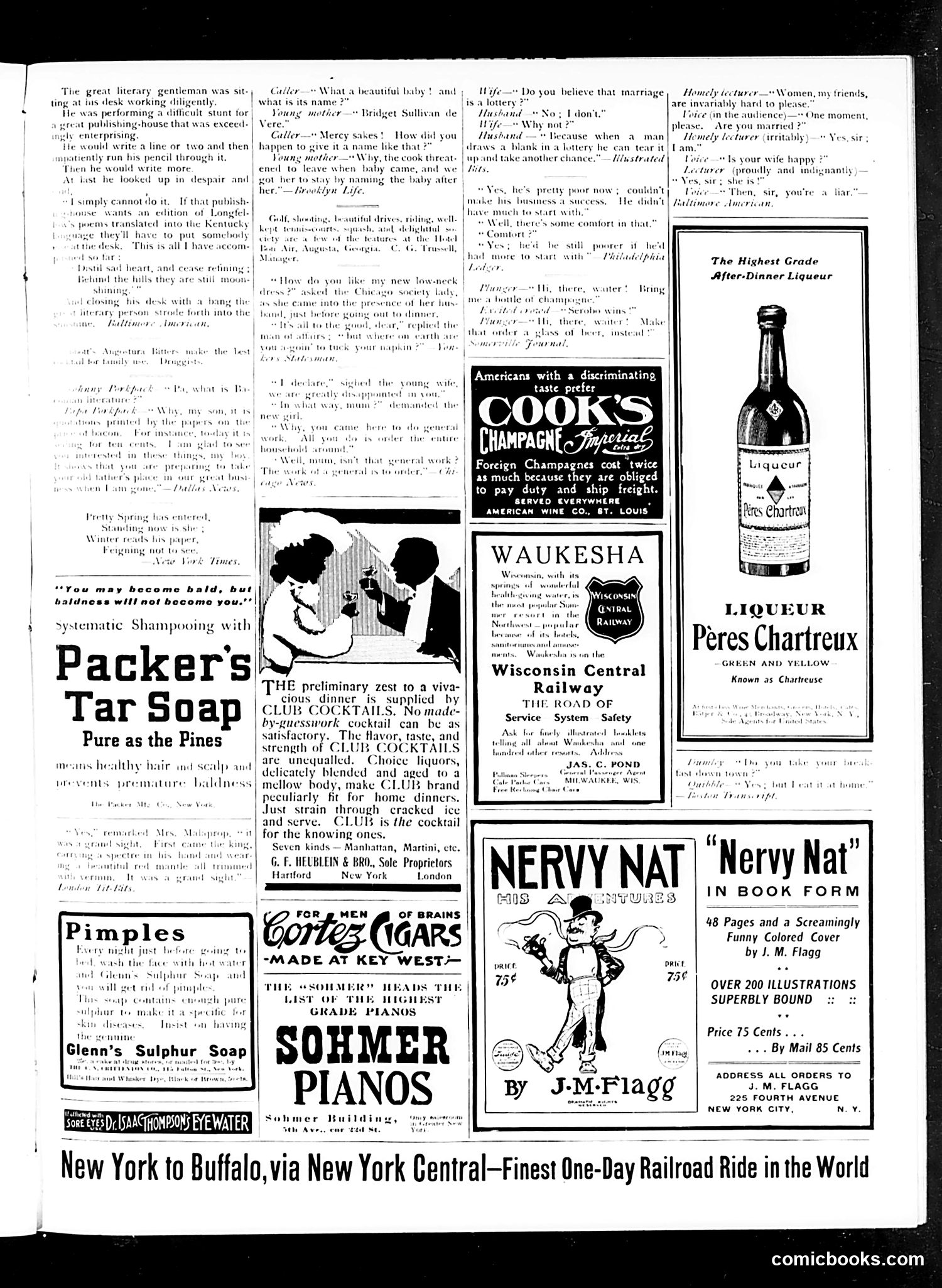
This page consists primarily of **advertisements and brief humorous anecdotes** rather than a cohesive political cartoon. The scattered text snippets depict everyday domestic and social situations meant for mild humor: a literary gentleman frustrated with work; a new mother naming her baby after the cook; a suitor discussing poverty and marriage prospects; discussions of alcohol and dining. The advertisements dominate the page—liqueurs (Peres Chartreux, Cook's Champagne), Sommer pianos, Parker's Tar Soap, Cortez cigars, and the Wisconsin Central Railway. One ad features "Nervy Nat," a cartoon character promoting J.M. Flagg's humorous book. Without identified political figures or clear satirical targets visible in the image, this appears to be a **typical Judge magazine miscellany page**—combining light social satire with commercial advertising. The humor is gentle, domestically-focused, and representative of early 20th-century American periodical content rather than pointed political commentary.
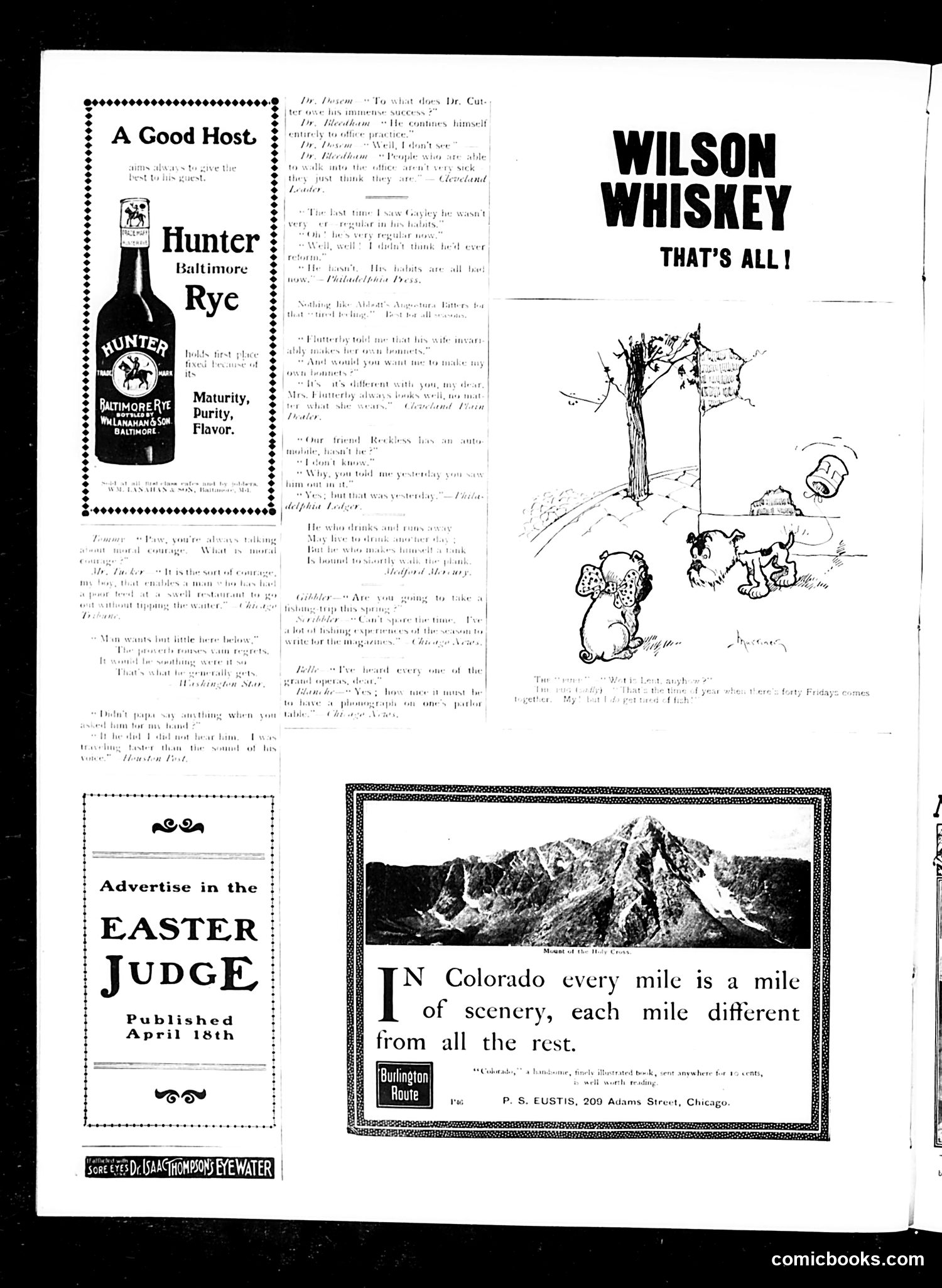
This is primarily an **advertising page** from Judge magazine, not a political cartoon. It contains three distinct advertisements: 1. **Hunter Baltimore Rye Whiskey** (left): A liquor ad emphasizing "Maturity, Purity, Flavor" with a bottle illustration. 2. **Wilson Whiskey** (right): Features a humorous illustration of dogs beneath a bare tree with a hanging bottle, using the tagline "That's All I" — apparently a joke about dogs' simple desires (implying they'd want whiskey as much as their basic needs). 3. **Burlington Route Colorado Tourism** (bottom right): Promotes scenic train travel through Colorado's mountains. 4. **Easter Judge Advertisement** (bottom left): Promotes advertising space in Judge's April 18th Easter issue. The page reflects early-20th-century advertising practices mixing alcohol promotion with travel and publication marketing. There is no significant political satire visible.
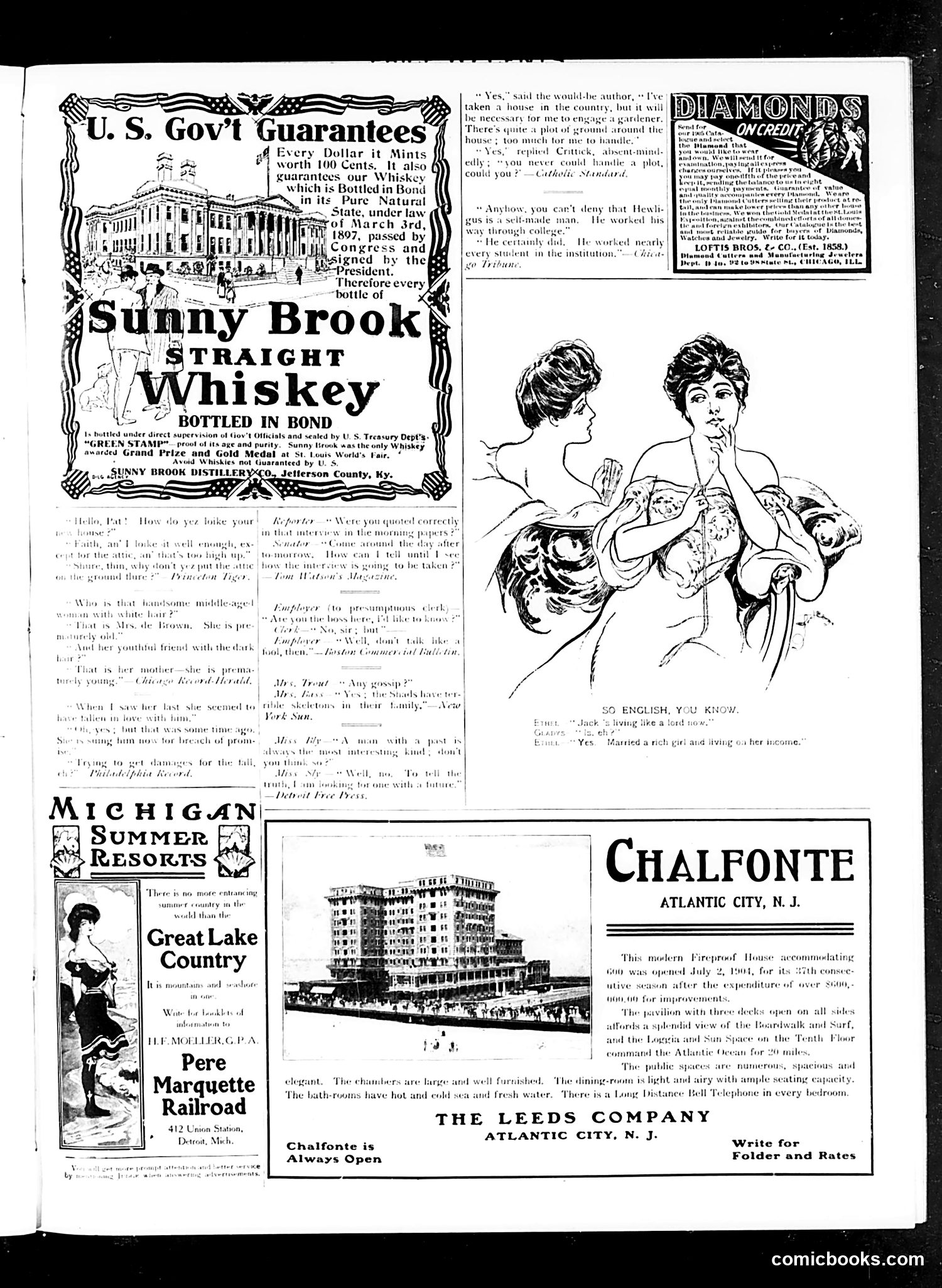
This page is primarily **advertising** rather than editorial cartoon content. The dominant feature is a large advertisement for Sunny Brook Whiskey, emphasizing U.S. Government guarantees of purity—a key selling point during an era of unregulated patent medicines and questionable spirits production. The small humorous excerpts scattered throughout appear to be **joke fillers** common to Judge magazine: - A dialogue mocking a would-be author who can't "handle a plot" - Quips about self-made men and gossip about romantic entanglements Additional advertisements promote Michigan's Great Lake Country resort travel, Atlantic City's Chalfonte hotel, and railroad services—typical of early 1900s periodicals targeting middle-class leisure activities. The **political/satirical content is minimal**; the page functions primarily as a revenue vehicle through paid advertisements, with light humor used as filler between ads rather than substantive commentary.
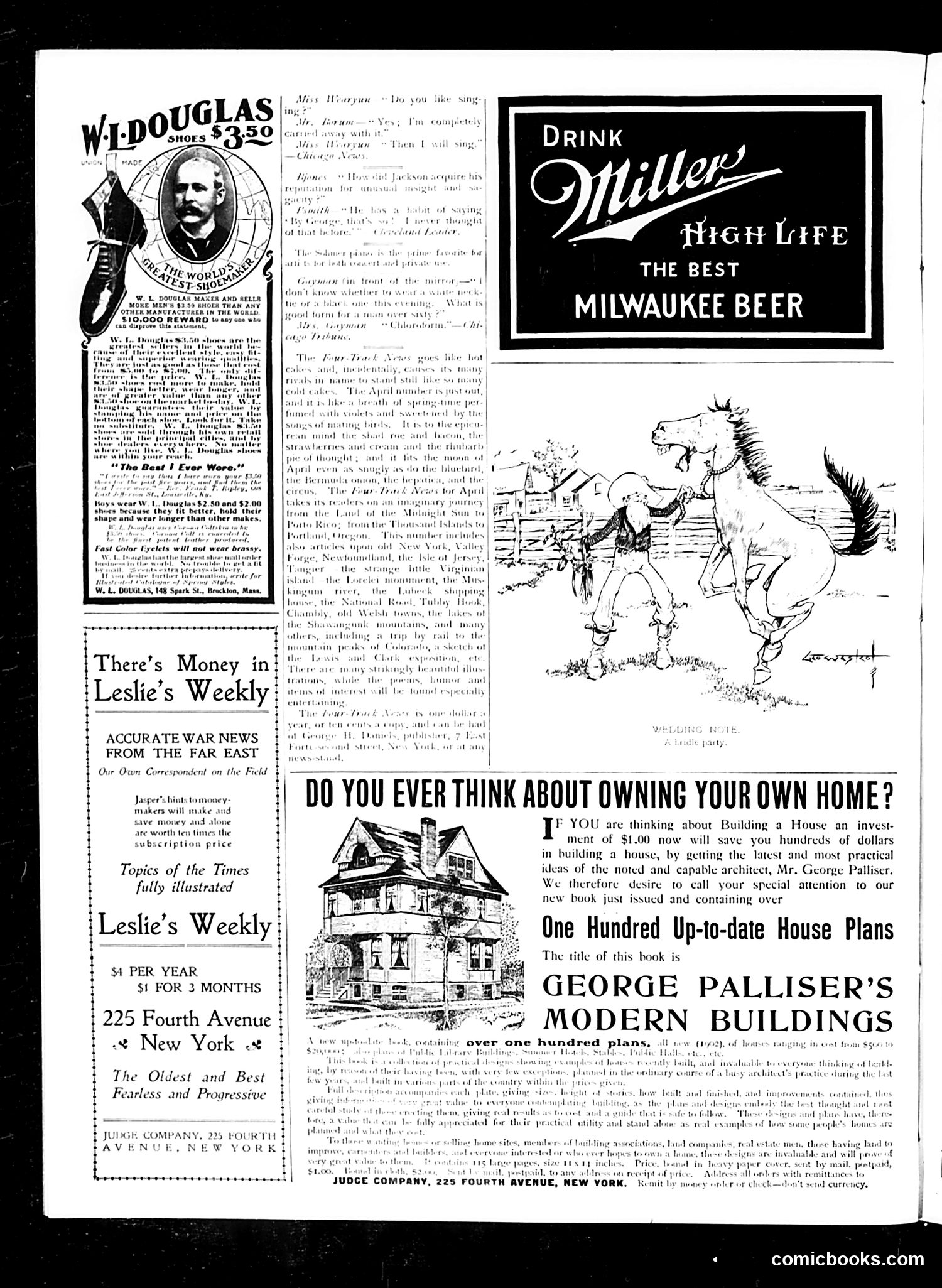
This is primarily an **advertising page** rather than editorial content. The main satirical cartoon appears to be "Welling Note" — a whimsical sketch of anthropomorphic horses or similar creatures in an absurd situation, likely commenting on contemporary politics or social folly, though the specific reference is unclear without additional context. The page is dominated by period advertisements: - **W.L. Douglas Shoes** ($3.50) — emphasizing value and "honest" manufacturing - **Miller High Life Beer** — Milwaukee's premium product - **Leslie's Weekly** — promoting subscription to this competing satirical magazine, advertising "accurate war news from the Far East" (likely referencing the Russo-Japanese War, 1904-1905) - **George Palliser's Modern Buildings** — a mail-order architectural pattern book for homeowners These ads reflect early-1900s consumer culture: mass-produced goods, international conflicts as entertainment, and the American aspirational dream of home ownership. The mixture reveals Judge's audience: middle-class readers interested in current events, consumer products, and self-improvement.
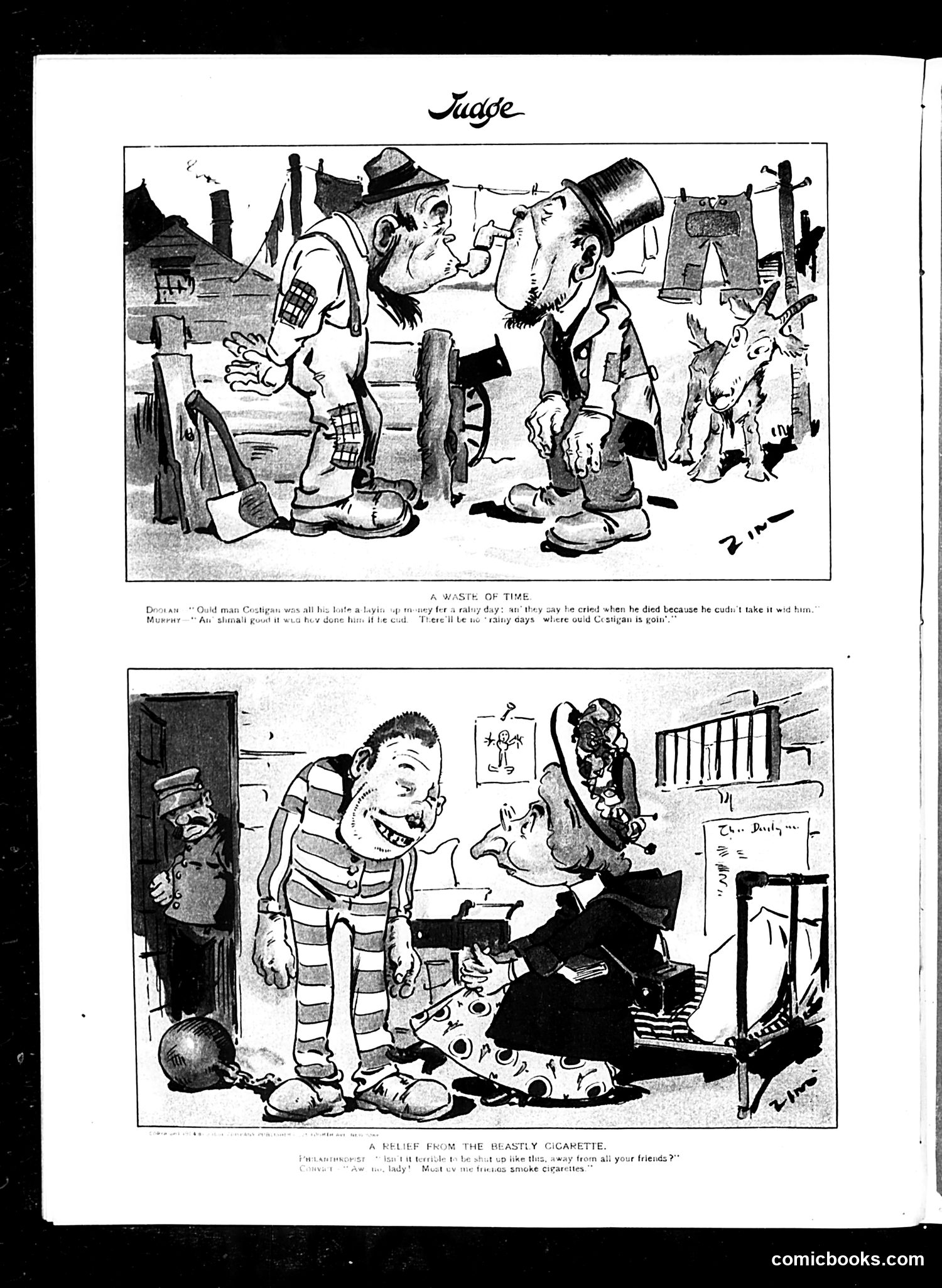
This page contains two political cartoons satirizing financial corruption and waste. **Top cartoon ("A Waste of Time"):** Depicts a "Gold man Coolidge" (likely President Calvin Coolidge) being examined by a "Doctor" and "Moneybags" character. The satire critiques the wealthy's indifference to the poor—the caption suggests a rich man cried when losing money but wouldn't mourn a poor person's death. This reflects 1920s class tensions and criticism of the wealthy elite's callousness. **Bottom cartoon ("A Relic from the Beastly Cigarette"):** Shows a child in striped clothing (suggesting imprisonment or poverty) with adults discussing cigarette branding. This appears to satirize advertising directed at children and corporate exploitation of youth, common Progressive-era concerns about corporate manipulation and child welfare. Both cartoons critique wealth inequality and corporate exploitation prevalent in the 1920s.