
A complete issue · 16 pages · 1900
Judge — October 13, 1900
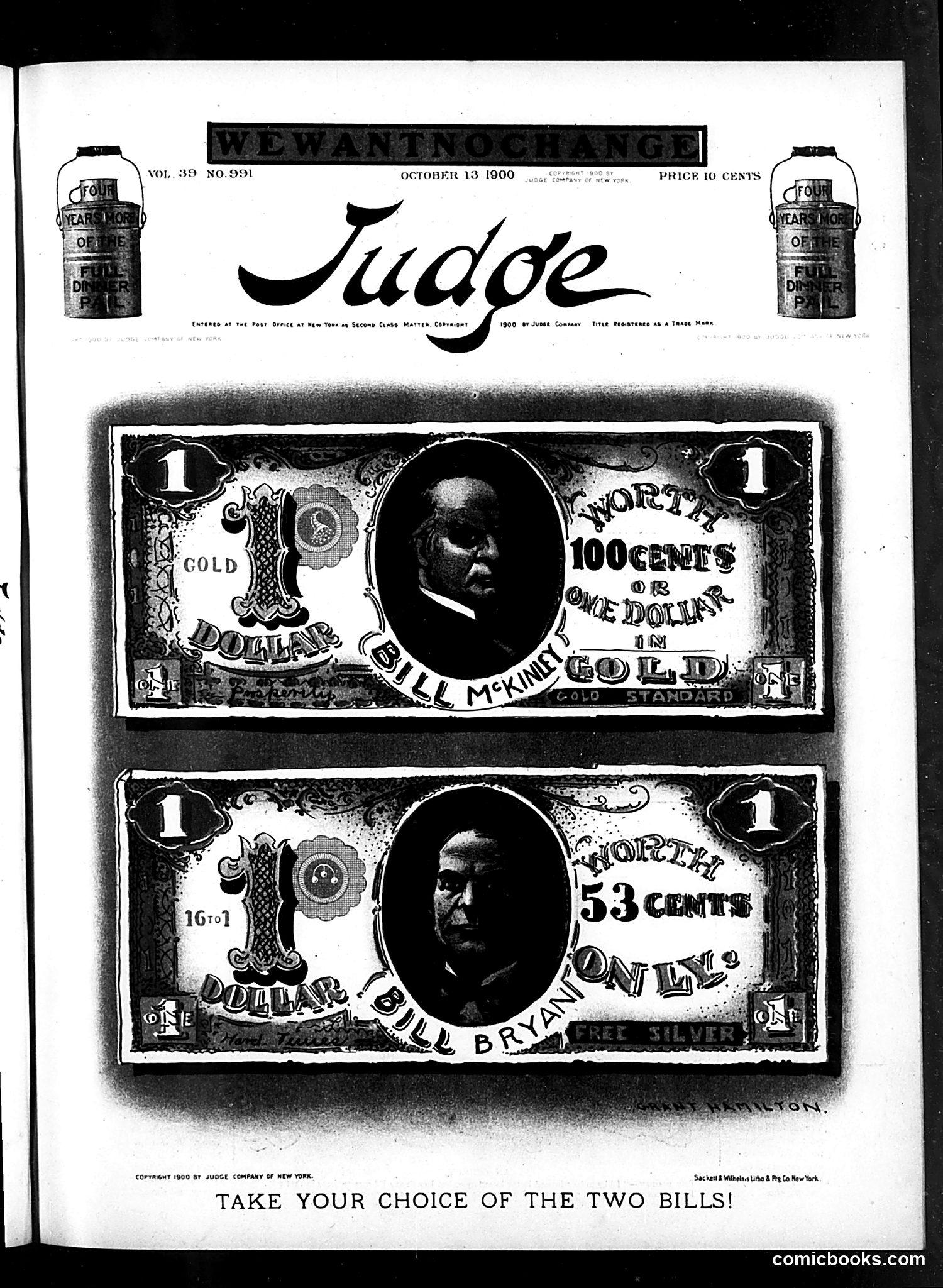
This page satirizes the 1900 U.S. presidential election through fake currency designs. The two bills parody competing candidates: **Top bill**: Features "Bill McKinley" worth "100 Cents or One Dollar" in "Gold" — supporting President William McKinley's re-election campaign, which championed the gold standard. **Bottom bill**: Shows "Bill Bryan" worth "53 Cents or Only" in "Free Silver" — mocking William Jennings Bryan's Democratic platform advocating free silver coinage, which opponents feared would devalue currency. The satire suggests Bryan's free-silver position would literally make money worth less. The "Take Your Choice of the Two Bills!" caption frames the election as a choice between sound currency (McKinley/gold) versus inflationary risk (Bryan/silver). This reflects a central 1900 campaign debate.
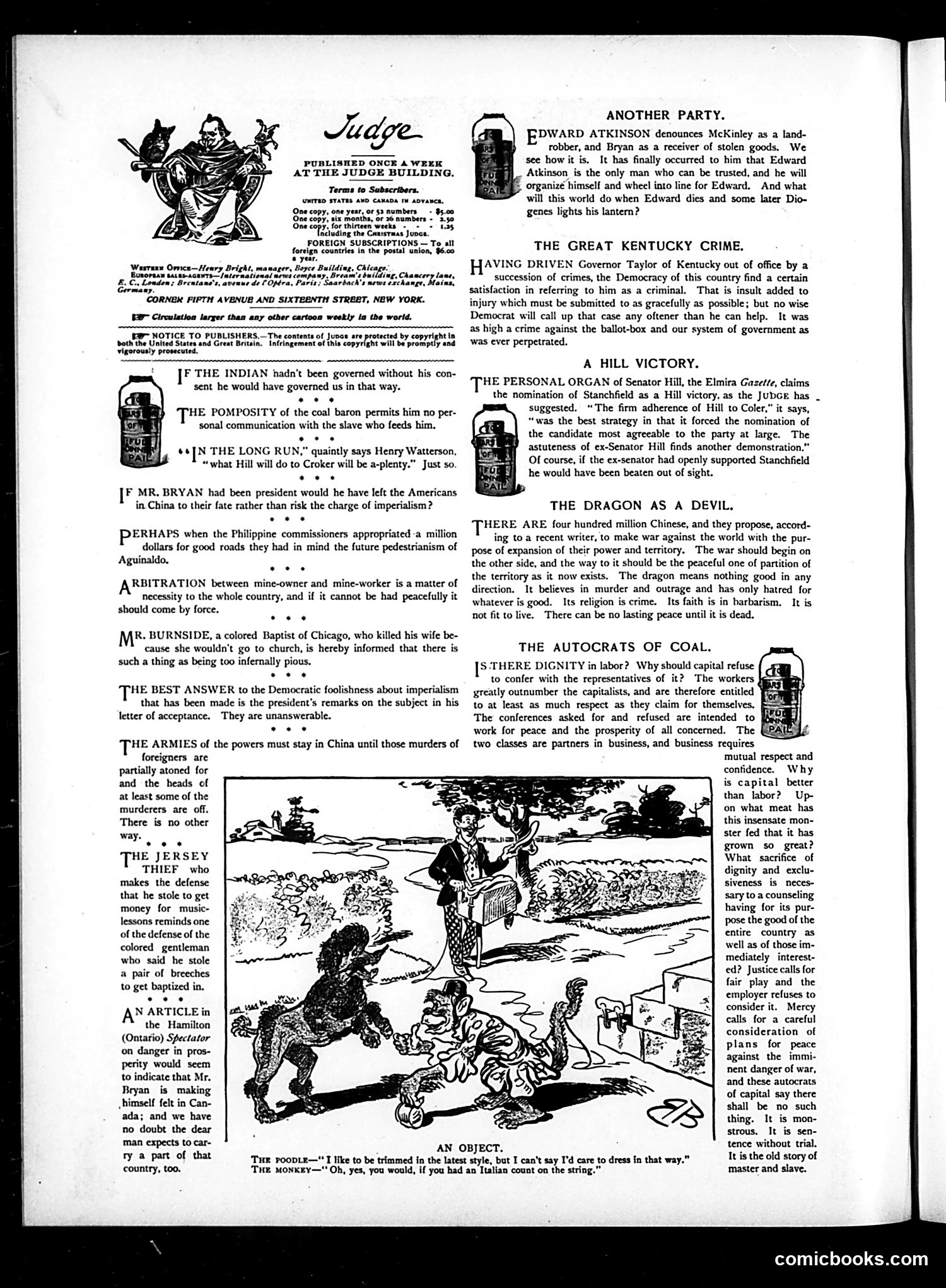
This page contains political commentary rather than traditional cartoons. The main illustrated piece, captioned "An Object," depicts a poodle and monkey in conversation about clothing and fashion—likely satirizing human vanity or class pretension through animal characters. The text sections address serious political issues: Governor Taylor of Kentucky's removal from office (called a "crime" against democracy), Senator Hill's political maneuvering regarding Stanchfield's nomination, and Chinese expansion as a military threat. A substantial article criticizes coal industry autocrats for refusing labor dignity and fair negotiation, arguing capitalists and workers should respect each other as equal partners rather than master and slave. The overall tone is progressive-leaning, attacking political corruption, imperialism, and labor exploitation while defending democratic principles.
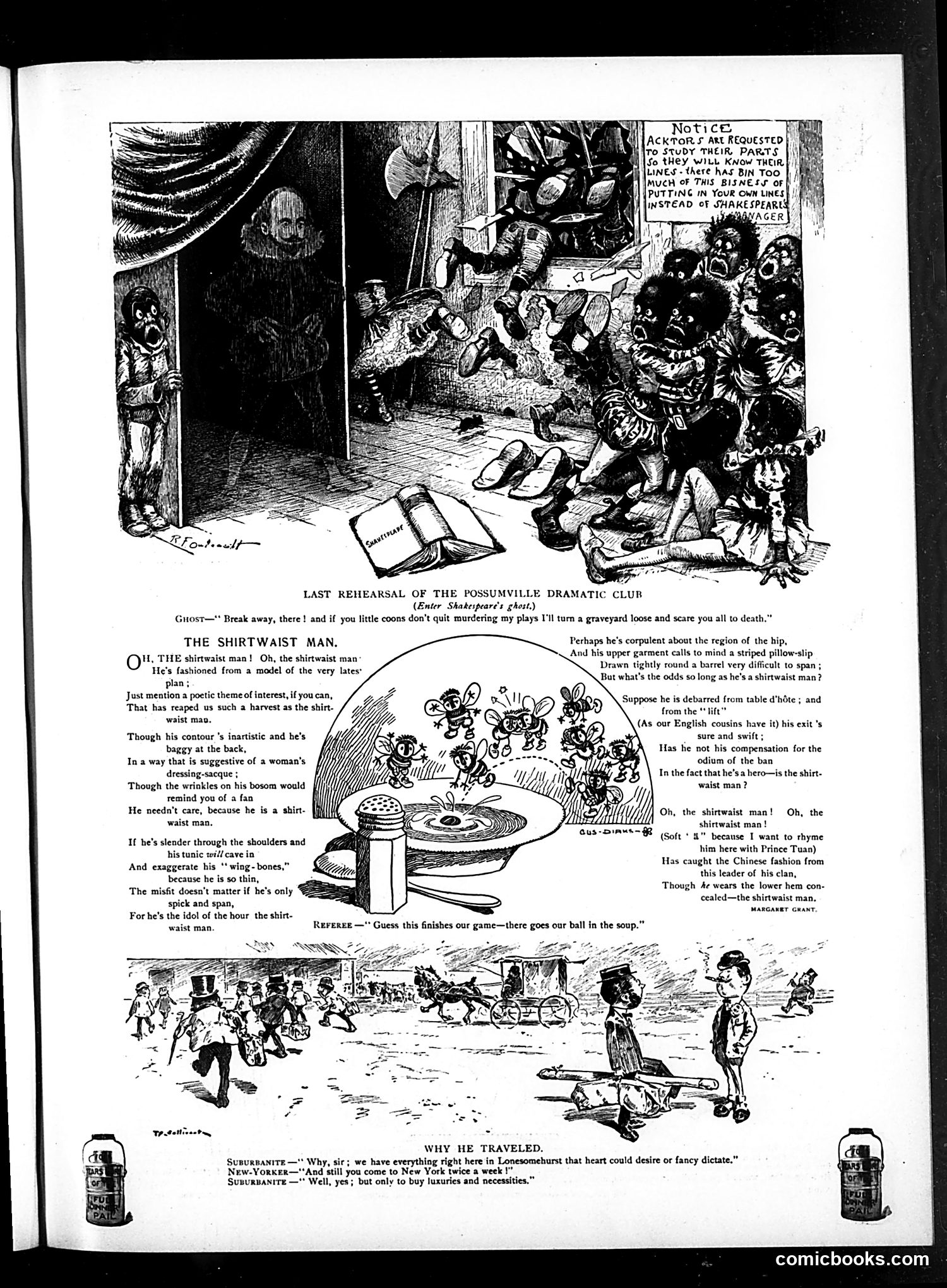
This page contains three distinct pieces of satirical content: 1. **"Last Rehearsal of the Posumville Dramatic Club"** (top): A chaotic theater scene mocking amateur theatrical productions, with performers butchering Shakespeare's lines and creating mayhem onstage. 2. **"The Shirtwaist Man"** (center): Satirizes a fashion-conscious man obsessed with his shirtwaist (a type of garment). The verse ridicules his vanity and suggests he's adopted "Chinese fashion" with the shirtwaist as his defining characteristic—mocking both fashion obsession and cultural appropriation. 3. **"Why He Traveled"** (bottom): A dialogue between a Suburbanite and New-Yorker about why someone left Locust-hursts for the city, attributing it to desire for luxuries and necessities rather than mere rural satisfaction. The page satirizes contemporary vanity, theater culture, and urban-rural differences.
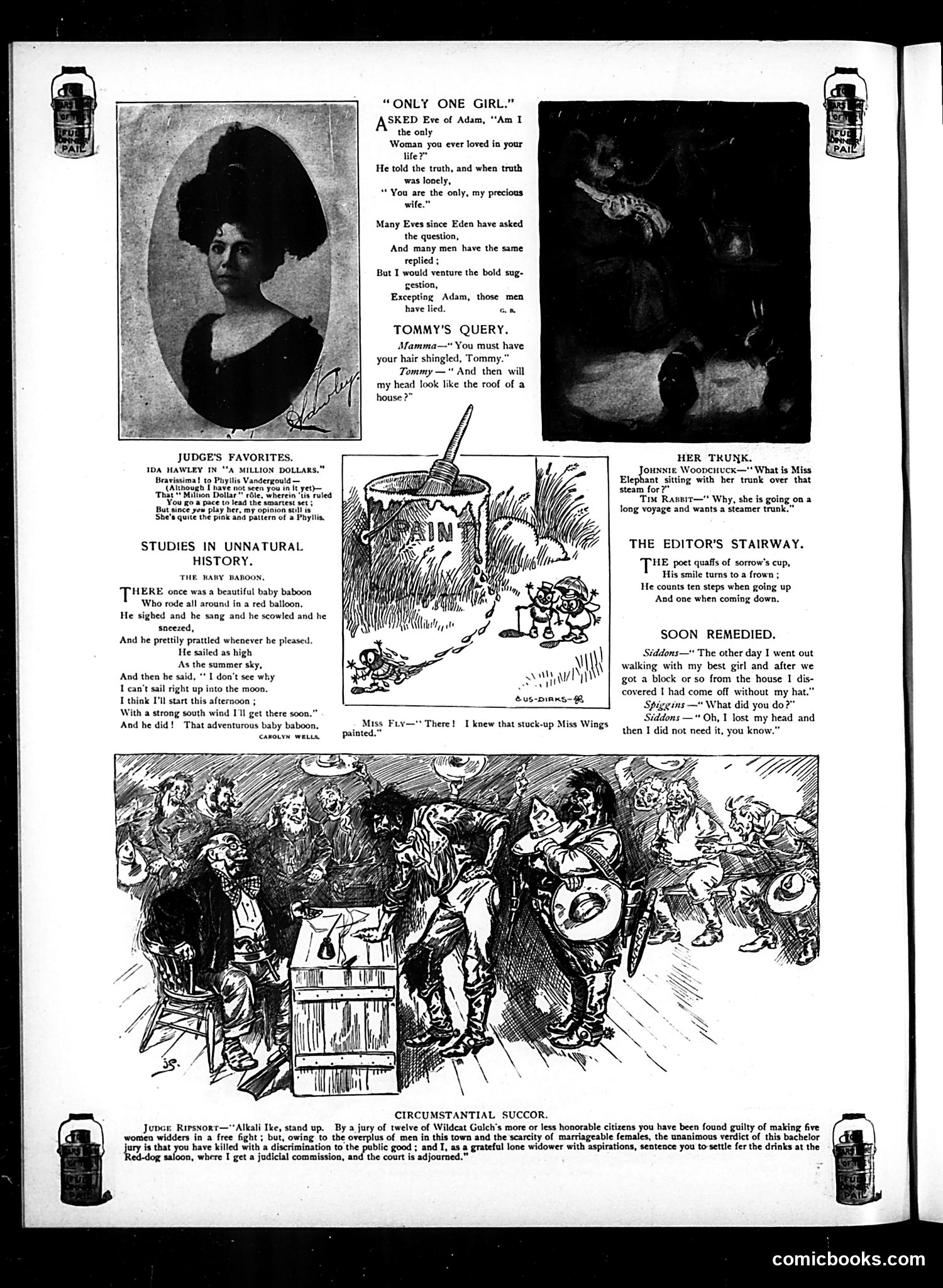
This page contains several satirical pieces and humor columns typical of early 20th-century Judge magazine: **"Only One Girl"** presents a poetic debate about whether Adam loved only Eve, with the implication that most men since have loved multiple women. **"Studies in Unnatural History"** satirizes a man's attempts to reach the moon via hot air balloon—likely mocking both overly ambitious technological dreams and foolish male behavior. **"Tommy's Query"** jokes about a child's innocent misunderstanding of grooming ("shingled" hair). **The bottom illustration** titled "Circumstantial Succor" appears to depict a crowded social scene, possibly satirizing urban life or social gatherings, though specifics are unclear from the image quality. The page reflects Judge's formula: mixing romantic/gender humor with absurdist satire and social commentary aimed at educated, urban readers.
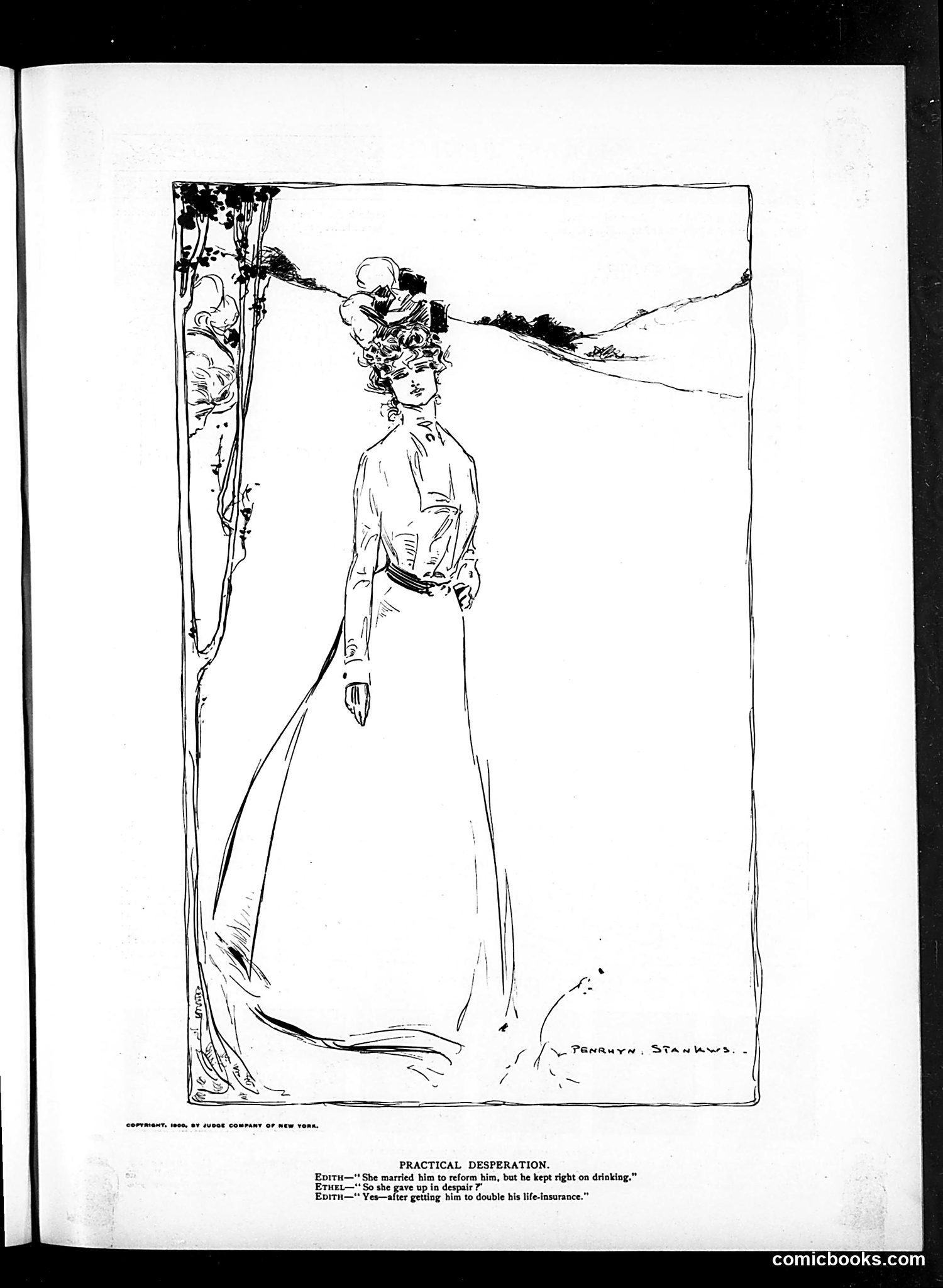
This satirical dialogue cartoon critiques both marriage and insurance practices circa early 1900s. Two women (Edith and Ethel) discuss a wife's failed attempt to reform her drinking husband. The joke's cynical punchline—that she abandoned reform efforts after increasing his life insurance to double—suggests the wife now has financial incentive for his death rather than his improvement. The satire operates on multiple levels: it mocks the era's common belief that wives could "reform" husbands through marriage, while simultaneously satirizing the emerging life-insurance industry and the perverse incentives it could create. The elegant illustration style (signed "Penrhyn Stanlaws") contrasts darkly with the morbid humor, typical of Judge magazine's sophisticated satirical approach to social follies.
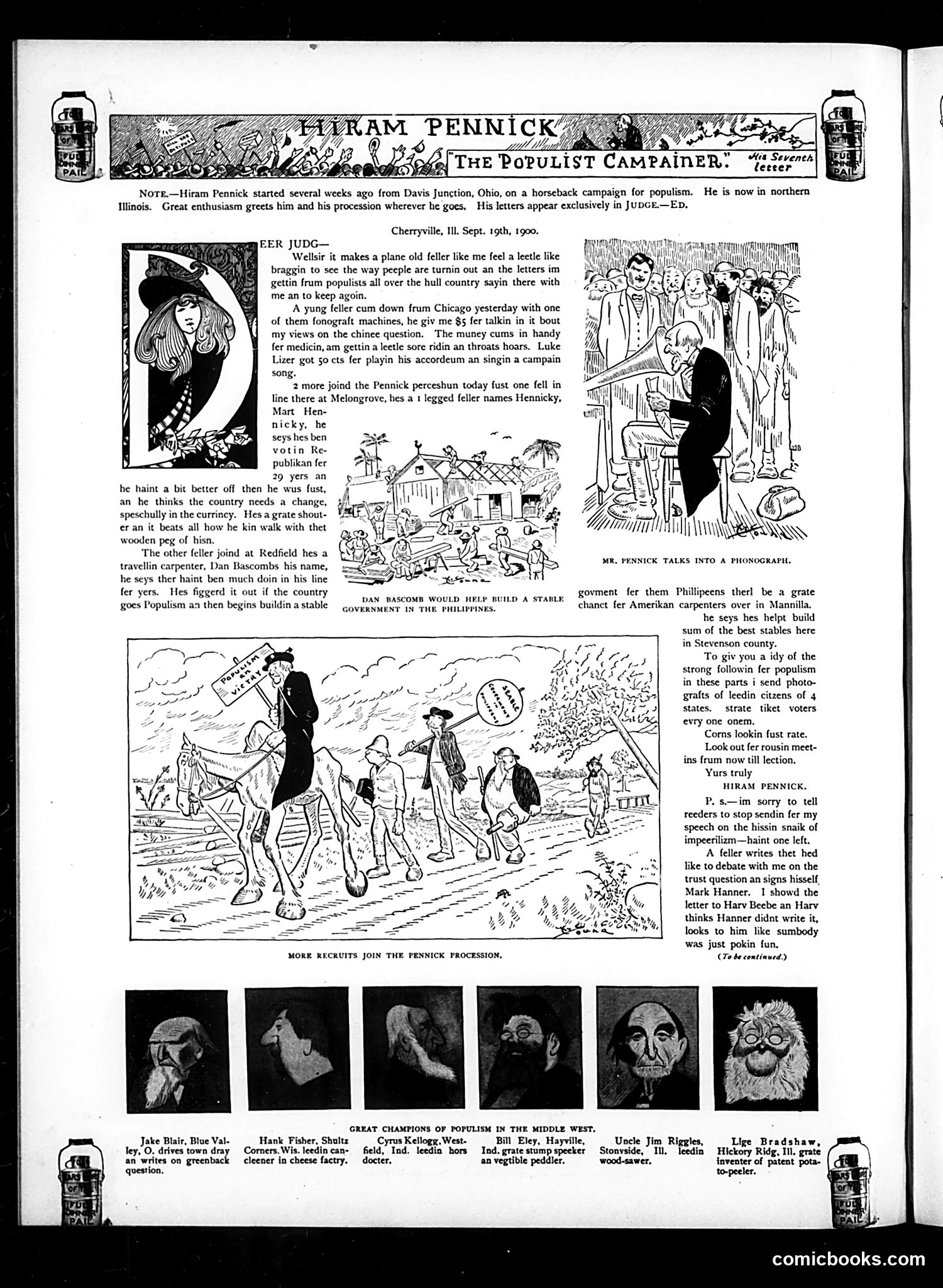
This page satirizes the Populist Party movement through letters from "Hiram Pennick," a rural Ohio politician campaigning for populism on horseback across the Midwest. Judge magazine mocks populism by depicting Pennick as an unsophisticated farmer attracting equally quirky recruits—a one-legged voter, a traveling carpenter, and various working-class figures photographed below. The satire targets populist rhetoric about currency reform, opposition to imperialism (the Philippines conflict), and anti-monopoly ("trust question") positions. By showing Pennick monetizing his campaign (receiving $5 to speak into a phonograph), Judge ridicules populism as theatrical hucksterism rather than serious politics. The accompanying cartoons show an increasingly absurd "procession" joining the campaign, emphasizing that populism appeals to society's margins and malcontents rather than respectable citizens. The final postscript—someone prank-writing under a fake name—reinforces the magazine's dismissal of populist discourse as mere "pokin fun."
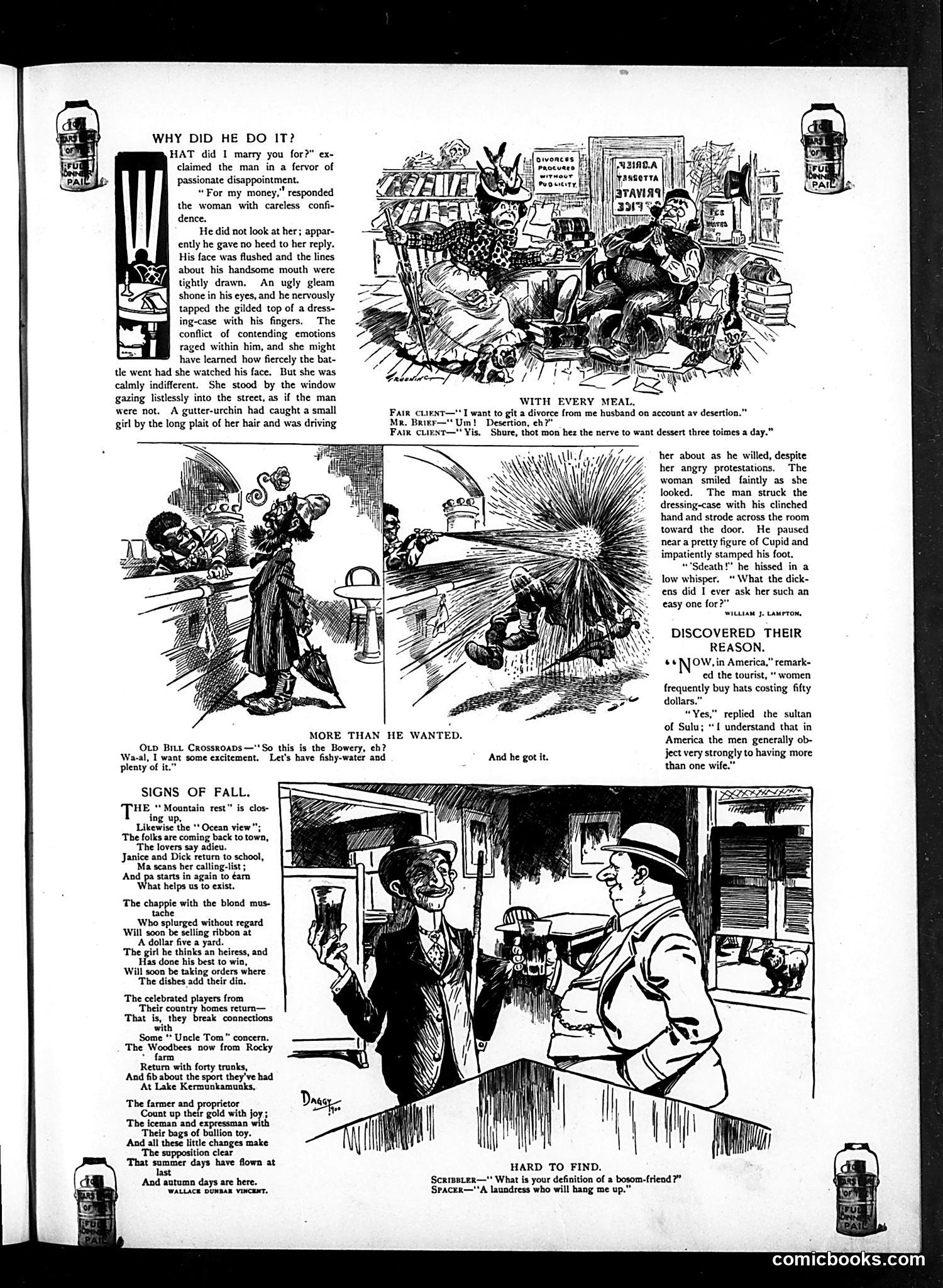
This page contains satirical humor typical of early 20th-century American comedy magazines. The main narratives mock domestic relationships and social pretenses: **"Why Did He Do It?"** depicts a husband learning his wife married him purely for money—she admits this casually while he suffers emotional turmoil. The satire targets both his naive romanticism and her mercenary pragmatism. **"With Every Meal"** features an Irish immigrant wife seeking divorce for "desertion" because her husband wants dessert three times daily—wordplay on "desertion/dessert" satirizing both marital discord and immigrant dialect humor common in the era. **"Discovered Their Reason"** contrasts American women's expensive hat-buying ($50) with a sultan's polygamy, suggesting both cultures prioritize material excess. Other content includes seasonal humor about summer visitors returning to city life, and brief jokes about class anxieties (the broke "chappie" reduced to selling ribbons). The overall tone mocks marriage, materialism, and social climbing without endorsing any particular political position.
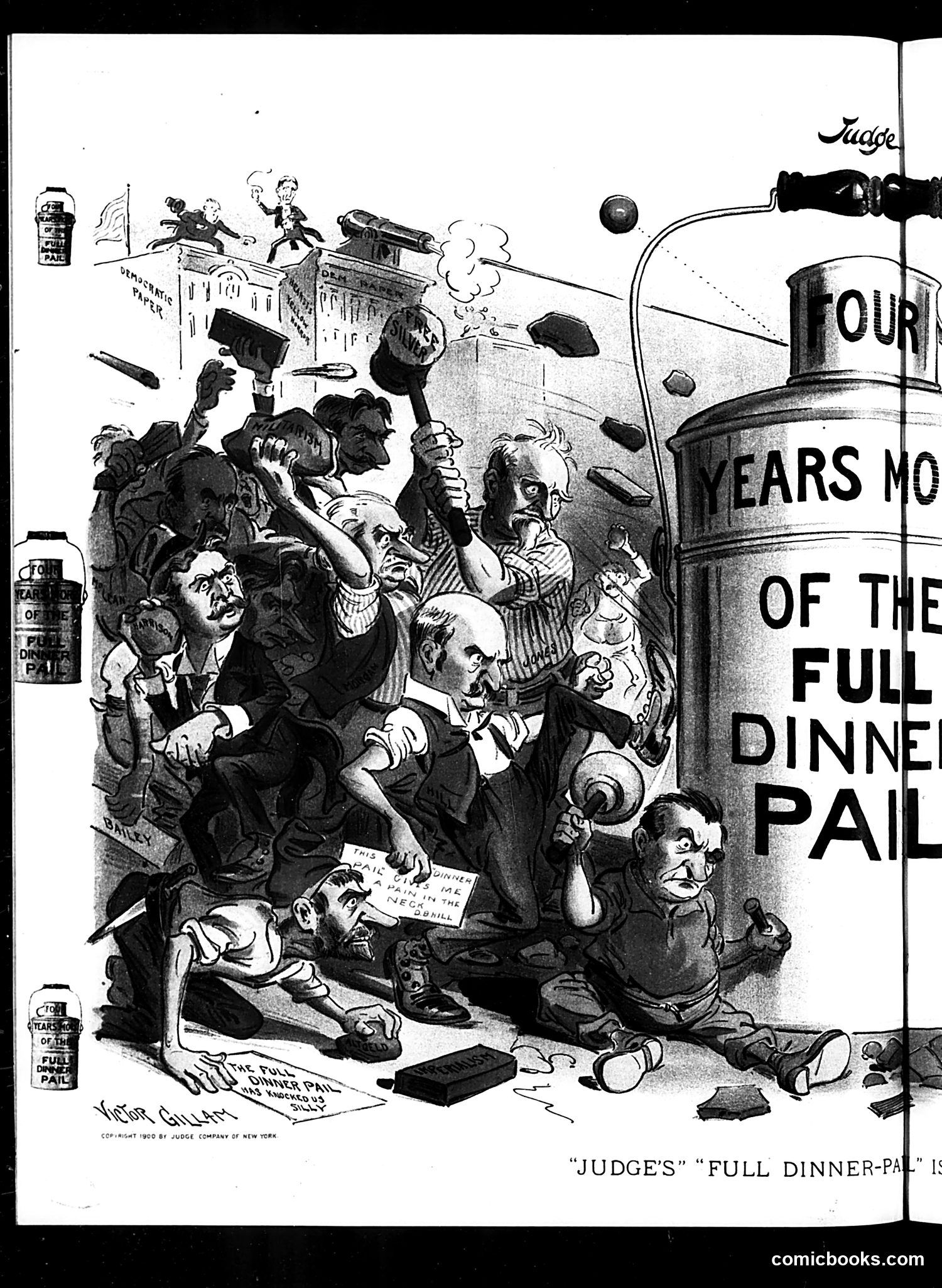
This Judge magazine cartoon satirizes what appears to be a scandal or controversy surrounding a "Full Dinner Pail"—a political slogan promising prosperity. The image depicts a large cylindrical container labeled "FOUR YEARS MO[RE] OF THE FULL DINNER PAIL" being attacked by an angry mob of working-class men wielding clubs and hammers. The figures appear to represent ordinary citizens expressing outrage, suggesting the promise of economic prosperity ("full dinner pail") had failed to materialize. The cartoon critiques either a political campaign's broken promises or economic hardship affecting workers. The chaotic scene with people literally assaulting the symbol of promised abundance emphasizes public frustration with unfulfilled pledges of economic well-being.
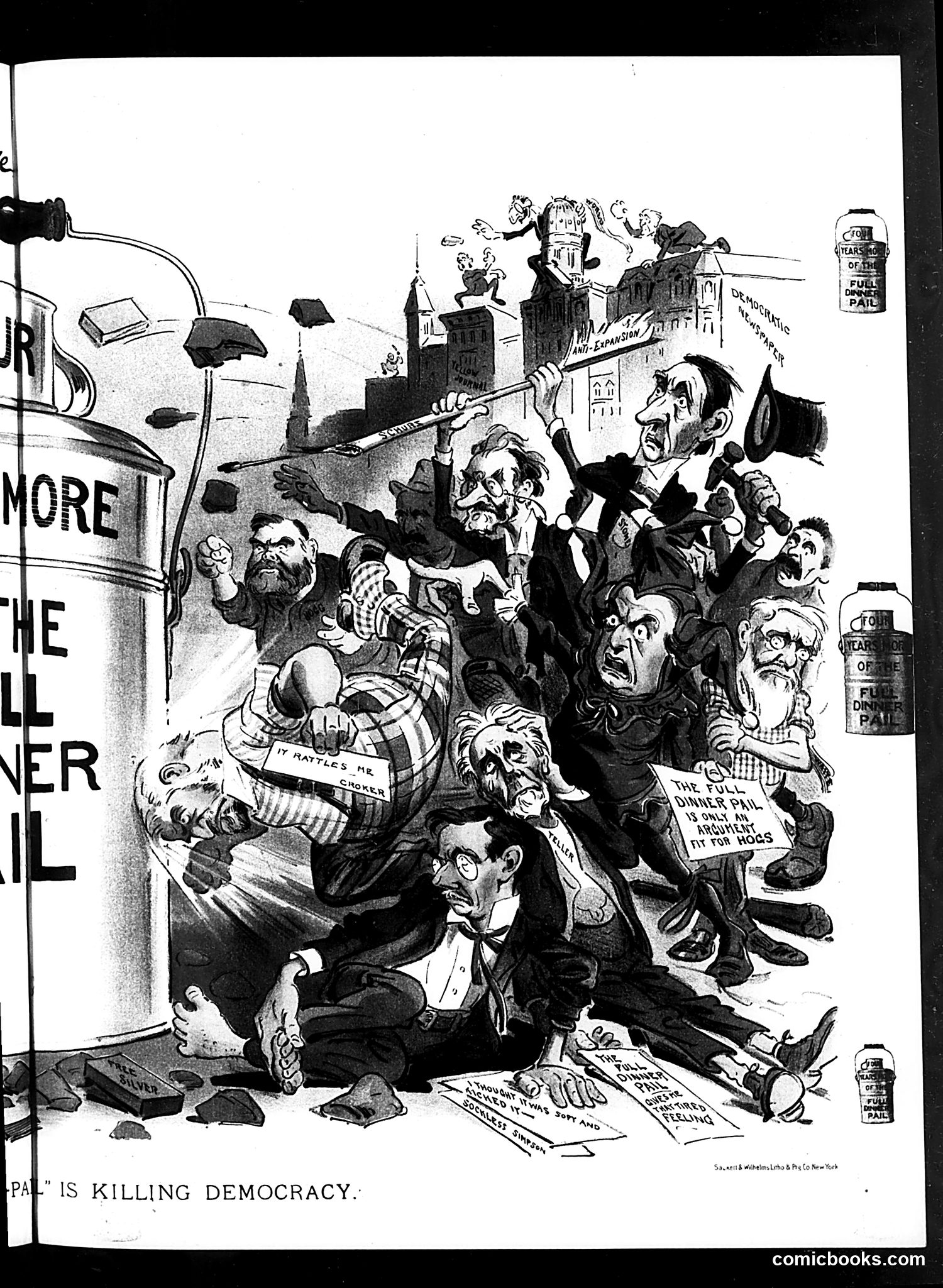
This Judge magazine cartoon depicts a large bottle labeled "DEMOCRATIC FUEL PANIC" pouring its contents onto a crowd of distressed figures. The caption reads "IS KILLING DEMOCRACY." The cartoon satirizes how panic—likely about fuel shortages or economic crisis—is destroying democratic institutions and public order. The crowd below appears to be various politicians and citizens in chaos, with scattered papers and signs visible. The exaggerated caricatures and frantic poses emphasize social upheaval. The bottles on the right labeled "DEMOCRATIC FUEL PANIC" suggest the satire targets how fear-mongering or actual resource scarcity can destabilize government and public trust. This likely comments on early-20th-century American anxieties about energy crises, economic stability, or political instability during times of national stress.
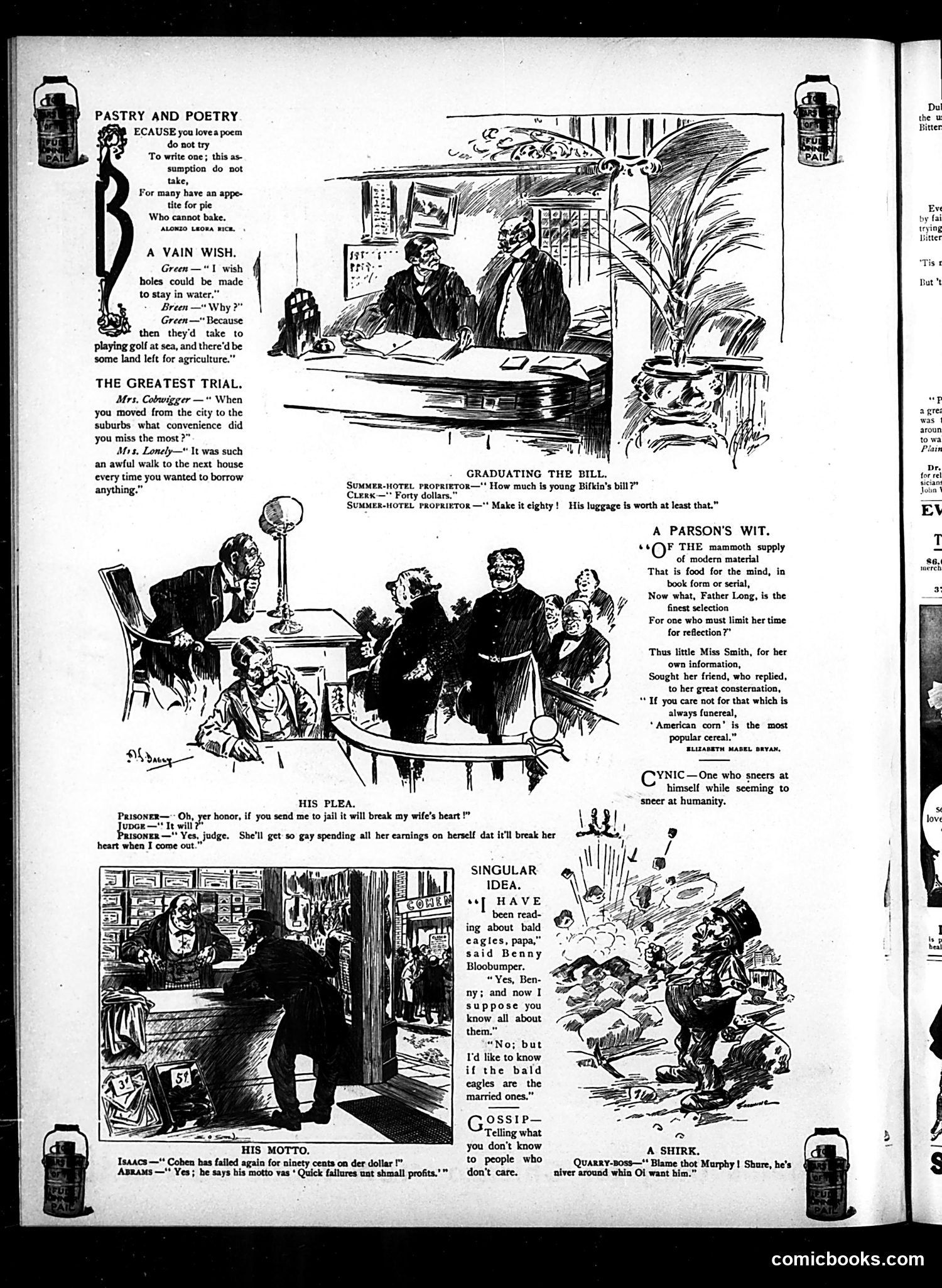
This page contains multiple satirical jokes and cartoons typical of early 20th-century American humor: **"A Vain Wish"** satirizes golf's growing popularity among the wealthy, suggesting golfers waste land that could be agricultural. **"The Greatest Trial"** jokes about suburban inconvenience—the irony being that moving to suburbs loses the convenience of urban borrowing. **"Graduating the Bill"** pokes fun at summer hotel proprietors inflating guest bills based on luggage value rather than actual services. **"A Parson's Wit"** uses wordplay: a priest recommends "American corn" (breakfast cereal) as reading material, mocking both modern literature's quality and commercial advertising. **"His Plea"** presents dark humor about a prisoner's wife spending his earnings while he's imprisoned. **"His Motto"** appears to ridicule a businessman named Cohen for repeated financial failures. The cartoons employ ethnic caricatures and class-based humor common to the era, targeting immigrants, the poor, and nouveaux riches for satire.
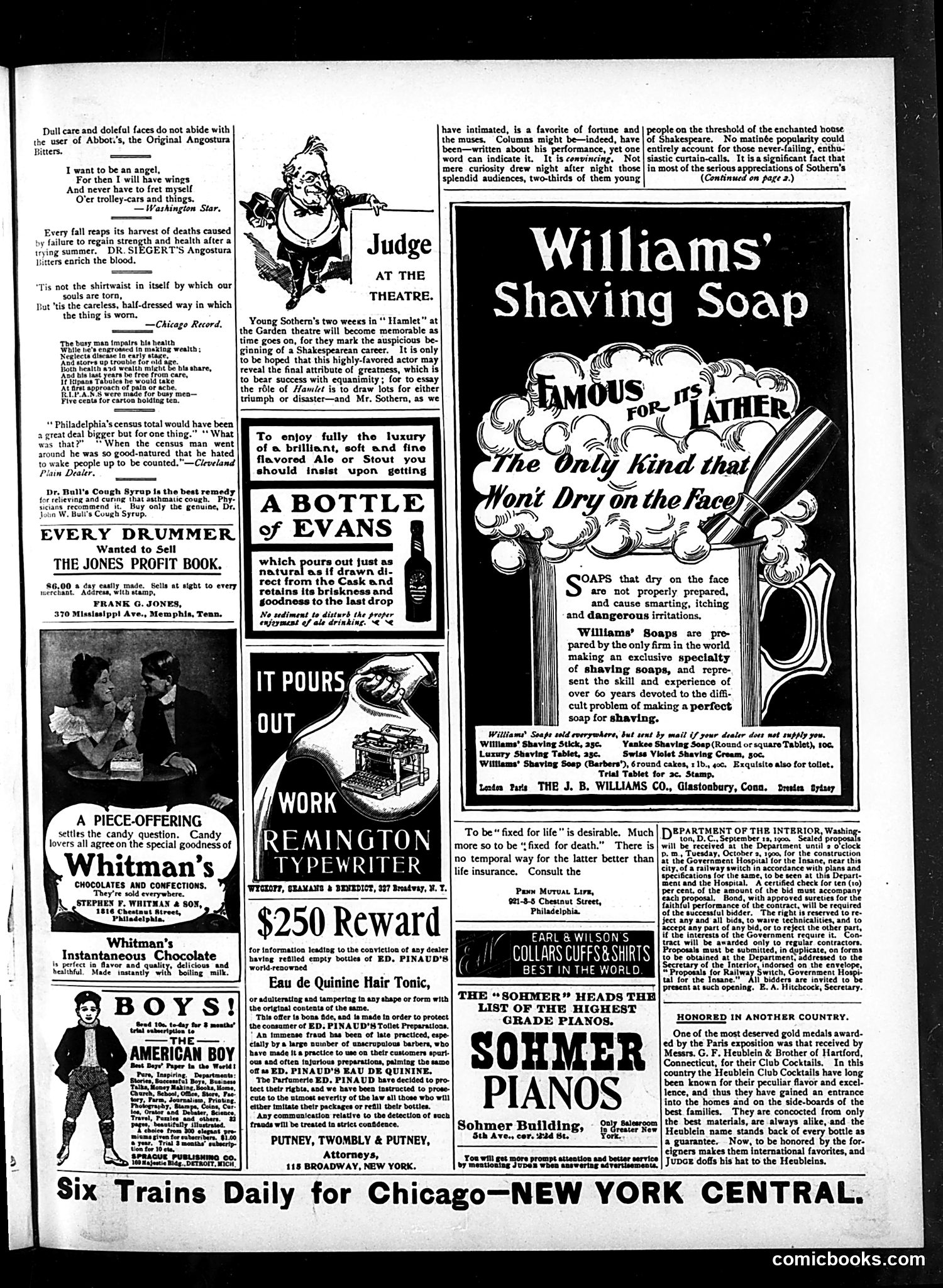
This page is primarily **advertising** with some editorial content. The main elements are: **Editorial Content:** - A brief theater review praising actor Young Sothern's Shakespearean debut in *Hamlet* at the Garden Theatre, noting this marks the beginning of his serious dramatic career. **Advertisements:** The page contains numerous product ads typical of early 20th-century magazines: Abbott's Angostura Bitters, Dr. Siegert's Bitters, Dr. Ball's Cough Syrup, Evans Ale, Remington Typewriters, Williams' Shaving Soap, Whitman's Chocolates, and others. **Notable Features:** - Several small poems/witticisms scattered throughout (from *Washington Star*, *Chicago Record*, *Cleveland Plain Dealer*) - A $250 reward notice from ED. PINAUD perfume for information about counterfeit bottles—addressing fraud by barbers refilling empty bottles with inferior products The page reflects advertising conventions and consumer concerns of the era, with emphasis on patent medicines and personal grooming products.
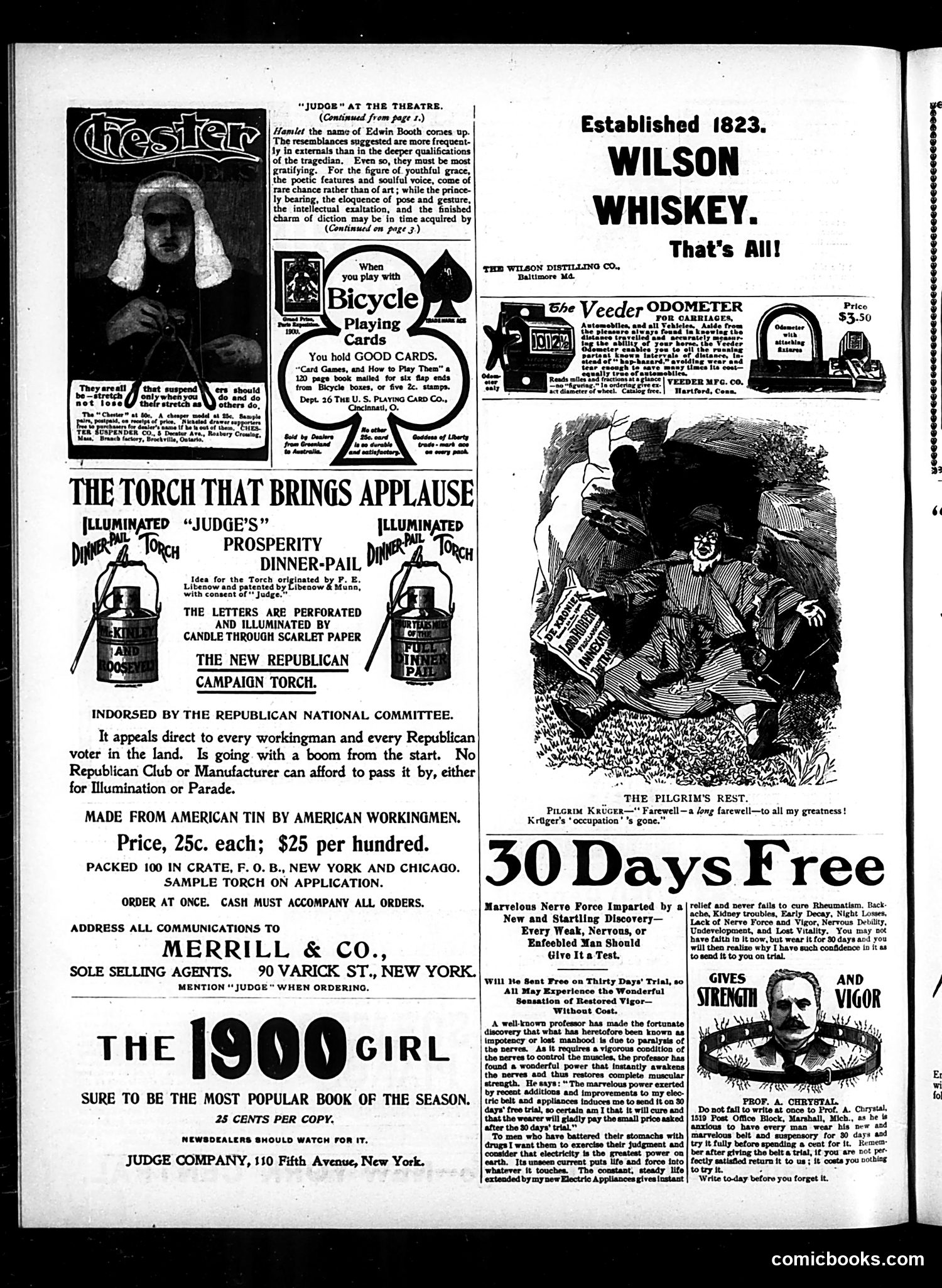
This page is primarily **advertising** rather than editorial content, though it includes one theatrical review excerpt at the top. The review discusses **Edwin Booth's performance as Hamlet**, praising his "youthful grace" and "poetic features" while noting his resemblance to the character comes more from external appearance than deep tragic interpretation. The advertisements reflect early 1900s consumer culture: - **Republican Campaign Torch**: A patriotic product endorsed by the Republican National Committee, marketed as "Judge's Prosperity Dinner-Pail"—linking the party to workingman prosperity - **Wilson Whiskey** and **Veeder Odometer**: Standard product ads - **"The 1900 Girl"** book advertisement - **Patent medicine ads**: A "Nerve Force" treatment and "Electric Appliances" for male vitality issues—typical of the era's dubious health claims The **Pilgrim's Rest illustration** appears to be a literary or theatrical reference, though context isn't clear from this page. Overall, the page demonstrates how Judge balanced satirical commentary with commercial advertising revenue.
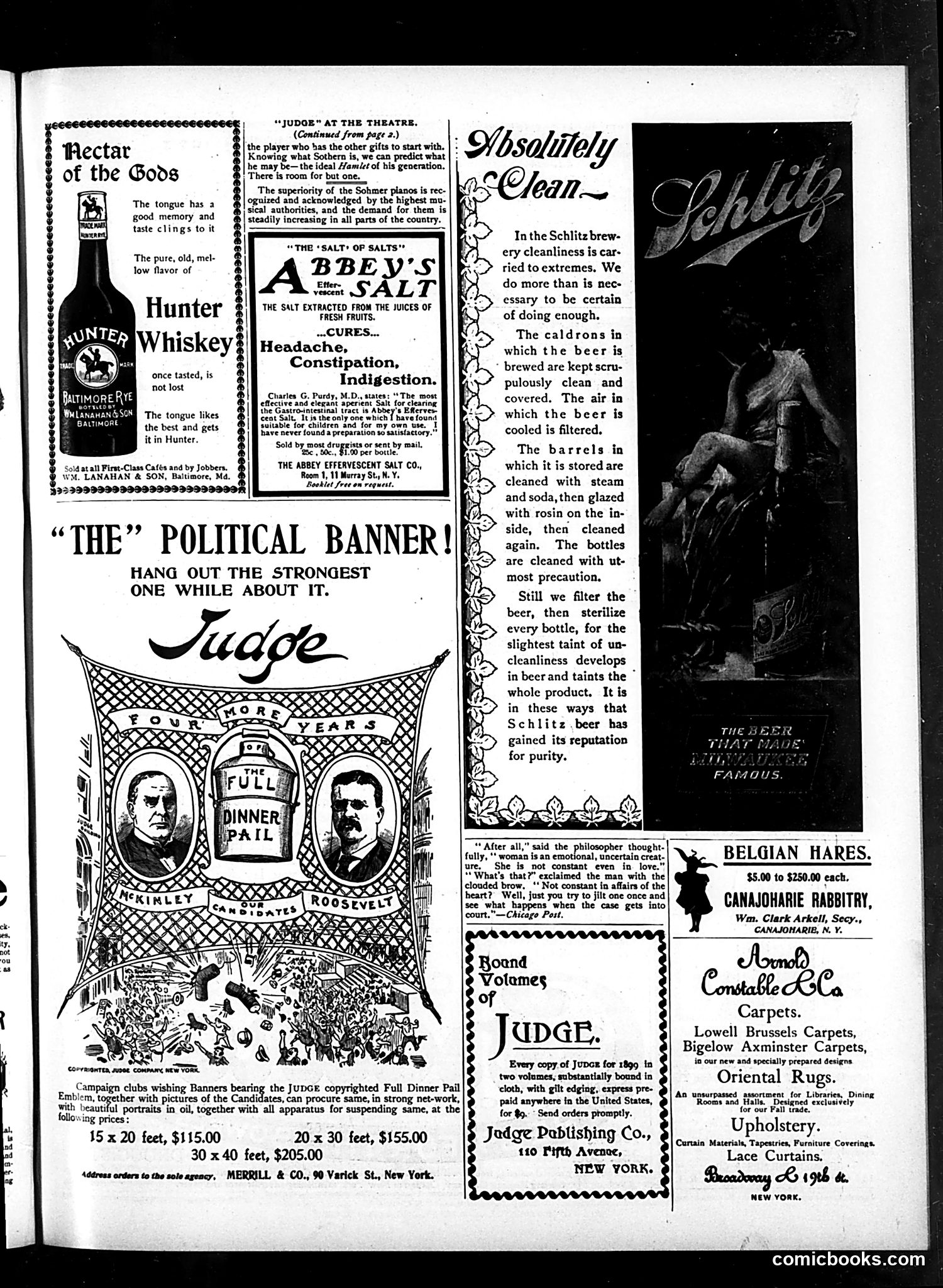
The central cartoon advertises campaign banners featuring the "Full Dinner Pail"—the Republican Party's 1900 election slogan promoting economic prosperity under President McKinley. The banner design shows portraits of two political figures (appearing to be McKinley and his running mate) flanking a dinner pail emblem, representing the promise of prosperity and full employment. The satirical headline "HANG OUT THE STRONGEST ONE WHILE ABOUT IT" suggests Judge magazine's ironic commentary on campaign messaging: politicians should display their boldest claims boldly. The "Full Dinner Pail" was McKinley's central campaign message emphasizing American economic success versus Democratic claims of hardship. The page is primarily advertisement-driven, selling these banners to campaign clubs at various sizes ($115-$205). This reflects Judge's role as both satirical commentary and commercial enterprise, monetizing the very political theater it mocked.
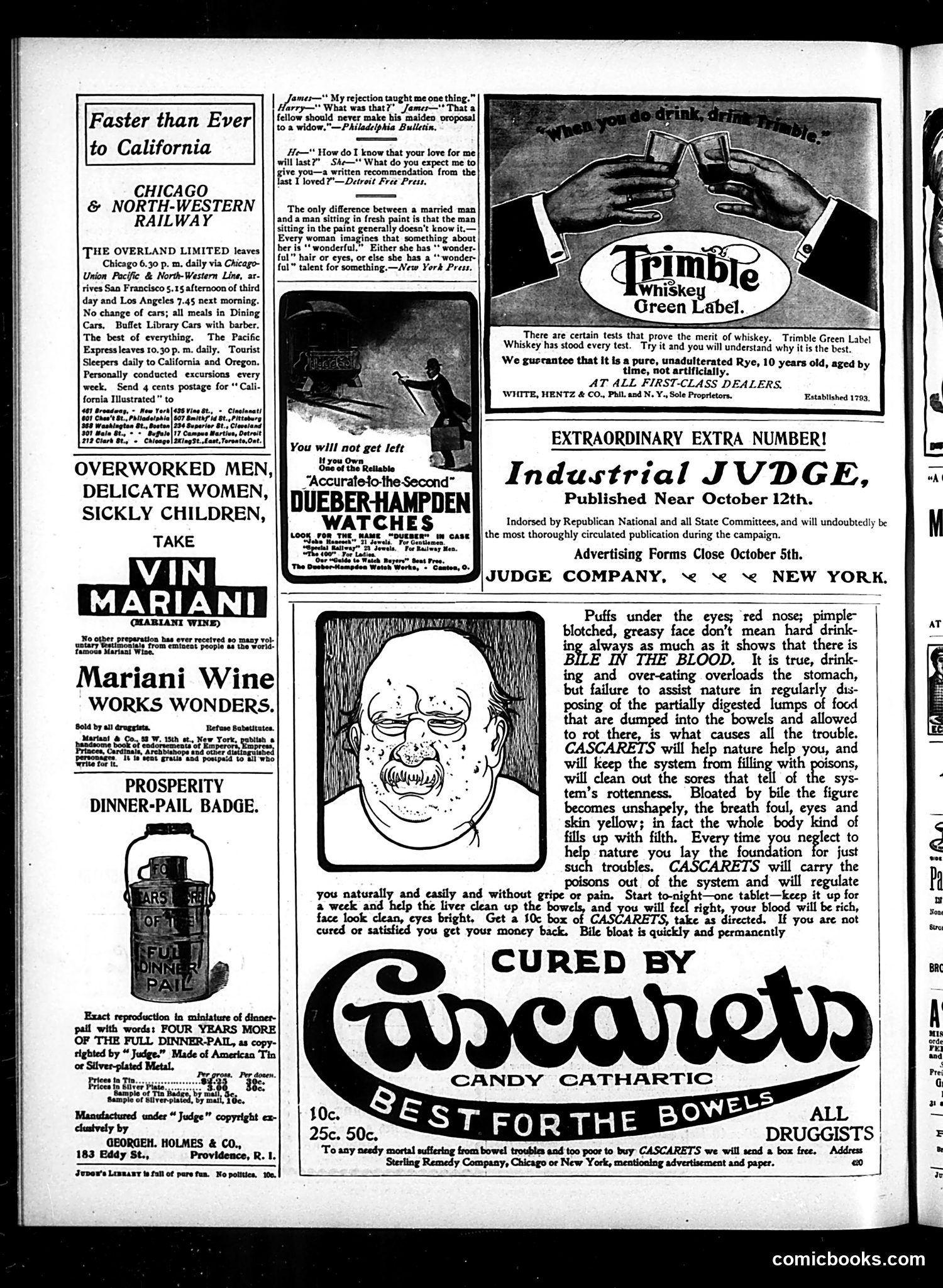
This page is primarily **advertising**, with some brief joke snippets interspersed. The main content includes: - Railroad and wine advertisements (Mariani Wine, Chicago & North-Western Railway) - Product ads for Trimble Whiskey and Cascarets laxative candy - A notice for an "Industrial Judge" special election edition **The only political/satirical content** is a small "Prosperity Dinner-Pail Badge" advertisement. This references a Republican campaign slogan from the 1900 election—the "full dinner pail" symbolized working-class prosperity under Republican policies. The badge itself appears to be a trinket merchandise item. **The Cascarets ad** features a caricatured face with exaggerated features (puffed eyes, red nose, pimples), using turn-of-the-century pseudo-medical language to suggest the remedy cures digestive ailments. This was typical patent-medicine advertising of the era. The brief jokes scattered throughout are generic observations about romance and marriage—not politically significant. Overall, this is a commercial/advertising page rather than a satirical one.
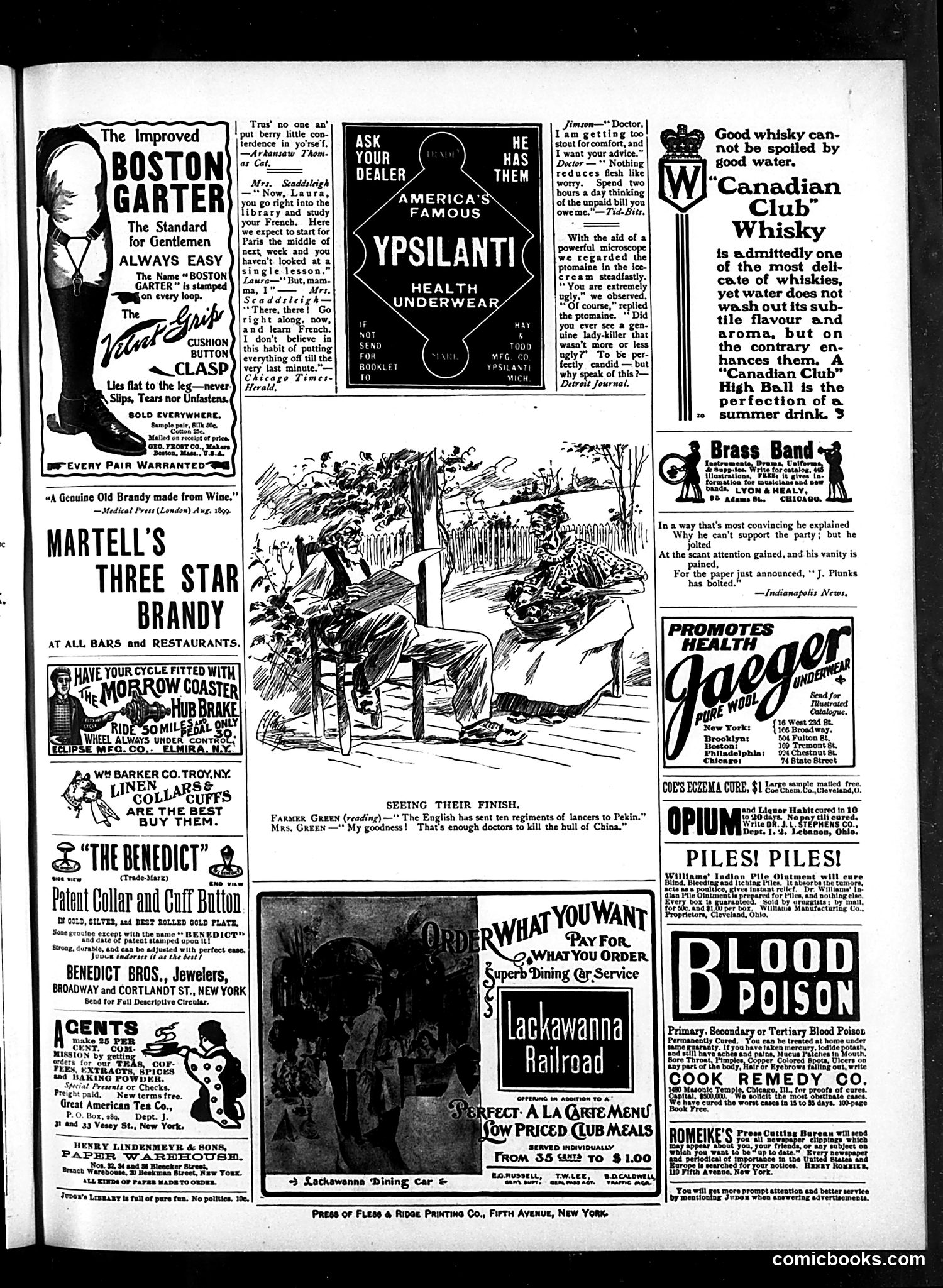
This page is primarily **advertising**, typical of Judge magazine's revenue model. The main cartoon depicts "Seeing Their Finish"—a satirical joke about the Boxer Rebellion (the Pekin/China reference dates this to 1900-1901). **The Cartoon's Joke:** Farmer Green misunderstands military terminology: when told "England has sent ten regiments of lancers to Pekin," he thinks "lancers" are doctors, not cavalry soldiers. Mrs. Green responds in relief that such medical expertise should suffice to "kill the hull of China"—a darkly comic comment on Western imperial assumptions about their military superiority and casualness toward Chinese casualties. **The Satire:** The joke mocks rural American ignorance while simultaneously satirizing Western imperialist attitudes—the casualness with which Americans discuss destroying an entire nation. The farmer's malapropism becomes a vehicle for critiquing both American provincialism and imperial arrogance. The remainder consists of period advertisements for garters, brandy, whisky, patent collars, and patent medicines—typical commercial content filling the magazine.
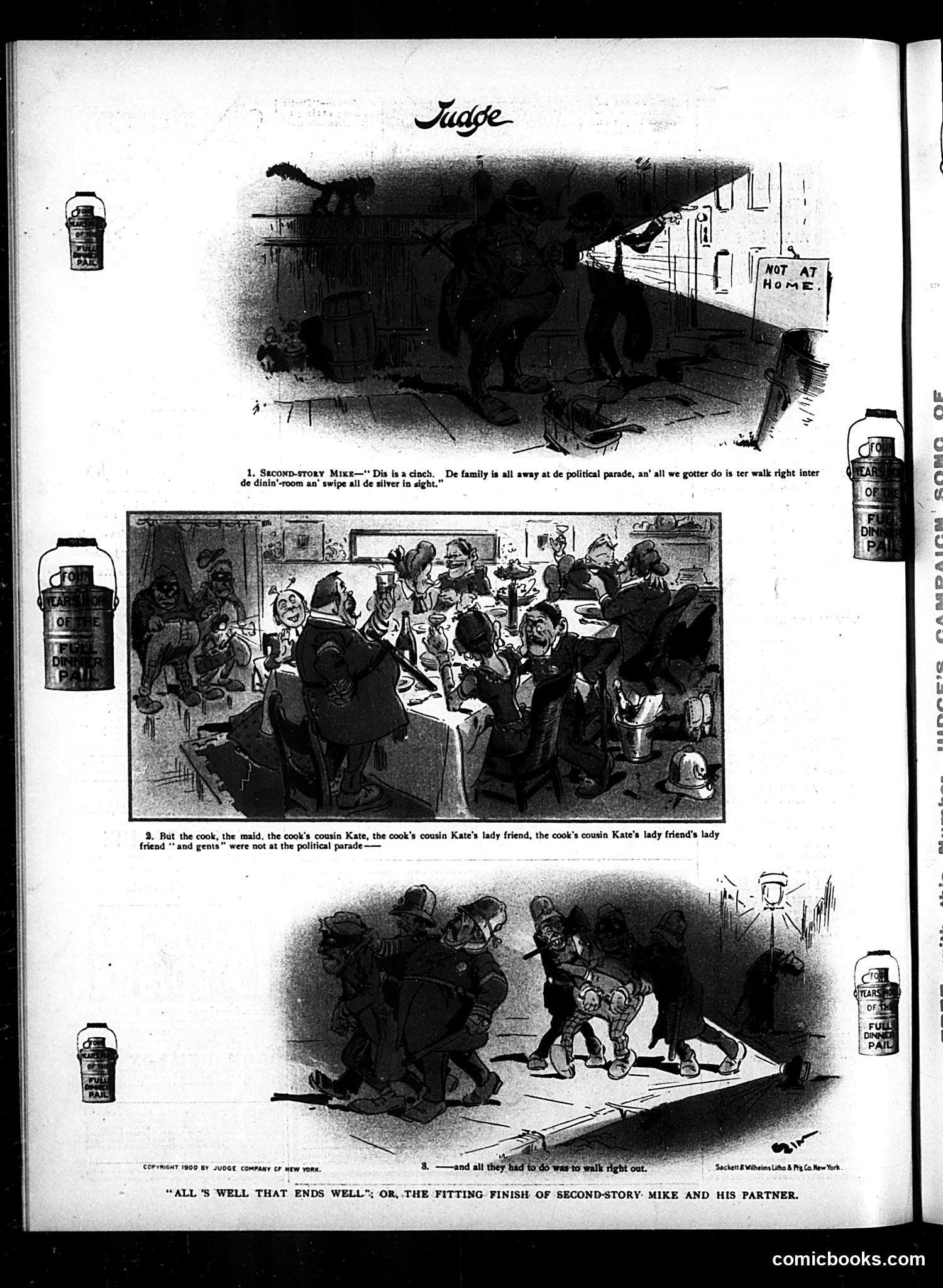
This three-panel Judge cartoon satirizes burglars exploiting a common urban situation. Panel 1 shows "Second-Story Mike" and a partner planning a robbery, believing the family is away at a political parade—a timely reference to the page's era when large public political gatherings were common events that emptied homes. The joke's irony unfolds in Panel 2: the servants (cook, maid, and their various friends) remained home, uninterested in politics. Panel 3 shows the thieves' comeuppance as they're discovered and expelled. The satire works on multiple levels: it mocks both criminals' carelessness *and* implicitly critiques working-class indifference to political participation. The title's Shakespearean reference ("All's Well That Ends Well") suggests justice prevails when the criminals face consequences.