
A complete issue · 16 pages · 1899
Judge — May 20, 1899
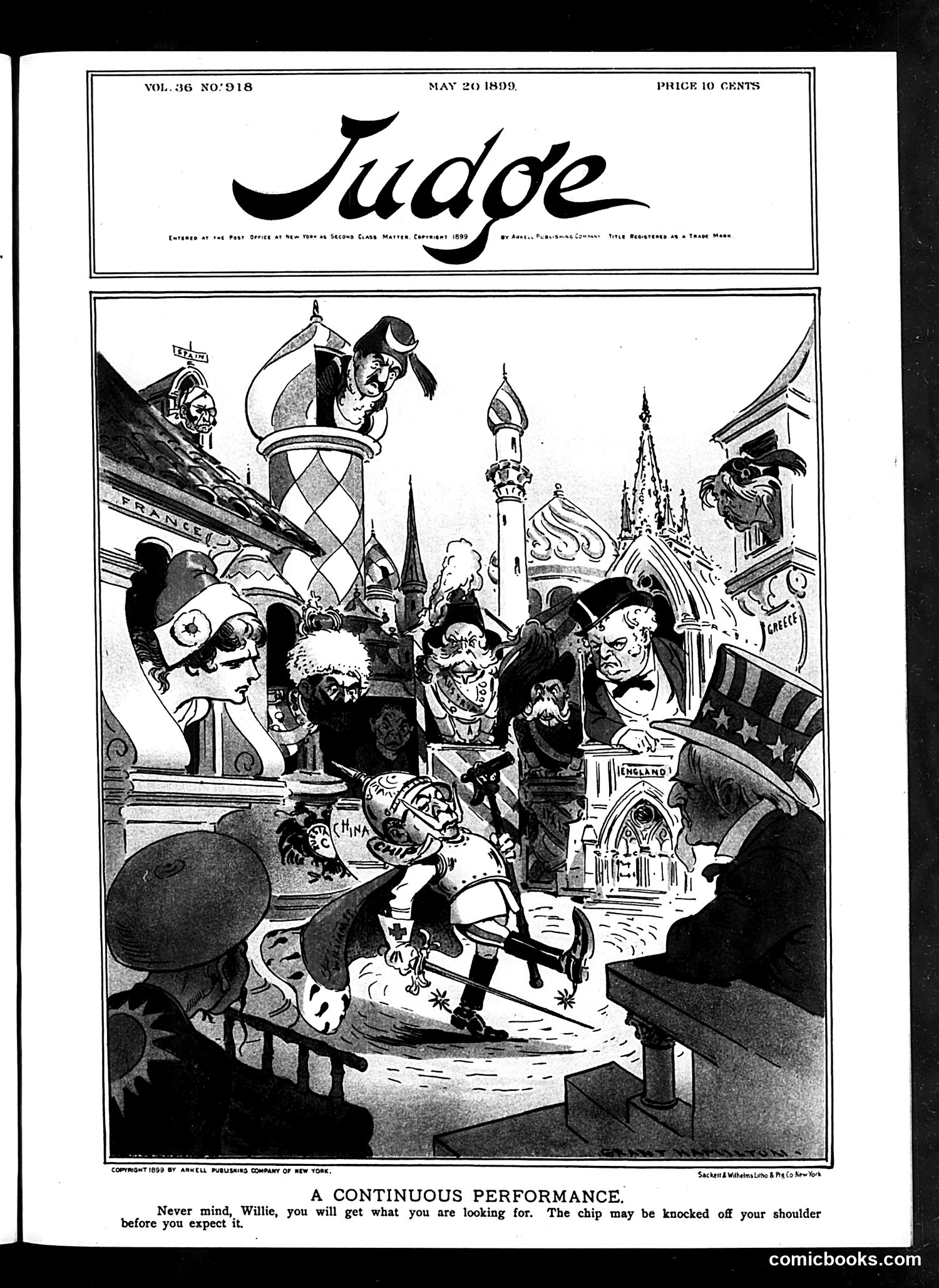
This political cartoon satirizes international competition and conflict, likely referencing the Boxer Rebellion in China (1899-1900). The central figure labeled "China" appears as a small character being threatened by larger caricatured figures representing major world powers—identifiable by national symbols like the American flag and what appears to be European imperial nations (including Russia, Germany, France, and Britain). The architectural backdrop suggests Asian temples and European landmarks. The caption "A Continuous Performance" mocks how these powers perpetually compete to dominate China, treating its fate as entertainment. The subtitle's reference to getting "what you are looking for" with "the chip knocked off your shoulder" suggests the cartoon critiques imperialist ambitions and the violent competition among nations treating a sovereign nation as spoils to divide.
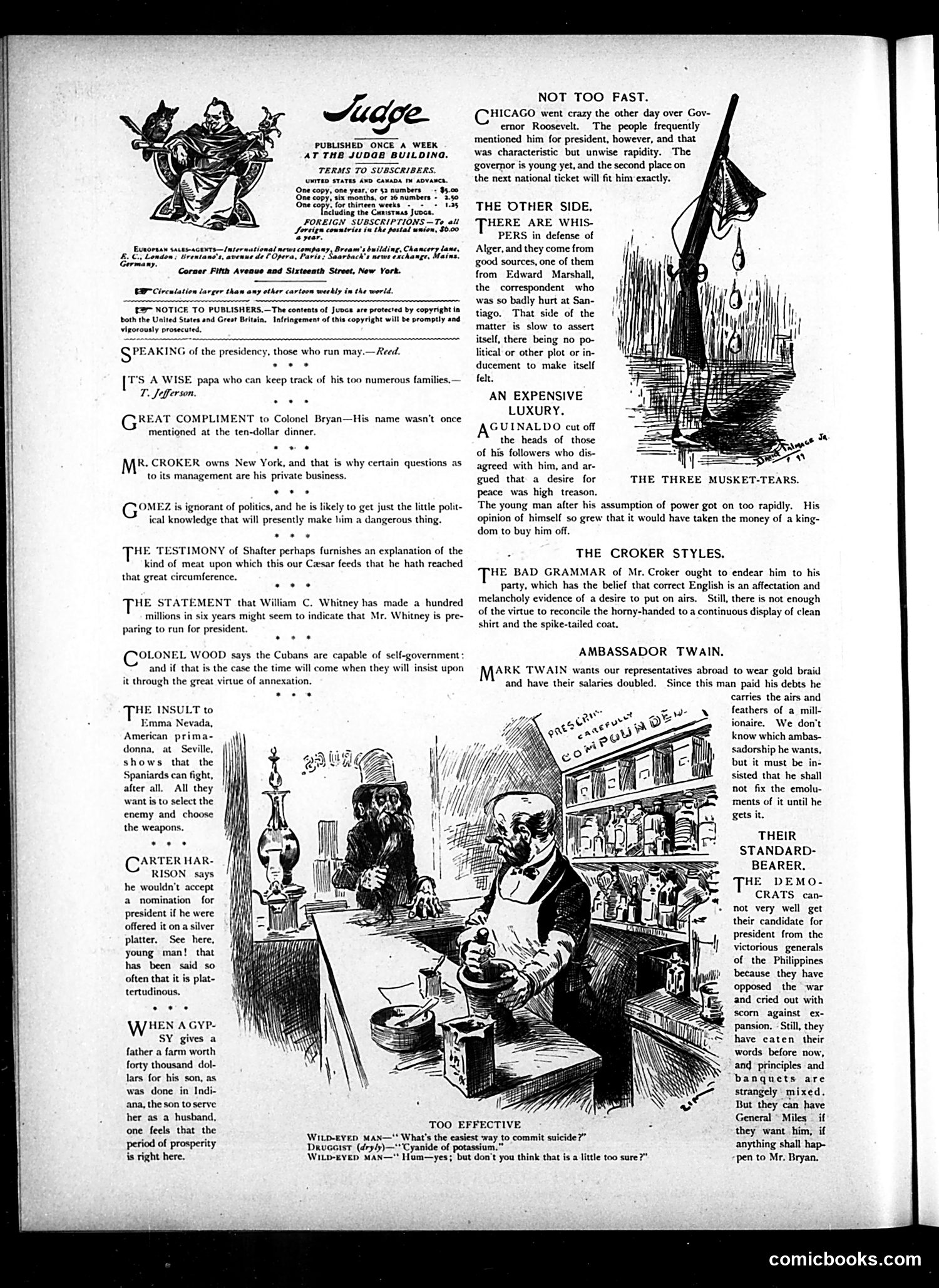
This page contains political commentary and satirical pieces typical of early 20th-century Judge magazine. The main cartoon titled "Too Effective" depicts two men in what appears to be a pharmacy or apothecary shop, with one asking about "the easiest way to commit suicide." The joke plays on cyanide of potassium as a poison. Other brief satirical items target contemporary figures: Colonel Bryan (likely William Jennings Bryan), Mr. Croker (political boss of New York), and Mark Twain regarding diplomatic representation abroad. The page criticizes politicians' competence and behavior, using humor to comment on American politics and society. Without specific date information visible, the exact historical moment remains unclear, though references suggest early 1900s American political discourse.
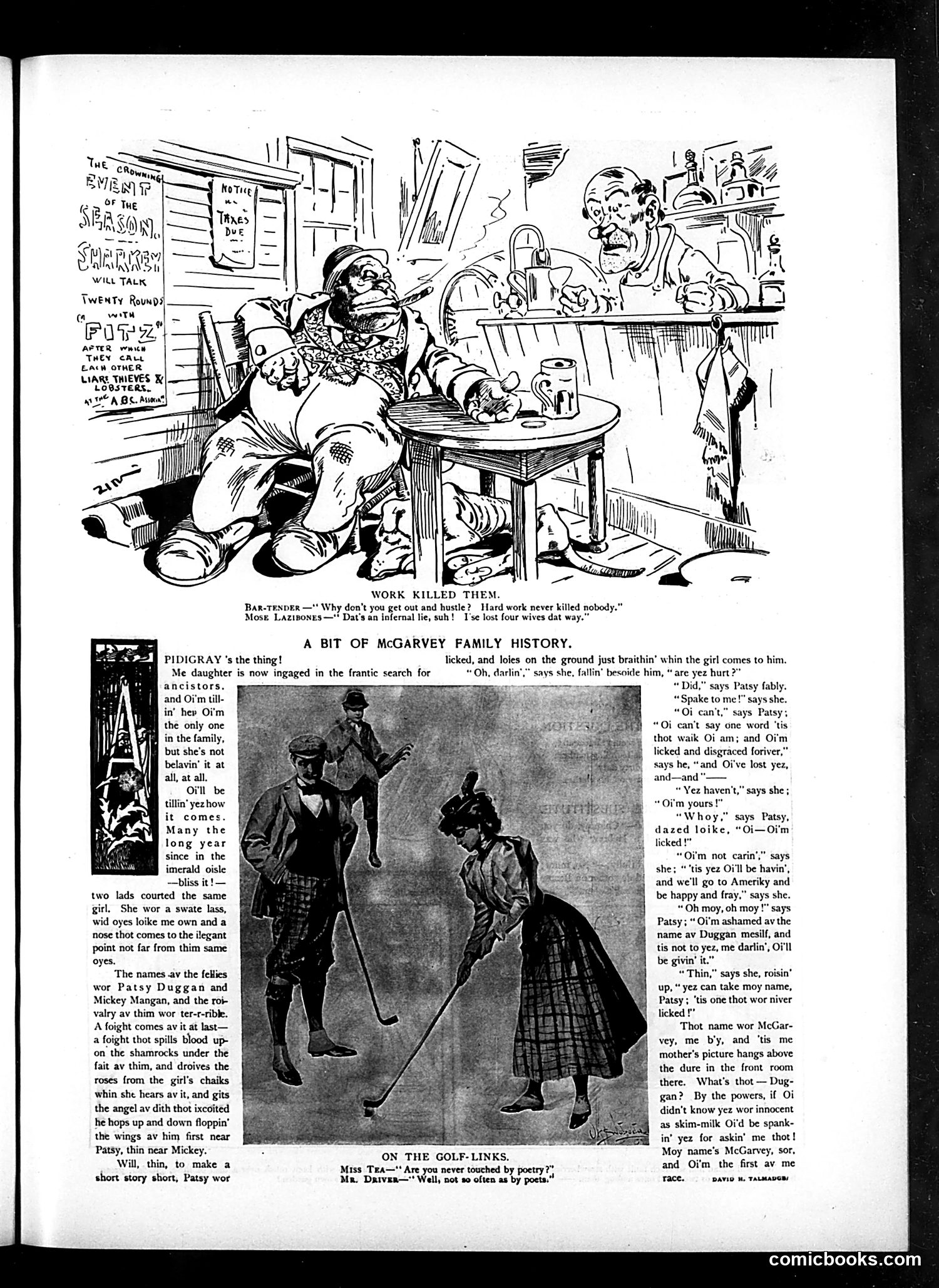
**Top Cartoon - "Work Killed Them":** This depicts a bar scene where a disheveled laborer confronts a well-dressed bartender. The caption contrasts their explanations for death: the bartender claims "hard work never killed nobody," while the laborer counters that he lost "four wives dat way." The satire targets working-class exploitation and the wealthy's dismissive attitudes toward labor's physical toll. **Lower Content - "A Bit of McGarvey Family History":** This appears to be serialized Irish-immigrant fiction, featuring characters named Patsy Duggan and Mickey Mangan. The narrative uses heavy Irish dialect ("O'm," "yez") and depicts poor immigrant family life, likely satirizing or caricaturing Irish-American experiences of the era through exaggerated stereotypes common to period publications.
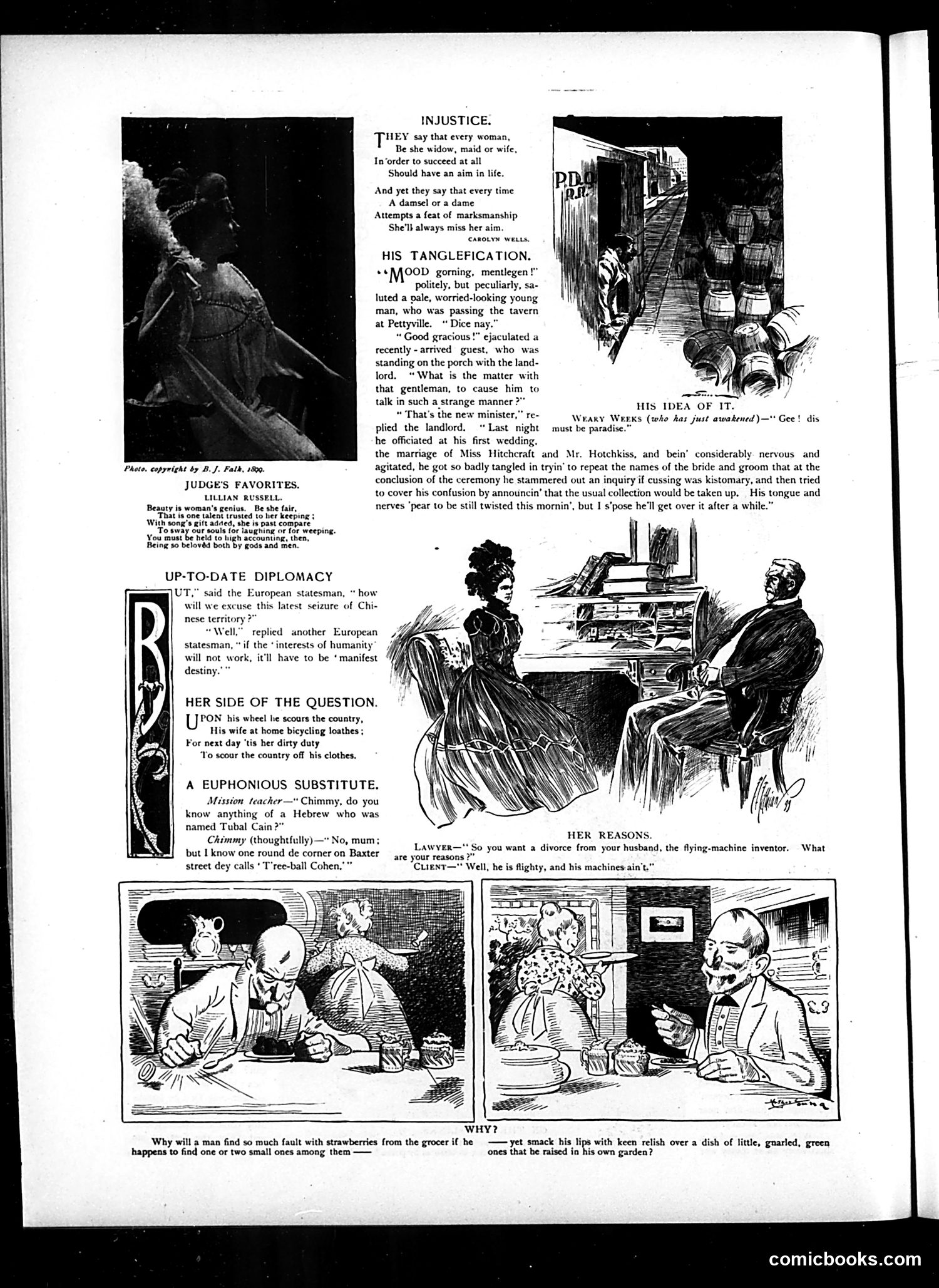
This page contains several satirical sketches mocking social and gender dynamics of the era: **"Injustice"** critiques women's exclusion from professional opportunity—a widow or unmarried woman cannot succeed without "an aim in life," yet society says women always miss their mark. **"His Tanglefication"** mocks a nervous groom at his wedding reception, confused by the minister's name repetition during the ceremony. **"Up-to-Date Diplomacy"** and related sections appear to satirize contemporary political debates and domestic situations. The bottom cartoons humorously address marriage frustrations—a husband's peculiar preference for store-bought strawberries over homegrown ones, suggesting absurd male irrationality in domestic life. Overall, the page blends social commentary on women's limitations with humor about marriage and gender relations typical of early 20th-century satirical magazines.
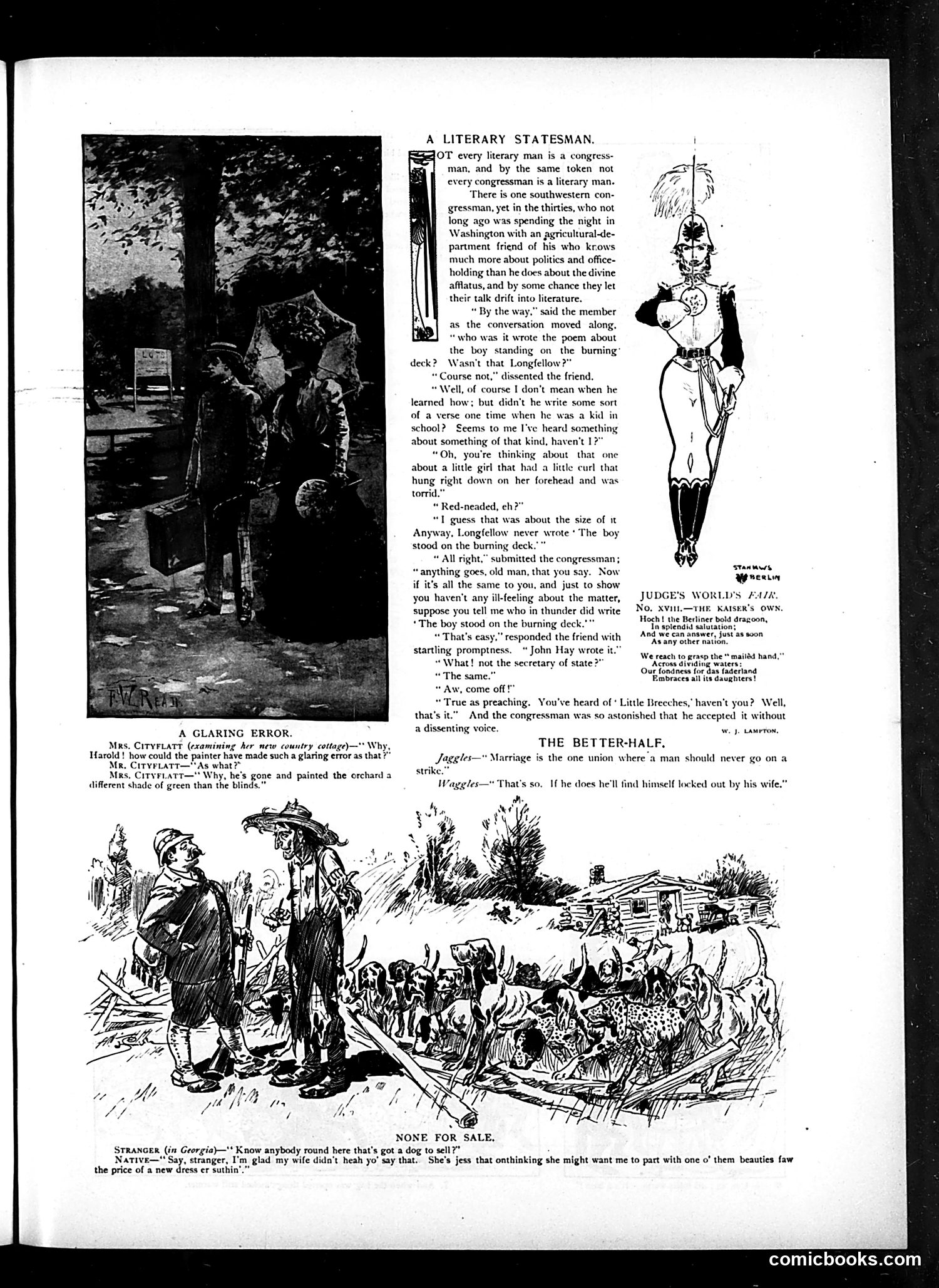
This page satirizes a Congressman's ignorance of American literature. A southwestern representative doesn't know that Henry Wadsworth Longfellow didn't write "The boy stood on the burning deck"—actually written by Felicia Hemans. When corrected by his friend, he's so intellectually outmatched that he accepts the absurd claim that Secretary of State John Hay wrote it instead, without objection. The satire mocks elected officials who lack basic cultural literacy while holding high office. The joke assumes readers know these literary facts and the identity of the Secretary of State, making the Congressman's gullibility particularly embarrassing. It's a common Judge theme: lampooning politicians as ignorant buffoons unfit for their positions. The page's other brief jokes about marriage and home life are unrelated filler material.
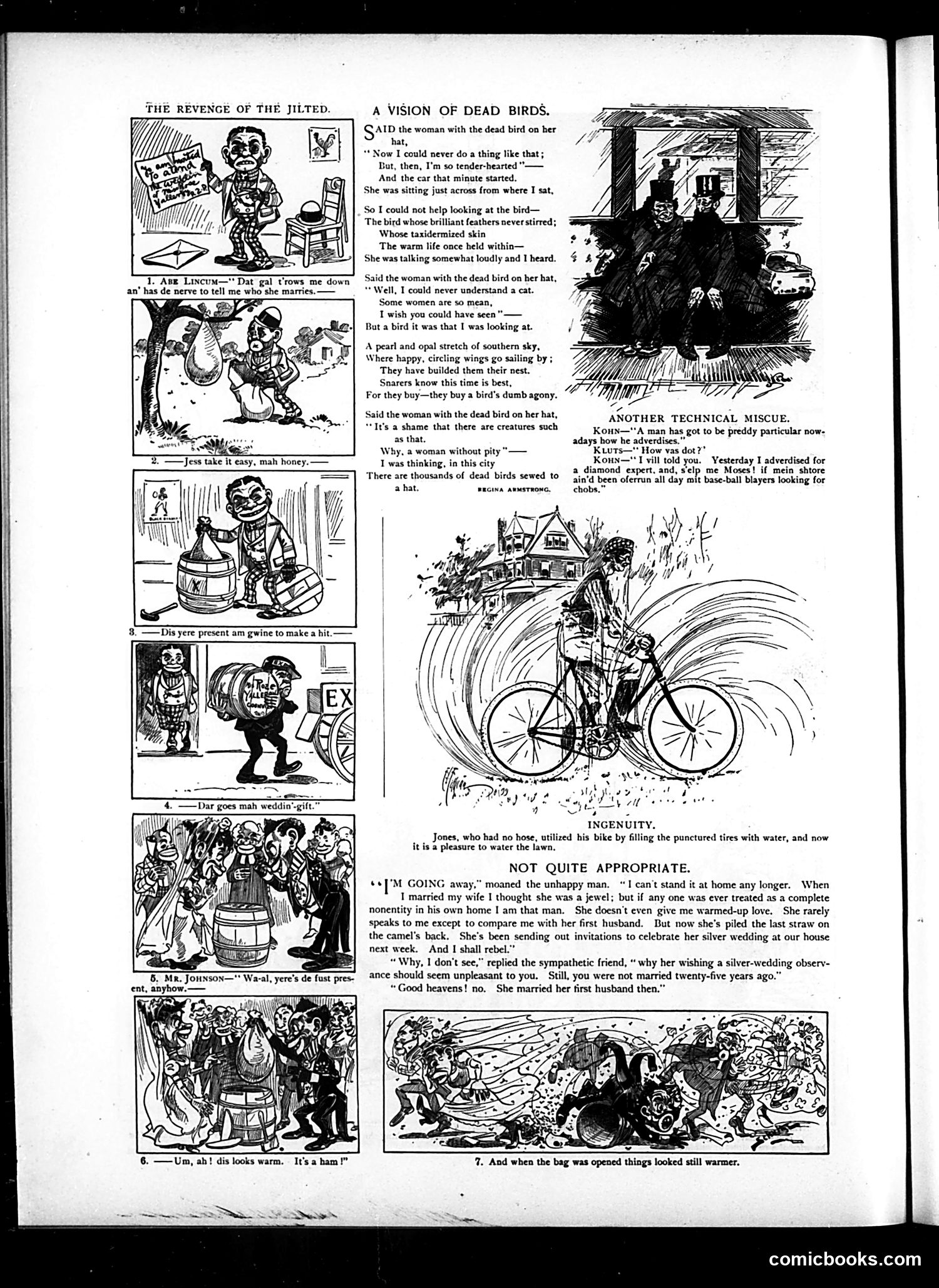
This page satirizes early 20th-century social hypocrisy, particularly regarding women's fashion and morality. **"The Revenge of the Jilted"** (left column) mocks women wearing dead birds as hat decoration—a common fashion trend. A woman callously displays a taxidermied bird while claiming she's "tender-hearted" and couldn't harm animals. The satire exposes the contradiction: these women purchase thousands of dead birds for vanity while professing compassion. **"A Vision of Dead Birds"** (right column) elaborates this critique poetically, describing birds' natural beauty and nests, contrasting with their fate as fashion commodities—"a bird's dumb agony." The other brief items are unrelated jokes: a woman advertising for a "diamond expert" accidentally attracts baseball players seeking "chobs" (jobs); a man uses water-filled bicycle tires to water his lawn; a husband resents his wife's silver-wedding celebration because she remarried after her first husband. The page targets consumer excess and the disconnect between professed values and actual behavior—particularly women's simultaneous claims of sensitivity while participating in the slaughter of birds for fashion.
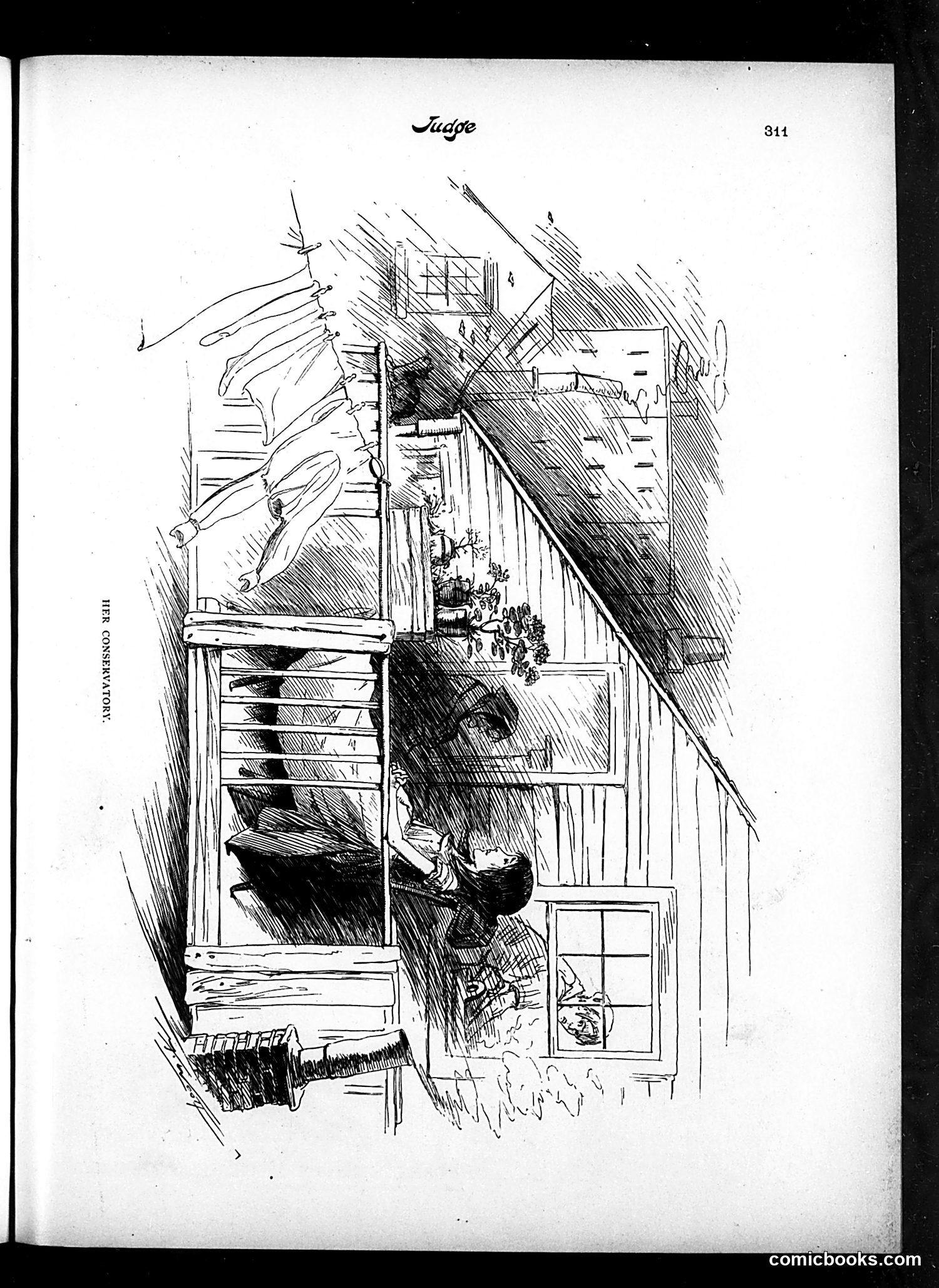
The OCR text is essentially unreadable—it appears to be garbled characters rather than legible content. Based on the **image alone**: This is a sketch-style illustration showing a domestic interior scene, rotated 90 degrees. A figure appears to be entering or exiting through a doorway of a cottage or small house, with various household items visible (furniture, windows, plants). The artistic style suggests late 19th or early 20th-century illustration. **Without readable text, I cannot confidently identify**: the specific political or social reference, any caricatured figures, or the satirical point intended. The drawing's domestic focus suggests it may comment on home life, family dynamics, or social class, but this remains speculation without supporting text or clearer context. To properly analyze this Judge magazine page would require either clearer OCR text or additional contextual information about the publication date.
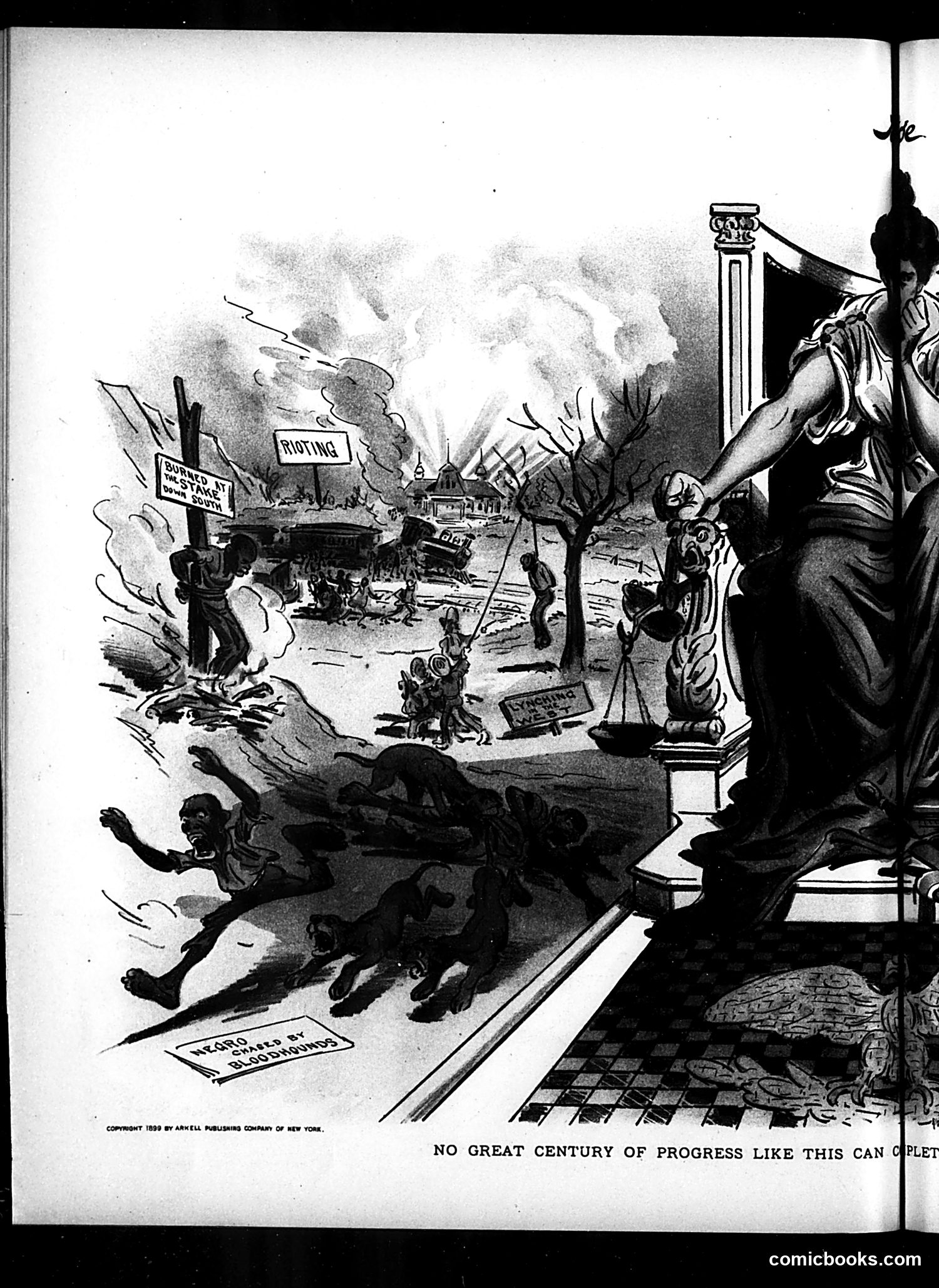
This 1899 *Judge* magazine cartoon satirizes urban chaos and social disorder. The scene depicts a city street engulfed in violence and destruction—marked "RIOTING" and showing fires, chaos, and fleeing civilians. On the right, a classical female figure (likely Lady Liberty or Justice) watches helplessly from her pedestal as the city burns behind her. The cartoon's incomplete caption ("NO GREAT CENTURY OF PROGRESS LIKE THIS CAN C[OMPLET]E") appears ironic, contrasting ideals of 19th-century progress with the depicted breakdown of civil order. The work likely comments on late-1890s labor unrest, racial violence, or political turmoil threatening American institutions. The juxtaposition of classical civic ideals against urban violence creates the satirical critique of American society's failure to maintain stability despite claims of progress.
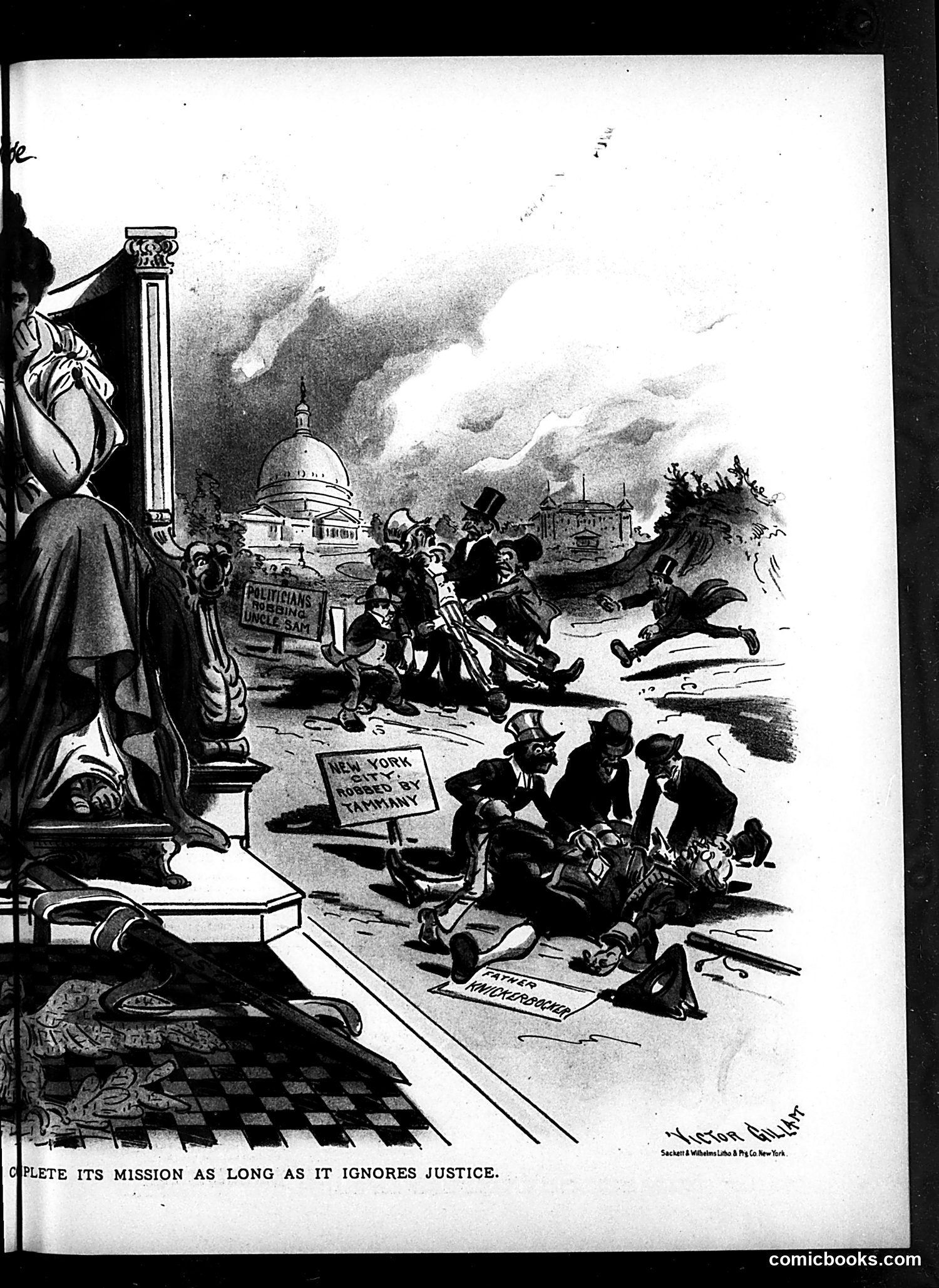
This satirical cartoon critiques what appears to be government corruption or institutional failure in Washington, D.C. (the Capitol dome is visible in the background). Lady Justice stands prominently on the left, overlooking a chaotic scene below. Various figures labeled "POLITICIANS," "NEW YORK" (appears to be about municipal corruption), and other references suggest widespread misconduct. Men in top hats and formal dress engage in questionable activities while ignoring the symbolic representation of justice above them. The caption—"COMPLETE ITS MISSION AS LONG AS IT IGNORES JUSTICE"—sarcastically suggests that corrupt institutions can succeed only by disregarding legal and moral principles. The cartoon's point: American political leadership systematically circumvents justice to advance private interests, mocking the ideals Lady Justice represents.
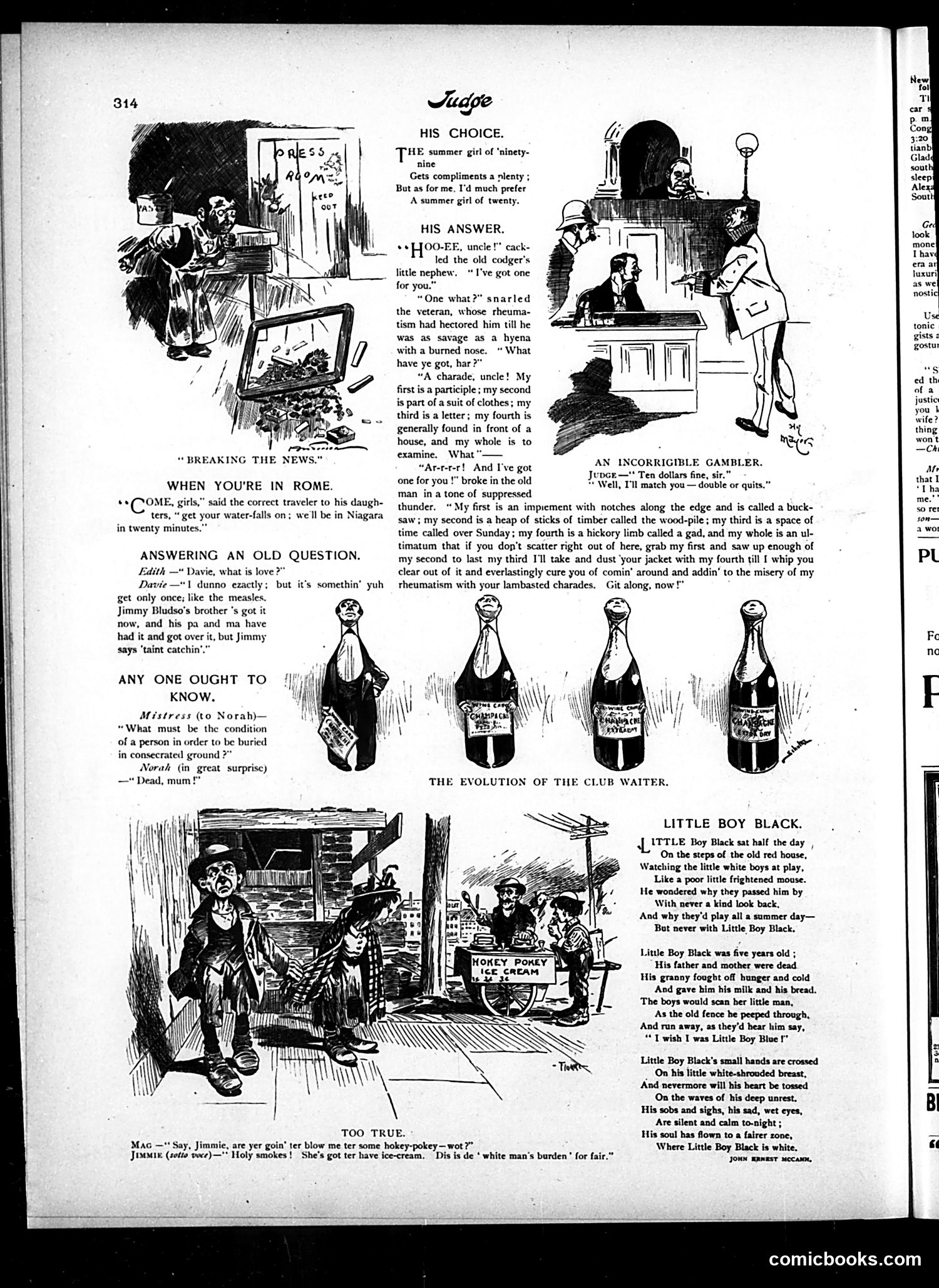
This page contains multiple satirical pieces typical of 1890s American humor: **"His Choice/Answer"** and **"Breaking the News"**: Light romantic/domestic humor about age preferences and family dynamics—unremarkable by modern standards. **"Little Boy Black"**: A sentimental poem about a Black child excluded from play with white children, ending with his death. This reflects the era's casual racism embedded in "sentimental" narratives; the poem presents racial segregation and the child's death as tragically poignant rather than critiquing injustice. **"Too True"** (bottom): A brief exchange where a man asks a boy about ice cream, and the boy's response includes the phrase "white man's burden"—a reference to Rudyard Kipling's 1899 poem justifying imperial colonialism. The joke appears to sarcastically comment on responsibility or obligation, though the exact satirical target is unclear. **"The Evolution of the Club Waiter"**: Four bottle illustrations showing progression—likely commentary on drinking culture or class mobility. Overall, the page mixes genteel humor with period-typical racial attitudes presented without irony.
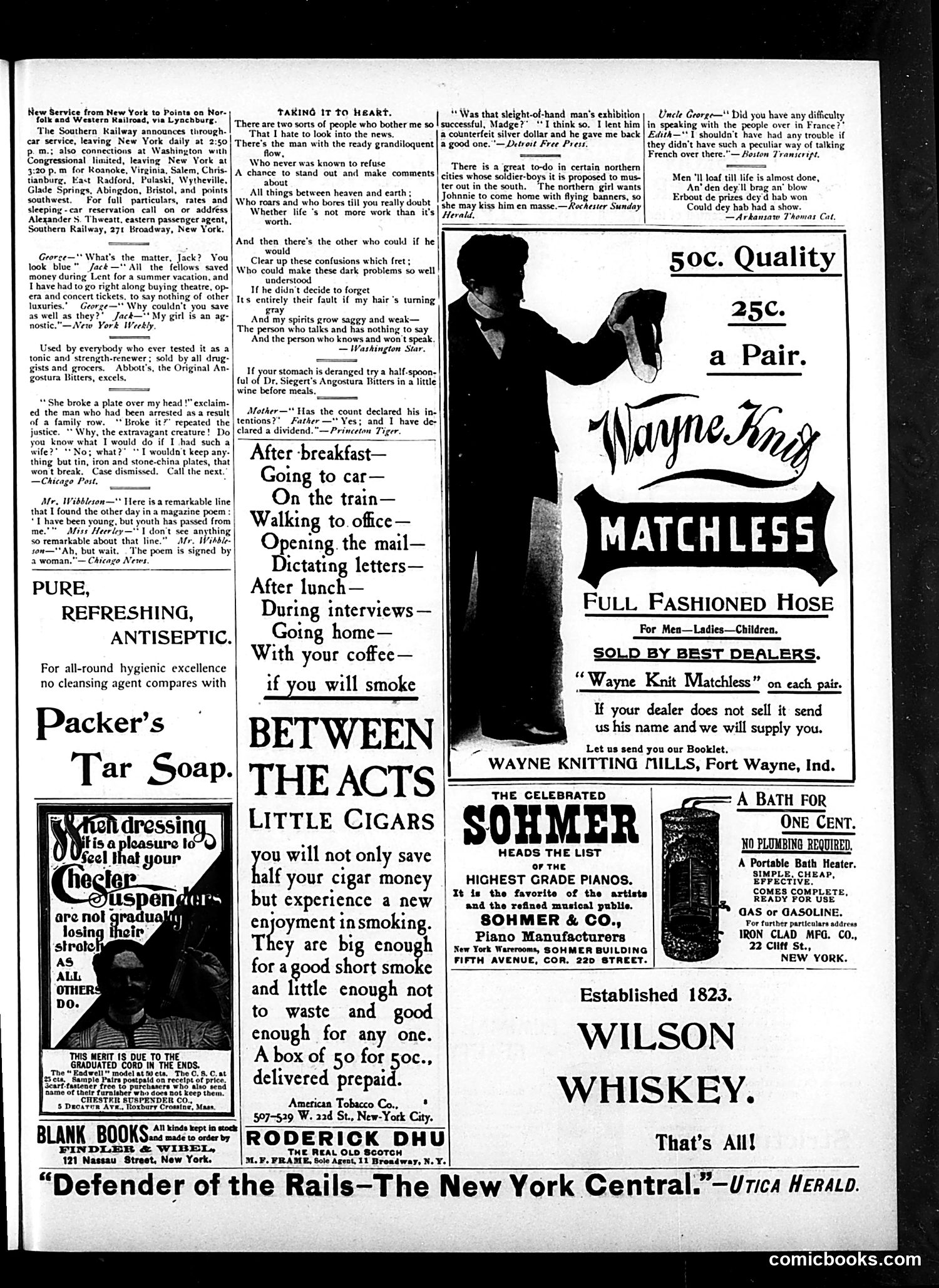
This page is primarily **advertisements with minimal editorial content**. The cartoons are brief joke columns rather than political satire. The small comic items include workplace humor (a man unable to save money because his "agnostic" girlfriend demands entertainment), domestic comedy (a wife breaking plates), and literary observation (a woman poet claiming youth has passed). The advertisements dominate: Packer's Tar Soap, Abbott's Angostura Bitters, Wayne Knit Matchless hosiery, Sohmer pianos, Between the Acts little cigars, Wilson Whiskey, and railroad/hotel services. The Between the Acts ad is notable for positioning small cigars as economical yet satisfying—a marketing appeal to businessmen during their workday. **No major political figures or events are referenced.** This is a standard commercial page from an early 20th-century magazine mixing light humor with product promotion.
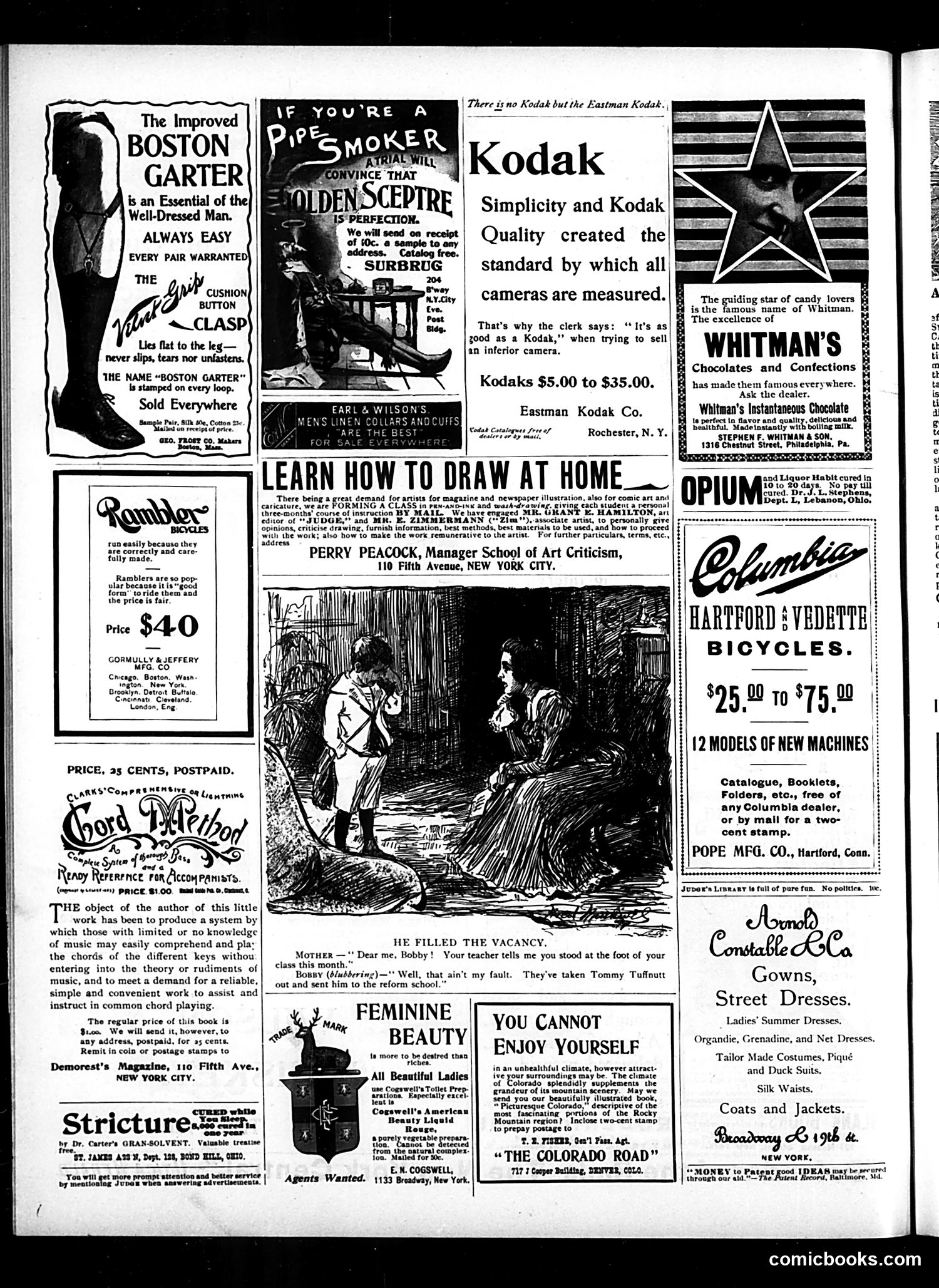
This is primarily a **advertising page**, not a satirical cartoon. The page contains multiple commercial advertisements typical of early-20th-century magazines. The one narrative illustration present—titled "HE FILLED THE VACANCY"—depicts a domestic scene where a mother confronts her son Bobby about standing "at the foot of your class." Bobby protests it's not his fault, claiming the teacher replaced a poor student (Tommy Tuffoutt) with him to fill a vacancy. The joke plays on the boy's misunderstanding: he thinks he was hired as a *replacement worker* rather than understanding he's simply ranked lowest academically. It's a mild humor piece about childhood logic and parental discipline. The remaining content advertises products including Boston Garters, Kodak cameras, Whitman's chocolates, bicycles, beauty preparations, and art instruction courses—reflecting consumer goods marketed to middle-class readers of the era.
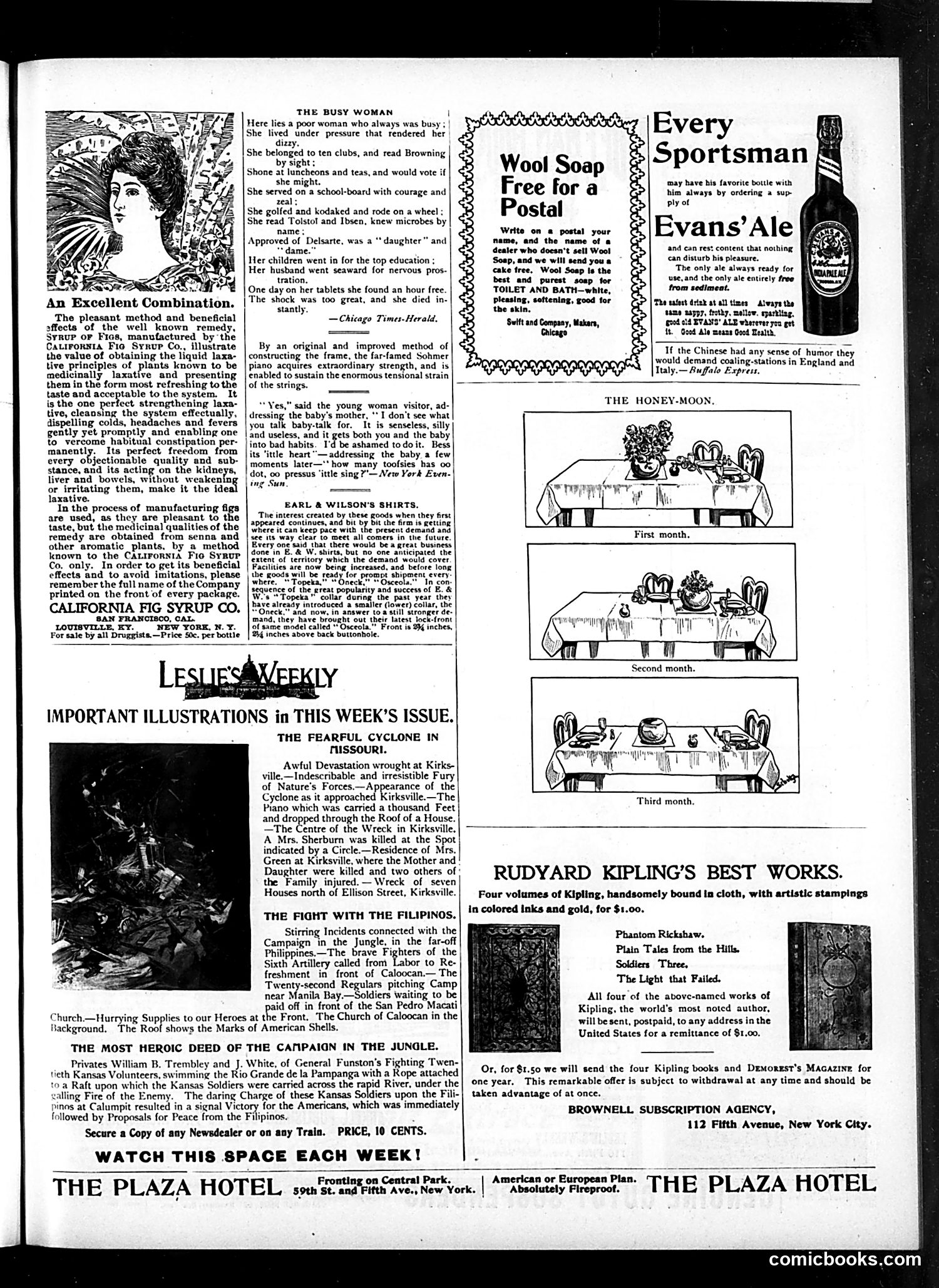
This page's primary satirical content is the poem "The Busy Woman," a critique of the overscheduled, socially ambitious woman of the era. The poem mocks a woman constantly engaged in clubs, intellectual pursuits (reading Browning, Tolstoy, Ibsen), fashionable activities (golfing, photography), and progressive causes—all while her husband flees to sea for "nervous prostration" (stress-related illness). The satire's punch line: she dies of shock upon discovering one free hour in her calendar. This reflects early-1900s anxieties about the "New Woman"—newly educated, socially active, and independent—viewed by satirists as ridiculous and exhausting. The poem suggests such ambition is unnatural and destructive to family life. The secondary joke mocks a visitor who hypocritically criticizes baby-talk while immediately doing it herself.
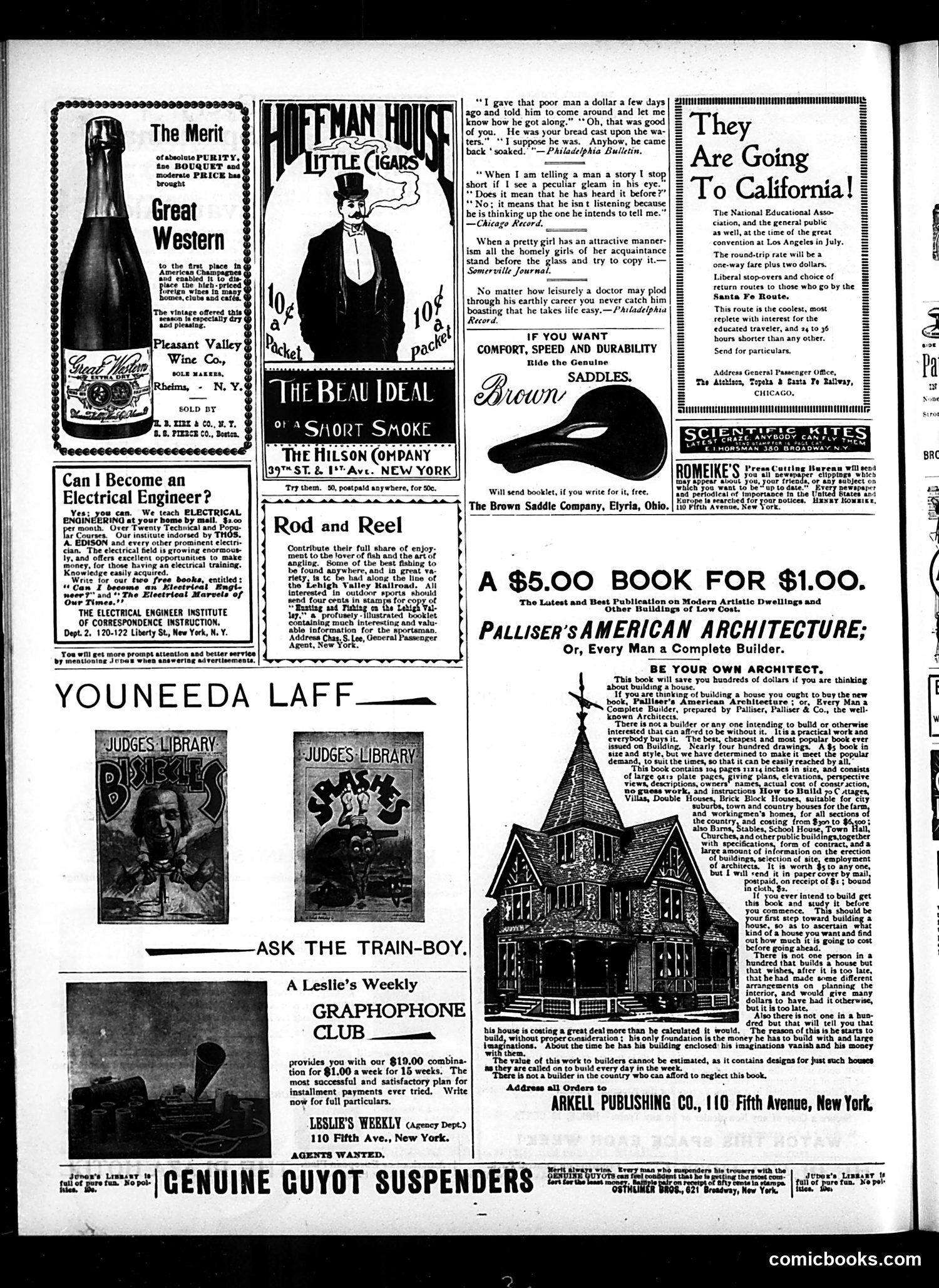
This page is primarily **advertising**, not political satire. It contains commercial notices for products and services typical of early 20th-century American periodicals: whiskey (Great Western), electrical engineering correspondence courses, cigars, fishing equipment, phonographs, and saddles. The only humor content consists of brief, generic **joke reprints** credited to newspapers like the *Chicago Record* and *Philadelphia Bulletin*. These are aphoristic observations about human nature—about charity, listening, imitation, and doctors—rather than political commentary. The page includes educational/travel notices, including one advertising a railroad excursion to Los Angeles for the National Educational Association convention. There are no identifiable political cartoons, caricatures, or satirical targets on this page. It represents Judge magazine's revenue model: mixing lighthearted filler content with paid advertisements.
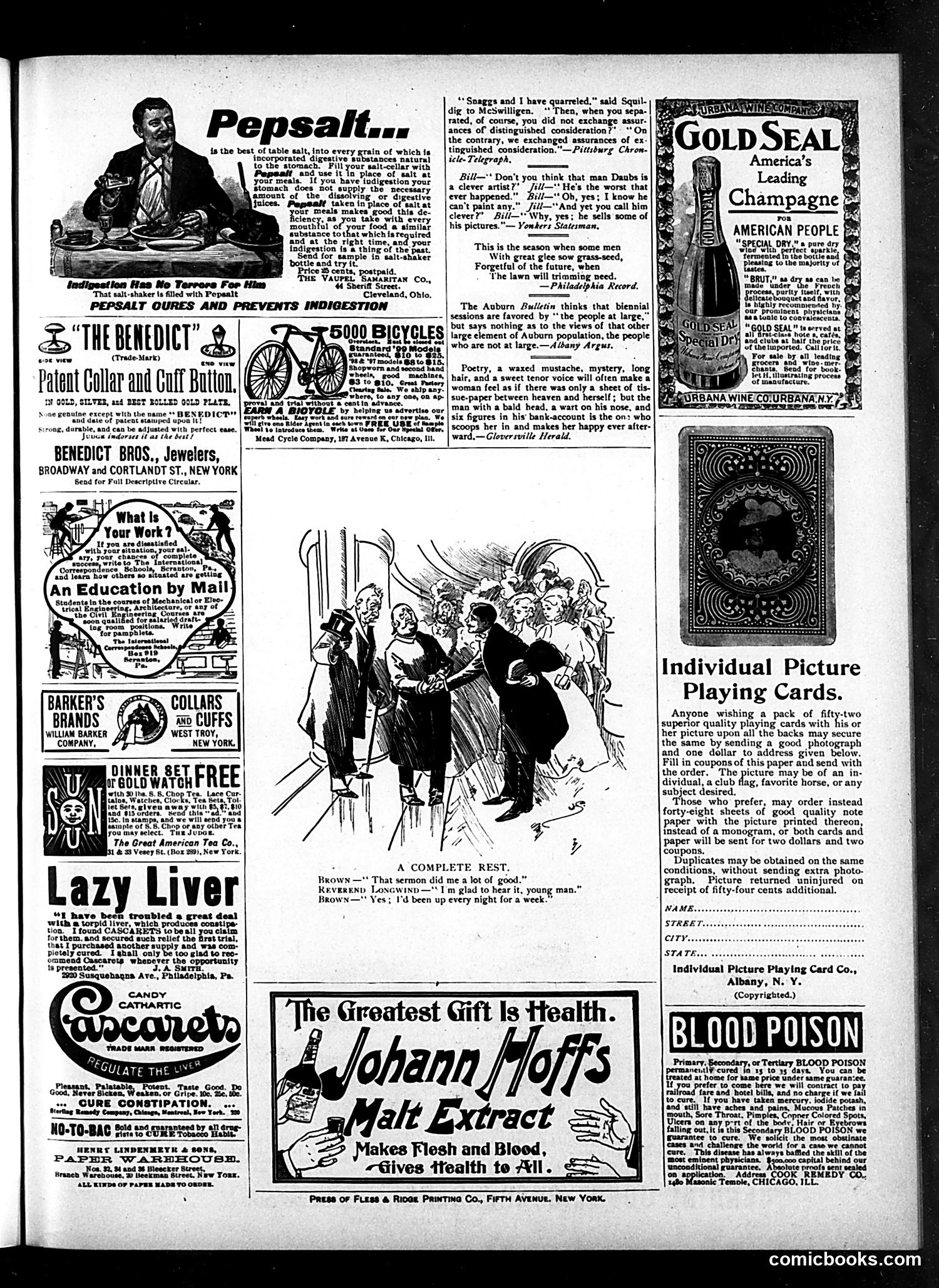
This is primarily an **advertising page** from Judge magazine, with minimal editorial content. The few cartoon jokes visible are brief, satirical quips rather than substantial political commentary. The small cartoons and jokes mock: - **Social pretension**: A dialogue about an artist ("Daubs") whom people despise but patronize because he sells paintings—satirizing mercenary art appreciation. - **Romantic delusion**: A poem suggesting that mustaches, mystery, and tenor voices seduce women into overlooking actual assets (like wealth and baldness)—poking fun at naive female romanticism. - **Seasonal foolishness**: A joke about men planting grass seed while forgetting lawn maintenance costs—gentle satire of springtime optimism. The page is dominated by **patent medicines and consumer goods** (Pepsalt for indigestion, Cascarets laxatives, malt extract) with exaggerated health claims typical of early 1900s advertising. The "Individual Picture Playing Cards" advertisement and various collar/jewelry ads fill remaining space. There is **no significant political content** on this page.
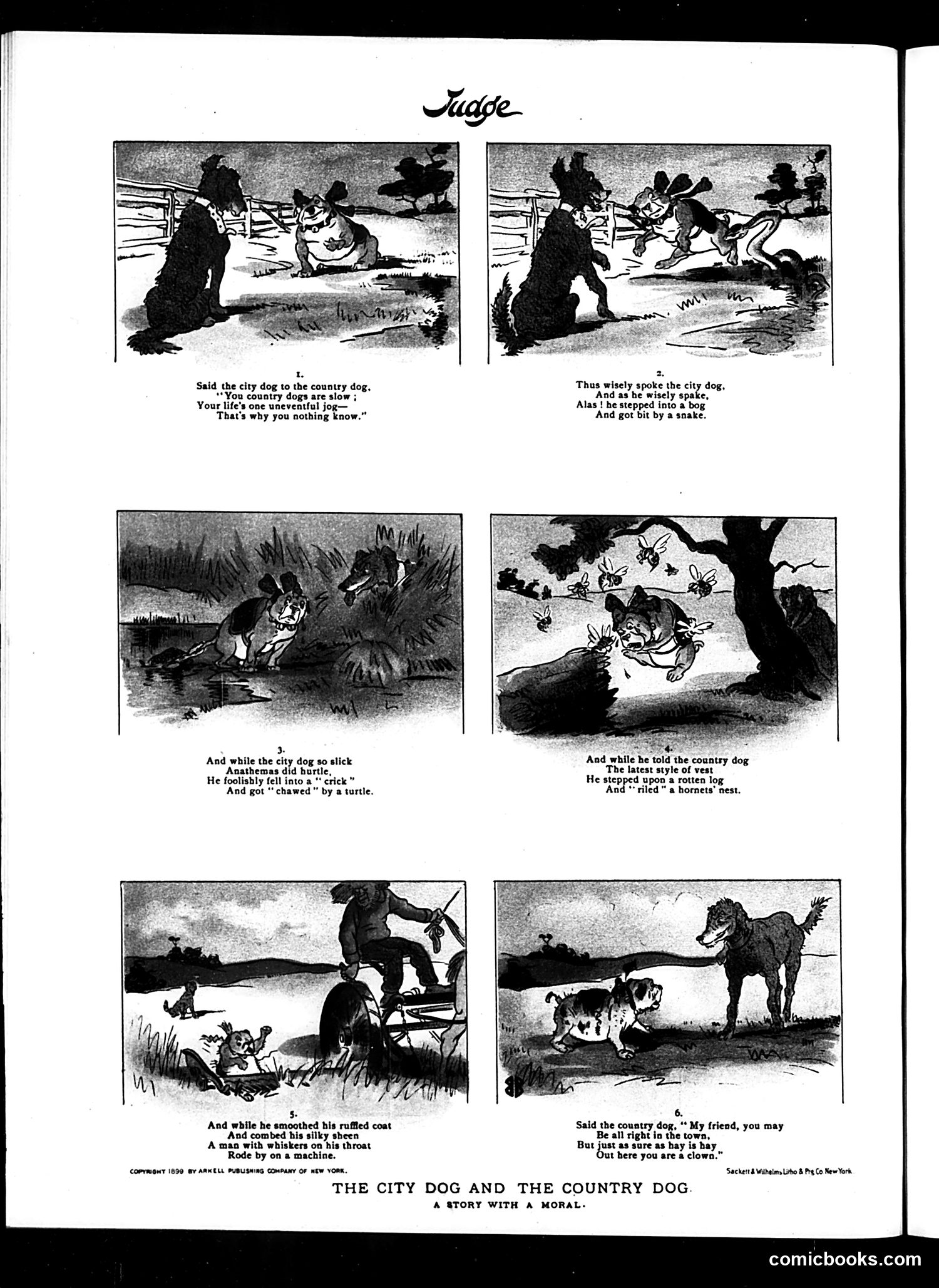
This is a six-panel fable comparing urban and rural life, likely reflecting late-19th-century American tensions between city and country cultures. The city dog arrogantly dismisses country dogs as slow and ignorant, but his sophistication proves useless when faced with rural dangers—he's bitten by a snake, chased into a creek where a turtle attacks him, and nearly run down by a bicycle (a new, urban invention). The country dog, meanwhile, remains unfazed by the city dog's boasts about fashionable vests and modern machines. The moral is clear: city sophistication and technological progress offer no practical advantage in the country, where traditional knowledge and pragmatism matter more. The satire targets urban condescension toward rural America, suggesting that cosmopolitan pretensions are actually foolish when removed from their proper context. It's a defense of country values against modernizing urban culture.