
A complete issue · 16 pages · 1888
Judge — January 7, 1888
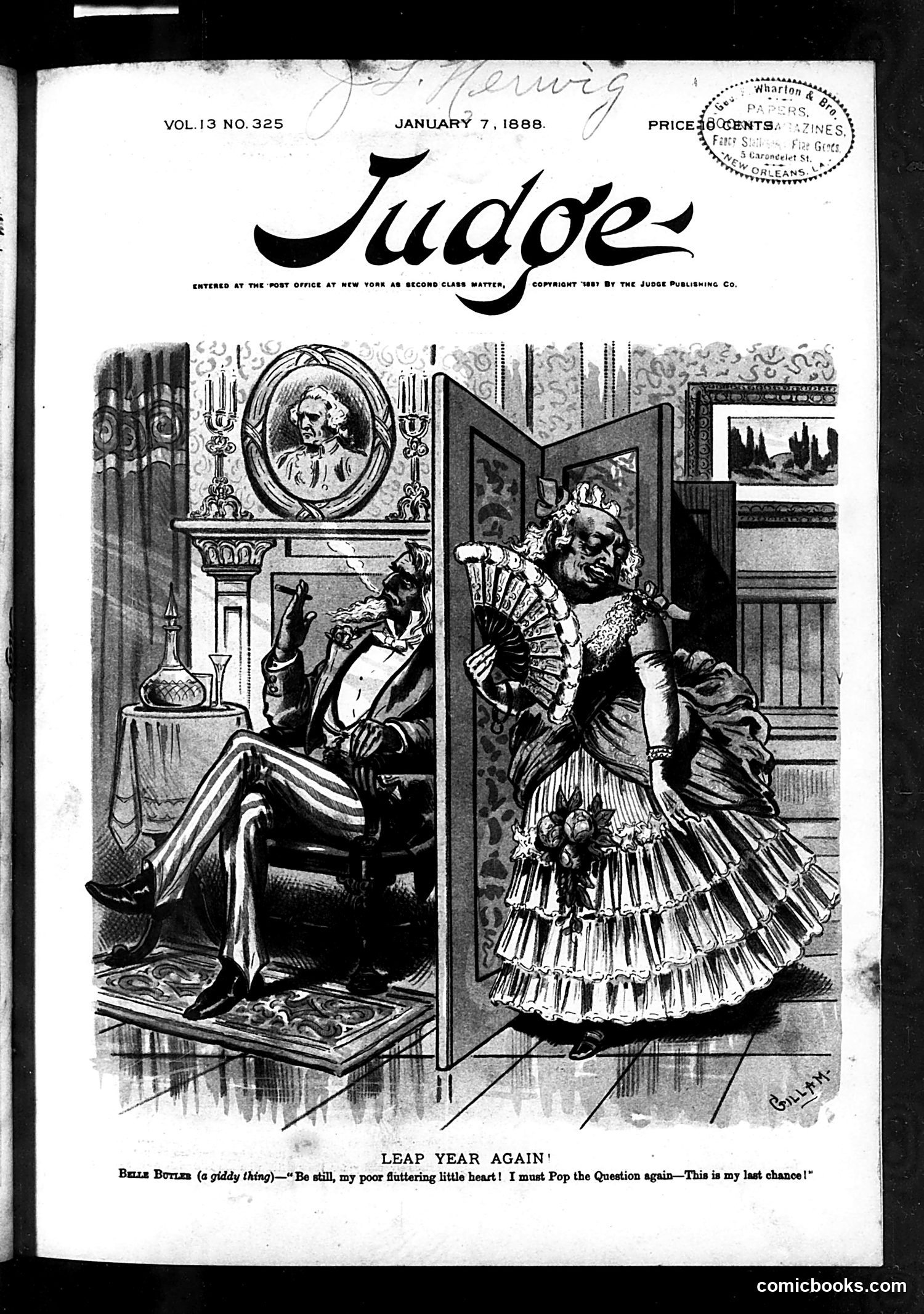
This cartoon satirizes the tradition of "Leap Year" when women could propose to men. The caption identifies the female figure as "Bella Butter (a giddy thing)" approaching a well-dressed man with her fan raised, saying: "Be still, my poor fluttering little heart! I must Pop the Question again—This is my last chance!" The joke plays on Victorian gender conventions—women were supposed to be passive and wait for male proposals. The cartoon mocks both the absurdity of role-reversal and the desperation suggested by "my last chance," implying an aging woman's urgency to marry before it's too late. The man's anxious posture contrasts with her aggressive courtship, emphasizing the comedic violation of social propriety that Leap Year permitted.
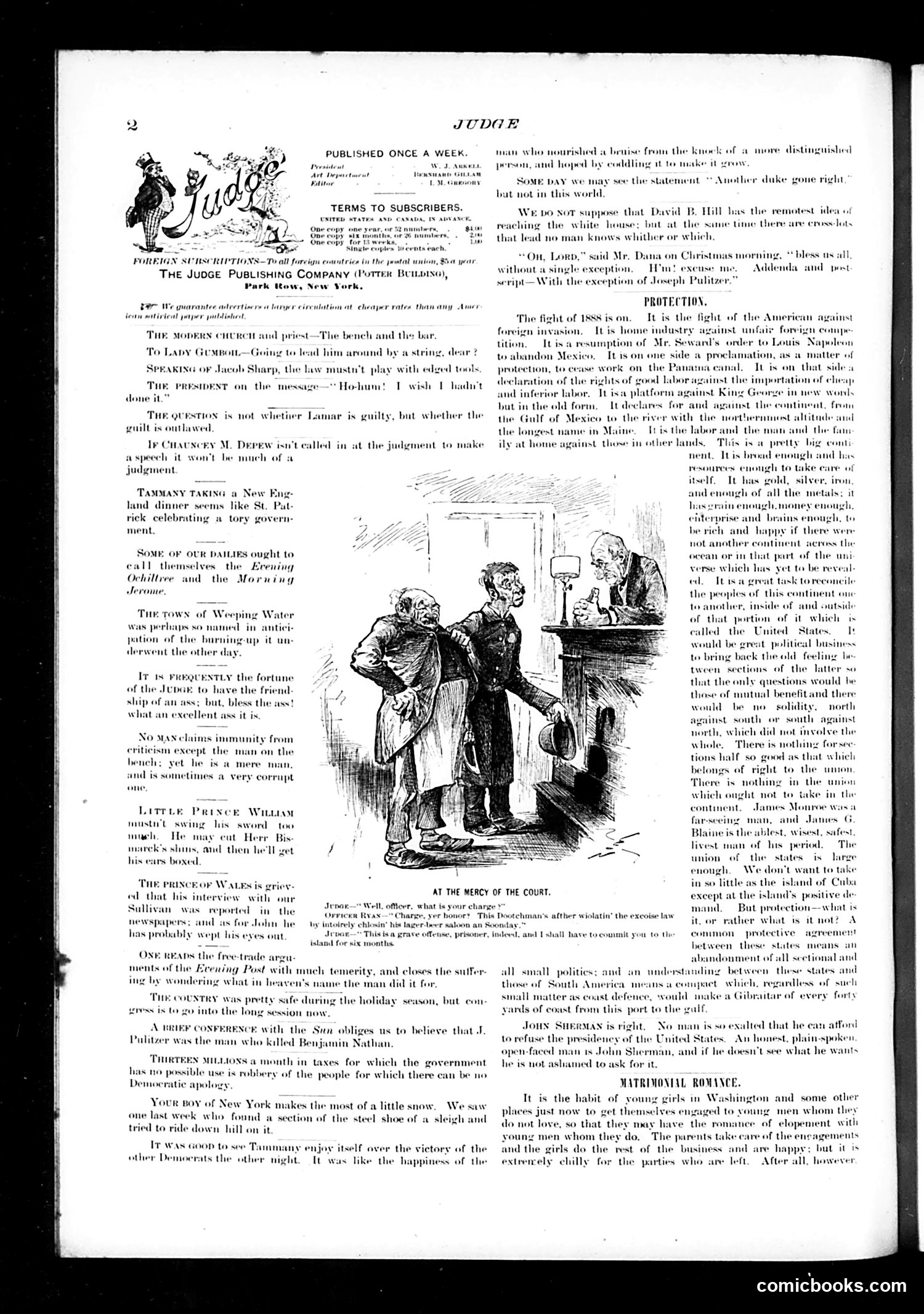
This cartoon depicts a legal confrontation before a judge. A well-dressed officer presents a charge against a disheveled man, while the judge presides. The caption reads: "Well, officer, what is your charge?" The officer responds about the defendant's behavior, and the judge declares he'll have him remanded. The satirical point appears to target judicial discretion and power dynamics—specifically how officers of the law can bring charges and judges wield authority over common citizens. The caricature emphasizes class difference through clothing and appearance. Without additional context identifying the specific figures, the cartoon likely critiques either courtroom corruption, arbitrary justice, or police/judicial abuse of power—common themes in Gilded Age satirical commentary.
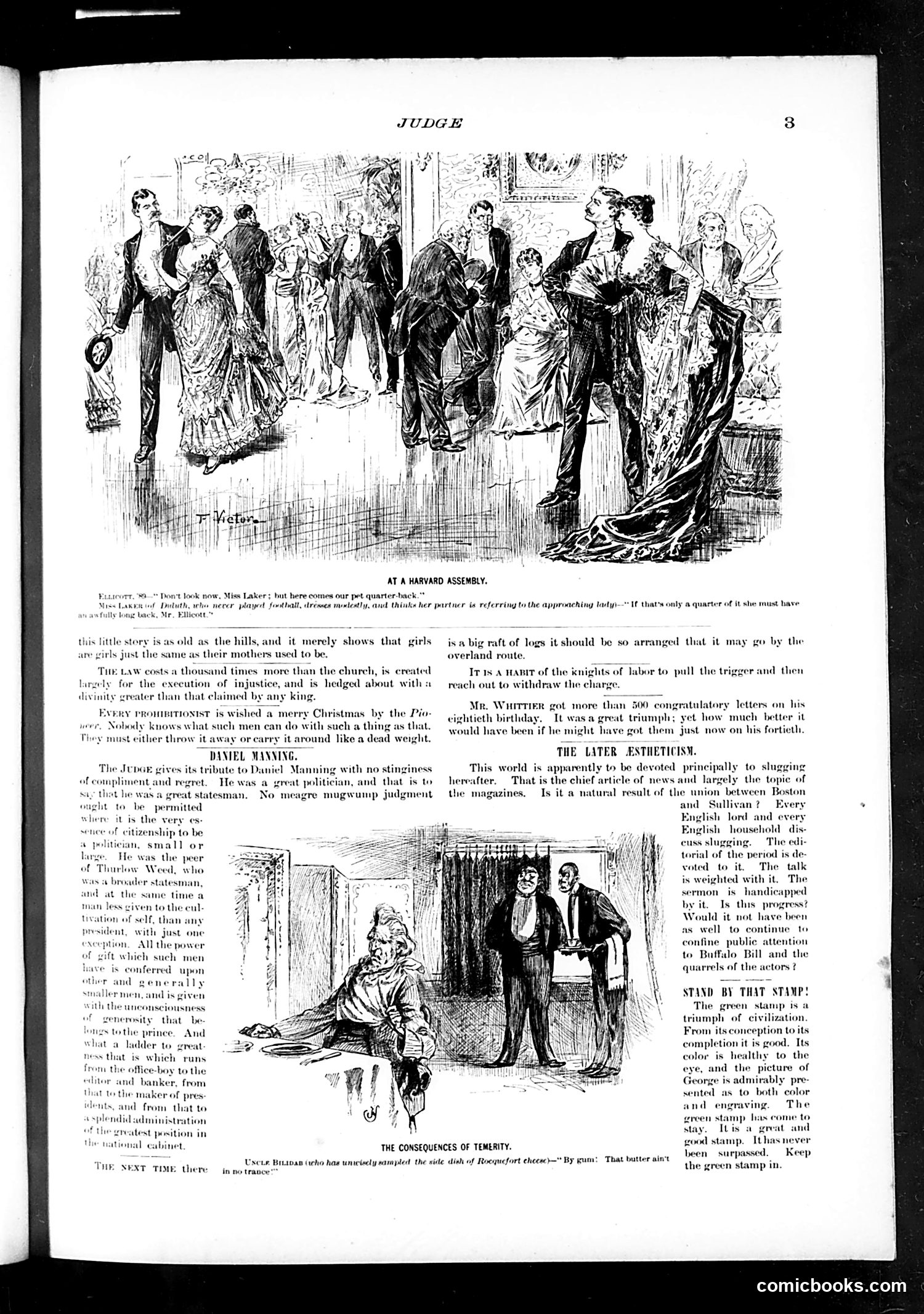
This page from *Judge* contains three satirical pieces: **"At a Harvard Assembly"** mocks the social pretension of college gatherings, where a young woman mistakes a football player for an aristocratic suitor—critiquing how girls judge men by superficial status rather than character. **"The Later Aestheticism"** attacks the obsession with boxing/prizefighting that apparently dominated 1880s-90s discourse. The satire suggests that "slugging" (boxing) has become such a cultural preoccupation that it infects every institution—sermons, editorials, magazines. The reference to "Sullivan" likely means John L. Sullivan, the famous boxer. The piece sardonically asks whether public attention should return to Buffalo Bill or other topics instead. **"The Consequences of Temerity"** is a brief visual joke about someone sampling Roquefort cheese and declaring its butter superior—ironic praise of something unsuitable or misidentified. The page also contains scattered editorial comments on prohibition, labor strikes, and Whittier's birthday congratulations. The overall tone is cynical about contemporary American society.
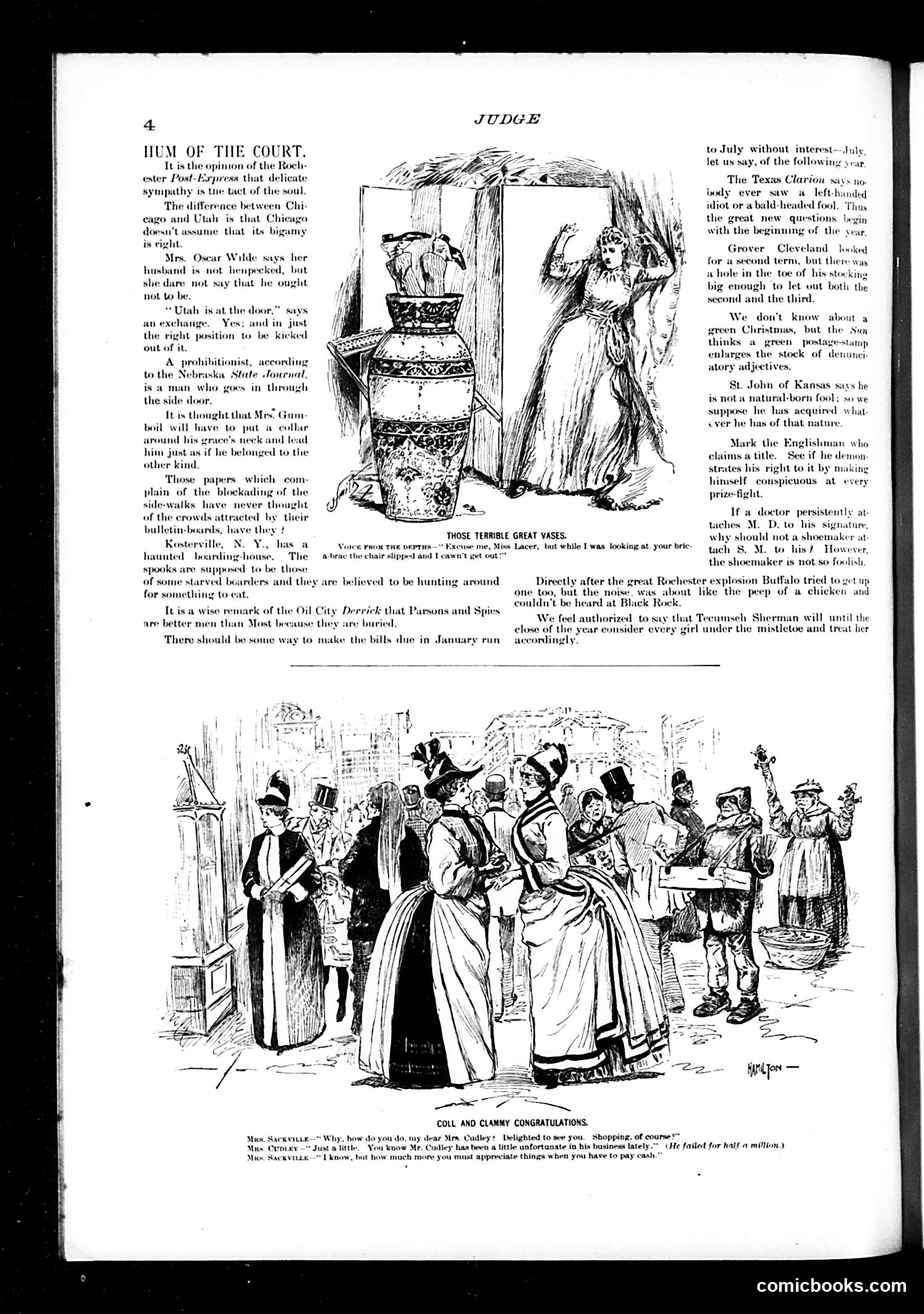
This page contains several short satirical commentaries typical of Judge's "Hum of the Court" section—brief witty observations on social and political topics of the era. **Key references:** - **Oscar Wilde**: A jab at the famous playwright, mocking claims about his marriage dynamics - **Utah/polygamy**: References to Utah's status as a territory seeking statehood while practicing polygamy—a major political controversy - **Cleveland's second term**: Mentions Grover Cleveland's return to the presidency, with a joke about a hole in his stocking (suggesting incompleteness or inadequacy) - **Tecumseh Sherman**: A Civil War general referenced in a mistletoe joke - **Rochester explosion/Buffalo**: References to industrial disasters, likely from the 1880s-90s **The cartoons** illustrate two scenes: "Those Terrible Great Vases" (showing people examining large decorative vessels) and "Coll and Clarry Congatulations" (a street scene with well-dressed figures). The page's humor relies on contemporary events and personalities now largely obscure to modern readers.
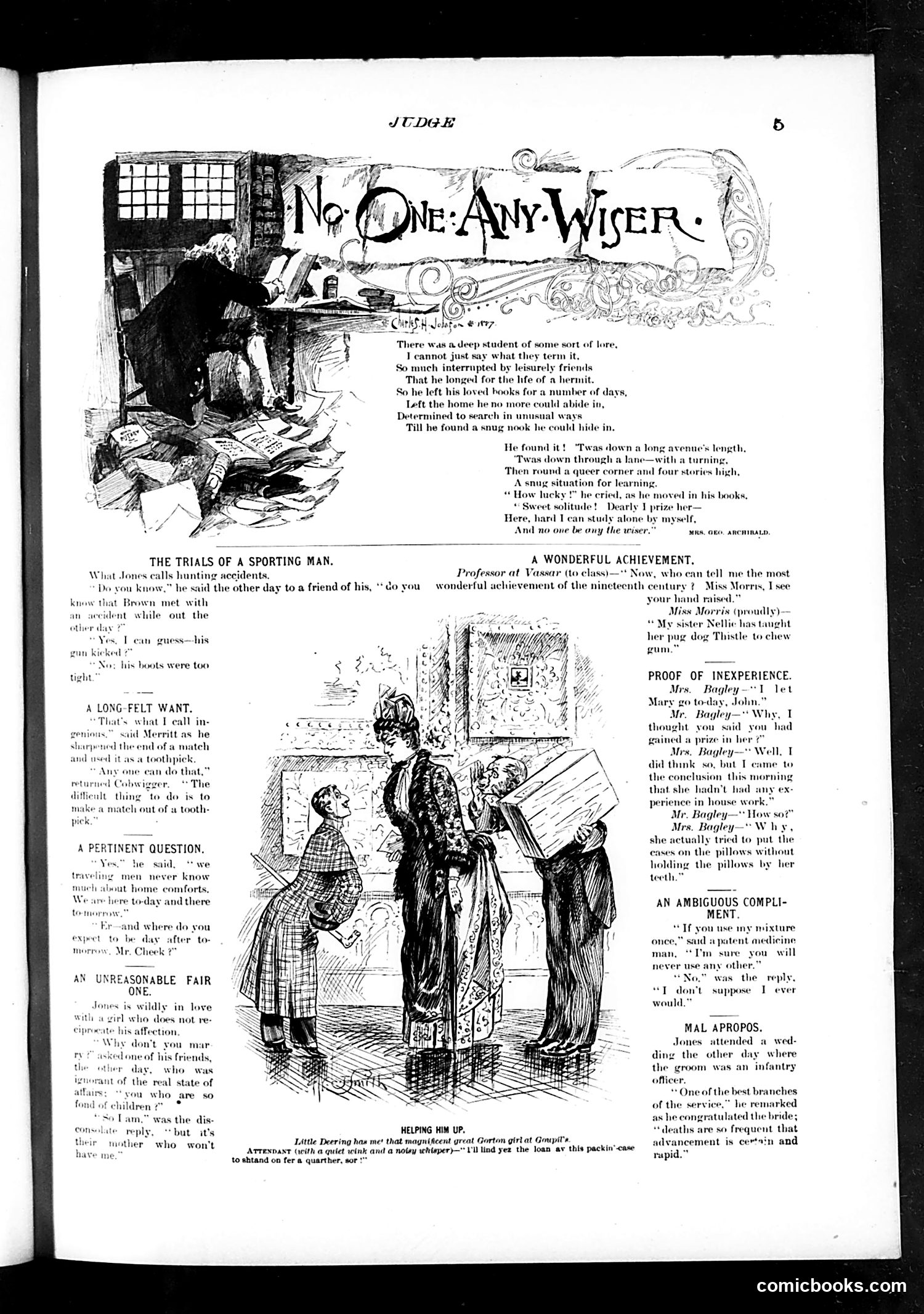
This page contains multiple short humor pieces typical of late-19th-century satirical magazines. The jokes rely on wordplay and situational comedy rather than political commentary: **"No One Any Wiser"** (top): A student seeks solitude for studying but discovers a noisy, crowded location—the humor lies in the ironic contradiction. **"Trials of a Sporting Man"**: Brief quips about hunting accidents and tight boots—gentle mockery of upper-class sporting pursuits. **"A Long-Felt Want"**: A man uses a burnt matchstick as a toothpick—absurdist humor about practical (if crude) solutions. **"A Wonderful Achievement"**: A Vassar College professor asks about 19th-century achievements; a student's answer about teaching a dog to chew gum satirizes shallow priorities among the educated classes. **"Proof of Inexperience"**: A new housemaid hasn't learned to hold pillows with her teeth while changing pillowcases—domestics humor mocking incompetence. **"Mal Apropos"**: An officer's wedding guest tactlessly celebrates military deaths as career advancement. The page emphasizes domestic life, class interactions, and everyday social awkwardness rather than political satire.
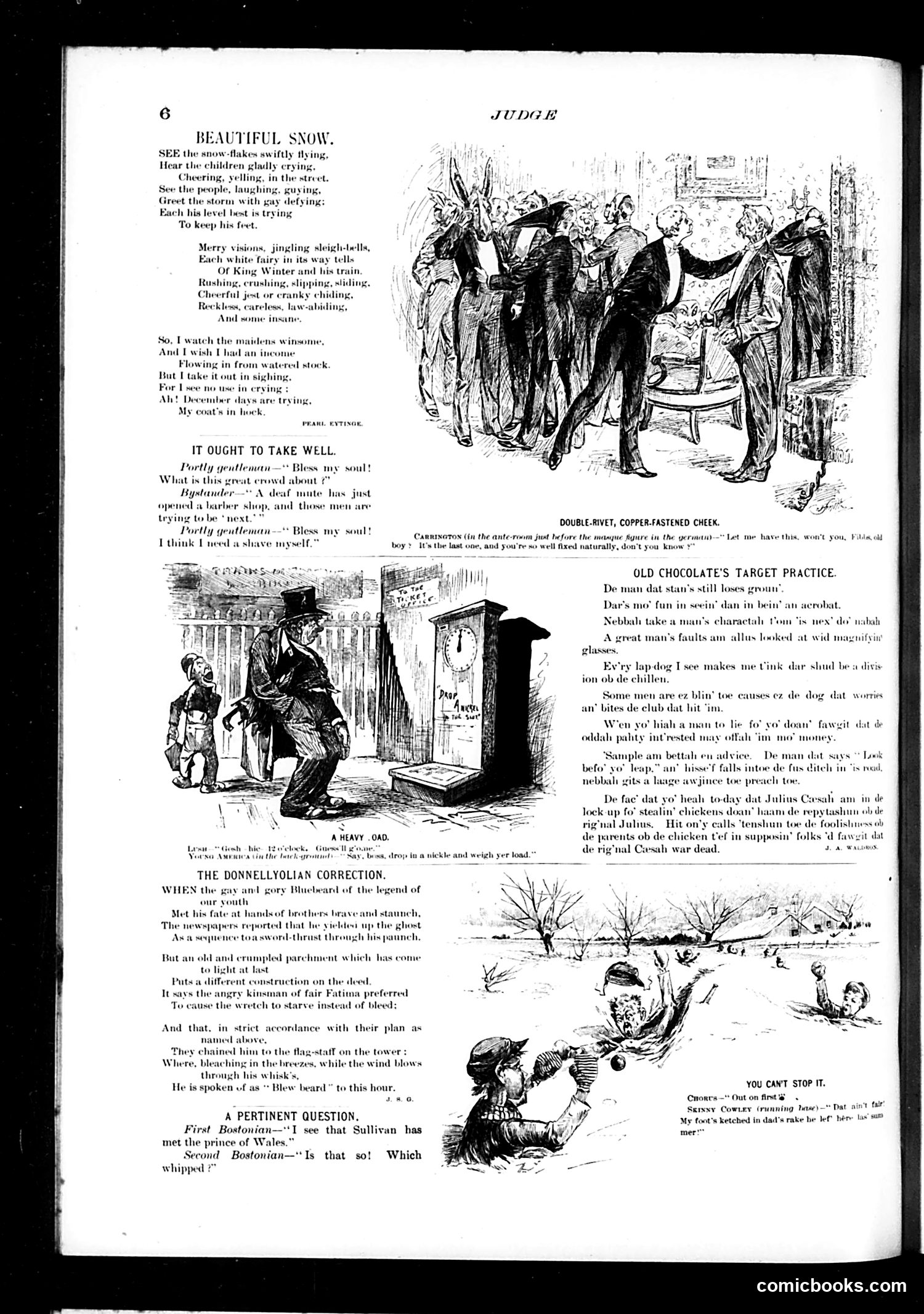
This page from **Judge** (a late 19th-century American humor magazine) contains several unrelated satirical pieces: **"Beautiful Snow"** - A poem mocking winter complaints, particularly targeting someone in financial hardship ("My coat's in hock"). **"It Ought to Take Well"** - A joke about a newly opened barber shop run by a deaf mute, playing on communication difficulties. **"The Donnellyolian Correction"** - Appears to reference the Donnelly family (likely the Irish-Canadian Donnellys, victims of a notorious 1880 massacre), reframing the historical "Bluebeard" legend with corrected facts. **"Old Chocolate's Target Practice"** - Uses a Black dialect speaker dispensing folk wisdom, a common (though offensive by modern standards) humor format of the era. **"You Can't Stop It"** - A baseball joke about a player unable to avoid stepping in a rake left in the field. The page reflects period humor: slapstick, wordplay, dialect comedy, and commentary on contemporary news events—without cohesive thematic connection beyond general amusement.
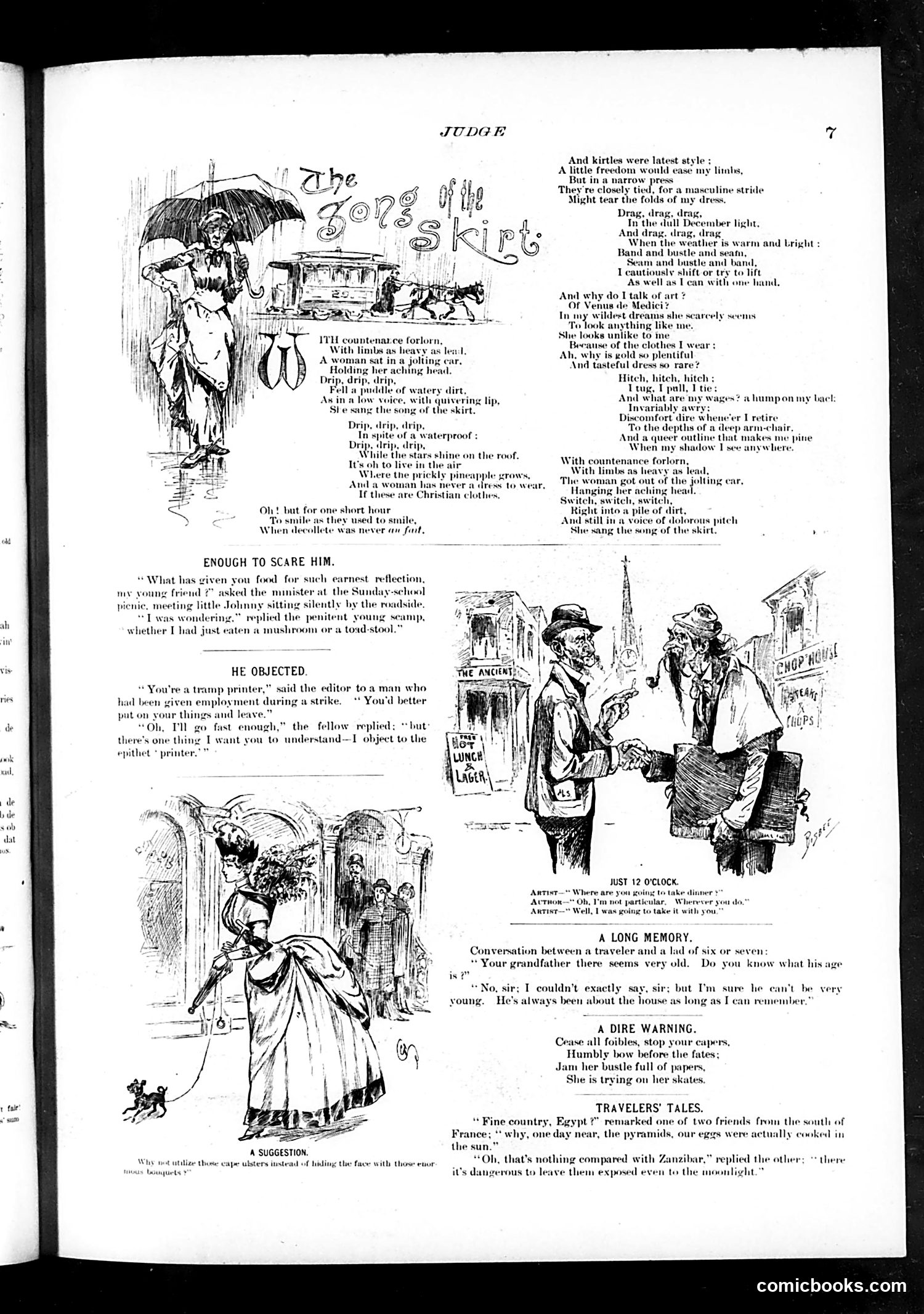
This page contains multiple brief satirical pieces typical of 19th-century American humor magazines: **"The Sorrows of the Skirt"** (top): A poem lamenting women's restrictive Victorian clothing—the heavy skirts, corsets, and bustles that required constant adjustment. The accompanying illustration shows a bedraggled woman in the rain. The satire mocks both the impracticality of fashionable dress and women's resigned acceptance of discomfort in pursuit of style. **"Enough to Scare Him"** and other brief jokes: Simple punchlines about a boy worried about mushrooms, a "tramp printer" objecting to his job title, and other everyday absurdities. **"A Dire Warning"**: A humorous cautionary verse about a woman trying on ice skates while wearing a bustled skirt full of papers—poking fun at women navigating modern activities in impractical Victorian fashion. The satire throughout targets the gap between fashionable femininity and practical reality, a recurring Judge theme reflecting period anxieties about women's clothing and social roles.
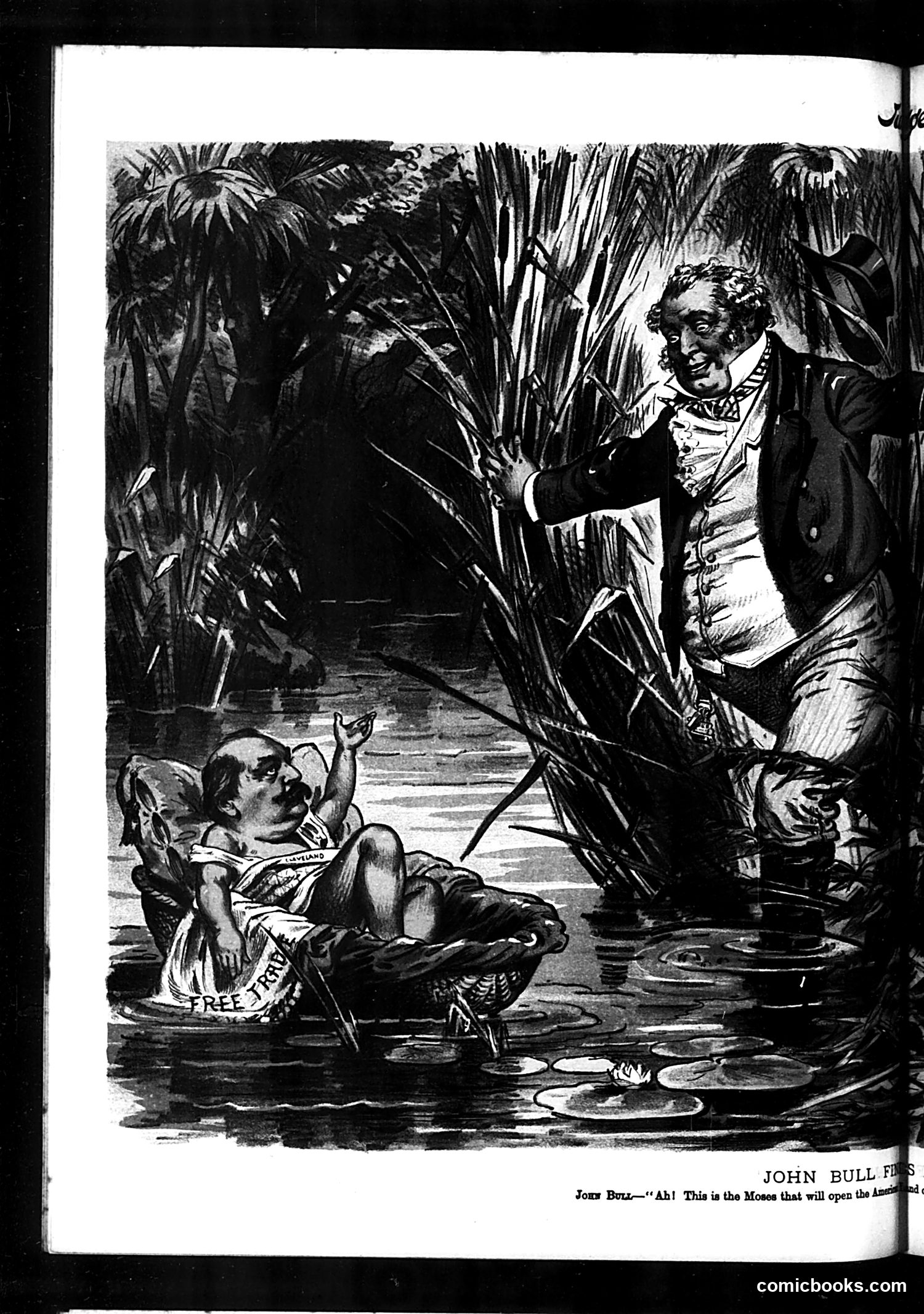
This appears to be a satirical cartoon titled "John Bull" from *Judge* magazine. The image shows a well-dressed gentleman (representing Britain, as "John Bull" is the traditional personification of England) standing in a swampy setting with palm trees, gesturing toward a figure in the water labeled "Free Trade." The figure in the water appears to be drowning or struggling, suggesting the cartoon critiques British free trade policy as failed or dangerous. The swampy, tropical setting likely references colonial or foreign territories affected by British trade policies. The satire appears to mock either British imperial trade practices or the consequences of free trade ideology. Without the complete caption or publication date, the specific political moment being referenced remains unclear, though the imagery suggests criticism of Britain's economic policies and their real-world effects.
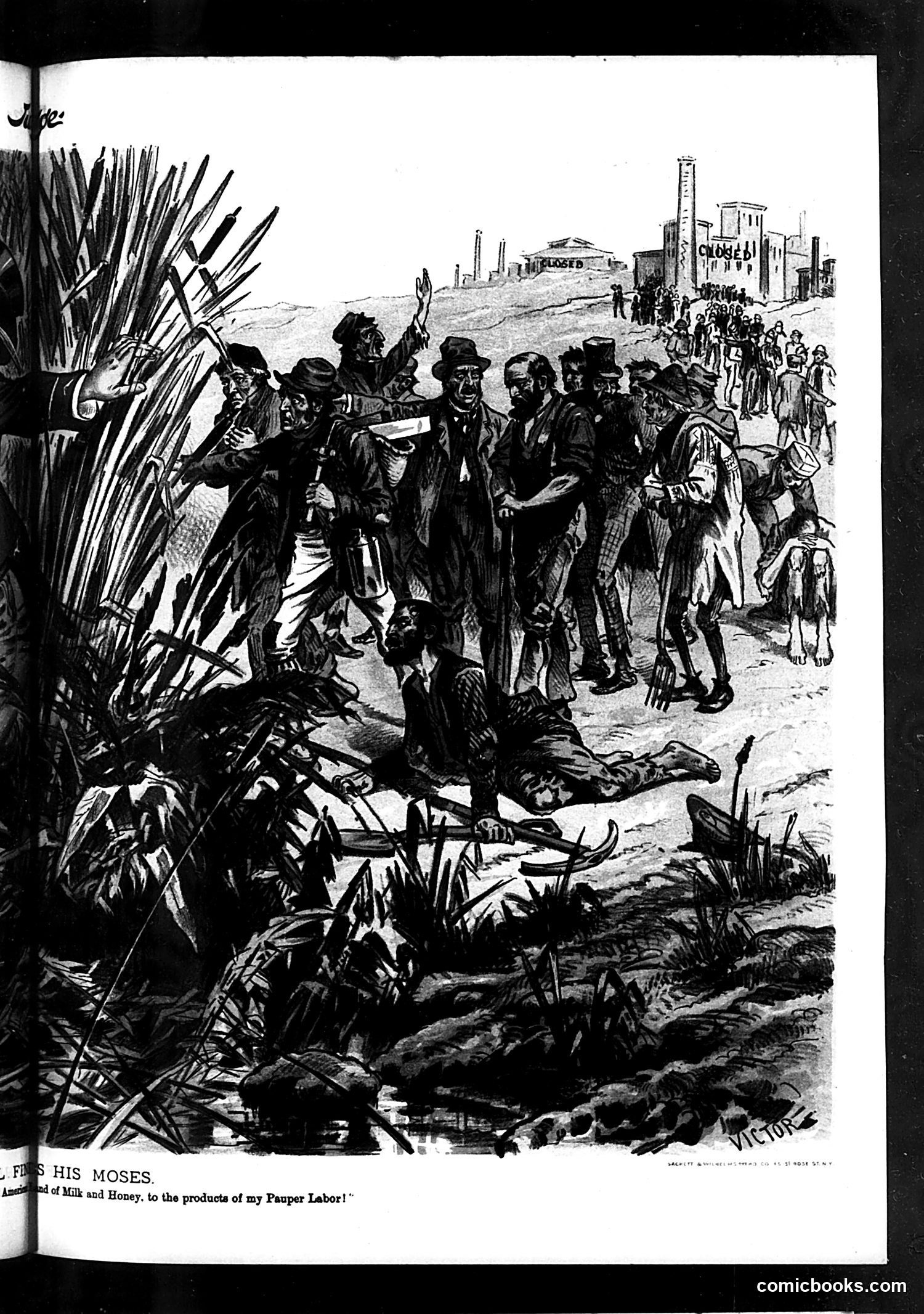
This Gilded Age satirical cartoon depicts a biblical reference to critique labor exploitation. A figure—likely representing capitalist employers or industrial magnates—addresses a crowd of workers (appearing impoverished and desperate) as "Moses," promising to lead them to a "land of Milk and Honey." The ironic caption reveals the deception: instead of prosperity, workers are offered only "products of my Pauper Labor"—meaning they'll remain trapped in poverty-wage work. The industrial buildings visible in the background emphasize the factory/manufacturing context. The cartoon satirizes how wealthy industrialists manipulated working-class hopes with false promises of prosperity during America's rapid industrial expansion. The "Moses" comparison mocks their pretense of benevolence while delivering only exploitation.
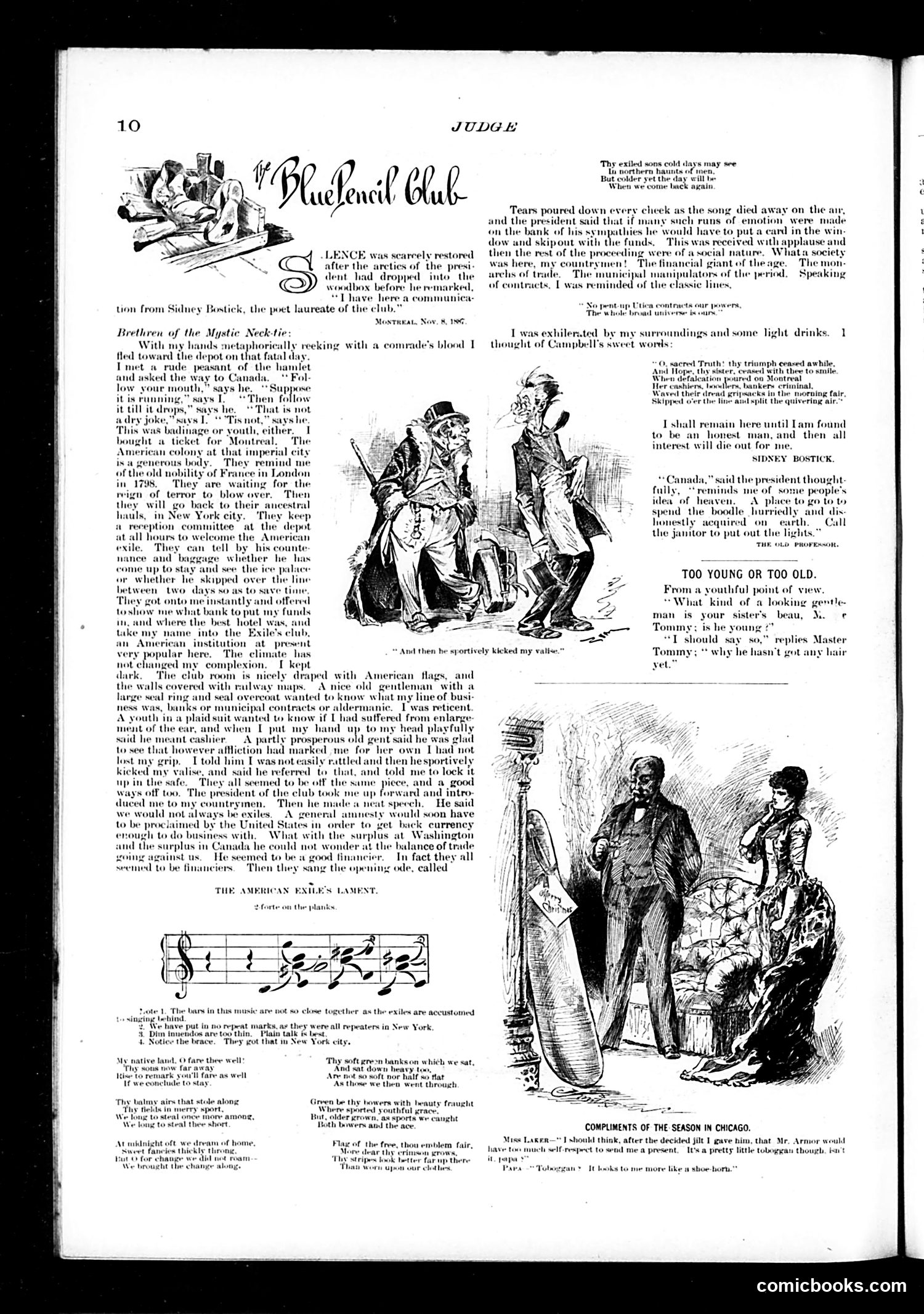
This page satirizes American expatriates living abroad in an "Exiles Club," likely in London around the 1880s. The main narrative, credited to poet Sidney Bostick, depicts a visiting American encountering a room of self-important exiles—wealthy or formerly wealthy Americans who've abandoned the U.S. The club members are caricatured as pretentious busybodies, making awkward inquiries about the narrator's health and business. The satire peaks when the club president delivers a patriotic speech about financial patriotism and the surplus Canada could acquire if Americans didn't flee—a jab at wealthy tax-dodgers abandoning their country. The accompanying illustrations show elderly gentlemen in Victorian dress engaging in maudlin nostalgia. The humor targets both American expatriate snobbery and those who romanticize the homeland while refusing to contribute to it financially. The smaller comic at bottom mocks romantic misunderstandings among younger Americans, offering social comedy alongside the political satire.
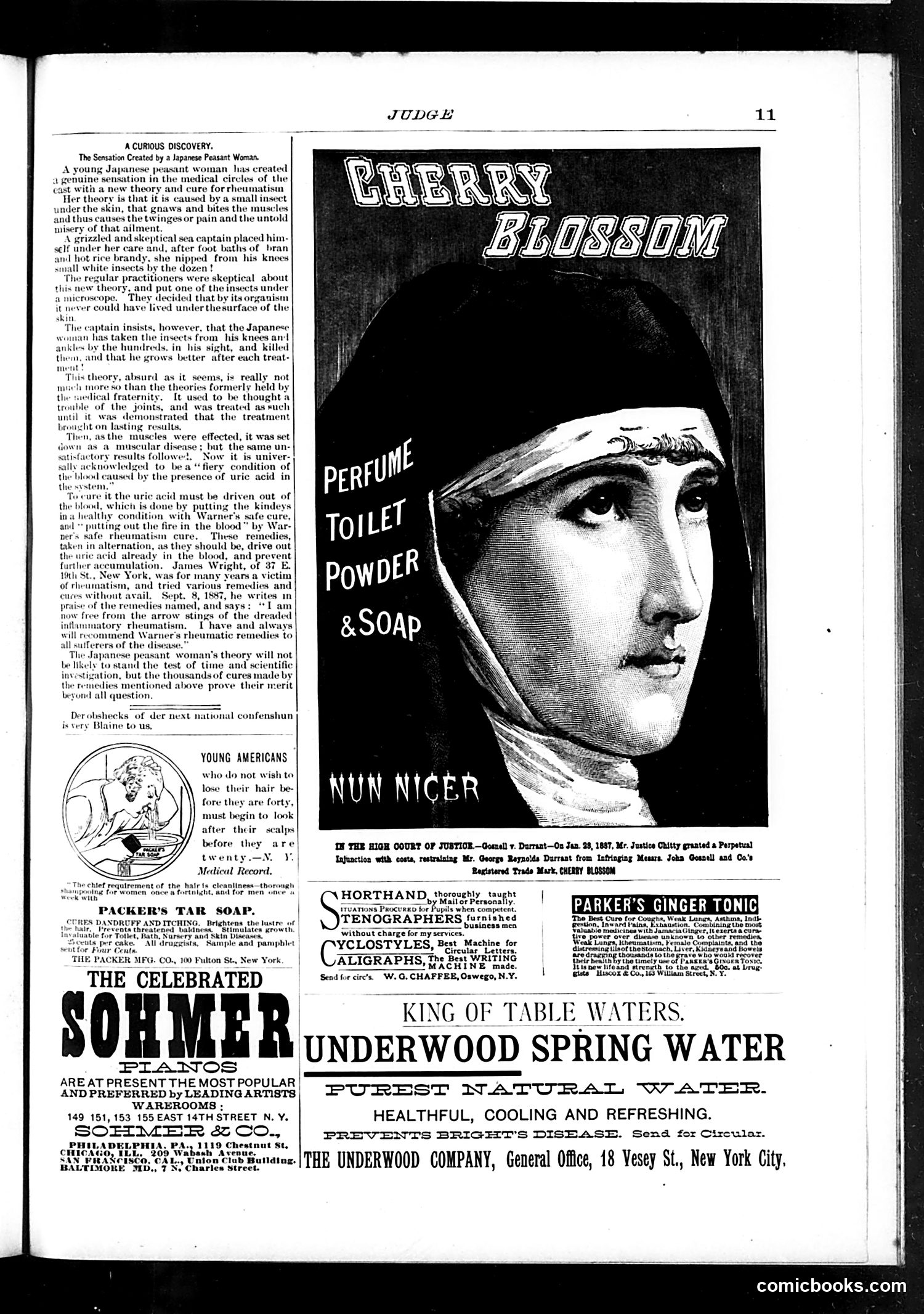
This page is primarily **advertising**, with one small cartoon at the top left and a large product advertisement dominating the right side. **The Cartoon:** "A Curious Discovery" describes a Japanese peasant woman's theory that rheumatism is caused by small insects living under the skin. A skeptical sea captain supposedly had hundreds of these insects removed from his knees. The piece mocks the theory while actually promoting **Warner's Safe Cure** as the real solution, suggesting the disease stems from uric acid in the blood. **The Satire:** The joke operates on two levels—ridiculing an absurd foreign medical theory while simultaneously pushing a patent medicine remedy. This reflects late-19th-century American skepticism toward non-Western medicine, combined with the era's widespread promotion of dubious "cure-all" tonics. **The Large Advertisement:** Features "Cherry Blossom" perfume, toilet powder, and soap by "Nun Nicer," with an ornate illustration of a woman's profile. This represents typical Victorian-era luxury goods marketing. The page captures the magazine's blend of satire and commercial content typical of 1880s American publishing.
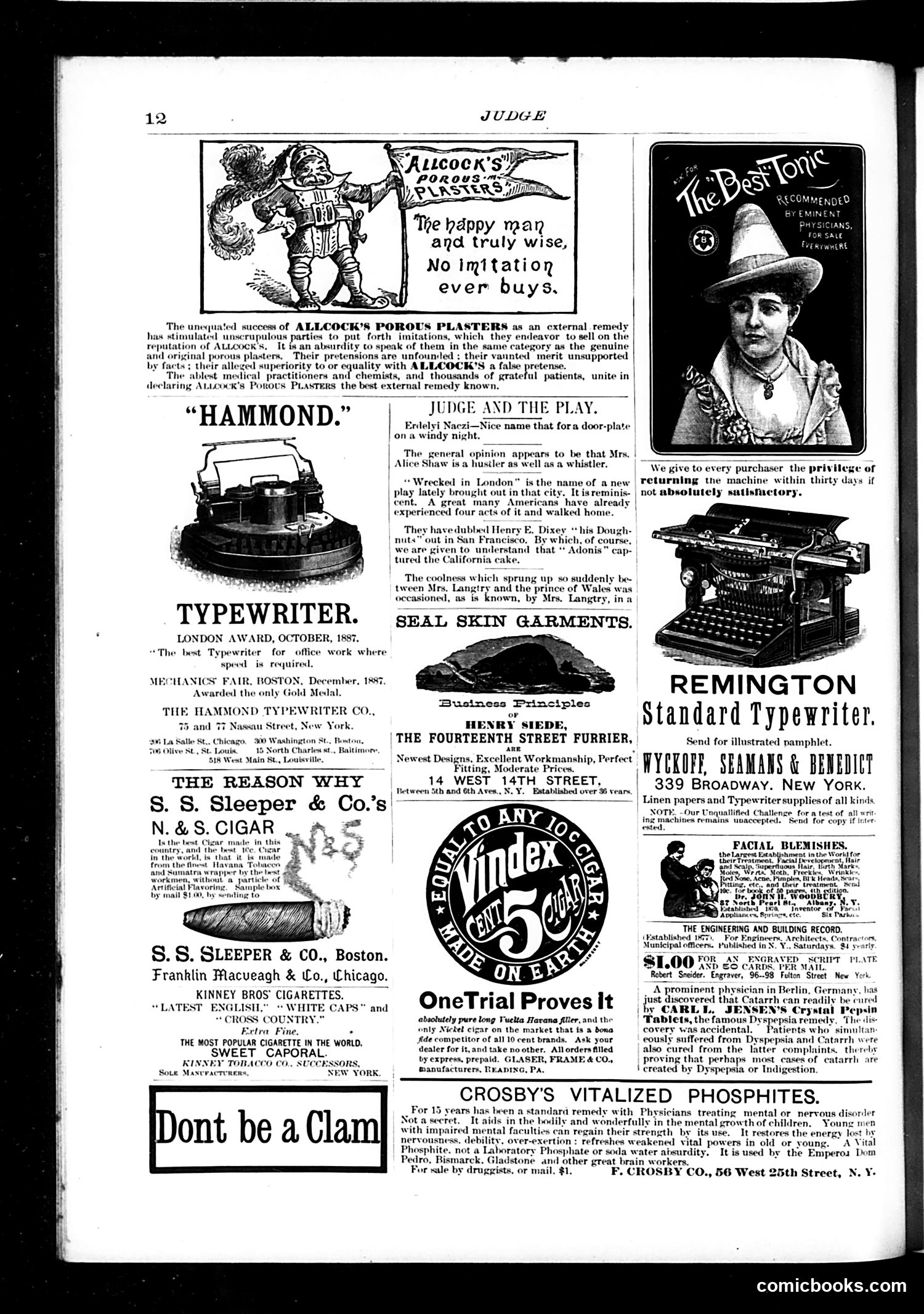
This page is primarily **advertising** for various late-19th-century products, with minimal satirical content. The main cartoon at top depicts Allcock's Porous Plasters, a medical product, showing a figure labeled "The happy man and truly wise" rejecting imitations—a straightforward product endorsement rather than satire. Brief satirical mentions appear in the "Judge and the Play" section: "Erdelyi Naczi" mocks a peculiar name; references to Mrs. Alice Shaw as both "hustler" and "whistler" suggest she performs multiple dubious services; mentions of theatrical failures ("Wrecked in London," "Adonis") appear to be standard theater criticism. The bulk of the page comprises advertisements for typewriters (Hammond, Remington), cigarettes (Kinney Bros, Sweet Caporal), cigars, and patent medicines (Crosby's Vitalized Phosphites, Carle Jensen's Tablets for catarrh). The small "Don't be a Clam" box at bottom—advising against silence, likely encouraging product purchase—represents typical period advertising rhetoric.
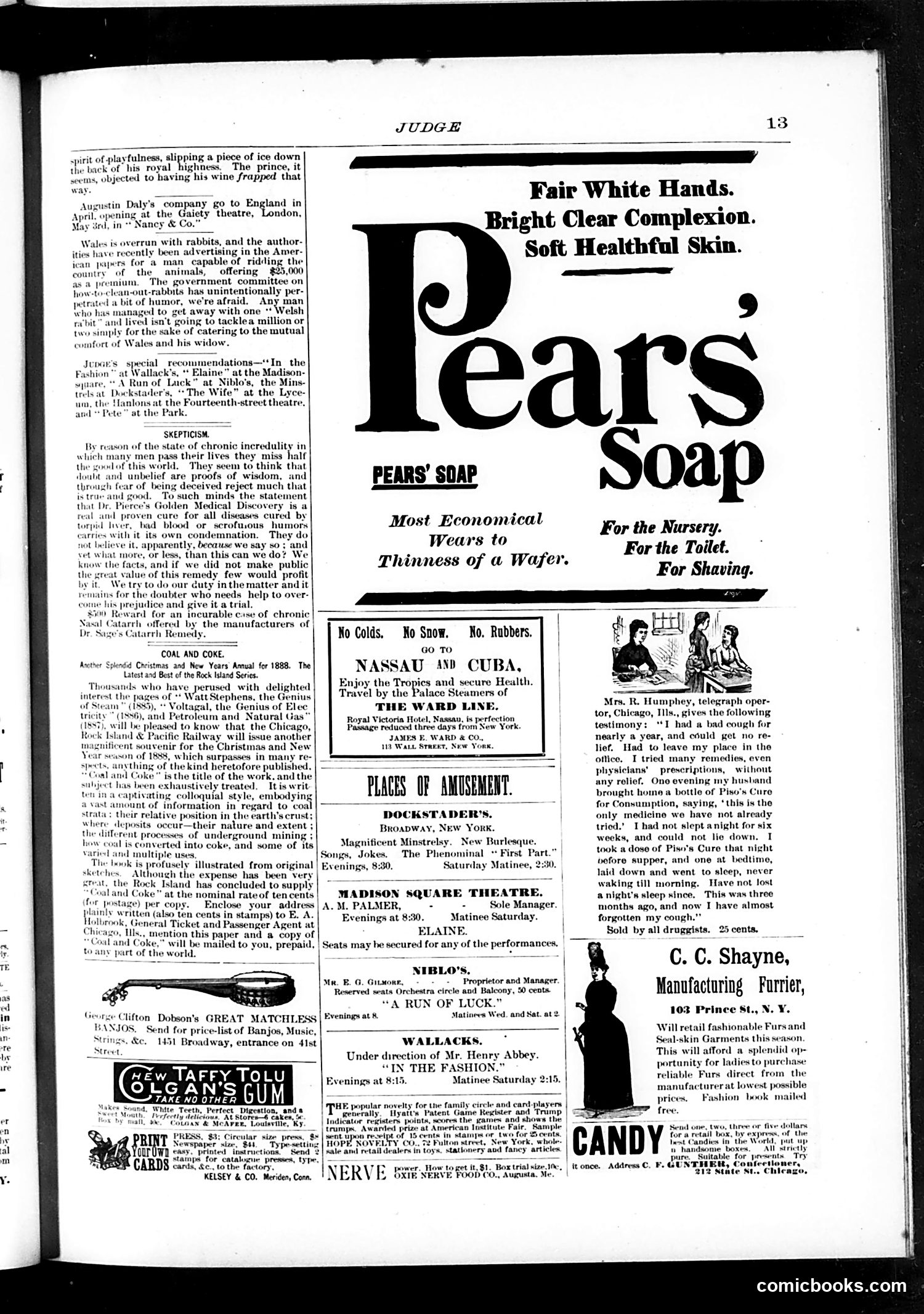
This page is primarily **advertising**, not satirical editorial content. The dominant feature is a large Pears' Soap advertisement emphasizing beauty standards of the era: "Fair White Hands. Bright Clear Complexion. Soft Healthful Skin." The editorial text discusses minor theatrical gossip (Augustin Daly's company going to England, various stage performances) and includes a piece titled "Skepticism" promoting Dr. Pierce's Golden Medical Discovery—essentially disguised advertising for patent medicine. There's a brief note about Wales being overrun with rabbits, offering £25,000 to solve the problem, with light satire suggesting no one would tackle millions of rabbits for that reward. The remaining space contains travel ads (Nassau and Cuba), theater listings, and various product advertisements typical of late-1880s magazines. **No political cartoons are visible on this page.**
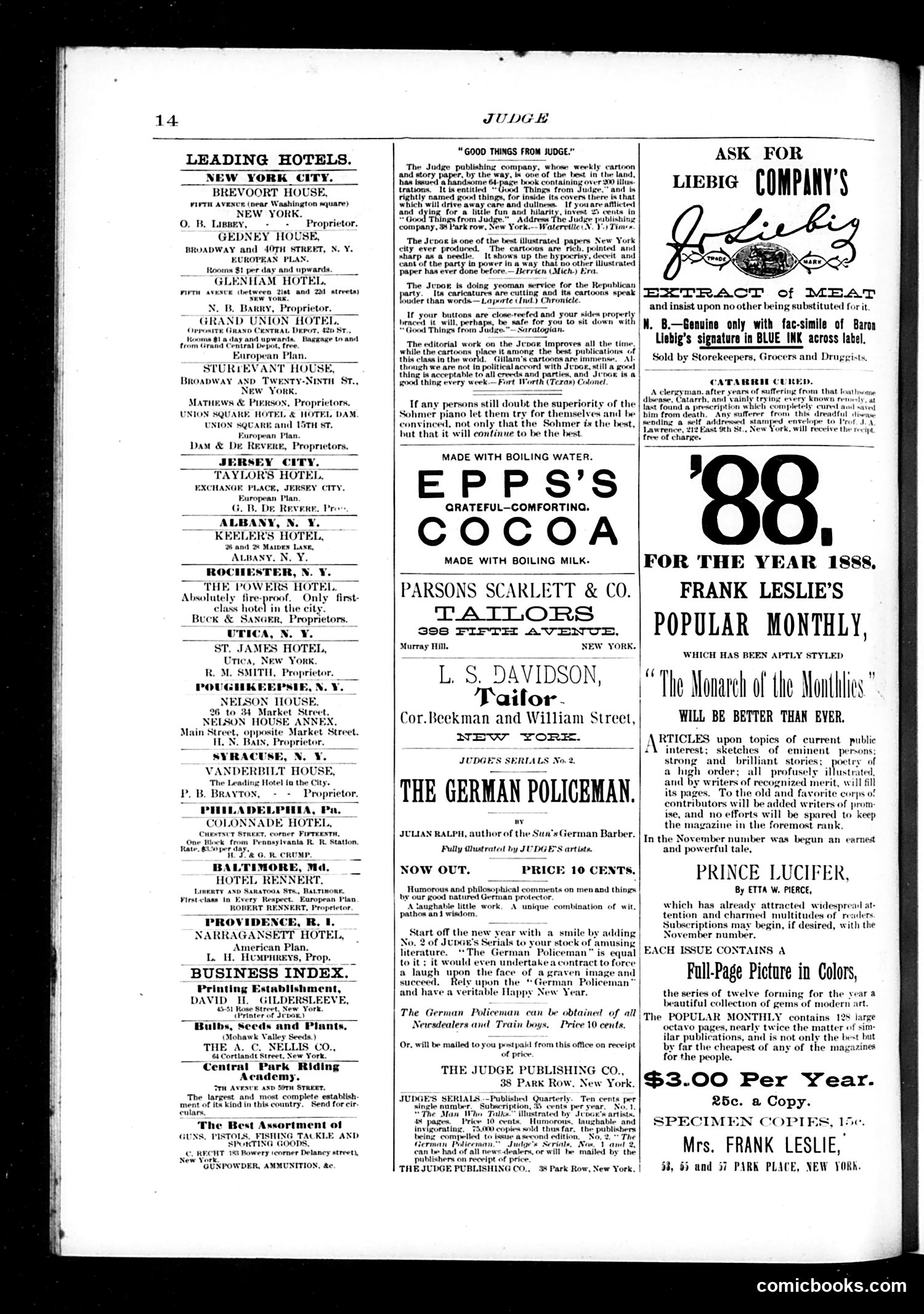
This page is primarily advertising and business listings for *Judge* magazine, with limited editorial cartoon content visible. The main satirical piece appears to be "The German Policeman" by Julian Ralph—a humorous illustrated serial story (newly available, 10 cents) about a sympathetic German police character. The OCR'd description mentions it combines "wit, pathos, and wisdom" with "laughable" situations. The advertisements reflect 1880s commercial interests: hotels, extract of meat (likely Liebig's, a patent food), cocoa products, and tailoring services. The page credits *Judge's* success to its sharp Republican-leaning political cartoons criticizing the party "in power" (the exact party affiliation is unclear from this excerpt alone, though one source calls them "yeoman service for the Republican party"). This suggests *Judge* functioned as political-satirical commentary alongside humorous content—typical for American satirical magazines of this era.
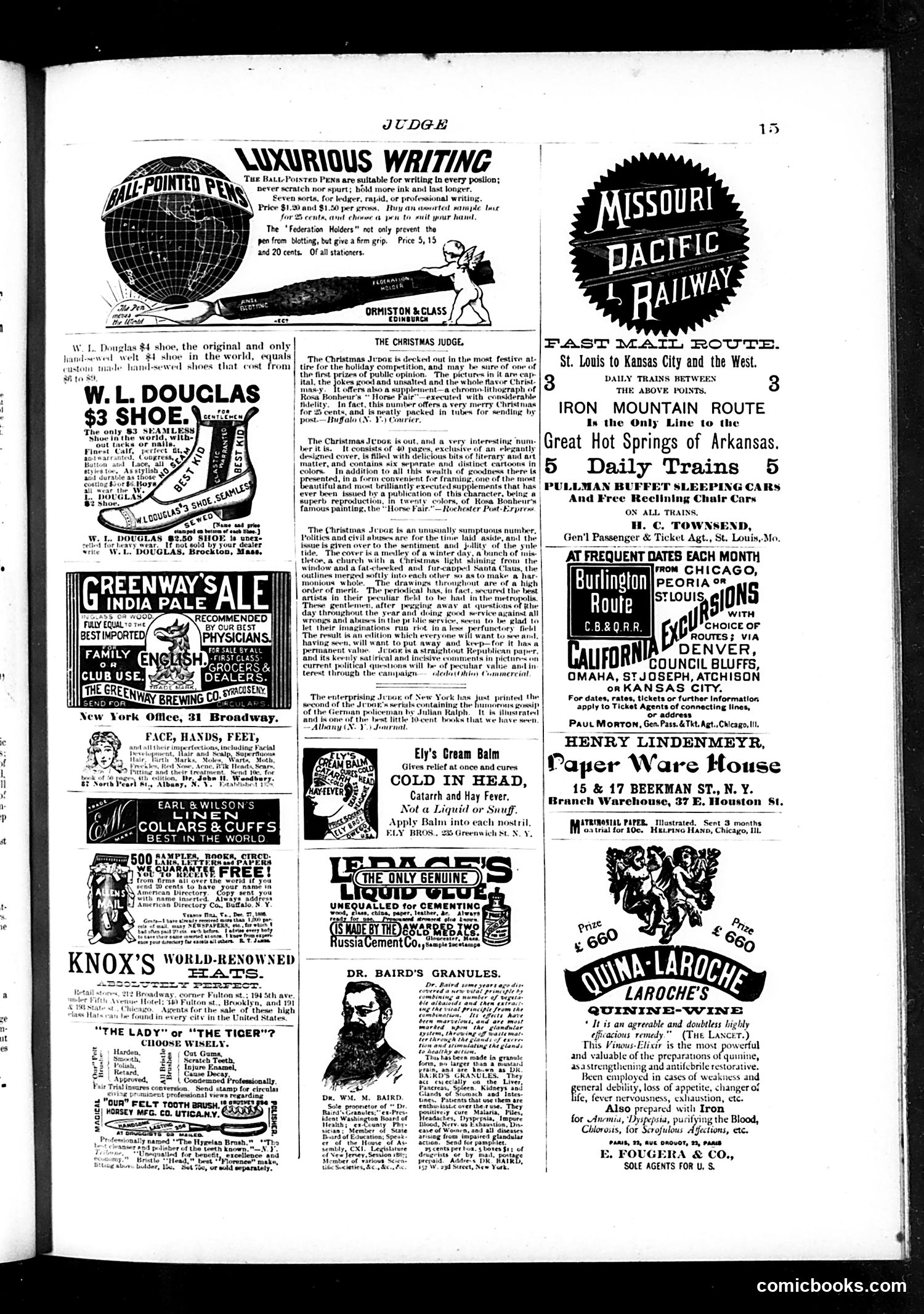
This is primarily an **advertising page** from Judge magazine, not a satirical cartoon page. The layout contains numerous commercial advertisements for late-19th/early-20th century products and services. Notable advertisements include: - **Writing instruments** (Ball-Pointed Pens, Federation Holders) - **W.L. Douglas shoes** ($3 shoe claim) - **Railway services** (Missouri Pacific, Burlington Route, Iron Mountain Route to Hot Springs, Arkansas) - **Patent medicines** (Ely's Cream Balm for colds, Dr. Baird's Granules, Quinine-Wine tonic) - **Haberdashery** (Earl & Wilson collars/cuffs, Knox hats) - **Miscellaneous products** (tooth brushes, paper warehouse supplies) The only editorial content visible is a brief mention of Judge's Christmas issue, praising its illustrations and humor. This page reflects the magazine's business model: mixing satirical commentary with paid advertising to reach middle and upper-class readers interested in consumer goods and patent remedies.
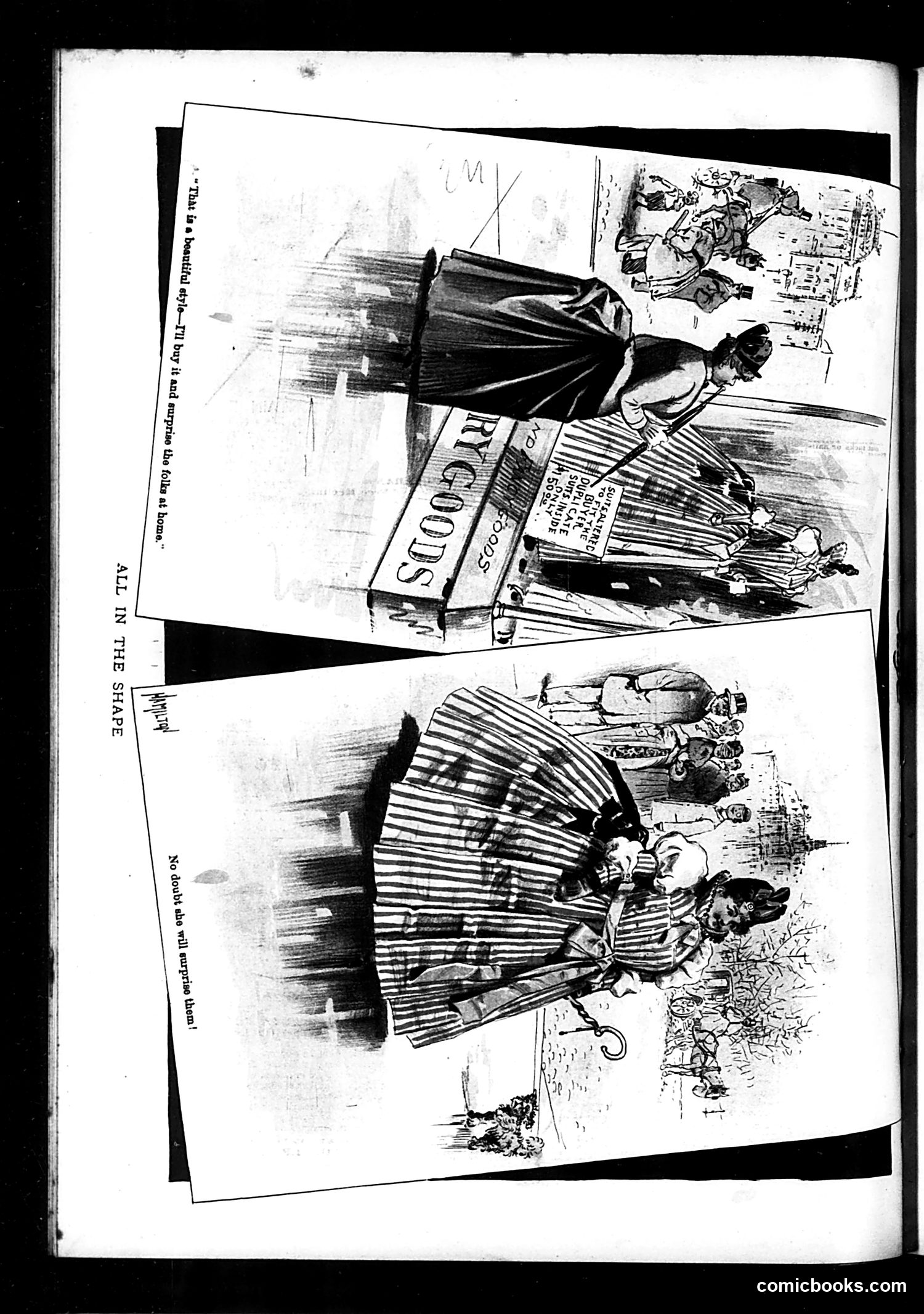
This page contains two illustrations depicting women in contrasting styles of dress. The top image shows a woman in dark, conservative clothing labeled "SCHOOL" (visible on what appears to be a book or sign). The bottom image shows a woman in a striped dress with a wide skirt—a fashionable silhouette of the era. The caption "No doubt she will surprise them!" suggests satirical commentary on women's clothing and behavior, likely contrasting modest school attire with fashionable dress. This appears to be social satire about young women, education, and changing fashion standards—a common Judge magazine theme. The exact historical moment and specific figures referenced are unclear from the visible text, but the humor relies on juxtaposing conservative versus fashionable presentation.