
A complete issue · 16 pages · 1887
Judge — December 17, 1887
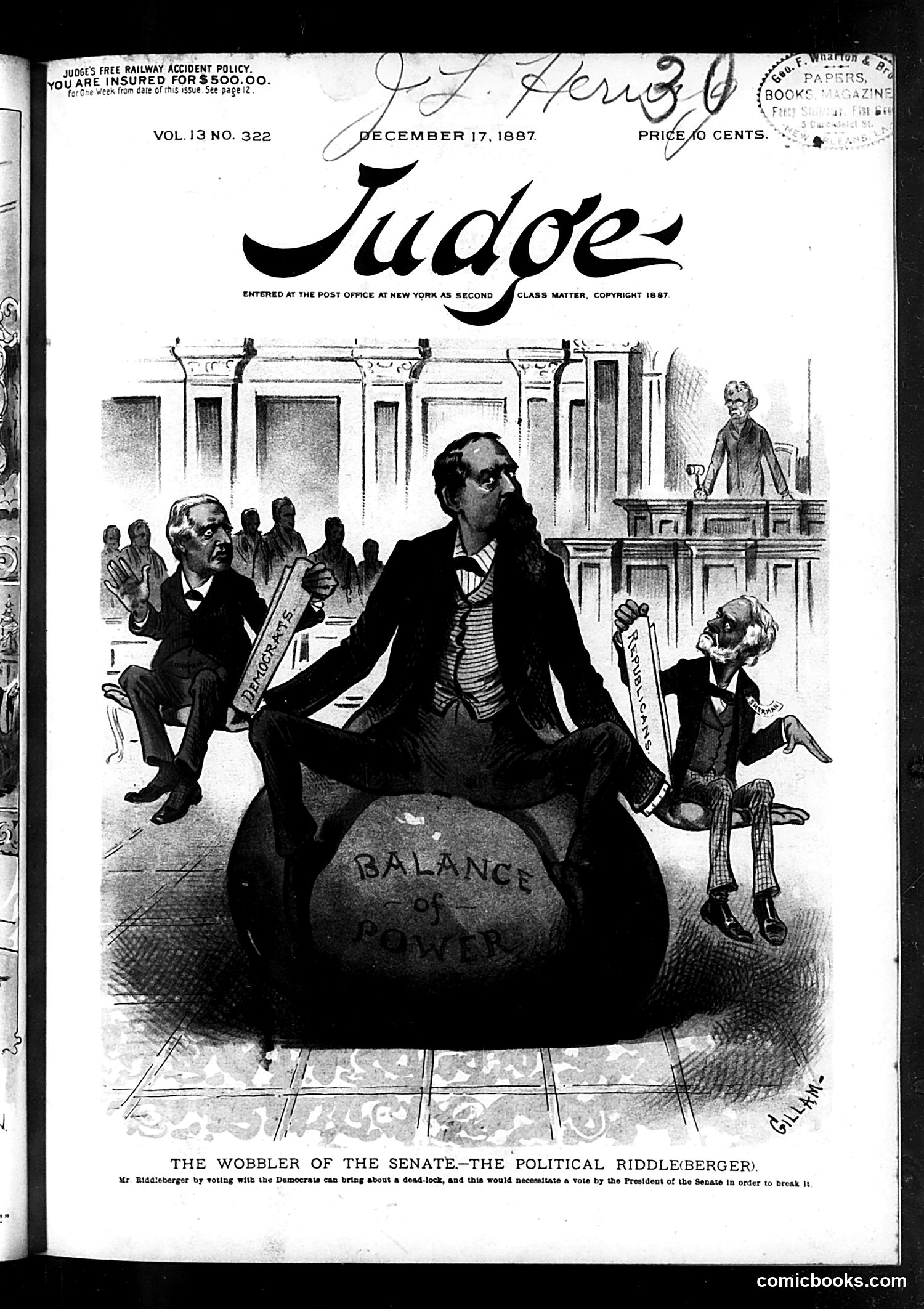
This December 1887 *Judge* cartoon satirizes Senator Riddleberger's political unreliability. The central figure balances precariously on a large sphere labeled "Balance of Power," juggling various labeled objects while surrounded by onlookers in what appears to be the Senate chamber. The caption explains Riddleberger could swing a crucial Senate vote by allying with Democrats, which would deadlock the chamber and require a presidential tiebreaker. The cartoon mocks him as an unprincipled "wobbler"—a politician whose shifting allegiances make him pivotal but unreliable in closely divided legislatures. The imagery of unstable balance visualizes how Riddleberger's political positioning held disproportionate power during this era of tight congressional control.
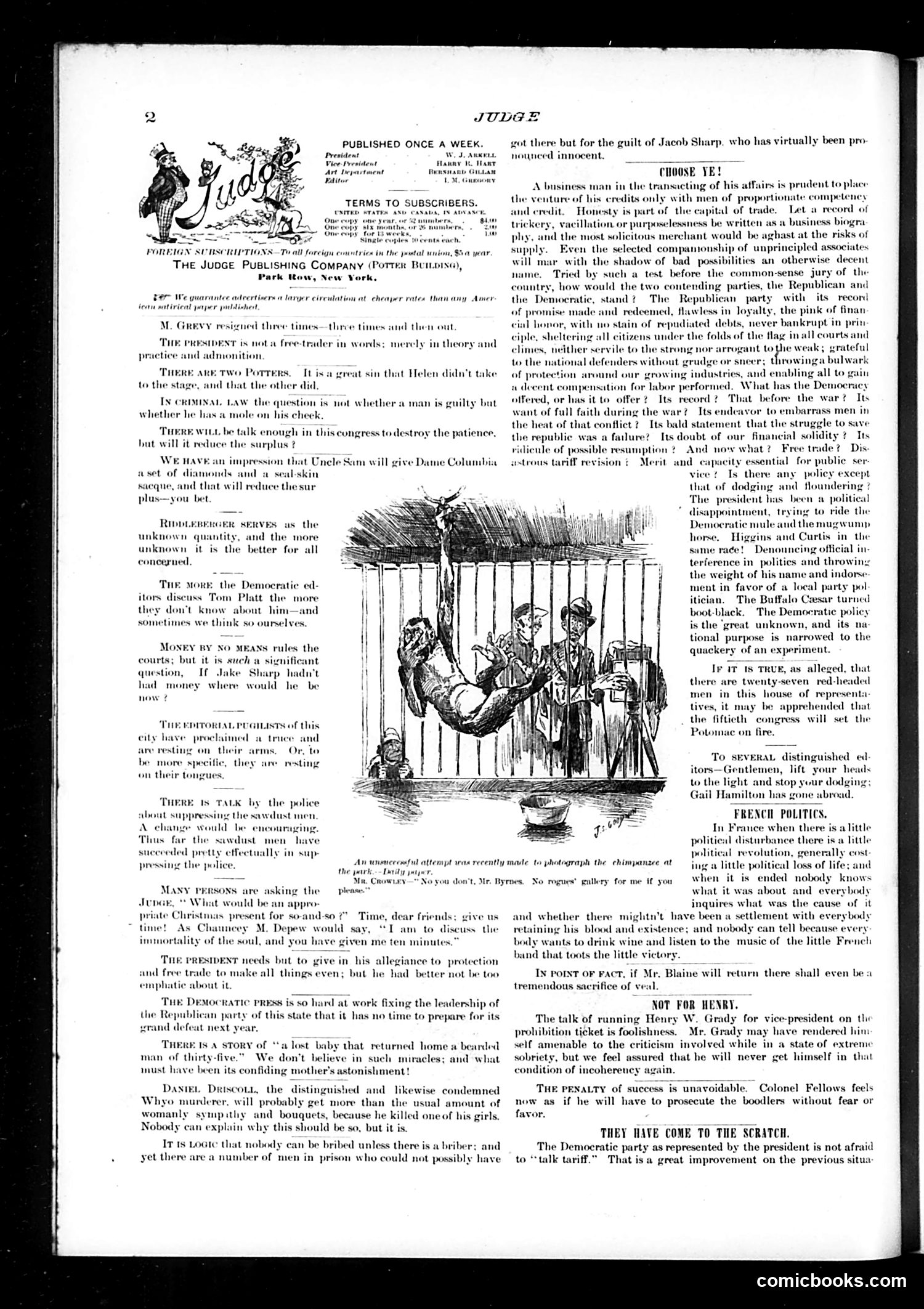
The main cartoon depicts a man suspended in what appears to be a restraining device or cage, labeled "An unsuccessful attempt was recently made to photograph the chimpanzee of the park. Teddy player." The caption references "No 'coons' gallery for me if you can help it," suggesting a crude visual comparison between the subject and a chimpanzee. This is political satire attacking a figure (likely a political opponent of the magazine's editorial stance) by associating them with animalistic characteristics—a common though offensive tactic in early 20th-century American political cartooning. The surrounding text discusses Republican and Democratic politics, suggesting this ridicules a Democratic figure, though the specific identity remains unclear from context alone.
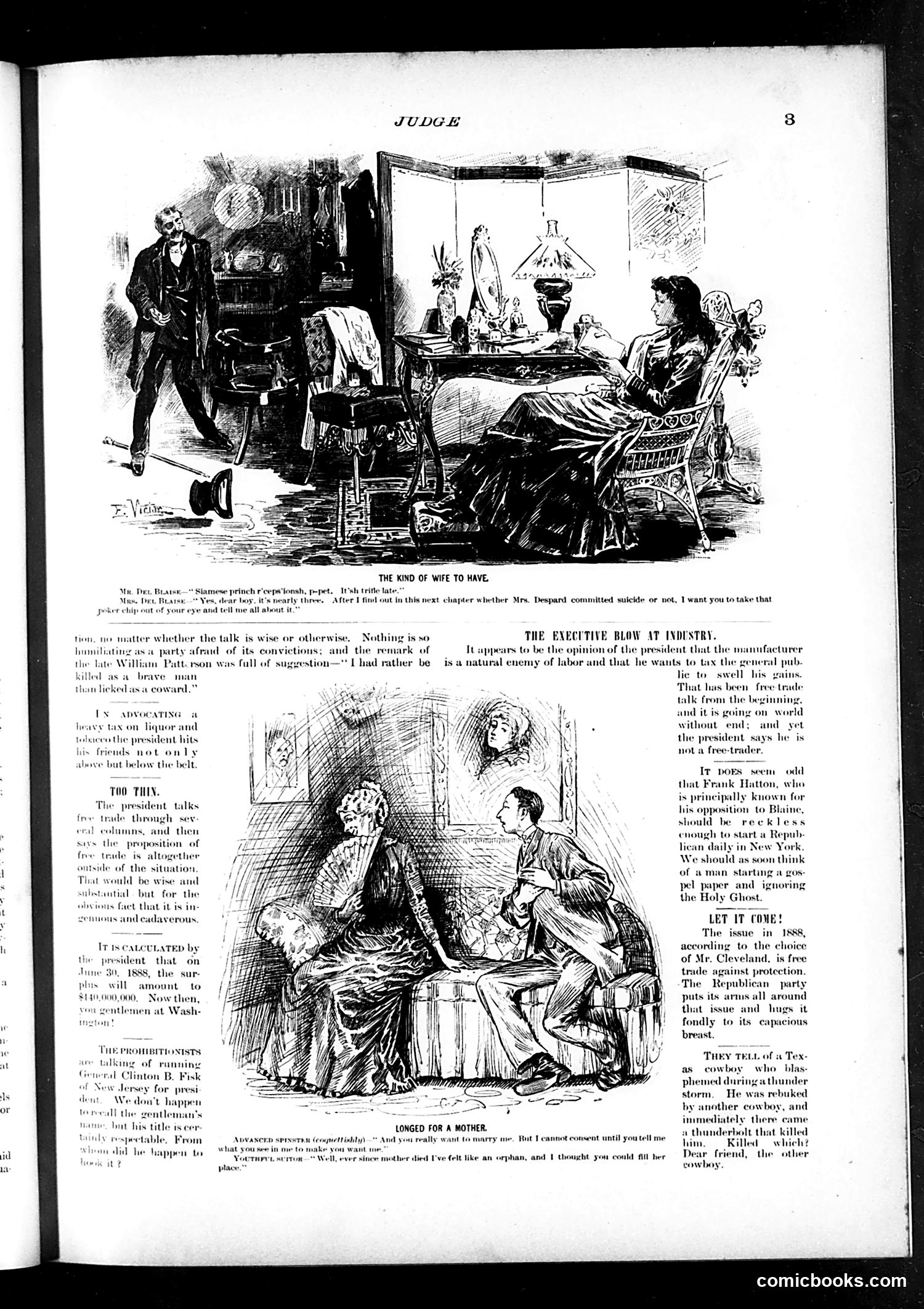
This page from Judge combines political commentary with domestic humor typical of 1880s American satire. **"The Kind of Wife to Have"** (top): A domestic scene satirizing marriage negotiations, where a woman demands her suitor prove his worthiness before commitment—likely commentary on evolving gender relations and marriage expectations. **"The Executive Blow at Industry"** (right column): Attacks President Cleveland's tariff policy, arguing he's hostile to manufacturers despite claiming not to be a "free-trader." The satire suggests his anti-tariff stance contradicts his stated position and harms American labor and industry—a core Republican argument of the 1880s. **"Longed for a Mother"** (center): A sentimental domestic scene, possibly mocking melodramatic serialized fiction popular in magazines. **"Let It Come!"** and the Texas cowboy anecdote (bottom): Brief political/humorous asides about the 1888 election and free trade as the central issue, plus a joke about blasphemy and divine justice. The page overall targets Cleveland's trade policies while mixing entertainment content.
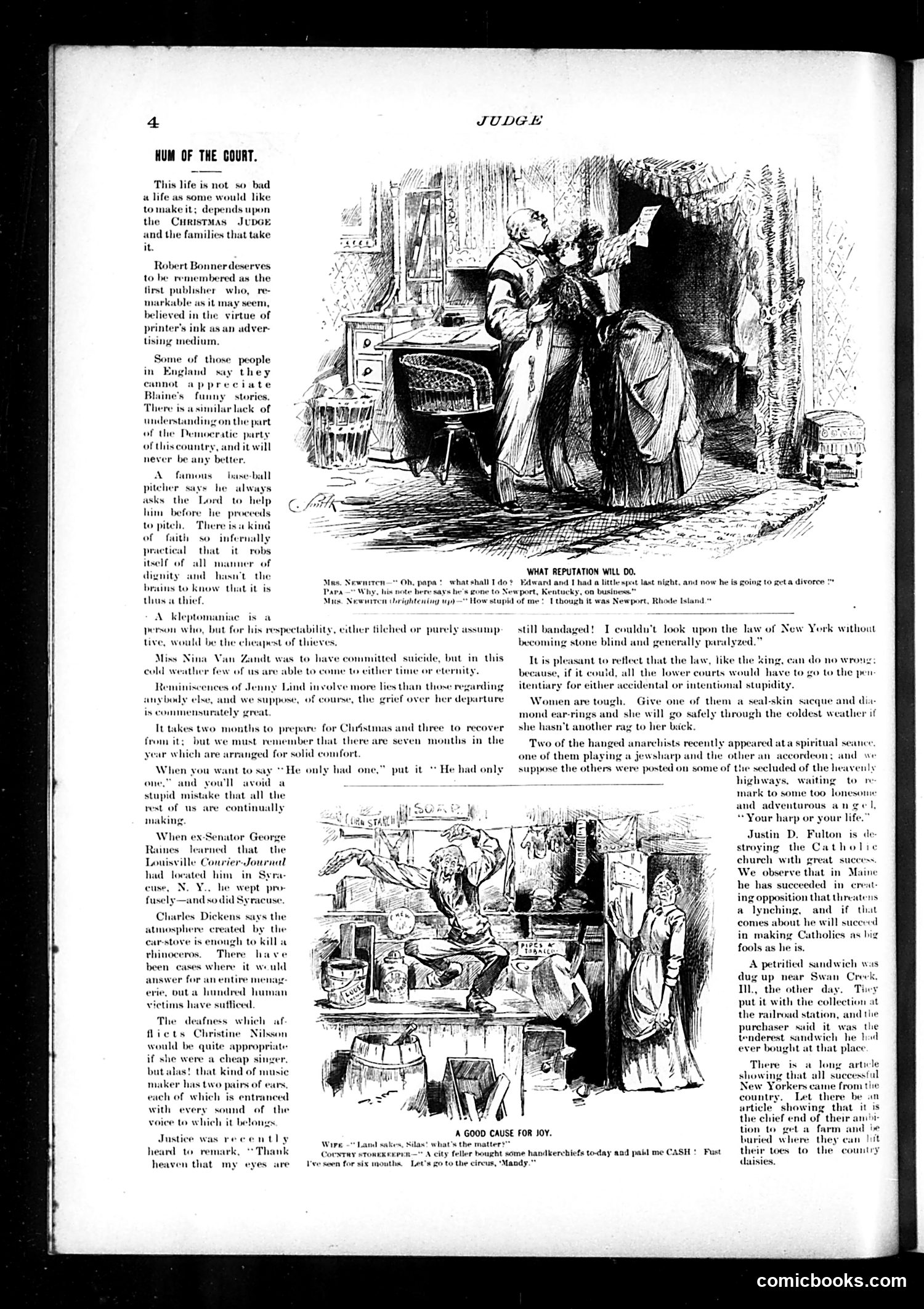
This page contains various short satirical commentary pieces typical of Judge's "Hum of the Court" section, mixing social observation with gentle mockery. **Key satirical targets include:** - **Robert Bonner**: Praised as an early advertising innovator, suggesting others should learn from his example - **Democratic Party**: Mocked for failing to appreciate humor (likely James G. Blaine's wit) - **Baseball pitcher's superstition**: Ridiculed for asking God's help before pitching—criticized as "infernally practical faith" - **Women's resilience**: Humorously noted as exceptionally tough; a woman with seal-skin jacket and diamond earrings can survive harsh weather - **The legal system**: Sardonically observed that law "can do no wrong" because lower courts would face penitentiary charges if it could The two illustrations depict domestic/social scenes reflecting these observations. Overall, the page offers lighthearted social commentary on American manners, institutions, and absurdities—typical Judge magazine fare for educated, middle-class readers.
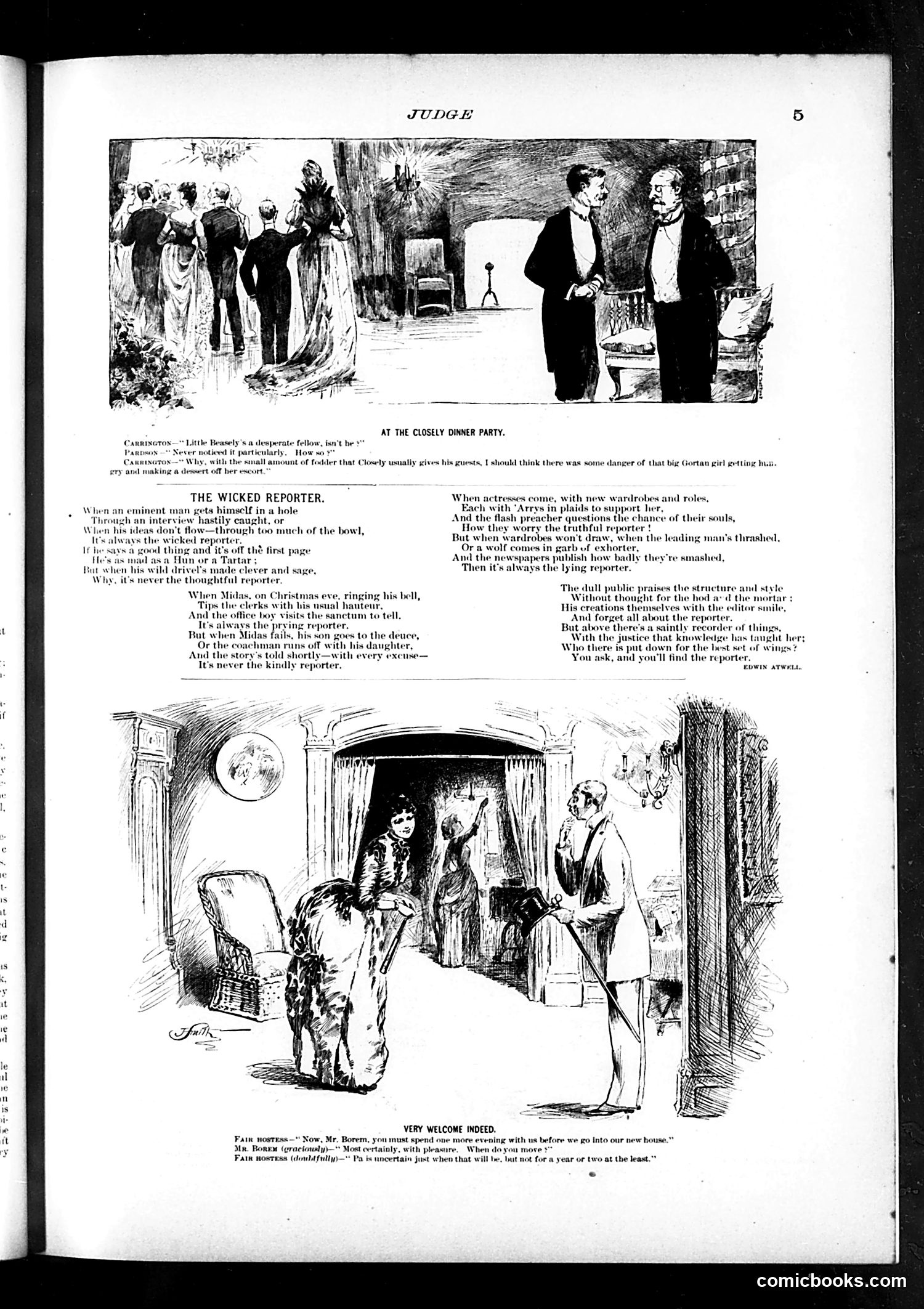
This page contains two distinct satirical pieces from the late 19th or early 20th century: **"The Wicked Reporter"** is a poem satirizing newspaper journalists. It argues that reporters receive blame for publishing negative stories about actresses and scandals, yet receive no credit for positive coverage. The satire suggests reporters are selectively vilified—called "wicked" and "lying" when they expose uncomfortable truths, but ignored when they report favorable news. The piece critiques both the press and public hypocrisy about journalism ethics. **"Very Welcome Indeed"** is a brief comedic dialogue about a dinner invitation. A host invites a guest (Mr. Boren) to visit before they move to a new house. When asked when they're moving, the hostess admits uncertainly it won't be for "a year or two at the least"—the joke being the invitation is disingenuous, offering hospitality from someone with no immediate plans to leave. It's satirical commentary on insincere social conventions.
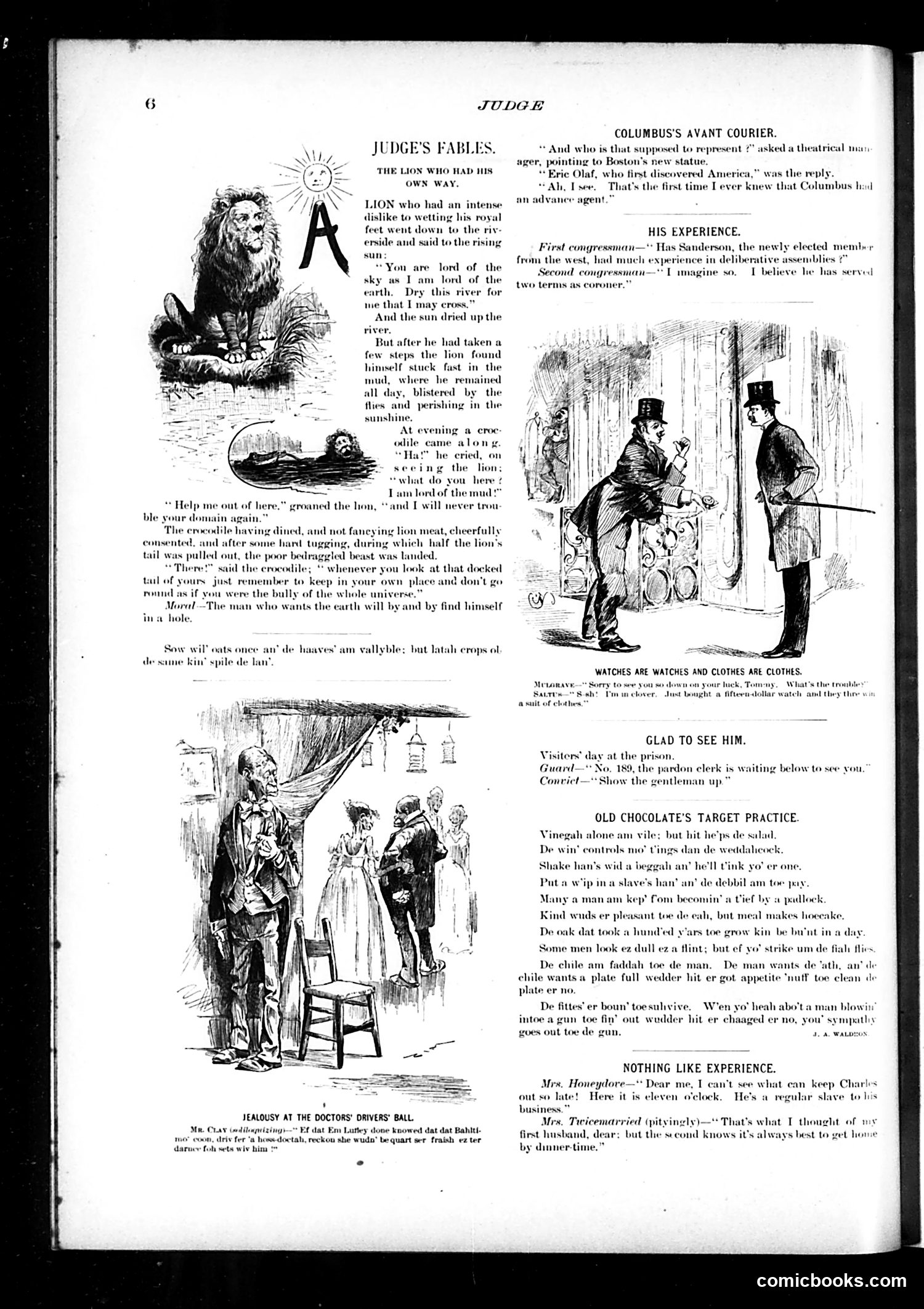
This page contains multiple satirical pieces typical of Judge magazine's social commentary: **"Judge's Fables"** uses a lion fable to mock politicians seeking unchecked power. The lion demands the sun dry a river so he won't wet his feet—representing self-serving leaders who expect reality to bend to their whims. He gets stuck in mud, teaching that such arrogance backfires. **"Columbus's Avant Courier"** satirizes theatrical promotion around Boston's Columbus statue, mocking how historical narratives are commercially manipulated and oversimplified for audiences. The remaining pieces are lighter social humor: "His Experience" jokes about inexperienced congressmen, "Watches Are Watches and Clothes Are Clothes" mocks social pretension, "Glad to See Him" plays on prison visits, and "Nothing Like Experience" jokes about marriage. **"Old Chocolate's Target Practice"** appears to be dialect humor (likely using African American vernacular), representing folk wisdom—common in period magazines but reflecting era's racial attitudes. The overall tone criticizes political ambition, social climbing, and institutional incompetence through humor.
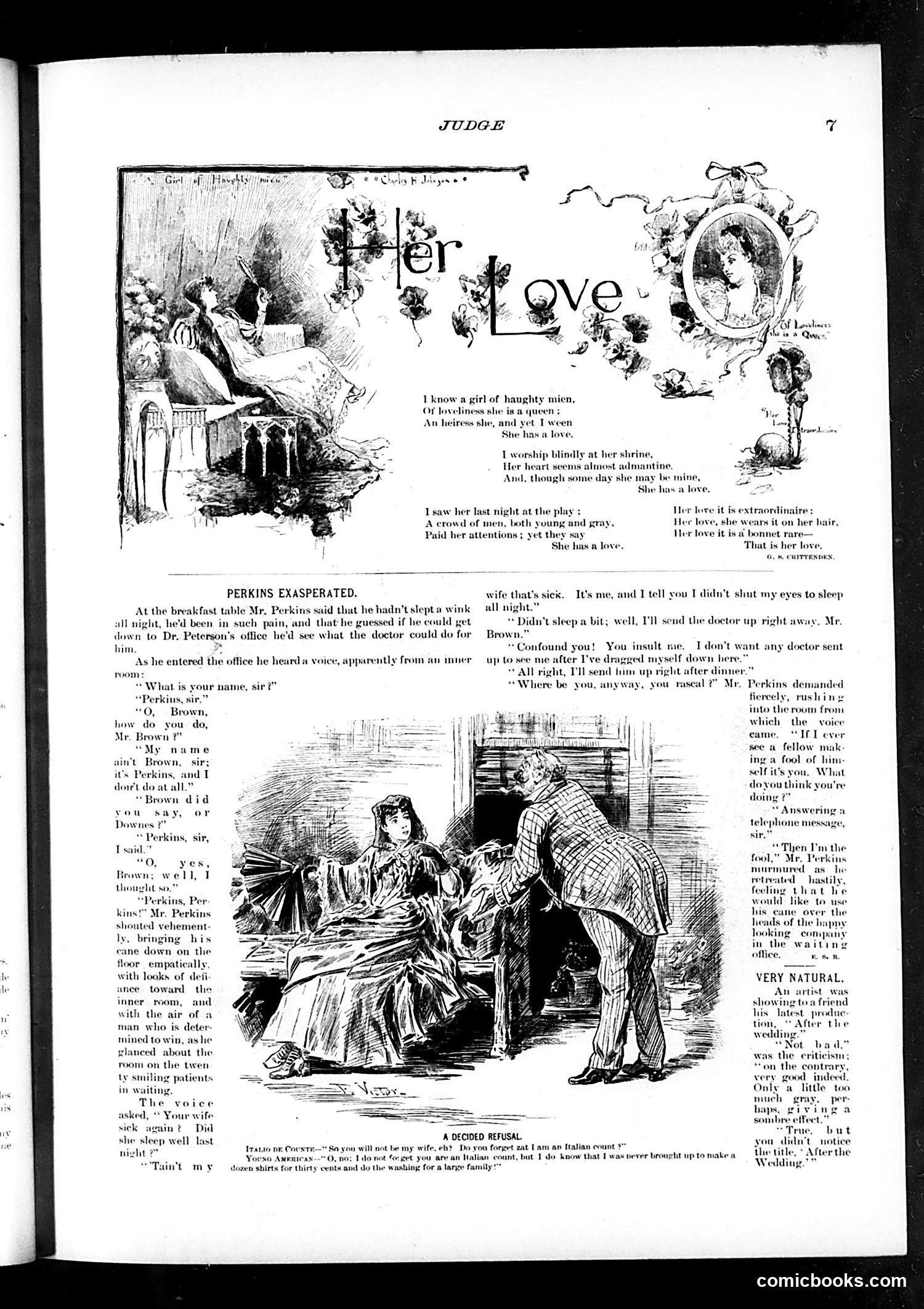
This page contains two satirical stories mocking middle-class domestic life circa the late 19th century. **"Perkins Exasperated"** depicts a comic misunderstanding: Mr. Perkins, suffering from insomnia and back pain, visits Dr. Peterson's office seeking relief. A voice from an inner room repeatedly addresses him as "Mr. Brown," causing escalating frustration. Perkins angrily corrects the mistake multiple times, finally storming into the room—where the humor suggests he's been confused with another patient. The satire targets both medical incompetence and the absurdity of bureaucratic mix-ups. **"A Decided Refusal"** (bottom) shows a woman rejecting a suitor's marriage proposal, claiming she won't marry him because he expects her to wash dozens of shirts and do laundry for a large family—a cutting commentary on unrealistic marital expectations and women's domestic servitude. The page also includes romantic poetry about a woman whose "love" is merely a fashionable bonnet she wears, satirizing superficial courtship rituals and materialism among the wealthy.
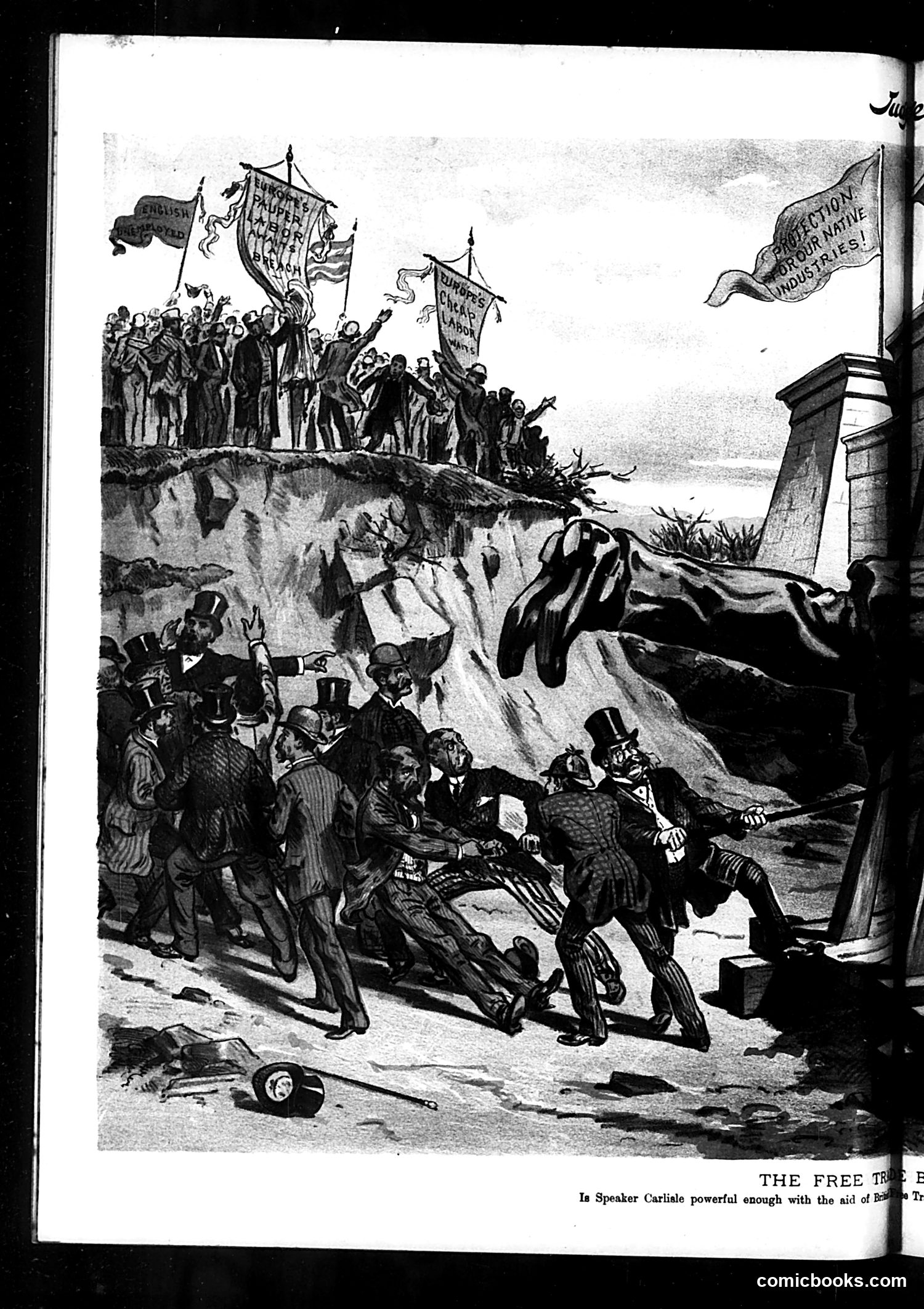
This appears to be a political cartoon satirizing Speaker of the House Carlisle and his political power or lack thereof. The image depicts a dramatic scene: well-dressed men in top hats (likely representing politicians or the establishment) stand on elevated ground on the right, while workers or common people gather on a cliff above on the left, carrying banners related to what appears to be labor or reform causes (text on banners is partially illegible). The composition suggests tension between political leadership and popular movements demanding change. The incomplete caption asks whether "Speaker Carlisle [is] powerful enough with the aid of [text cut off]" — likely questioning his ability to manage or control labor unrest or reform pressures. The cartoon critiques either Carlisle's weakness or complicity with establishment interests against working-class demands.
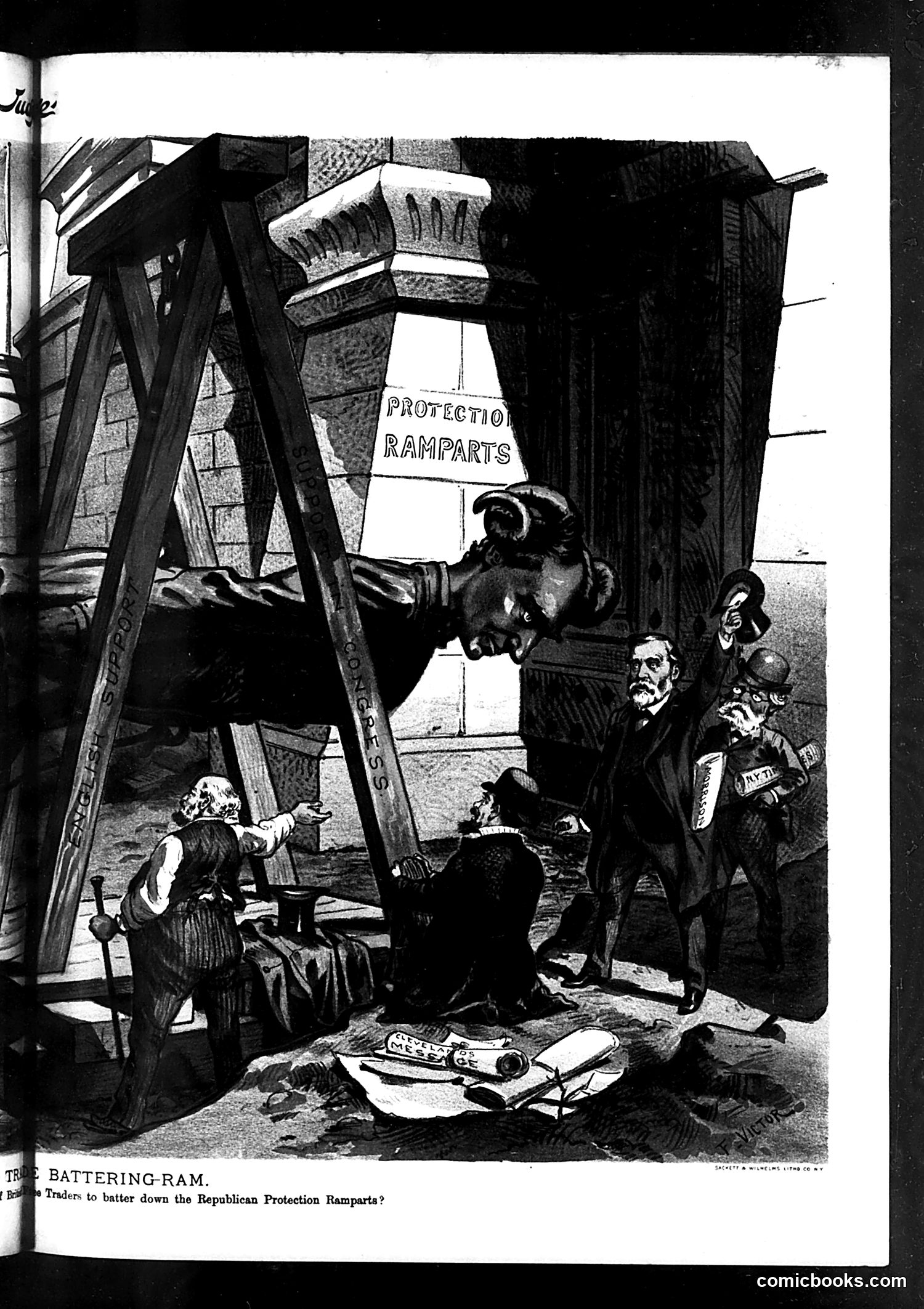
This cartoon depicts a large battering ram labeled "Protection Ramparts" being used against a fortified structure. The caption reads: "Traders to batter down the Republican Protection Ramparts?" The satire targets Republican protectionist trade policies (likely tariffs). The cartoon suggests that traders/merchants are attempting to demolish Republican economic protections. The caricatured figures appear to represent business interests or political opponents working to dismantle protective barriers that Republicans had established. The "ramparts" metaphor presents protective tariffs as defensive fortifications, while the battering ram represents aggressive commercial or political pressure to break them down. This reflects late 19th-century American political debates over free trade versus protectionism, where Republicans typically favored tariffs while critics (often Democrats and merchants) opposed them as economically restrictive.
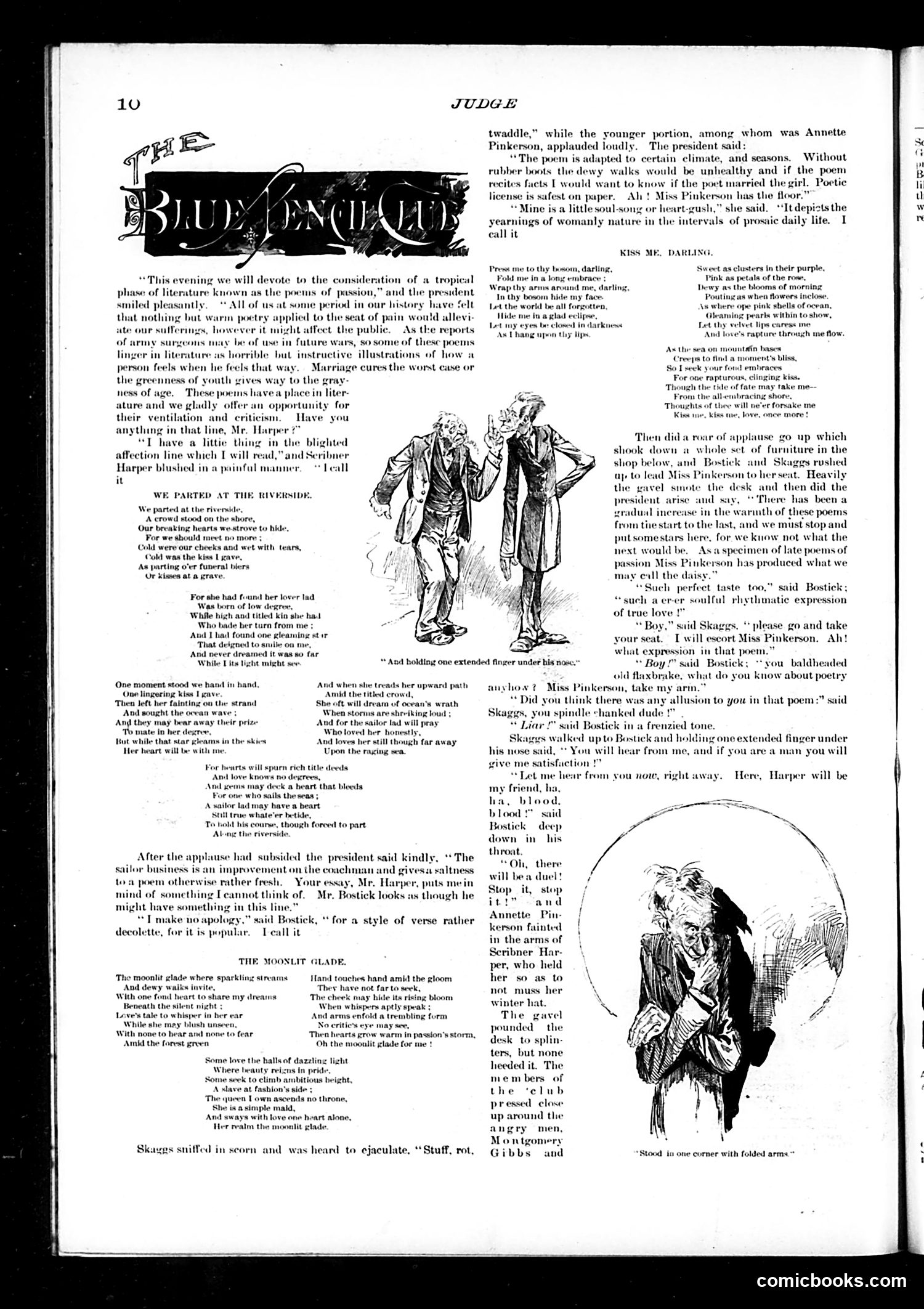
This page satirizes pretentious poetry readings and affected literary criticism of the era. The scene depicts a literary society meeting where amateur poets present "poems of passion"—sentimental romantic verses popular in late 19th-century parlors. The humor targets: **The poets**: Characters like Bostick and Skaggs present overwrought romantic poems ("We Parted at the Riverside," "Kiss Me, Darling") full of melodrama about doomed love across class lines and moonlit encounters. **The audience**: Members react with exaggerated emotion—applause so violent it shakes furniture below. One character, Skaggs, dismissively snorts "Stuff, rot, twaddle" before being won over, while younger attendees like Annette Pinkerson applaud enthusiastically. **The critic** (likely the "president"): Makes pompous observations about poetry's purpose, marriage, and proper decorum, often missing the point entirely. The satire mocks both the earnest mediocrity of amateur verse and the pretentious solemnity with which literary societies received it—a common subject for Judge's mockery of middle-class cultural aspirations.
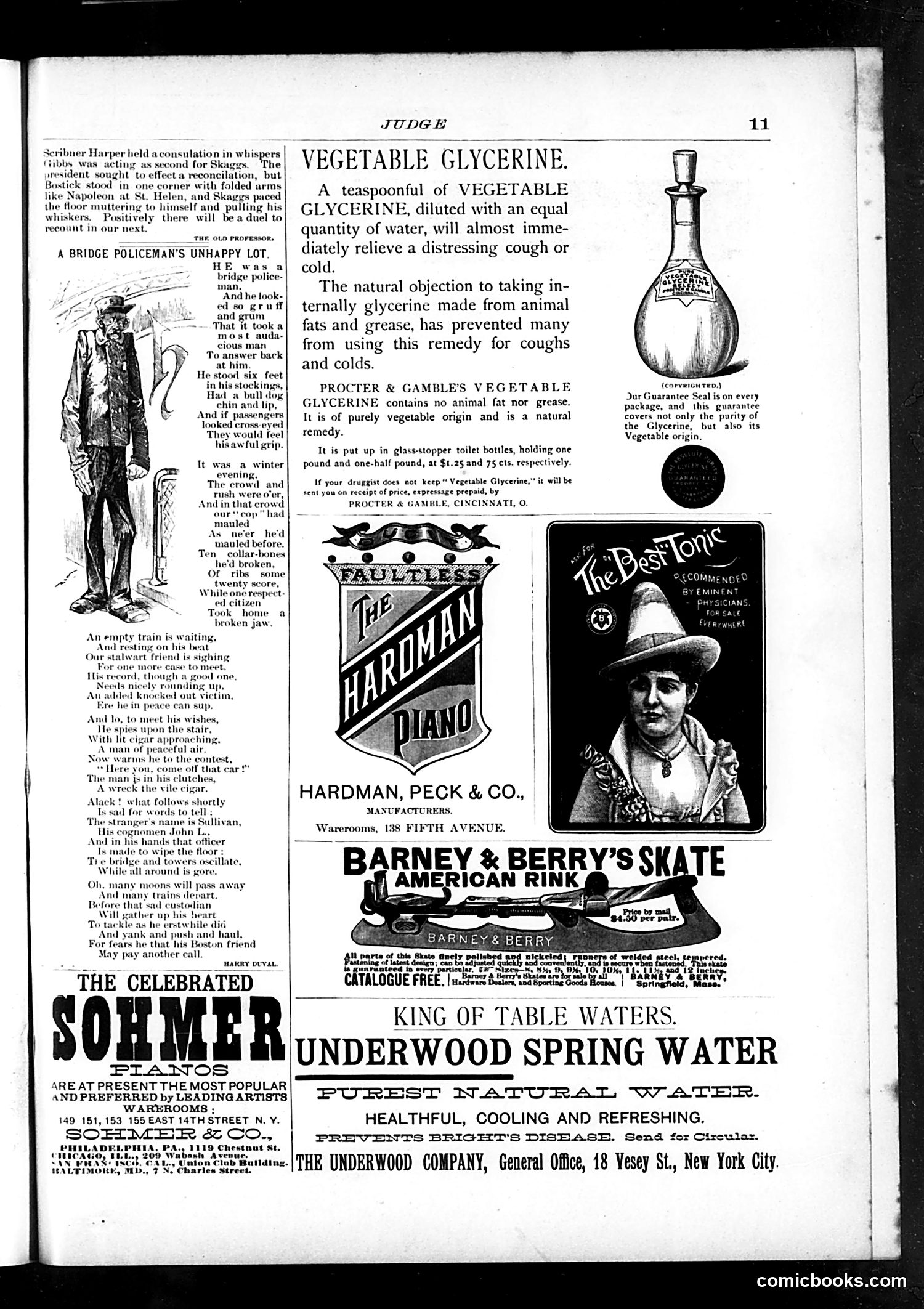
This satirical poem, illustrated with a gruff, imposing figure, mocks an overzealous bridge policeman. The cartoon depicts a brutish officer who intimidates passengers through physical aggression—he's broken collarbones and jaws simply for passengers looking at him wrong or talking back. The satire critiques police brutality and abuse of authority. The officer takes perverse pleasure in violence ("Now warms he to the contest"), suggesting the job attracts or corrupts men who enjoy dominating others. The phrase "unhappy lot" suggests this grim behavior characterizes the entire profession. The poem's dark humor underscores a genuine social problem: unaccountable police violence against ordinary citizens. This was evidently a recognizable concern to *Judge*'s readers, who would find the exaggerated brutality both funny and uncomfortably familiar. The remainder of the page consists of period advertisements for pianos, health remedies, and spring water.
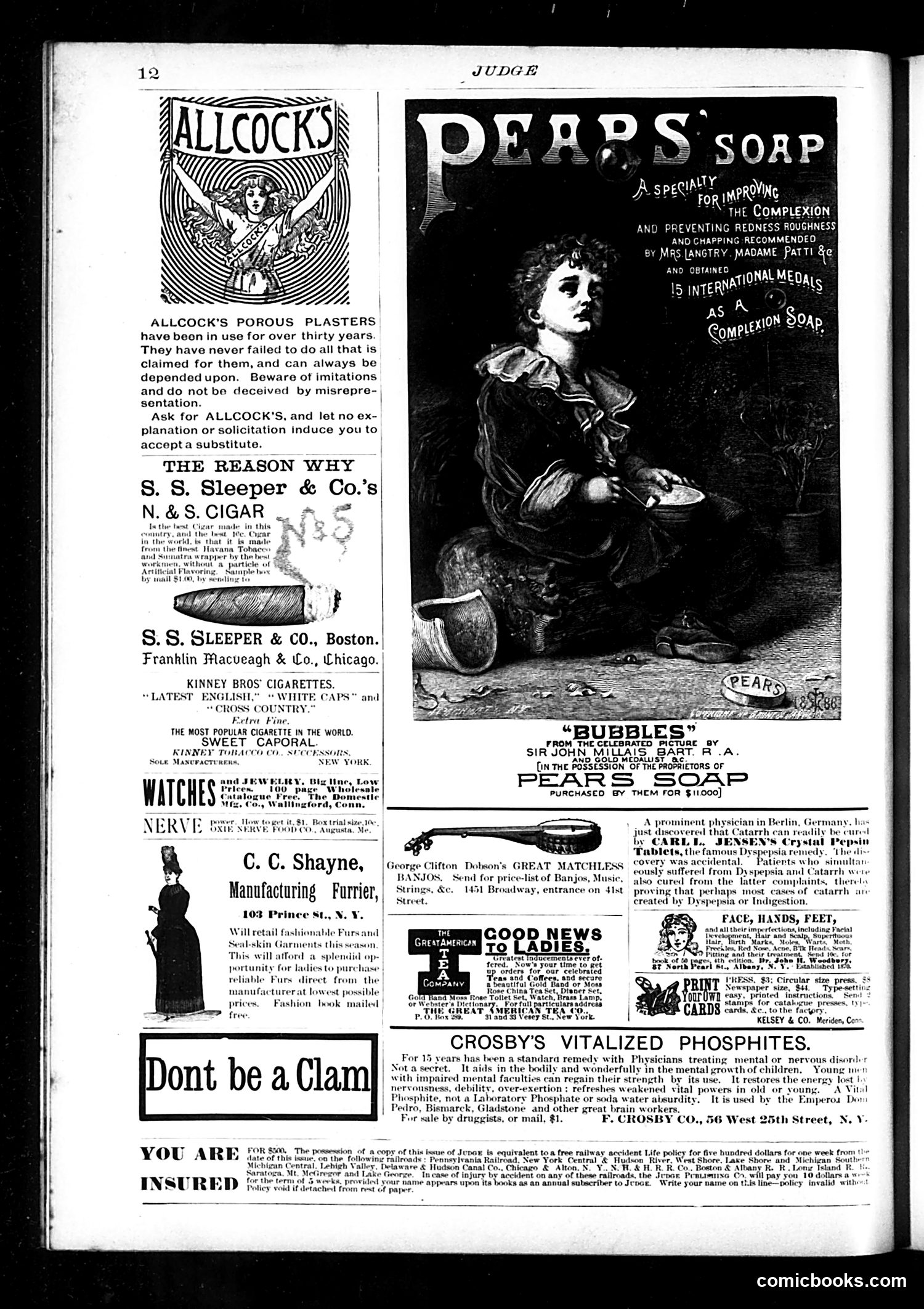
This page is primarily **advertisements** rather than political satire or editorial cartoons. It features Victorian-era product marketing, including: **Main advertisements:** - **Pears' Soap** (center): Prominently advertises its complexion benefits, endorsement by celebrities Mrs. Langtry and Madame Patti, and 15 international medals - **Allcock's Porous Plasters**: Medical products with 30-year history - **S.S. Sleeper & Co. cigars** and **Kinney Bros' cigarettes** - **Crosby's Vitalized Phosphites**: A patent medicine for mental/nervous disorders **Notable detail:** The bottom states readers possess accident life insurance valued at $500 simply by owning Judge—a promotional gimmick covering specific railroad companies. The page reflects late-19th-century advertising conventions: celebrity endorsements, pseudo-scientific health claims, and sensational marketing language typical of the period before modern consumer protections.
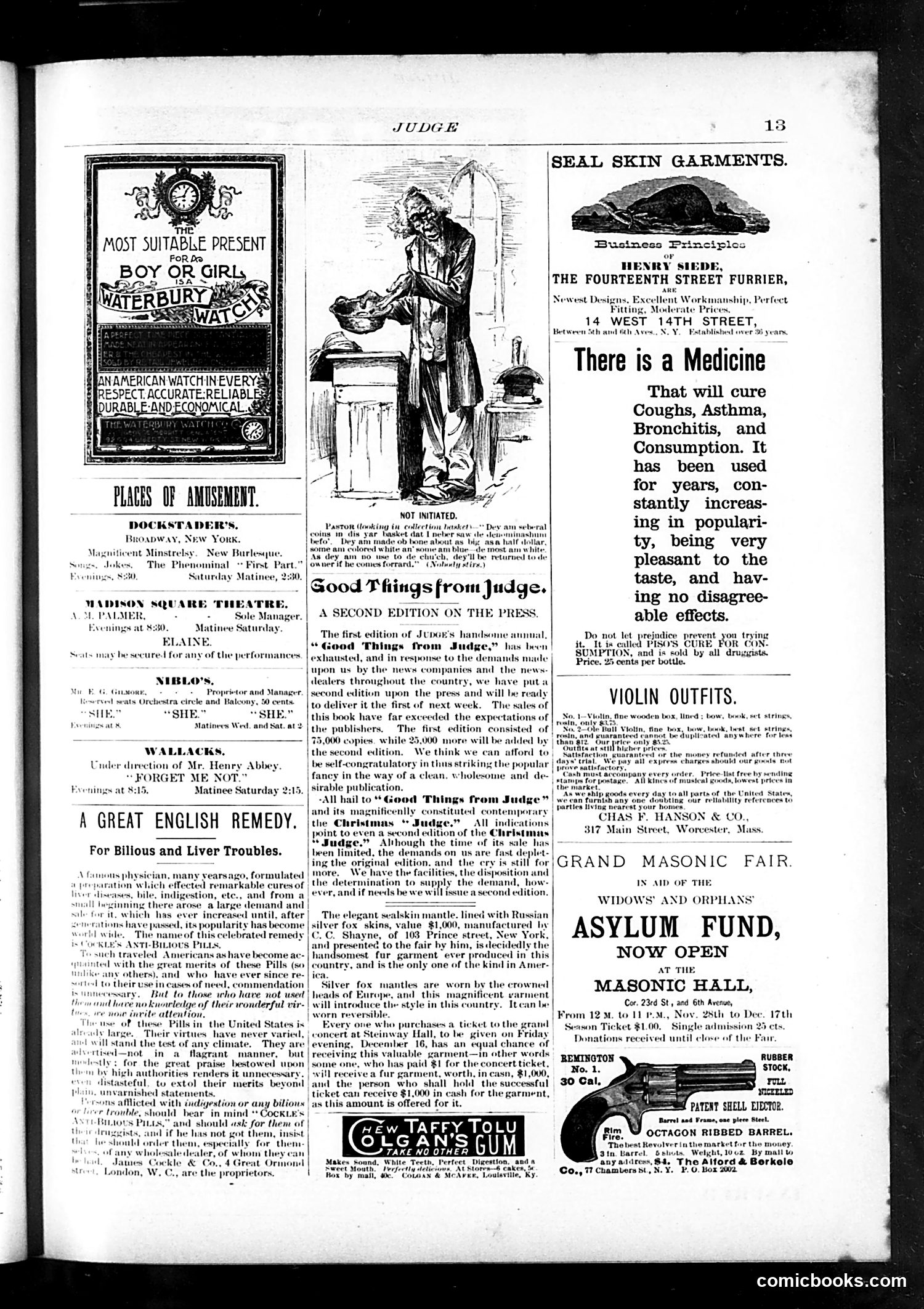
This page contains primarily **advertisements and editorial content** rather than satirical cartoons. The notable elements are: **Central illustration**: A sketch labeled "NOT IMITATED" shows a pastor looking at a donation box—likely satirizing the heavy charitable solicitations of the era. **Editorial content**: Judge announces a second printing of its popular annual collection, "Good Things from Judge," boasting strong sales and responding to demand. This is self-promotional content celebrating the magazine's success. **Advertisements** dominate the page, promoting: - Waterbury watches - Theater performances (Dockstader's, Madison Square Theatre) - A patent medicine for consumption and coughs - Seal skin garments (a luxury fur item) - Violin outfits - A Masonic charity fair for "widows and orphans" - Firearms (Remington) The page reflects **Gilded Age consumerism**—luxury goods, medical nostrums, charitable appeals, and entertainment. No specific political satire is evident here; this is a magazine page showcasing period advertising and editorial matter.
This page is primarily **advertising and business listings** for Judge magazine (a satirical publication), with one small article titled "JUDGE AND THE PLAY." The main text content discusses **Cupid as an "undressed kid"** causing social disruption despite Anthony Comstock's censorship efforts and cold weather. It references a recent theatrical incident in Philadelphia involving an actress disrobing on stage—apparently she popularized this act, which was then imitated in New York. The piece humorously comments on how Philadelphia's "brotherly love" made it an "appropriate place" for this behavior, and sarcastically notes that author H. Rider Haggard shouldn't be blamed for not thinking of Philadelphia when writing his work. The satire mocks both theatrical propriety debates of the era and Philadelphia's reputation, playing on the city's Quaker heritage ("brotherly love") as ironic contrast to scandalous behavior. The page is otherwise dominated by hotel advertisements, business listings, and product ads (cocoa, meat extract, tailoring services), typical of Judge's revenue model.
This page is primarily **advertising**—it's from a late 19th-century American magazine dominated by product promotions and commercial notices. The notable editorial content includes satirical pieces on familiar themes: - **"Luxurious Writing"**: A joke about how expensive fountain pens (H. Hewitt's patent) promised much but delivered little. - **"Find the White Horse"**: Hope Novelty Co. advertised a puzzle but charged postage for solutions—poking fun at minor commercial deceptions. - **"Mrs. O'Leary's Famous Cow"**: References the 1871 Chicago fire legend (allegedly started by Mrs. O'Leary's cow), used here to advertise Dr. Pierce's medicines as treating respiratory disease ("neglected cold" developing into consumption). The remaining content is advertisements for period products: organs, patent medicines (catarrh remedies, tonics), clothing, cocoa, tooth brushes, and caskets. These ads often made exaggerated health claims typical of the era—practices now illegal. **The satire is light, focusing on consumer culture and dubious medical claims.**
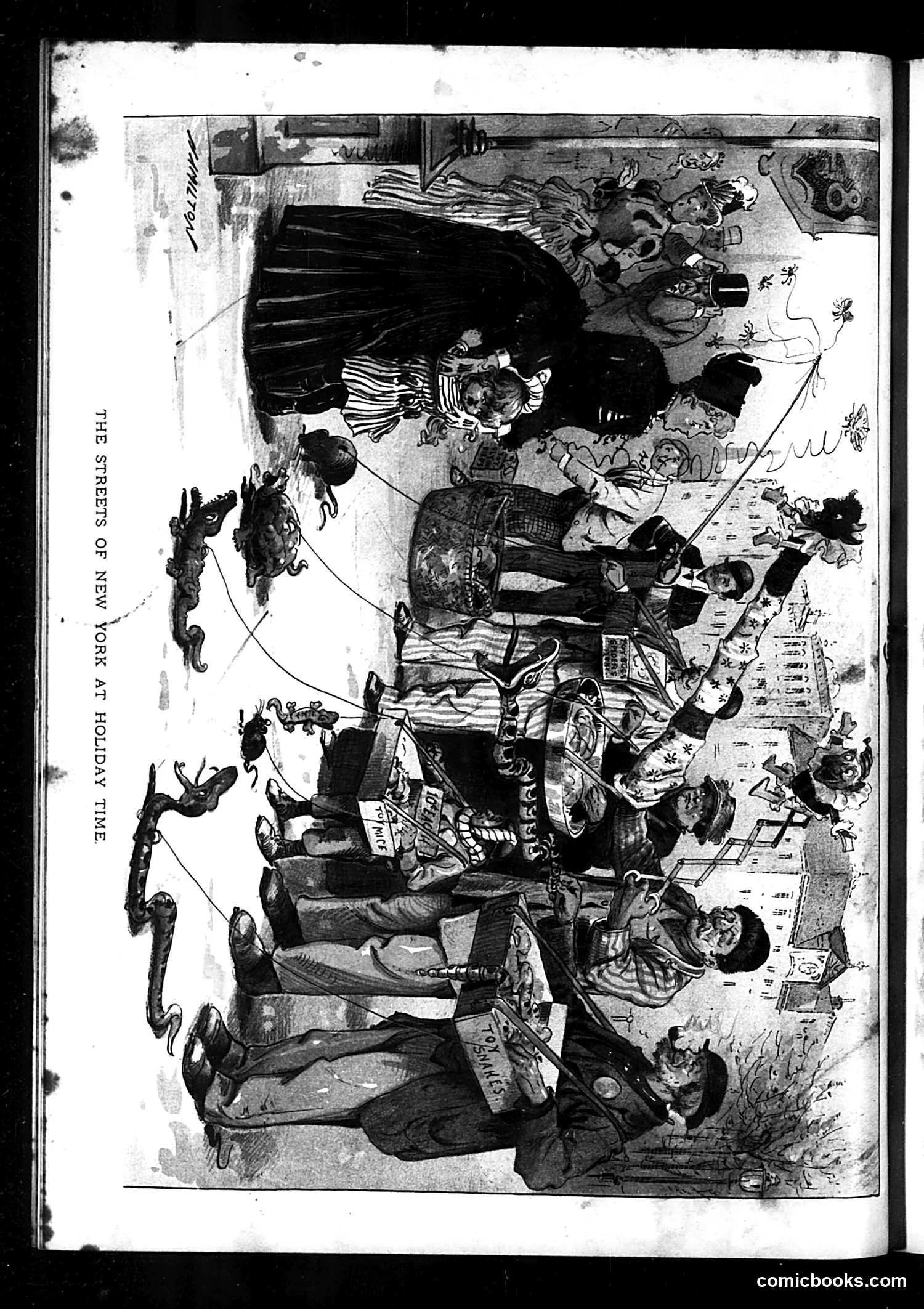
The OCR text is too corrupted to read clearly, making interpretation difficult. However, the image shows what appears to be a satirical illustration rotated 90 degrees (meant to be viewed sideways). It depicts multiple figures in various poses and costumes in what looks like a crowded street or holiday scene, with text elements visible on signs or papers scattered throughout. The caption reads "THE STREETS OF NEW YORK AT HOLIDAY TIME," suggesting this satirizes holiday shopping crowds and seasonal street activity in early 20th-century Manhattan. The chaotic composition and varied character types likely mock the commercial chaos and social mixing that characterizes holiday shopping seasons. Without legible text identifying specific figures or clearer visual details, I cannot confidently explain the precise satirical targets or contemporary references this cartoon makes.