
A complete issue · 16 pages · 1887
Judge — October 29, 1887
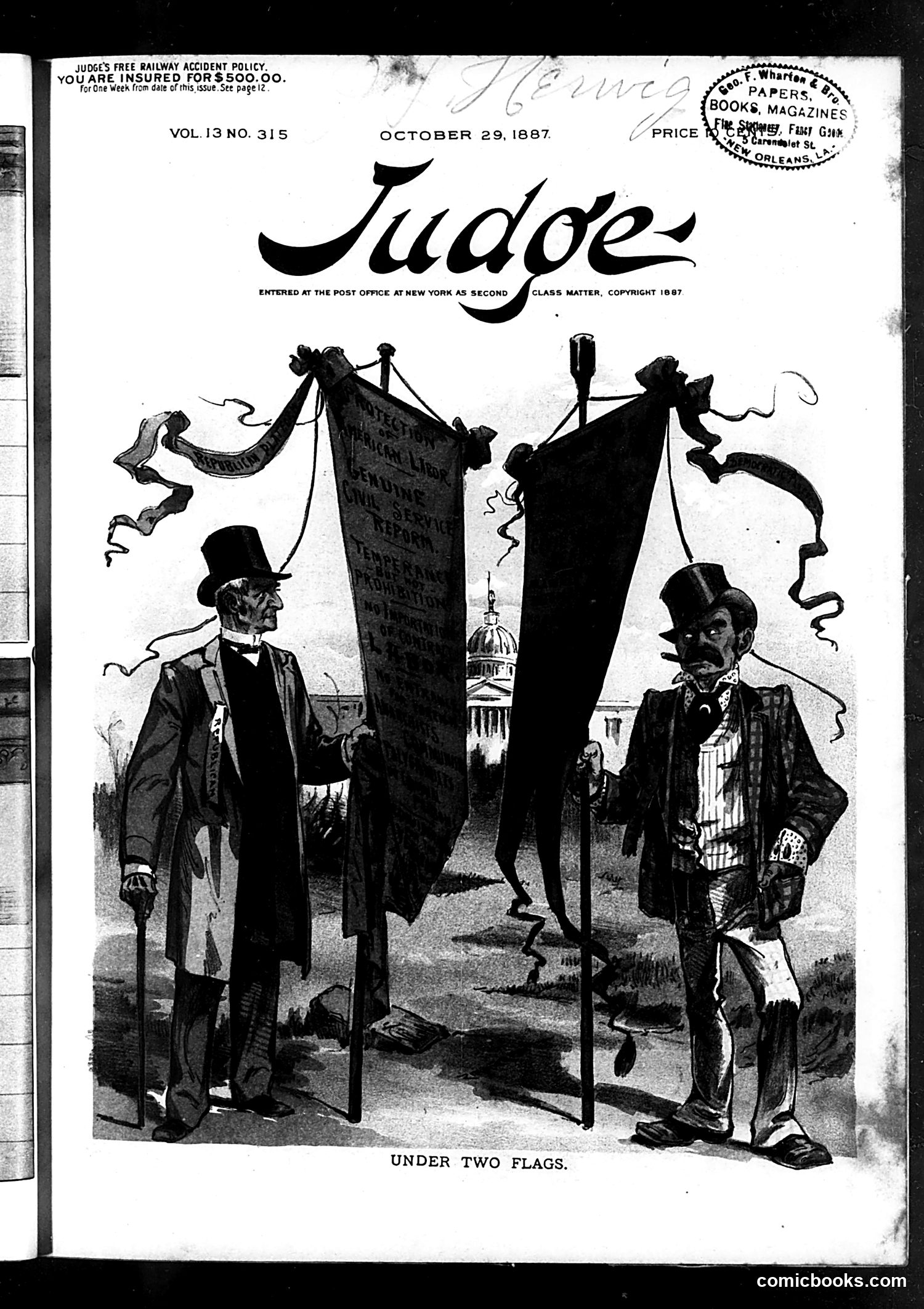
This Judge magazine cover from October 29, 1887 depicts two caricatured figures standing beneath large flags in front of the U.S. Capitol building. The title "Under Two Flags" suggests dual loyalty or conflicting allegiances. The exaggerated facial features and caricature style indicate these represent specific political figures or groups of the era, likely related to contested authority or competing interests in American politics. The snakes coiling around the flagpoles suggest deception or treachery associated with whoever these figures represent. Without clearer identifying labels or knowledge of specific 1887 political controversies, the exact identities and specific dispute remain unclear, though the overall message criticizes politicians operating under divided or questionable loyalties during this Gilded Age period.
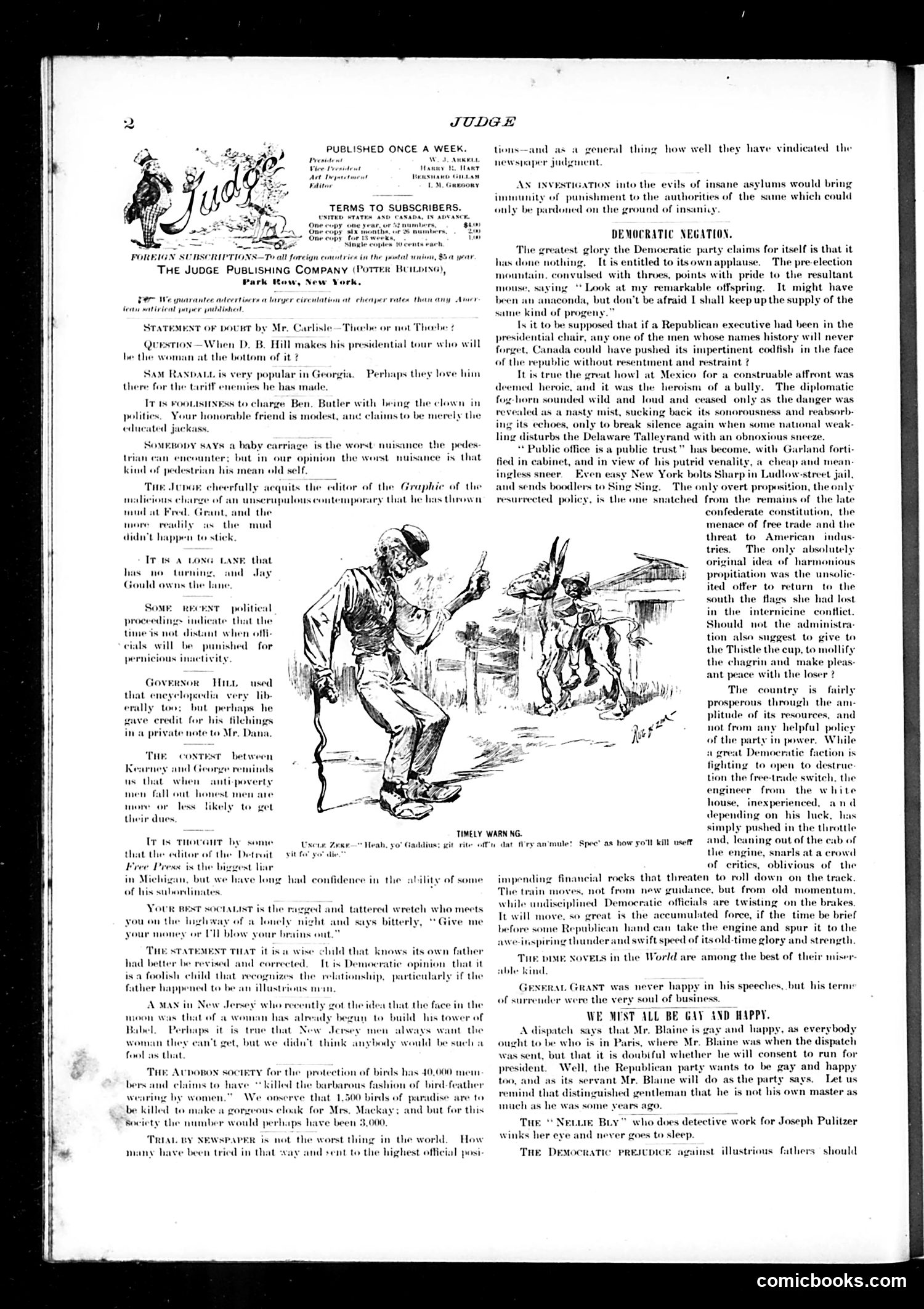
This cartoon depicts a confrontation between two figures over a locomotive engine. The caption "TIMELY WARNING" and the dialogue—"Uncle Zeke: 'Heah, yo' Gasholin, go ride off a dat fry-en-mile! Spec' as how you'll kill us-self wid yo' foolishness!'"—suggests a racial caricature (the dialect and name indicate a Black character) warning another about reckless behavior with an engine. The cartoon likely critiques Democratic mismanagement or dangerous political/economic policies, using the locomotive as a metaphor for governmental control. The "timely warning" appears to satirize concerns about incompetent Democratic leadership threatening the nation's progress or stability, a common Judge magazine theme criticizing the Democratic party's governance.
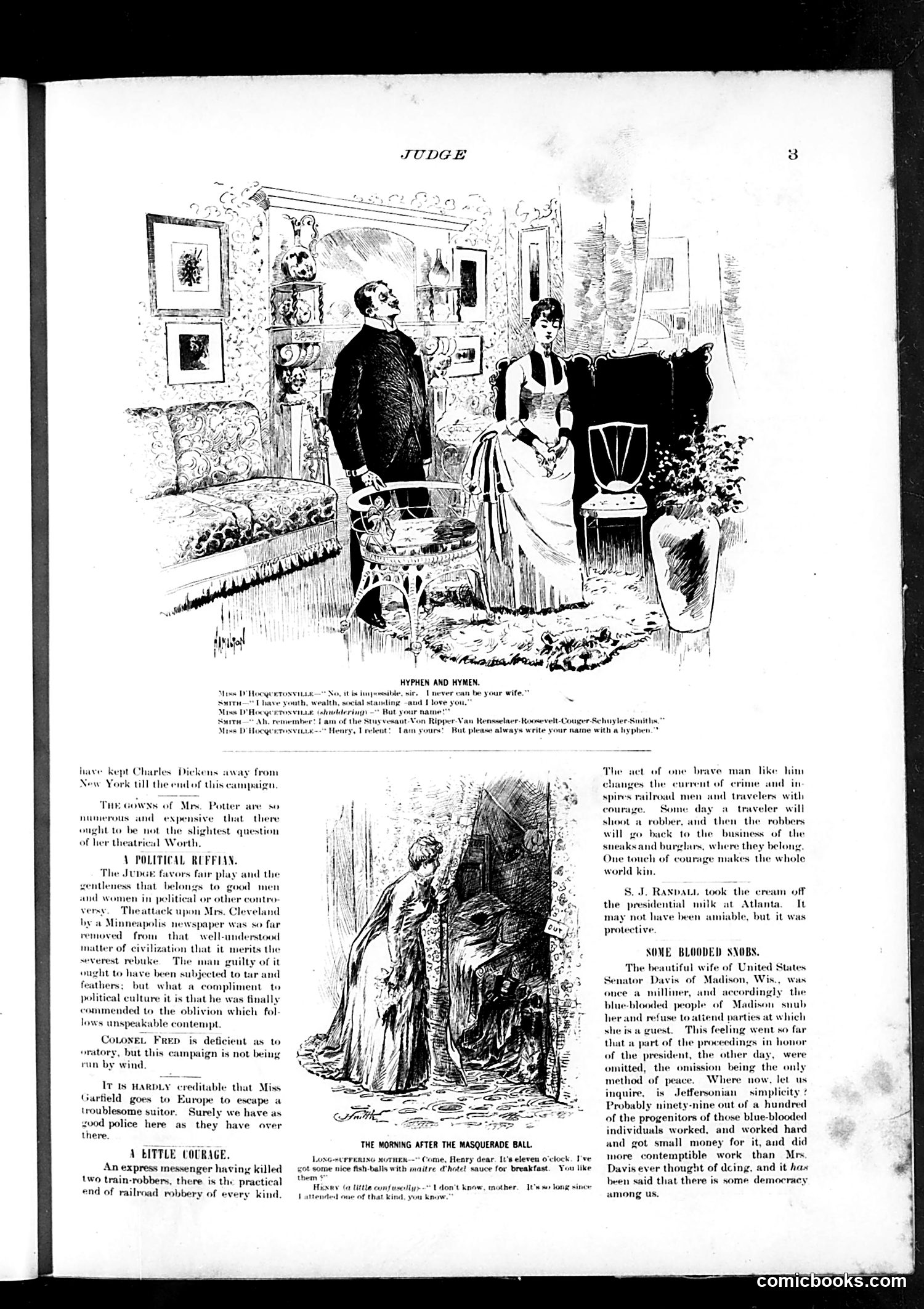
This page from the satirical magazine *Judge* contains several short political commentaries and cartoons targeting 1880s American society: **"Hyphen and Hymen"** mocks upper-class marriage pretensions, specifically the absurdly long hyphenated surnames (Von Ripper-Van Renselaer-Roosevelt-Couger) of the wealthy elite seeking to establish lineage through naming conventions. **"The Morning After the Masquerade Ball"** appears to be a domestic scene suggesting infidelity or questionable behavior at social events. **The main illustrated cartoon** shows an elegant interior with two figures in formal dress, though the specific political figures referenced remain unclear from available context. **"Some Blooded Snobs"** directly criticizes Madison, Wisconsin society for snubbing the wife of Senator Davis because she was formerly a milliner (working-class seamstress). The satire argues that blue-blooded elites' ancestors themselves performed manual labor, making their social snobbery hypocritical—a classic *Judge* theme attacking class pretension in Gilded Age America.
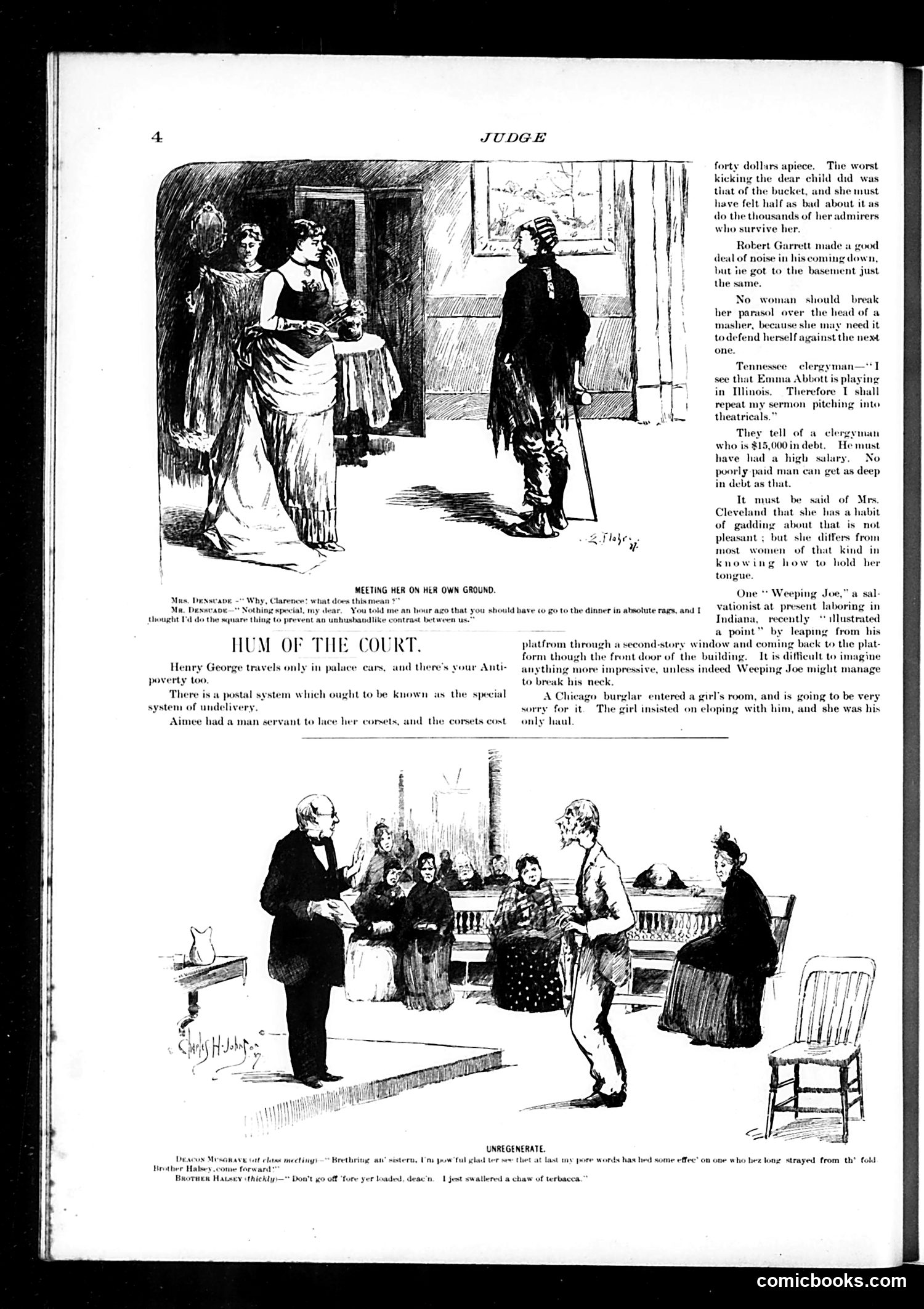
This page contains multiple satirical items typical of Judge magazine's humor: **"Hum of the Court"** section offers brief social commentary, including jabs at: Henry George (anti-poverty advocate) for traveling luxuriously; the postal system's inefficiency; and a woman (Aimee) requiring a servant to lace corsets—mocking both excessive wealth and women's fashion constraints. **Upper cartoon** depicts a domestic dispute, likely about women confronting aggressive men ("mashers"), suggesting women should defend themselves despite societal expectations. **Lower cartoon titled "Unregenerate"** shows a revival meeting or religious gathering. The humor targets evangelical religion, portraying congregants and preachers as hypocritical or unsophisticated—one preacher has just swallowed tobacco while preaching temperance. **References to Emma Abbott** (opera singer), Tennessee clergy, and "Weeping Joe" (a salvationist) provide contemporary cultural commentary on entertainment, religion, and social reform movements of the era. The overall tone is cynical toward religious earnestness and social pretension.
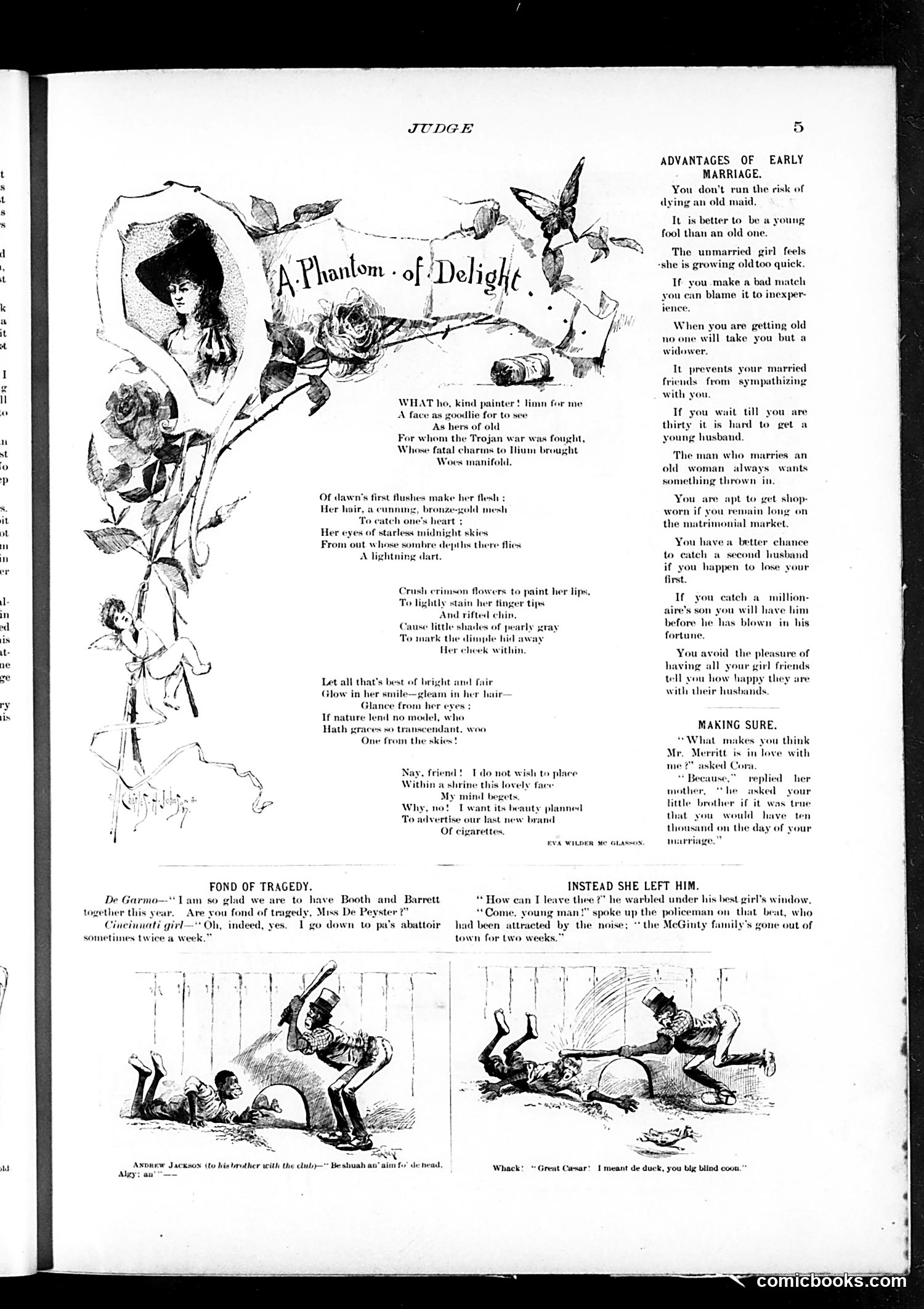
This page contains several satirical pieces typical of late 19th-century American humor: **"A Phantom of Delight"** (center): A poetic illustration mocking overwrought romantic advertising. The poem ironically describes painting an idealized woman's beauty—only to reveal the real purpose is advertising cigarettes. The satire targets both flowery sentimentalism and commercialism. **"Fond of Tragedy"** (bottom left): A joke where a Cincinnati woman claims she loves tragedy, then reveals she frequently visits her father's slaughterhouse. The humor derives from the double meaning—she enjoys actual bloodshed, not theatrical tragedy. **"Instead She Left Him"** (bottom right): A comedic scenario where a man serenades beneath a window, but the resident mistakes him for someone else and throws something (likely a duck) at him. **"Advantages of Early Marriage"** (right column): A satirical list of reasons to marry young, presenting absurd logic (marrying young prevents dying an old maid; allows blaming bad matches on inexperience). The satire critiques pressure on women to marry quickly. **"Making Sure"** (lower right): A brief joke about a woman's suitor asking her brother about her dowry. The page exemplifies Judge's focus on domestic relations, gender dynamics, and social hypocrisy.
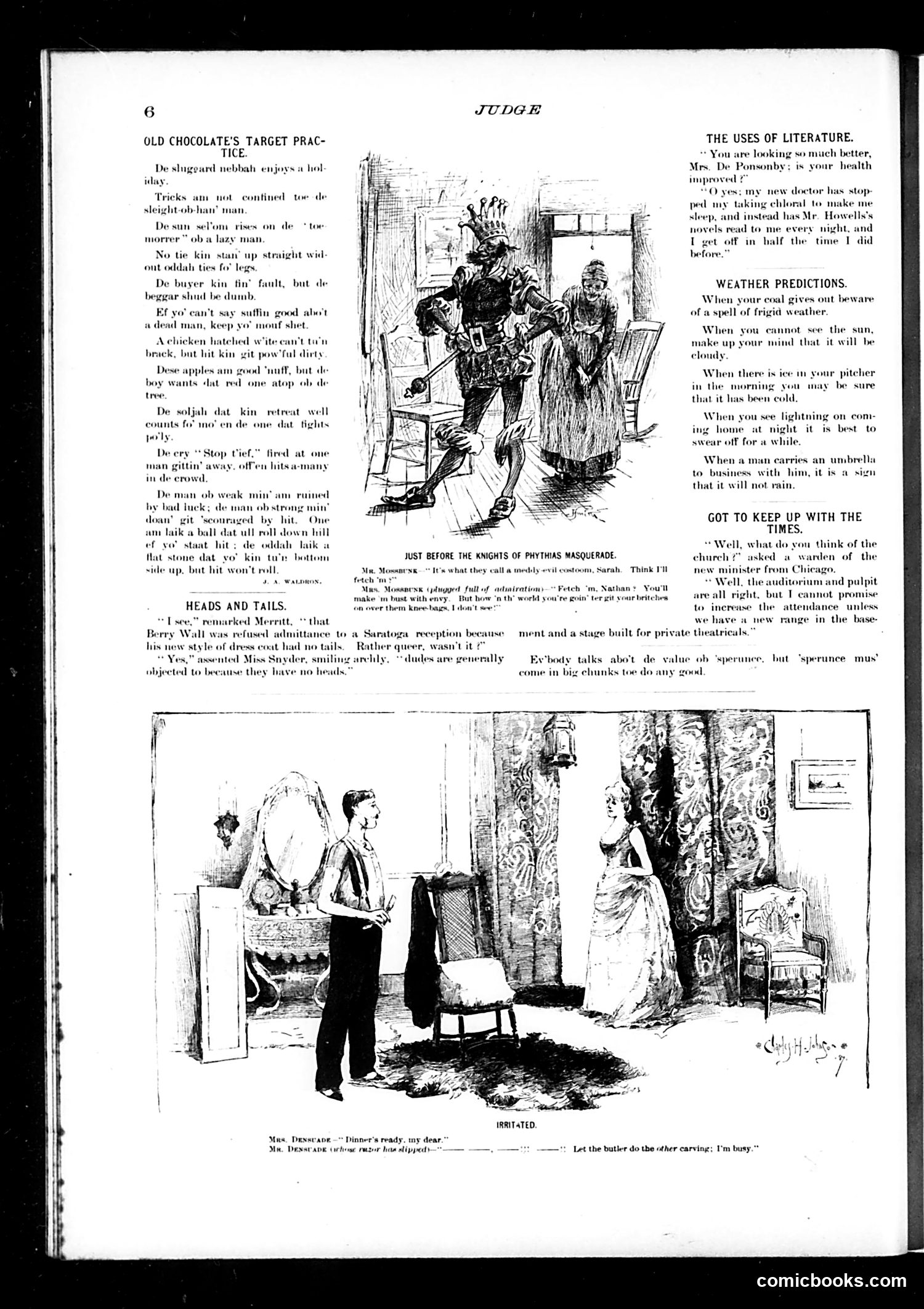
This page contains two distinct cartoons satirizing different subjects: **Top cartoon ("Just Before the Knights of Pythias Masquerade"):** Shows a man in elaborate medieval costume, apparently preparing for a Knights of Pythias (a fraternal organization) masquerade ball. The humor appears to mock the pretentiousness of men dressing in elaborate historical costumes for social club events—contrasting their ordinary appearance with their theatrical disguise. **Bottom cartoon ("Irritated"):** Depicts a domestic scene where a wife tells her husband "Dinner's ready, my dear," but he responds that the butler should handle the carving because he's busy. This satirizes upper-class leisure and the absurdity of a man too occupied with leisure activities to assist with basic domestic duties, even when servants are available. The page also includes humorous aphorisms in dialect (likely African American vernacular, reflecting period conventions) about life lessons, plus sections on literature's health benefits and weather prediction humor.
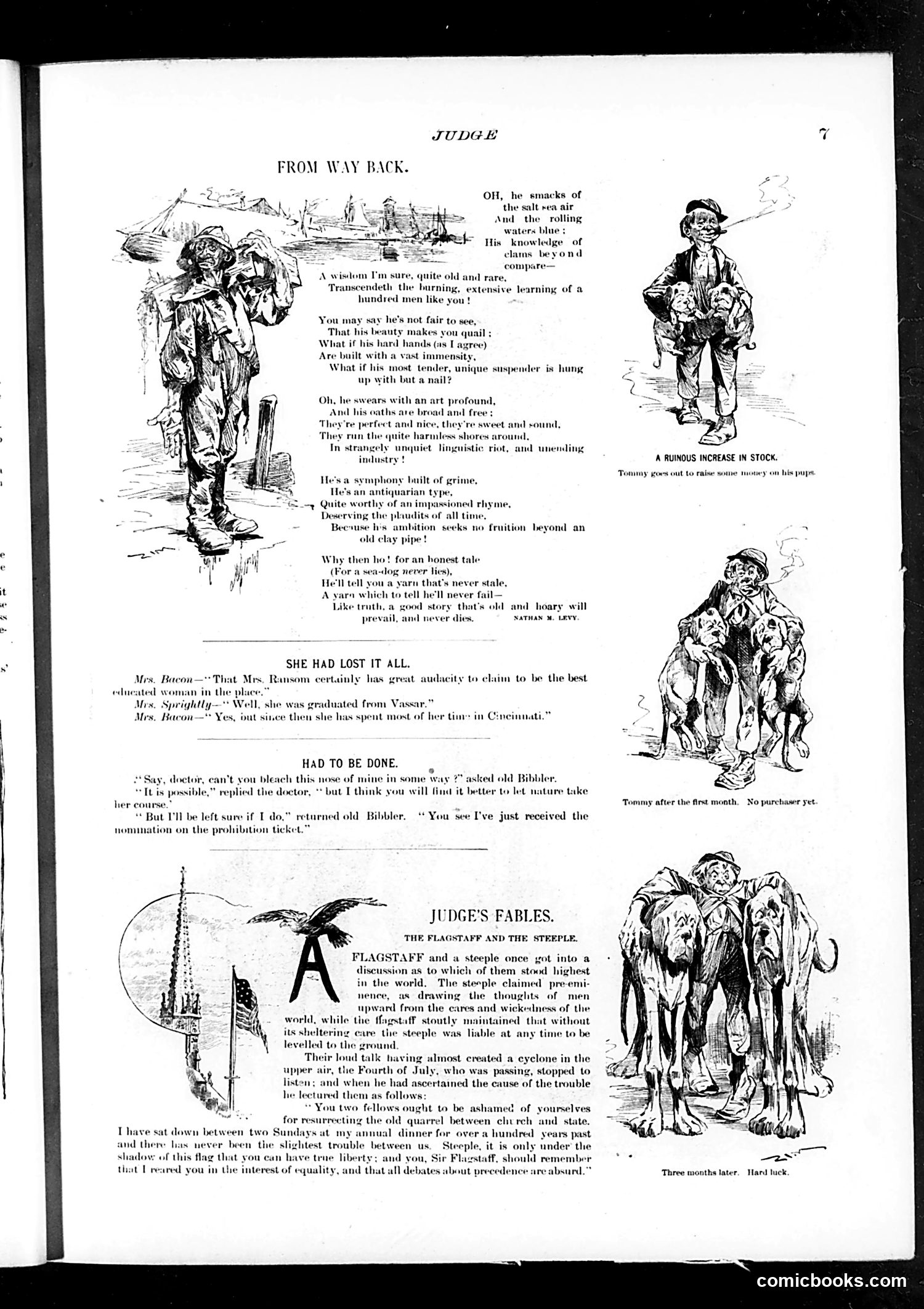
This Judge magazine page contains three separate satirical pieces: **"From Way Back"** celebrates a rough, weathered sailor—a working-class man with calloused hands, crude speech, and limited education, yet possessing genuine knowledge and virtue. The satire critiques snobbish attitudes toward the working poor. **"She Had Lost It All"** mocks a woman who claims educational superiority (graduated from Vassar, an elite women's college) but has squandered her reputation by spending years in Cincinnati—apparently suggesting the city corrupted her status or respectability. **"Judge's Fables: The Flagstaff and the Steeple"** satirizes the church-state separation debate. A flagstaff (secular authority) and church steeple argue over who stands highest. Independence Day (Fourth of July) personified lectures both, claiming they coexist peacefully at his annual dinner—suggesting partisan religious-political conflict is absurd and unnecessary. The cartoon illustrations show typical late 19th-century Judge visual style: exaggerated features and working-class caricatures.
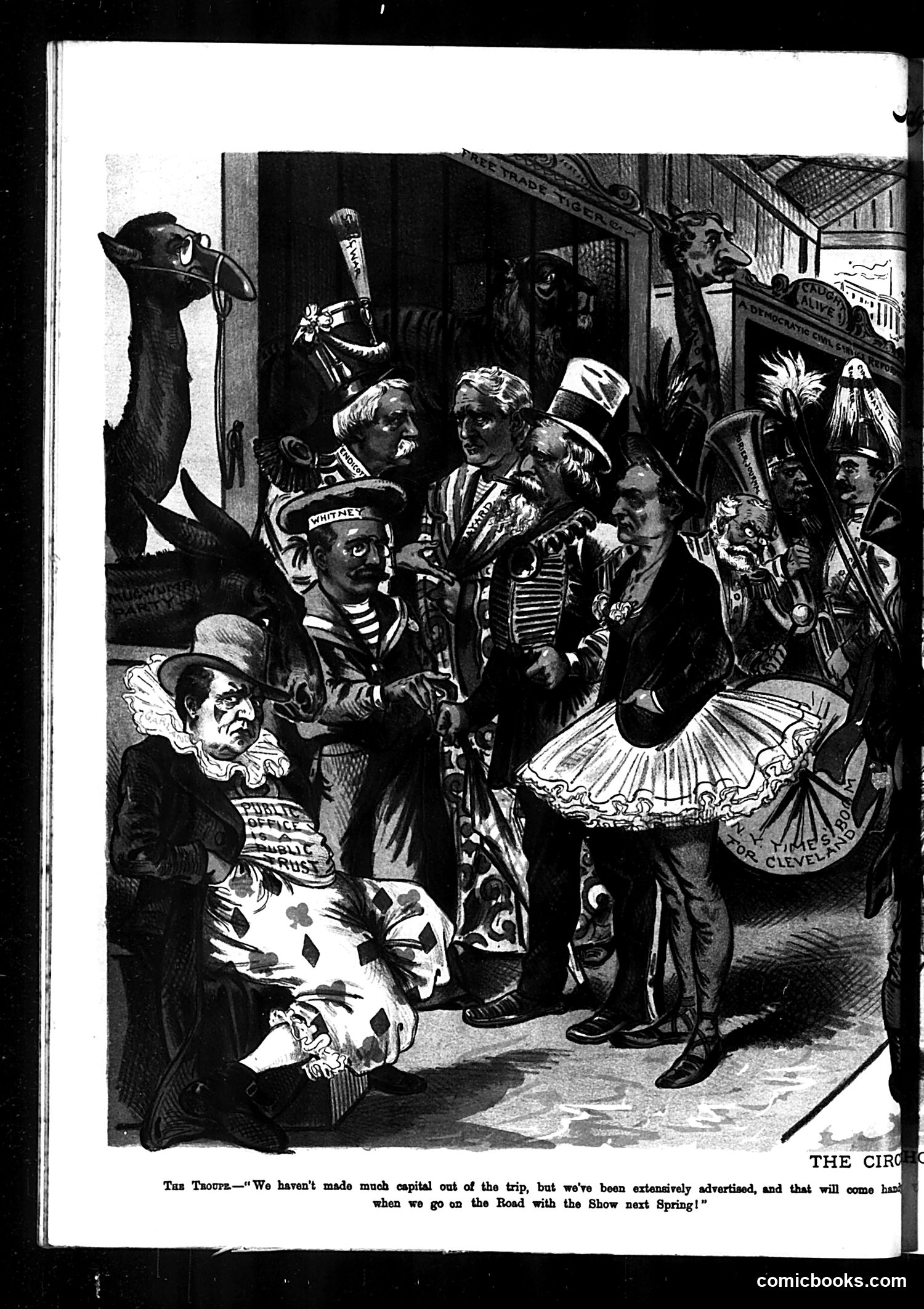
This satirical cartoon depicts circus performers and animals (including what appears to be a camel or llama on the left) in discussion. The dialogue suggests they're a traveling troupe who haven't profited financially from their tour but have gained valuable publicity. The joke targets theatrical economics: the performers rationalize their unprofitable trip as a marketing investment for future touring seasons. The caricatured figures—wearing period costumes and makeup—represent stock circus character types (clowns, performers in elaborate dress). The satire likely mocks how entertainment ventures justify poor financial returns through vague promises of future success based on publicity alone, a common rationalization in show business. The performers' optimism despite empty coffers reflects Judge magazine's satirical view of circus economics and theatrical self-delusion.
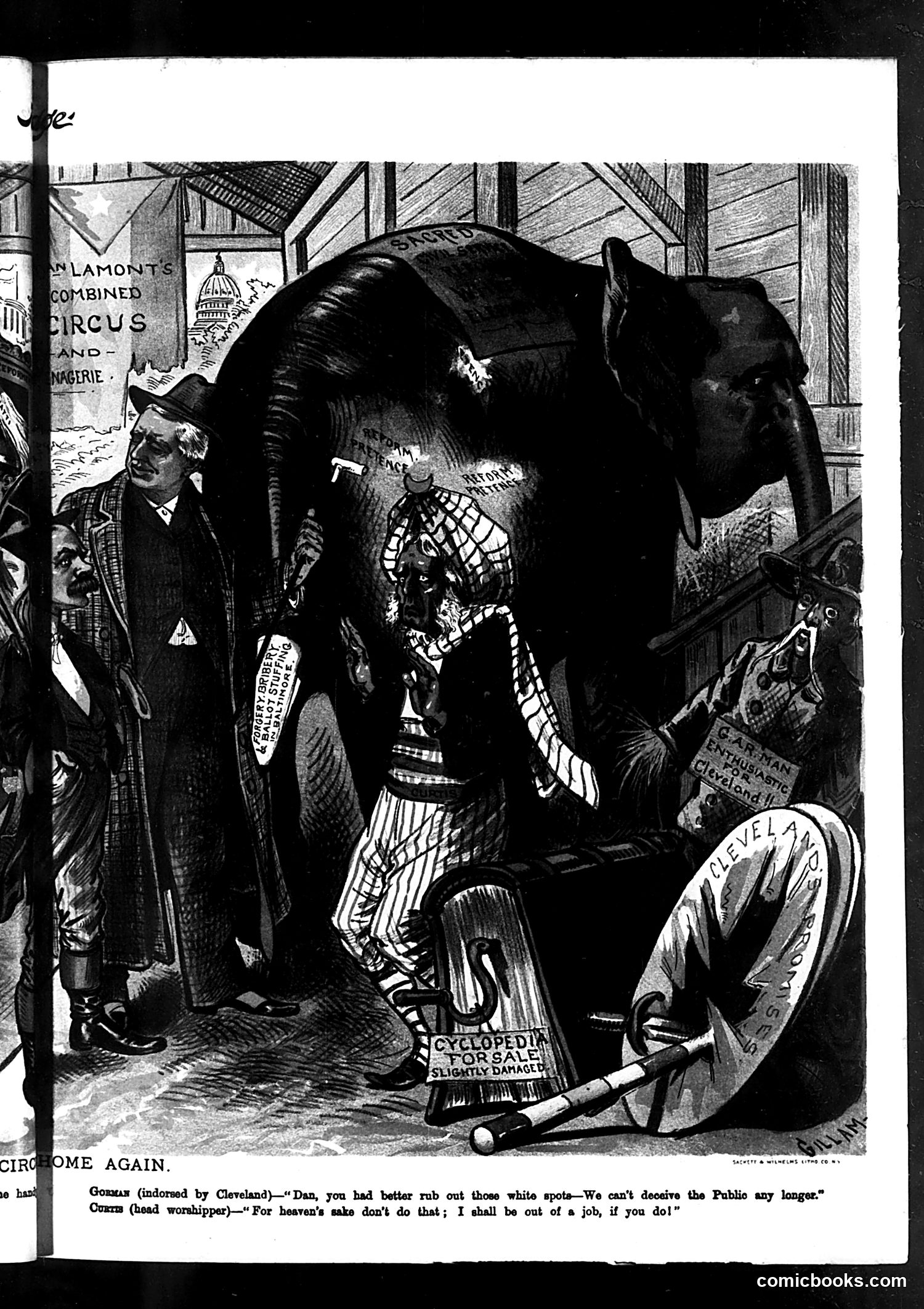
This Judge magazine cartoon satirizes circus fraud and political corruption, circa the Cleveland administration (1880s-90s). The image shows an elephant (the Republican symbol) with visible white spots being examined by two men. "Gorman" (likely Arthur Gorman, a Democratic politician "indorsed by Cleveland") instructs "Dan" to cover up the spots to deceive the public. "Cours" (the "head worshipper," likely a circus promoter or corrupt official) protests that removing the spots will cost him his job. The satire suggests that Democratic politicians are complicit in covering up fraud—whether literal (a painted elephant in Lamont's Combined Circus, visible on signage) or metaphorical corruption—to maintain their positions and deceive citizens. The cartoon criticizes both the deception itself and officials' willingness to perpetuate it for self-interest.
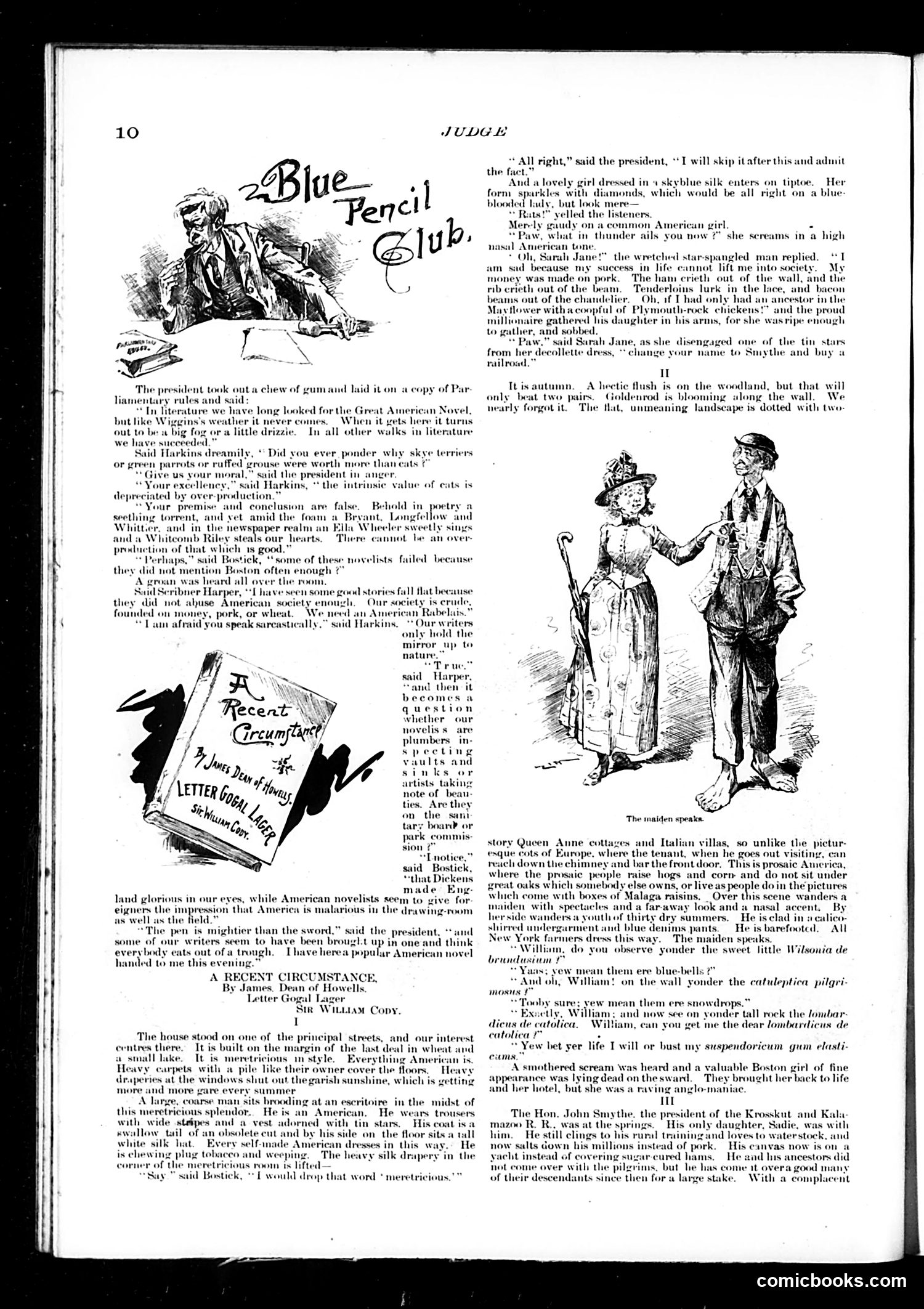
This page satirizes pretentious American literary culture and the nouveaux riche. The main piece, "A Recent Circumstance" by James Dean of Howells, mocks affected writing about wealth and social climbing. The framing dialogue at top features magazine editors debating whether American novels are artistically worthwhile or merely commercial products. One character dismisses them as lacking merit compared to European literature. The story itself ridicules wealthy Americans obsessed with status symbols—a nouveau riche businessman's mansion filled with ostentatious furnishings, his daughter in expensive clothes, his concern with "society." The dialogue parodies overwrought literary language ("tenderloin lurks in the face") applied to banal situations. The second section satirizes sentimental pastoral writing, with characters employing flowery language to describe nature while remaining fundamentally shallow and materialistic. Overall, Judge mocks both pretentious American writers attempting European sophistication and the newly wealthy imitating old-money refinement—suggesting American letters and society lack authentic substance.
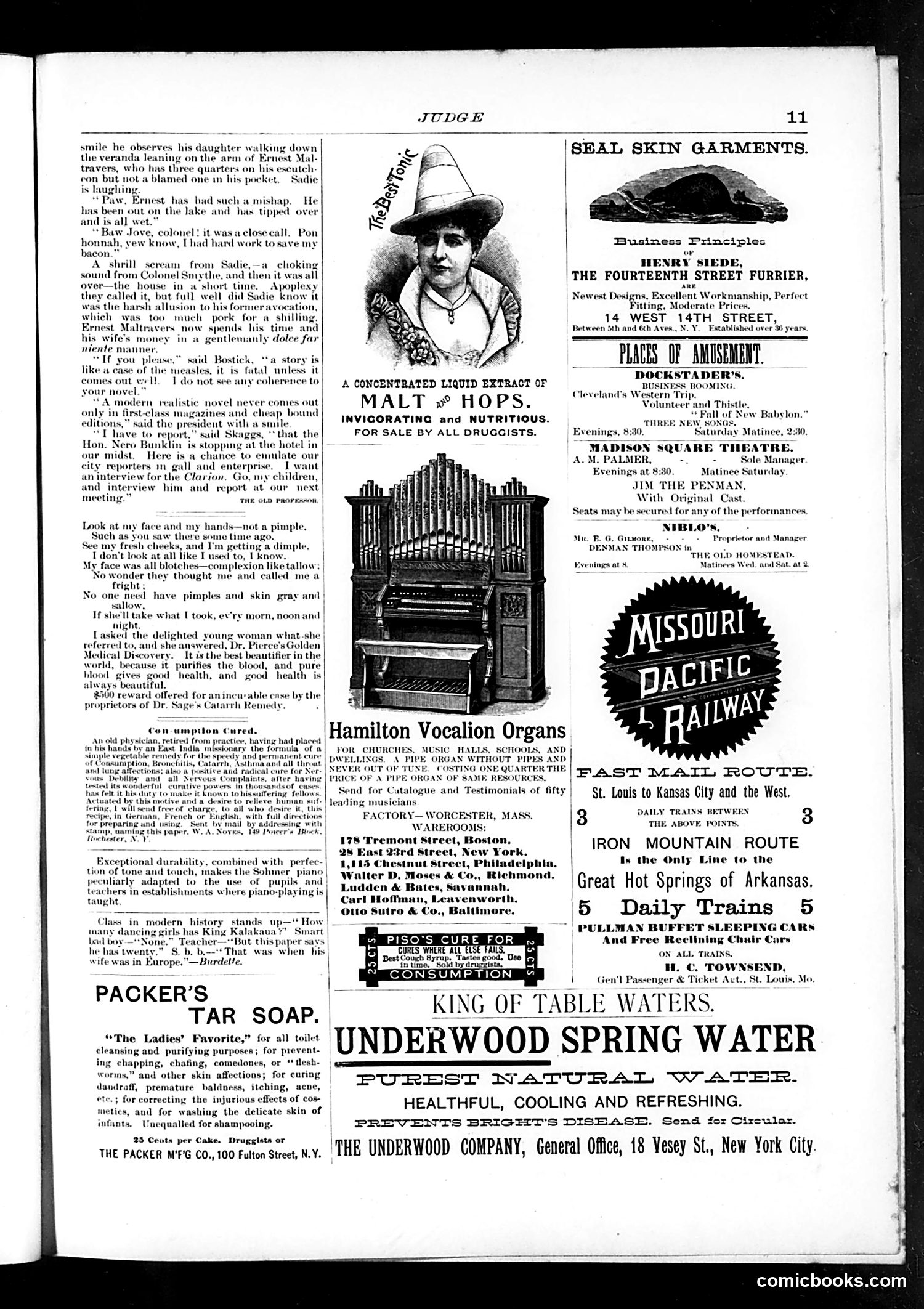
This page is predominantly **advertisements and notices**, with minimal editorial cartoon content. The visible narrative text at the top appears to be a short story excerpt about a character named Sadie and Ernest Maltravers, a penniless gentleman marrying into money—a common satirical subject about social climbing and class pretense in the Gilded Age. The bulk of the page features period product advertisements: Packer's Tar Soap (with before-and-after skin claims), Dr. Pierce's Golden Medical Discovery (patent medicine), Hamilton Vocational Organs, Underwood Spring Water, and railroad/hotel notices. These ads reflect late 19th-century commercial culture and the prevalence of dubious health claims marketed to readers. There is **no identifiable political cartoon** on this page—it's a typical Judge magazine layout mixing satirical fiction with period advertising. The entertainment and business notices (theaters, railroads) suggest this is from approximately the 1880s-1890s.
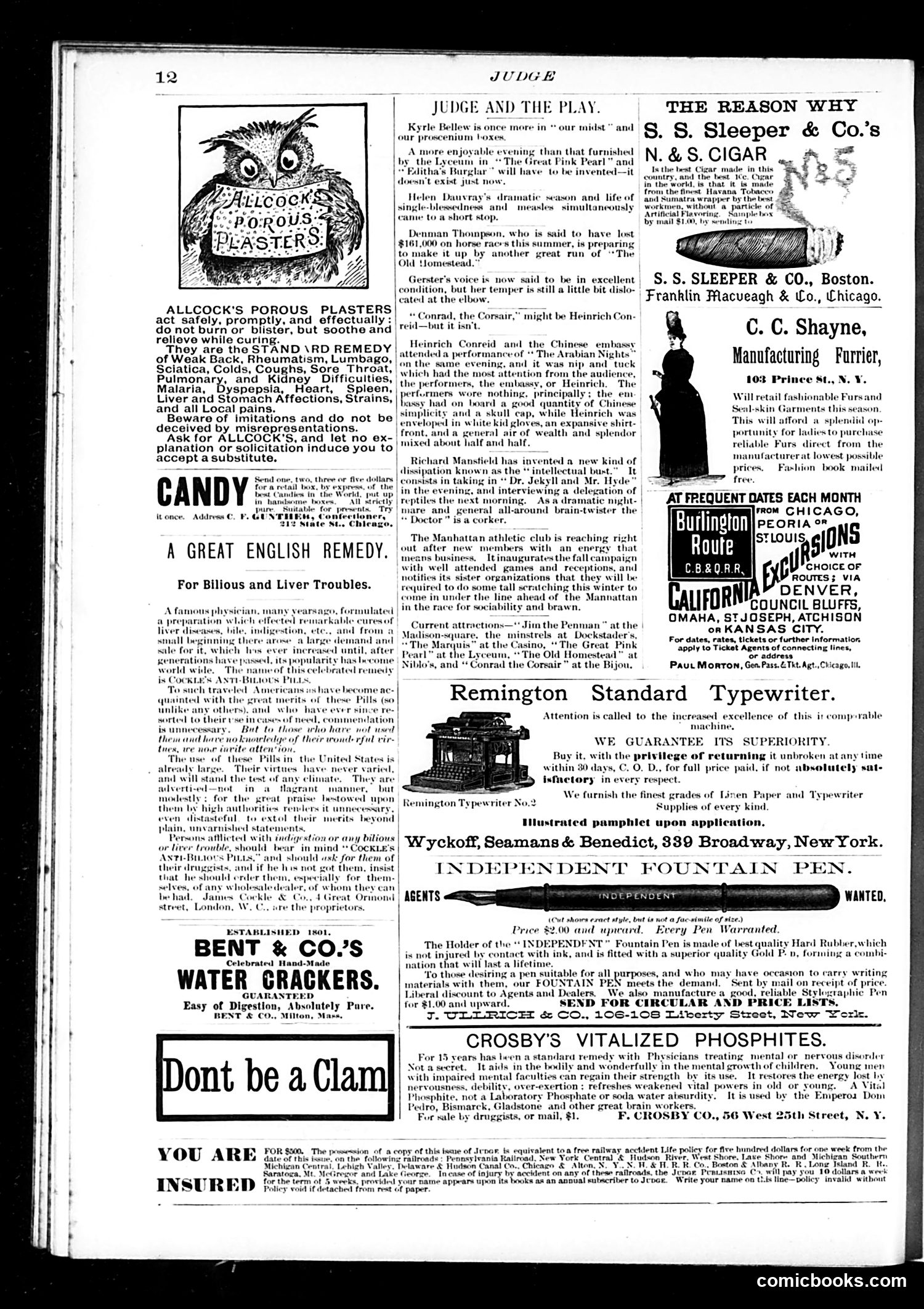
This page is primarily **advertising** rather than political satire. The dominant content consists of commercial advertisements for patent medicines, office equipment, and consumer goods typical of the 1890s. The one identifiable cartoon is the **owl logo for Allcock's Porous Plasters** (top left), a medical product—not political commentary. The text snippets about theatrical personalities (Denman Thompson, Gerster, Heinrich Conreid) appear to be entertainment gossip rather than satire with political meaning. References to "The Old Homestead" and "Conrad the Corsair" are theater productions, mentioned casually. The advertisements promote Cockle's Anti-Bilious Pills, Bent & Co.'s water crackers, the Remington typewriter, and the Independent Fountain Pen—all standard period marketing. **Conclusion**: This is a typical advertising-heavy page from Judge magazine. There is no discernible political cartoon or satirical commentary targeting specific figures or events on this particular page.
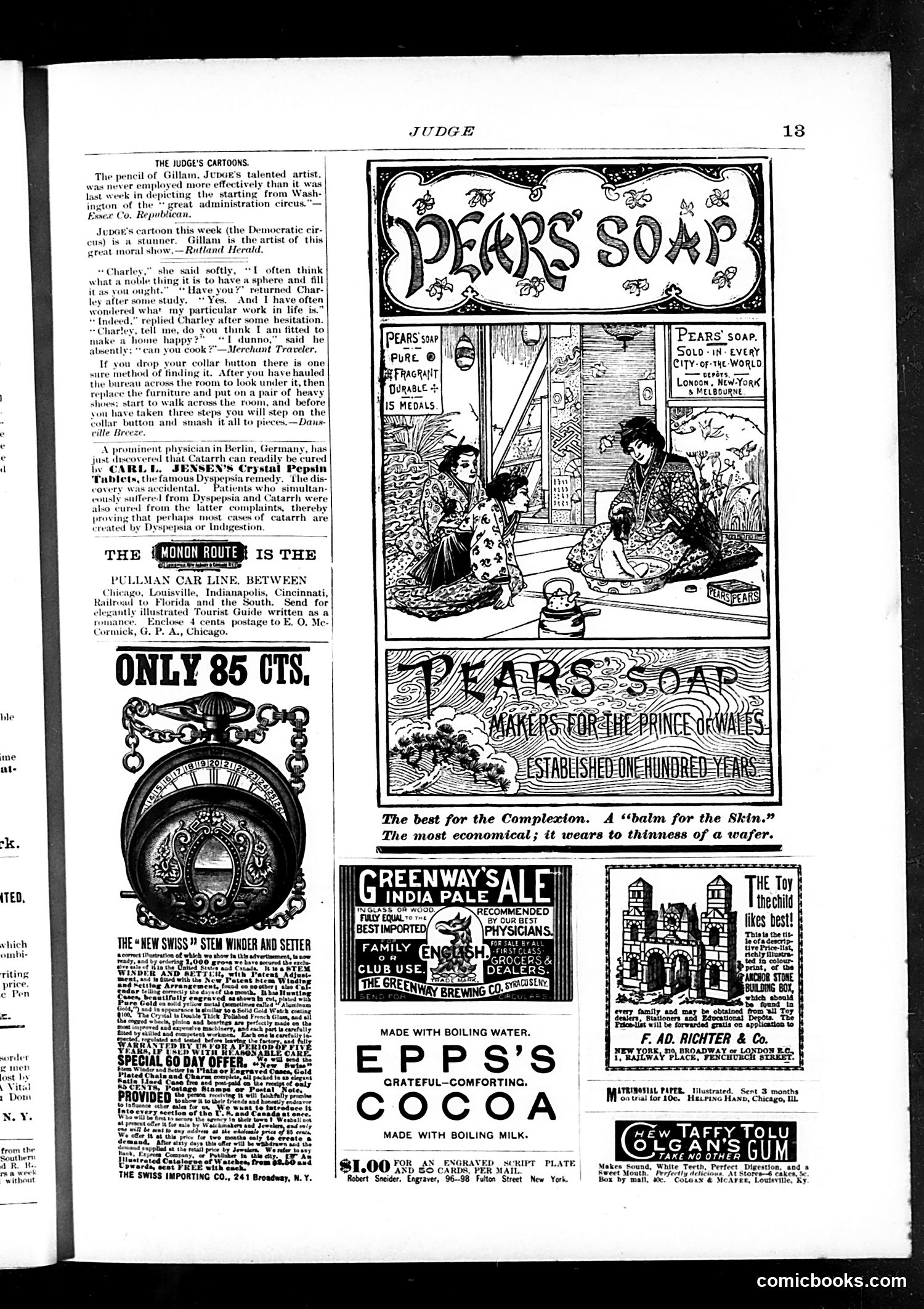
This page is primarily **advertising**, with minimal editorial cartoon content. The main visual element is a **Pears' Soap advertisement** featuring a Victorian-era illustration of women and children using soap—typical of late 19th-century product marketing emphasizing cleanliness and domesticity. The page's limited editorial content includes brief commentary on cartoonist Gillam's work depicting "the Democratic circus" as a "moral show," suggesting partisan Republican criticism of Democratic politics, though no specific cartoon or event is identified. The remainder consists of period advertisements: Swiss stem winders, the Monon Route railroad line, Greenway's India Pale Ale, Epps's Cocoa, printing services, and Taffy Tolu gum. These ads reflect contemporary consumer goods and services typical of this era's Judge readership. **No specific political figures or satirical cartoons are clearly identifiable on this page.**
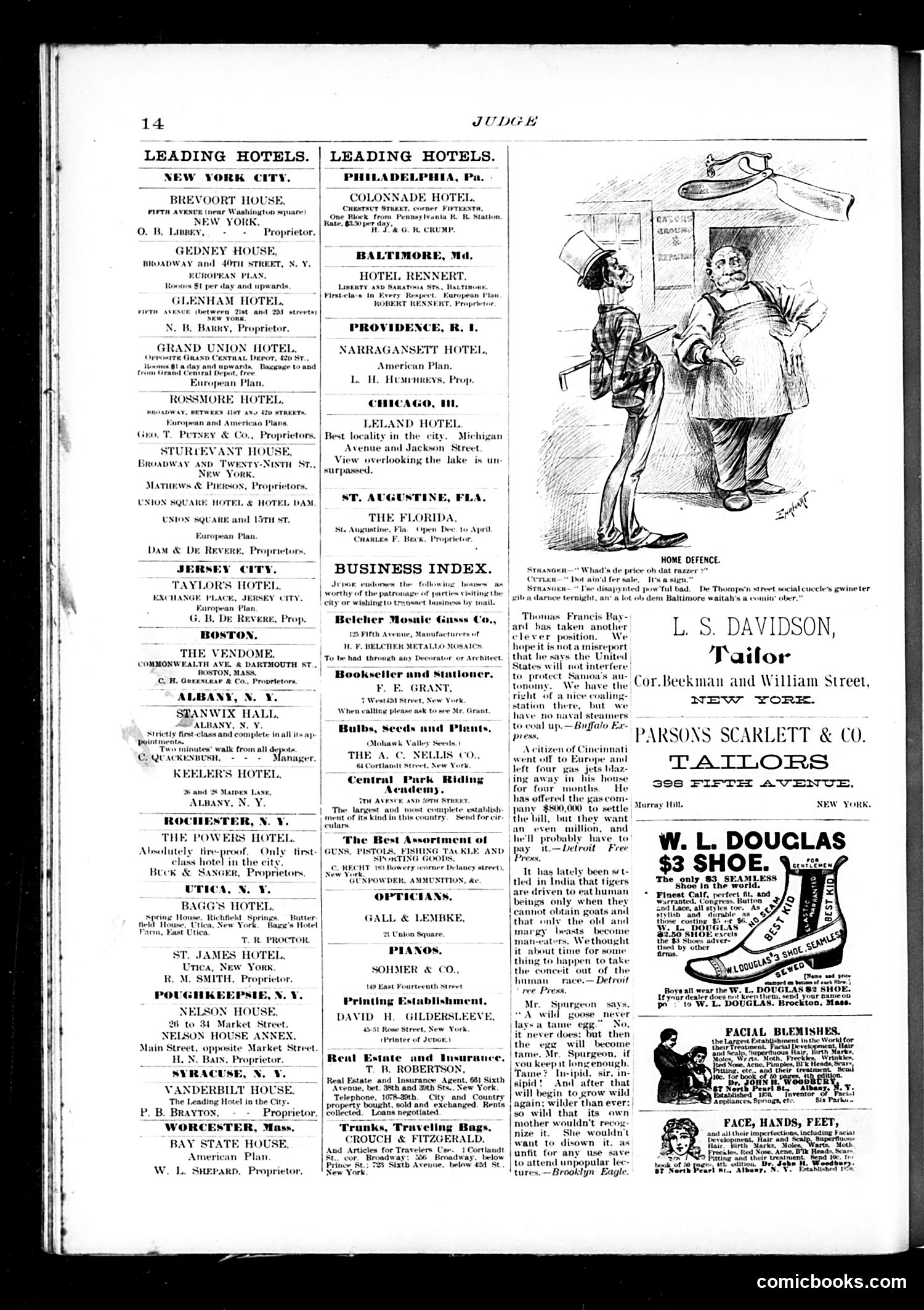
This page is primarily **advertising** for leading hotels and businesses, but features one significant political cartoon titled "A Strange Coincidence" in the upper right. The cartoon depicts two figures—a thin man in tattered clothes and a rotund, well-dressed man—in conversation. The dialogue reveals the satire: the poor man asks about "the price of that parrot," and the wealthy man responds with a story about a Cincinnati citizen who left gas jets running for four months while in Europe, resulting in a $400,000 bill dispute with the gas company. **The point**: The cartoon satirizes the absurd disparity between rich and poor. While working-class people struggle with basic survival (the beggar), the wealthy face such trivial problems that they can casually laugh them off—even a $400,000 utility bill becomes a mere anecdote. It's social commentary on economic inequality dressed as humor, typical of *Judge* magazine's satirical approach to Gilded Age excess.
This page is primarily **advertising**, typical of late 19th/early 20th-century American magazines. The content consists almost entirely of commercial notices for products and services, with minimal editorial content or satire. The few notable items include: **"Good Things from Judge"** - A brief anecdote about a couple on a boat, apparently a romantic/humorous story meant to entertain readers. **Product advertisements** dominate: Sohmer Pianos, Knox Hats, Baker's Breakfast Cocoa, Quinine-Wine tonics, and various patent medicines. These ads reflect period concerns—hay fever remedies, "granules" for unnamed ailments, tonics for "weakness and debility." **Social context**: The ads reveal class markers (pianos, dress goods from "Constable & Co."), gender roles (women's fashion, "school costumes"), and medical attitudes (unregulated patent medicines claiming cure-all properties). The page exemplifies how 19th-century satirical magazines sustained themselves—editorial content was minimal; advertising revenue was primary. This particular page contains **no discernible political satire or social commentary**.
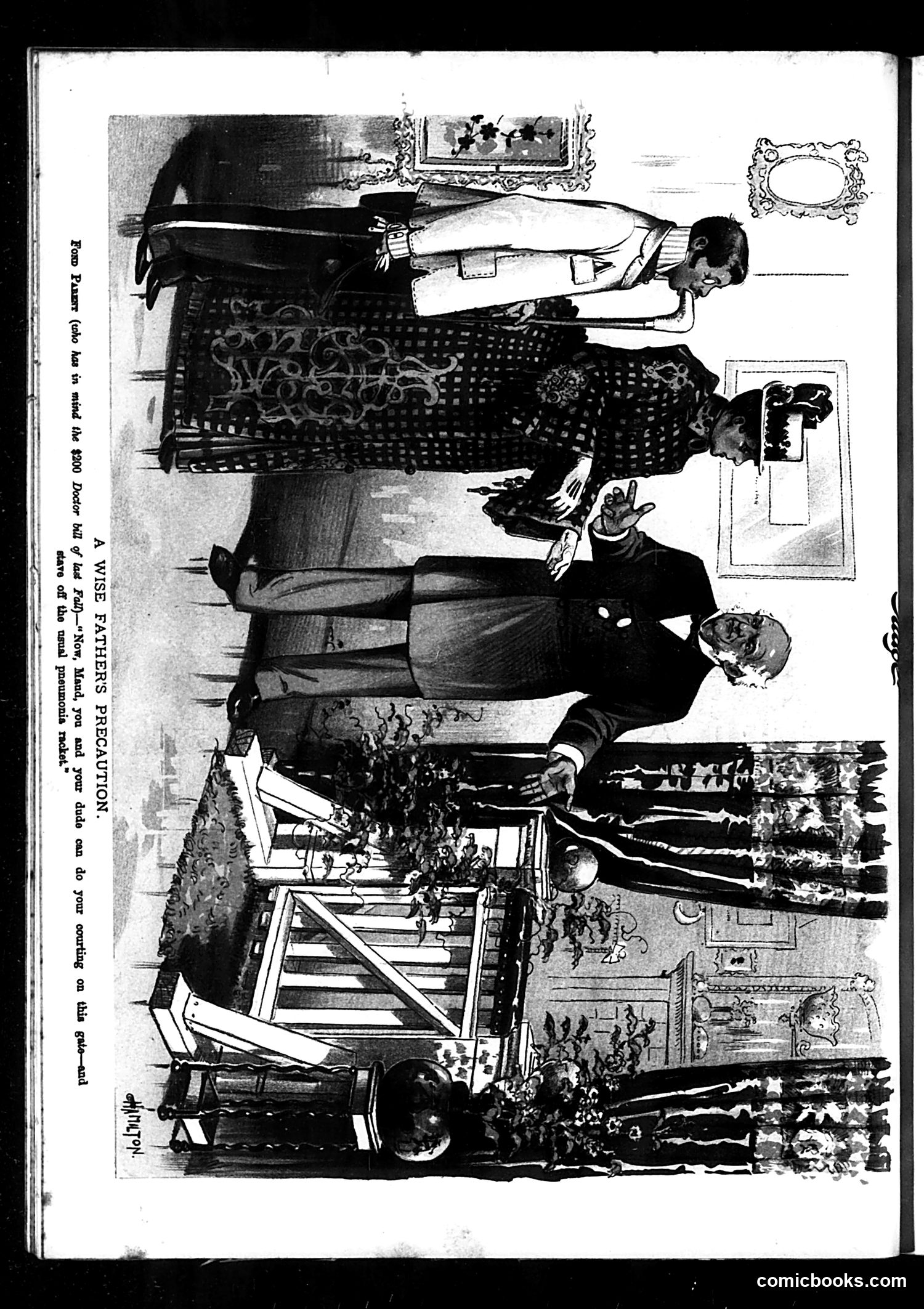
This cartoon satirizes protective parenting and courtship customs of the era. A father, having paid a $200 doctor bill the previous fall (likely for pneumonia contracted during outdoor courting), now restricts his daughter Maud and her "dude" (fashionable suitor) to courting on a gate rather than in the open air. The joke operates on multiple levels: the father's absurd "solution" (a gate offers no real protection), the high cost of medical care, and period anxieties about young women's health during courtship. It mocks both overprotective fathers and the era's vulnerability to illness. The term "pneumonia racket" suggests the father views the illness cynically as an expected expense of allowing courtship.