
A complete issue · 16 pages · 1886
Judge — February 6, 1886
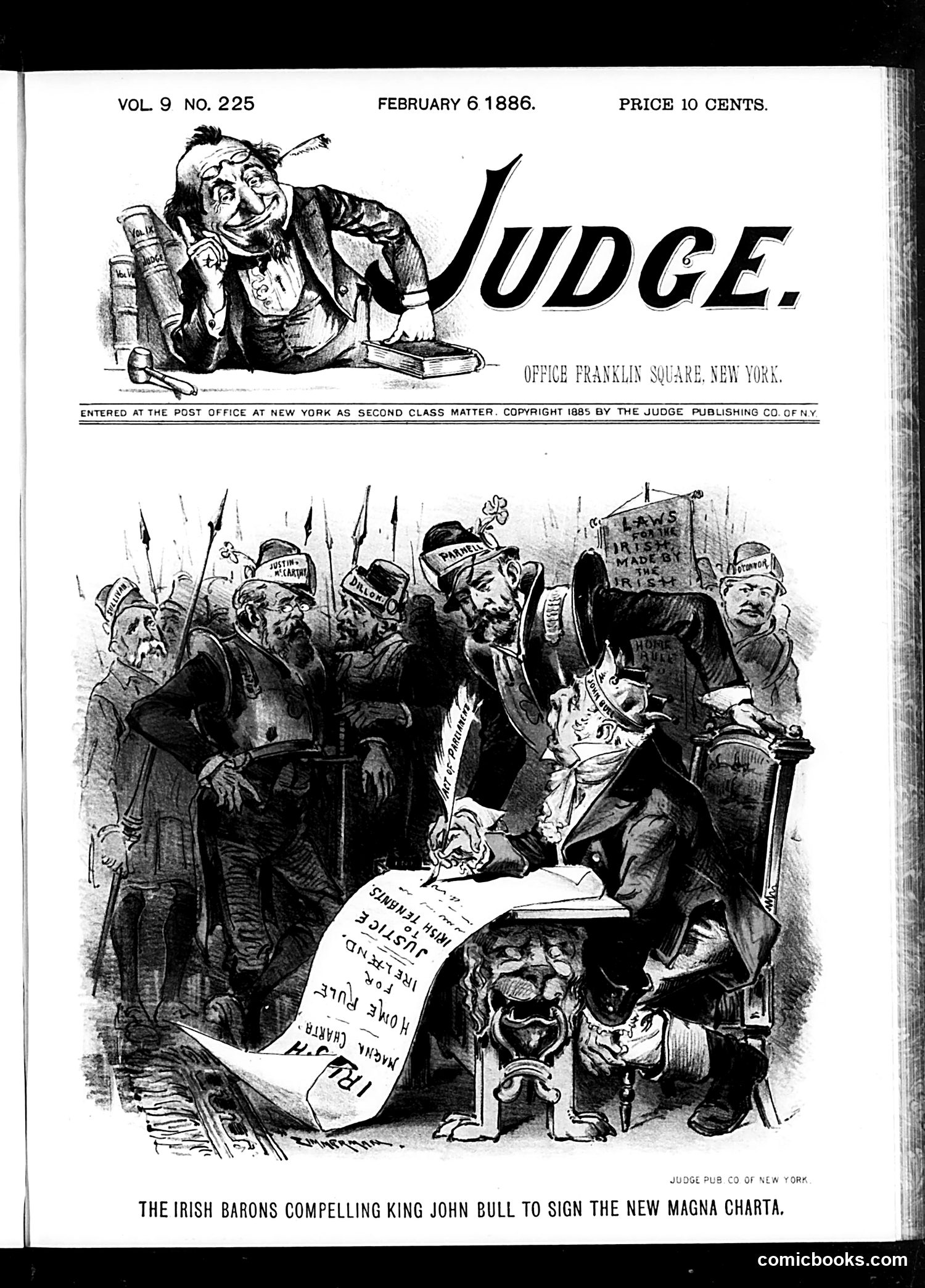
This February 1886 Judge cartoon uses British historical allegory to satirize Irish-British relations. "King John Bull" (representing Britain) is forced by armed "Irish Barons" to sign a document labeled "Magna Charta" — referencing the 1215 charter that limited royal power. The cartoon depicts Irish nationalists as rebels compeling Britain to grant concessions, likely referencing Home Rule debates dominating 1886 politics. The militaristic imagery with bayonets and the inversion of power (subjects forcing a monarch) satirizes Irish demands for self-governance. The historical parallel suggests Irish activists see themselves as justified resisters against tyranny, while the Judge's presentation implies criticism of their coercive tactics and revolutionary posturing.
The main cartoon shows a disheveled, distressed figure labeled "JUDGE." Based on the accompanying article "AN EMBARRASSMENT OF RICHES," the satire concerns wealthy individuals during wartime—specifically a Confederate citizen purchasing breakfast with gold while others face scarcity. The cartoon likely mocks profiteering and class disparity during the Civil War period. The articles below address political figures (references to Gladstone, Jacob Sharp) and social issues. "THE NEW ADONIS" discusses physical attractiveness standards, while "THE QUEEN'S LAUGH" references Queen Victoria. The content reflects typical Judge magazine satire: critiquing political corruption, social hypocrisy, and contemporary scandals through sharp commentary and caricature. The overall tone targets wealthy elites exploiting wartime conditions.
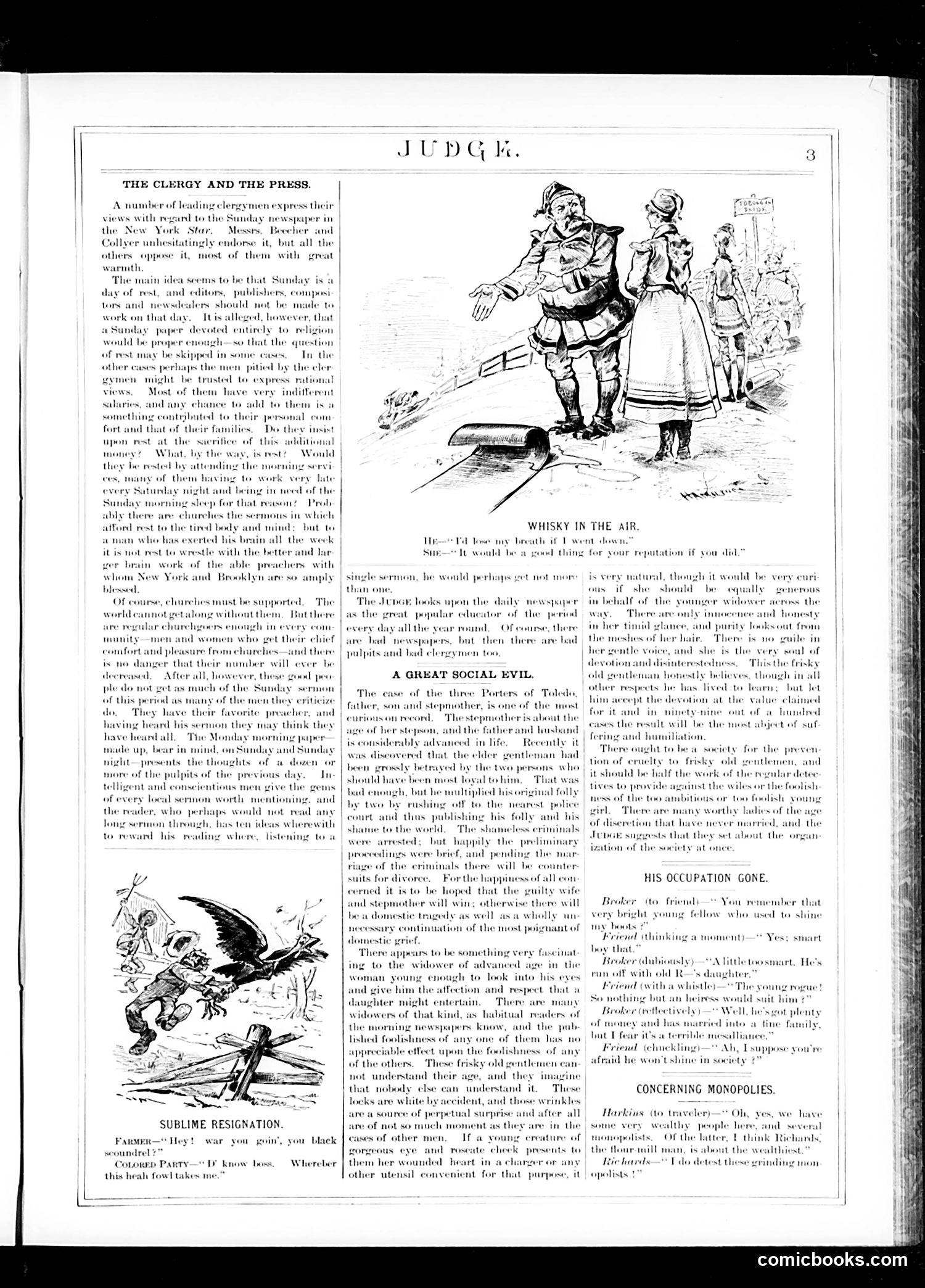
This page contains three cartoons satirizing contemporary American social issues: **"The Clergy and the Press"** discusses whether Sunday newspapers should publish, with clergy opposing work on the Sabbath. The accompanying cartoon shows a military or authority figure gesturing dismissively at working people, satirizing clergy hypocrisy—they rest on Sunday while condemning laborers' need for newspapers. **"Whisky in the Air"** depicts a gentleman concerned that his reputation would suffer if a young woman drank whisky, yet he himself indulges. The satire targets double standards regarding morality and propriety based on gender and class. **"Sublime Resignation"** shows a Black farmer resignedly accepting wherever his employer sends him ("this heah fowl takes me"), satirizing the powerlessness and resigned acceptance African Americans faced under post-Reconstruction social conditions. The page reflects 1880s-era debates about labor rights, religious hypocrisy, gender morality, and racial inequality—using humor to critique social injustices of the Gilded Age.
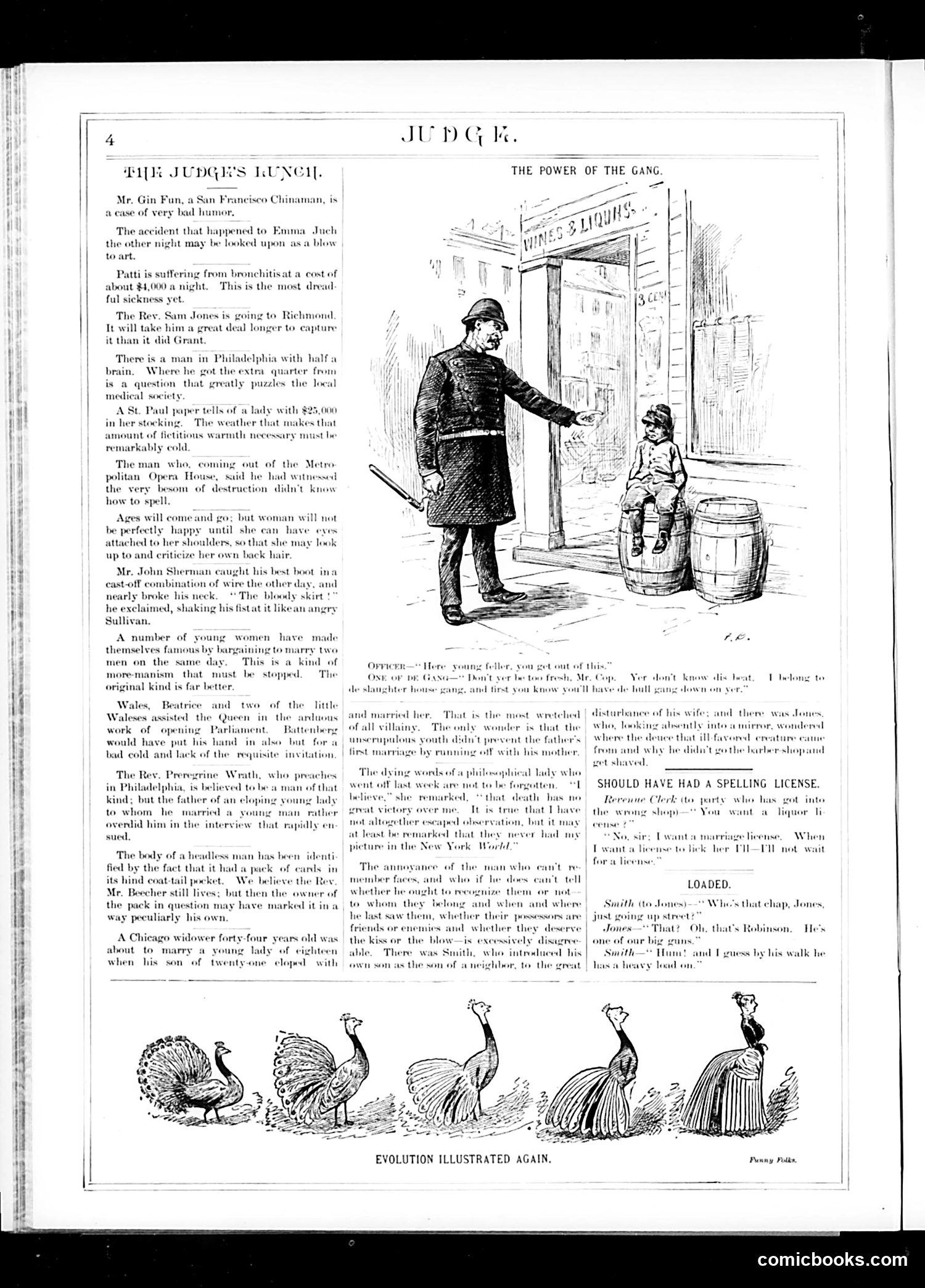
This page contains several satirical pieces typical of 1880s American humor: **Main Cartoon - "The Power of the Gang"**: Shows a police officer confronting a boy near barrels. The dialogue reveals the officer's powerlessness: the boy threatens that "the slaughter house gang" will retaliate if the cop arrests him. This satirizes urban gang culture and police inability to control organized youth crime in cities—a genuine social problem of the era. **Miscellaneous Brief Items**: Short, often crude jokes about contemporary figures (opera singer Emma Juch, politician Sam Jones) and social observations (women's fashion, clerical hypocrisy, a headless corpse identified by playing cards). **Bottom Section Dialogue**: Brief exchanges mocking pretension and malapropisms—a man called "Robinson" is actually "one of our big guns" (an important person). **Footer**: "Evolution Illustrated Again"—a peacock sequence likely mocking Darwinism debates popular at the time. The page reflects Judge's characteristic approach: cynical commentary on crime, class, religion, and contemporary absurdities, with crude but pointed social criticism.
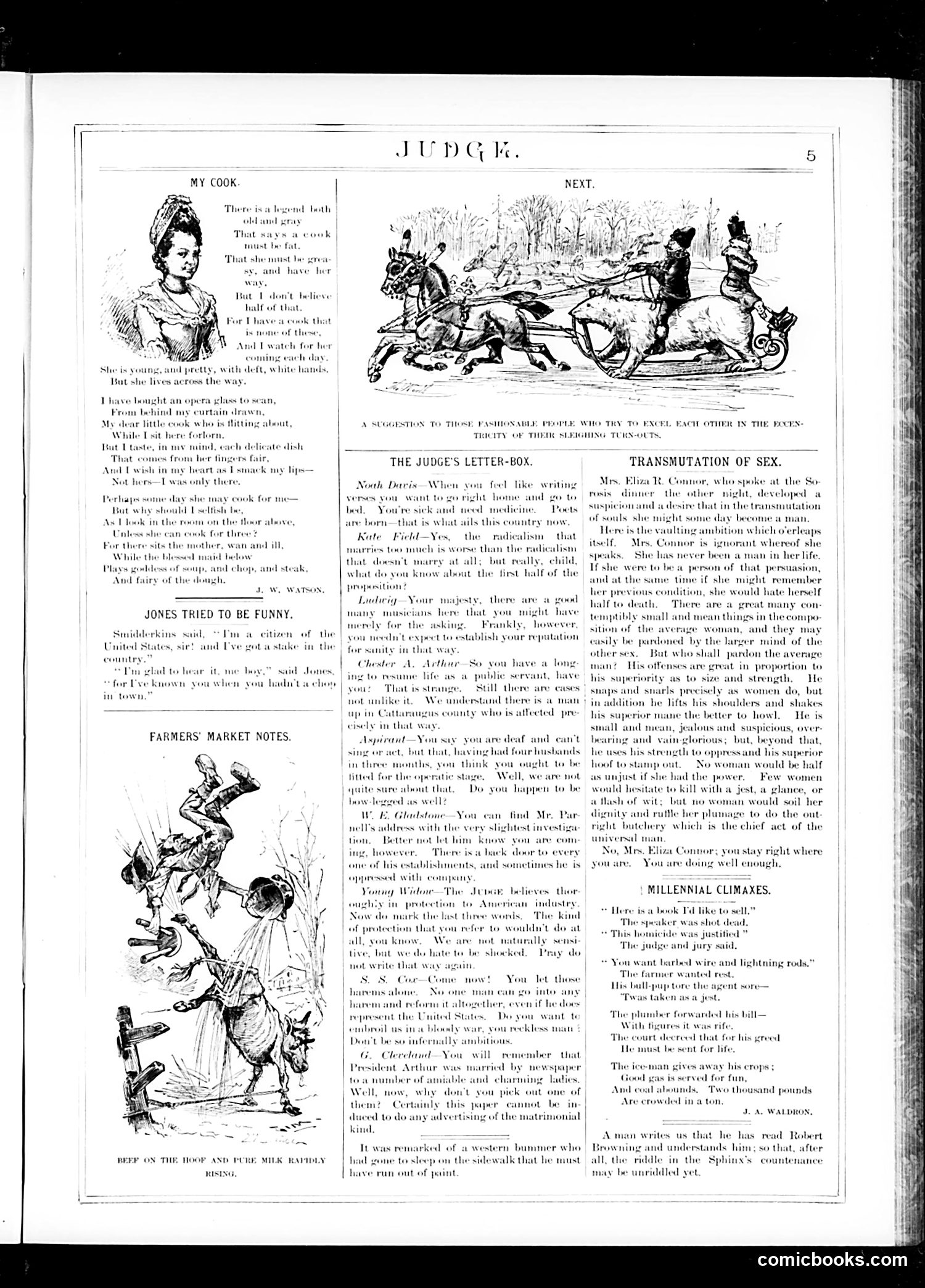
This page from the satirical magazine *Judge* contains several humorous pieces mocking contemporary social conventions and politics. **"My Cook"** (left column) satirizes a common Victorian fantasy—a gentleman admiring his young, attractive servant through binoculars while she sits across the way. The satire targets the absurdity of the poet's idealization versus the mundane reality. **"The Judge's Letter-Box"** features mock advice columns addressing absurd questions about marriage, politics, and social propriety. References include President Arthur and G. Cleveland (Grover Cleveland), suggesting the page dates to the mid-1880s. The advice ridicules both questioners and public figures with biting wit. **"Transmutation of Sex"** critiques arguments about women's physical inferiority to men, sarcastically suggesting women possess superior moral restraint precisely because they're weaker—turning anti-feminist arguments on their heads. The **farmers' market cartoon** (bottom left) shows rural figures in exaggerated poses, likely mocking rural stereotypes or agricultural politics. Overall, the page satirizes Victorian sentimentality, gender politics, and partisan political figures through humor and caricature.
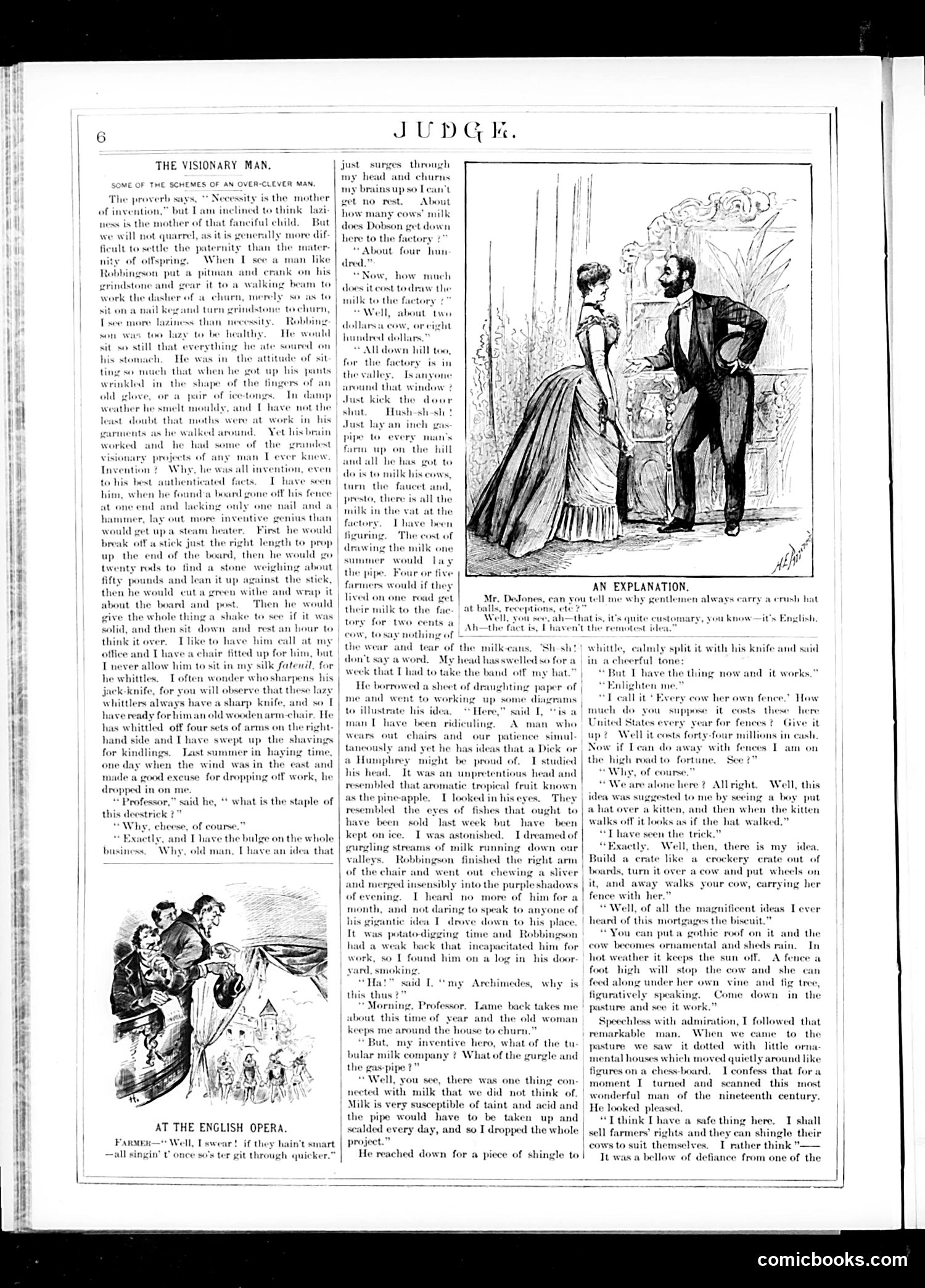
This page satirizes a lazy but imaginative man who invents elaborate, impractical schemes to avoid work. The central character, "Robbing," exemplifies the stereotype of the American lazybones who compensates for indolence with grandiose fantasizing. The primary joke: While visiting a cheese factory, Robbing conceives an absurd plan to pipe milk directly from hilltop farms down to the valley factory—an unnecessarily complex solution to a simple transportation problem. His "visionary" idea demonstrates how laziness masquerades as innovation; he dreams up complicated schemes rather than performing straightforward labor. The secondary cartoon ("At the English Opera") jokes about opera singers being incomprehensibly loud—a common 19th-century American criticism of opera's artistic pretensions. The satire targets both individual laziness and the American tendency to over-engineer solutions, mocking the "inventive genius" born from sheer unwillingness to work directly.
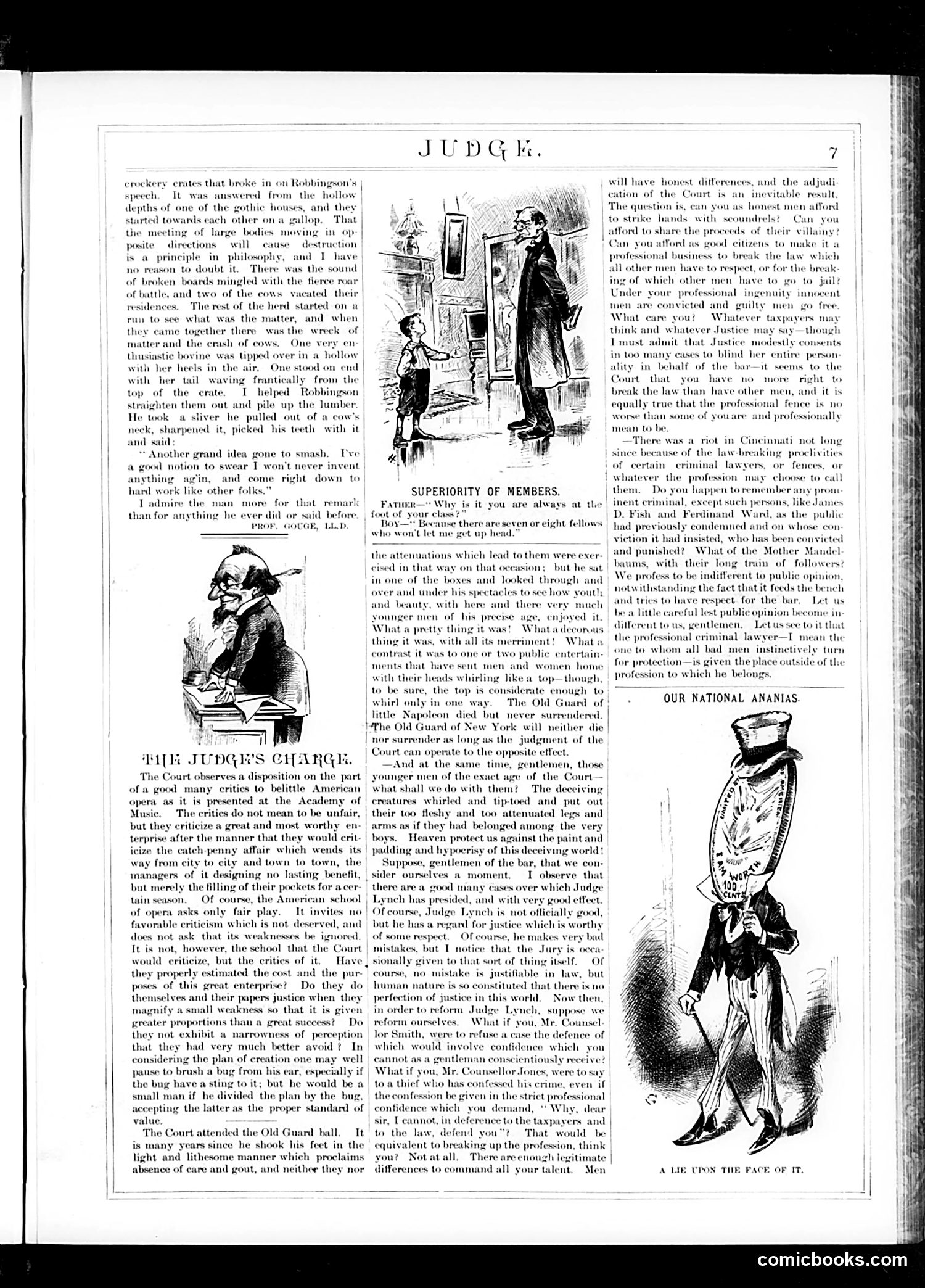
This page contains two distinct satirical pieces: **"The Judges' Charge"** (left): A judge addresses concerns about lawyers breaking laws to defend clients. The satire mocks judicial hypocrisy—the judge lectures attorneys about professional ethics while acknowledging that injustice is inevitable in the legal system. The cartoon critiques the contradiction: judges demand lawyers respect the law, yet the court itself produces guilty men going free and innocent men convicted. The satire suggests the entire system is morally compromised. **"Superiority of Members"** (right): A brief joke about class rankings. A student at the foot of his class explains there are "seven or eight fellows who won't let me get up his head"—implying his classmates deliberately keep him down rather than merit determining rank. Both pieces reflect Judge's typical focus: exposing institutional corruption and human hypocrisy through witty dialogue and pointed caricature.
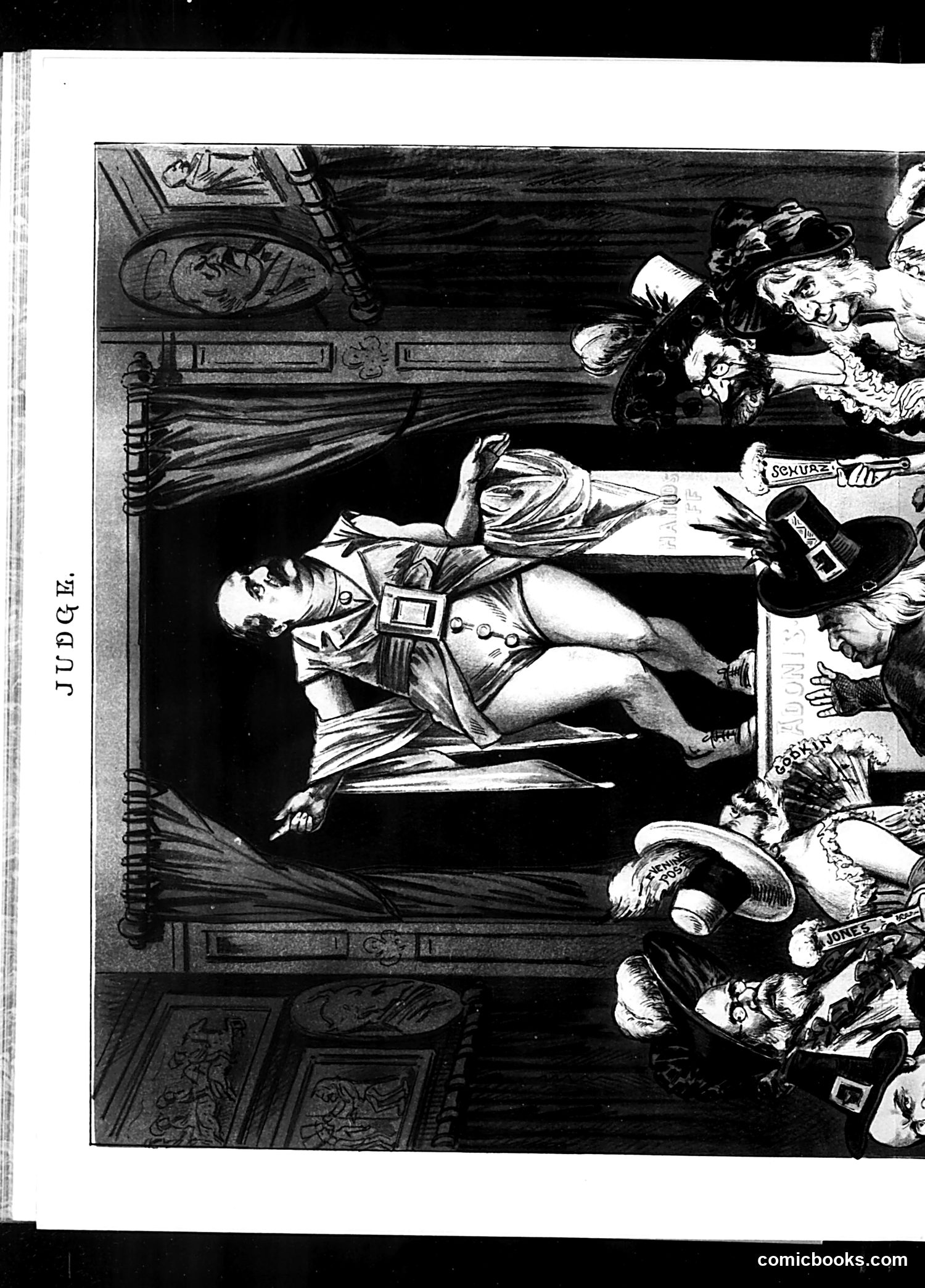
I can see this is a black and white engraving from *Judge* magazine showing a classical or allegorical scene. The image depicts a reclining female figure in classical dress in a central position, surrounded by multiple figures on the right side who appear to be observing or attending to her. The style suggests 19th-century satirical illustration. However, the OCR text provided only contains "comicbooks.com," which doesn't supply the actual article text, caption, or title that would clarify the satire's specific political or social targets. Without that contextual information visible or readable in the image itself, I cannot confidently identify which historical figures, events, or issues this cartoon satirizes. To explain the cartoon's meaning accurately, I would need the accompanying text or caption.
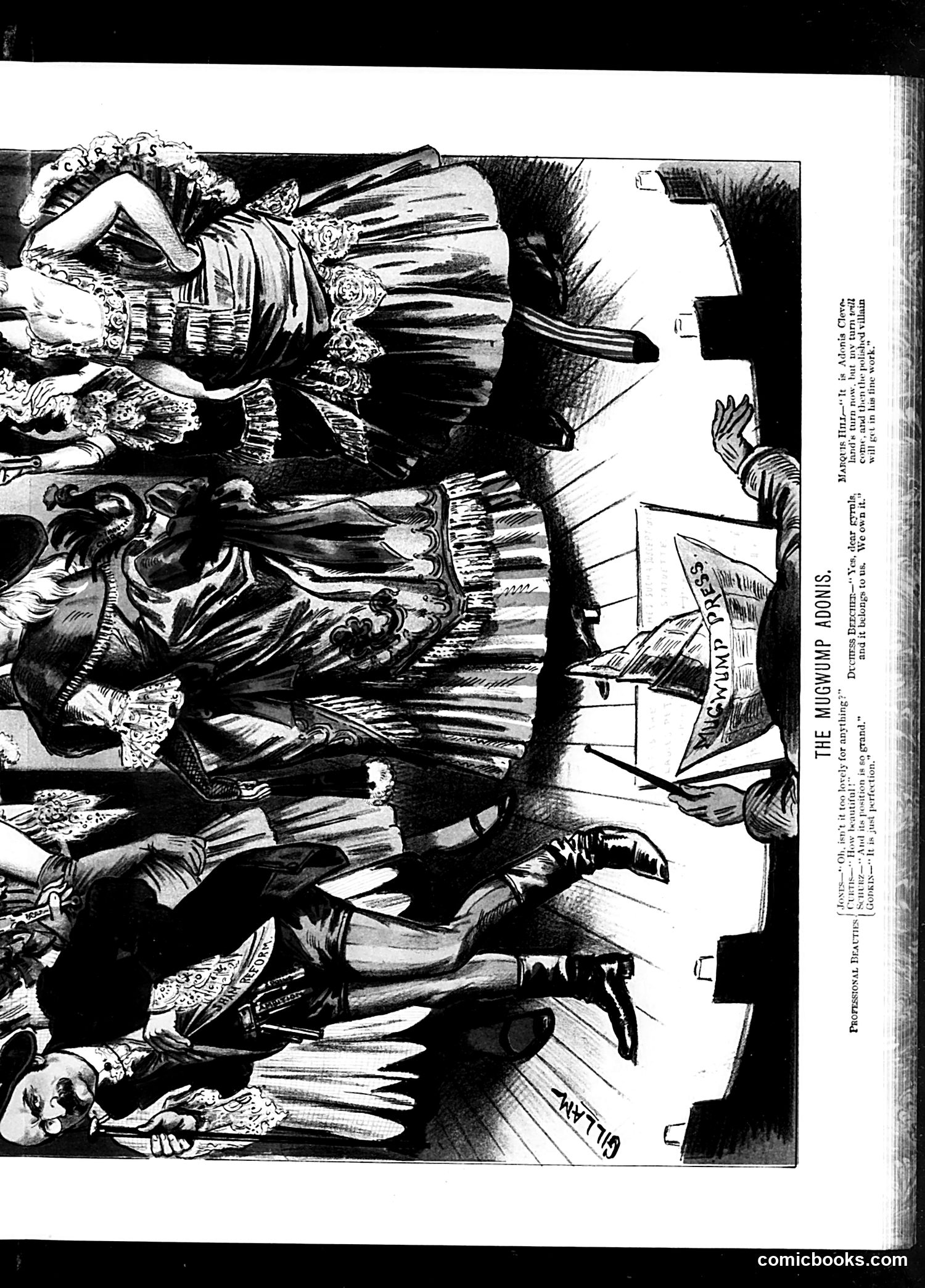
This satirical cartoon appears to depict figures labeled as "Mugwumps"—a term for Republican defectors who opposed their party's nominee. The elaborate, ornate costumes and exaggerated poses suggest these political figures are being mocked for pretentiousness and self-importance. The cartoon's title references "Mugwump Adorers," likely satirizing the public support or adoration these breakaway Republicans received from certain quarters. The detailed cross-hatching and dramatic composition emphasize the cartoonist's contempt for their perceived vanity and political inconsistency. Without clearer dates or additional context, the specific election or figures cannot be definitively identified, but the satire targets political opportunism and sanctimonious defection from party loyalty—common Judge magazine themes during the late 19th century.
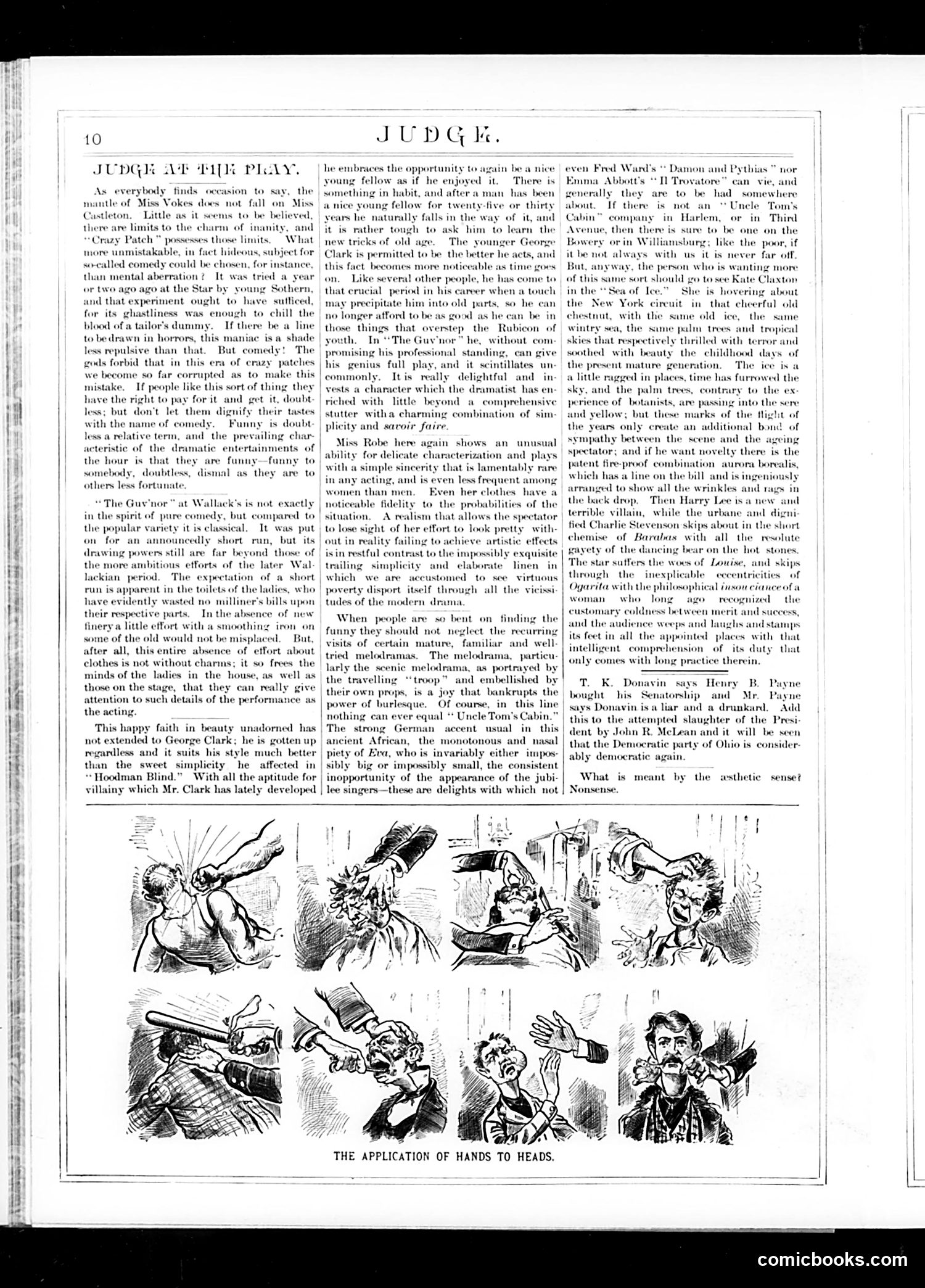
This page critiques theatrical performances, particularly actress Miss Castleton's "Crazy Patch," which the reviewer dismisses as mindless comedy. The text argues that depicting mental aberration (implied to be comedic insanity) crosses ethical boundaries—it's "hideous" rather than funny, especially after a similar failed attempt by actor Young Sothern. The review praises "The Guv'nor" at Wallack's Theatre as superior, highlighting Mr. Clark's skilled characterization and villainy. It notes the play attracted fashionable audiences unconcerned with elaborate dress. The page includes eight small illustrations captioned "THE APPLICATION OF HANDS TO HEADS"—slapstick vignettes depicting various comedic head-slapping scenarios, likely satirizing crude physical humor prevalent in contemporary theater. **Context for modern readers**: This reflects late 19th-century theatrical criticism debating the legitimacy of different comedy styles—whether "crazy" characters constitute genuine entertainment or exploitative sensationalism.
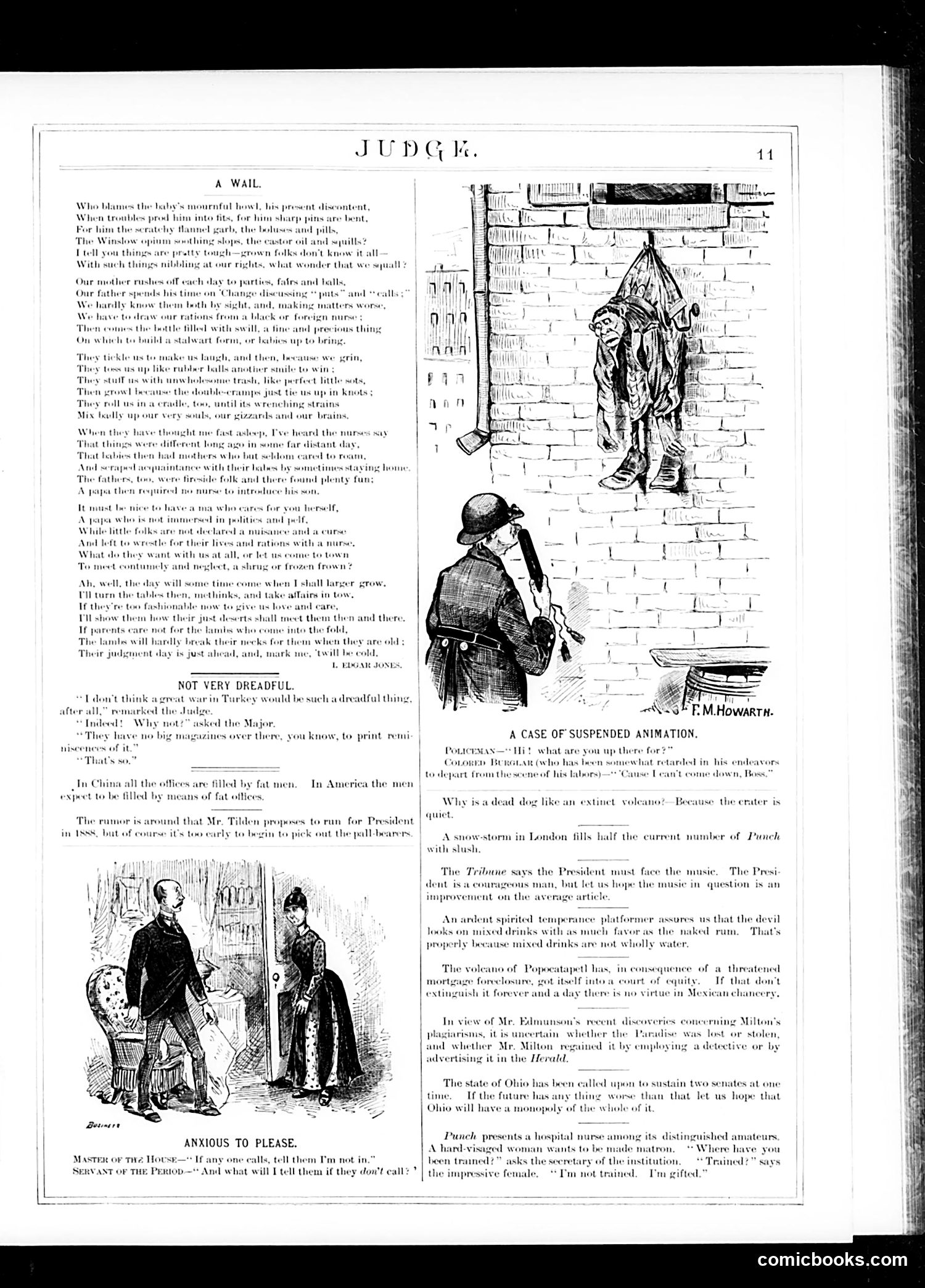
This page contains three satirical pieces typical of 1880s American humor: **"A Wail"** mocks Victorian parenting practices, particularly the use of wet nurses and nannies. The poem laments that babies are handled by servants rather than parents, subjected to rough treatment, and raised without genuine parental affection—a critique of wealthy families outsourcing childcare. **"Not Very Dreadful"** presents brief political jokes. A character dismisses concern about war with Turkey, noting Turkey lacks magazines to print "reminiscences" of the conflict. A follow-up joke mocks American politics: offices filled through personal connections rather than merit. **"A Case of Suspended Animation"** includes riddles and social commentary, including a jab at President (appears to reference late 1880s politics), and a hospital scene where a hard-faced woman claims to be "gifted" rather than "trained"—satirizing unqualified people assuming professional roles. The cartoons illustrate these texts with pen-and-ink drawings. Overall, the page targets Victorian social pretension, parental negligence among the wealthy, and incompetence in public service.
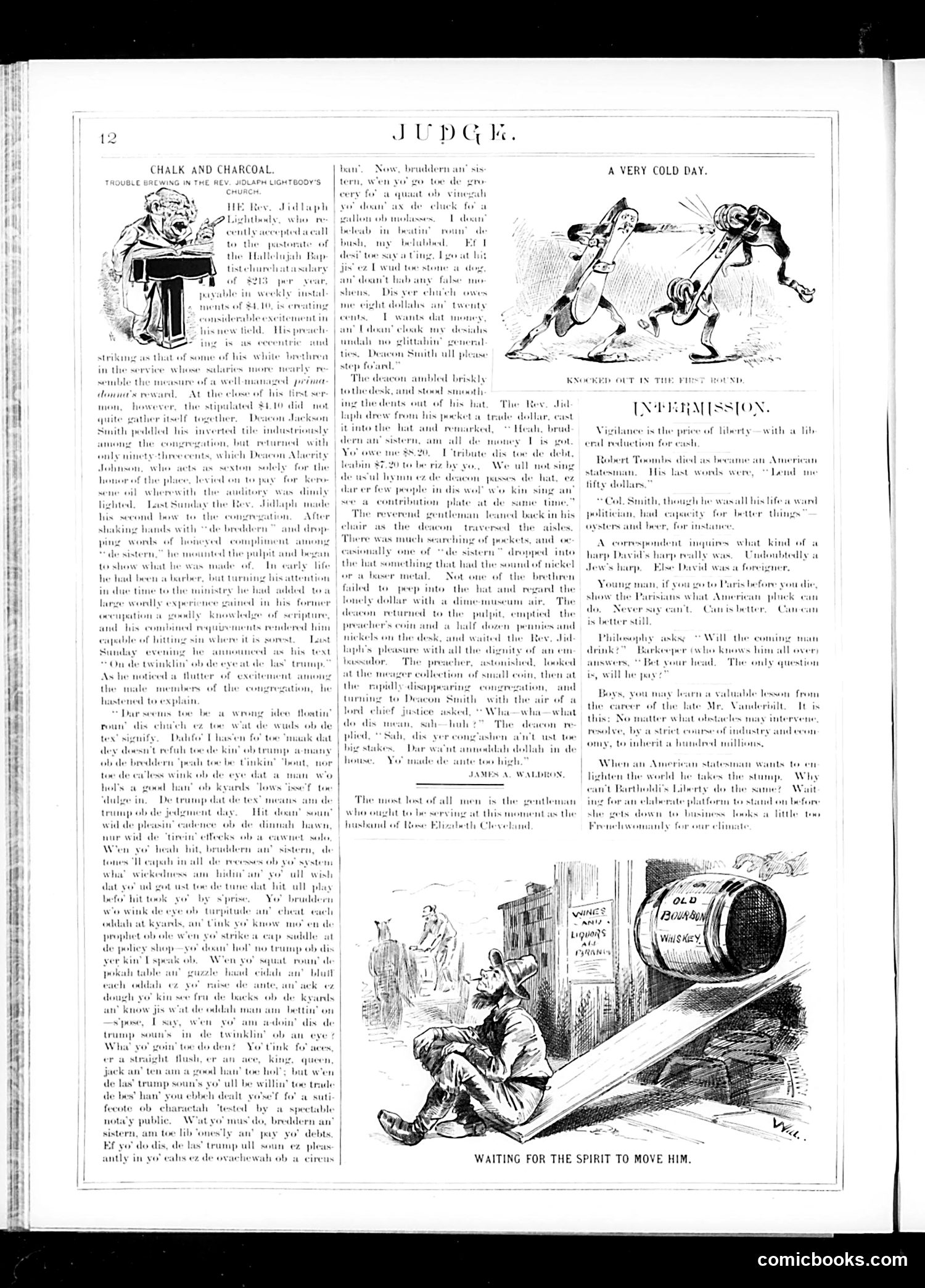
This page from *Judge* magazine contains two distinct items: **"Chalk and Charcoal"** is a satirical dialect piece mocking a newly appointed Black Baptist minister's first sermon. The narrative uses exaggerated phonetic spelling to ridicule both the minister's speech and his tendency to solicit money from his congregation. The satire targets his carpentry background and his conflation of religious "trumpets" with card-playing, portraying him as unsophisticated and financially exploitative. **"A Very Cold Day"** includes a cartoon showing someone knocked out in a boxing ring, and a separate image of a drunk man beside a whiskey barrel. The accompanying text references Robert Toombs (a historical Confederate figure) and discusses American political ambitions. The page reflects *Judge*'s 19th-century satirical approach, employing racial caricature and dialect humor typical of the era's print culture—material offensive by modern standards but historically significant for understanding period attitudes.
This is primarily a **title/masthead page and advertising section** for Judge Publishing Company's publications, rather than a page featuring editorial cartoons. The page includes: - **Masthead material** describing Frank Leslie's Illustrated Newspaper as an independent journal covering silver, tariff, and civil service reform - **A brief dialogue snippet** (appears to be racist dialect humor, typical of 19th-century publications) where "old James" discusses Christmas—reflecting period attitudes - **Dense advertising** for printing services, typewriters, safes, and business equipment—standard for publication mastheads of this era - **No identifiable political cartoons or caricatures** visible in the image The page reflects Judge as a commercial publishing enterprise rather than showcasing its satirical content. The racist language in the dialogue excerpt reflects troubling historical attitudes embedded in period publications, even those claiming editorial independence.
This page is **primarily an advertising section** rather than satirical content. It contains numerous commercial advertisements from late 19th-century manufacturers and retailers, including: - Lundborg's Perfumes and Rhenish Cologne - Piano rentals (Horace Waters & Co.) - Flour sacks and grocery bags - Printing inks and safes - Time globes and various industrial products The only narrative content visible is a brief column titled "HENRY LINDENMEYR, Paper Warehouse" discussing a teacher's question to a student about their father's profession—a minor anecdote rather than political satire. **For modern readers:** This demonstrates how Judge magazine funded operations through paid advertisements interspersed with editorial content. The products advertised (perfumes, pianos, industrial supplies) reflect turn-of-the-century consumer goods and business services. The page lacks the political cartoons or satirical commentary Judge was known for—it's simply a revenue-generating advertisement section.
This is primarily an **advertising page** rather than a satirical cartoon page. It contains numerous product advertisements from the late 19th century, including: - Patent medicines (Hale's Honey cough remedy, Ely's Cream Balm for catarrh/hay fever) - Medical devices (trusses for rupture) - Industrial products (linseed oil, printing inks, paper sacks) - Consumer goods (cocoa, underwear, grocery bags) The notable content is **Ely's Cream Balm advertisement**, which prominently features testimonials claiming it cures catarrh and hay fever. The circular logo emphasizes "CURES COLD IN HEAD" and "HAY-FEVER." The page reflects **late 1800s patent medicine marketing**, where unregulated remedies made sweeping health claims with testimonial evidence. This was before FDA regulations restricted such advertising. There are **no visible political cartoons or satire** on this page—it's a straightforward commercial advertisement section typical of Judge magazine's revenue model.
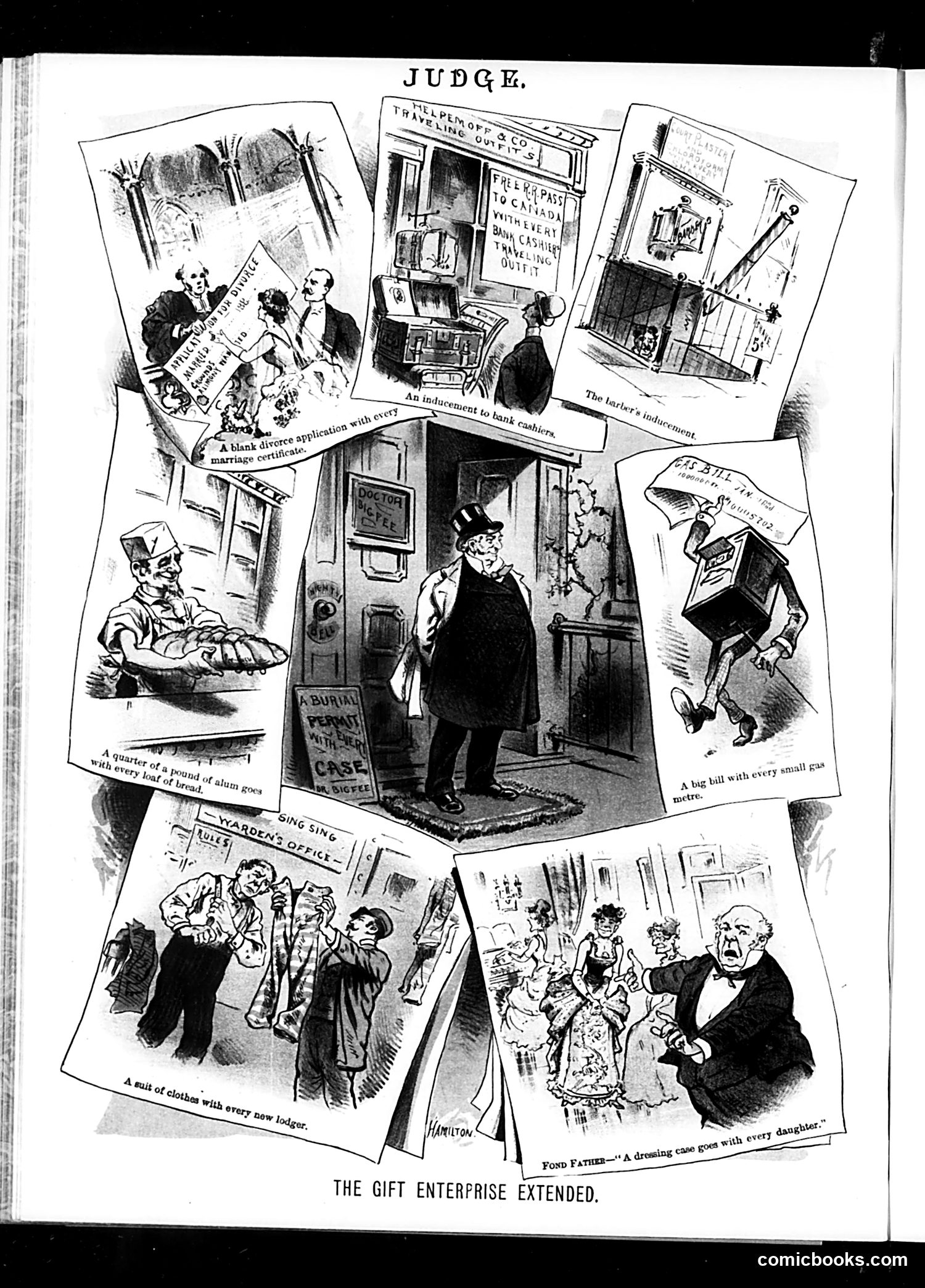
This satirical cartoon critiques what appears to be a widespread social phenomenon of petty bribery and corruption affecting various professions. The central figure (a judge in top hat) is surrounded by vignettes showing different occupations—bank cashiers, gas meter readers, doctors, lodgers, and fathers—each depicted receiving small "gifts" or payments in exchange for favorable treatment. The satire suggests that bribery has become normalized across society: a quarter with every loaf of bread, small payments with official documents, clothing gifts from lodgers, etc. The title "Gift Enterprise Extended" mockingly frames this corruption as an expanding business practice. The overall message criticizes how such petty corruption has become systemic, affecting trust in institutions from banking to medicine to family relationships.