
A complete issue · 16 pages · 1886
Judge — January 30, 1886
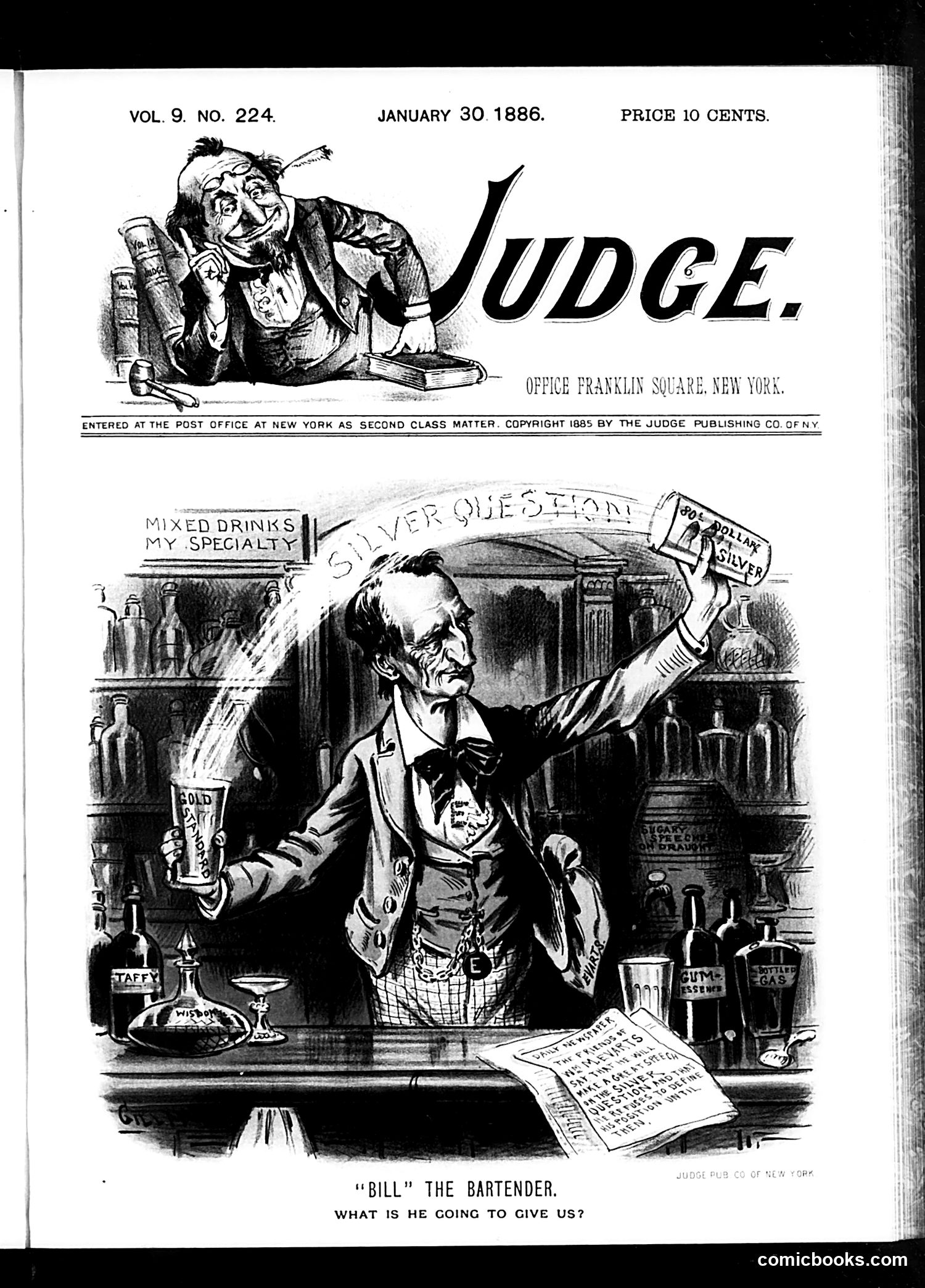
This cartoon satirizes a bartender's ability to create mixed drinks with questionable ingredients. The figure behind the bar, labeled "Bill the Bartender," holds up a bottle marked "SILVER" while displaying various liquor bottles on shelves behind him. A sign reads "Mixed Drinks My Specialty" and another asks "Silver Question." The satire appears to reference debates about monetary policy, specifically the "Silver Question"—the late-19th-century controversy over whether the U.S. should base currency on silver or gold. By depicting a bartender mixing drinks with silver, the cartoon jokes that politicians were "mixing" or adulterating currency policy just as a bartender might adulterate drinks. The caption "What is he going to give us?" suggests skepticism about the outcome of such monetary experimentation.
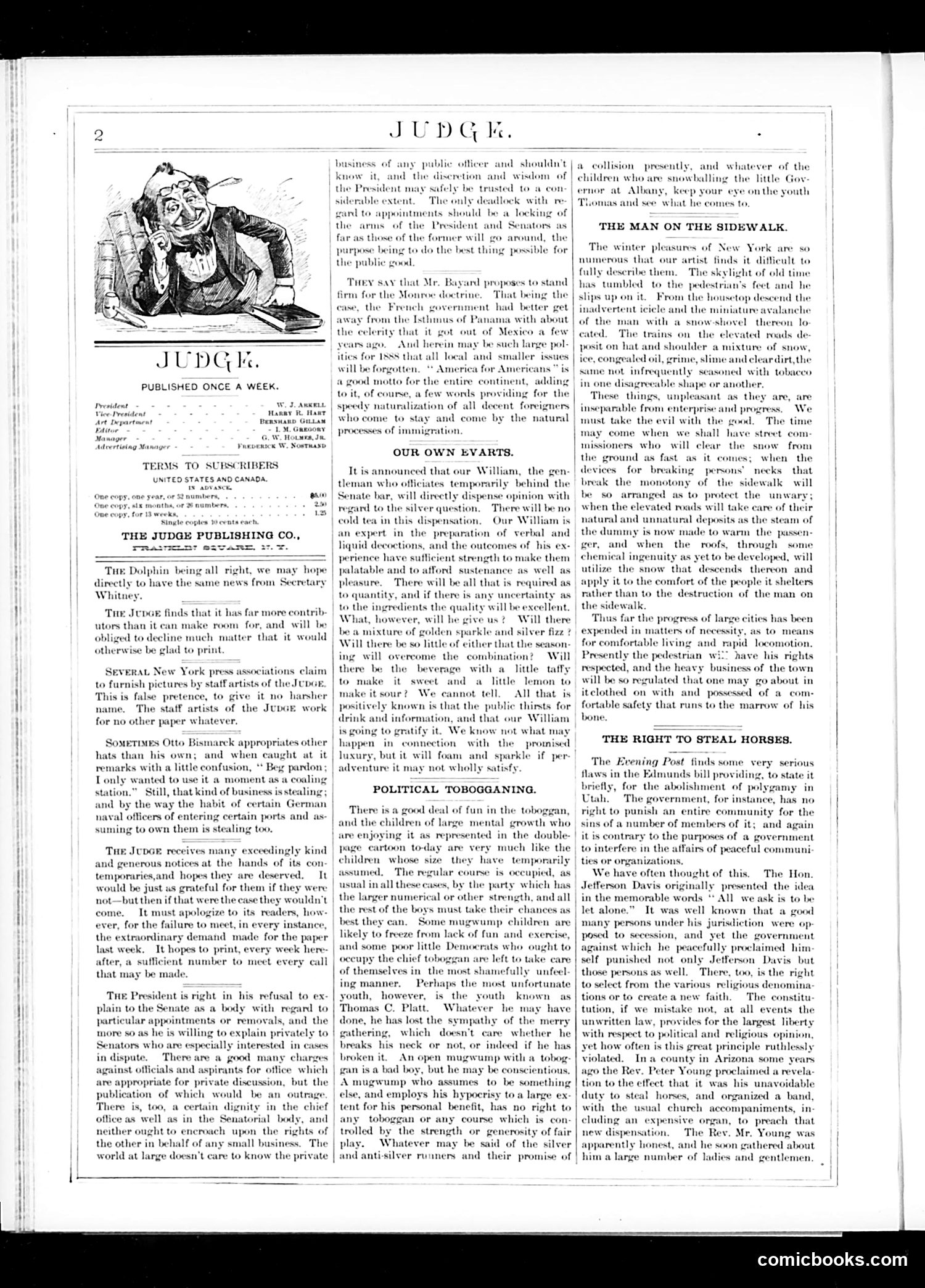
The main cartoon depicts a disheveled figure labeled "JUDCK" (the magazine's mascot), appearing distressed or agitated. The accompanying articles discuss several contemporary political controversies: presidential appointments and Senate discretion; William (likely Secretary of State) and the silver question; and criticisms of youth exposure to Democratic "tobogganing" (political maneuvering). One piece satirizes what it calls inappropriate political posturing by children, while another addresses Utah polygamy abolition efforts and government intervention in religious practice. A final article titled "The Right to Steal Horses" references horse theft in Arizona and clergy involvement in questionable activities. The exact historical moment is unclear without dating information, but these pieces reflect 1890s-era debates about executive power, monetary policy, religious practice, and government authority.
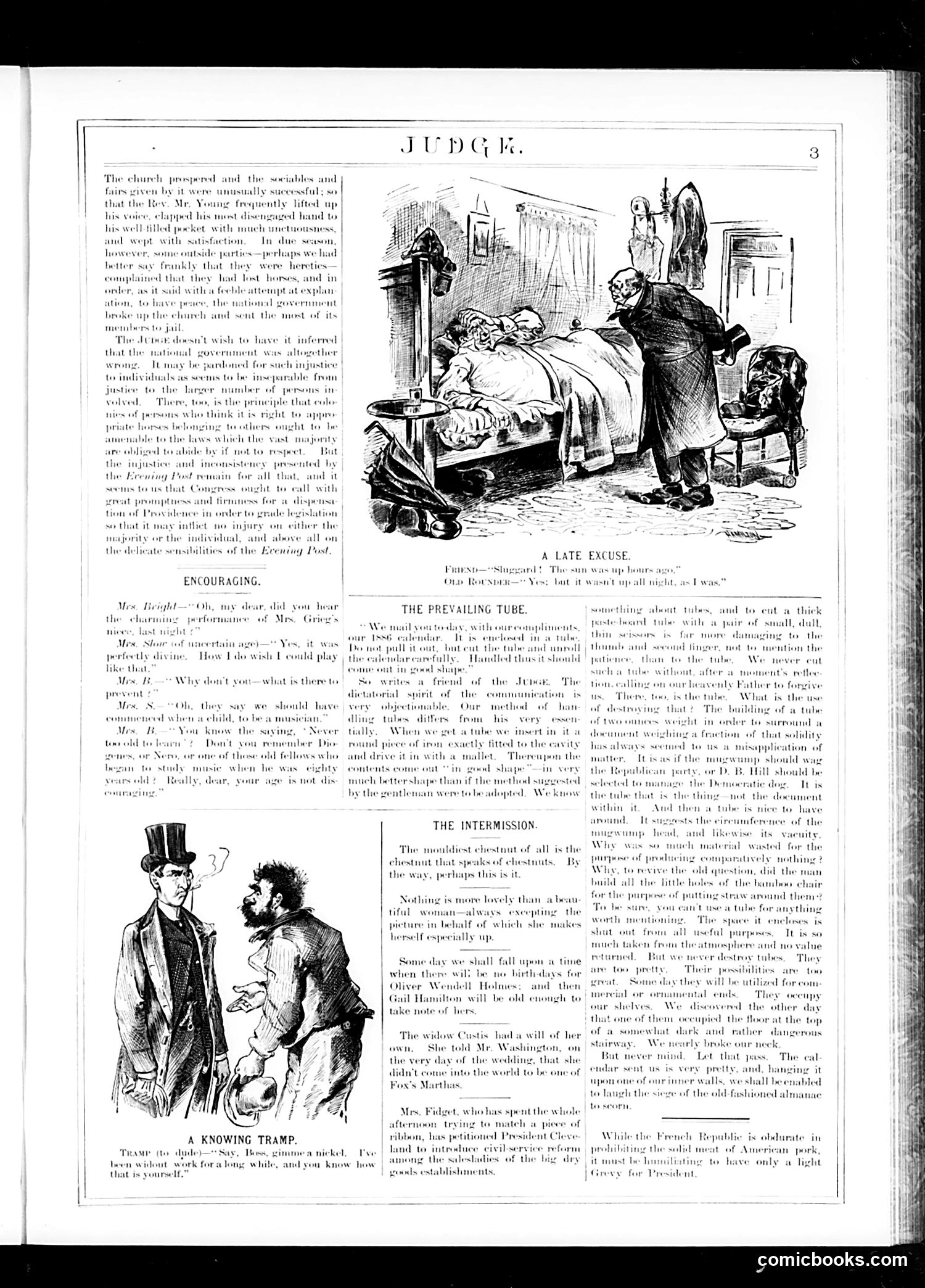
This page from *Judge* contains three satirical pieces mocking contemporary social issues: **"A Late Excuse"** depicts a domestic scene where a husband claims his lateness resulted from poor sunlight, not negligence—absurd reasoning the cartoonist ridicules. **"The Prevailing Tube"** satirizes rigid bureaucratic procedure. A correspondent complains that experts insist tubes be carefully unrolled, but common practice is to hammer them open with mallets. The satire targets pedantic officialdom imposing impractical rules contrary to practical working methods. **"The Intermission"** column contains gossipy anecdotes, including a jab at a woman's age and marriage prospects, and Mrs. Fidget's petition to President Cleveland regarding civil service reform among female employees—mocking both feminine concerns and political patronage. The dialogue piece "Encouraging" jokes about a woman claiming age prevents her from learning piano, referencing the proverb that one can learn at any age. The overall tone ridicules social pretension, bureaucratic absurdity, and contemporary gender dynamics with typical Victorian-era humor.
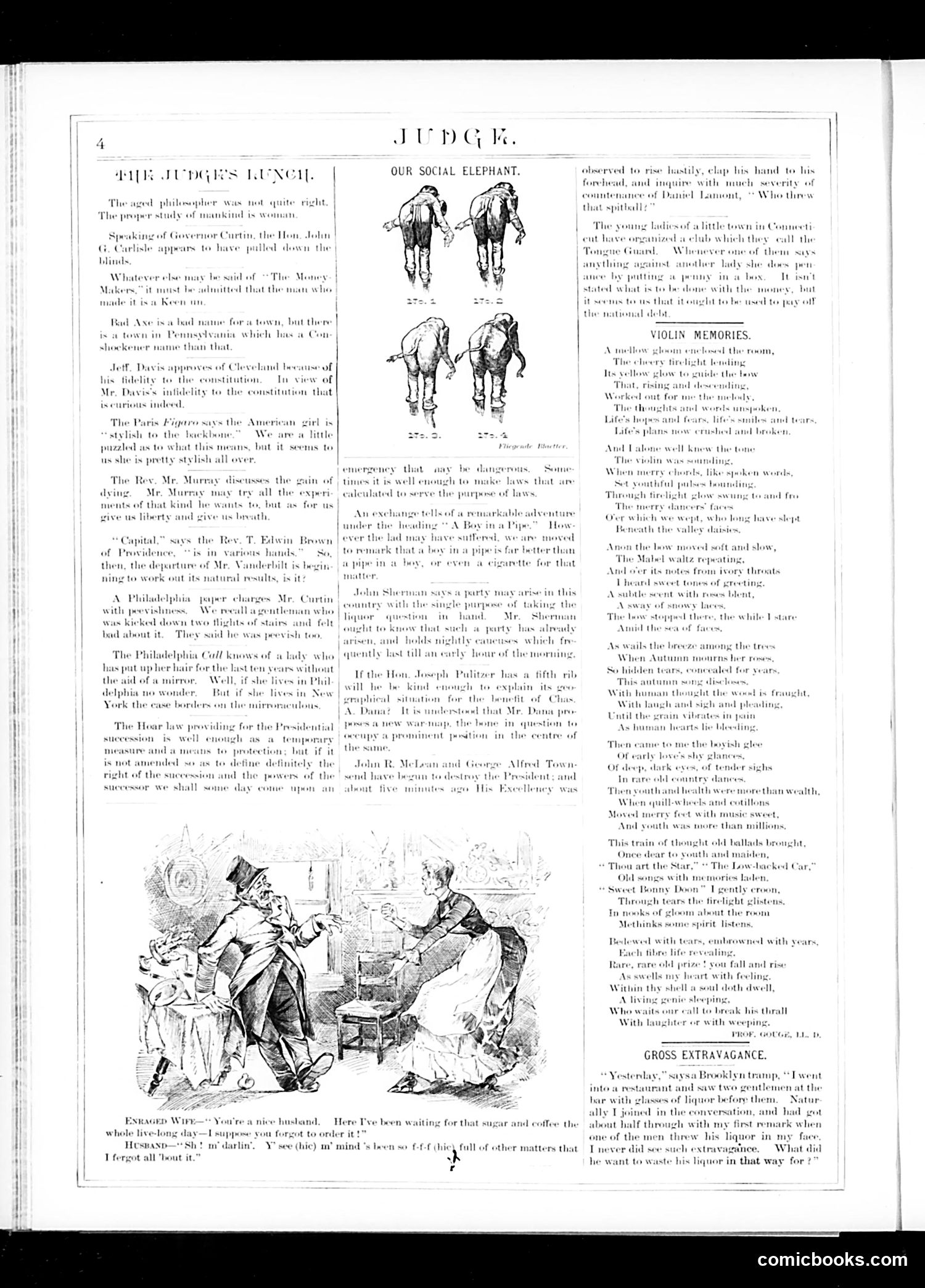
This page from *Judge* contains several satirical pieces typical of the publication's political and social commentary. The main visual cartoon shows an "Aged Wife" confronting her drunk husband about forgetting to order sugar and coffee—a domestic humor piece poking fun at marital discord and male irresponsibility. The text includes various brief satirical commentaries on contemporary figures and issues, referencing President Cleveland, Jeff Davis, and various social observations. "Our Social Elephant" section contains four elephant drawings with captions about legal matters. The page also features "Violin Memories," a sentimental poem about music and nostalgia, and "Gross Extravagance," a short joke about a Brooklyn tramp describing wasteful bar behavior. The overall content mixes political jabs, domestic humor, and sentimental verse—typical of *Judge's* eclectic 1880s-90s format blending satire with lighter entertainment for middle-class readers.
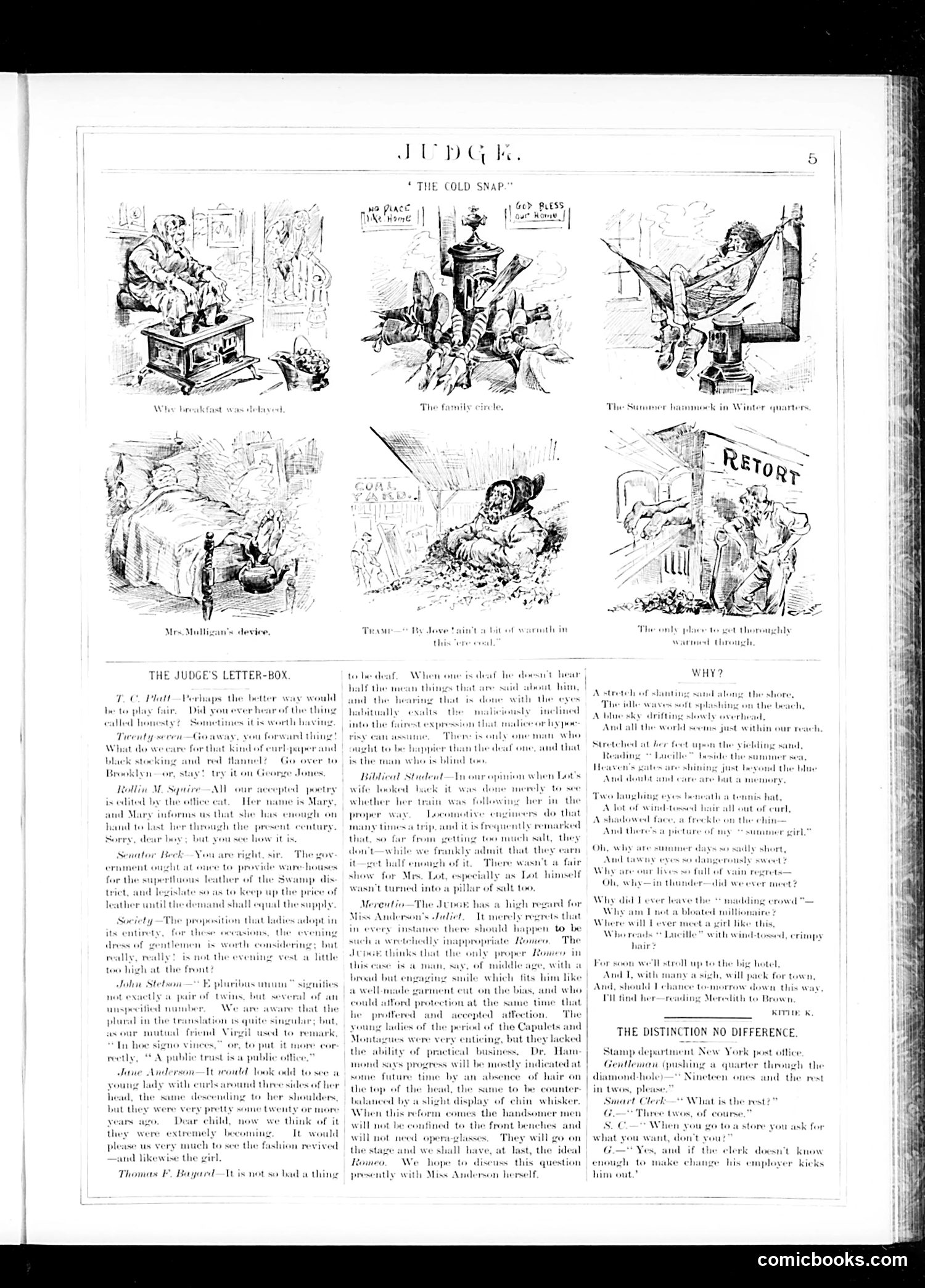
This Judge magazine page (titled "The Cold Snap") contains six satirical comic panels and a letters section poking fun at Victorian-era social conventions and public figures. **The Comics:** The six illustrated vignettes mock how people cope with winter cold—a man by his stove, a family huddled together, someone in a hammock indoors, someone in bed, and scenes at a resort. The humor targets the absurd lengths people go to escape winter discomfort. **The Letters Section:** Readers write complaints and observations to Judge's editor. References include Senator Platt (likely Thomas Collier Platt, a New York Republican), discussions about proper etiquette, deaf versus blind people (a moral lesson), and the Biblical story of Lot's wife. The tone is gentle mockery of readers' earnest concerns. **"Why?"** is a sentimental poem about lost summer romance—typical of the era's nostalgic verse. **"The Distinction No Difference"** is a brief joke about a Post Office clerk unable to make change, mocking bureaucratic incompetence. The page reflects Judge's role: satirizing middle-class anxieties, social pretense, and minor frustrations of Gilded Age America.
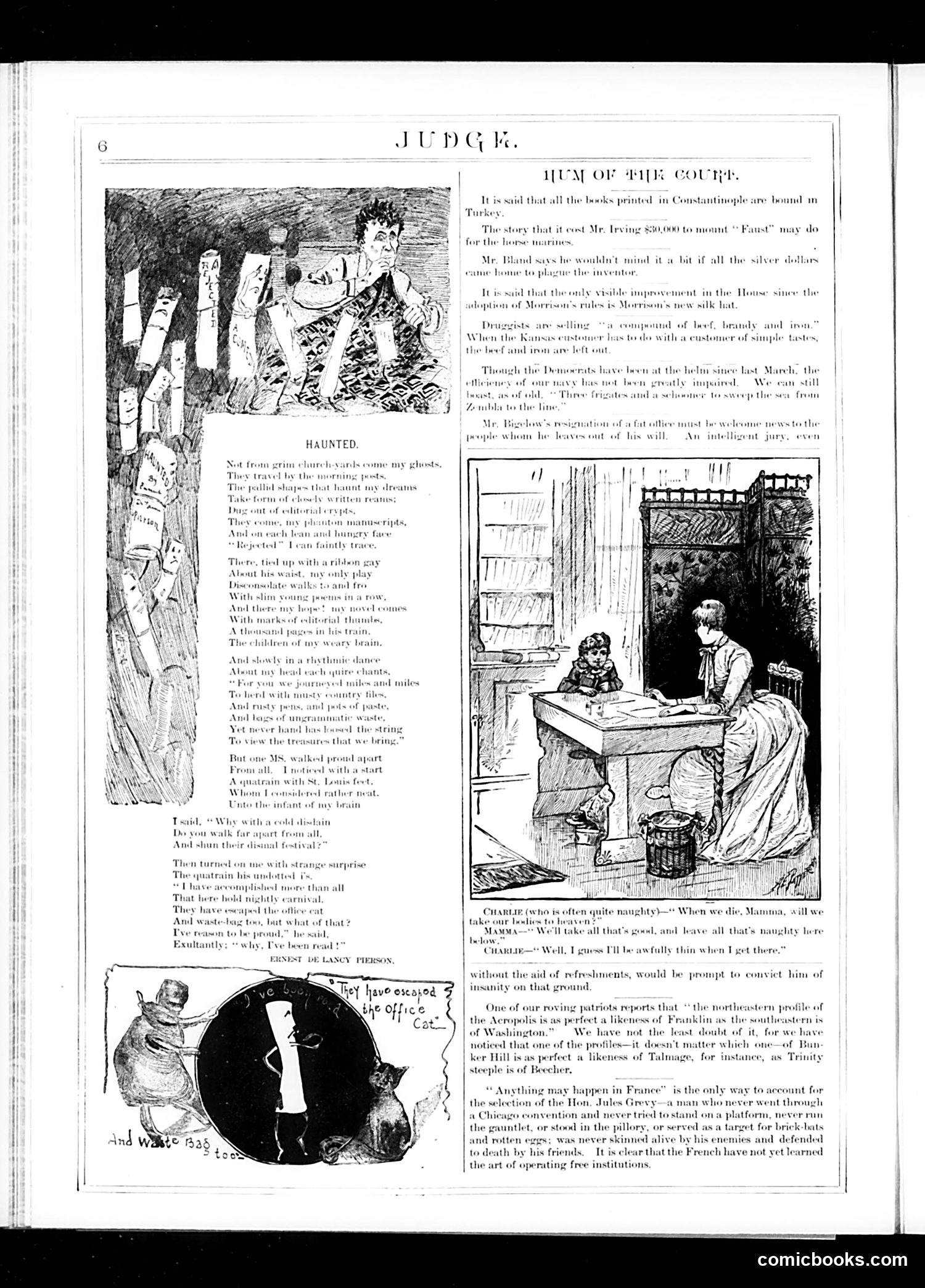
This page contains satirical commentary on contemporary American politics and society (circa 1870s-80s, based on references). **Left side:** "Haunted" is a poem by Ernest de Lancy Pierson about a writer's unpublished manuscripts that haunt him like ghosts—a relatable complaint about editorial rejection. **Right side illustrations and text** mock various political figures and issues: - A conversation between "Charlie" and "Mamma" about dying and the afterlife appears to be gentle domestic satire - References to **Morrison's silk hat** as the only "visible improvement" in the House since Democrats took helm—mocking the ineffectiveness of Democratic leadership - Criticism of the Navy's efficiency decline under Democratic administration - A jab at **Jules Grévy's** election in France, suggesting anything absurd can happen there - Comparisons of political profiles to famous figures like **Henry Ward Beecher** and **Bunker Hill**—implying politicians resemble caricatures The overall tone critiques Democratic governance while poking fun at recognizable public figures through unflattering comparisons.
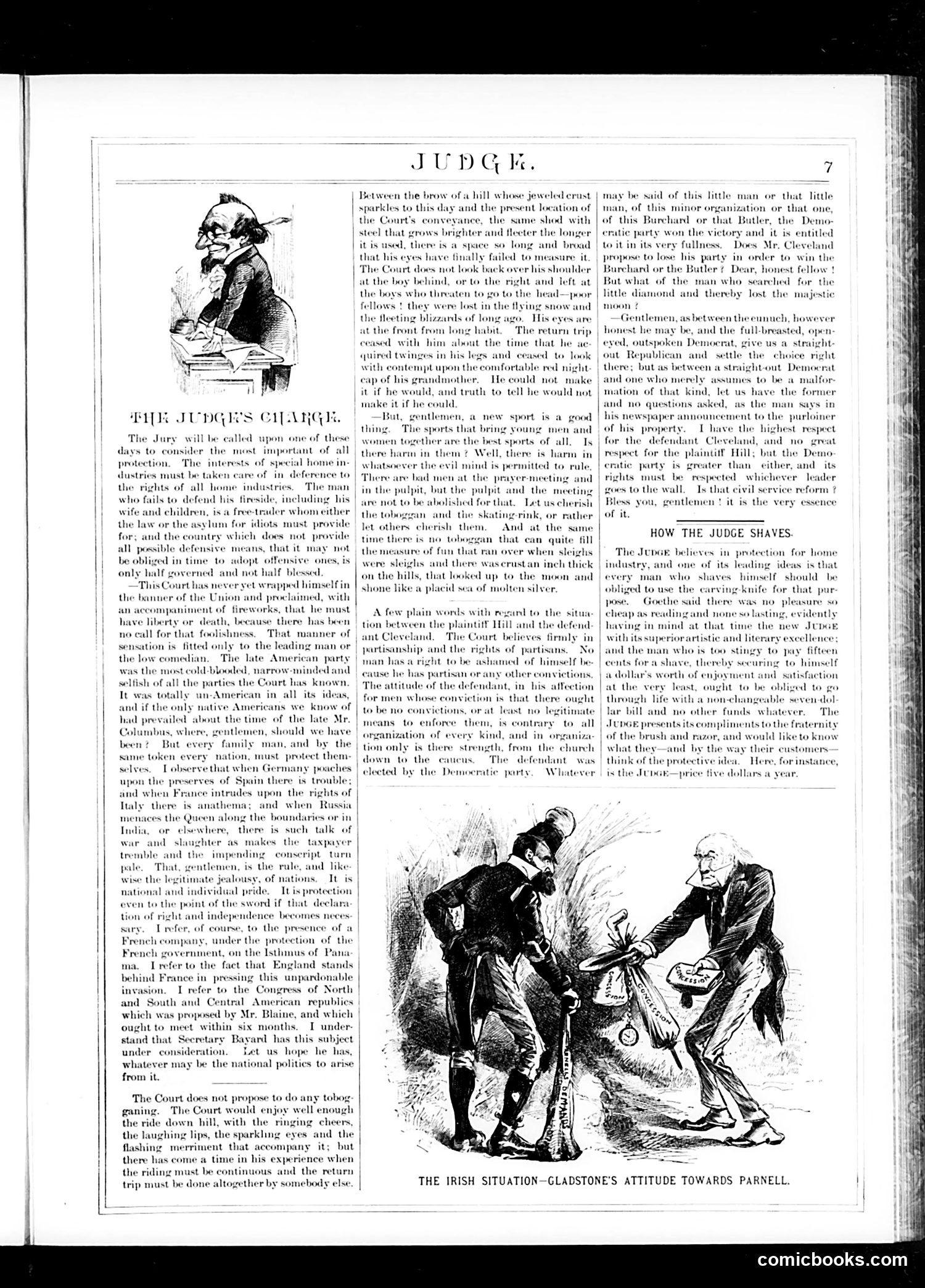
This page contains two political cartoons addressing late 19th-century American politics, likely from the 1880s based on references to Cleveland and civil service reform. **Top Cartoon - "The Judge's Charge":** Features an elderly judge addressing a jury about protecting American industries and national interests. The lengthy text emphasizes defending "home industries" and criticizes the "late American party" (the Know-Nothing Party) as "un-American." The judge defends nationalist foreign policy, referencing European interventions and Congressional discussions about Central American republics. **Bottom Cartoon - "The Irish Situation—Gladstone's Attitude Towards Parnell":** Depicts an interaction between two figures likely representing British Prime Minister William Gladstone (right) and Irish nationalist Charles Parnell (left), reflecting tensions over Irish Home Rule. The satire concerns Britain's contradictory stance toward Irish independence. Both cartoons critique political inconsistency and hypocrisy—whether regarding American protectionism or British Irish policy. The illustrations use exaggerated facial features typical of period political satire.
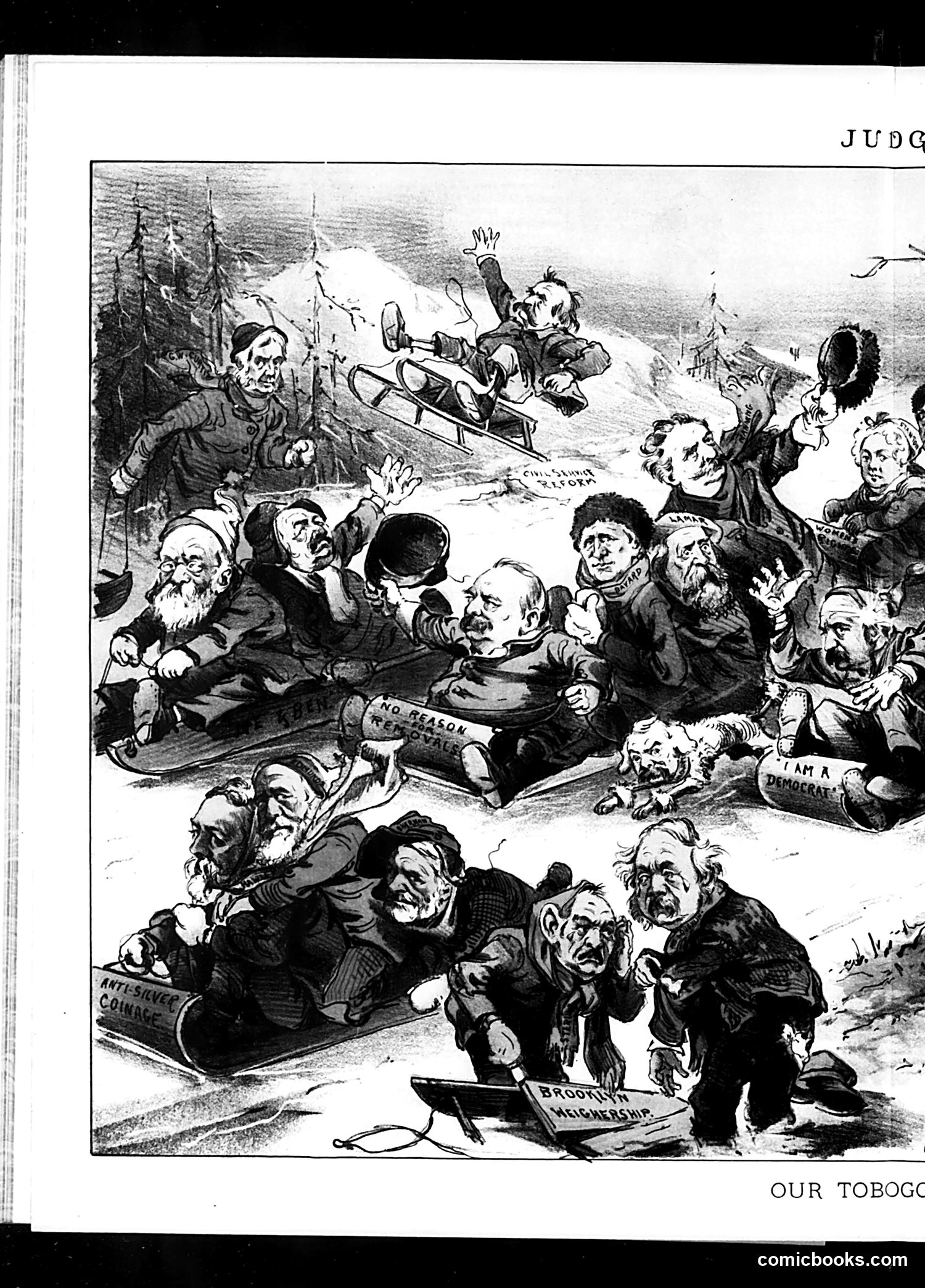
This appears to be a political cartoon titled "Our Toboggan" from *Judge* magazine. The image depicts numerous caricatured figures sliding down a snowy slope on toboggans, suggesting a descent or decline. Several figures are labeled with visible text including "NO REASON," "I AM A DEMOCRAT," and what appears to be references to political positions or scandals. The cartoon likely satirizes political figures or movements of its era experiencing a downward trajectory—a "toboggan slide" being a metaphor for rapid, uncontrolled descent. The exaggerated facial features and crowded composition typical of late 19th/early 20th-century political satire suggest mockery of specific politicians or parties. However, without clearer OCR text or date information, the specific figures and exact political event being satirized cannot be definitively identified from the image alone.
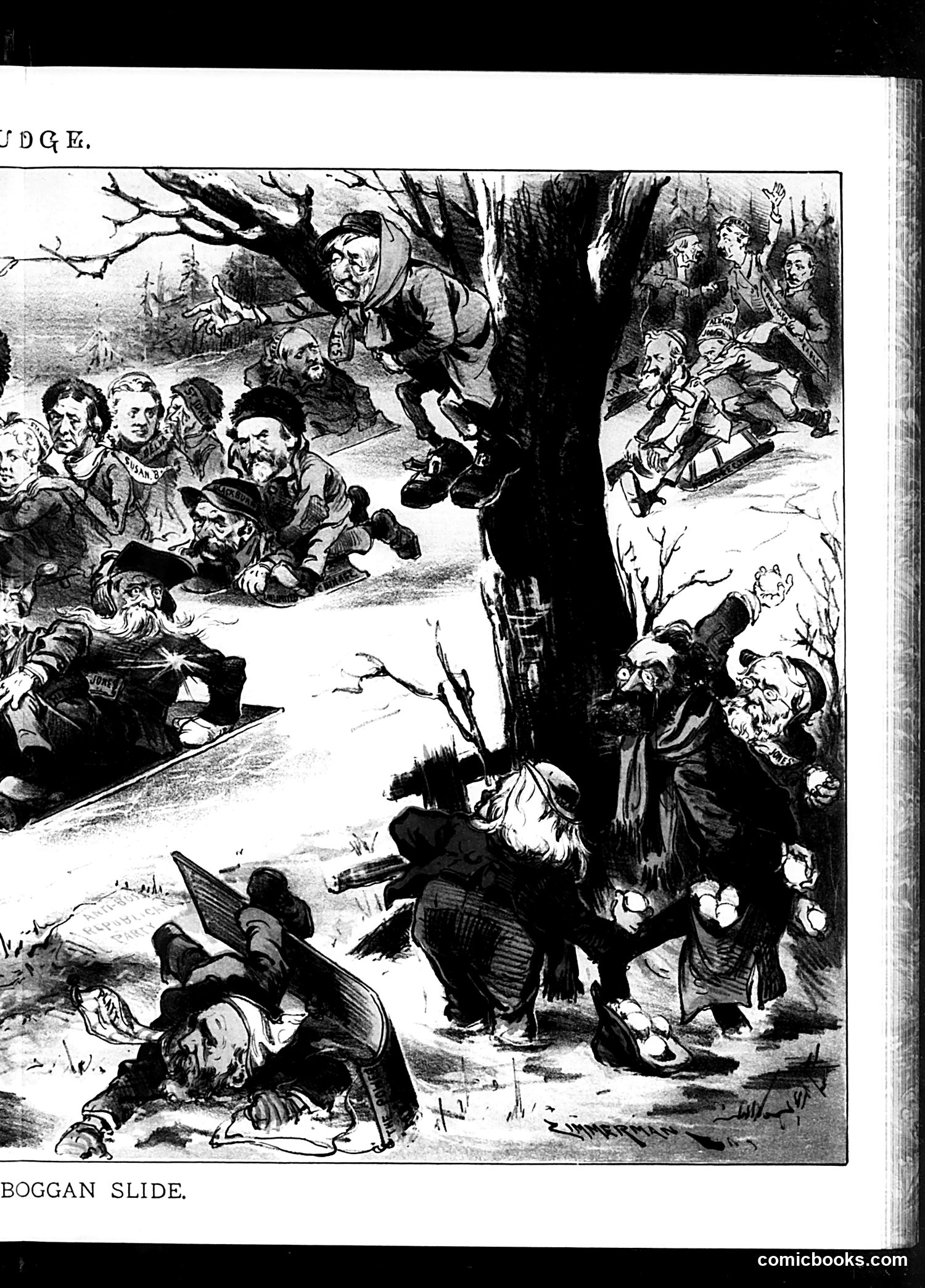
This Judge cartoon satirizes Irish immigrants, using the term "boggan" (a derogatory reference to Irish bog dwellers). The image depicts numerous figures with exaggerated Irish features in a chaotic winter scene on a snowy slope. The composition shows Irish immigrants literally sliding down a hill—likely a visual pun on their supposed incompetence or lack of control. Figures tumble and fall while others watch from above, suggesting mockery of Irish people as clumsy or foolish. This reflects late-19th/early-20th century American anti-Irish prejudice. Judge magazine frequently published such ethnic caricatures. The "slide" appears to metaphorically represent Irish social or economic "decline" while simultaneously playing on slapstick humor common to the era's satirical publications.
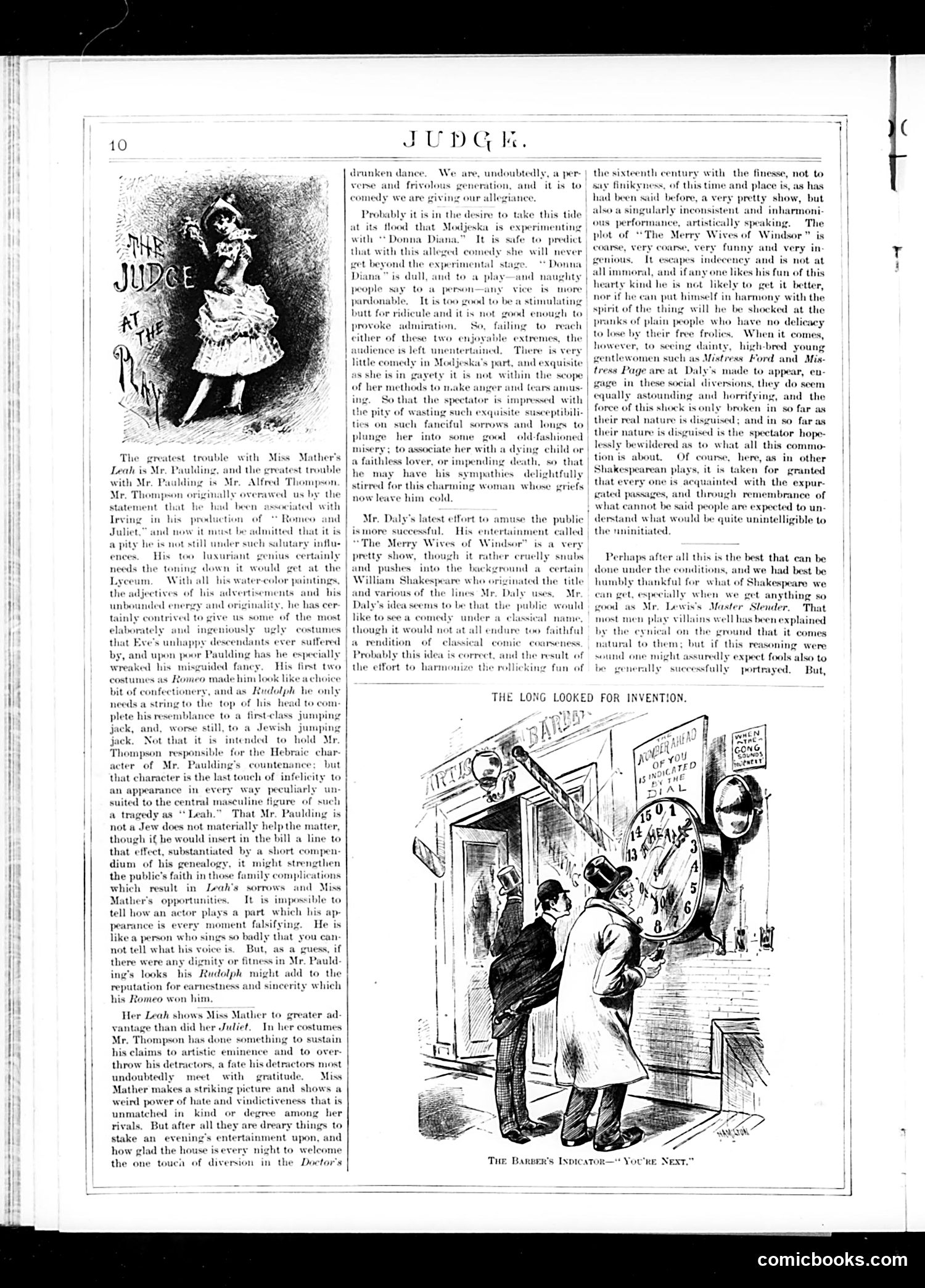
This page contains theater criticism discussing productions at what appears to be a major New York theater (likely Daly's Theatre, mentioned at bottom). The main review critiques actor Mr. Paulding's performances in *Romeo and Juliet* and *Leah*, directed by Mr. Thompson. **The Satire:** The critic mercilessly mocks Paulding's appearance and casting, particularly his physical unsuitability for tragic roles. There's a notably harsh antisemitic jab—the reviewer suggests Paulding's "Hebraic" features make him inherently wrong for tragedy and sarcastically suggests adding a genealogical note to the playbill to clarify he's "not a Jew." **The Cartoon** (bottom right) titled "The Barber's Indicator—You're Next" shows customers waiting outside a barber shop with a large clock/indicator showing "You're Next"—a visual pun about the wait times. **Context:** This reflects late 19th-century theater criticism's personal viciousness and the casual antisemitism embedded in period entertainment discourse. The page demonstrates Judge magazine's function as arbiter of theatrical taste and social values.
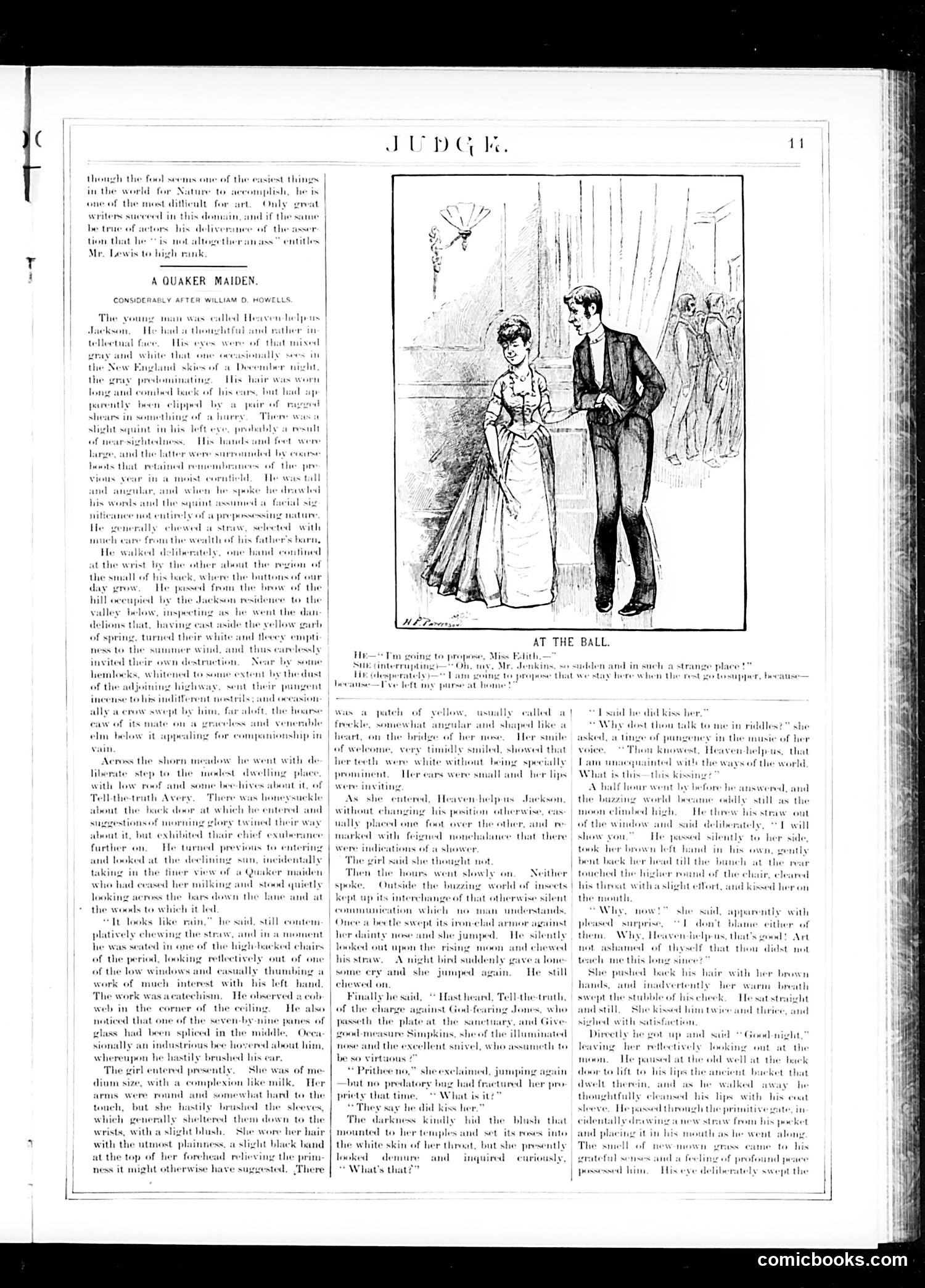
This page presents a romantic narrative titled "A Quaker Maiden" by William D. Howells, illustrated with a sketch of a couple at a ball. The story describes a young man called "Heaven-help-us Jackson" — characterized by his awkward appearance, drawling speech, and rural New England mannerisms — courting a Quaker woman named Edith. The satire targets the contrast between Jackson's ungainly exterior and his unexpectedly poetic, philosophical courtship. The dialogue captures the tension: when Edith questions his sincerity after a kiss, he responds with cryptic, almost Shakespearean declarations rather than direct romantic reassurance. The humor derives from the juxtaposition of rustic clumsiness with pretentious intellectualism—suggesting that even awkward, inarticulate men might harbor romantic idealism, while also gently mocking both Quaker propriety and rural American courtship conventions of the period.
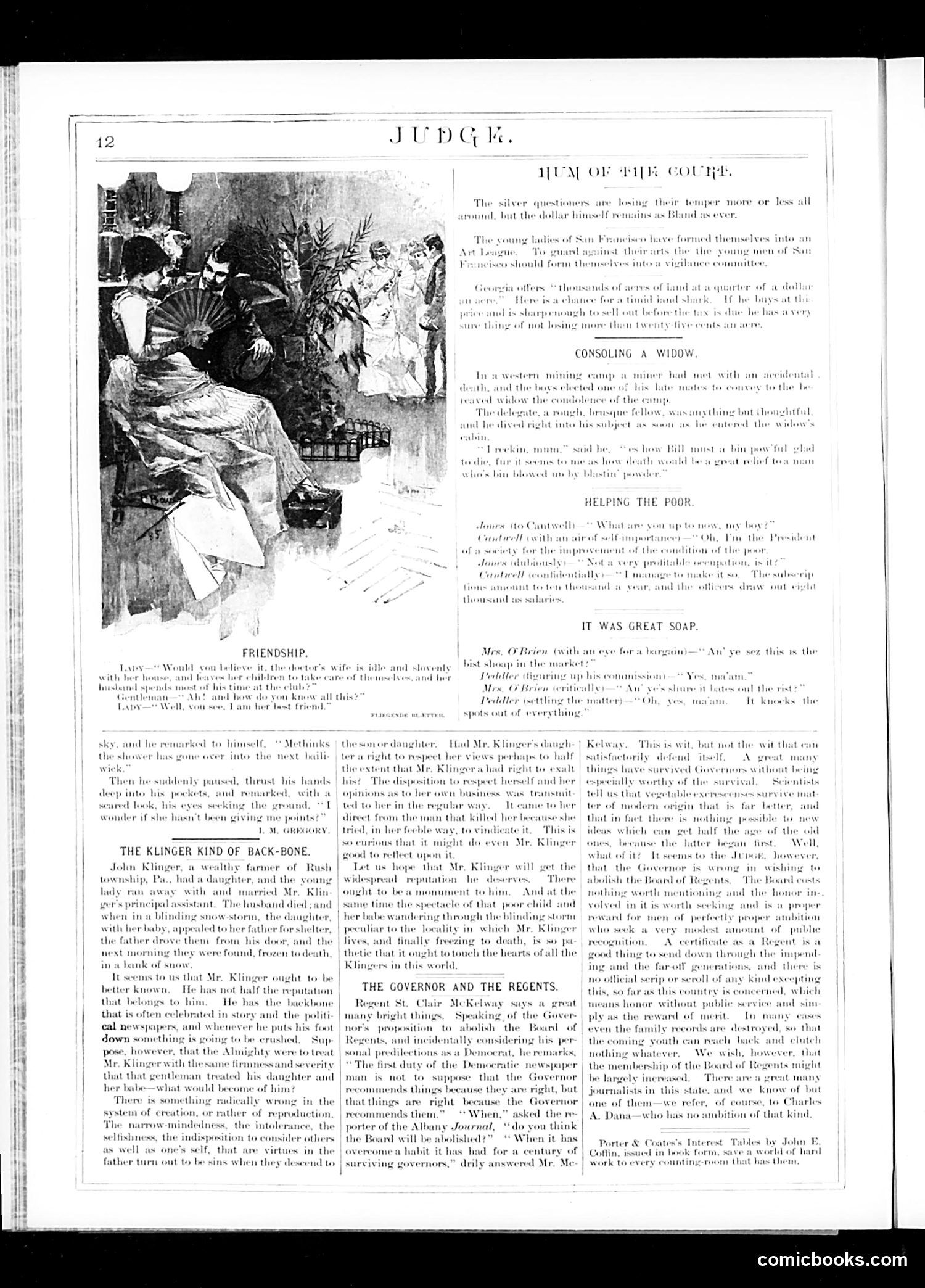
This page contains multiple satirical sketches typical of Judge's social commentary: **"The Klinger Kind of Back-bone"** criticizes a farmer named Klinger who abandoned his pregnant daughter rather than face social shame. The satire mocks his cowardice—he lacks moral backbone despite being wealthy. **"The Governor and the Regents"** appears to debate whether the Governor should abolish the Board of Regents. The dialogue suggests tension between Democratic leadership and institutional governance, with commentary on whether things are "right because the Governor recommends them." **Smaller sketches** include "Consoling a Widow" (a miner's awkward condolence), "Helping the Poor" (apparent hypocrisy in charity work), and "It Was Great Soap" (a working-class transaction). The overall theme reflects Judge's focus on exposing moral hypocrisy, particularly among the wealthy and powerful who lack courage or genuine philanthropy. The specific political references (Governor, Board of Regents, Democratic politics) are unclear without additional historical context.
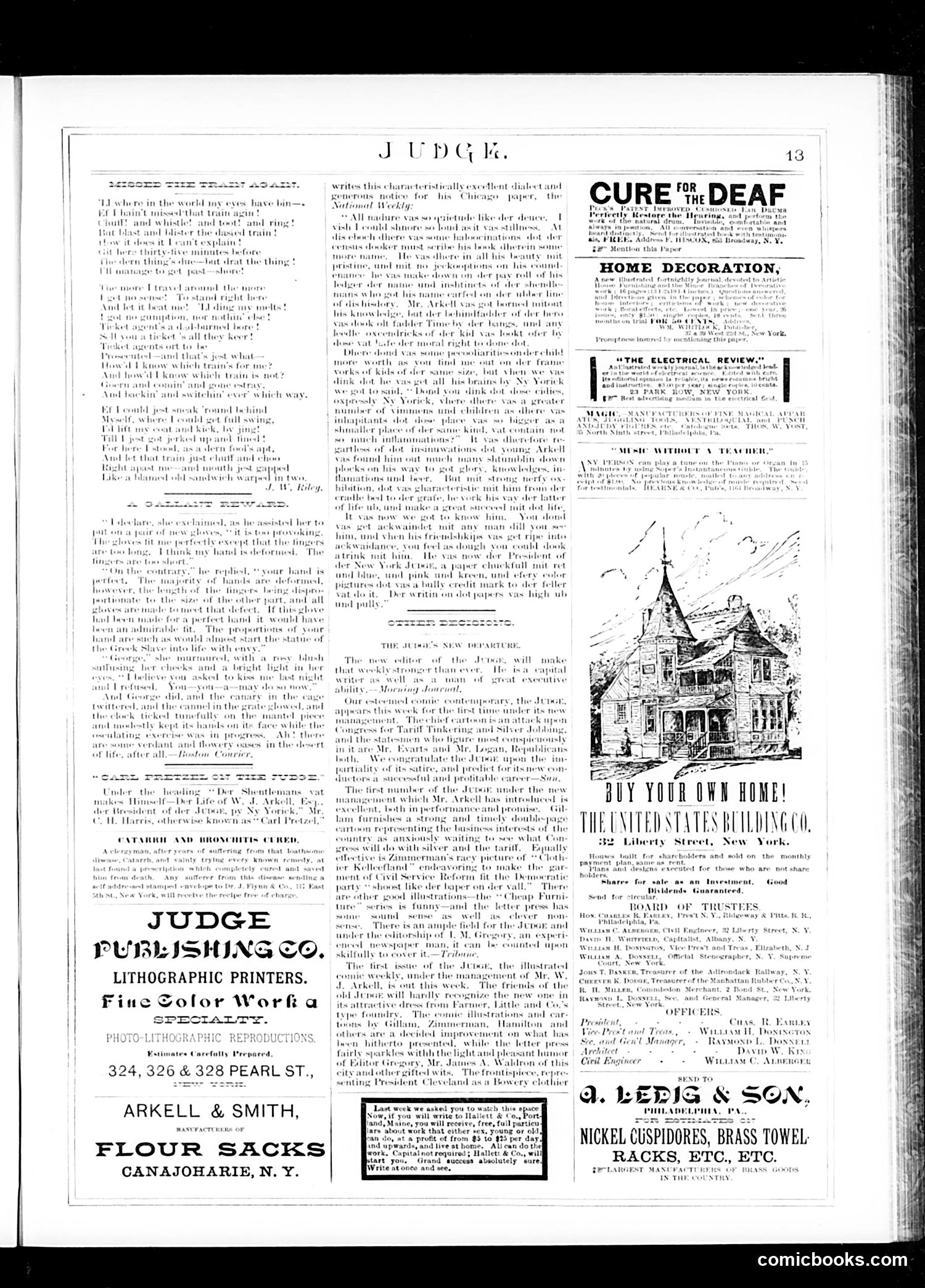
This page is primarily **advertising and announcements** with minimal cartoon content visible. The readable elements show: **Main Content:** - A poem or article titled "WHERE THE TRAMP AGAIN" discussing a vagrant character, written in dialect - References to "Der Shentle" and "Carl Pretzel"—likely German-American stereotypes common to Judge's satirical style **Notable Advertisement:** - "CURE FOR THE DEAF" (top right)—a period medical advertisement, typical of magazine content **Other Advertisements:** Judge Publishing Co. (lithographic printers), Arkell & Smith (flour sacks), and G. Ledig & Son (nickel cuspidores and brass towel racks) **Historical Context:** The German-dialect writing and character names suggest ethnic humor targeting German immigrants, which was common in 1880s-90s American satire. However, without clearer cartoon imagery, the specific satirical point remains unclear. This appears to be a regular issue page mixing editorial content with commercial advertising.
This page is primarily **advertising**, not editorial content or political cartoons. It consists of dense commercial advertisements for late 19th-century products and services: perfumes (Lundborg's), pianos for rent, flour sacks, printing inks, safes, wedding gifts, linseed oil, and various manufacturing companies. The only illustration appears to be a small **Hay-Fever Cream Balm advertisement** with a product image, but the text is too small to discern specifics. There is **no political cartoon or satirical content visible**. This is a standard ads page from Judge magazine—the publication did contain cartoons and satire elsewhere, but this particular page served the practical function of generating revenue through paid advertisements rather than commentary on current events or politics. The page reflects the commercial nature of late 19th-century American magazines, which relied heavily on advertising to sustain publication.
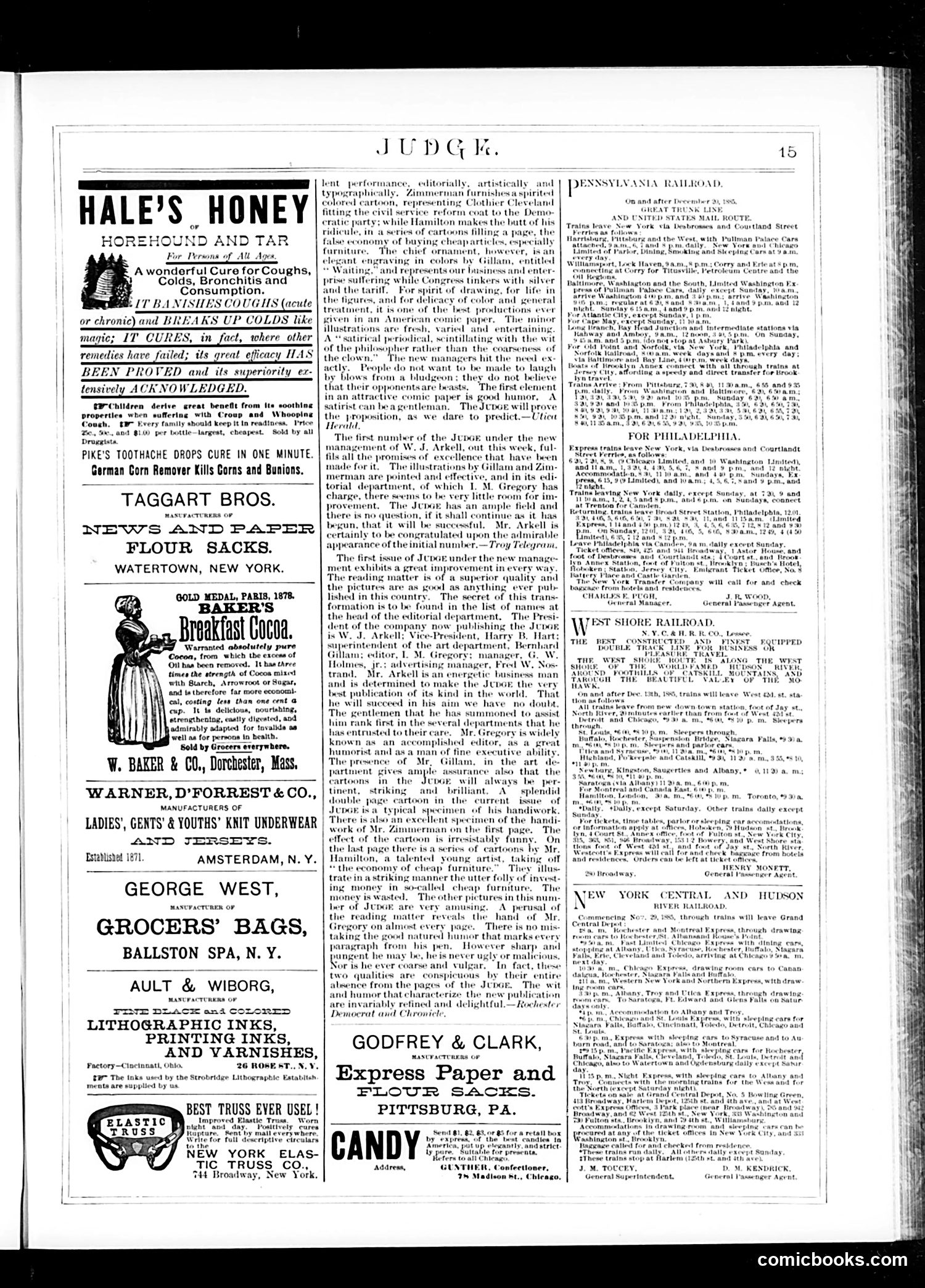
This page is primarily **advertisements** with a brief editorial section praising the new *Judge* magazine's inaugural issue. The editorial text (center-right) reviews the magazine's quality, highlighting cartoons by artists named Zimmerman and Hamilton. It praises the publication's "wit" and "satire," noting that *Judge* aims for "the philosophy of the philosopher rather than the clown." The text mentions W.J. Arkell as a key figure in the publication's management. The bulk of the page features **period advertisements** for various products: Hale's Honey cough remedy, Baker's Cocoa, corset products, lithographic inks, and medical devices like Pike's Toothache Drops and an elastic truss. These ads are typical of 1880s trade publications and reflect contemporary consumer goods and health products. **No specific political figures or events are identifiable** from the visible content, though the editorial mentions the magazine will satirize current affairs including tariffs and silver currency debates.
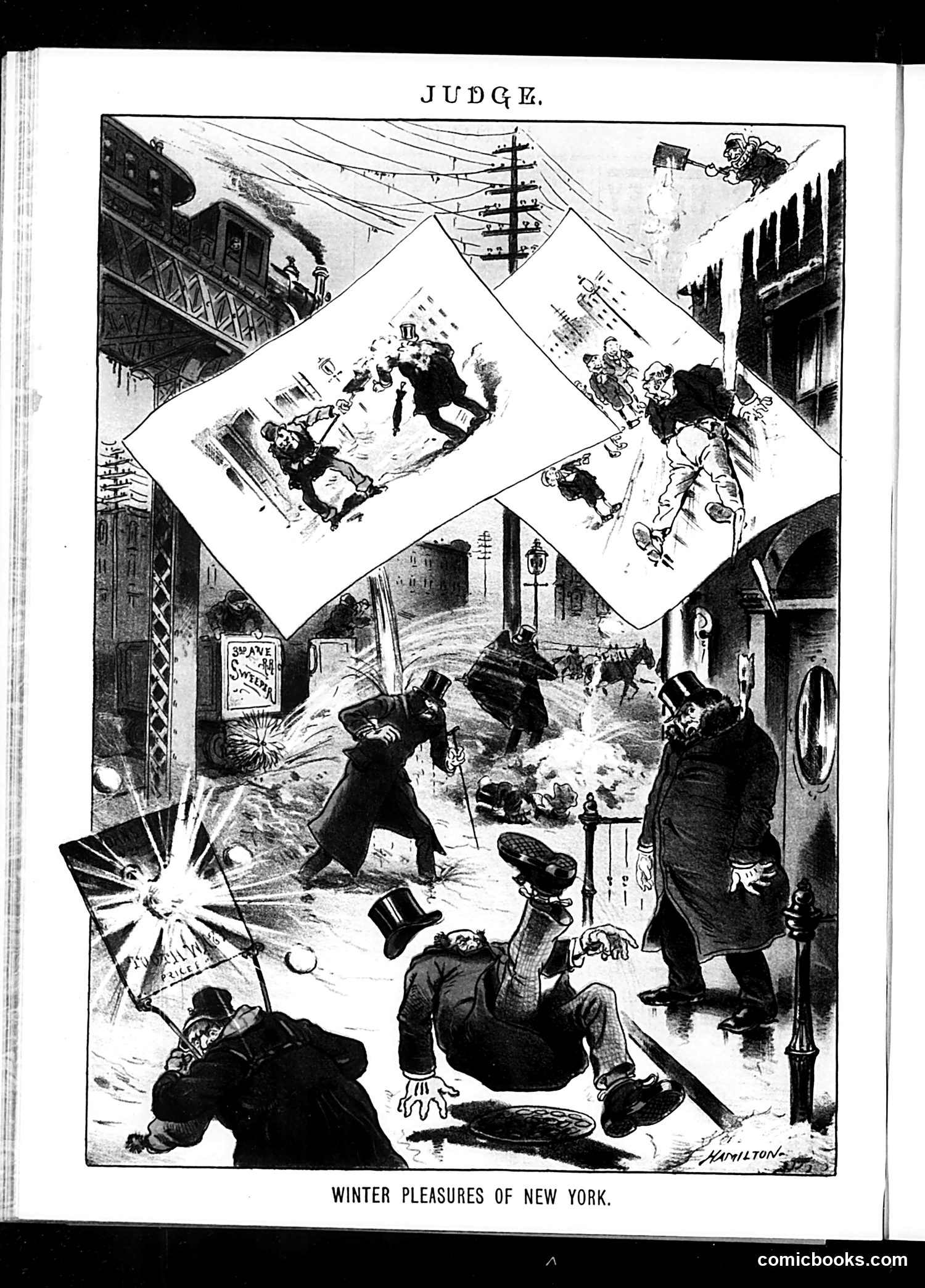
This Judge cartoon satirizes the chaos of New York winters through slapstick humor. The street scene shows well-dressed gentlemen in top hats repeatedly falling on ice, slipping, and colliding with each other. Two floating panels above depict additional mishaps—more people tumbling and struggling. The satire targets the contrast between New Yorkers' dignified appearance (formal winter coats and hats) and their undignified reality during icy conditions. The title "Winter Pleasures of New York" is ironic; rather than pleasant activities, the cartoon shows the inevitable physical comedy of urban winter life. The artist, Hamilton (visible signature), uses exaggerated motion lines and expressions to emphasize the absurdity. This reflects Judge's typical approach: mocking contemporary urban life through visual humor rather than political commentary.