
A complete issue · 16 pages · 1883
Judge — April 7, 1883
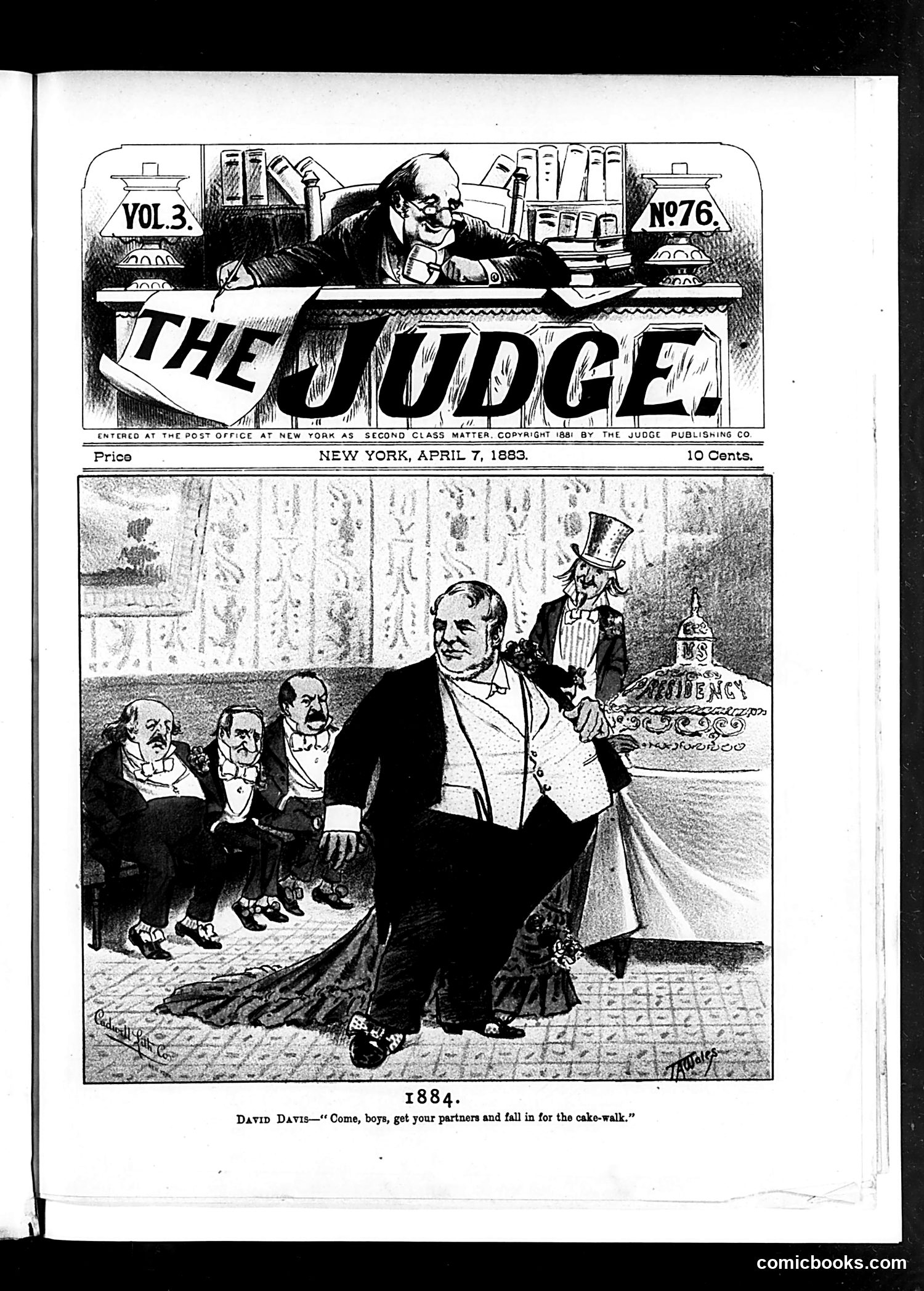
This political cartoon, attributed to the artist Tames (signature visible), depicts **David Davis** inviting young boys to participate in an "cake-walk"—a reference to a popular African American dance of the era, which Judge uses here as satirical imagery. The cartoon appears to critique Davis (likely the politician/judge of that name) through exaggerated caricature and the degrading racial stereotype of the cake-walk. The small suited figures behind him and the formal setting suggest mockery of his authority or political position. The 1884 date caption and formal dress indicate this ridicules a specific political figure or scandal, though the precise historical context requires additional research. The satirical intent uses racial imagery common to the era's offensive editorial cartooning.
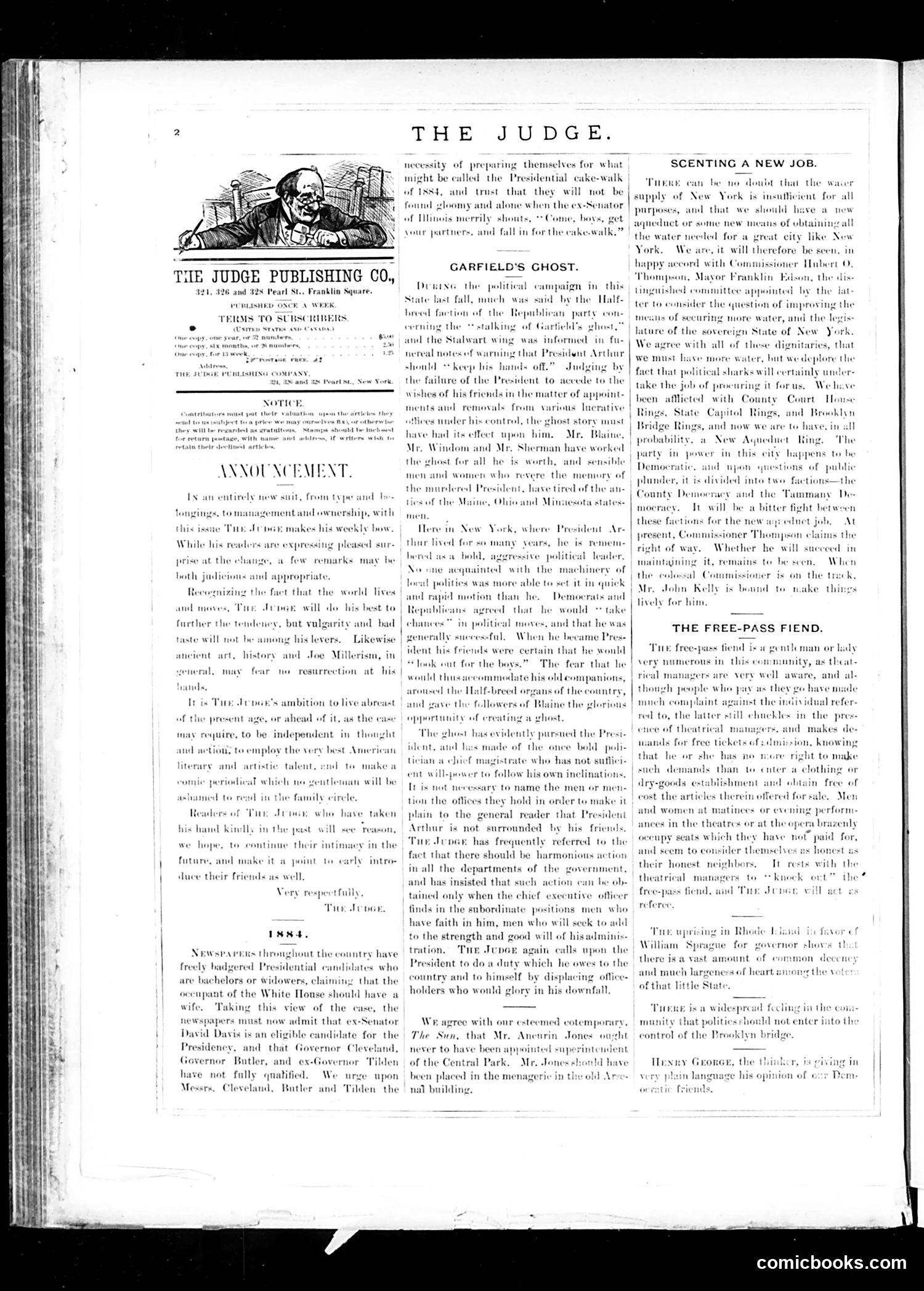
This page from Judge (1884) contains primarily editorial and advertising content rather than cartoons. The masthead shows **The Judge Publishing Company** announcing a complete redesign and new management. The main political content appears in "**Garfield's Ghost**," which references the 1881 assassination of President James A. Garfield. The article criticizes President **Chester Arthur** (Garfield's successor) for allegedly failing to honor Garfield's memory and legacy. It suggests Arthur is being haunted by pressure from both "Half-breed" and "Stalwart" factions of the Republican Party—rival wings competing for control. The piece urges Arthur to demonstrate independence by removing political appointees who don't serve him loyally, framing this as a duty to Garfield's ghost and the nation. Another article, "**The Free-Pass Fiend**," criticizes theatrical managers who abuse free passes and expect favorable reviews in return, satirizing theater industry corruption. The page reflects 1884 Republican Party divisions and civil service reform debates of the era.
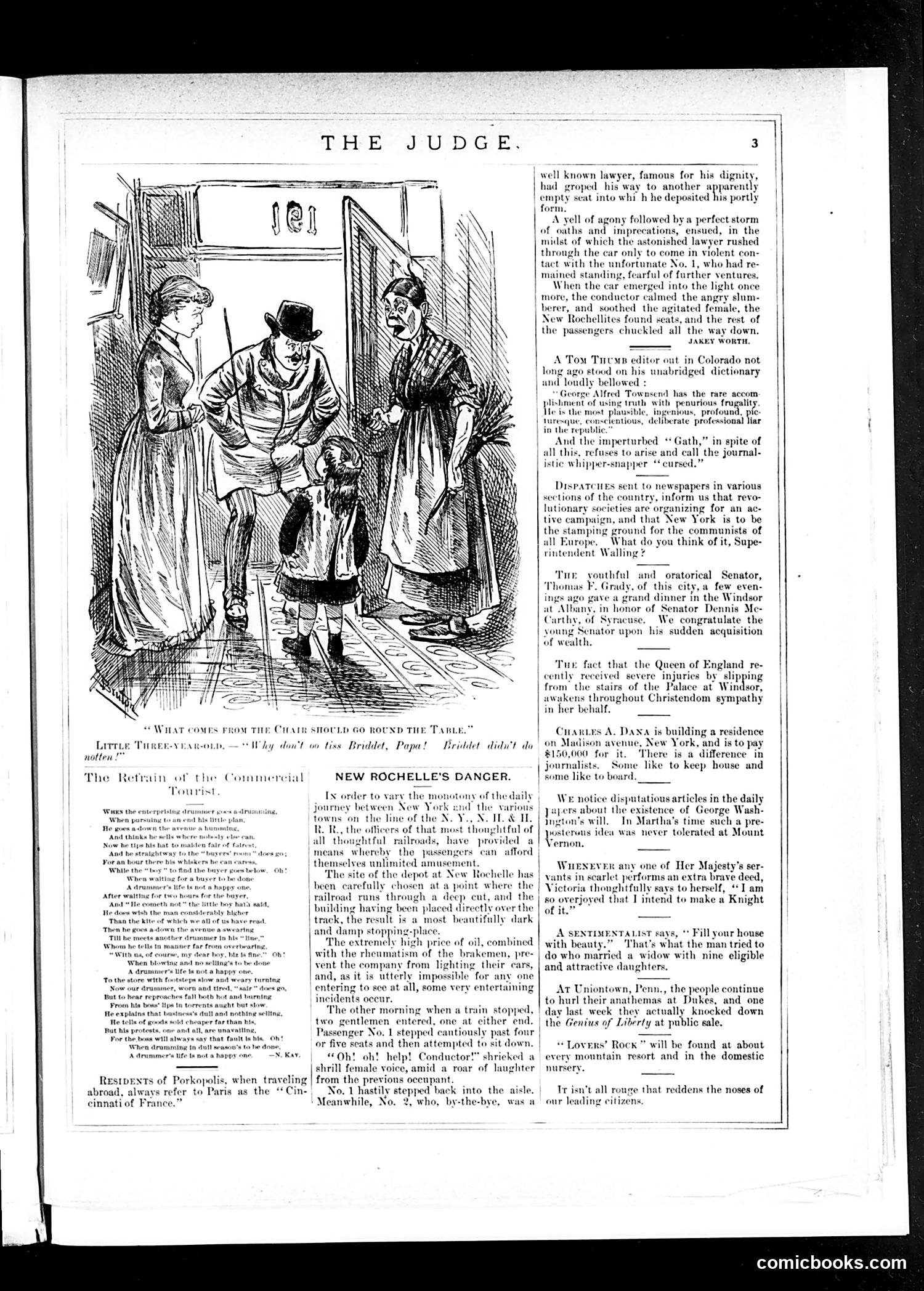
This page contains several satirical pieces typical of Judge's social commentary: **Main Cartoon:** "What Comes from the Churn Should Go Round the Table" depicts a domestic scene where a child (Bridget) is being scolded for not kissing someone named "Papa." The humor appears to reference Irish servants and domestic etiquette norms of the era. **"New Rochelle's Danger":** This article satirizes the New York, New Haven & Hartford Railroad's cost-cutting measures. The company saved money by not lighting passenger cars, leading to farcical incidents where passengers sit on occupied seats in the darkness—one unfortunate passenger sits on a lawyer, resulting in chaos when the train emerges into daylight. **Additional brief items** mock various public figures and events: a Colorado newspaper editor, revolutionary organizing concerns, Senator Brady's sudden wealth acquisition, Charles Dana's expensive house-building, debate over George Washington's existence, and miscellaneous social absurdities. The page's humor relies on the audience recognizing contemporary local figures, railroad practices, and social pretensions of the Gilded Age.
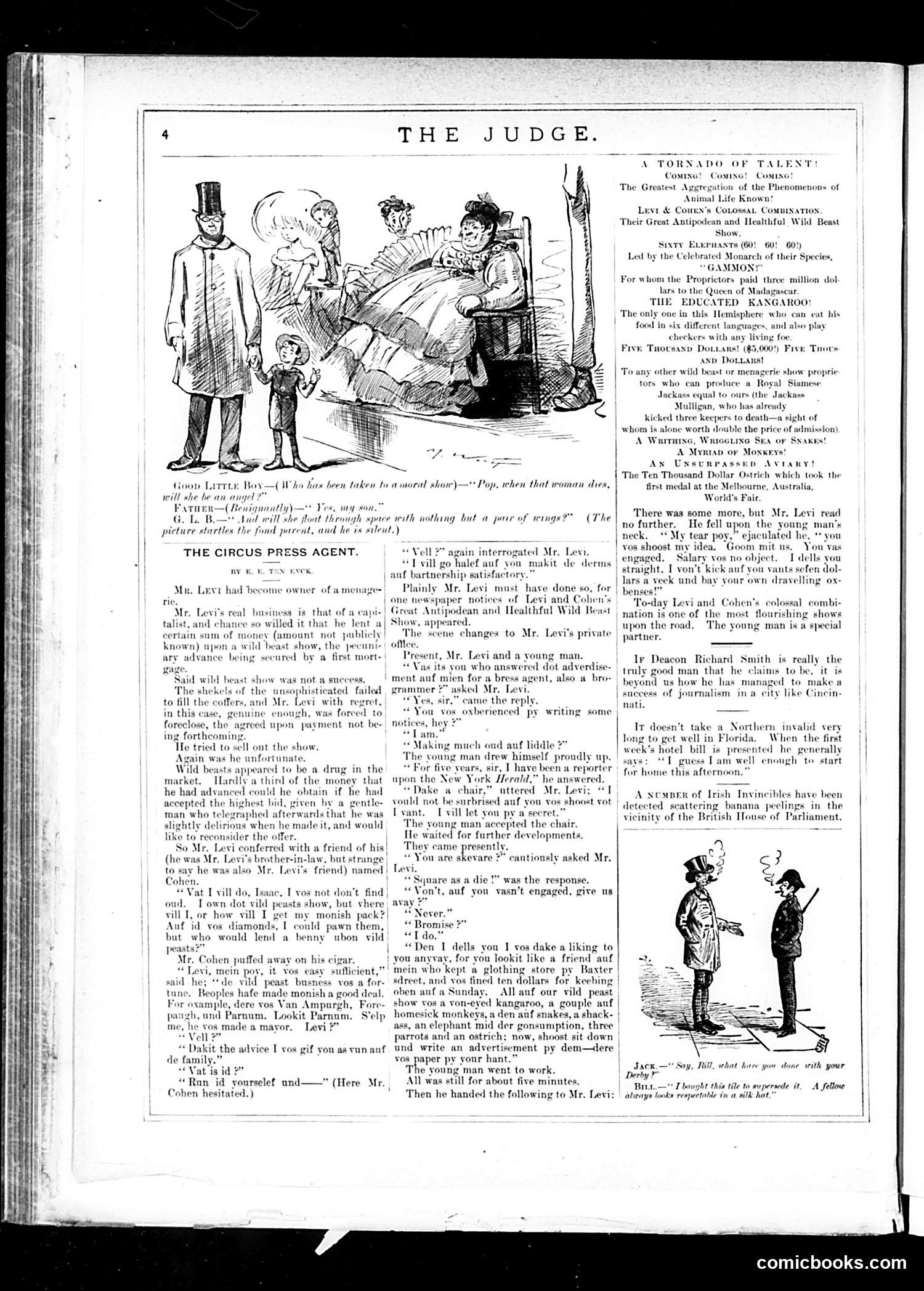
This is a humorous story about Mr. Levi, a Jewish capitalist who loses money lending to a failing wild beast show. Unable to recover his investment through conventional means, he partners with his brother-in-law Cohen to hire a young newspaper reporter as a "press agent" to drum up publicity. The satire targets two things: the exaggerated advertising claims of circus promoters (the absurd advertisement for the "Educated Kangaroo" and other fabricated attractions), and the desperation of circus owners to manufacture interest through press manipulation. The Yiddish-accented dialogue between Levi and Cohen—a common comedic device in Judge—reflects period stereotypes about Jewish businessmen, though the story itself portrays them as clever operators rather than villains. The page also includes a small sidebar about an Irish political threat, typical of Judge's varied content.
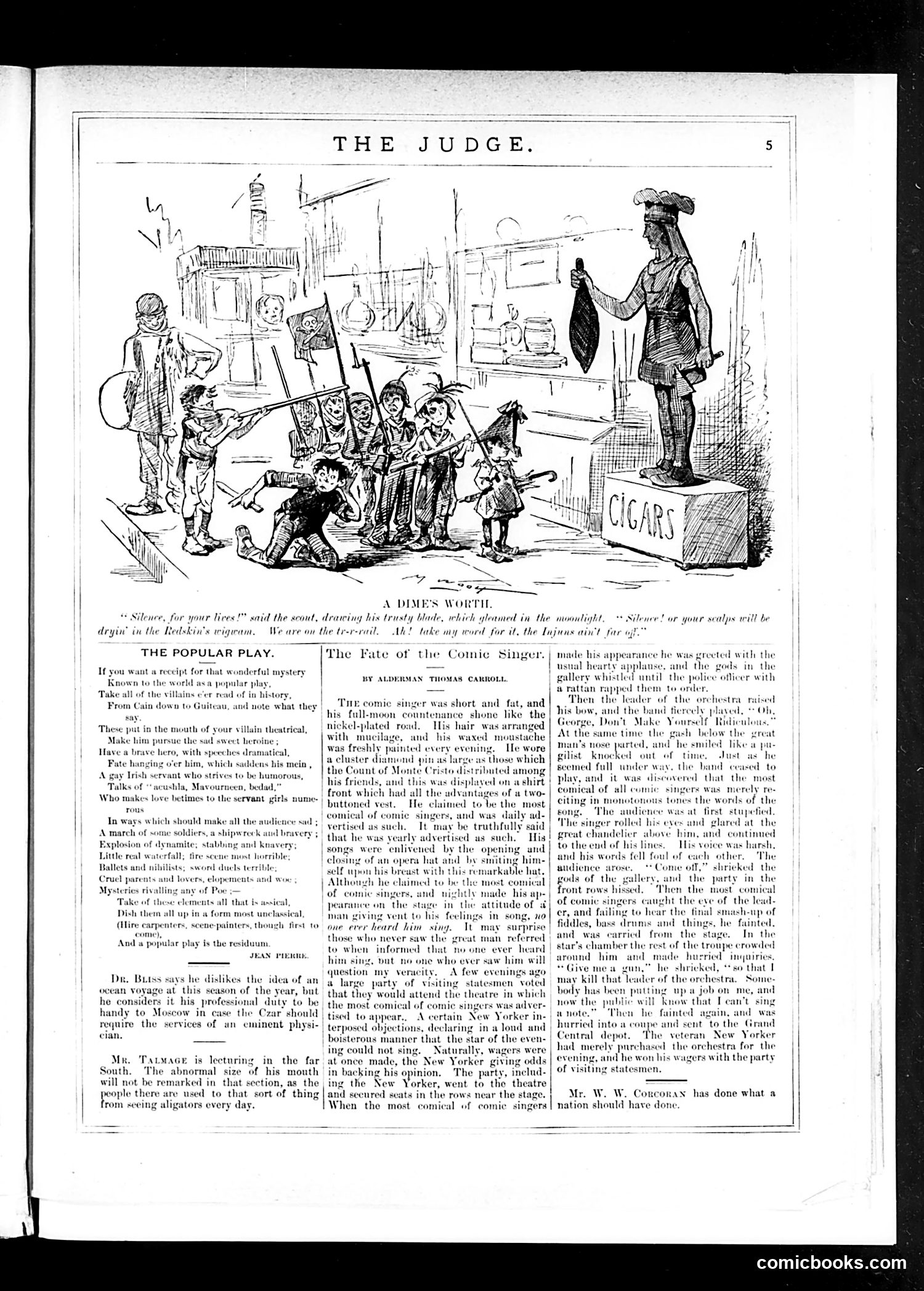
This page satirizes the formulaic construction of popular theatrical melodramas. The main cartoon illustrates a scout protecting settlers from Native Americans, accompanied by verse mocking how playwrights mechanically assemble plays by combining stock elements: villains (referencing Guiteau, the presidential assassin), heroines in distress, comic relief servants, explosions, sword fights, and shipwrecks. The accompanying article about "The Fate of the Comic Singer" by Thomas Carroll tells of a short, fat comic performer whose terrible singing voice goes unnoticed due to audience indifference—until one evening when an orchestra conductor exposes his lack of talent. The statesmen attending are so appalled they demand refunds. Together, these pieces mock theatrical mediocrity: both the lazy construction of melodramas and performers who succeed despite genuine incompetence. The satire targets American popular entertainment's low standards and audiences' uncritical acceptance of poor-quality productions.
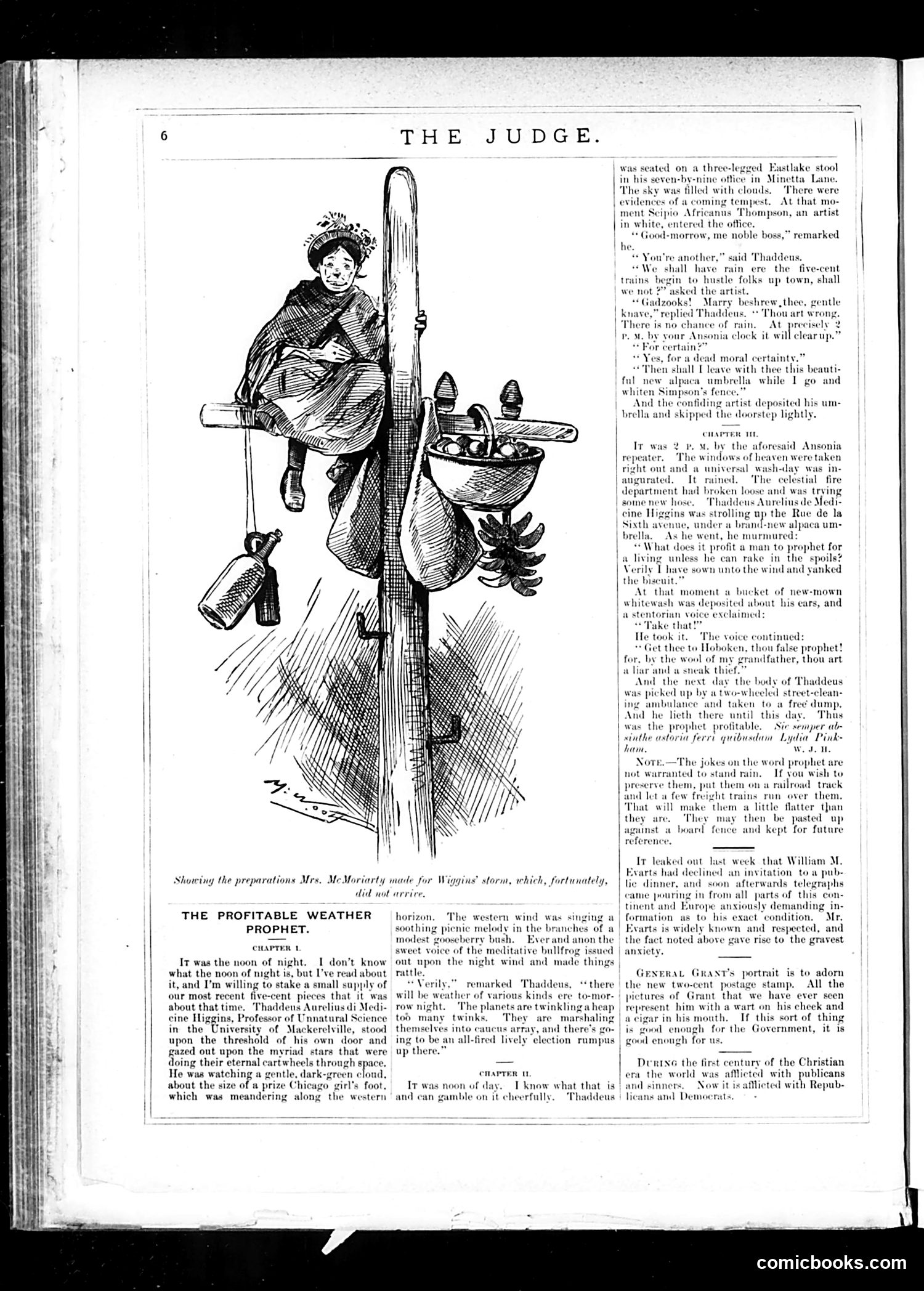
This satirical story mocks fraudulent weather forecasters—a common scam of the era. Professor Thaddeus Aurelius Higgins, a self-proclaimed "Professor of Unnatural Science," predicts rain to an artist and loans him an umbrella as "proof" of his prophetic powers. The artist then pelts Higgins with whitewash from a fence, claiming the "prediction" justified his trust. Higgins is subsequently hit by a bucket and dies in a dump. The joke: fake weather prophets exploited public gullibility for profit. The closing note adds humor by suggesting readers preserve the jokes on railroad tracks to flatten them further—mocking their weak quality. A secondary item mentions William M. Evartsʼ dinner invitation, while another quip compares contemporary Republicans and Democrats to ancient publicans and sinners.
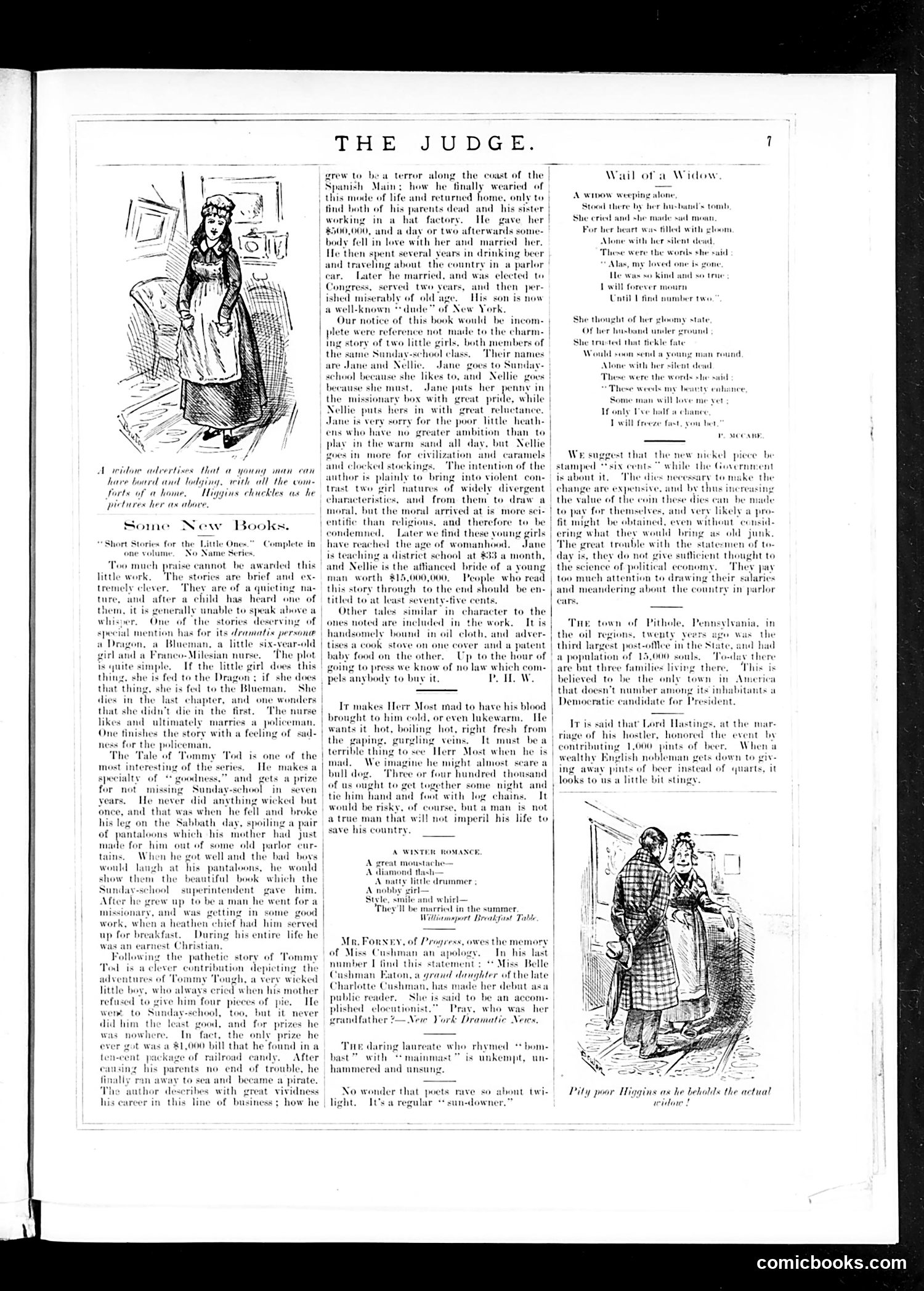
This page contains literary reviews and social commentary rather than political cartoons. The main content discusses children's books, including stories about morally instructive young characters (Jane and Nellie, Tommy Tough) from what appears to be 19th-century Sunday school literature. The text critiques these overly simplistic moral tales. A brief satirical note targets **Herr Most**, likely Johann Most, a German-American anarchist agitator of the 1880s-90s, mocking his temperament and demands for "hot" food—a joking reference to his fiery revolutionary rhetoric. The page also includes society gossip about theatrical debuts (Miss Belle Cushman), suggesting Judge's typical blend of literary criticism and upper-class social commentary. The accompanying illustrations show a widow in mourning and what appears to be a domestic scene, accompanying sentimental verse. Overall, this represents Judge's satirical approach to contemporary culture and personalities rather than electoral politics.
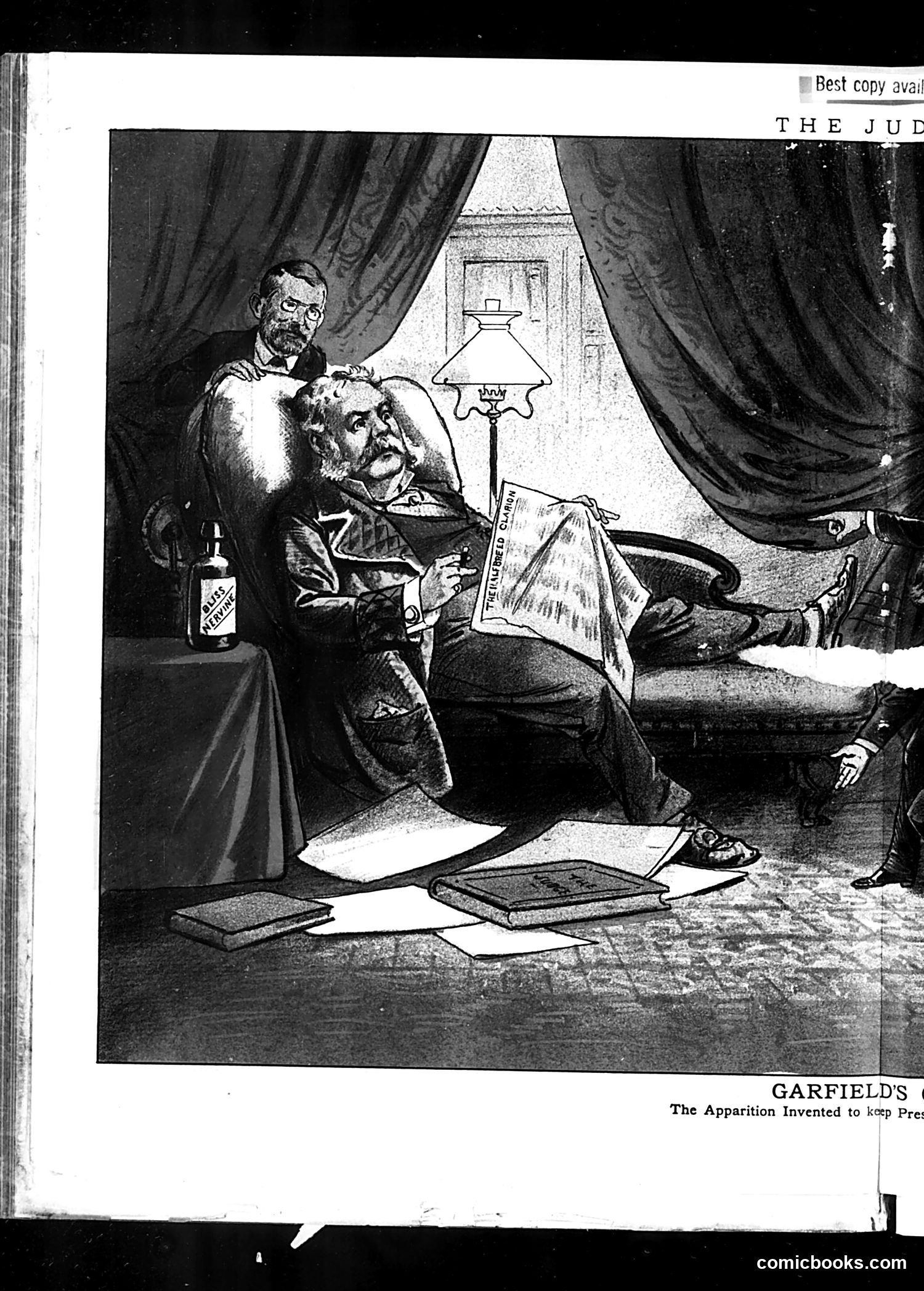
This satirical illustration from *Judge* magazine depicts "Garfield's Apparition Invented to keep Presidents [in line]" (based on the visible caption). The cartoon shows a bearded military figure (likely a general or high-ranking officer) appearing as a ghostly vision to a seated politician or president, who reads documents at a desk surrounded by books and papers. The satire suggests that the memory or legacy of a past military leader—possibly James A. Garfield, the assassinated president—was invoked as a cautionary or controlling force over sitting executives. The "apparition" device mocks the political use of deceased leaders' reputations to influence current policy or behavior. The lamp and formal interior suggest an official office setting where this supernatural intimidation occurs.
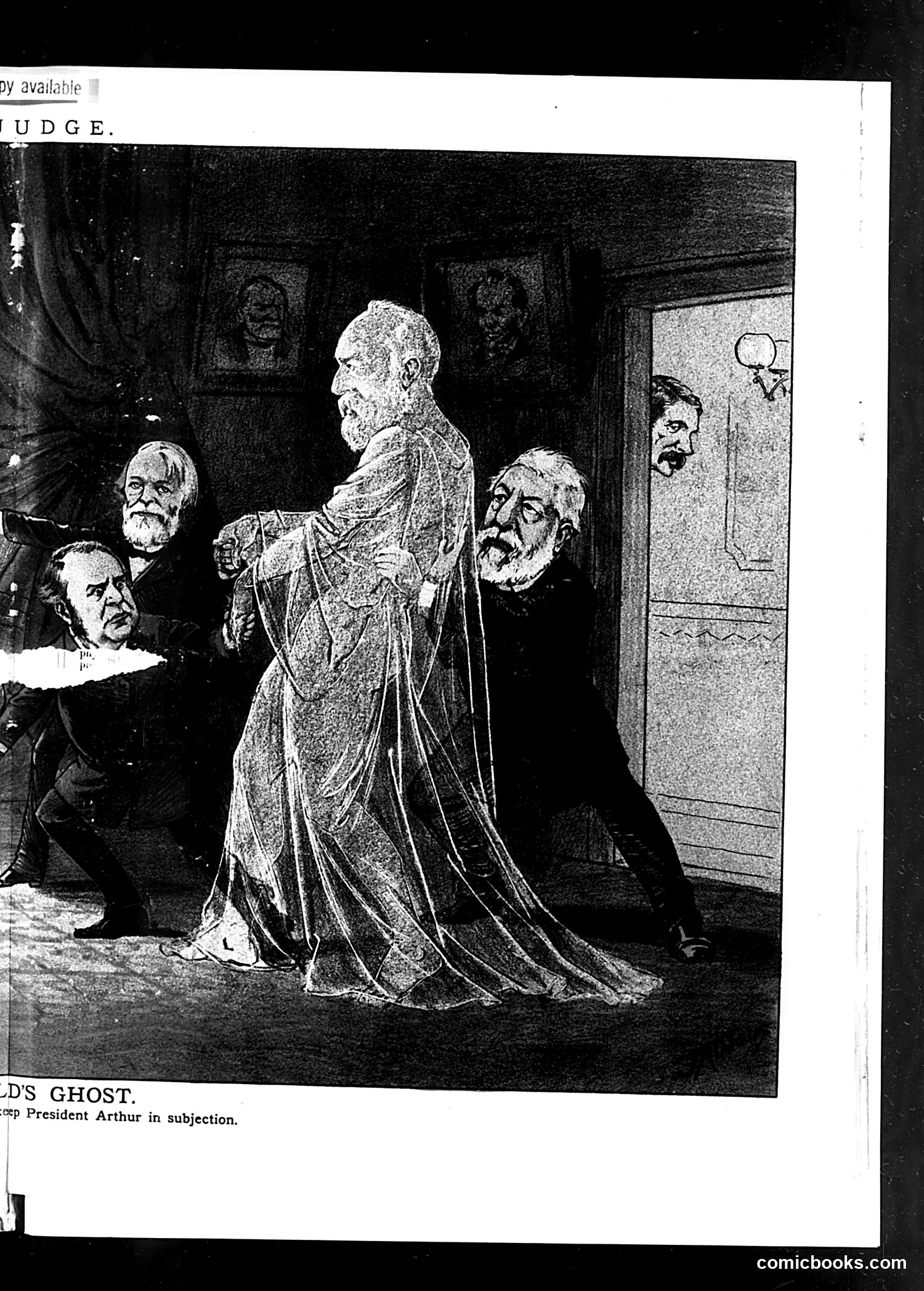
This political cartoon depicts a ghostly, robed figure (appearing translucent or skeletal) standing before several seated men. The caption identifies this as relating to "President Arthur in subjection," suggesting the ghost represents a deceased president's influence over Chester A. Arthur's administration. The "D" likely refers to President James A. Garfield, who was assassinated in 1881. The cartoon satirizes how Garfield's death and legacy continued to haunt Arthur's presidency—Arthur, his successor, faced pressure from Garfield loyalists and struggled with his own legitimacy as a replacement president. The seated figures appear to be politicians or officials bound by or subjected to this spectral presence, suggesting the dead president's political legacy constrained Arthur's ability to govern independently.
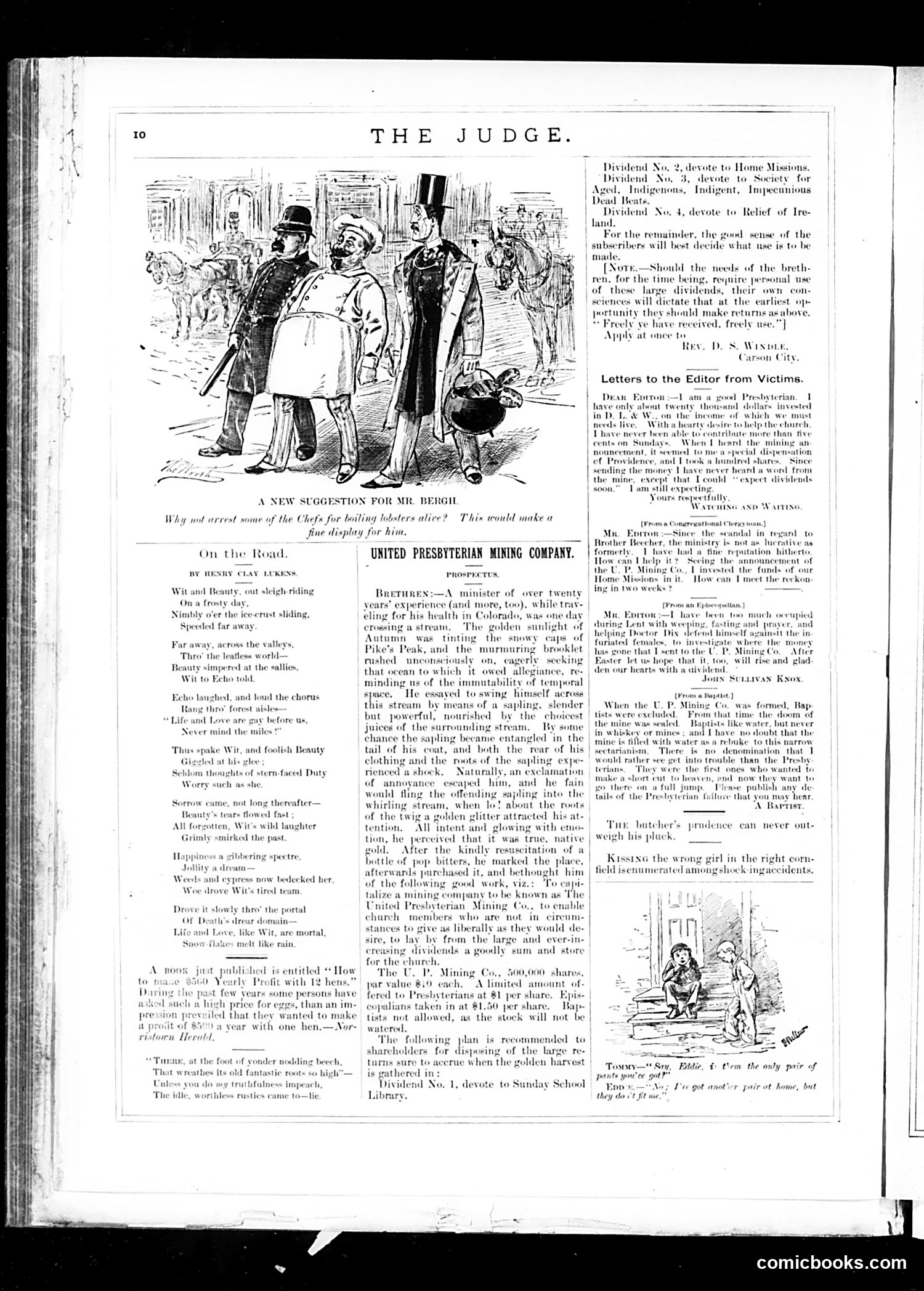
This page contains satirical content about the **United Presbyterian Mining Company**, a scheme targeting church members. The main cartoon depicts a well-dressed man (possibly a con artist or promoter) with potential investors on a street. The "prospectus" section ridicules a minister who discovered gold while crossing a stream, then sold shares to fellow Presbyterians at inflated prices ($10 par value, offered at $1.50). The satire mocks how church members were duped into investing in what appears to be a fraudulent mining venture. Letters from "victims" reinforce the joke: investors sent money expecting dividends but received nothing—only vague assurances. The final quip about "kissing the wrong girl in the right cornfield" suggests the investors got fooled into a bad bargain. The satire targets both denominational sectarianism (Presbyterians excluding Baptists from the scheme) and the gullibility of religious communities susceptible to financial schemes dressed up as charitable enterprises.
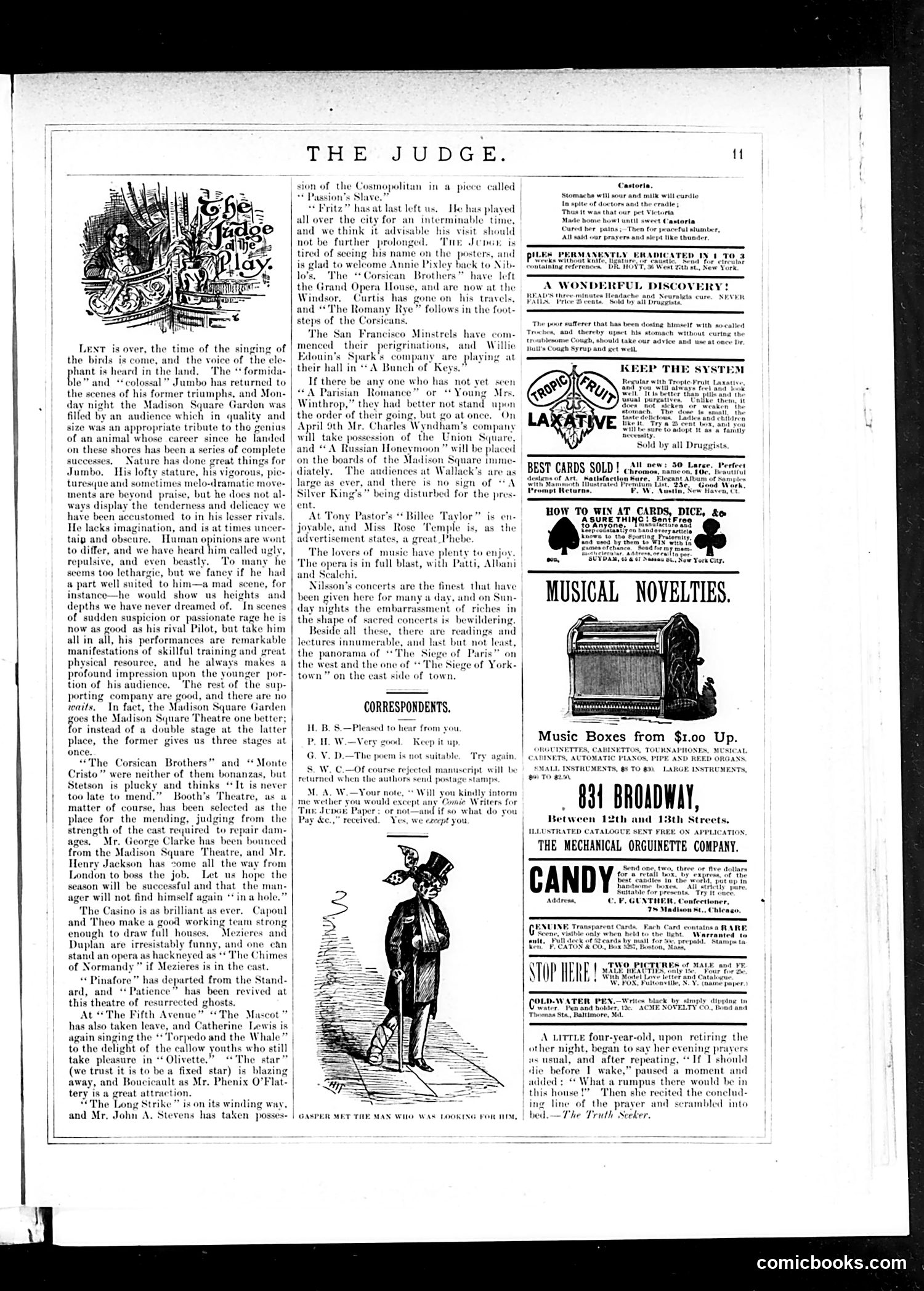
This page from Judge magazine is primarily **theatrical criticism and entertainment advertising** rather than political satire. The main content reviews New York theater productions circa the 1880s. **Key theatrical references:** - **Jumbo the elephant** dominated Madison Square Garden—a famous performing elephant whose U.S. tour was a major cultural event - Reviews of popular operettas and plays: "Patience," "H.M.S. Pinafore," "The Corsican Brothers," "Monte Cristo" - Famous performers mentioned: Patti, Nilsson (opera singers), various actors **The satirical element** is subtle—the critic mocks theatrical pretension, weak performances, and recycled plots, particularly criticizing actors who lack imagination and overly sentimental plays. The tone is dismissive of mediocre entertainment while celebrating genuine talent. The page also contains **personal advertisements** for music boxes, candy, and other goods—typical of 19th-century magazines. The "Correspondents" section suggests readers submitted comments. This reflects late Victorian entertainment culture rather than political commentary.
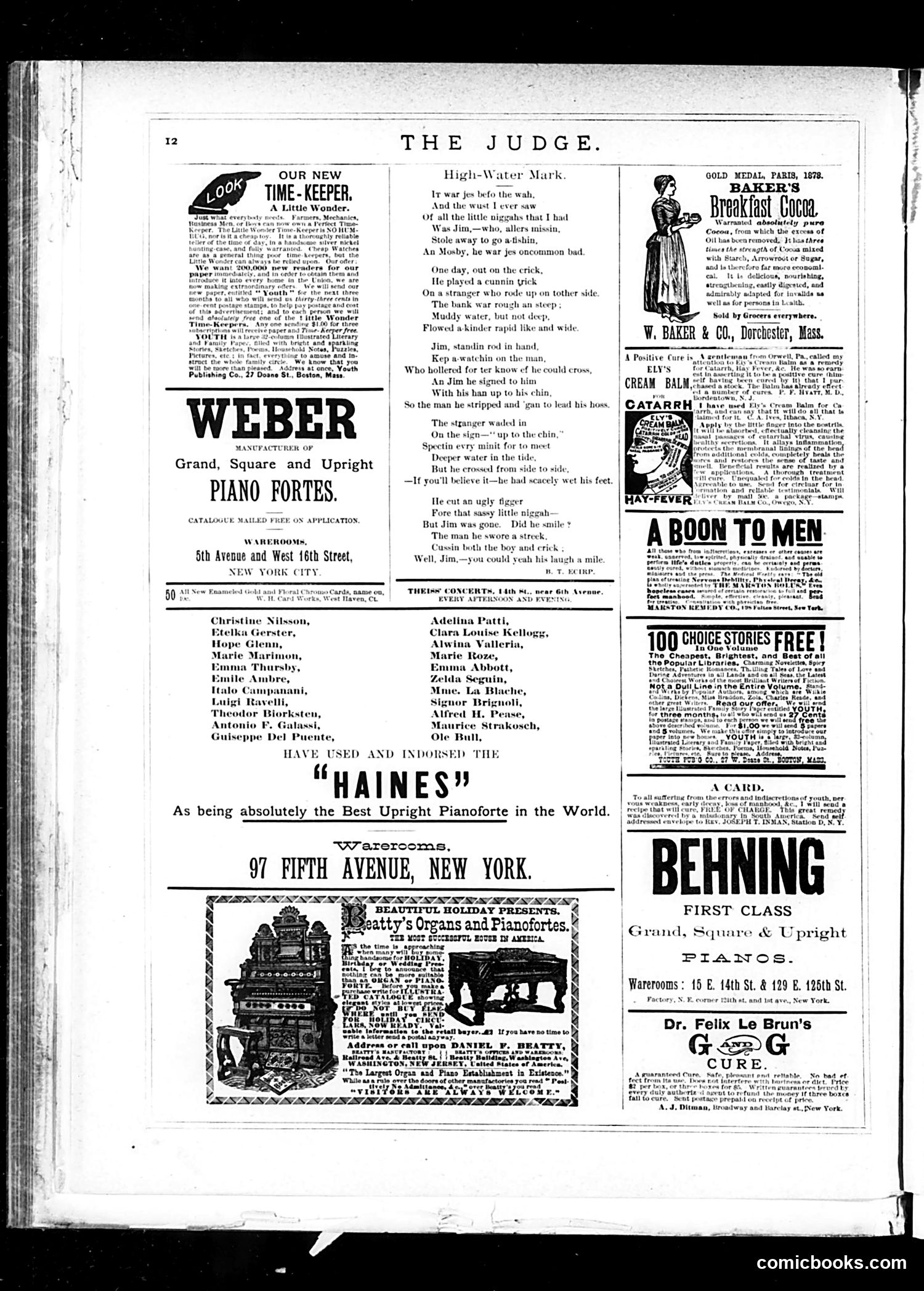
This page is primarily **advertisements for pianos and related products**, with one poem featured prominently. The poem "High-Water Mark" uses **dialect verse** to tell a story set before the Civil War. It describes Jim, apparently an enslaved person, fishing at a river crossing. A stranger (likely a Confederate soldier or Union sympathizer, possibly referencing the historical figure Mosby, a Confederate guerrilla) crosses the water on horseback. The narrative emphasizes Jim's composure and skill—he crosses the river "scarcely wet his feet" while the white man struggles. The satire appears to mock **white incompetence and fear** versus Black competence and calm under pressure. The title "High-Water Mark" may suggest this represents a peak moment of dignity or capability. However, the use of racial epithets and dialect reflects the casual racism endemic to 19th-century American periodicals, even satirical ones. The poem is surrounded by piano manufacturer advertisements (Weber, Haines, Behning) and other period product endorsements, indicating this was primarily a commercial publication.
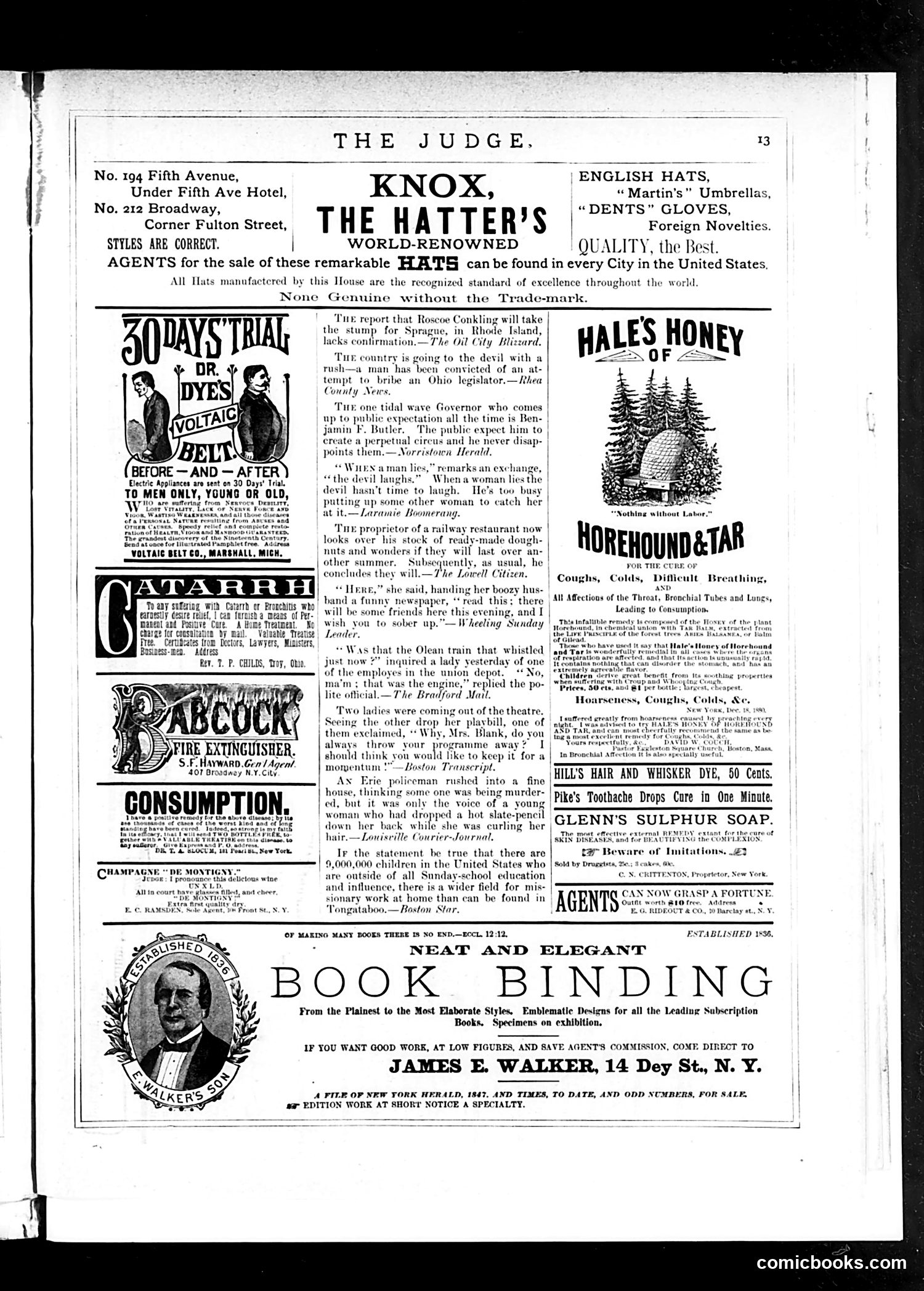
This is primarily an **advertising page** from Judge magazine (page 13), with minimal editorial content. The few scattered news items are brief satirical quotes typical of the publication's format. ## Identifiable References: **Roscoe Conkling** appears in the opening item—a prominent Republican politician of the era whose public activities were fodder for commentary. **Benjamin F. Butler** is mentioned as a "tidal wave Governor" expected to create "perpetual circus," suggesting satirical mockery of his colorful political persona. ## Satire/Humor: The scattered one-liners mock contemporary behavior: men lying versus women lying, the absurdity of confusing train engines with whistles, women discarding playbills. These are mild social observations rather than pointed political satire. The page is dominated by period **product advertisements**: Knox hats, Voltaic belts, patent medicines (Horehound & Tar, Glenn's Sulphur Soap), and book binding services—typical of 19th-century magazine economics. The satirical content is secondary to commercial messaging.
This page presents a satirical multi-panel comic addressing domestic upheaval, likely from the early 20th century based on style and typography. The main headline "A STARTLING DOMESTIC REVOLUTION" frames the content as social commentary on household transformation. The visible panels include segments titled "JUDGE TURPEE POLECONTENTS," "COUNTRY FRUGALS," and references to "WEEKLY WINNERS" and "SUBURBAN DRUDGERY." The cartoon appears to satirize changing gender roles and domestic labor, depicting how household responsibilities—traditionally women's domain—were being revolutionized or disrupted. Without clearer visibility of specific caricatures and panel details, the precise political targets remain unclear, though the satire likely mocks contemporary anxieties about shifting domestic arrangements and women's roles during this period of social change.
This page is primarily **advertising**, not political satire. It contains multiple advertisements for "Frank Siddalls Soap," a cleaning product from Philadelphia. The main content includes instructional text about washing clothes and identifying "a person of refinement" — likely humorous advice suggesting that proper use of quality soap distinguishes genteel people from others. The advertisements claim the soap has "quaint uses" and "special uses" beyond standard laundry, including washing telescope lenses and photographic equipment. The OCR text is heavily garbled (reversed and corrupted), making precise interpretation difficult, but the visual layout shows typical late-19th/early-20th century magazine advertising with small illustrations of people using the product. **This is not political or social satire** in the traditional Judge magazine sense — it's purely commercial content designed to promote a soap brand to middle and upper-class readers who would recognize refined behavior as a status marker.
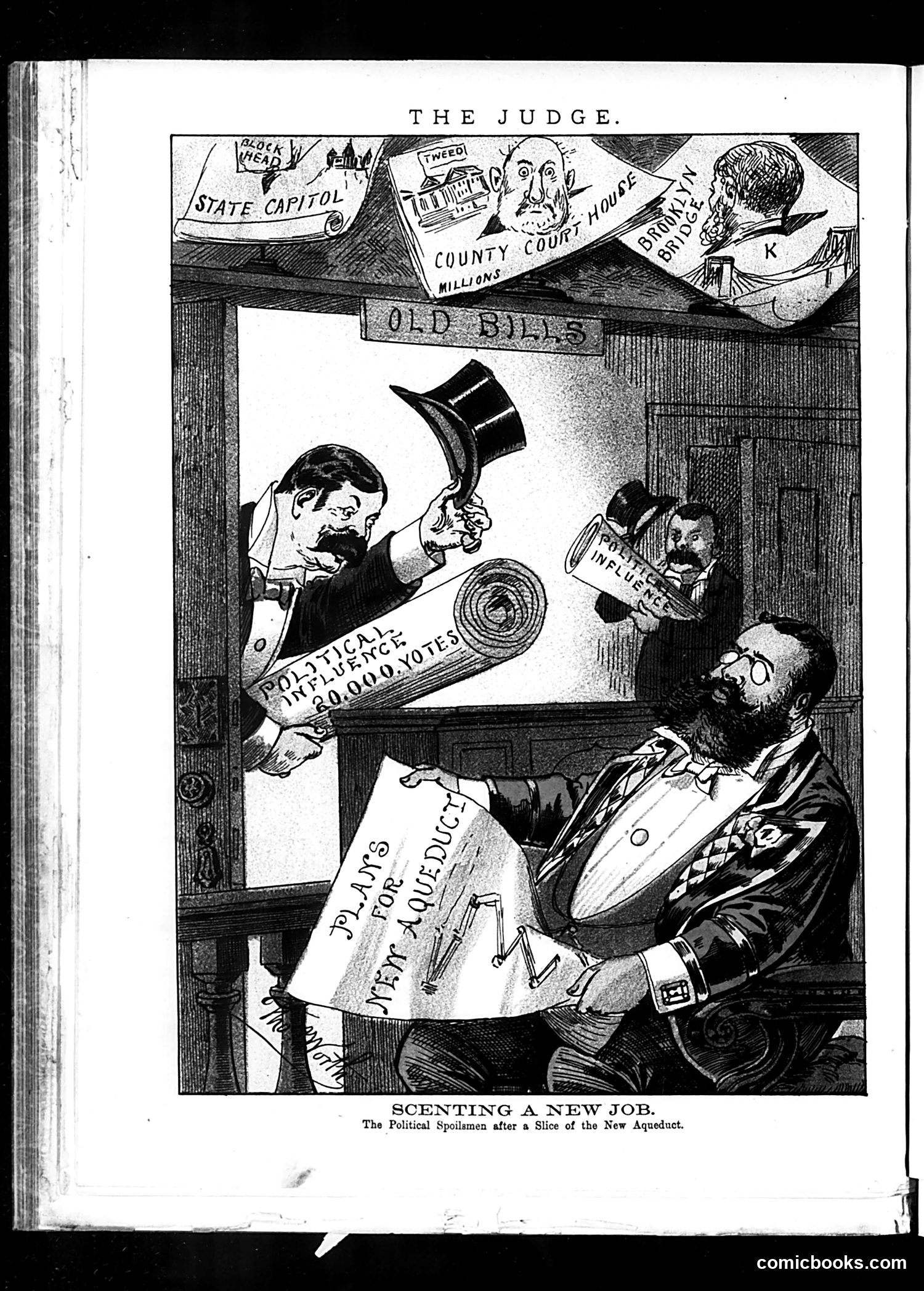
This cartoon satirizes political corruption during a major public works project—specifically, a new aqueduct. The title "Scenting a New Job" uses animal imagery to depict politicians and bureaucrats as predatory creatures literally sniffing out opportunities for graft and patronage. The figures labeled with positions like "State Capitol," "County Court House," and "Block Head" appear to represent various government officials and institutions converging on the aqueduct project. Their eager, aggressive postures suggest they're competing to secure lucrative contracts or positions related to this construction. The term "Political Spoilsmen" references the "spoils system"—the practice of awarding government jobs and contracts as political favors rather than through merit. The cartoon criticizes how public infrastructure projects attract corrupt officials seeking personal profit rather than public benefit. The bearded figure at bottom labeled with "Influence" emphasizes how backroom connections, not qualifications, determined who got these jobs.