
Pulp Fiction, March 1912 · page 186 of 244
Green Book Magazine, March 1912 — page 186: what you’re looking at
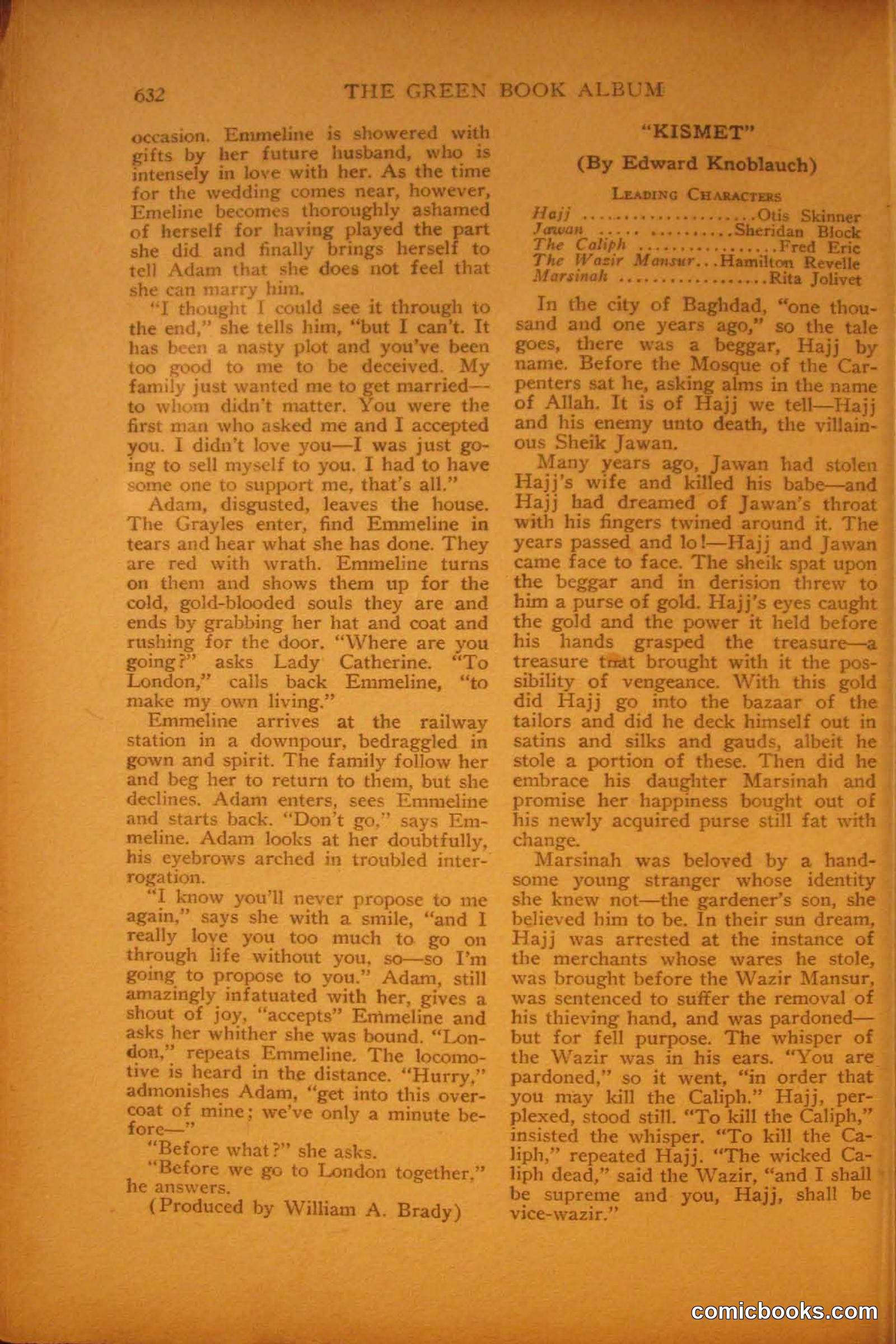
A restored page from Pulp Fiction, March 1912. Page through the whole issue in the reader above.
📄 Transcribed text from this page (OCR, searchable)
Machine-transcribed from the original scan — historical spelling and the odd misread are preserved.
occasion, gifts by her future husband, > inten: Bot ae with her, As ss time for the ing comes near, however, Emeline becomes thoroughly ashamed of herself for ory | played the ai she did and finally brings herself to tell Adam that she does not feel that she can marry him, “J thought I could see it through to the end,” she tells him, “but I can’t. It has been a nasty plot and you've been too good to me to be deceived. My family just wanted me to get married— to whom didn’t matter, You were the first man who asked me and I accepted you. I didn’t love you—I was just go- ing to sell myself to you. I had to have some one to support me, that’s all.” Adam, disgusted, leaves the house. The Grayles enter, find Emmeline in tears and hear what she has done. They are red with wrath. Emmeline turns on them and shows them up for the cold, gold-blooded souls they are and ends by grabbing her hat and coat and rushing for the door, “Where are you going?” asks Lady Catherine. “To London,” calls back Emmeline, “to make my own living.” Emmeline arrives at the railway station in a downpour, bedraggled in gown and spirit. The family follow her and beg her to return to them, but she declines. Adam enters, sees Emmeline and starts back. “Don’t go,” says Em- meline. Adam looks at her doubtfully, his eyebrows arched in troubled inter- rogation. “I know you'll never propose to me again,” says she with a smile, “and I really loye you too much to go on through life without you, so—so I’m going to propose to you.” Adam, still amazingly infatuated with her, gives a shout of joy, “accepts” Emmeline and asks her whither she was bound. “Lon- don,” repeats Emmeline. The locomo- tive is heard in the distance. “Hurry,” admonishes Adam, “get into this over- coat of mine; we’ve only a minute be- fore—” “Before what?” she asks. “Before we go to London together,” he answers. (Produced by William A. Brady) H j Ce ee ee 2 oe 1 . Mersionh svn; ete tees ee In the city of Baghdad, “one thou- sand and one years ago,” so the tale goes, there was a beggar, Hajj by name. Before the Mosque of the Car- penters sat he, asking alms in the name of Allah. It is of Hajj we tell—Hajj — and his enemy unto death, the villain- ous Sheik Jawan. Many years ago, Hajj’s wife and his babe—and awan had stolen q Hajj had dreamed of Jawan’s throat with his fingers twined around it. The years passed and lo!—Hajj and Jawan came face to face. The sheik spat upon the beggar and in derision threw to him a purse of gold. Hajj’s eyes caught the gold and the power it held before his hands grasped the treasure—a treasure that brought with it the pos- sibility of vengeance. With this gold did Hajj go into the bazaar of the | tailors and did he deck himself out in satins and silks and gauds, albeit he stole a portion of these. Then did he embrace his daughter Marsinah and promise her happiness bought out of his newly acquired purse still fat with change. Marsinah was beloved by a hand- some young stranger whose identity she knew not—the gardener’s son, she © believed him to be. In their sun dream, Hajj was arrested at the instance of © the merchants whose wares he stole, was brought before the Wazir Mansur, was sentenced to suffer the removal of © his thieving hand, and was pardoned— but for fell purpose. The whisper of the Wazir was in his ears. “You are pardoned,” so it went, “in order that — you may kill the Caliph.” Hajj, per-— plexed, stood still. “To kill the Caliph,” insisted the whisper. “To kill the Ca- liph,” repeated Hajj. “The wicked Ca- liph dead,” said the Wazir, “and I shall be supreme and you, Hajj, shall be vice-wazir.” +7