
Pulp Fiction, 1926 · page 14 of 212
Munsey's Magazine, September 1926 — page 14: what you’re looking at
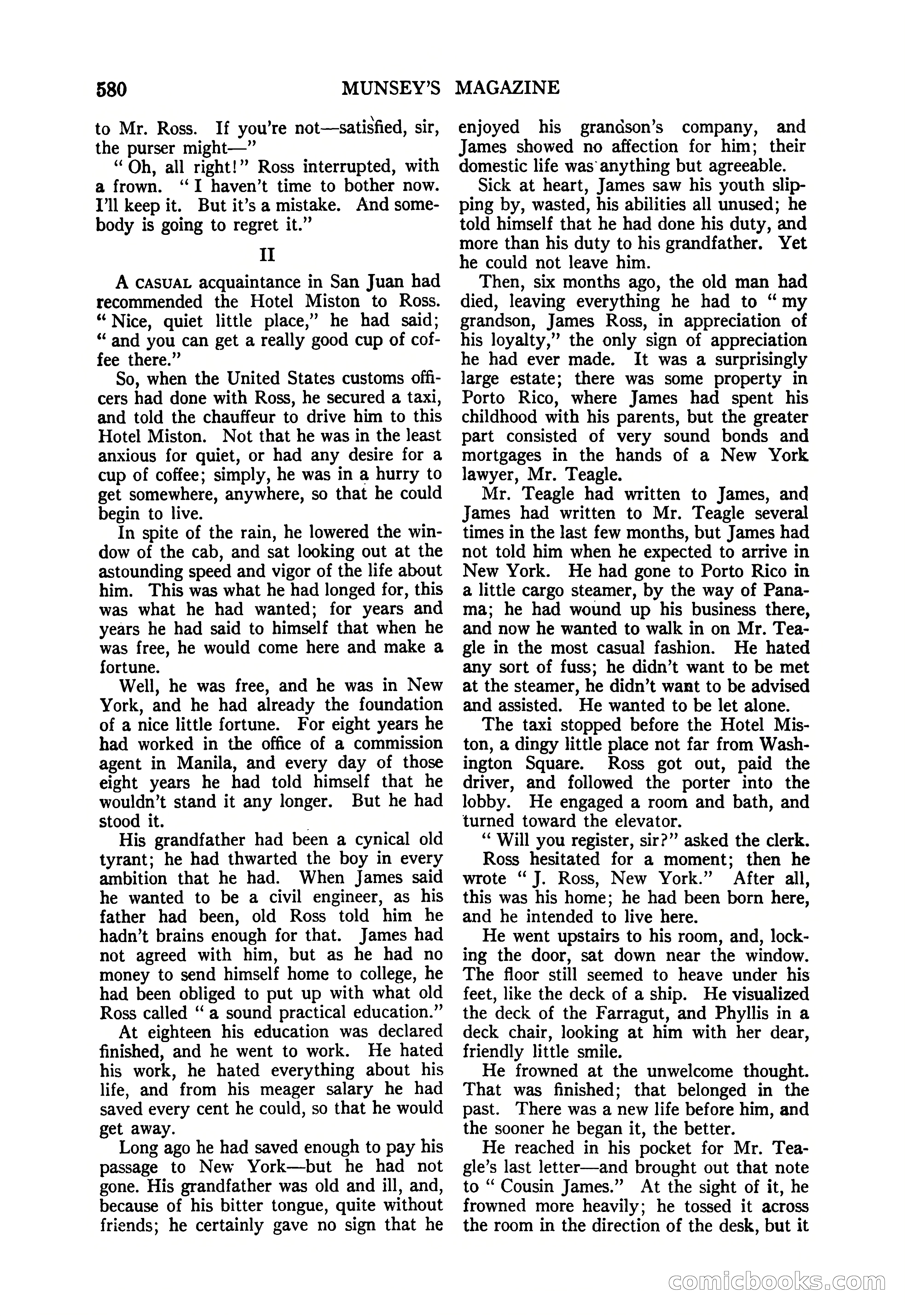
A restored page from Pulp Fiction, 1926. Page through the whole issue in the reader above.
📄 Transcribed text from this page (OCR, searchable)
Machine-transcribed from the original scan — historical spelling and the odd misread are preserved.
580 MUNSEY’S to Mr. Ross. If you're not—satisfied, sir, the purser might—” “Oh, all right!” Ross interrupted, with a frown. ‘I haven’t time to bother now. I'll keep it. But it’s a mistake. And some- body is going to regret it.” II A CASUAL acquaintance in San Juan had recommended the Hotel Miston to Ross. “Nice, quiet little place,” he had said; “ and you can get a really good cup of cof- fee there.” So, when the United States customs offi- cers had done with Ross, he secured a taxi, and told the chauffeur to drive him to this Hotel Miston. Not that he was in the least anxious for quiet, or had any desire for a cup of coffee; simply, he was in a hurry to get somewhere, anywhere, so that he could begin to live. In spite of the rain, he lowered the win- dow of the cab, and sat looking out at the astounding speed and vigor of the life about him. This was what he had longed for, this was what he had wanted; for years and years he had said to himself that when he was free, he would come here and make a fortune. Well, he was free, and he was in New York, and he had already the foundation of a nice little fortune. For eight years he had worked in the office of a commission agent in Manila, and every day of those eight years he had told himself that he wouldn’t stand it any longer. But he had stood it. His grandfather had been a cynical old tyrant; he had thwarted the boy in every ambition that he had. When James said he wanted to be a civil engineer, as his father had been, old Ross told him he hadn’t brains enough for that. James had not agreed with him, but as he had no money to send himself home to college, he had been obliged to put up with what old Ross called “a sound practical education.” At eighteen his education was declared finished, and he went to work. He hated his work, he hated everything about his life, and from his meager salary he had saved every cent he could, so that he would get away. Long ago he had saved enough to pay his passage to New York—but he had not gone. His grandfather was old and ill, and, because of his bitter tongue, quite without friends; he certainly gave no sign that he MAGAZINE enjoyed his grandson’s company, and James showed no affection for him; their domestic life was anything but agreeable. Sick at heart, James saw his youth slip- ping by, wasted, his abilities all unused; he told himself that he had done his duty, and more than his duty to his grandfather. Yet he could not leave him. Then, six months ago, the old man had died, leaving everything he had to “ my grandson, James Ross, in appreciation of his loyalty,” the only sign of appreciation he had ever made. It was a surprisingly large estate; there was some property in Porto Rico, where James had spent his childhood with his parents, but the greater part consisted of very sound bonds and mortgages in the hands of a New York lawyer, Mr. Teagle. Mr. Teagle had written to James, and James had written to Mr. Teagle several times in the last few months, but James had not told him when he expected to arrive in New York. He had gone to Porto Rico in a little cargo steamer, by the way of Pana- ma; he had wound up his business there, and now he wanted to walk in on Mr. Tea- gle in the most casual fashion. He hated any sort of fuss; he didn’t want to be met at the steamer, he didn’t want to be advised and assisted. He wanted to be let alone. The taxi stopped before the Hotel Mis- ton, a dingy little place not far from Wash- ington Square. Ross got out, paid the driver, and followed the porter into the lobby. He engaged a room and bath, and turned toward the elevator. “ Will you register, sir?” asked the clerk. Ross hesitated for a moment; then he wrote “ J. Ross, New York.” After all, this was his home; he had been born here, and he intended to live here. He went upstairs to his room, and, lock- ing the door, sat down near the window. The floor still seemed to heave under his feet, like the deck of a ship. He visualized the deck of the Farragut, and Phyllis in a deck chair, looking at him with her dear, friendly little smile. He frowned at the unwelcome thought. That was finished; that belonged in the past. There was a new life before him, and the sooner he began it, the better. He reached in his pocket for Mr. Tea- gle’s last letter—and brought out that note to “‘ Cousin James.” At the sight of it, he frowned more heavily; he tossed it across the room in the direction of the desk, but it iclooooks.com