
Pulp Fiction, 1913 · page 34 of 36
Cheer Boys Cheer: The Boys' Journal, No. 62 — page 34: what you’re looking at
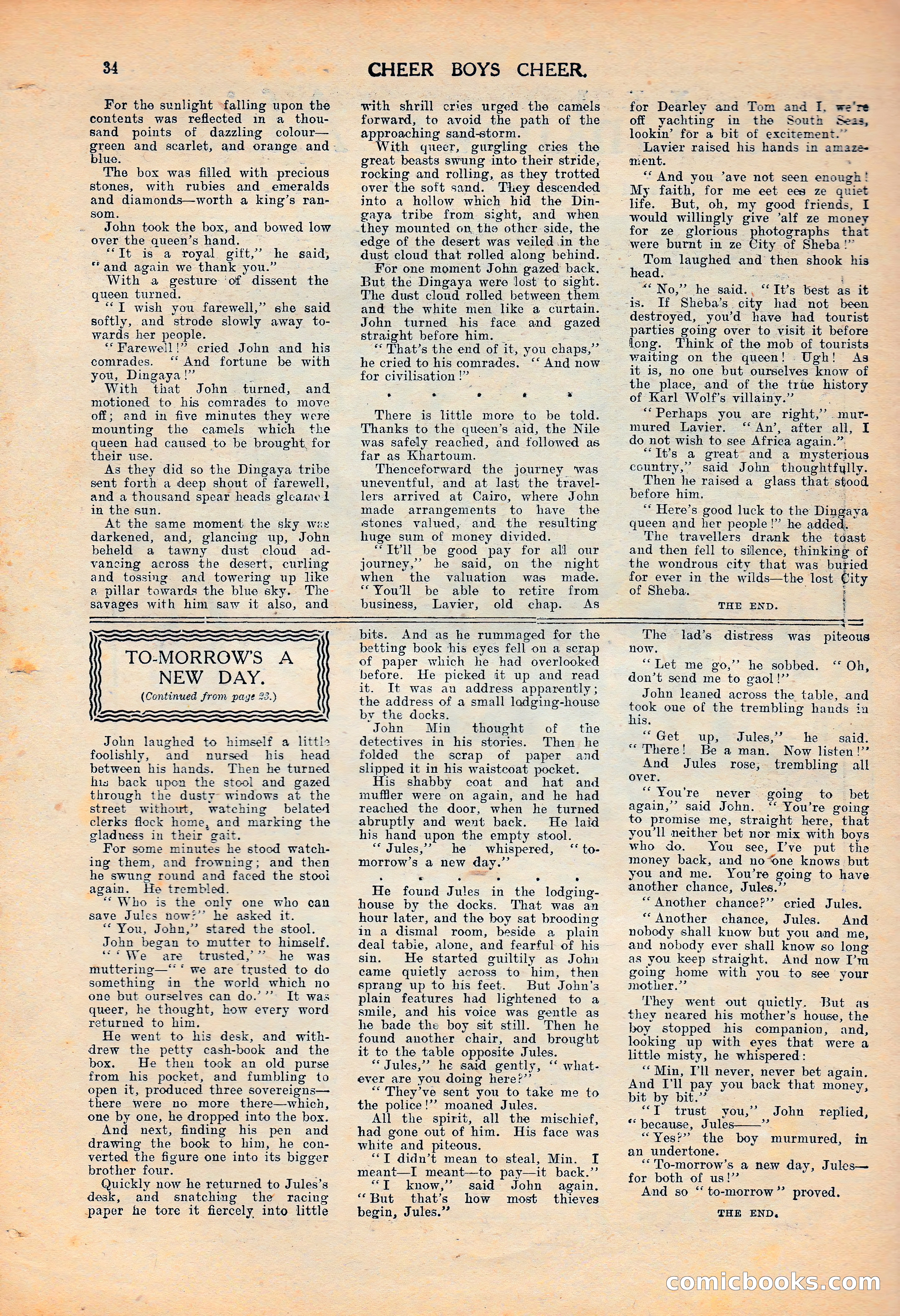
A restored page from Pulp Fiction, 1913. Page through the whole issue in the reader above.
📄 Transcribed text from this page (OCR, searchable)
Machine-transcribed from the original scan — historical spelling and the odd misread are preserved.
ie 34 For the sunlight falling upon the contents was reflected in a thou- sand points of dazzling colour— green and scarlet, and orange and - blue. : ‘ The box was filled with precious stones, with rubies and emeralds and diamonds—worth a king’s ran- som. John took the box, and bowed low over the queen’s hand. “Tt is a royal gift,’ he said, “and again we thank you.” With a gesture ‘of dissent the queen turned. : “JT wish you farewell,” she said softly, and strode slowly away to- wards her people. “* Farewell!” cried John and his comrades. “‘ And fortune be with you, Dingaya!” : With that John. turned, and motioned to his comrades to move off; and in five minutes they were mounting the camels which the queen had caused to be brought, for their use. As they did so the Dingaya tribe sent forth a deep shout of farewell, and a thousand spear heads gleamel in the sun. At the same moment the sky wae darkened, and; glancing up, John beheld a tawny dust cloud ad- vancing across the desert, curling and tossing. and towering up like a pillar towards the blue sky. The savages with him saw it also, and TO-MORROW’'S A NEW DAY. (Continued from page 23. L——_—~ John laughed to himself a little foolishly, and nursed his head between his hands. Then he turned his back upon the stool and gazed through the dusty windows at the street without, watching belated clerks flock home, and marking the gladness in their gait. For some minutes he stood watch- ing them, and frowning; and then he swung round and faced the stooi again. He trembled. “Who is the only one who can save Jules now?’ he asked it. “You, John,” stared the stool. John began to mutter to himself. “*We are trusted,’’’ he was muttering—‘** we are trusted to do something in the world which no one but ourselves can do.’’’ It was queer, he thought, how every word returned to him. He went to his desk, and with- drew the petty cash-book and the box. He then took an old purse from his pocket, and fumbling to open it, produced three sovereigns— there were no more there—which, one by one, he dropped into the box. And next, finding his pen and drawing the book to him, he con- verted the figure one into its bigger brother four. ; Quickly now he returned to Jules’s desk, and snatching the racing paper he tore it fiercely into little CHEER BOYS CHEER, with shrill cries urged. the camels forward, to avoid the path of the approaching sand-storm. With queer, gurgling cries the great beasts swung into their stride, rocking and rolling, as they trotted over the soft sand. They descended into a hollow which hid the Din- gaya tribe from sight, and when .they mounted on the other side, the edge of the desert was veiled .in the dust cloud that rolled along behind. For one moment John gazed back. But the Dingaya were lost to sight. The dust cloud rolled between them and the white men like a curtain. John turned his face and gazed straight before him. _ “ That’s the end of it, you chaps,” he cried to his comrades. ‘‘ And now for civilisation !” - . * e £ * There is little more to be told. Thanks to the queen’s aid, the Nile was safely reached, and followed as far as Khartoum. Thenceforward the journey ‘was uneventful, and at last the travel- lers arrived at Cairo, where John made arrangements to have the stones valued, and the resulting huge sum of money divided. “It'll be good pay for all our journey,’ he said, on the night when the valuation was made. “You'll be able to retire from business, Lavier, old chap. As bits. And as he rummaged for the betting book ‘his eyes fell on a scrap of paper which he had overlooked before. He picked it up and read it. It was an address apparently ; the address of a small ladging-house by the docks. John Min thought of the detectives in his stories. Then he folded the scrap of paper and slipped it in his waistcoat pocket. His shabby coat and hat and muffler were on again, and he had reached the door, when he turned abruptly and went back. He laid his hand upon the empty stool. “Jules,” he whispered, “ to- morrow’s a new day.’ He found Jules in the lodging- house by the docks. That was an hour later, and the boy sat brooding in a dismal room, beside a plain deal tabie, alone, and fearful of his sin. He started guiltily as Johan came quietly across to him, then sprang up to his feet. But John’s plain features had lightened to a smile, and his voice was gentle as he bade the boy sit still. Then he found another chair, and brought it to the table opposite Jules. “Jules,” he said gently, “‘ what- ever are you doing here?” ““ They've sent you to take me to the police!”” moaned Jules. All the spirit, all the mischief, had gone out of him. His face was white and piteous. “JT didn’t mean to steal, Min. TI meant—I meant—to pay—it back.”’ “T know,’ said John again. “But that’s how most thieves begin, Jules.”’ for Dearley and Tom and I, we're off yachting in the South Seas, lookin’ for a bit of excitement.” Lavier raised his hands in amaze ment. . ““And you ’ave not seen enough! My faith, for me eet ees ze gniet life. But, oh, my good friends, I would willingly give ’alf ze money for ze glorious photographs that were burnt in ze City of Sheba!” Tom laughed and then shook his head. “*No,”’ he said. , “It’s best as it -is. If Sheba’s city had not been destroyed, you'd have had tourist parties going over to visit it before long. Think of the mob of tourists waiting on the queen! Ugh! As it is, no one but ourselves know of the place, and of the true history of Karl Wolf's villainy.” ““Perhaps you are right,’ .mur- mured Lavier. ‘‘ An’, after all, I do not wish to see Afriea again.”. “TIt’s a great and a mysterious country,” said John thoughtfylly. Then he raised a glass that stood before him. . ; : ** Here’s good luck to the Dingaya queen and her people!” he added. The travellers drank the téast and then fell to silence, thinking of the wondrous city that was buried for ever in the wilds—the lost City of Sheba. : i THE END. oe it —= The lad’s distress was piteous now. “Let me go,’ he sobbed. ‘* Oh, don’t send me to gaol!” John leaned across the table, and ee oue of the trembling hands in his. “Get up, Jules,’ he said. “There! Be a man. Now listen!’’ And Jules rose, trembling all over. “You're never. going to bet again,’ said John. ‘‘ You’re goin to promise me, straight here, that you'll neither bet nor mix with boys who do. You see, I’ve put the money back, and no*one knows but you and me. You’re going to have another chance, Jules.’ ““Another chance?’’ cried Jules. “Another chance, Jules. And nobody shall know but you and me, and nobody ever shall know so long as you keep straight. And now I’m going home with you to see your mother.”’ They went out quietly. But as they neared his mother’s house, the boy stopped his companion, and, looking up with eyes that were a little misty, he whispered: “ Min, Ill never, never bet again. And I'll pay you back that money, bit by bit.” “YT trust you,’ John replied, ** because, Jules——”’ “Yes?” the boy murmured, in an undertone. ** To-morrow’s a new day, Jules— for both of us!” And so “‘ to-morrow” proved. THE END, a ie Tess) eee = a fafataallaevaye Ks (e(ayan) CONUICOOO <Sae@Olin