
Pulp Fiction, 1913 · page 30 of 36
Cheer Boys Cheer: The Boys' Journal, No. 62 — page 30: what you’re looking at
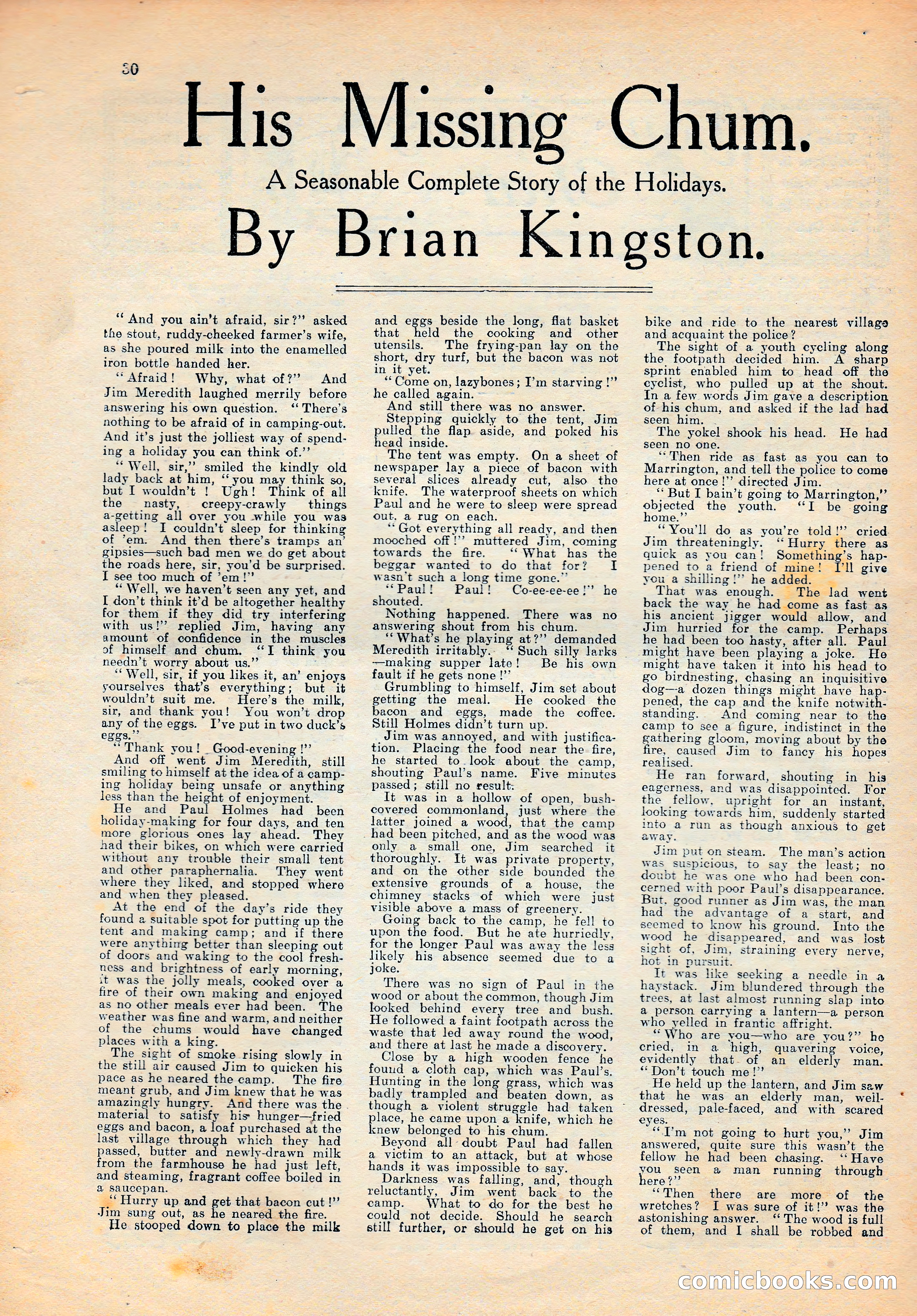
A restored page from Pulp Fiction, 1913. Page through the whole issue in the reader above.
📄 Transcribed text from this page (OCR, searchable)
Machine-transcribed from the original scan — historical spelling and the odd misread are preserved.
~ His Missing Chum. A Seasonable Complete Story of the Holidays. By Brian Kingston. “And you ain’t afraid, sir?” asked the stout, ruddy-cheeked farmer’s wife, as she poured milk into the enamelled iron bottle handed her. “Afraid! Why, what of?” And Jim Meredith laughed merrily before answering his own question. ‘‘There’s nothing to be afraid of in camping-out. And it’s just the jolliest way of spend- ing a holiday you can think of.’’ ““ Well, sir,’’? smiled the kindly old lady back at him, ‘you may think so, but I wouldn’t ! Ugh! Think of all the nasty, creepy-crawly things a-getting all over you while you was asleep! I couldn’t sleep for thinking of *em. And then there’s tramps an’ gipsies—such bad men we do get about the roads here, sir, you’d be surprised. I see too much of ’em!” “Well, we haven’t seen any yet, and I don’t think it’d be altogether healthy for them if they did try interfering with us!” replied Jim, having any amount of confidence in the muscles of himself and chum. ‘I think you needn’t worry about us.” “Well, sir, if you likes it, an’ enjoys yourselves that’s everything; but it wouldn’t suit me. Here’s the milk, sir, and thank you! You won’t drop any of the eggs. I’ve put in two duck’s eggs,” “Thank you! _Good-evening !”’ And off went Jim Meredith, still smiling to himself at the idea of a camp- ing holiday being unsafe or anything less than the height of enjoyment. He and Paul Holmes had been holiday-making for four days, and ten more glorious ones lay ahead. They had their bikes, on which were carried without any trouble their small tent and other paraphernalia. They went where they liked, and stopped where and when they pleased. At the end of the day’s ride they found a suitable spot for putting up the tent and making camp; and if there were anything better than sleeping out of doors and waking to the cool fresh- ness and brightness of early morning, it was the jolly meals, cooked over a fire of their own making and enjoyed as no other meals ever had been. The weather was fine and warm, and neither of the chums would have changed places with a king. The sight of smoke rising slowly in the still air caused Jim to quicken his pace as he neared the camp. The fire meant grub, and Jim knew that he was amazingly hungry. And there was the material to satisfy hiss hunger—fried eggs and bacon, a loaf purchased at the last village through which they had passed, butter and newly-drawn milk from the farmhouse he had just left, and steaming, fragrant coffee boiled in & saucepan. “Hurry up and get that bacon cut!” Jim sung out, as he neared the fire. He stooped down to place the milk and eggs beside the long, flat basket that held the cooking and other utensils. The frying-pan lay on the short, dry turf, but the bacon was not in it yet. : “Come on, lazybones; I’m starving!” he called again. And still there was no answer. Stepping quickly to the tent, Jim pulled the flap aside, and poked his head inside. - The tent was empty. On a sheet of newspaper lay a piece of bacon with several slices already cut, also tho knife. The waterproof sheets on which Paul and he were to sleep were spread out, a rug on each. “Got everything all ready, and then mooched off!’ muttered Jim, coming towards the fire. ““What has the beggar wanted to do that for? I wasn't such a long time gone.” “Paul! Paul! Co-ee-ee-ee!”’ he shouted. Nothing happened. There was no answering shout from his chum. ‘*What’s he playing at?’’? demanded Meredith irritably.- ‘‘ Such silly larks —making supper late! Be his own fault if he gets none !”’ Grumbling to himself, Jim set about getting the meal. He cooked the bacon and eggs, made the coffee. Still Holmes didn’t turn up. Jim was annoyed, and with justifica- tion. Placing the food near the fire, he started to.look about the camp, shouting Paul’s name. Five minutes passed; still no result: It was in a hollow of open, bush- covered commonland, just where the latter joined a wood, that the camp _ had been pitched, and as the wood was only a small one, Jim searched it thoroughly. It was private property, and on the other side bounded the extensive grounds of a house, the chimney stacks of which were just visible above a mass of greenery. Going back to the camp, he fell to upon the food. But he ate hurriedly, for the longer Paul was away the less likely his absence seemed due to a joke. There was no sign of Paul in the wood or about the common, though Jim looked behind every tree and bush. He followed a faint footpath across the waste that led away round the wood, and there at last he made a discovery. Close by a high wooden fence he fouud a cloth cap, which was Paul’s, Hunting in the long grass, which was badly trampled and beaten down, as though a violent struggle had taken ~ place, he came upon a knife, which he knew belonged to his chum. Beyond all- doubt Paul had fallen a victim to an attack, but at whose hands it was impossible to say. Darkness was falling, and, though reluctantly, Jim went back to the camp. What to do for the best he could not decide. Should he search still further, or should he get on his bike and ride to the nearest village and acquaint the police? : The sight of a youth cycling along the footpath decided him. A sharp sprint enabled him to head off the cyclist, who pulled up at the shout. In a few words Jim gave a description of his chum, and asked if the lad had seen him. | The yokel shook his head. He had seen no one. “Then ride as fast as you can to Marrington, and tell the police to come here at once !”’ directed Jim. “ But I bain’t going to Marrington,” objected the youth, “I be going home.”’ “You'll do as you're told!” cried Jim threateningly. ‘Hurry there as quick as you can! Something’s hap- pened to a friend of mine! I'll give you a shilling !”’ he added. That was enough. The lad went back the way he had come as fast as his ancient jigger would allow, and Jim hurried for the camp. Perhaps he had been too hasty, after all. Paul might have been playing a joke. He might have taken it into his head to go birdnesting, chasing an inquisitive dog—a dozen things might have hap- pened, the cap and the knife notwith- standing. And coming near to the camp to see a figure, indistinct in the gathering gloom, moving about by the fire, caused Jim to fancy his hopes realised. : He ran forward, shouting in his eagerness, and was disappointed. Yor the fellow. upright for an instant, looking towards him, suddenly started into a run as though anxious to get away. Jim put on steam. The man’s action was suspicious, to say the least; no doubt he was one who had been con- cerned with poor Paul’s disappearance. But. good runner as Jim was, the man had the advantage of a start, and seemed to know his ground. Into the wood he disappeared, and was _ lost sight of, Jim, straining every nerve, hot in pursuit. Tt was like seeking a needle in a haystack. Jim blundered through the trees, at last almost running slap into a person carrying a lantern—a person who yelled in frantic affright. “Who are you—who are you?” he eried, in a high, quavering voice, evidently that. of an elderly man. “Don’t touch me!” He held up the lantern, and Jim sew that he was an elderly man, weil- dressed, pale-faced, and with scared eyes. : “I’m not going to hurt you,’ Jim answered, quite sure this wasn’t the fellow he had been chasing. ‘‘ Have you seen a man running through ere?” “Then there are more of the wretches? I was sure of it!” was the astonishing answer. ‘The wood is full of them, and I shall be robbed and [WA - (a 1 ol a a COMMIG