
Pulp Fiction, 1913 · page 22 of 36
Cheer Boys Cheer: The Boys' Journal, No. 62 — page 22: what you’re looking at
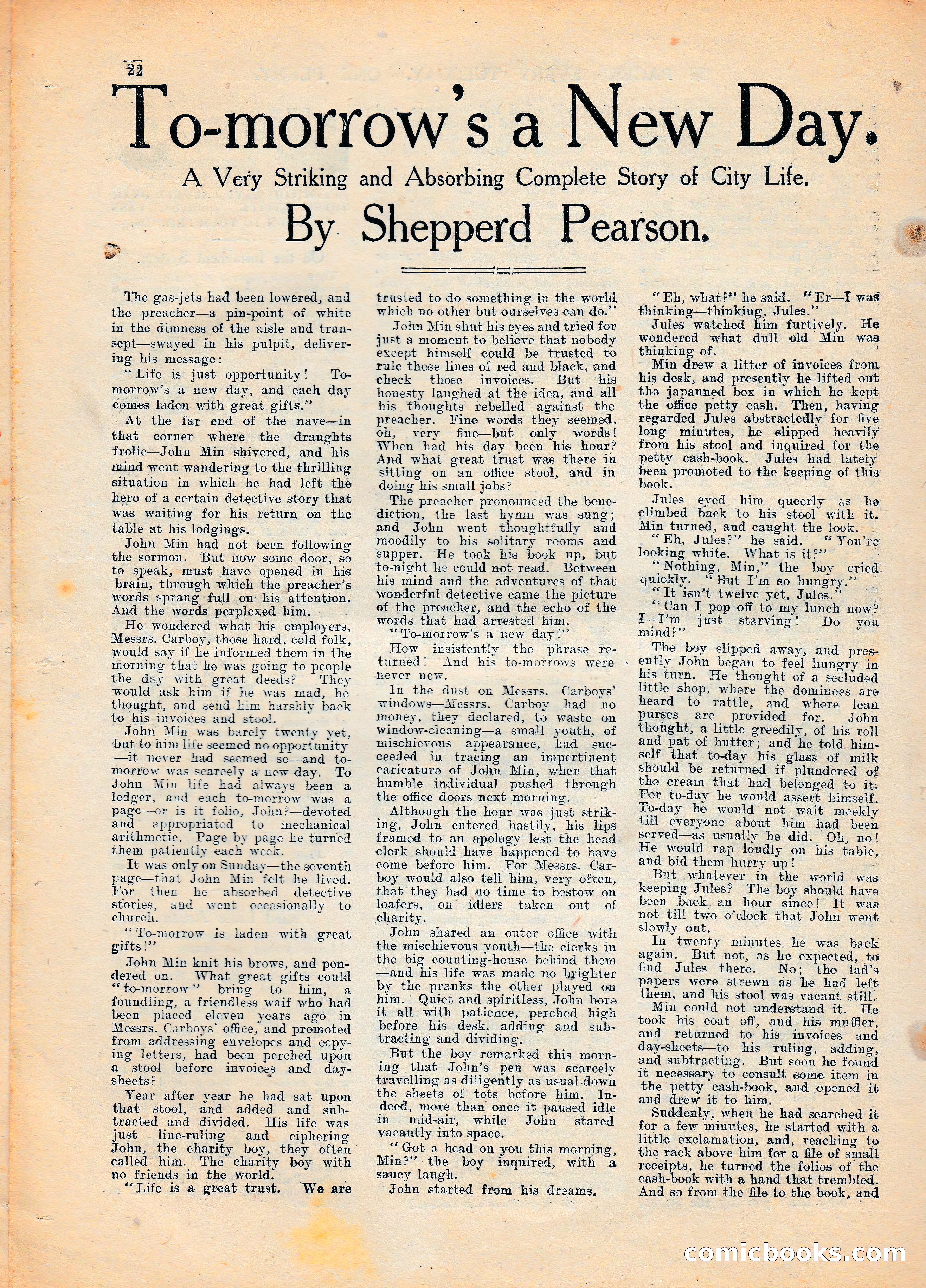
A restored page from Pulp Fiction, 1913. Page through the whole issue in the reader above.
📄 Transcribed text from this page (OCR, searchable)
Machine-transcribed from the original scan — historical spelling and the odd misread are preserved.
‘To-morrow s a ew Day. A Very Striking and Absorbing Complete Story of City Life, 2 The gas-jets had been lowered, and the preacher—a pin-point of white in the dimness of the aisle and tran- sept—swayed in his pulpit, deliver- ing his message: “Life is just opportunity! To- morrow’s a new day, and each day comes laden with great. gifts.” At the far end of the nave—in that corner where the draughts frottc—John Min shivered, and his mind went wandering to the thrilling situation in which he had left the hero of a certain detective story that was waiting for his return on the table at his lodgings. John Min had not been following the sermon. But now some door, so te speak, must have opened in his brain, through which the preacher’s words sprang full on his attention. And the words perplexed him. | He wondered what his employers, Messrs. Carboy, those hard, cold folk, would say if he informed them in the morning that he was going to people the day with great deeds? They would ask him if he was mad, he thought, and send him harshly back to his invoices and stool. John Min was barely twenty vet, ‘but to him lite seemed no opportunity —it never had seemed sc—and_ to- morrow was scarcely a new day. To John Min life had always been a ledger, and each to-morrow was a page—or is it folio, John?—devoted and appropriated to mechanical arithmetic. Page by page he turned them patientiy each week. It was only on Sunday—the seventh page—that John Min ielt he lived. for then he absorbed detective stories, and went occasionally to church. “To-morrow is laden with great gifts!’ John Min knit his brows, and pon- dered on. What great gifts could ‘to-morrow’? bring to him, a foundling, a friendless waif who had been placed eleven years ago in Messrs. Carboys’ office, and promoted from addressing envelopes and ccpy- ing letters, had been perched upon a stool before invoices and day- sheets? Year after year he had sat upon that stool, and added and sub- tracted and divided. His life was just line-ruling and ciphering John, the charity boy, they often’ called him. The charity boy with no friends in the world. “Life is a great trust. We are real — trusted to do something in the world which no other but ourselves can do.”’ John Min shut his eyes and tried for just a moment to believe that nobody except himself could be trusted to rule those lines of red and black, and check those invoices. But his honesty laughed-at the idea, and all his thoughts rebelled against the preacher. Fine words they seemed, oh, very fine—but only words! When had his day been his hour? And what great trust was there in sitting on an office stool, and in doing his small jobs? The preacher pronounced the bene- diction, the last hymn was sung; and John went thoughtfully and moodily to his solitary rooms and supper. He took his book up, but to-night he could not read. Between his mind and the adventures of that wonderful detective came the picture of the preacher, and the echo of the words that had arrested him. ““To-morrow’s a new day!”’ How insistently the phrase re- turned! And his to-morrows were never new. In the dust on Messrs. windows—Messrs. Carboy had no money, they declared, to waste on window-cleaning—a small youth, of mischievous appearance, had _ suc- ceeded in tracing an impertinent caricature of John Min, when that humble individual pushed through the office doors next morning. Although the hour was just strik- ing, John entered hastily, his lips framed to an apology lest the head clerk should have happened to have come before him. For Messrs. Car- boy would also tell him, very often, that they had no time to bestow on loafers, on idlers taken out of charity. John shared an outer office with the mischievous youth—the clerks in the big counting-house behind them —and his life was made no brighter by the pranks the other played on him. Quiet and spiritless, John bore it all with patience, perched high before his desk, adding and sub- tracting and dividing. But the boy remarked this morn- ing that John’s pen was scarcely travelling as diligently as usual-down the sheets of tots before him. In- deed, more than once it paused idle in mid-air, while John stared vacantly into space. _ “Got a head on you this morning, Min?” the boy inquired, with a saucy laugh. John started from his dreama, Carboys’ ~ By Shepperd Pearson. “Eh, what?’ he said. thinking—thinking, Jules.” q Jules watched him furtively. thinking of. Min drew a litter of invoices from his desk, and presently he lifted out the japanned box in which he kept the office petty cash. Then, having regarded Jules abstractedly for five long minutes, petty cash-book. Jules had lately been promoted to the keeping of this’ book. Jules eyed him climbed back to his stool with it. Min turned, and caught the look. “Eh, Jules?” he said. * You're looking white. quickly. “But I’m so hungry.” “It isn’t twelve yet, Jules.” “Can I pop off to my lunch now? i—I’m just starving! Do mind?” The bey slipped away, and pres- . ently John began to feel hungry in his turn. He thought of a secluded little shop, where the dominoes are heard to rattle, and where lean purses are provided for. John thought, a little greedily, of his roll and pat of butter; and he told him- self that to-day his plass of milk should be returned if plundered of the cream that had belonged to it. For to-day he would assert himself. To-day he would not wait meekly till everyone about him had been served—as usually he did. Oh, no! He would rap loudly on his table, and bid them hurry up! But whatever in the world was keeping Jules? The boy should have been back an hour since! It was not till two o’clock that John went slowly out. In twenty minutes he was back again. But not, as he expected, to find Jules there. No: the lad’s papers were strewn as he had left them, and his stool was vacant still. Min could not understand it. He took his coat off, and his muffer, and returned to his invoices and day-sheets—to his ruling, adding, and subtracting. But soon he found it necessary to consult some item in the petty cash-book, and opened it and drew it to him. Suddenly, when he had searched it for a few minutes, he started with a little exclamation, and, reaching to the rack above him for a file of small receipts, he turned the folios of the cash-book with a hand that trembled. And so from the file to the book, and Avena ial bYovo) <2 _(eroyan) COMME NOOKS. Colin ** Er—I was He wondered what dull old Min was he slipped heavily from his stool and inquired for the queerly as he What is it?” = ‘Nothing, Min,” the boy cried. you