
Pulp Fiction, 1913 · page 14 of 36
Cheer Boys Cheer: The Boys' Journal, No. 62 — page 14: what you’re looking at
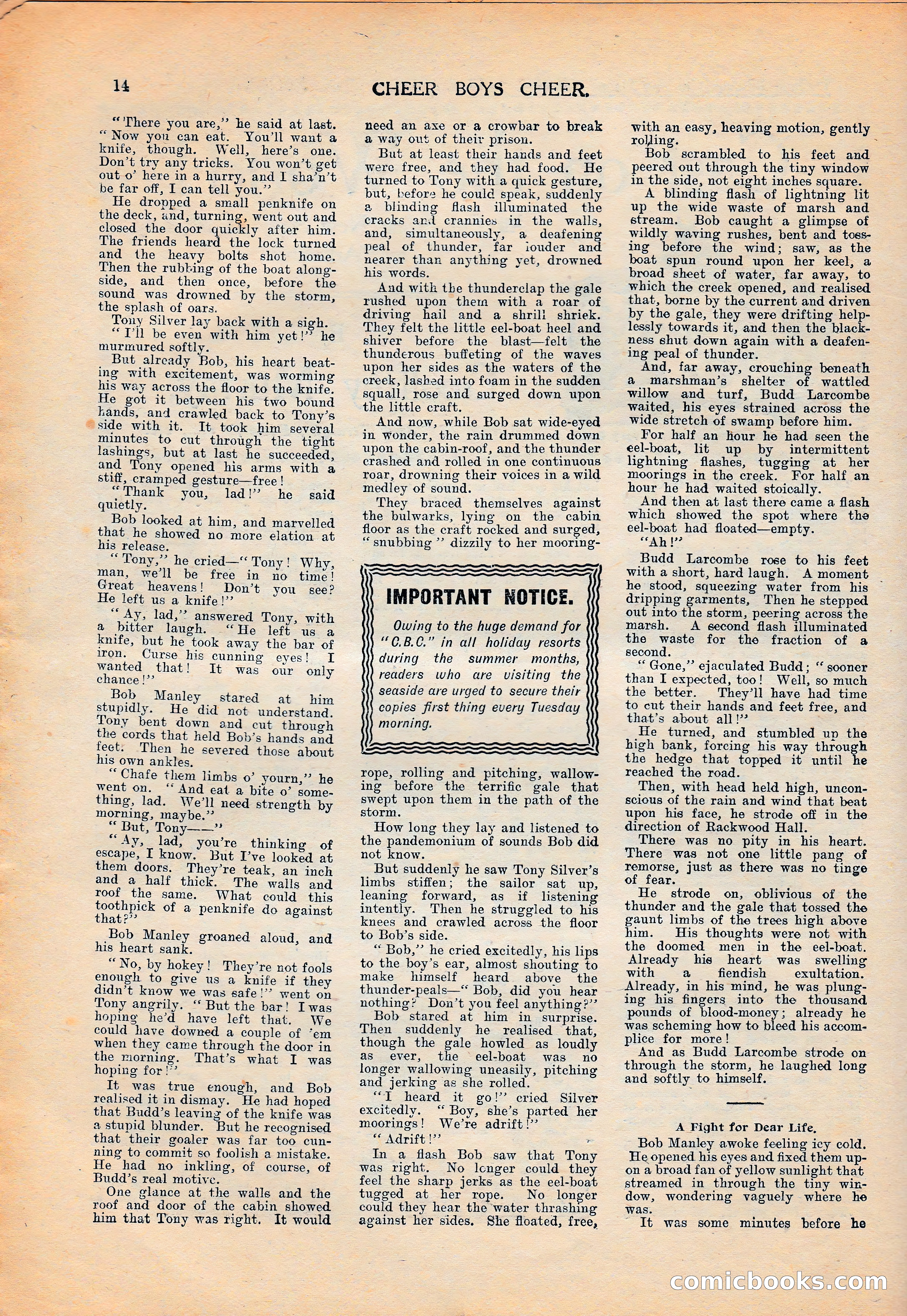
A restored page from Pulp Fiction, 1913. Page through the whole issue in the reader above.
📄 Transcribed text from this page (OCR, searchable)
Machine-transcribed from the original scan — historical spelling and the odd misread are preserved.
14 “There you are,’ he said at last. “ Now yon can eat. You'll want a knife, though. Well, here’s one. Don’t try any tricks. You won’t get out o° here in a hurry, and I sha’n’t be far off, I can tell you.” He dropped a small penknife on the deck, and, turning, went out and closed the door quickly after him. The friends heard the lock turned and the heavy bolts shot home. Then the rubbing of the boat along- side, and then once, before the sound was drowned by the storm, the splash of oars. Tony Silver lay back with a sigh. “TH be even with him yet!’ he murmured softly. But already Bob, his heart beat- ing with excitement, was worming his way across the floor to the knife. He got it between his two bound hands, and crawled back to Tony’s side with it. It took him several minutes to cut through the tight lashings, but at last he succeeded, and Tony opened his arms with a stiff, cramped gesture—free ! “Thank you, lad!’ he quietly. : Bob looked at him, and marvelled that he showed no more elation at his release. “Tony,’’ he cried—“ Tony! Why, man, we'll be free in no time! Great heavens! Don’t you see? He left us a knife!” “Ay, lad,’? answered Tony, with a bitter laugh. “He left us a knife, but he took away the bar of iron. Curse his cunning eyes! TI wanted that! It was our only chanee!’’ Bob Manley stared at him stupidly. He did not understand. Tony bent down and cut throuch the cords that held Bob’s hands and feet. Then he severed those about his own ankles, “Chafe them limbs o’ yourn,’’ he went on. “And eat a bite o’ some- thing, lad. We'll need strength by morning, maybe.” said *“ But, Tony——” “Ay, lad, you’re thinking of escape, I know. But I’ve looked at them doors. They’re teak, an inch and a half thick. The walls and roof the same. What could this toothpick of a penknife do against that?” Bob Manley groaned aloud, and his heart sank. “No, by hokey! They’re not fools enough to give us a knife if they didn’t know we was safe!” went on Tony angrily. ‘‘ But the bar! I was hoping he’d have left that. We could have downed a couple of ‘em when they came through the door in the morning. That’s what I was hoping for!” It was true enough, and Bob realised it in dismay. He had hoped that Budd’s leavin= of the knife was a stupid blunder. But he recognised that their goaler was far too cun- ning to commit so foolish a mistake. He had no inkling, of course, of Budd’s real motive. One glance at the walls and the roof and door of the cabin showed him that Tony was right. It would CHEER BOYS CHEER, need an axe or a crowbar to break a way out of their prison. But at least their hands and feet were free, and they had food. He turned to Tony with a quick gesture, but, before he could speak, suddenly a blinding flash illuminated the cracks and crannies in the walls, and, simultaneously, a deafening peal of thunder, far iouder and nearer than anything yet, drowned his words. And with the thunderclap the gale rushed upon them with a roar of driving hail and a shrill shriek. They felt the little eel-boat heel and shiver before the blast—felt the thunderous buffeting of the waves upon her sides as the waters of the creek, lashed into foam in the sudden squall, rose and surged down upon the little craft. And now, while Bob sat wide-eyed in wonder, the rain drummed down upon the cabin-roof, and the thunder crashed and rolled in one continuous roar, drowning their voices in a wild medley of sound. They braced themselves against the bulwarks, lying on the cabin floor as the craft rocked and surged, “snubbing ”’ dizzily to her mooring- a ——— IMPORTANT NOTICE. Owing to the huge demand for “C.B.C.” in all holiday resorts during the summer months, readers who are visiting the seaside are urged to secure their copies first thing every Tuesday morning. rope, rolling and pitching, wallow- ing before the terrific gale that swept upon them in the path of the storm. How long they lay and listened to the pandemonium of sounds Bob did not know. But suddenly he saw Tony Silver’s limbs stiffen; the sailor sat up, leaning forward, as if listening intently. Then he struggled to his knees and crawled across the floor to Bob’s side. “Bob,”’ he cried excitedly, his lips to the boy’s ear, almost shouting to make himself heard above the thunder-peals—“ Bob, did you hear nothing? Don’t you feel anything?’’ Bob stared at him in surprise. Then suddenly he realised that, though the gale howled as loudly as ever, the eel-boat was no longer wallowing uneasily, pitching and jerking as she rolled. “T heard it go!’ cried Silver excitedly. “ Boy, she’s parted her moorings! We’re adrift!” ** Adrift!’ ; In a flash Bob saw that Ton was right. No lenger could they feel the sharp jerks as the eel-boat tugged at her rope. No longer could they hear the water thrashing against her sides. She floated, free, with an easy, heaving motion, gently rolling. Bob scrambled to his feet and peered out through the tiny window in the side, not eight inches square. A blinding flash of lightning lit up the wide waste of marsh and stream. Bob caught a glimpse of wildly waving rushes, bent and toss- ing before the wind; saw, as the boat spun round upon her keel, a broad sheet of water, far away, to which the creek opened, and realised that, borne by the current and driven by the gale, they were drifting help- lessly towards it, and then the black- ness shut down again with a deafen- ing peal of thunder. And, far away, crouching beneath @ marshman’s shelter of wattled willow and turf, Budd Larcombe waited, his eyes strained across the wide stretch of swamp before him. For half an hour he had seen the eel-boat, lit up by intermittent lightning flashes, tugging at her moorings in the creek. For half an hour he had waited stoically. And then at last there came a flash which showed the spot where the eel-boat had floated—empty. “Ah 22 Budd Larcombe rose to his feet with a short, hard laugh. A moment he stood, squeezing water from his dripping garments, Then he stepped out into the storm, peering across the marsh. A second flash illuminated the waste for the fraction of a second. “ Gone,”’ ejaculated Budd; “ sooner than I expected, too! Well, so much the better. They'll have had time to cut their hands and feet free, and that’s about all!” He turned, and stumbled up the high bank, forcing his way sone the hedge that topped it until he reached the road. Then, with head held high, uncon- scious of the rain and wind that beat upon his face, he strode off in the direction of Rackwood Hall. There was no pity in his heart. There was not one little pang of remorse, just as there was no tinge of fear. He_ strode on, oblivious of the thunder and the gale that tossed the gaunt limbs of the trees high above him. His thoughts were not with the doomed men in the eel-boat. Already his heart was swelling with a fiendish exultation. Already, in his mind, he was plung- ing his fingers into the thousand pounds of blood-money; already he was scheming how to bleed his accom- plice for more! : And as Budd Larcombe strode on through the storm, he laughed long and softly to himself. A Fight for Dear Life, Bob Manley awoke feeling icy cold. He opened. his eyes and fixed them up- on a broad fan of yellow sunlight that streamed in through the tiny win- dow, wondering vaguely where he was. It was some minutes before he WR rary (Alarl ana) SAVAY SA) COMED O SAS AL) "a ‘a \