
Pulp Fiction, 1913 · page 12 of 36
Cheer Boys Cheer: The Boys' Journal, No. 62 — page 12: what you’re looking at
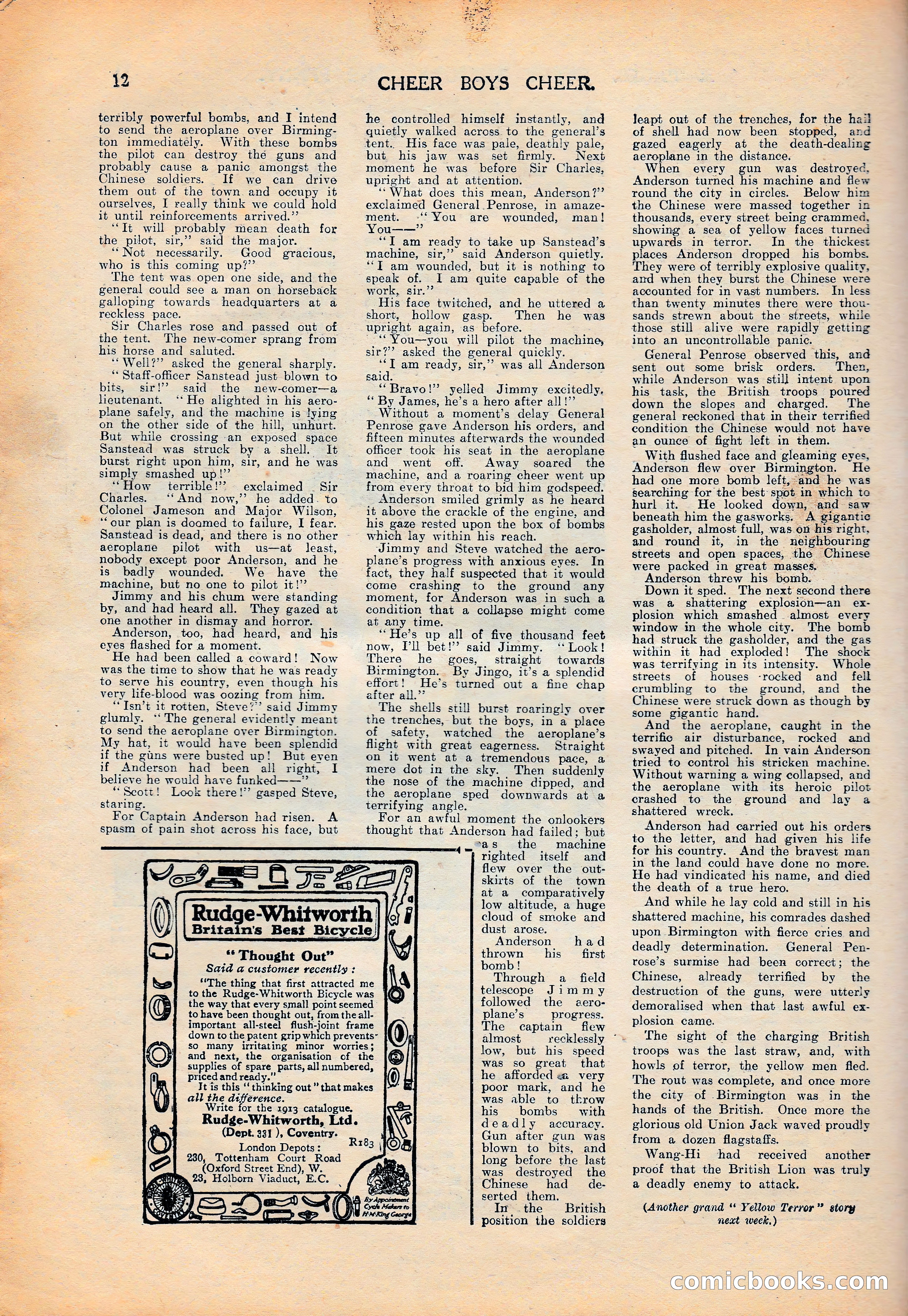
A restored page from Pulp Fiction, 1913. Page through the whole issue in the reader above.
📄 Transcribed text from this page (OCR, searchable)
Machine-transcribed from the original scan — historical spelling and the odd misread are preserved.
By) terribly powerful bombs, and I intend to send the aeroplane over Birming- ton immediately. With these bombs the pilot can destroy thé guns and probably cause a panic amongst the Chinese soldiers. If we can drive them out of the town. and occupy it ourselves, I really think we could hold it until reinforcements arrived.’ “Tt will probably mean death for the pilot, sir,” said the major. “Not necessarily. Good gracious, who is this coming up?” The tent was open one side, and the general could see a man on horseback galloping towards headquarters at a reckless pace. Sir Charles rose and passed ont of the tent. The new-comer sprang from his horse and saluted. “Well?” asked the general sharply. “ Staff-officer Sanstead just blown to bits, sir!’? said the new-comer—a lieutenant. ‘‘ He alighted in his aero- plane safely, and the machine is lying on the other side of the hill, unhurt. But while crossing -an exposed space Sanstead was struck by a shell. It burst right upon him, sir, and he was simply smashed up!” “How terrible!’”? exclaimed | Sir Charles. ‘‘ And now,’ he added. to Colonel Jameson and Major Wilson, ‘““our plan is doamed to failure, I fear. Sanstead is dead, and there is no other - aeroplane pilot with us—at least, nobody except poor Anderson, and he is badly wounded. We have the machine, but no one to pilot it!” Jimmy and his chum were standing by, and had heard all. They gazed at one another in dismay and horror. Anderson, too, had heard, and his eyes flashed for a moment. He had been called a coward! Now was the time to show that he was ready to serve his country, even though his very life-blood was oozing from him. “Isn’t it rotten, Steve?’ said Jimmy glumly. ‘‘The general evidently meant to send the aeroplane over Birmington. My hat, it would have been splendid if the guns were busted up! But even if Anderson had been all right, I believe he would have funked——” “Scott! Look there!’ gasped Steve, staring. For Captain Anderson had risen. A spasm of pain shot across his face, but Rudge-Whi Britain's Best Bicycle ** Thought Out” Said a customer recently : “The thing that first attracted me | to the Rudge-Whitworth Bicycle was the way that every small point seemed to have been thought out, from the all- important all-steel flush-joint frame The down to the patent grip which prevents~ so many irritating minor worries; and next, the organisation of the supplies of spare parts, all numbered, priced and ready. It is this ‘‘thinking out” that makes all the difference. Write for the 1913 catalogue. Rudge-Whitworth, Ltd. (Dept. 331 ), Coventry. London Depots: 230, Tottenham Court Road Oxford Street End), W. By, 23, Holborn Viaduct, E.C. CHEER BOYS CHEER, he controlled himself instantly, and quietly walked across. to the general’s tent.. His face was pale, deathly pale, but his jaw was set firmly. Next moment he was before Sir Charles, upright and at attention. “What does this mean, Anderson?’’ exclaimed General. Penrose, in amaze- ment. -‘‘ You are wounded, man! You——” ““T am ready to take up Sanstead’s machine, sir,” said Anderson quietly. ““T am wounded, but it is nothing to speak of. I am quite capable of the work, sir.’’ His face twitched, and he uttered a short, hollow gasp. Then he was upright again, as before. ““You—you will pilot the machine, sir?’ asked the general quickly. ‘‘T am ready, sir,’’ was all Anderson said. ; “Bravo!” yelled Jimmy excitedly. “By James, he’s a hero after all !”’ Without a moment’s delay General Penrose gave Anderson his orders, and fifteen minutes afterwards the wounded officer took his seat in the aeroplane and went off. Away soared the machine, and a roaring cheer went up from every throat to bid him godspeed. Anderson smiled grimly as he heard it above the crackle of the engine, and his gaze rested upon the box of bombs which lay within his reach. ‘Jimmy and Steve watched the aero- plane’s progress with anxious eyes. In fact, they half suspected that it would come crashing to the ground any moment, for Anderson was in such a condition that a collapse might come at any time. “He’s up all of five thousand feet now, I'll bet!” said Jimmy. ‘‘ Look! There he goes, straight towards Birmington. By Jingo, it’s a splendid effort! He’s turned out a fine chap after all.” The shells still burst roaringly over the trenches, but the boys, in a place of safety, watched the aeroplane’s flight with great eagerness. Straight on it went at a tremendous pace, a mere dot in the sky. Then suddenly the nose of the machine dipped, and the aeroplane sped downwards at a terrifying angle. For an awful moment the onlookers thought that Anderson had failed; but _*as the machine righted itself and flew over the out- skirts of the town at a comparatively low altitude, a huge cloud of smoke and dust arose. Anderson had thrown his first bomb! Through a field telescope Jimmy low, but his speed was so great that he afforded « very poor mark, and he was able to tkraw his bombs with deadly accuracy. Gun after gun was blown to bits, and long before the last was destroyed the Chinese had de- serted them. In the British position the soldiers followed the aero- plane’s progress. captain flew almost recklessly ~ leapt out of the trenches, for the hail of shell had now been stopped, and gazed eagerly at the death-dealing aeroplane in the distance. When every gun was destroyed. Anderson turned his machine and flew round the city in circles. Below him the Chinese were massed together in thousands, every street being crammed, showing a sea of yellow faces turned upwards in terror. In the thickest places Anderson dropped his bombs. They were of terribly explosive quality, and when they burst the Chinese were accounted for in vast numbers. In less than twenty minutes there were thou- sands strewn about the streets, while those still alive were rapidly getting into an uncontrollable panie. General Penrose observed this, and sent out some brisk orders. Then, while Anderson was stil] intent upon his task, the British troops poured down the slopes and charged. The general reckoned that in their terrified condition the Chinese would not have an ounce of fight left in them. With flushed face and gleaming eyes, Anderson flew over Birmington. He had one more bomb left,-and he was searching for the best: spot in which te hurl it. He looked down, -and- saw beneath him the gasworks. A gigantic gasholder, almost full, was on his right. and round it, in the neighbouring streets and open spaces, the Chinese were packed in great masses. Anderson threw his bomb. Down it sped. The next second there was a shattering explosion—an ex- plosion which smashed almost every window in the whole city. The bomb had struck the gasholder, and the gas within it had exploded! The shock was terrifying in its intensity. Whole streets of houses -rocked and felt crumbling to the ground, and the Chinese were struck down as though by some gigantic hand. And the aeroplane, caught in the terrific air disturbance, rocked and swayed and pitched. In vain Anderson tried to control his stricken machine. Without warning a wing collapsed, and the aeroplane with its heroic pilot crashed to the ground and lay a shattered wreck. Anderson had carried out his orders to the letter, and had given his life for his country. And the bravest man in the land could have done no more. He had vindicated his name, and died the death of a true hero. And while he lay cold and still in his shattered machine, his comrades dashed upon Birmington with fierce cries and deadly determination. General Pen- rose’s surmise had been correct; the Chinese, already terrified by the destruction of the guns, were utterly demoralised when that last awful ex- plosion came. The sight of the charging British troops was the last straw, and, with howls of terror, the yellow men fied. The rout was complete, and once more the city of Birmington was in the hands of the British. Once more the glorious old Union Jack waved proudly from a dozen flagstaffs. Wang-Hi shad received another proof that the British Lion was truly a deadly enemy to attack. (Another grand “ Yellow Terror’ story next week.) = efavlan ile : (ClAA) icboo Ss) OG OKO)! KSA (ECLA)