
Pulp Fiction, 1913 · page 10 of 36
Cheer Boys Cheer: The Boys' Journal, No. 62 — page 10: what you’re looking at
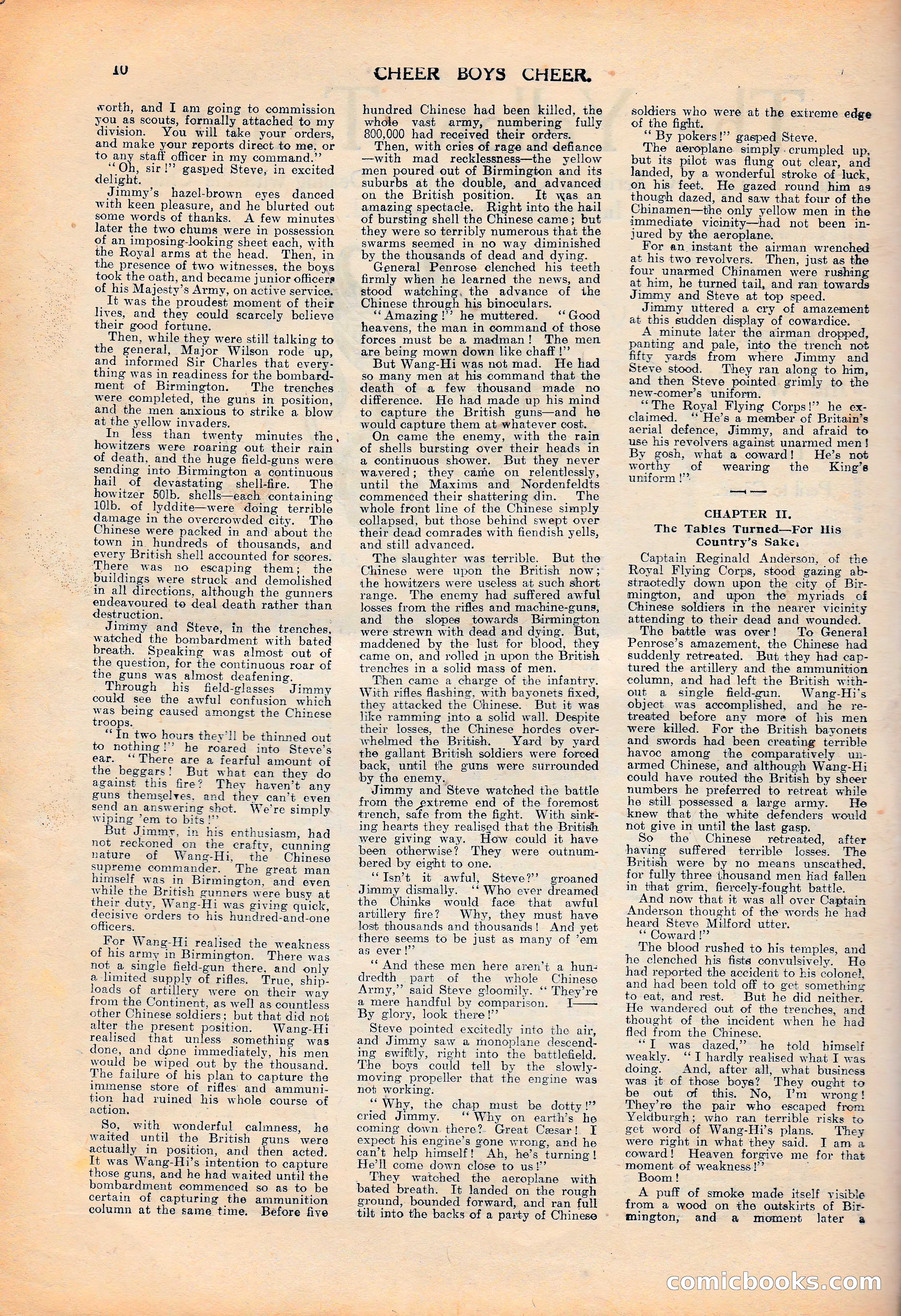
A restored page from Pulp Fiction, 1913. Page through the whole issue in the reader above.
📄 Transcribed text from this page (OCR, searchable)
Machine-transcribed from the original scan — historical spelling and the odd misread are preserved.
40 worth, and I am going to commission you as scouts, formally attached to my division. You will take your orders, and make your reports direct to me, or to any staff officer in my command.”’ s ihe sir !”? gasped Steve, in excited delight. Jimmy’s hazel-brown eyes danced with keen pleasure, and he blurted out some words of thanks. A few minutes later the two chums were in possession of an imposing-looking sheet each, with the Royal arms at the head. Then, in the presence of two witnesses, the boys took the oath, and became junior officers of his Majesty’s Army, on active service. _Iét was the proudest moment of their lives, and they could scarcely believe their good fortune. Then, while they were still talking to the general, Major Wilson rode up, and informed Sir Charles that every- thing was in readiness for the bombard- ment of Birmington. The trenches were completed, the guns in position, and the men anxious to strike a blow at the yellow invaders. In less than twenty minutes the howitzers were roaring out their rain of death, and the huge field-guns were sending into Birmington a continuous hail of devastating shell-fire. The howitzer 50lb. shells—each containing 10lb. of lyddite—were doing terrible damage in the overcrowded city. The Chinese were packed in and about the town in hundreds of thousands, and every British shell accounted for scores. There was no escaping them; the buildings were struck and demolished in all directions, although the gunners endeavoured to deal death rather than destruction. ‘ Jimmy and Steve, in the trenches, watched the bombardment with bated breath. Speaking was almost out of the question, for the continuous roar of the guns was almost deafening. Through his field-glasses Jimmy could see the awful confusion which was being caused amongst the Chinese troops. “Tn two hours they'll be thinned out to nothing!’ he roared into Steve's ear. “There are a fearful amount of the beggars! But what can they do against this fire? They haven’t any guns themselyes. and they can’t even send an answering shot. We’re simply wiping ’em to bits!” But Jimmy, in his enthusiasm, had not reckoned on the crafty, cunning nature of Wang-Hi, the Chinese supreme commander. The great man himself was in Birmington, and even while the British gunners were busy at their duty, Wang-Hi was giving quick, decisive orders to his hundred-and-one officers. For Wang-Hi realised the weakness of his army in Birmington. There was not a single field-gun there, and only a limited supply of rifles. True, ship- loads of artillery were on their way from the Continent, as well as countless other Chinese soldiers: but that did not alter the present position. Wang-Hi realised that unless something was done, and done immediately, his men would be wiped out by the thousand. The failure of his plan to capture the immense store of rifles and ammuni- tion had ruined his whole course of action, : So, with wonderful calmness, he waited until the British guns were actually in position, and then acted. It was Wang-Hi’s intention to capture those guns, and he had waited until the bombardment commenced so as to be certain of capturing the ammunition column at the same time. Before five CHEER BOYS CHEER, hundred Chinese had been killed, the whole vast army, numbering fully 800,000 had received their orders. Then, with cries of rage and defiance with mad recklessness—the yellow men poured out of Birmington and its suburbs at the double, and advanced on the British position. It was an amazing spectacle. Right into the hail of bursting shell the Chinese came; but they were so terribly numerous that the swarms seemed in no way diminished by the thousands of dead and dying. General Penrose clenched his teeth firmly when he learned the news, and stood watching, the advance of the Chinese through his binoculars. ‘* Amazing!’ he muttered. ‘‘ Good heavens, the man in command of those forces must be a madman! The men are being mown down like chaff !”’ But Wang-Hi was not mad. He had so many men at his command that the death of a few thousand made no difference. He had made up his mind to capture the British guns—and he would capture them at whatever cost. On came the enemy, with the rain of shells bursting over their heads in a continuous shower. But they never wavered; they came on relentlessly, until the Maxims and Nordenfeldts commenced their shattering din. _ The whole front line of the Chinese simply collapsed, but those behind swept over their dead comrades with fiendish yells, and still advanced. The slaughter was terrible. But the Chinese were upon the British now; ihe howitzers were useless at such short range. The enemy had suffered awful losses from the rifles and machine-guns, and the slopes towards Birmington were strewn with dead and dying. But, maddened by the lust for blood, they came on, and rolled in upon the British trenches in a solid mass of men. Then came a charge of the infantry. With rifles flashing, with bayonets fixed, they attacked the Chinese. But it was like ramming into a solid wall. Despite their losses, the Chinese hordes over- whelmed the British. Yard by yard the gallant British soldiers were forced back, until the guns were surrounded by the enemy. Jimmy and Steve watched the battle from the extreme end of the foremost trench, safe from the fight. With sink- ing hearts they realised that the British were giving way. How could it have been otherwise? They were outnum- bered by eight to one. “Tsn’t it awful, Steve?’ groaned Jimmy dismally. ‘‘ Who ever dreamed the Chinks would face that awful artillery fire? Why, they must have lost thousands and thousands! And yet there seems to be just as many of ’em as ever !”’ ‘And these men here aren’t a hun: dredth part of the whole Chinese Army,” said Steve gloomily. ‘“ They’re a mere handful by comparison. I By glory, look there!’ Steve pointed excitedly into the air, and Jimmy saw a monoplane descend- ing swiftly, right into the battlefield. The boys could tell by the slowly- moving propeller that the engine was not working. “Why, the chap must be dotty !” cried Jimmy. “Why on earth’s he coming down. there?. Great Cesar! I expect his engine’s gone wrong, and he can’t help himself! Ah, he’s turning! He’ll come down close to us!’ They watched the aeroplane with bated breath. It landed on the rough ground, bounded forward, and ran full tilt into the backs of a party of Chinese ? soldiers who were at the extreme edge of the fight. : ** By pokers!”’ gasped Steve. The aeroplane simply .crumpled up, but its pilot was flung out clear, and landed, by a wonderful stroke of luck, on his feet. He gazed round him as though dazed, and saw that four of the Chinamen—the only yellow men in the immediate vicinity—had not been in- jured by the aeroplane. For an instant the airman wrenched at his two revolvers. Then, just as the four unarmed Chinamen were rushing at him, he turned tail, and ran towards Jimmy and Steve at top speed. Jimmy uttered a cry of amazement at this sudden display of cowardice. A minute later the airman dropped, panting and pale, into the trench not fifty yards from where Jimmy and Steve stood. They ran along to him, and then Steve pointed grimly to the new-comer’s uniform. “The Royal Flying Corps!” he ex- claimed. ‘“‘ He’s a member of Britain’s aerial defence, Jimmy, and afraid to use his revolvers against unarmed men! By gosh, what a coward! He’s not worthy of wearing the King’s uniform !”? recs CHAPTER II, The Tables Turned—For His Country’s Sake; Captain Reginald Anderson, of the Royal Flying Corps, stood gazing ab- stractedly down upon the city of Bir- mington, and upon the myriads of Chinese soldiers in the nearer vicinity attending to their dead and wounded. The battle was over! To General Penrose’s amazement, the Chinese had suddenly retreated. But they had cap- tured the artillery and the ammunition column, and had left the British with- out a single field-gun. Wang-Hi's object was accomplished, and he re- treated before any more of his men were killed. For the British bayonets and swords had been creating terrible havoc among the comparatively un- armed Chinese, and although Wang-Hi could have routed the British by sheer numbers he preferred to retreat while he still possessed a large army. He knew that the white defenders would not give in until the last gasp. So the Chinese retreated, after having suffered terrible losses. The British were by no means unscathed, for fully three thousand men Had fallen in that grim, fiercely-fought battle. And now that it was all over Captain Anderson thought of the words he had heard Steve Milford utter. ** Coward !” The blood rushed to his temples, and he clenched his fists convulsively. He had reported the accident to his colonel, and had been told off to get something to eat, and rest. But he did neither. He wandered out of the trenches, and thought of the incident when he had fled from the Chinese. “Twas dazed,” he told himself weakly. ‘T hardly realised what I was doing. And, after all, what business was it of those boys? They ought to be out of this. No, I’m wrong! They're the pair who escaped from Yeldburgh; who ran terrible risks to get word of Wang-Hi’s plans. They were right in what they said. I am a eoward! Heaven forgive me for that moment of weakness!’ : Boom! A puff of smoke made itself visible from a wood on the outskirts of Bir- mington, and a moment later a ool SF al 0\0\(0)|| = (Alay a ¥ COMNMICWIOOKS .COla