
Pulp Fiction, 1922 · page 14 of 132
The Black Mask — page 14: what you’re looking at
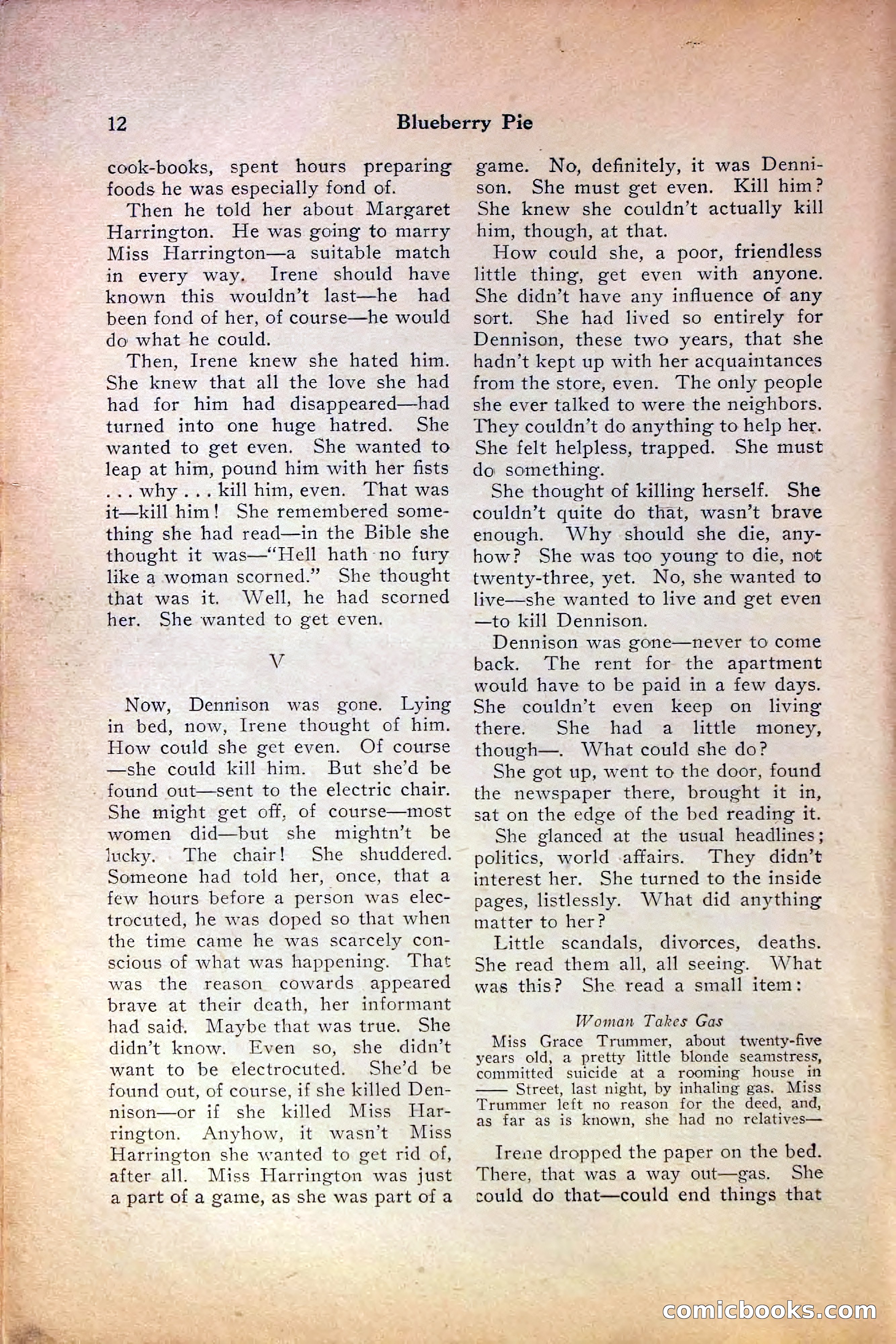
A restored page from Pulp Fiction, 1922. Page through the whole issue in the reader above.
📄 Transcribed text from this page (OCR, searchable)
Machine-transcribed from the original scan — historical spelling and the odd misread are preserved.
Sea. « 12 Blueberry Pie cook-books, spent hours preparing foods he was especially fond of. Then he told her about Margaret Harrington. He was going to marry Miss Harrington—a suitable match in every way. Irene should have known this wouldn’t last—he had been fond of her, of course—he would do what he could. Then, Irene knew she hated him. She knew that all the love she had had for him had disappeared—had turned into one huge hatred. She wanted to get even. She wanted to leap at him, pound him with her fists ... why... kill him, even. That was it—kill him! She remembered some- thing she had read—in the Bible she thought it was—‘‘Hell hath no fury like a woman scorned.” She thought that was it. Well, he had scorned her. She wanted to get even. SVE Now, Dennison was gone, Lying in bed, now, Irene thought of him. How could she get even. Of course —she could kill him. But she'd be - found out—sent to the electric chair. She might get off, of course—most women did—but she mightn’t be lucky. The chair! She shuddered. Someone had told her, once, that a few hours before a person was elec- trocuted, he was doped so that when the time came he was scarcely con- scious of what was happening. That was the reason cowards appeared brave at their death, her informant had said. Maybe that was true. She didn’t know. Even so, she didn’t want to be electrocuted. She'd be found out, of course, if she killed Den- nison—or if she killed Miss Har- rington. Anyhow, it wasn’t Miss Harrington she wanted to get rid of, after all. Miss Harrington was just a part of a game, as she was part of a game. No, definitely, it was Denni- son. She must get even. Kill him? She knew she couldn’t actually kill him, though, at that. How could she, a poor, friendless little thing, get even with anyone. She didn’t have any influence of any sort. She had lived so entirely for Dennison, these two years, that she hadn’t kept up with her acquaintances from the store, even. The only people she ever talked to were the neighbors. They couldn’t do anything to help her. She felt helpless, trapped. She must do something. She thought of killing herself. She couldn’t quite do that, wasn’t brave enough. Why should she die, any- how? She was too young to die, not twenty-three, yet. No, she wanted to live—she wanted to live and get even —to kill Dennison. Dennison was gone—never to come back. The rent for the apartment would have to be paid in a few days. She couldn’t even keep on living there. She had a little money, though—. What could she do? She got up, went to the door, found the newspaper there, brought it in, sat on the edge of the bed reading it. She glanced at the usual headlines; politics, world -affairs. They didn’t interest her. She turned to the inside pages, listlessly. What did anything matter to her? Little scandals, divorces, deaths. She read them all, all seeing. What was this? She read a small item: Woman Takes Gas Miss Grace Trummer, about twenty-five years old, a pretty little blonde seamstress, committed suicide at a rooming house in Street, last night, by inhaling gas. Miss Trummer left no reason for the deed, and, as far as is known, she had no relatives— Irene dropped the paper on the bed. There, that was a way out—gas. She could do that—could end things that Eomicbooks.com . ’ bh ' ¥ ° iwi ha. heen bil