
Pulp Fiction, 1922 · page 14 of 132
The Black Mask — page 14: what you’re looking at
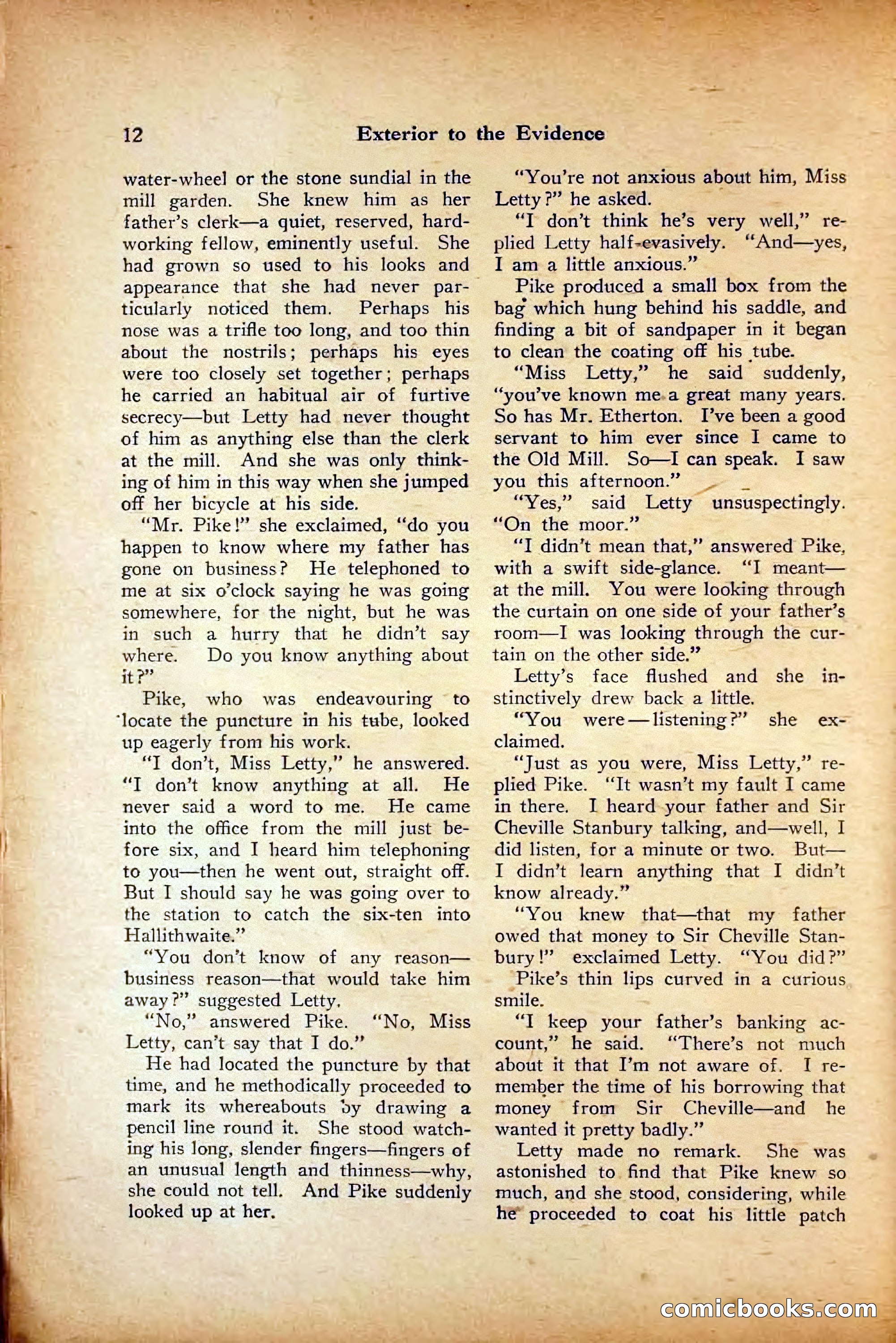
A restored page from Pulp Fiction, 1922. Page through the whole issue in the reader above.
📄 Transcribed text from this page (OCR, searchable)
Machine-transcribed from the original scan — historical spelling and the odd misread are preserved.
GEE ee 12 Exterior to the Evidence water-wheel or the stone sundial in the mill garden. She knew him as her father’s clerk—a quiet, reserved, hard- working fellow, eminently useful. She had grown so used to his looks and appearance that she had never par-— ticularly noticed them. Perhaps his nose was a trifle too long, and too thin about the nostrils; perhaps his eyes were too closely set together; perhaps he carried an habitual air of furtive secrecy—but Letty had never thought of him as anything else than the clerk at the mill. And she was only think- ing of him in this way when she jumped off her bicycle at his side. “Mr. Pike!’ she exclaimed, ‘‘do you happen to know where my father has gone on business? He telephoned to me at six o'clock saying he was going somewhere, for the night, but he was in such a hurry that he didn’t say where. Do you know anything about it?” Pike, who was endeavouring to ‘locate the puncture in his tube, looked up eagerly from his work. “T don’t, Miss Letty,” he answered. “T don’t know anything at all. He never said a word to me. He came into the office from the mill just be- fore six, and I heard him telephoning to you—then he went out, straight off. But I should say he was going over to the station to catch the six-ten into Hallithwaite.” “You don’t know of any reason— business reason—that would take him away?” suggested Letty, “No,” answered Pike. Letty, can’t say that I do.” He had located the puncture by that time, and he methodically proceeded to mark its whereabouts by drawing a pencil line round it. She stood watch- ing his long, slender fingers—fingers of an unusual length and thinness—why, she could not tell. And Pike suddenly looked up at her. “No, Miss “You're not anxious about him, Miss Letty?” he asked. “I don’t think he’s very well, ores plied Letty half-evasively. ae I am a little anxious.” Pike produced a small box from the bag which hung behind his saddle, and finding a bit of sandpaper in it began to clean the coating off his tube. “Miss Letty,” he said suddenly, “you’ve known me-a great many years. So has Mr. Etherton. [ve been a good servant to him ever since I came to the Old Mill. So—I can speak. I saw you this afternoon.” _ “Yes, said _ Letty unsuspectingly. “On the moor.’ “T didn’t mean that,” answered Pike, with a swift side-glance. at the mill. You were looking through the curtain on one side of your father’s room—lI was looking through the cur- tain on the other side.” Letty’s face flushed and she in- stinctively drew back a little. “You were—listening?’ she ex-= claimed. “Just as you were, Miss Letty,” re- plied Pike. “It wasn’t my fault I came in there. I heard-your father and Sir Cheville Stanbury talking, and—well, I did listen, for a minute or two. But— I didn’t learn anything that I didn’t know already.” “You knew that—that my father owed that money to Sir Cheville Stan- bury!’ exclaimed Letty. “You did?” _Pike’s thin lips curved in a curious smile. “T keep your father’s banking ac- count,” he said. “There’s not much about it that I’m not aware of. I re- member the time of his borrowing that money from Sir Cheville—and he wanted it pretty badly.” Letty made no remark. She was astonished to find that Pike knew so much, and she stood, considering, while he* proceeded to coat his little patch