
Pulp Fiction, 1920 · page 89 of 136
The Black Mask — page 89: what you’re looking at
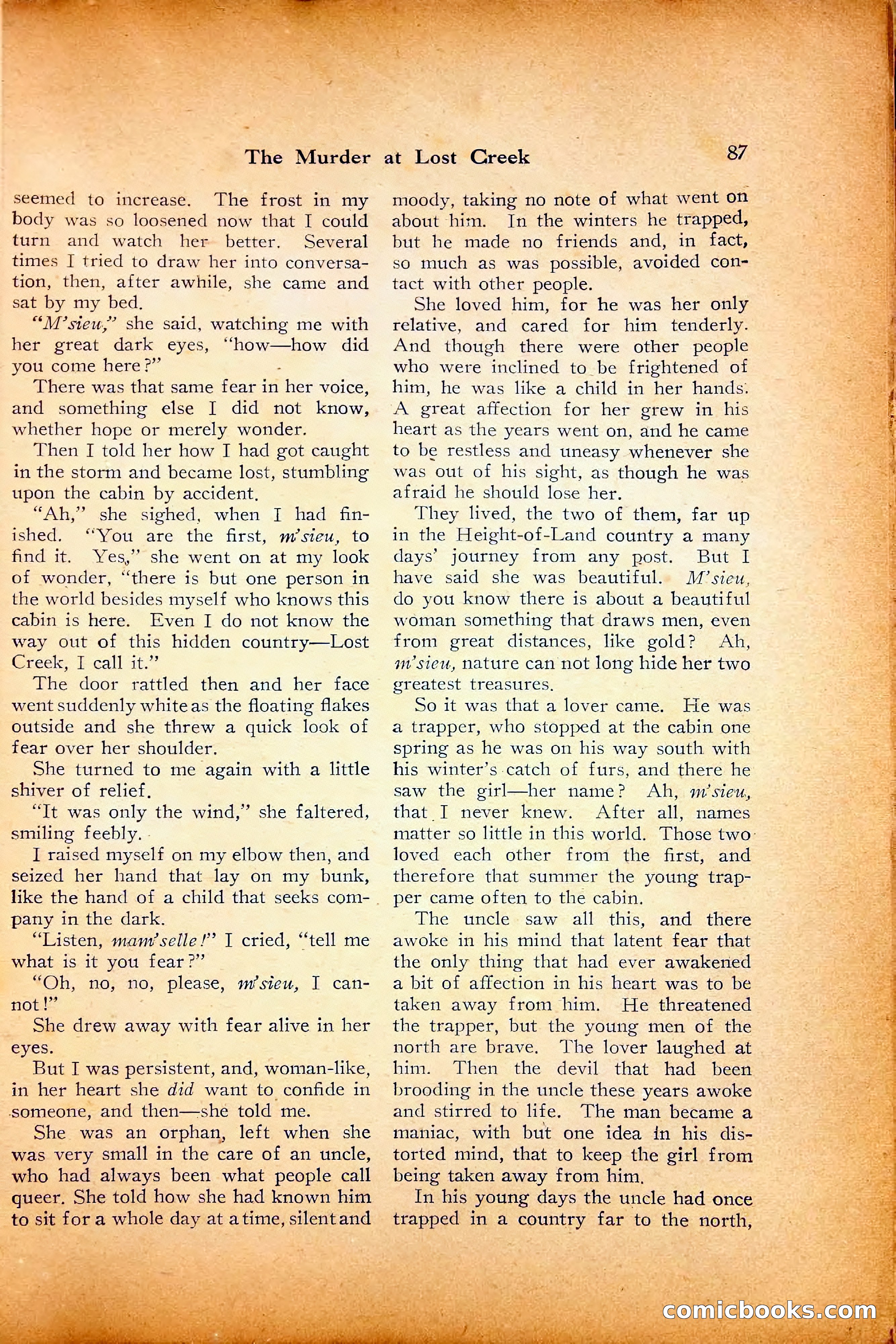
A restored page from Pulp Fiction, 1920. Page through the whole issue in the reader above.
📄 Transcribed text from this page (OCR, searchable)
Machine-transcribed from the original scan — historical spelling and the odd misread are preserved.
The Murder seemed to increase. The frost in my body was so loosened now that I could turn and watch her better. Several times | tried to draw her into conversa- tion, then, after awhile, she came and sat by my bed. “M’steu,” she said, watching me with her great dark eyes, “how—how did you come here ?”’ : There was that same fear in her voice, and something else I did not know, whether hope or merely wonder. Then I told her how I had got caught in the storm and became lost, stumbling upon the cabin by accident, “Ah,” she sighed, when I had fin- ished. “You are the first, m’steu, to find it. Yes,’’ she went on at my look of wonder, “there is but one person in the world besides myself who knows this cabin is here. Even I do not know the way out of this hidden country—Lost Greek. | call it.” The door rattled then and her face went suddenly whiteas the floating flakes outside and she threw a quick look of fear over her shoulder. She turned to me again with a little shiver of relief, “It was only the wind,” smiling feebly. . I raised myself on my elbow then, and seized her hand that lay on my bunk, she faltered, like the hand of a child that seeks com- . pany in the dark. “Listen, mam/’selle!’’ J cried, what is it you fear?” “Oh, no, no, please, m’sieu, I can- not!” She drew away with fear alive in her eyes. But I was persistent, and, woman-like, in her heart she did want to confide in someone, and then—she told me. She was an orphan, left when she etell me was very small in the care of an uncle, who had always been what people call queer. She told how she had known him to sit for a whole day at atime, silentand at Lost Creek 87 moody, taking no note of what went on about him. In the winters he trapped, but he made no friends and, in fact, so much as was possible, avoided con- tact with other people. She loved him, for he was her only relative, and cared for him tenderly. And though there were other people who were inclined to be frightened of him, he was like a child in her hands. A great affection for her grew in his heart as the years went on, and he came to be restless and uneasy whenever she was out of his sight, as though he was afraid he should lose her. They lived, the two of them, far up in the Height-of-Land country a many days’ journey from any post. But I have said she was beautiful. M’sieu, do you know there is about a beautiful woman something that draws men, even from great distances, like gold? Ah, msieu, nature can not long hide her two greatest treasures. So it was that a lover came. He was a trapper, who stopped at the cabin one spring as he was on his way south with his winter’s-catch of furs, and there he saw the girl—her name? Ah, m’sieu, that I never knew. After all, names matter so little in this world. Those two- loved each other from the first, and therefore that summer the young trap- per came often to the cabin. The uncle saw all this, and there awoke in his mind that latent fear that the only thing that had ever awakened a bit of affection in his heart was to be taken away from him. He threatened the trapper, but the young men of the north are brave. ‘The lover laughed at him. Then the devil that had been brooding in the uncle these years awoke and stirred to life. The man became a maniac, with but one idea in his dis- torted mind, that to keep the girl from being taken away from him, In his young days the uncle had once trapped in a country far to the north, COMI 9BOX» com. i ae See en hg f y Se < hah len eeneereaiier, pa, ee eee | 3 4! fh erty vate ie FTN OY es Se