
Pulp Fiction, 1920 · page 83 of 136
The Black Mask — page 83: what you’re looking at
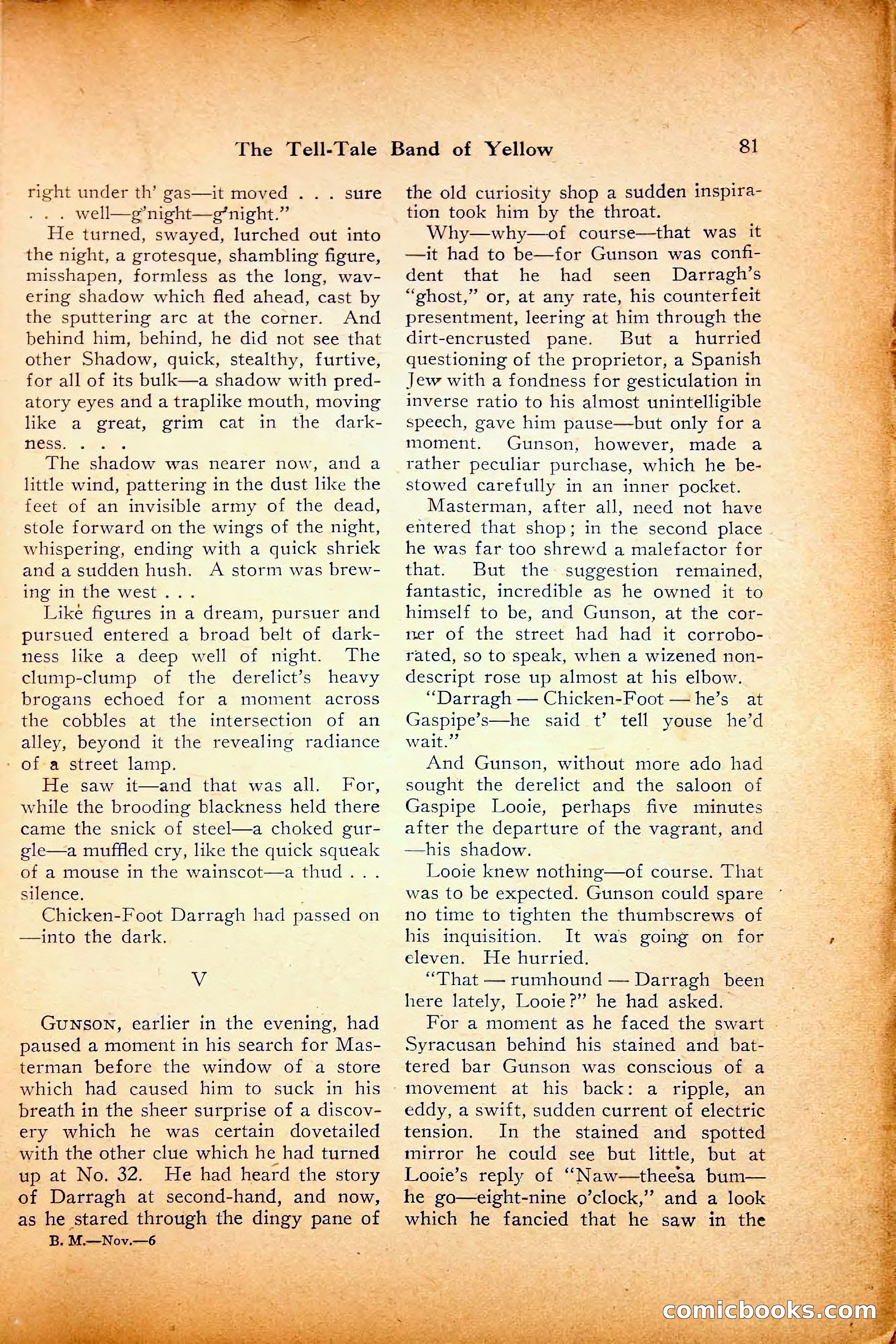
A restored page from Pulp Fiction, 1920. Page through the whole issue in the reader above.
📄 Transcribed text from this page (OCR, searchable)
Machine-transcribed from the original scan — historical spelling and the odd misread are preserved.
The Tell-Tale right under th’ gas—it moved... . well—g’night—¢*night.” He turned, swayed, lurched out into the night, a grotesque, shambling figure, misshapen, formless as the long, wav- ering shadow which fled ahead, cast by the sputtering arc at the corner. And behind him, behind, he did not see that other Shadow, quick, stealthy, furtive, for all of its bulk—a shadow with pred- atory eyes and a traplike mouth, moving like a great, grim cat in the dark- ness. The shadow was nearer now, and a little wind, pattering in the dust ite the feet of an invisible army of the dead, stole forward on the wings of the night, whispering, ending with a quick shriek and a sudden hush. A storm was brew- ing in the west... Like figures in a dream, pursuer and pursued entered a broad belt of dark- ness like a deep well of night. The clump-clump of the derelict’s heavy brogans echoed for a moment across the cobbles at the intersection of an alley, beyond it the revealing radiance - of a street lamp. me saw if—and that was all. For, while the brooding blackness held there came the snick of steel—a choked gur- gle—a muffled cry, like the quick squeak of a mouse in the wainscot—a thud . silence. Chicken-Foot Darragh had passed on —into the dark. sure Vv Gunson, earlier in the evening, had paused a moment in his search for Mas- terman before the window of a store which had caused him to suck in his breath in the sheer surprise of a discov- ery which he was certain dovetailed _ with the other clue which he had turned up at No. 32. He had heard the story ; Darragh | at second- hand, and now, | fi oo the sae pane of Band of Yellow ‘tnovement at his back: eddy, a swift, sudden current of electric the old curiosity shop a sudden inspira- tion took him by the throat. Why—why—of course—that was it —it had to be—for Gunson was confi- dent that he had seen Darragh’s “ghost,” or, at any rate, his counterfeit presentment, leering at him through the dirt-encrusted pane. But a _ hurried questioning of the proprietor, a Spanish Jew with a fondness for gesticulation in inverse ratio to his almost unintelligible speech, gave him pause—but only for a moment. Gunson, however, made a rather peculiar purchase, which he be- stowed carefully in an inner pocket. Masterman, after all, need not have entered that shop; in the second place he was far too shrewd a malefactor for that. But the suggestion remained, fantastic, incredible as he owned it to himself to be, and Gunson, at the cor- ner of the street had had it corrobo- rated, so to speak, when a wizened non- descript rose up almost at his elbow. “Darragh — Chicken-Foot —he’s at Gaspipe’s—he said t’ tell youse he’d wait.” And Gunson, without more ado had sought the derelict and the saloon of Gaspipe Looie, perhaps five minutes after the departure of the vagrant, and —his shadow. Looie knew nothing—of course. That was to be expected. Gunson could spare no time to tighten the thumbscrews of his inquisition. It was going on for eleven. He hurried. “That — rumhound — Darragh been here lately, Looie?” he had asked. For a moment as he faced the swart Syracusan behind his stained and bat- tered bar Gunson was conscious of a a ripple, an tension. In the stained and spotted mirror he could see but little, but at Looie’s reply of “Naw—theesa bum— he go—eight-nine o’clock,” and a look > which he oe that he | saw in the Ee