
Pulp Fiction, 1920 · page 40 of 136
The Black Mask — page 40: what you’re looking at
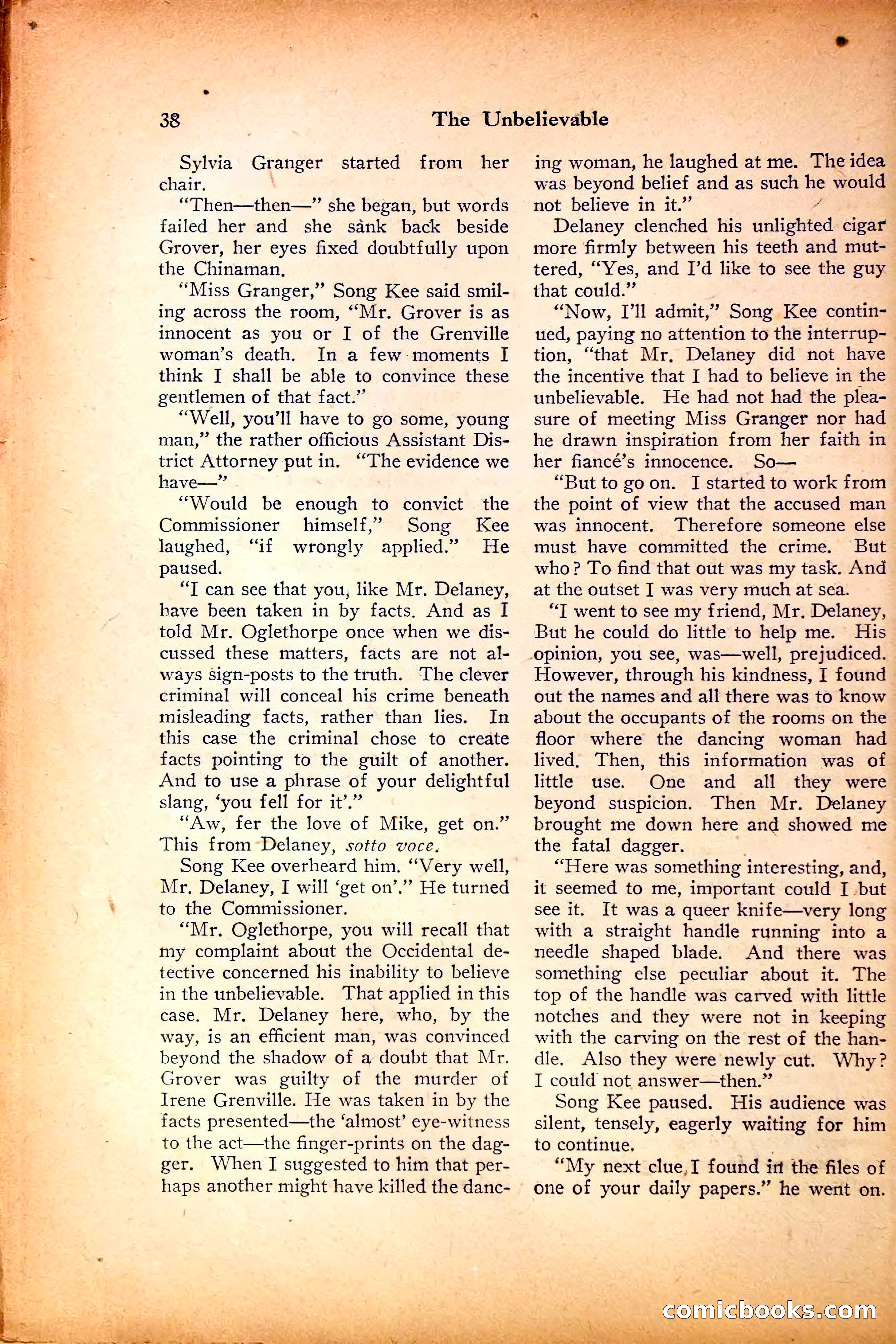
A restored page from Pulp Fiction, 1920. Page through the whole issue in the reader above.
📄 Transcribed text from this page (OCR, searchable)
Machine-transcribed from the original scan — historical spelling and the odd misread are preserved.
MS ce NT hy 2 +96 aCe ote Sylvia Granger started from her chair. “Then—then—” she began, but words failed her and she sank back beside Grover, her eyes fixed doubtfully upon the Chinaman, “Miss Granger,” Song Kee said smil- ing across the room, “Mr. Grover is as innocent as you or I of the Grenville woman’s death. In a few: moments I think J shall be able to convince these gentlemen of that fact.” “Well, you’ll have to go some, young man,” the rather officious Assistant Dis- trict Attorney put in. “The evidence we have—” “Would be enough to convict the Commissioner himself,’ Song Kee laughed, “if wrongly applied.” He paused. “T can see that you, like Mr. Delaney, have been taken in by facts. And as I told Mr. Oglethorpe once when we dis- cussed these matters, facts are not al- ways Sign-posts to the truth. The clever criminal will conceal his crime beneath misleading facts, rather than lies. In this case the criminal chose to create facts pointing to the guilt of another. And to use a phrase of your delightful slang, ‘you fell for it’.” “Aw, fer the love of Mike, get on.” This from ‘Delaney, sotto voce. Song Kee overheard him. ‘Very well, Mr. Delaney, I will ‘get on’.”” He turned to the Commissioner. “Mr. Oglethorpe, you will recall that my complaint about the Occidental de- tective concerned his inability to believe in the unbelievable. That applied in this case. Mr. Delaney here, who, by the way, is an efficient man, was convinced beyond the shadow of a doubt that Mr. Grover was guilty of the murder of Irene Grenville. He was taken in by the facts presented—the ‘almost’ eye-witness to the act—the finger-prints on the dag- ger. When I suggested to him that per- haps another might have killed the danc- The Unbelievable 4 ing woman, he laughed at me. The ideal . was beyond belief and as such he would — : not believe in it.” 4 j Delaney clenched his unlighted cigar : more firmly between his teeth and mut-— tered, “Yes, and I’d like to see the guy that could.” “Now, I'll admit,” Song Kee contin- ued, paying no attention to the interrup- tion, “that Mr, Delaney did not have the incentive that I had to believe in the unbelievable. He had not had the plea- sure of meeting Miss Granger nor had he drawn inspiration from her faith in her fiancé’s innocence. So— } “But to goon. I started to work from the point of view that the accused man was innocent. Therefore someone else must have committed the crime. But > who? To find that out was my task. And at the outset I was very much at sea. “T went to see my friend, Mr. Delaney, But he could do little to help me. His opinion, you see, was—well, prejudiced. However, through his kindness, I found | out the names and all there was to know about the occupants of the rooms on the floor where the dancing woman had lived. Then, this information was of little use. One and all they were beyond suspicion. Then Mr. Delaney brought me down here and showed me the fatal dagger. “Here was something interesting, and, it seemed to me, important could I but see it. It was a queer knife—very long with a straight handle running into a needle shaped blade. And there was something else peculiar about it. The top of the handle was carved with little notches and they were not in keeping with the carving on the rest of the han- dle. Also they were newly cut. Why? I could not answer—then.” Song Kee paused. His audience was silent, tensely, eagerly waiting for him to continue. “My next clue,I found int the files of one of your daily papers.” he went on.