
Pulp Fiction, 1920 · page 98 of 132
The Black Mask — page 98: what you’re looking at
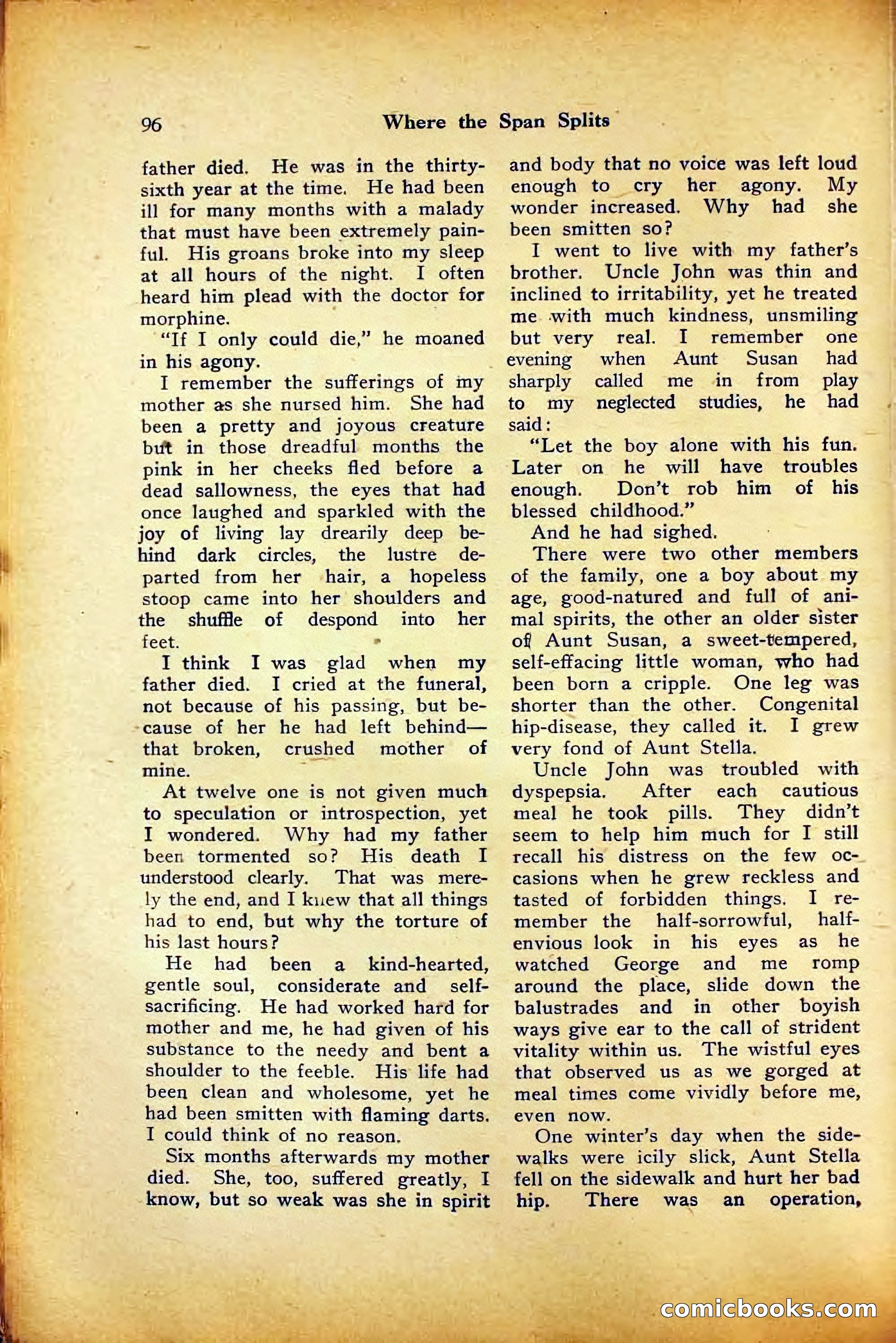
A restored page from Pulp Fiction, 1920. Page through the whole issue in the reader above.
📄 Transcribed text from this page (OCR, searchable)
Machine-transcribed from the original scan — historical spelling and the odd misread are preserved.
Where the Span Splits ¢ ie father died. He was in the thirty- sixth year at the time. He had been ill for many months with a malady that must have been extremely pain- ful. His groans broke into my sleep at all hours of the night. I often heard him plead with the doctor for morphine. : “Tf I only could die,” he moaned in his agony. I remember the sufferings of my mother as she nursed him. She had been a pretty and joyous creature but in those dreadful months the pink in her cheeks fled before a dead sallowness, the eyes that had once laughed and sparkled with the joy of living lay drearily deep be- hind dark circles, the lustre de- parted from her hair, a_ hopeless stoop came into her shoulders and the shuffle of despond into her feet. ° I think I was glad when my father died. I cried at the funeral, not because of his passing, but be- -cause of her he had left behind— that broken, crushed mother of mine. : At twelve one is not given much to speculation or introspection, yet I wondered. Why had my father been tormented so? His death I understood clearly. That was mere- ly the end, and I kuew that all things had to end, but why the torture of his last hours? He had been a_ kind-hearted, gentle soul, considerate and _ self- sacrificing. He had worked hard for mother and me, he had given of his substance to the needy and bent a shoulder to the feeble. His life had been clean and wholesome, yet he had been smitten with flaming darts. I could think of no reason. Six months afterwards my mother died. She, too, suffered greatly, I -know, but so weak was she in spirit and body that no voice was left loud enough to cry her agony. My wonder increased. Why had_ she been smitten so? I went to live with my father’s brother. Uncle John was thin and inclined to irritability, yet he treated me with much kindness, unsmiling but very real. I remember one evening when Aunt Susan had sharply called me in from play to my neglected studies, he had said: es “Let the boy alone with his fun. Later on he will have troubles enough. Don’t rob him of his blessed childhood.” And he had sighed. There were two other members of the family, one a boy about my age, good- -natured and full of ani- mal spirits, the other an older sister of Aunt Susan, a sweet-tempered, self-effacing little woman, who had been born a cripple. One leg was shorter than the other. Congenital hip-disease, they called it. I grew very fond of Aunt Stella. Uncle John was troubled with dyspepsia. After each cautious meal he took pills. They didn’t seem to help him much for I still tecall his distress on the few oc- casions when he grew reckless and tasted of forbidden things, I re- member the _ half-sorrowful, half- envious look in his eyes as he watched George and me _ romp around the place, slide down the balustrades and in other boyish ways give ear to the call of strident vitality within us. The wistful eyes that observed us as we gorged at meal times come vividly before me, even now. One winter’s day when the side- walks were icily slick, Aunt Stella fell on the sidewalk and hurt her bad hip. There was an _ operation, i¢books.com