
Pulp Fiction, 1920 · page 95 of 132
The Black Mask — page 95: what you’re looking at
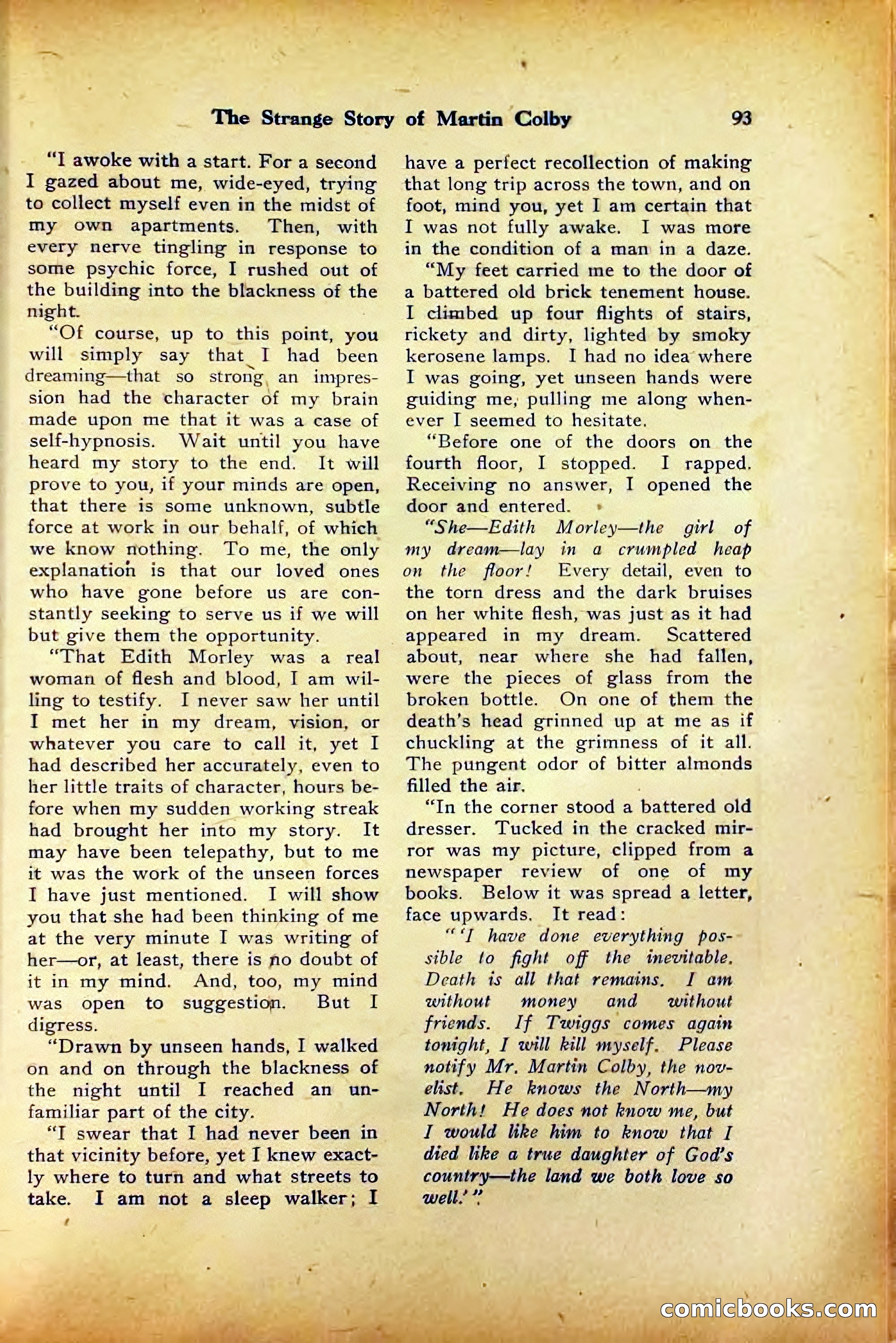
A restored page from Pulp Fiction, 1920. Page through the whole issue in the reader above.
📄 Transcribed text from this page (OCR, searchable)
Machine-transcribed from the original scan — historical spelling and the odd misread are preserved.
_ The Strange Story of Martin Colby 93 “I awoke with a start. For a second I gazed about me, wide-eyed, trying to collect myself even in the midst of my own apartments. Then, with every nerve tingling in response to some psychic force, I rushed out of the building into the blackness of the night. “Of course, up to this point, you will simply say that_ I had been dreaming—that so strong, an impres- sion had the character of my brain made upon me that it was a case of self-hypnosis. Wait until you have heard my story to the end. It will prove to you, if your minds are open, that there is some unknown, subtle force at work in our behalf, of which we know nothing. To me, the only explanation is that our loved ones who have gone before us are con- stantly seeking to serve us if we will but give them the opportunity. “That Edith Morley was a real woman of flesh and blood, I am wil- ling to testify. I never saw her until I met her in my dream, vision, or whatever you care to call it, yet I had described her accurately, even to her little traits of character, hours be- fore when my sudden working streak had brought her into my story. It may have been telepathy, but to me it was the work of the unseen forces I have just mentioned. I will show you that she had been thinking of me at the very minute I was writing of her—or, at least, there is no doubt of it in my mind. And, too, my mind was open to suggestion. But I digress. “Drawn by unseen hands, I walked on and on through the blackness of the night until I reached an un- familiar part of the city. “IT swear that I had never been in that vicinity before, yet I knew exact- ly where to turn and what streets to take. I am not a sleep walker; I appeared in my dream. have a perfect recollection of making that long trip across the town, and on foot, mind you, yet I am certain that I was not fully awake. I was more in the condition of a man in a daze. “My feet carried me to the door of a battered old brick tenement house. I climbed up four flights of stairs, rickety and dirty, lighted by smoky kerosene lamps. I had no idea where I was going, yet unseen hands were guiding me, pulling me along when- ever I seemed to hesitate. “Before one of the doors on the fourth floor, I stopped. I rapped. Receiving no answer, I opened the door and entered. » “She—Edith Morley—the girl of my dream—lay in a crumpled heap on the floor! Every detail, even to the torn dress and the dark bruises on her white flesh, was just as it had Scattered about, near where she had fallen, were the pieces of glass from the broken bottle. On one of them the death’s head grinned up at me as if chuckling at the grimness of it all. The pungent odor of bitter almonds filled the air. “In the corner stood a battered old dresser. Tucked in the cracked mir- ror was my picture, clipped from a newspaper review of one of my books. Below it was spread a letter, face upwards. It read: “*T have done everything pos-- sible to fight off the tmevitable. Death is all that remains. I am without money and without friends. If Twiggs comes again tonight, I will kill myself. Please notify Mr. Martin Colby, the nov- elist. He knows the North—my North! He does not know me, but I would like him to know that I died like a true daughter of God’s country—the land we both love so well.”