
Pulp Fiction, 1920 · page 87 of 132
The Black Mask — page 87: what you’re looking at
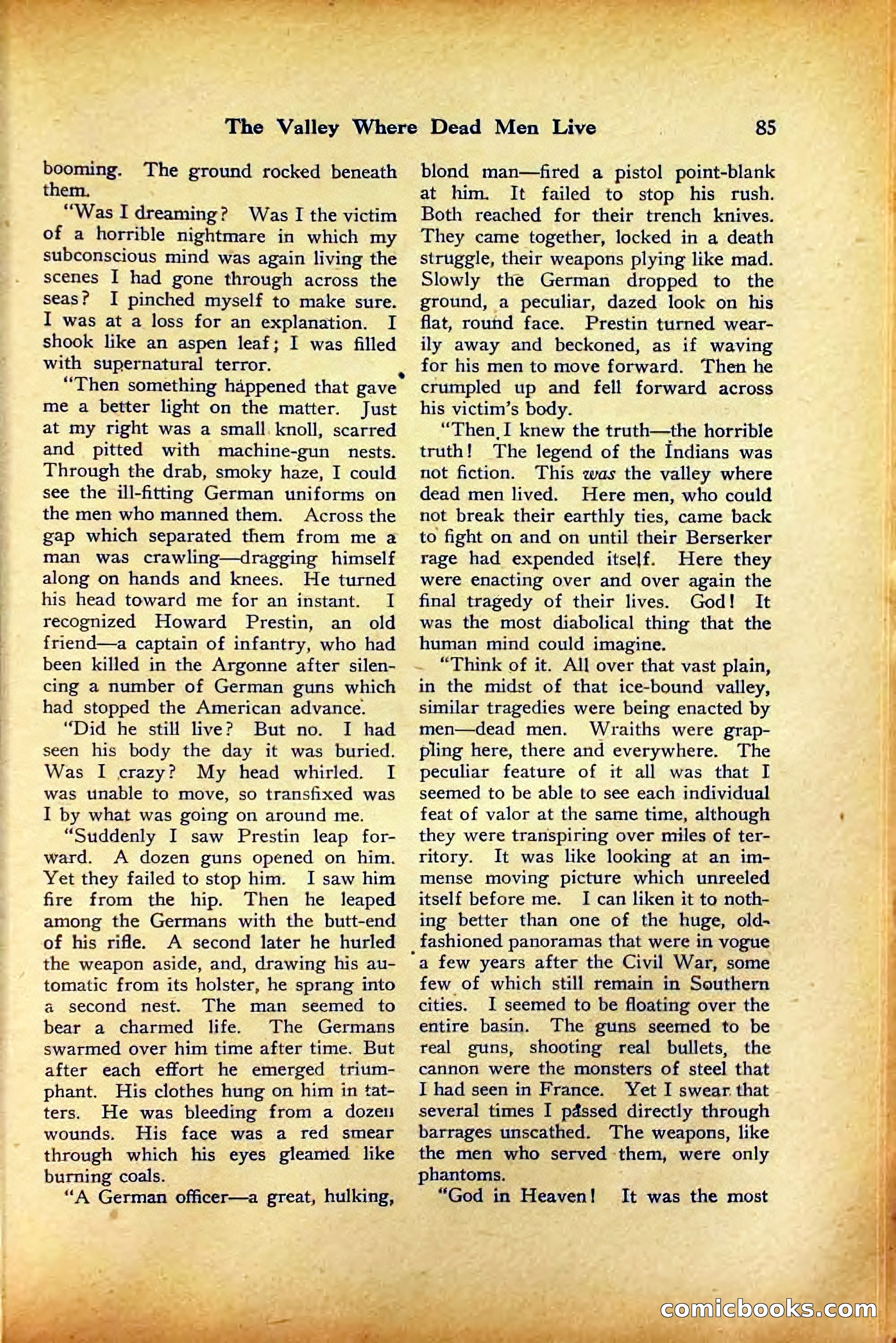
A restored page from Pulp Fiction, 1920. Page through the whole issue in the reader above.
📄 Transcribed text from this page (OCR, searchable)
Machine-transcribed from the original scan — historical spelling and the odd misread are preserved.
The Valley Where Dead Men Live 85 booming. The ground rocked beneath them. “Was I dreaming? Was I the victim of a horrible nightmare in which my subconscious mind was again living the scenes I had gone through across the seas? I pinched myself to make sure. I was at a loss for an explanation. I shook like an aspen leaf; I was filled with supernatural terror. “Then something happened that gave’ me a better light on the matter. Just at my right was a small. knoll, scarred and pitted with machine-gun nests. Through the drab, smoky haze, I could see the ill-fitting German uniforms on the men who manned them. Across the gap which separated them from me a man was crawling—dragging himself along on hands and knees. He turned his head toward me for an instant. I recognized Howard Prestin, an old friend—a captain of infantry, who had been killed in the Argonne after silen- cing a number of German guns which had stopped the American advance. “Did he still live? But no. I had seen his body the day it was buried. Was I crazy? My head whirled. I was unable to move, so transfixed was I by what was going on around me. “Suddenly I saw Prestin leap for- ward. A dozen guns opened on him. Yet they failed to stop him. I saw him fire from the hip. Then he leaped among the Germans with the butt-end of his rifle. A second later he hurled the weapon aside, and, drawing his au- tomatic from its holster, he sprang into a second nest. The man seemed to bear a charmed life. The Germans swarmed over him time after time. But after each effort he emerged trium- phant. His clothes hung on him in tat- ters. He was bleeding from a dozen wounds, His face was a red smear through which his eyes gleamed like burning coals. “A German officer—a great, hulking, € blond man—fired a pistol point-blank at him. It failed to stop his rush. Both reached for their trench knives. They came together, locked in a death struggle, their weapons plying like mad. Slowly the German dropped to the ground, a peculiar, dazed look on his flat, round face. Prestin turned wear- ily away and beckoned, as if waving for his men to move forward. Then he crumpled up and fell forward across his victim’s body. “Then I knew the truth—the horrible truth! The legend of the Indians was not fiction. This was the valley where dead men lived. Here men, who could not break their earthly ties, came back to fight on and on until their Berserker rage had expended itself. Here they were enacting over and over again the final tragedy of their lives. God! It was the most diabolical thing that the human mind could imagine. “Think of it. All over that vast plain, in the midst of that ice-bound valley, similar tragedies were being enacted by men—dead men. Wraiths were grap- pling here, there and everywhere. The peculiar feature of it all was that I seemed to be able to see each individual feat of valor at the same time, although they were transpiring over miles of ter- ritory. It was like looking at an im- mense moving picture which unreeled itself before me. I can liken it to noth- ing better than one of the huge, old- _ fashioned panoramas that were in vogue a few years after the Civil War, some few of which still remain in Southern cities. I seemed to be floating over the entire basin. The guns seemed to be real guns, shooting real bullets, the cannon were the monsters of steel that I had seen in France. Yet I swear. that several times I pdssed directly through barrages unscathed. The weapons, like the men who served them, were only phantoms. “God in Heaven! It was the most