
Pulp Fiction, 1920 · page 49 of 132
The Black Mask — page 49: what you’re looking at
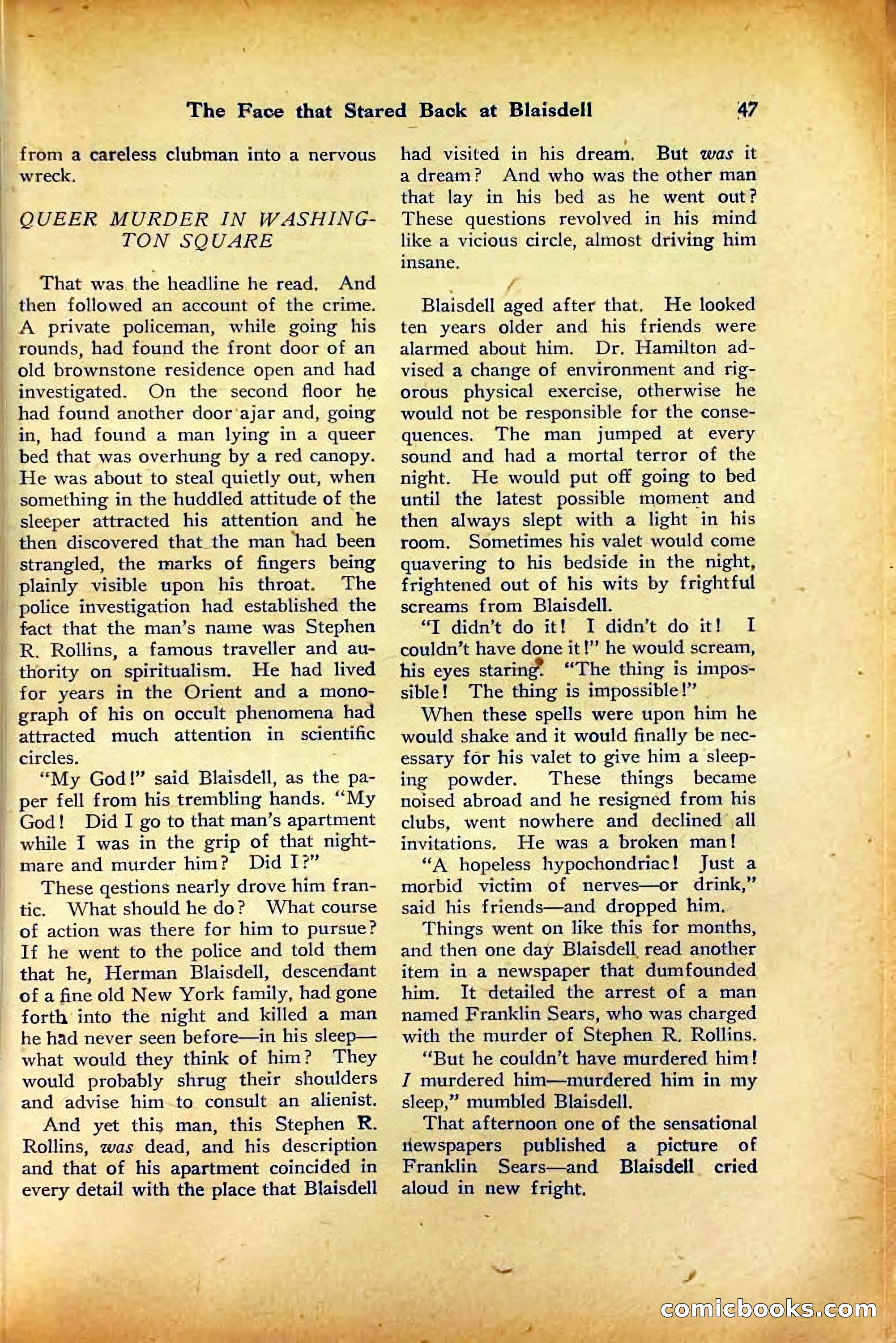
A restored page from Pulp Fiction, 1920. Page through the whole issue in the reader above.
📄 Transcribed text from this page (OCR, searchable)
Machine-transcribed from the original scan — historical spelling and the odd misread are preserved.
i The Face that Stared Back at Blaisdell 47 from a careless clubman into a nervous wreck, ¥ QUEER MURDER IN WASHING- TON SQUARE That was the headline he read, And then followed an account of the crime. A private policeman, while going his rounds, had found the front door of an old brownstone residence open and had investigated. On the second floor he had found another door’ajar and, going in, had found a man lying in a queer bed that was overhung by a red canopy. He was about to steal quietly out, when _ something in the huddled attitude of the sleeper attracted his attention and he then discovered that the man ‘had been strangled, the marks of fingers being plainly visible upon his throat. The police investigation had established the fact that the man’s name was Stephen R. Rollins, a famous traveller and au- thority on spiritualism. He had lived for years in the Orient and a mono- _ graph of his on occult phenomena had attracted much attention in scientific - circles. ; “My God!” said Blaisdell, as the pa- per fell from his trembling hands. “My God! Did I go to that man’s apartment while I was in the grip of that night- mare and murder him? Did I?” These gestions nearly drove him fran- tic. What should he do? What course of action was there for him to pursue? If he went to the police and told them that he, Herman Blaisdell, descendant | of a fine old New York family, had gone forth into the night and killed a man he had never seen before—in his sleep— what would they think of him? They would probably shrug their shoulders and advise him to consult an alienist. And yet this man, this Stephen R. Rollins, was dead, and his description and that of his apartment coincided in every detail with the place that Blaisdell had visited in his dream. But was it a dream? And who was the other man that lay in his bed as he went out? These questions revolved in his mind like a vicious circle, almost driving him insane. : A Blaisdell aged after that. He looked ten years older and his friends were alarmed about him. Dr. Hamilton ad- vised a change of environment and rig- orous physical exercise, otherwise he would not be responsible for the conse- quences. The man jumped at every sound and had a mortal terror of the night. He would put off going to bed until the latest possible moment and then always slept with a light in his room. Sometimes his valet would come quavering to his bedside in the night, frightened out of his wits by frightful screams from Blaisdell. “T didn’t do it! I didn’t do it! I couldn’t have done it!’ he would scream, his eyes staring. “The thing is impos- sible! The thing is impossible!” When these spells were upon him he would shake and it would finally be nec- essary for his valet to give him a sleep- ing powder. These things became noised abroad and he resigned from his clubs, went nowhere and declined all invitations, He was a broken man! “A hopeless hypochondriac! Just a morbid victim of nerves—or drink,” said his friends—and dropped him. Things went on like this for months, and then one day Blaisdell read another item in a newspaper that dumfounded him. It detailed the arrest of a man named Franklin Sears, who was charged with the murder of Stephen R. Rollins. “But he couldn’t have murdered him! I murdered him—murdered him in my sleep,” mumbled Blaisdell. _ That afternoon one of the sensational newspapers published a picture of Franklin Sears—and Blaisdell cried aloud in new fright.