
Pulp Fiction, 1920 · page 43 of 132
The Black Mask — page 43: what you’re looking at
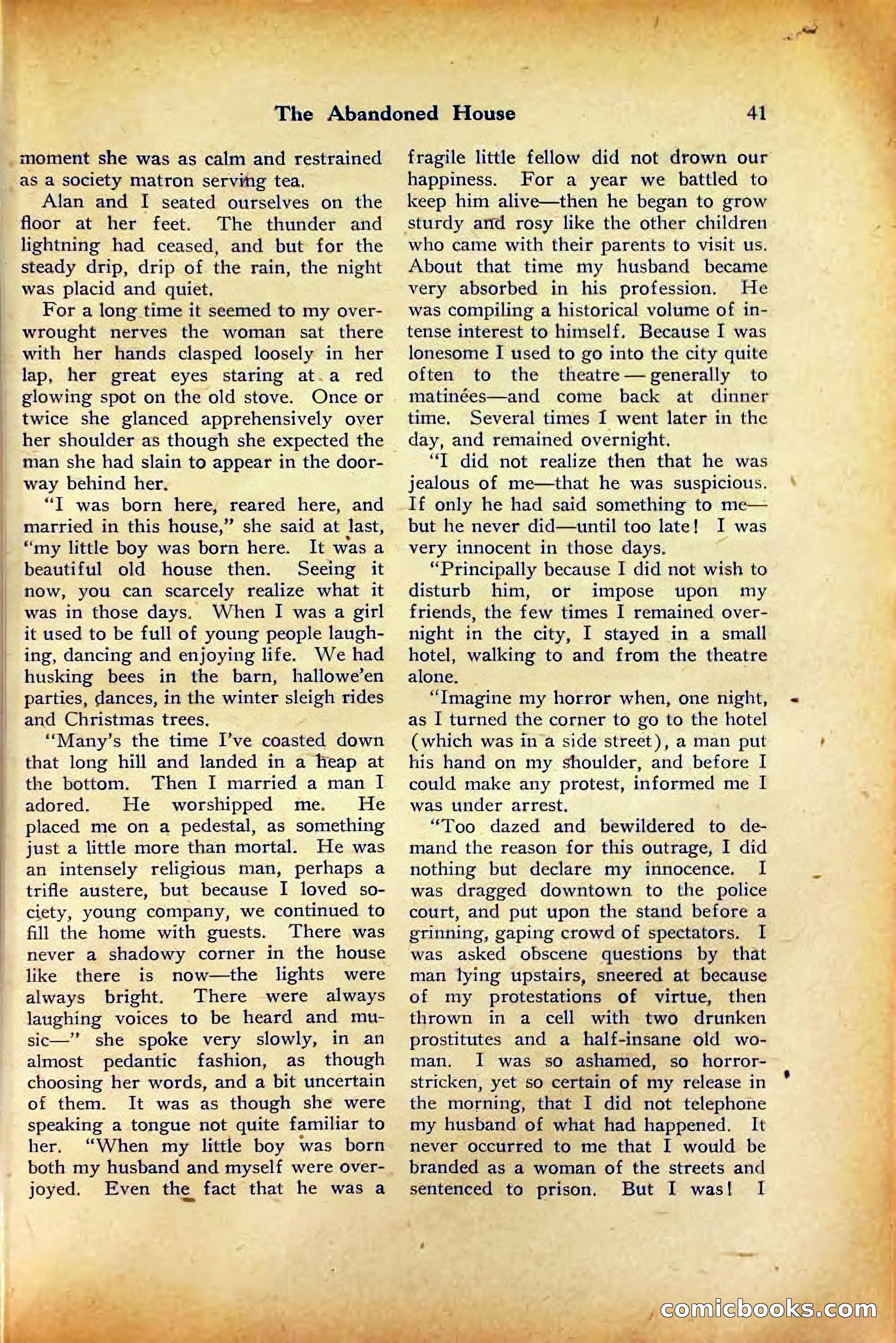
A restored page from Pulp Fiction, 1920. Page through the whole issue in the reader above.
📄 Transcribed text from this page (OCR, searchable)
Machine-transcribed from the original scan — historical spelling and the odd misread are preserved.
The Abandoned House 41 .moment she was as calm and restrained _as a society matron serving tea. Alan and I seated ourselves on the floor at her feet. The thunder and lightning had ceased, and but for the steady drip, drip of the rain, the night was placid and quiet. For a long time it seemed to my over- wrought nerves the woman sat there with her hands clasped loosely in her lap, her great eyes staring at.a red glowing spot on the old stove. Once or twice she glanced apprehensively over her shoulder as though she expected the man she had slain to appear in the door- way behind her, “I was born here, reared here, and married in this house,” she said at last, _ “my little boy was born here. It was a beautiful old house then. Seeing it now, you can scarcely realize what it was in those days. When I was a girl it used to be full of young people laugh- ing, dancing and enjoying life. We had husking bees in the barn, hallowe’en parties, dances, in the winter sleigh rides and Christmas trees. ““Many’s the time I’ve coasted down that long hill and landed in a heap at the bottom. Then I married a man I adored. He worshipped me. MHe placed me on a pedestal, as something just a little more than mortal. He was an intensely religious man, perhaps a trifle austere, but because I loved so- ciety, young company, we continued to fill the home with guests. There was never a shadowy corner in the house like there is now—the lights were always bright. There were always laughing voices to be heard and mu- sic—”’ she spoke very slowly, in an almost pedantic fashion, as though choosing her words, and a bit uncertain of them. It was as though she were speaking a tongue not quite familiar to her. “When my little boy was born both my husband and myself were over-_ joyed. Even the fact that he was a fragile little fellow did not drown our happiness. For a year we battled to keep him alive—then he began to grow sturdy arid rosy like the other children who came with their parents to visit us. About that time my husband became very absorbed in his profession. He was compiling a historical volume of in- tense interest to himself. Because I was lonesome I used to go into the city quite often to the theatre— generally to matinées—and come back at dinner time, Several times I went later in the day, and remained overnight, “T did not realize then that he was jealous of me—that he was suspicious. If only he had said something to me— but he never did—until too late! I was very innocent in those days. “Principally because I did not wish to disturb him, or impose upon my friends, the few times I remained over- night in the city, I stayed in a small hotel, walking to and from the theatre alone. “Tmagine my horror when, one night, as I turned the corner to go to the hotel (which was in a side street), a man put his hand on my shoulder, and before I could make any protest, informed me I was under arrest, “Too dazed and bewildered to de- mand the reason for this outrage, I did nothing but declare my innocence, I was dragged downtown to the police court, and put upon the stand before a grinning, gaping crowd of spectators. I was asked obscene questions by that man tying upstairs, sneered at because of my protestations of virtue, then thrown in a cell with two drunken prostitutes and a half-insane old wo- man. I was so ashamed, so horror- stricken, yet so certain of my release in the morning, that I did not telephone my husband of what had happened. It never occurred to me that I would be branded as a woman of the streets and sentenced to prison. But I was! I —— + a ——— EEE ==