
Pulp Fiction, 1920 · page 29 of 132
The Black Mask — page 29: what you’re looking at
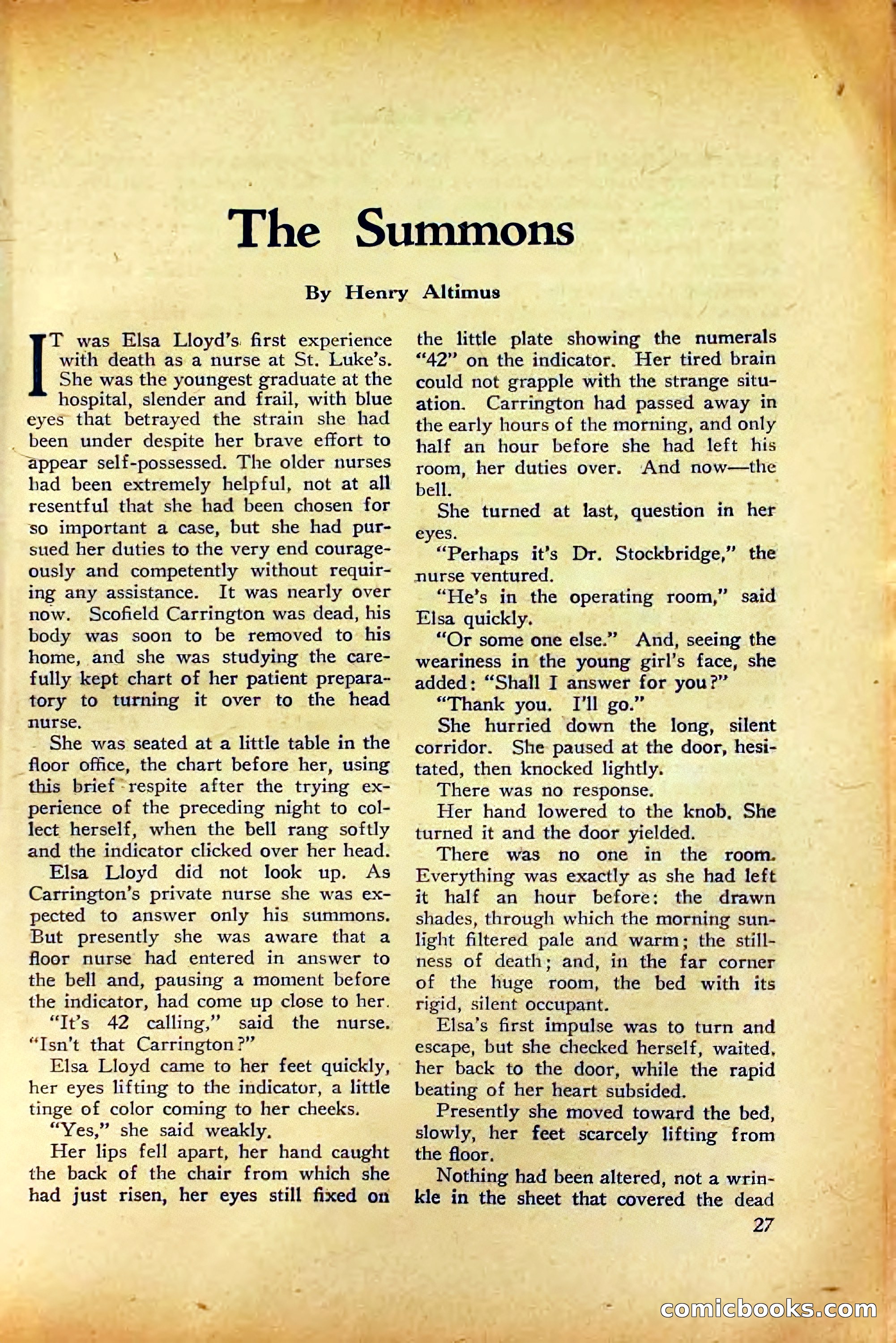
A restored page from Pulp Fiction, 1920. Page through the whole issue in the reader above.
📄 Transcribed text from this page (OCR, searchable)
Machine-transcribed from the original scan — historical spelling and the odd misread are preserved.
The Summons By Henry Altimus T was Elsa Lloyd’s: first experience with death as a nurse at St. Luke’s. She was the youngest graduate at the hospital, slender and frail, with blue eyes that betrayed the strain she had _ been under despite her brave effort to appear self-possessed. The older nurses had been extremely helpful, not at all resentful that she had been chosen for so important a case, but she had pur- sued her duties to the very end courage- ously and competently without requir- ing any assistance. It was nearly over now. Scofield Carrington was dead, his body was soon to be removed to his home, and she was studying the care- fully kept chart of her patient prepara- tory to turning it over to the head nurse, _ She was seated at a little table in the _floor office, the chart before her, using this brief“respite after the trying ex- perience of the preceding night to col- lect herself, when the bell rang softly and the indicator clicked over her head. Elsa Lloyd did not look up. As Carrington’s private nurse she was ex- pected to answer only his summons. But presently she was aware that a floor nurse had entered in answer to the bell and, pausing a moment before the indicator, had come up close to her. “It’s 42 calling,’ said the nurse. “Isn't that Carrington?” Elsa Lloyd came to her feet quickly, ~ her eyes lifting to the indicator, a little tinge of color coming to her cheeks. “Yes,” she said weakly, Her lips fell apart, her hand caught the back of the chair from which she had just risen, her eyes still fixed on the little plate showing the numerals “42” on the indicator. Her tired brain could not grapple with the strange situ- ation. Carrington had passed away in the early hours of the morning, and only half an hour before she had left his room, her duties over. And now—the bell. : She turned at last, question in her eyes. “Perhaps it’s Dr. Stockbridge,” the nurse ventured. “He’s in the operating room,” said Elsa quickly. “Or some one else.” And, seeing the weariness in the young girl’s face, she added: “Shall I answer for you?” “Thank you. I'll go.” She hurried down the long, silent corridor. She paused at the door, hesi- tated, then knocked lightly. There was no response. Her hand lowered to the knob, She turned it and the door yielded. There was no one in the room. Everything was exactly as she had left it half an hour before: the drawn shades, through which the morning sun- light filtered pale and warm; the still- ness of death; and, in the far corner of the huge room, the bed with its rigid, silent occupant. Elsa’s first impulse was to turn and escape, but she checked herself, waited, her back to the door, while the rapid beating of her heart subsided. Presently she moved toward the bed, slowly, her feet scarcely lifting from the floor. Nothing had been altered, not a wrin- kle in the sheet that covered the dead 27