
Pulp Fiction, 1920 · page 17 of 132
The Black Mask — page 17: what you’re looking at
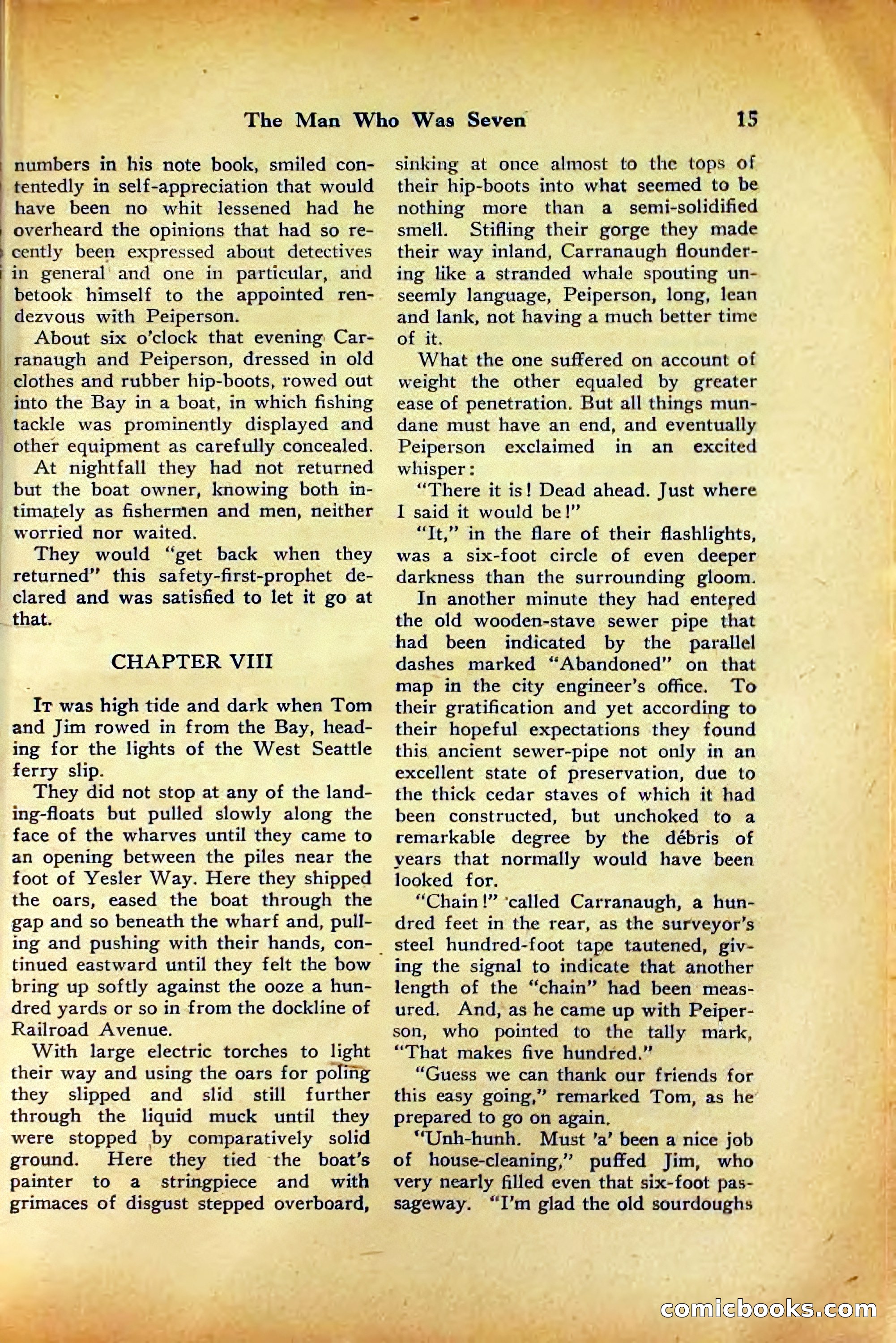
A restored page from Pulp Fiction, 1920. Page through the whole issue in the reader above.
📄 Transcribed text from this page (OCR, searchable)
Machine-transcribed from the original scan — historical spelling and the odd misread are preserved.
Pa je, The Man Who Was Seven 15 numbers in his note book, smiled con- tentedly in self-appreciation that would have been no whit lessened had he overheard the opinions that had so re- cently been expressed about detectives }in general’ and one in particular, and betook himself to the appointed ren- dezvous with Peiperson. About six o’clock that evening Car- ranatigh and Peiperson, dressed in old clothes and rubber hip-boots, rowed out into the Bay in a boat, in which fishing tackle was prominently displayed and other equipment as carefully concealed. At nightfall they had not returned but the boat owner, knowing both in- timately as fishermen and men, neither _ worried nor waited. _ They would “get back when they returned” this safety-first-prophet de- clared and was satisfied to let it go at _that. CHAPTER VIII Ir was high tide and dark when Tom and Jim rowed in from the Bay, head- ing for the lights of the West Seattle ferry slip. They did not stop at any of the land- ing-floats but pulled slowly along the face of the wharves until they came to an opening between the piles near the foot of Yesler Way. Here they shipped the oars, eased the boat through the gap and so beneath the wharf and, pull- ing and pushing with their hands, con-_ tinued eastward until they felt the bow bring up softly against the ooze a hun- dred yards or so in from the dockline of Railroad Avenue. With large electric torches to light their way and using the oars for poling they slipped and slid still further through the liquid muck until they were stopped by comparatively solid ground. MHere they tied the boat’s painter to a stringpiece and with grimaces of disgust stepped overboard, sinking at once almost to the tops of their hip-boots into what seemed to be nothing more than a_ semi-solidified smell. Stifling their gorge they made their way inland, Carranaugh flounder- ing like a stranded whale spouting un- seemly language, Peiperson, long, lean and lank, not having a much better time of it. What the one suffered on account of weight the other equaled by greater ease of penetration. But all things mun- dane must have an end, and eventually Peiperson exclaimed in an _ excited whisper: “There it is! Dead ahead. Just where I said it would be!” “Tt,” in the flare of their flashlights, was a six-foot circle of even deeper darkness than the surrounding gloom. In another minute they had entered the old wooden-stave sewer pipe that had been indicated by the parallel dashes marked “Abandoned” on that map in the city engineer’s office. To their gratification and yet according to their hopeful expectations they found this ancient sewer-pipe not only in an excellent state of preservation, due to the thick cedar staves of which it had been constructed, but unchoked to a remarkable degree by the débris of years that normally would have been looked for. “Chain!” ‘called Carranaugh, a hun- dred feet in the rear, as the surveyor’s steel hundred-foot tape tautened, giv- ing the signal to indicate that another length of the “chain” had been meas- ured, And, as he came up with Peiper- son, who pointed to the tally mark, “That makes five hundred.” “Guess we can thank our friends for this easy going,” remarked Tom, as he’ prepared to go on again, “Unh-hunh. Must ’a’ been a nice job of house-cleaning,” puffed Jim, who very nearly filled even that six-foot pas- sageway. “I’m glad the old sourdoughs comicbook