
Pulp Fiction, 1920 · page 100 of 132
The Black Mask — page 100: what you’re looking at
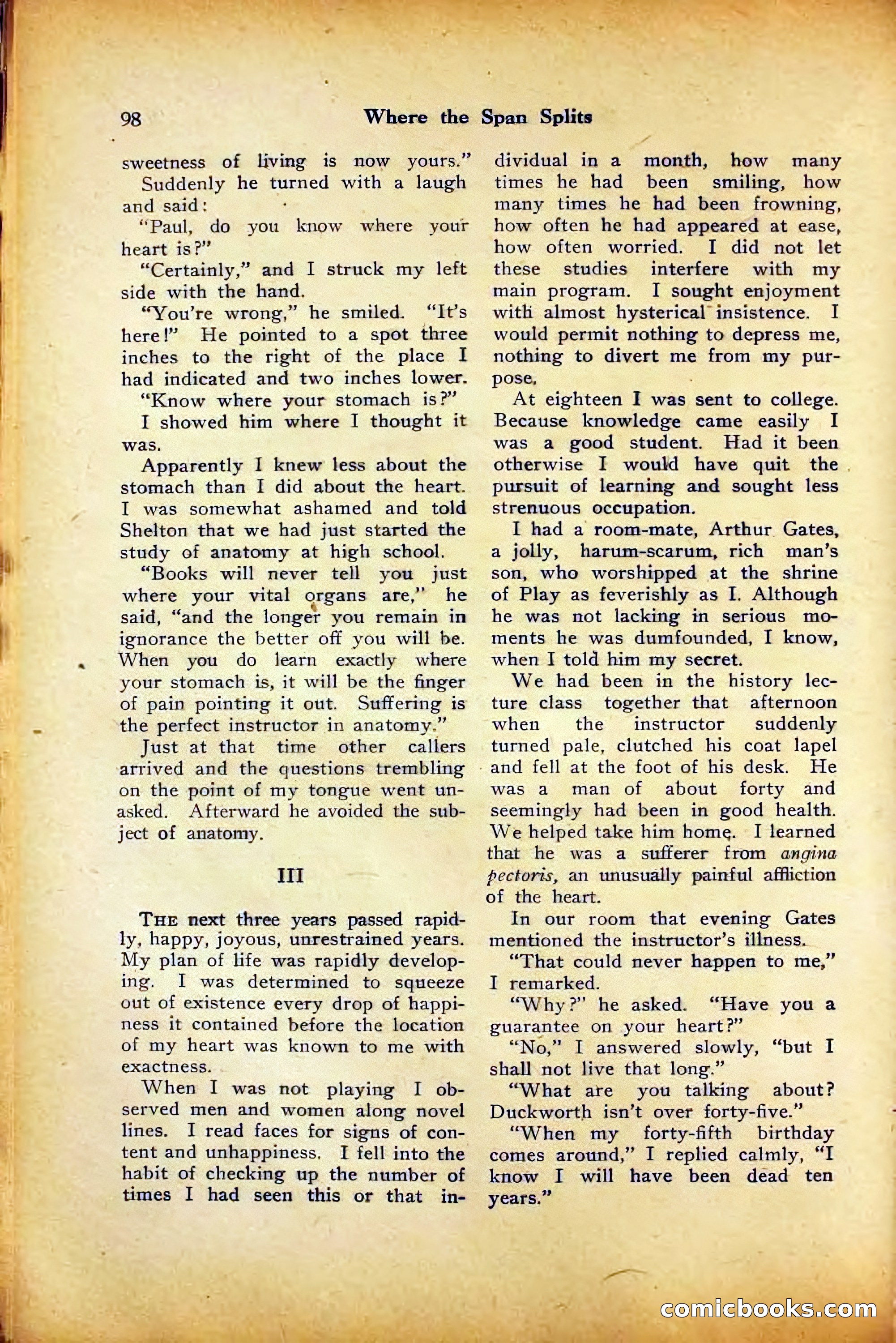
A restored page from Pulp Fiction, 1920. Page through the whole issue in the reader above.
📄 Transcribed text from this page (OCR, searchable)
Machine-transcribed from the original scan — historical spelling and the odd misread are preserved.
98 Where the ” sweetness of living is now yours. Suddenly he musned with a laugh and said: “Paul, do you know where your heart is?” “Certainly,” and I struck my left side with the hand. “You’re wrong,” he smiled. “It’s here!” He pointed to a spot three inches to the right of the place I had indicated and two inches lower. “Know where your stomach is?” I showed him where I thought it was. Apparently I knew less about the stomach than I did about the heart. I was somewhat ashamed and told Shelton that we had just started the study of anatomy at high school. “Books will never tell you just where your vital organs are,” he said, “and the longer you remain in ignorance the better off you will be. When you do learn exactly where your stomach is, it will be the finger of pain pointing it out. Suffering is the perfect instructor in anatomy.” Just at that time other callers arrived and the questions trembling on the point of my tongue went un- asked. Afterward he avoided the sub- ject of anatomy, III THE next three years passed rapid- ly, happy, joyous, unrestrained years. My plan of life was rapidly develop- ing. I was determined to squeeze out of existence every drop of happi- ness it contained before the location of my heart was known to me with exactness. When I was not playing I ob- served men and women along novel lines. I read faces for signs of con- tent and unhappiness, I fell into the habit of checking up the number of times I had seen this or that in- Span Splits — a dividual in a month, how many times he had been smiling, how many times he had been frowning, how often he had appeared at ease, how often worried. I did not let these studies interfere with my main program. I sought enjoyment with almost hysterical insistence. I would permit nothing to depress me, nothing to divert me from my pur- pose, At eighteen I was sent to college. Because knowledge came easily I was a good student. Had it been otherwise I would have quit the. pursuit of learning and sought less strenuous occupation. I had a room-mate, Arthur Gates, a jolly, harum-scarum, rich man’s son, who worshipped at the shrine of Play as feverishly as I. Although he was not lacking in serious mo- ments he was dumfounded, I know, when I told him my secret. We had been in the history lec- ture class together that afternoon when the instructor suddenly turned pale, clutched his coat lapel -and fell at the foot of his desk. He was a man of about forty and seemingly had been in good health. We helped take him home. I learned that he was a sufferer from angina pectoris, an unusually painful affliction of the heart. In our room that evening Gates mentioned the instructor’s illness. “That could never happen to me,” I remarked. “Why? he asked. “Have you a guarantee on your heart?” “No,” I answered slowly, “but I shall not live that long.” “What are you talking about? Duckworth isn’t over forty-five.” “When my forty-fifth birthday comes around,” I replied calmly, “I know I will have been dead ten years.” qicbooks.com