
Pulp Fiction, 1935 · page 124 of 132
Bill Barnes Air Adventurer, July 1935 — page 124: what you’re looking at
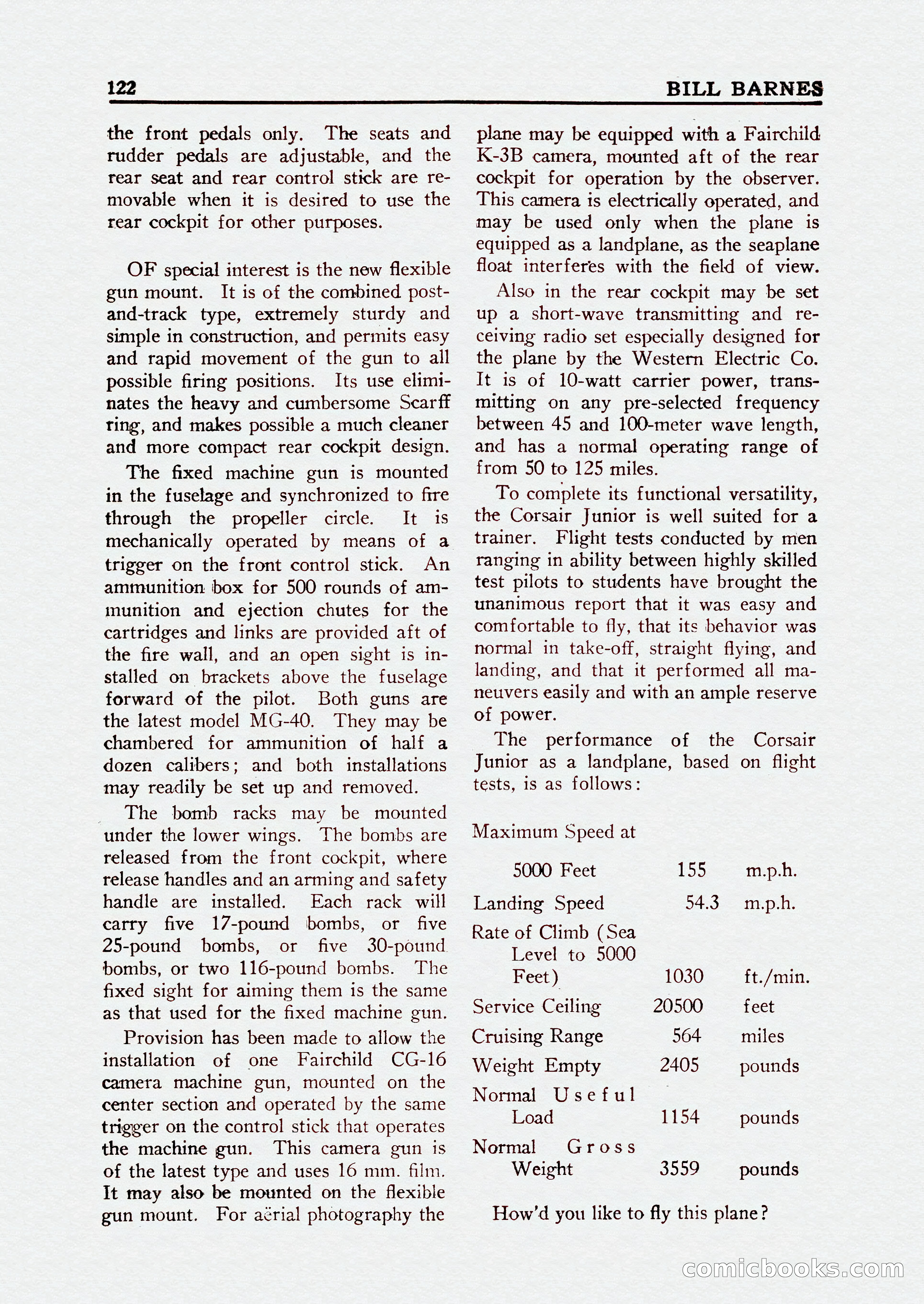
A restored page from Pulp Fiction, 1935. Page through the whole issue in the reader above.
📄 Transcribed text from this page (OCR, searchable)
Machine-transcribed from the original scan — historical spelling and the odd misread are preserved.
122 the front pedals only. The seats and rudder pedals are adjustable, and the rear seat and rear control stick are re- movable when it is desired to use the rear cockpit for other purposes. OF special interest is the new flexible gun mount. It is of the combined post- and-track type, extremely sturdy and simple in construction, and permits easy and rapid movement of the gun to all possible firing positions. Its use elim1- nates the heavy and cumbersome Scarff ring, and makes possible a much cleaner and more compact rear cockpit design. The fixed machine gun is mounted in the fuselage and synchronized to fire through the propeller circle. It 1s mechanically operated by means of a trigger on the front control stick. An ammunition box for 500 rounds of am- munition and ejection chutes for the cartridges and links are provided aft of the fire wall, and an open sight is in- stalled on brackets above the fuselage forward of the pilot. Both guns are the latest model MG-40. They may be chambered for ammunition of half a dozen calibers; and both installations may readily be set up and removed. _ The bomb racks may be mounted under the lower wings. The bombs are released from the front cockpit, where release handles and an arming and safety handle are installed. Each rack will carry five 17-pound bombs, or five 25-pound bombs, or five 30-pound bombs, or two 116-pound bombs. The fixed sight for aiming them is the same as that used for the fixed machine gun. Provision has been made to allow the installation of one Fairchild CG-16 camera machine gun, mounted on the center section and operated by the same trigger on the control stick that operates the machine gun. This camera gun is of the latest type and uses 16 mm. film. It may also be mounted on the flexible gun mount. For aérial photography the BILL BARNES plane may be equipped with a Fairchild K-3B camera, mounted aft of the rear cockpit for operation by the observer. This camera is electrically operated, and may be used only when the plane is equipped as a landplane, as the seaplane float interferes with the field of view. Also in the rear cockpit may be set up a short-wave transmitting and re- ceiving radio set especially designed for the plane by the Western Electric Co. It is of 10-watt carrier power, trans- mitting on any pre-selected frequency between 45 and 100-meter wave length, and has a normal operating range of from 50 to 125 miles. To complete its functional versatility, the Corsair Junior is well suited for a trainer. Flight tests conducted by men ranging in ability between highly skilled test pilots to students have brought the unanimous report that it was easy and comfortable to fly, that its behavior was normal in take-off, straight flying, and landing, and that it performed all ma- neuvers easily and with an ample reserve of power. The performance of the Corsair Junior as a landplane, based on flight tests, 1s as follows: Maximum Speed at 5000 Feet 155 m.p.h. Landing Speed 54.3 m.p.h. Rate of Climb (Sea Level to 5000 Feet) 1030 ft./min. Service Ceiling 20500 feet Cruising Range 564 miles Weight Empty 2405 pounds Normal Usefur. Load 1154 pounds Normal Gross Weight 3559 pounds How’d you like to fly this plane? oO mn CO Ghook CO