
Pulp Fiction, 1935 · page 12 of 132
Bill Barnes Air Adventurer, July 1935 — page 12: what you’re looking at
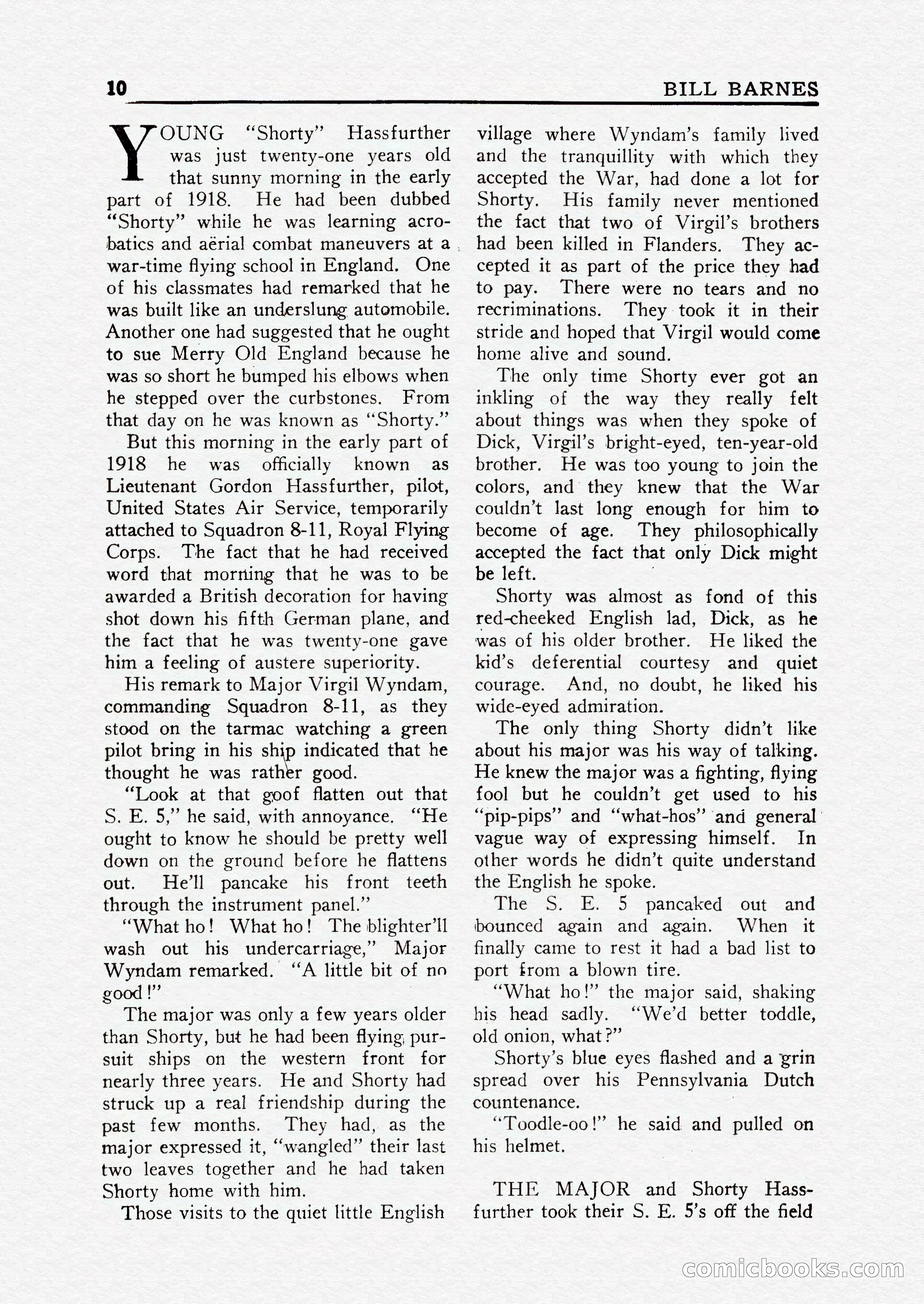
A restored page from Pulp Fiction, 1935. Page through the whole issue in the reader above.
📄 Transcribed text from this page (OCR, searchable)
Machine-transcribed from the original scan — historical spelling and the odd misread are preserved.
10 OUNG “Shorty” MHassfurther was just twenty-one years old that sunny morning in the early part of 1918. He had been dubbed “Shorty” while he was learning acro- batics and aérial combat maneuvers ata. war-time flying school in England. One of his classmates had remarked that he was built like an underslung automobile. Another one had suggested that he ought to sue Merry Old England because he was so short he bumped his elbows when he stepped over the curbstones. From that day on he was known as “Shorty.” But this morning in the early part of 1918 he was officially known as Lieutenant Gordon Hassfurther, pilot, United States Air Service, temporarily attached to Squadron 8-11, Royal Flying Corps. The fact that he had received word that morning that he was to be awarded a British decoration for having shot down his fifth German plane, and the fact that he was twenty-one gave him a feeling of austere superiority. His remark to Major Virgil Wyndam, commanding Squadron 8-11, as they stood on the tarmac watching a green pilot bring in his ship indicated that he thought he was Babe: good. “Look at that goof flatten out that S. E. 5,” he said, with annoyance. “He ought to know he should be pretty well down on the ground before he flattens out. He'll pancake his front teeth through the instrument panel.” “What ho! What ho! The blighter’ll wash out his undercarriage,” Major Wyndam remarked. ‘‘A little bit of no good !”’ : The major was only a few years older than Shorty, but he had been flying, pur- suit ships on the western front for nearly three years. He and Shorty had struck up a real friendship during the past few months. They had, as the major expressed it, ““wangled” their last two leaves together and he had taken Shorty home with him. Those visits to the quiet little English BILL BARNES village where Wyndam’s family lived and the tranquillity with which they accepted the War, had done a lot for Shorty. His family never mentioned the fact that two of Virgil’s brothers had been killed in Flanders. They ac- cepted it as part of the price they had to pay. There were no tears and no recriminations. They took it in their stride and hoped that Virgil would come home alive and sound. The only time Shorty ever got an inkling of the way they really felt about things was when they spoke of Dick, Virgil’s bright-eyed, ten-year-old brother. He was too young to join the colors, and they knew that the War couldn't last long enough for him to become of age. They philosophically accepted the fact that only Dick might be left. Shorty was almost as fond of this red-cheeked English lad, Dick, as he was of his older brother. He liked the kid’s deferential courtesy and quiet courage. And, no doubt, he liked his wide-eyed admiration. The only thing Shorty didn’t like about his major was his way of talking. He knew the major was a fighting, flying fool but he couldn’t get used to his “pip-pips’ and ‘“‘what-hos” and general vague way of expressing himself. In other words he didn’t quite understand the English he spoke. anes, is. 3 * pancaxed = out < and bounced again and again. When it finally came to rest it had a bad list to port from a blown tire. “What ho!” the major said, shaking his head sadly. ‘We'd better toddle, old onion, what?” Shorty’s blue eyes flashed and a grin spread over his Pennsylvania Dutch countenance. . ‘“Toodle-oo!” he said and pulled on his helmet. THE MAJOR and Shorty Hass- further took their S. E. 5’s off the field oO COLA) clo@olx CO