
Pulp Fiction, 1935 · page 109 of 132
Bill Barnes Air Adventurer, July 1935 — page 109: what you’re looking at
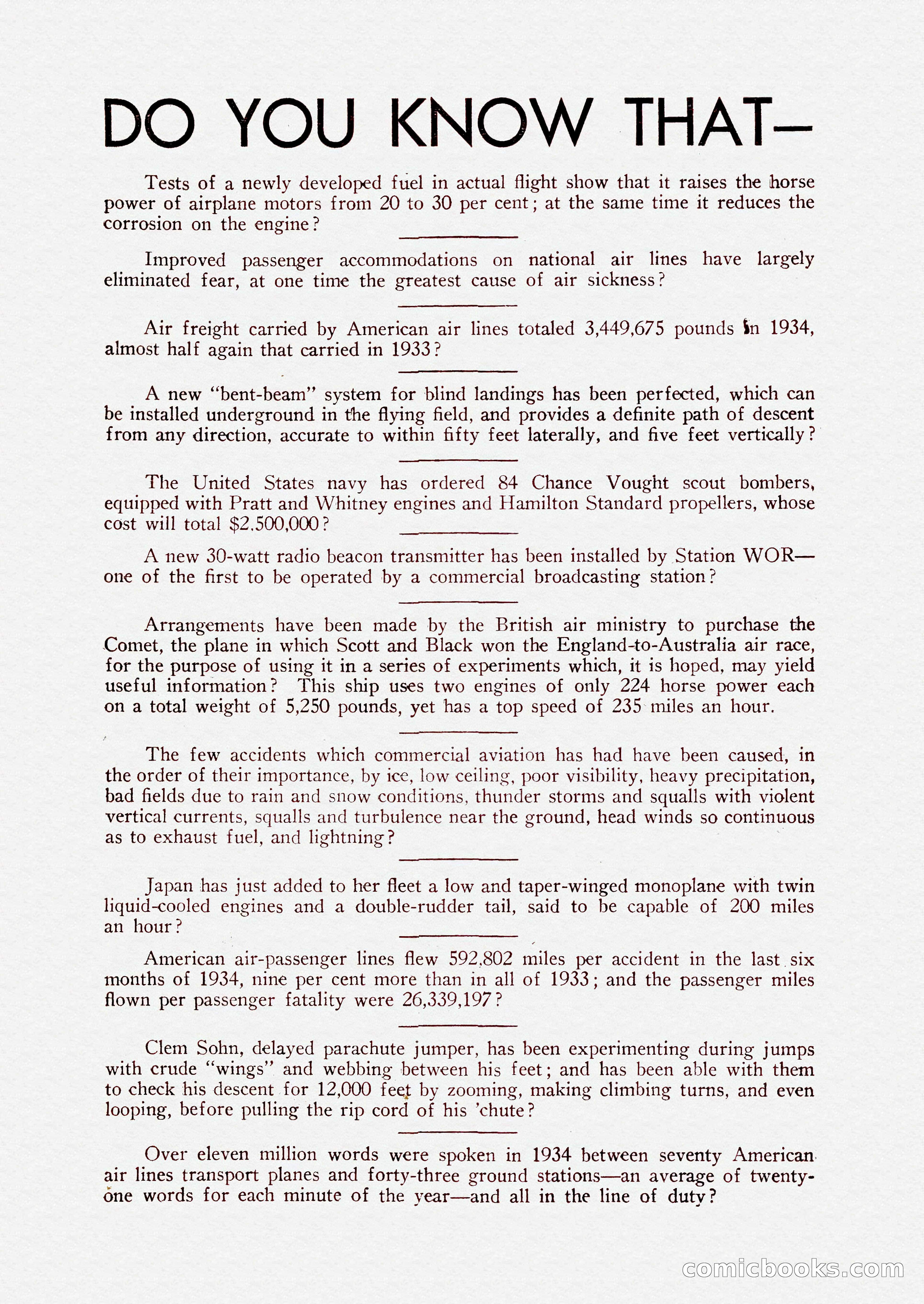
A restored page from Pulp Fiction, 1935. Page through the whole issue in the reader above.
📄 Transcribed text from this page (OCR, searchable)
Machine-transcribed from the original scan — historical spelling and the odd misread are preserved.
DO YOU KNOW THAT— Tests of a newly developed fuel in actual flight show that it raises the horse power of airplane motors from 20 to 30 per cent; at the same time it reduces the corrosion on the engine? Improved passenger accommodations on national air lines have largely eliminated fear, at one time the greatest cause of air sickness? Air freight carried by American air lines totaled 3,449,675 pounds $n 1934, almost half again that carried in 1933? A new “bent-beam’” system for blind landings has been perfected, which can be installed underground in the flying field, and provides a definite path of descent from any direction, accurate to within fifty feet laterally, and five feet vertically? The United States navy has ordered 84 Chance Vought scout bombers, equipped with Pratt and Whitney engines and Hamilton Standard propellers, whose cost will total $2,500,000? A new 30-watt radio beacon transmitter has been installed by Station WOR— one of the first to be operated by a commercial broadcasting station? Arrangements have been made by the British air ministry to purchase the Comet, the plane in which Scott and Black won the England-to-Australia air race, for the purpose of using it in a series of experiments which, it is hoped, may yield useful information? This ship uses two engines of only 224 horse power each on a total weight of 5,250 pounds, yet has a top speed of 235 miles an hour. The few accidents which commercial aviation has had have been caused, in the order of their importance, by ice, low ceiling, poor visibility, heavy precipitation, bad fields due to rain and snow conditions, thunder storms and squalls with violent vertical currents, squalls and turbulence near the ground, head winds so continuous as to exhaust fuel, and lightning? Japan has just added to her fleet a low and taper-winged monoplane with twin liquid-cooled engines and a double-rudder tail, said to be capable of 200 miles an hour? American air-passenger lines flew 592,802 file per accident in the last six months of 1934, nine per cent more than in all of 1933; and the passenger miles flown per passenger fatality were 26,339,197? Clem Sohn, delayed parachute jumper, has been experimenting during jumps with crude “wings” and webbing between his feet; and has been able with them to check his descent for 12,000 feet by zooming, making climbing turns, and even looping, before pulling the rip cord of his ‘chute ? Over eleven million words were spoken in 1934 between seventy American. air lines transport planes and forty-three ground stations—an average of twenty- one words for each minute of the year—and all in the line of duty? COmiclbook CO