
Pulp Fiction, 1935 · page 104 of 132
Bill Barnes Air Adventurer, July 1935 — page 104: what you’re looking at
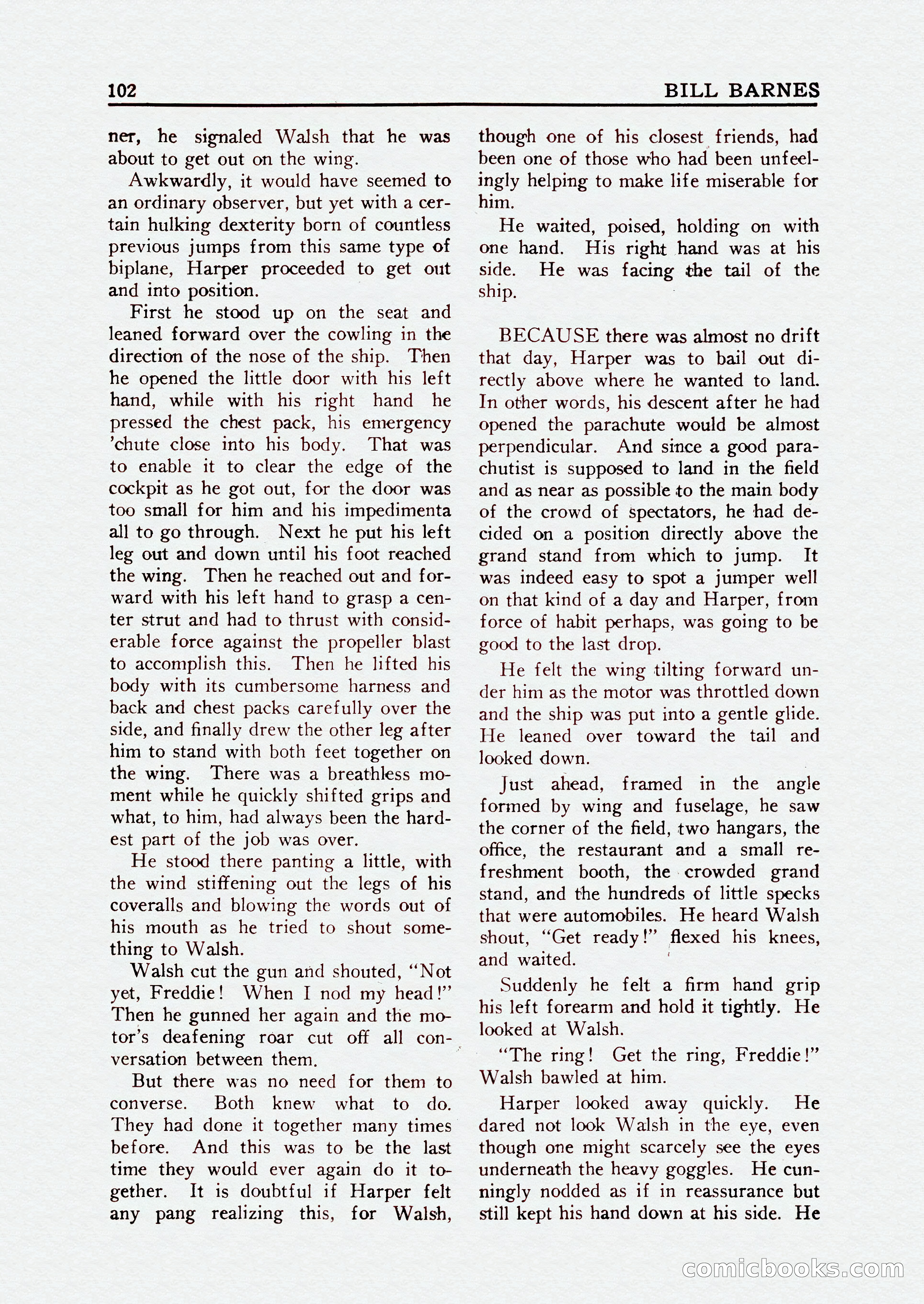
A restored page from Pulp Fiction, 1935. Page through the whole issue in the reader above.
📄 Transcribed text from this page (OCR, searchable)
Machine-transcribed from the original scan — historical spelling and the odd misread are preserved.
102 BILL BARNES ner, he signaled Walsh that he was about to get out on the wing. Awkwardly, it would have seemed to an ordinary observer, but yet with a cer- tain hulking dexterity born of countless previous jumps from this same type of biplane, Harper proceeded to get out and into position. : First he stood up on the seat and leaned forward over the cowling in the direction of the nose of the ship. Then he opened the little door with his left hand, while with his right hand he pressed the chest pack, his emergency ‘chute close into his body. That was to enable it to clear the edge of the cockpit as he got out, for the door was too small for him and his impedimenta all to go through. Next he put his left leg out and down until his foot reached the wing. Then he reached out and for- ward with his left hand to grasp a cen- ter strut and had to thrust with consid- erable force against the propeller blast to accomplish this. Then he lifted his body with its cumbersome harness and back and chest packs carefully over the side, and finally drew the other leg after him to stand with both feet together on the wing. There was a breathless mo- ment while he quickly shifted grips and what, to him, had always been the hard- est part of the job was over. He stood there panting a little, with the wind stiffening out the legs of his coveralls and blowing the words out of his mouth as he tried to shout some- thing to Walsh. Walsh cut the gun and shouted, “Not yet, Freddie! When I nod my head!’ Then he gunned her again and the mo- tor’s deafening roar cut off all con-_ versation between them. But there was no need for them to converse. Both knew what to do. They had done it together many times. before. And this was to be the last time they would ever again do it to- gether. It is doubtful if Harper felt any pang realizing this, for Walsh, though one of his closest friends, had been one of those who had been unfeel- ingly helping to make life miserable for him. He waited, poised, holding on with one hand. His right hand was at his side. He was facing the tail of the ship. | BECAUSE there was almost no drift that day, Harper was to bail out di- rectly above where he wanted to land. In other words, his descent after he had opened the parachute would be almost perpendicular. And since a good para- chutist is supposed to land in the field and as near as possible to the main body of the crowd of spectators, he had de- cided on a position directly above the grand stand from which to jump. It was indeed easy to spot a jumper well on that kind of a day and Harper, from force of habit perhaps, was going to be good to the last drop. He felt the wing tilting forward un- der him as the motor was throttled down and the ship was put into a gentle glide. He leaned over toward the tail and looked down. Just ahead, framed in the angle formed by wing and fuselage, he saw the corner of the field, two hangars, the office, the restaurant and a small re- freshment booth, the crowded grand stand, and the hundreds of little specks that were automobiles. He heard Walsh shout, “Get ready!” flexed his knees, and waited. Suddenly he felt a firm hand grip his left forearm and hold it tightly. He looked at Walsh. “The ring! Get the ring, Freddie!” Walsh bawled at him. Harper looked away quickly. He dared not look Walsh in the eye, even though one might scarcely see the eyes underneath the heavy goggles. He cun- ningly nodded as if in reassurance but still kept his hand down at his side. He oO COMIGHOO S (C©