
Pulp Fiction, 1897 · page 12 of 16
Beadle's Half Dime Library Vol. XL, No. 1020 — page 12: what you’re looking at
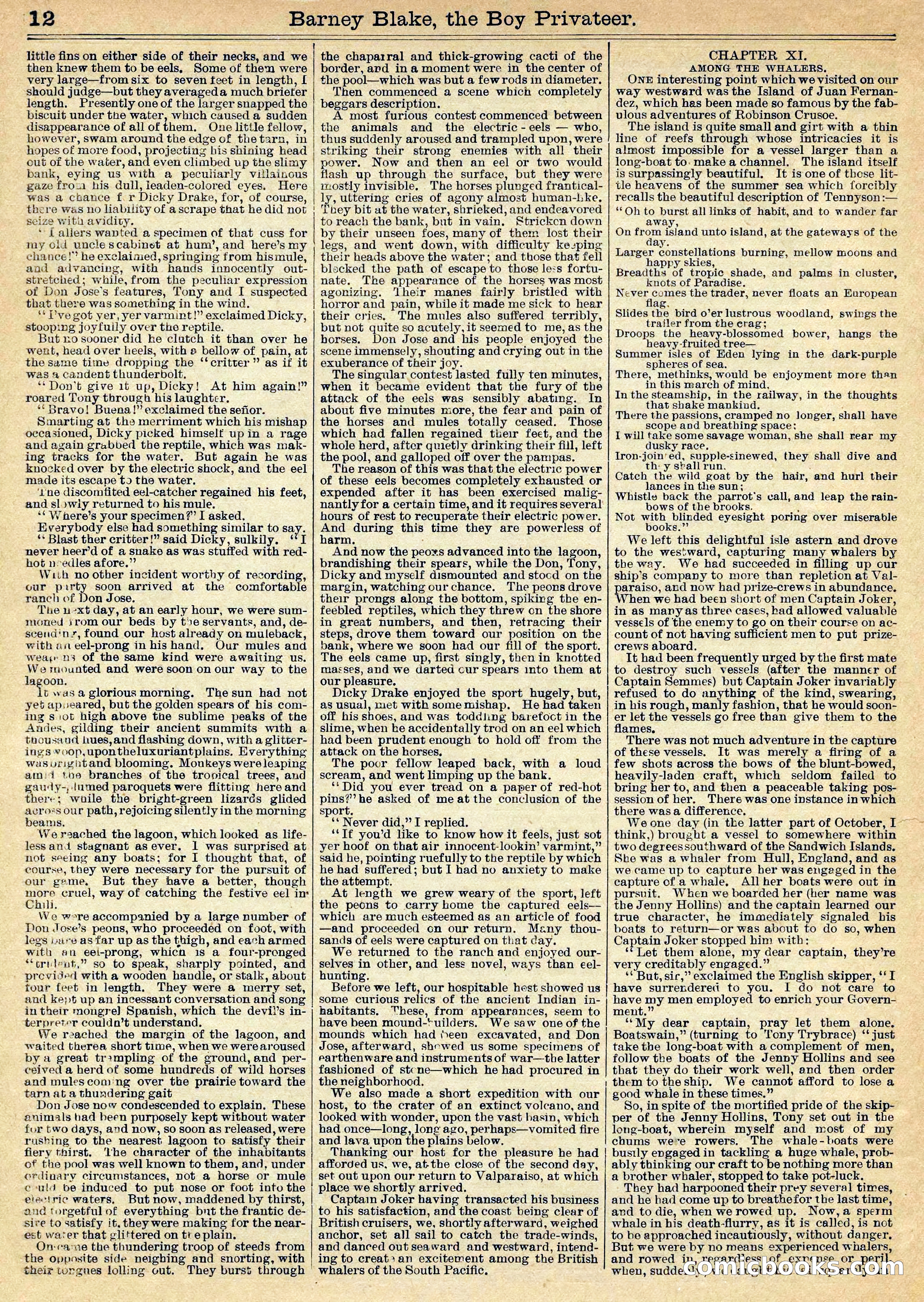
A restored page from Pulp Fiction, 1897. Page through the whole issue in the reader above.
📄 Transcribed text from this page (OCR, searchable)
Machine-transcribed from the original scan — historical spelling and the odd misread are preserved.
12 Barney Blake, the Boy Privateer. little fins on either side of their necks, and we then knew them to be eels, Some of them were very large—from six to seven feet in length, [ should judge—but they averageda much briefer length. Presently one of the larger snapped the biscuit under the water, which caused a sudden disappearance of allofthem. One little fellow, however, swam around the edge of thetarn, in hopes of more food, projecting his shining head out of the water, and even climbed up the slimy bank, eying us with a peculiarly villainous gaze frou his dull, leaden-colored eyes. Here was a chance f.r Dicky Drake, for, of course, there was no liability of ascrape that he did not seize with avidity. * { allers wanted a specimen of that cuss for my old uncle scabinet at hum’, and here’s my chance!” he exclaingied, springing from hismule, and advancing, with hands innocently out- stretched; while,from the peculiar expression of Don Jose's features, Tony and I suspected that there was something in the wind. ‘* Pve got yer, yer varmint!” exclaimed Dicky, stooping joyfuily over the reptile. But ro sooner did he clatch it than over he went, head over heels, with s bellow of pain, at the same time dropping the ‘‘critter” as if it was 4 candent thunderbolt. ‘* Don't give 16 up, Dicky! At him again!” roared Tony through his laughter. ‘‘ Bravo! Buena!” exclaimed the sefior. Smarting at the merriment which his mishap occasioned, Dicky picked himself upin a rage and again grabbed the reptile, which was mak- ing tracks for the water. But again he was knocked over by the electric shock, and the eel made its escape to the water. ‘ine discomfited eel-catcher regained his feet, and slywiy returned to his mule. ‘* W here’s your specimen?” I asked. Everybody else had something similar to say. ‘* Blast ther critter!” said Dicky, sulkily. ‘‘I never heer’d of a snake as was stuffed with red- hot n-edles afore,” Wiih no other incident worthy of recording, our purty soon arrived at the comfortable ranch of Don Jose. The u-xt day, at an early hour, we were sum- moned irom our beds by te servants, and, de- scendins, found our host already on muleback, with an eel-prong in his hand, Our mules and weay ns Of the same kind were awaiting us. Wernounted and were soon on our way to the lagoon. t was a glorious morning. Thesun had not yet ap: eared, but the golden spears of his com- ing sot high above the sublime peaks of the Andes, gilding their ancient summits with a thousand hues,and flashing down, with a glitter- ings voop,upontheluxuriantplains, Everything wasvrightand blooming. Moukeys were leaping ami tbe branches of the tropical trees, and gaurly-, luamed paroquets were flitting here and there; while the bright-green lizarcs glided rors our path, rejoicing silently in the morning eams, : We raached the lagoon, which looked as life- less and stagnant asever. I was surprised at not seeing any boats; for I thought that, of course, they were necessary for the pursuit of our game, But they have a better, though ae cruel, way of catching the festive eel im ili, We were accompanied by a large number of Don Jose’s peons, who proceeded on foot, with legs Lure as tar up as the thigh, and each armed with an eei-prong, whico is a four-pronged *‘trilent,” so to speak, sharply pointed, and previded with a wooden handle, or stalk, about tour feet in length. They were a merry set, and kept up an incessant conversation and song in their mongre] Spanish, which the devil’s in- terpret»r couldn’t understand. We reached the margin of the lagoon, and waited therea short time, when we werearoused by a great tr2mpling of the ground, and per- ceived a herd of some hundreds of wild horses and mulescom'ng over the prairie toward the tarn at a thundering gait Don Jose now condescended to explain, These animals had been purposely kept without water fur two days, and now, so soon as released, were rushing to the nearest lagoon to satisfy their fiery thirst, ‘lhe character of the inhabitants of the pool was well known to them, and, under ordinary circumstances, not a horse or mule e-uld be induced to put nose or foot into the electric waters. But now, maddened by thirst, and torgetful of everything but the frantic de- sire to satisfy it. they were making for the near- est water that clittered on tie plain. On:cave the thundering troop of steeds from the Opposite side neighing and snorting, with their torgues lolling cut, They burst through QC =F the chaparral and thick-growing cacti of the border, and in a moment were in the center of the pool—which was but a fewrods in diameter. Then commenced a scene which completely beggars description. A most furious contest commenced between the animals and the electric - eels — who, thus suddenly aroused and trampled upon, were striking their strong enemies with all their power. Now and then an eel or two would flash up through the surface, but they were mostly invisible. The horses plunged frantical- ly, uttering cries of agony almost human-Lke, They bit at the water, shrieked, and endeavored to reach the bank, but in vain, Strickcn down by their unseen foes, many of them lost their legs, and went down, with difficulty kesping their heads above the water; and those that fell blecked the path of escape to those le:s fortu- nate. The appearance of the horses was most agonizing. ‘heir manes fairly bristled with horror and pain, while it made me sick to hear their cries. The mules also suffered terribly, but not quite so acutely, it seemed to me, as the horses. Don Jose and his people enjoyed the scene immensely, shouting and crying out in the exuberance of their joy. The singular contest lasted fully ten minutes, when it became evident that the fury of the attack of the eels was sensibly abating. In about five minutes niore, the fear and pain of the horses and mules totally ceased. Those which had fallen regained tteir feet, and the whole herd, after quietly drinking their fill, left the pool, and galloped off over the pampas. The reason of this was that the electric power of these eels becomes completely exhausted or expended after it has been exercised malig- nantly for a certain time, and it requires several hours of rest to recuperate their electric power. And during this time they are powerless of harm. ; And now the peoxs advanced into the lagoon, brandishing their spears, while the Don, Tony, Dicky and myself dismounted and stocd on the margin, watching ourchance. The peons drove their prongs along the bottom, spiking the en- feebled reptiles, which they threw on the shore in great numbers, and then, retracing their steps, drove them toward our position on the vank, where we soon had our fill of the sport. The eels came up, first singly, then in knotted masses, and we darted cur spears into them at our pleasure. Dicky Drake enjoyed the sport hugely, but, as usual, met with somemishap, He had taken off his shoes, and was toddling barefoct in the slime, when ke accidentally trod on an eel which had been prudent enough to hold off from the attack on the horses. The poor fellow leaped back, with a loud scream, and went limping up the bank. ‘‘Did you ever tread on a paper of red-hot pins?’ he asked of meat the conclusion of the sport, ‘* Never did,” I replied. “Tf you’d like to know how it feels, just sot yer hoof on that air innocent-lookin’ varmint,” said he, pointing ruefully to the reptile by which he had suffered; but I had no anxiety to make the attempt. At length we grew weary of the sport, left the peons to carry home the captured eels— which are much esteemed as an article of food —and proceeded cn our return. Meny thou- sands of eels were captured on that cay. We returned to the ranch and enjoyed our- selves in other, and less novel, ways than eel- hunting. Before we left, our hospitable hest showed us some curious relics of the ancient Indian in- habitants. “hese, from appearances, seem to have been mound-‘uilders. We saw one of the mounds which had (been excavated, and Don Jose, afterward, showed us some specimens of earthenware and instruments of war—the latter fashioned of stcne—which he had procured in the neighborhocd. We also made a short expedition with our host, to the crater of an extinct volcano, and looked with wonder, upon the vast basin, which had once—long, long ago, perhaps—vomited fire and lava upon the plains below. Thanking our host for the pleasure he had afforded us, we, at-the close of the second day, set out upon our return to Valparaiso, at which place we shortly arrived. Captain Joker having transacted his business to his satisfaction, and the coast being clear of British cruisers, we, shortly afterward, weighed anchor, set all sail to catch the trade-winds, and danced out seaward and westward, intend- ing to creat» an excitement among the British whalers of the South Pacific. te re CHAPTER XI. AMONG THE WHALERS. ONE interesting point which we visited on our way westward was the Island of Juan Fernan- dez, which has been made so famous by the fab- ulous adventures of Robinson Crusoe. The island is quite small and girt with a thin line of reefs through whose intricacies it is almost impossible for a vessel larger than a long-boat to:makeachannel, The island itself is surpassingly beautiful. It is one of those lit- tle heavens of the summer sea which forcibly recalls the beautiful description of Tennyson :— **Oh to burst all links of habit, and to wander far away, On mora island unto island, at the gateways of the day. Larger constellations burning, mellow moons and happy skies, Breadths of tropic shade, and palms in cluster, knots of Paradise. Never comes the trader, never floats an European ag, Slides the bird o’er lustrous woodland, swings the trailer from the erag; Droops the heavy-blossomed bower, hangs the heavy-fruited tree— Summer isles of Eden lying in the dark-purple spheres of sea. There, methinks, would be enjoyment more than in this march of mind. In the steamship, in the railway, in the thoughts that shake mankind. : There the passions, cramped no longer, shall have scope and breathing space; I will take Some savage woman, she shall rear my dusky race, Iron-join'ed, supple-sinewed, they shall dive and th: y stall run. Catch the wild goat by the hair, and hurl their lances in the sun; Whistle back the parrot’s vall, and leap the rain- bows of the brooks. : Not with blinded eyesight poring over miserable books.” We left this delightful isle astern and drove to the westward, capturing many whalers by the way. We had succeeded in filling up our ship’s company to more than repletion at Val- araiso, and now had prize-crews in abundance. hen we had been short of men Captain Joker, in as many as three cases, bad allowed valuable vessels of the enemy to go on their course on ac- count of not having sufficient men to put prize- crews aboard. It had been frequently urged by the first mate to destroy such vessels (after the manner of Captain Semmes) but Captain Joker invariably refused to do anything of the kind, swearing, in his rough, manly fashion, that he would soon- er let the vessels go free than give them to the flames, There was not much adventure in the capture of these vessels. It was merely a firing of a few shots across the bows of the blunt-bowed, heavily-laden craft, which seldom failed to bring her to, and then a peaceable taking pos- session of her. There was one instance in which there was a difference, Weone day (in the latter part of October, I~ think,) brought a vessel to somewhere within two degreessouthward of the Sandwich Islands. She was a whaler from Hull, England, and as we came up to capture her was engeged in the capture of a whale, All her boats were out in pursuit. When we boarded her (her name was the Jenny Hollins) and the captain learned our true character, he immediately signaled his boats to return—or was about to do so, when Captain Joker stopped him with: ‘Let them alone, my dear captain, they’re very creditably engaged.” ‘* But, sir,” exclaimed the English skipper, ‘‘T have surrendered to you. I do not care to have my men employed to enrich your Govern- ment.” ‘“My dear captain, pray let them alone, Boatswain,” (turning to Tony Trybrace) ‘‘ just take the long-boat with a complement of men, follow the boats of the Jenny Hollins and see that they do their work well, and then order them to theship. We cannot afford to lose a good whale in these times.” So, in spite of the mortified pride of the skip- per of the Jenny Hollins, Tony set out in the long-boat, wherein myself and most of my chums were rowers. The whale-boats were busily engaged in tackling a huge whale, prob- ably thinking our craft to be nothing more than a brother whaler, stopped to take pot-luck. They had harpooned their prey several times, and he had come up to breathefor the last time, and to die, when we rowed up. Now,a sperm whale in his death-flurry, as it is called, is not to be approached incautiously, without danger, But we were by no means experienced whalers, and rowed i when, MACOMECHDOOKSCOM