
Pulp Fiction, 1897 · page 10 of 16
Beadle's Half Dime Library Vol. XL, No. 1020 — page 10: what you’re looking at
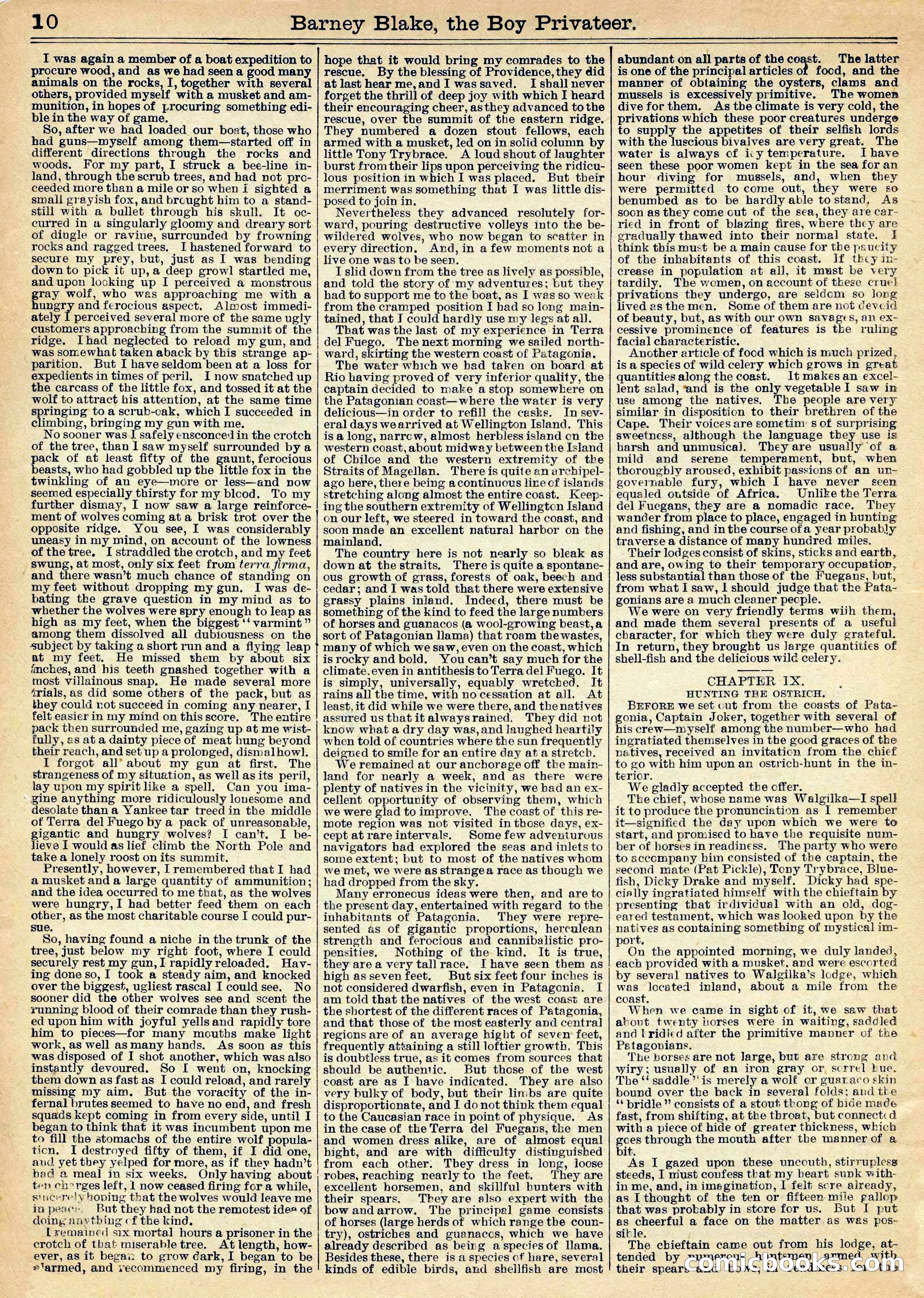
A restored page from Pulp Fiction, 1897. Page through the whole issue in the reader above.
📄 Transcribed text from this page (OCR, searchable)
Machine-transcribed from the original scan — historical spelling and the odd misread are preserved.
10 Barney Blake, the Boy Privateer. I was again a member of a boat expedition to procure wood, and as we had seen a good many animals on the rocks, I, together with several others, provided myself with a musket and am- munition, in hopes of procuring something edi- ble in the way of game, So, after we had loaded our boat, those who had guns—myself among them—started off in different directions through the rocks and woods. For my part, I struck a bee-line in- land, through the scrub trees, and had not pro- ceeded more than a mile or so when i sighted a small grayish fox, and brcught him to a stand- still with a bullet through his skull. It oc- curred in a singularly gloomy and dreary sort of dingle or ravine, surrounded by frowning rocks and ragged trees, I hastened forward to secure my prey, but, just as I was bending down to pick it up, a deep growl startled me, and upon locking up I perceived a monstrous gray wolf, who was approaching me with a hungry and ferocious aspect. Almost immedi- ately I perceived several more of the same ugly customers approaching from the summit of the ridge. Ihad neglected to reload my gun, and _ was somewhat taken aback by this strange ap- parition. But I have seldom been at a loss for expedients in times of peril, I now snatched up the carcass of the little fox, and tossed it at the wolf to attract his attention, at the same time springing to a scrub-cak, which I succeeded in climbing, bringing my gun with me. No sooner was I safely ensconce:lin the crotch of the tree, than I saw myself surrounded by a pack of at least fifty of the gaunt, ferocious beasts, who had gobbled up the little fox in the twinkling of an eye—more or less—and now seemed especially thirsty for my blood. To my further dismay, I now saw a large reinforce- ment of wolves coming ata brisk trot over the opposite ridge. You see, I was considerably uneasy in my mind, on account of the lowness of the tree, I straddled the crotch, and my feet swung, at most, only six feet from terra firma, and there wasn’t much chance of standing on my feet without dropping my gun. I was de- bating the grave question in my mind as to whether the wolves were spry enough to leap as high as my feet, when the biggest ‘‘ varmint ” among them dissolved all dubiousness on the subject by taking a short run and a flying leap at my feet. He missed them by about six imches, and his teeth gnashed together with a most villainous snap. He made several more ‘rials, as did some others of the pack, but as they could not succeed in coming any nearer, I felt easier in my mind on this score, The entire pack then surrounded me, gazing up at me wist- fully, 2s at a dainty piece of meat hung beyond their reach, and set up a prolonged, dismalhowl. I forgot all’ about my gun at first. The strangeness of my situation, as well as its peril, lay upon my spirit like a spell. Can you ima- - Zine anything more ridiculously lonesome and desolate than a Yankee tar treed in the middle of Terra del Fuego by a pack of unreasonable, gigantic and hungry wolves? I can’t, I be- lieve I would as lief climb the North Pole and take a lonely roost on its summit. Presently, however, I remembered that I had a musket and a large quantity of ammunition; and the idea occurred to me that, as the wolves were hungry, I had better feed them on each other, as the most charitable course I could pur- sue. So, having found a niche in the trunk of the tree, just below my right foot, where I could securely rest my gun,I rapidlyreloaded. Hav- ing done so, I took a steady aim, and knocked over the biggest, ugliest rascal I could see. No sooner did the other wolves see and scent the running blood of their comrade than they rush- ed upon him with joyful yellsand rapidly tore him to pieces—for many mouths make light work, as well asmany hands. As soon as this was disposed of I shot another, which was also instantly devoured. So I went on, knocking them down as fast as I could reload, and rarely missing my aim, But the voracity of the in- fernal brutes seemed to have no end, and fresh squads kept coming in from every side, until I began to think that it was incumbent upon me to fill the stomachs of the entire wolf popula- ticn, I destroyed fifty of them, if I did one, and yet they yelped for more, as if they hadn’t bad a meal in six weeks. Only having about ten chorges left, 1 now ceased firing for a while, stncere!y hoping that the wolves would leave me in peacs. But they had not the remotest ides of doing anvtbing cf the kind. Lyemained six mortal hours a prisoner in the crotch of that miserable tree. At length, how- ever, as it began: to grow dark, I began to be ‘armed, and vecommenced my firing, in the i i a hope that it would bring my comrades to the rescue, By the blessing of Providence, they did at last hear me,and I wassaved. I shall never forget the thrill of deep joy with which I heard their encouraging cheer, asthey advanced to the rescue, over the summit of the eastern ridge. They numbered a dozen stout fellows, each armed with a musket, led on in solid column by little Tony Trybrace. A loud shout of laughter burst from their lips upon perceiving the ridicu- lous position in which I was placed. But their merriment was something that I was little dis- posed to join in, Nevertheless they advanced resolutely for- ward, pouring destructive volleys into the be- wildered wolves, who now began to scatter in every direction, And,in afew moments not a live one was to be seen, I slid down from the tree as lively as possible, and told the story of ‘my adventures; but they had to support me to the boat, as 1 was so weak from the cramped position I had so long main- tained, that I could hardly use my legs at all. That was the last of my experience in Terra del Fuego. The next morning we sailed north- ward, skirting the western coast of Patagonia. The water which we bad taken on board at Rio having proved of very inferior quality, the captain decided to make astop somewhere on the Patagonian coast—where the water is very delicious—in order to refill the casks. In sev- eral days wearrived at Wellington Island. This is a long, narrcw, almost herbless island cn the western coast, about midway between the Island of Chilce and the western extremity of the Straits of Magellan. There is quite an archipel- ago here, there being acontinuous line of islands stretching along almost the entire coast. Keep- ing the southern extremity of Wellington Island on our left, we steered in toward the coast, and soon made an excellent natural harbor on the mainland. The country here is not nearly so bleak as down at the straits. There is quite a spontane- ous growth of grass, forests of oak, beech and cedar; and I was told that there were extensive grassy plains inland. Indeed, there must be something of the kind to feed the large numbers of horses and guanacos (a wool-growing beast, a sort of Patagonian llama) that roam the wastes, many of which we saw, even on the coast, which is rocky and bold. You can’t say much for the climate.even in antithesis to Terra del Fuego. It is simply, universally, equably wretched, It rains all the time, with no cessation at all. At least, it did while we were there, and the natives assured us thatitalwaysrained, They did not know what a dry day was, and laughed heartily when told of countries where the sun frequently deigned to smile for an entire day at a stretch. We remained at our anchorage off the main- land for nearly a week, and as there were plenty of natives in the vicinity, we bad an ex- cellent opportunity of observing them, which we were glad toimprove. The coast of this re- mote region was not visited in those days, ex- cept at rare intervals. Some few adventurous navigators had explored the seas and inlets to some extent; but to most of the natives whom we met, we were as strangea race as though we had dropped from the sky. Many erronecus ideas were then, and are to the present day, entertained with regard to the inhabitants of Patagonia. They were repre- sented as of gigantic proportions, herculean strength and ferocious and cannibalistic pro- pensities. Nothing of the kind. It is true, they area very tallrace. I have seen them as high asseven feet. But six feet four inches is not considered dwarfish, even in Patagonia. I am told that the natives of the west coast are the shortest of the different races of Patagonia, and that those of the most easterly and central regions are of an average hight of seven feet, frequently attaining a still loftier growth. This is doubtless true, as it comes from sources that should be authentic. But those of the west coast are as I have indicated. They are also very bulky of body, but their linibs are quite disproporticnate, and I do not think them equal to the Caucasian race in point of physique. <As in the case of the Terra del Fuegans, the men and women dress alike, are of almost equal hight, and are with difficulty distinguished from each other. They dress in long, loose robes, reaching nearly to the feet. They are excellent horsemen, and skillful hunters with their spears. They are also expert with the bow and arrow. The principal game consists of horses (large herds of which range the coun- try), ostriches and guanacos, which we have already described as being aspeciesof Hama. Besides these, there is a species of hare, several kinds of edible birds, and shellfish are most { abundant on all parts of the coast. The latter is one of the principal articles of focd, and the manner of obtaining the oysters, clams and mussels is excessively primitive. The women dive forthem. As tbe climate is very cold, the privations which these poor creatures underge to supply the appetites of their selfish lords with the luscious bivalves are very great. The water is always of icy temperature. Ihave seen these poor women kept in the sea for an hour diving for mussels, and, when they were permitted to come out, they were so benumbed as to be hardly able tostand, As soon as they come out of the sea, they are car- ried in front of blazing fires, where they are gradually thawed into their normal state. f think this must be a main cause for the paucity of the inhabitants of this coast. If they in- crease in population at all, it must be very tardily. The women, on account of these cruel privations they undergo, are seldom so long lived asthe men. Some of them are not devcid of beauty, but, as with our own savages, an ex- cessive prominence of features is the ruling facial characteristic. Ancther article of food which is much prized, is a species of wild celery which grows in great quantities along the coast. It makes an excel- lent salad, ‘and is the only vegetable I saw in use among the natives. The people are very similar in disposition to their brethren of the Cape. Their voices are sometim s of surprising sweetness, although the language they use is harsh and unmusica]. They are usually of a mild and serene temperament, but, when thoroughly aroused, exhibit passions of an un- governable fury, which I have never seen equaled outside of Africa. Unlike the Terra del Fuegans, they are a nomadic race, They wander from place to place, engaged in hunting and fishing, and in the course ofa year probably traverse a distance of many hundred miles. Their lodges consist of skins, sticks and earth, and are, owing to their temporary occupation, less substantial than those of the Fuegans, but, from what I saw, 1 should judge that the Pata- gonians are a much cleaner people. We were on very friendly terms wiih them, and made them several presents of a_ useful character, for which they were duly grateful. In return, they brought us large quantities of shell-fish and the delicious wild celery. CHAPTER IX, HUNTING THE OSTRICH. BEFORE we set cut from the coasts of Pata- gonia, Captain Joker, together with several of his crew—myself among the number—who had ingratiated themselves in the good graces of the natives, received an invitation from the chief to go with him upen an ostrich-hunt in the in- terior. We gladly accepted the cffer. The chief, whose name was Walgilka—lI spell it to produce the pronunciation as I remember it—signified the day upon which we were to start, and promised to have the requisite num- ber of horses in readiness. The party who were to accompany him consisted of the captain, the second mate (Pat Pickle), Tony Trybrace, Blue- fish, Dicky Drake and myself. Dicky had spe- cially ingratiated himself with the chieftain by presenting that irdividual with an old, dog- eared testament, which was looked upon by the natives as containing something of mystical im- port, On the appointed morning, we duly landed, each provided with a musket, and were escarted by several natives to Walgilka’s lodge, which was located inland, about a mile from the coast, When we came in sight of it, we saw that about twenty horses were in waiting, saddled and I ridied after the primitive manner of the Petagonians. The borses are not large, but are strong and wiry; usually of an iron gray or scrrel hue. The ‘‘saddle’'is merely a wolf cr guaraco skin bound over the back in several folds; and tie ‘‘ bridle” consists of a stout thong of hide made fast, from shifting, at the throat, but connect: d with a piece of hide of greater thickness, which goes through the mouth after the manner of a bit. As I gazed upon these uncouth, stirrupless steeds, I must confess that my beart sunk with- in me, and, in imegineation, I felt scre already, as [ thought of the ten or fifteen mile gallop that was probably in store for us. But I put es cheerful a face on the matter as was pos- sible. The chieftain came out from his lodge, at- Ta icomicbooks:com their spear