
Pulp Fiction, 1879 · page 25 of 40
Beadle's New York Dime Library, No. 66 — page 25: what you’re looking at
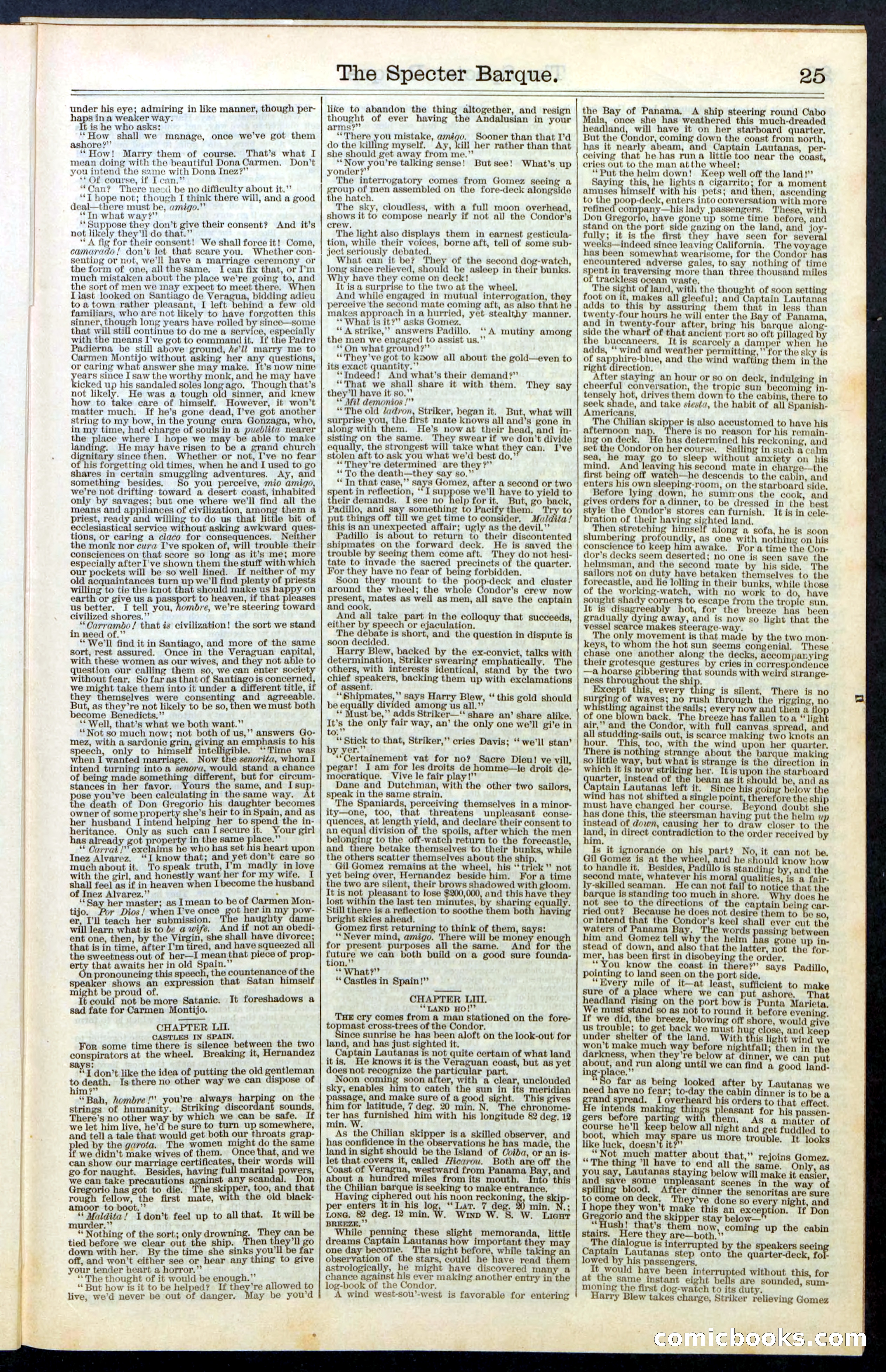
A restored page from Pulp Fiction, 1879. Page through the whole issue in the reader above.
📄 Transcribed text from this page (OCR, searchable)
Machine-transcribed from the original scan — historical spelling and the odd misread are preserved.
under his eye; admiring in like manner, though per- haps ina weaker way. is he who asks: ‘*How shall we manage, once we've got them ashore?”’ ‘How! Marry them of course. That’s what I mean doing with the beautiful Dona Carmen. Don't you intend the same with Dona Inez?” ‘** OF course, if I can.” “Can? There need be no difficulty about it.”’ **T hope not; though I think there will, and a good deal—there must be, amigo.” **In what way?”’ ** Suppose they don’t give their consent? And it’s not likely they'll do that.” ‘A fig for their consent! We shall force it! Come, camarado! don’t let that scare you. Whether con- senting or not, we'll have a marriage ceremony or the form of one, allthe same. I can fix that, or I'm much mistaken about the place we're going to, and the sort of men we may we to meet there. When Iiast looked on Santiago de Veragua, bidding adieu to a town rather pleasant, I left behind a few old familiars, who are not likely to have forgotten this sinner, though long years have rolled by sinco—some that will still continue to do me a service, especially with the means I've got to command it. If the Padre Padierna be still above ground, fell marry me to Carmen Montijo without asking her any questions, or caring what answer she may make, It’s now nine years since I saw the worthy monk, and he may have icked up his sandaled soles longago. Though that’s not likely. He was a tough old sinner, and knew how to take care of himself. However, it won't matter much. If he’s gone dead, I’ve got another string to my bow, in the young cura Gonzaga, who, in my time, had charge of souls in a pveblita nearer the place where I hope we may be able to make landing. He may have risen to be a grand church dignitary since then. Whether or not, I’ve no fear of his forgetting old times, when he and I used to go shares in certain smuggling adventures. Ay, and something besides. So you perceive, mio amigo, we're not drifting toward a desert coast, inhabited only by savages; but one where we'll find all the means and appliances of civilization, among them a priest, ready and willing to do us that little bit of ecclesiastical service without asking awkward ques- tions, or caring a claco for consequences. Neither the monk nor cura I've spoken of, will trouble their consciences on that score so long as it’s me; more especially after I’ve shown them the stuff with which our pockets will be so well lined. If neither of my old acquaintances turn up we'll find plenty of priests willing to tie the knot that should make us happy on earth or give us a p rt to heaven, if that pleases us better. I tell you, hombre, we're steering toward civilized shores.”’ “Oarrambo/ that is civilization! the sort we stand in need of.” “We'll find it in Santiago, and more of the same sort, rest assured. Once in the Veraguan capital, with these women as our wives, and they not able to question our calling them so, we can enter societ, without fear, So faras that of Santiago is concerned, we might take them into it under a different title, if they themselves were Rouge ne and agreeable. But, as they’re not likely to be so, then we must both become Benedicts.” ‘** Well, that’s what we both want.” “Not so much now; not both of us,” answers Go- mez, with a sardonic grin ss an emphasis to his speech, only to himself intelligible. ‘Time was when I wanted marriage. Now the senorita, whom I intend turning into a senora, would stand a chance of being made something different, but for circum- stances in her favor. Yours the same, and I sup- pose you’ve been calculating in the same way. t the death of Don Gregorio his daughter becomes owner of some property she’s heir to in Spain, and as her husband I intend helping her to spend the in- heritance. Only as such can I secure it. Your girl has already got »roperty in the same place. ‘ Carrai /” exclaims he who has set his heart upon Inez Alvarez. “I know that; and yet don’t care so much about it. To speak truth, I’m madly in love with the girl, and honestly want her for my wife. all feel as if in heaven when I become the husband of Inez Alv J . Ben gto as Imean to be of Carmen Mon- tijo. Dios! when I’ve once got her in my Veta er, I'll teach her submission. The haughty dame will learn what is to be a wife. And if not an obedi- ent one, then, by the Virgin, she shall have divorce; that is in time, after I’m tired, and have squeezed all the sweetness out of hens maeanithas piece of prop- erty that awaits her in old Spain. On pronouncing this speech, the countenance of the speaker snows ~ expression that Satan might be proud of. . it could not be more Satanic. It foreshadows a sad fate for Carmen Montijo. CHAPTER LIL. ‘thera a iiohen thet weet the two For some time there is silence conspirators at the wheel. Breaking it, Hernandez Says: : ‘I don’t like the idea of putting the old gentleman to death. Is there no other way we can dispose of him?” “Bah, hombre!” you're always harping on the strings of paroatiity, Striking discordant sounds, There’s no other way by which we can be safe. If we let him live, he’d be sure to turn up somewhere, and tell a tale that would get both our throats grap- led by the garota. The women might do the same tf we didn’t make wives of them. Once that, and we can show our m e certificates, their words will go for naught. Besides, having marital paket coe we can take precautions —— any scandal, Don Gregorio has got to die. The skipper, too, and that rough Ts the first mate, the old black- amoor to boot.” ‘‘ Maldita! Idon’t feel up to all that. It will be murder, ; * Nothing of the sort; only drowning. They can be tied before we clear out the ship. Then ti - ll go down with her. By the time she sinks you far off, and won't either see or hear any thing to give your tender heart a horror.” 3 “The thought of it would be enough.’ : “ But how is it to be helped? If they’re allowed to live, we'd never be out of danger. May be you'd The Specter Barque. SSS SSS Sines: 25 like to abandon the thing altogether, and resign thought of ever having the Andalusian in your arms?’ “There you mistake, améqo. Sooner than that I'd do the killing myself. Ay, kill her rather than that she should get away from me.” ‘Now you’re talking sense! But see! What's up yonder?’ The interrogatory comes from Gomez seeing a group of men assembled on the fore-deck alongside the hatch. The sky, cloudless, with a full moon overhead, shows it to compose nearly if not all the Condor’s crew. The light also displays them in earnest gesticula- tion, while their voices, borne aft, tell of some sub- ject seriously debated. What can it be? They of the second dog-watch, long since relieved, should be asleep in their bunks. Why have they come on deck! It is a surprise to the two at the wheel. And while engaged in mutual interrogation, they perceive the second mate coming aft, as also that he makes approach in a hurried, yet stealthy manner. ** What is it?” asks Gomez. “ A strike,’’ answers Padillo. ‘‘A mutiny among the men we engaged to assist us.”’ **On what ground?” “They've got to know all about the gold—even to its exact ¢ erie Ae “Indeed | And what's their demand?’ “That we shall share it with them. they'll have it so.”’ ** Mil demonios |” “The old dadron, Striker, began it. But, what will surprise you, the first mate knows all and’s gone in along with them. He’s now at their head, and in- sisting on the same. They swear if we don't divide equally, the strongest will take what they can. I’ve stolen aft to ask you what we'd best do,’ “They're determined are they?” “To the death—they say so.” ‘** In that case,”’ says Gomez, after a second or two spent in reflection, ** I mee Pee we'll have to yield to their demands. Isee no help forit. But, go back, Padillo, and say something to Pacify them. Try to put things off till we get time to consider. Muldita/ this is an unexpected affair; ugly as the devil.” Padillo is about to return to their discontented shipmates onthe forward deck. He is saved the trouble by seeing them come aft. They do not hesi- tate to invade the sacred precincts of the quarter. For they have no fear of being forbidden. Soon they mount to the oop-deck and cluster around the wheel; the whole Condor’s crew now present, mates as well as men, all save the captain and cook, And all take part in the colloquy that succeeds, either by speech or ejaculation. The debate is short, and the question in dispute is soon decided. Harry Blew, backed by the ex-convict, talks with determination, Striker swearing emphatically. The others, with interests identical, stand by the two chief speakers, backing them up with exclamations Oe Bhigmates. "sayy Blew, “ this gol ‘Shipmates,”’ says Ha ew. is gold should bee nally divided among us all.’” : ¥ share alike. They say ust be,” adds Striker—“ share an’ It’s the only fair way, an’ the only one we'll gi’e in to: ” “ Stick to that, Striker,” cries Davis; ‘‘ we'll stan’ by yer.” *Certainement vat for no? Sacre Dieu! ve vill, pegar! I am for les droits de homme—le droit de- mocratique. Vive le fair play!” Dane and Dutchman, with the other two sailors, speak in the same strain. The Spaniards, perceiving themselves in a minor- ity—one, too, that threatens unpleasant conse- quences, at length — and declare their consent to an equal division of the cote after which the men belonging to the off-watch return to the forecastle, and there betake themselves to their bunks, while the others scatter themselves about the ship. Gil Gomez remains at the wheel, his “ trick” not yet being over, Hernandez beside him. Fora time the two are silent, their brows shadowed with gloom. It is not pleasant to lose $200,000, and this have they lost within the last ten minutes, by sharing equally. Still there is a reflection to soothe them both having bright skies ahead. mez first returning to think of them, says: ** Never mind, amigo. There will be money enough for present purposes all the same. And for the rede we can both build on a good sure founda- on,"* oe Wha ”? ** Castles in Spain!” CHAPTER LIL. “LAND HO!”’ THE cry comes from a man stationed on the fore- topmast cross-trees of the Condor. ince sunrise he has been aloft on the look-out for land, and has just sighted it. Captain Lautanas is not quite certain of what land itis. He knows it is the Ve coast, but as yet does not recognize the particular part. Noon coming soon after, with a clear, unclouded sky, enables to catch the sun in its meridian assage, and make sure of a good sight. This gives im for latitude, 7 deg. 20 min. N. The chronome- ee has furnished him with his longitude 82 deg. 12 . Ww. As the Chilian skipper is a skilled observer, and has confidence in the observations he has made, the land in sight should be the Island of Coida, or an is- let that covers it, called Hicarou. Both off the Coast of Veragua, westward from Panama Bay, and about a hundred miles fromits mouth. Into this the Chilian barque is seeking to make entrance, Having oa out his noon recning. the skip- per enters itin his |} “Lat. 7 de min. N.; Lona. 82 deg. 12 min. W. Win W. 8. W. Liaar BREEZE.”’ While penning these slight memoranda, little dreams Captain Lautanas how important they may one day become. The night before, while taking an observation of the stars, could he have read t em astrologically, he might have discovered many a chance against his ever making another entry in the log-book of the Condor. A wind west-sou’-west is favorable for entering the Bay of Panama. A ship steering round Cabo Mala, once she has weathered this much-dreaded headland, will have it on her starboard quarter. But the Condor, coming down the coast from north, has it nearly abeam, and Captain Lautanas, per- ceiving that he has run a little too near the coast, cries out to the man atthe wheel: ‘Put the helm down! Keep well off the land!” Saying this, he lightsa cigarrito; for a moment amuses himself with his pets; and then, ascending to the poop-deck, enters into conversation with more refined company—his lady passengers. These, with Don Gregorio, have gone up some time before, and stand on the port side gazing on the land, and joy- fully; it is the first they have seen for several weeks—indeed since leaving California. The voyage has been somewhat wearisome, for the Condor has encountered adverse gales, to say nothing of time A pee in traversing more than three thousand miles of trackless ocean waste, The ba ge of land, with the thought of soon setting foot on it, makes all gleeful: and Captain Lautanas adds to this by assuring them that in less than twenty-four hours he will enter the Bay of Panama, and in twenty-four after, bring his barque along- side the whart of that ancient port so oft pillaged by the buccaneers, It is scarcely a damper when he adds, ** wind and weather permitting,’’ for the sky is of sapphire-blue, and the wind wafting them in'the right direction, After staying an hour or so on deck, indulging in cheerful conversation, the ane sun becoming in- tensely hot, drives them down to the cabins, there to seek shade, and take siesta, the habit of all Spanish- Americans, The Chilian skipper is also accustomed to have his afternoon nee here is no reason for his rermain- ing on deck, He has determined his reckoning, and set the Condoron her course. Sailing in such a calm sea, he may go to sleep without anxiety on his mind, And leaving his second mate in charge-—the first being off watch—he descends to the cabin, and enters his own sleeping-room, on the starboard side. Before lying down, he summons the cook, and gives orders for a dinner, to be dressed in the best style the Condor's stores can furnish. It is in cele- bration of their having sighted land. Then stretching himself along a sofa, he is soon slumbering profoundly, as one with nothing on his conscience to keep him awake. Yor a time the Con- dor’s decks seem deserted; no one is seen save the helmsman, and the second mate by his side. The sailors not on duty have betaken themselves to the forecastle, and lie lolling in their bunks, while those of the working-watch, with no work to do, have sought shady corners to escape from the tropic sun, It is disagreeably hot, for the breeze has been gradually dying away, and is now so light that the vessel scarce makes steerage-way. The only movement is that made by the two mon- keys, to whom the hot sun seems congenial. These chase one another along the decks, accompanying their grotesque gestures by cries in correspondence —a hoarse gibbering that sounds with weir strange- ness throughout the gr Except this, every thing is silent, There is no surging of waves; no rush through the rigging, no whistling against the sails; every now and then a flop of one blown back. The breeze has fallen toa “light air,” and the Condor, with full canvas spread, and all studding-sails out, is scarce making two knots an hour. This, too, with the wind upon her quarter. There is nothing strange about the barque making so little way, but what is strange is the ction in which it is now striking her. It is upon the starboard Akearte al instead of the beam as it should be, and as aptain Lautanas left it. Since his going below the wind has not shifted a single point, therefore the ship must have changed her course. Beyond doubt she has done this, the steersman having put the helm up instead of down, causing her to draw closer to the 2%, in direct contradiction to the order received by m Is it ignorance on his part? No, it can not be. Gil Gomez is at the wheel, and he should know how to handle it. Besides, Padillo is standing by, and the second mate, whatever his moral qualities, is a fair- ly-skilled seaman. He can not fail to notice that the barque is eerie 2 too much in shore. Why does he not see to the directions of the captain being car- ried out? Because he does not desire them to 80, or intend that the Condor’s keel shall ever cut the waters of Panama Bay, The words passing between him and Gomez tell why the helm has gone up in- stead of down, and also that the latter, not the for- mer, has been first in disobeying the order, “You know the coast in there?’ says Padillo, pointing to land seen on the port side. ‘Every mile of it—at least, sufficient to make sure of a place where we can put ashore. That headland rising on the port bow is Punta Marieta, We must stand so as not to round it before evening. If we did, the breeze, blowing off shore, would give us trouble; to get back we must hug close, and keep under shelter of the land. With this light wind we won't make much way before nightfall; then in the darkness, when they’re below at dinner, we can put dees and run along until we can find a good land- -place.”’ RE far as being looked after by Lautanas we need have no fear; to-day the cabin dinner is to bea d spread. I overheard his orders to that effect. e intends making cinge pleasant for his passen- gers before pareitg with them. As a matter of ae ig ao below all night and get fuddled to spare us more trouble. like luck, doesn't SS ‘ sal ica ai ‘ot much matter about that,” rejoins Gom “The thing “Il have to end all the pag Ouiy yr you say, Lautanas staying below will make it easier and save some unpleasant scenes in the way of spilling blood. After dinner the senoritas are sure to come on deck, They’ve done so every night, and I hope they won't make this an exception. If Don hy and the skipper stay below— ush! that’s them now coming up the cabin stairs. Here they are—both.” The dialogue is interrupted by the speakers seein Captain Lautanas step onto the quarter-deck, fol- lowed by passengers, It would have been interrupted without this, for at the same instant eight bells are sounded, sum- moning the first dog-watch to its duty. Harry Blew takes charge, Striker relieving Gomez <¢om (é 900 ‘Sii€Or