
Pulp Fiction, 1889 · page 10 of 32
Beadle's New York Dime Library No. 534 — page 10: what you’re looking at
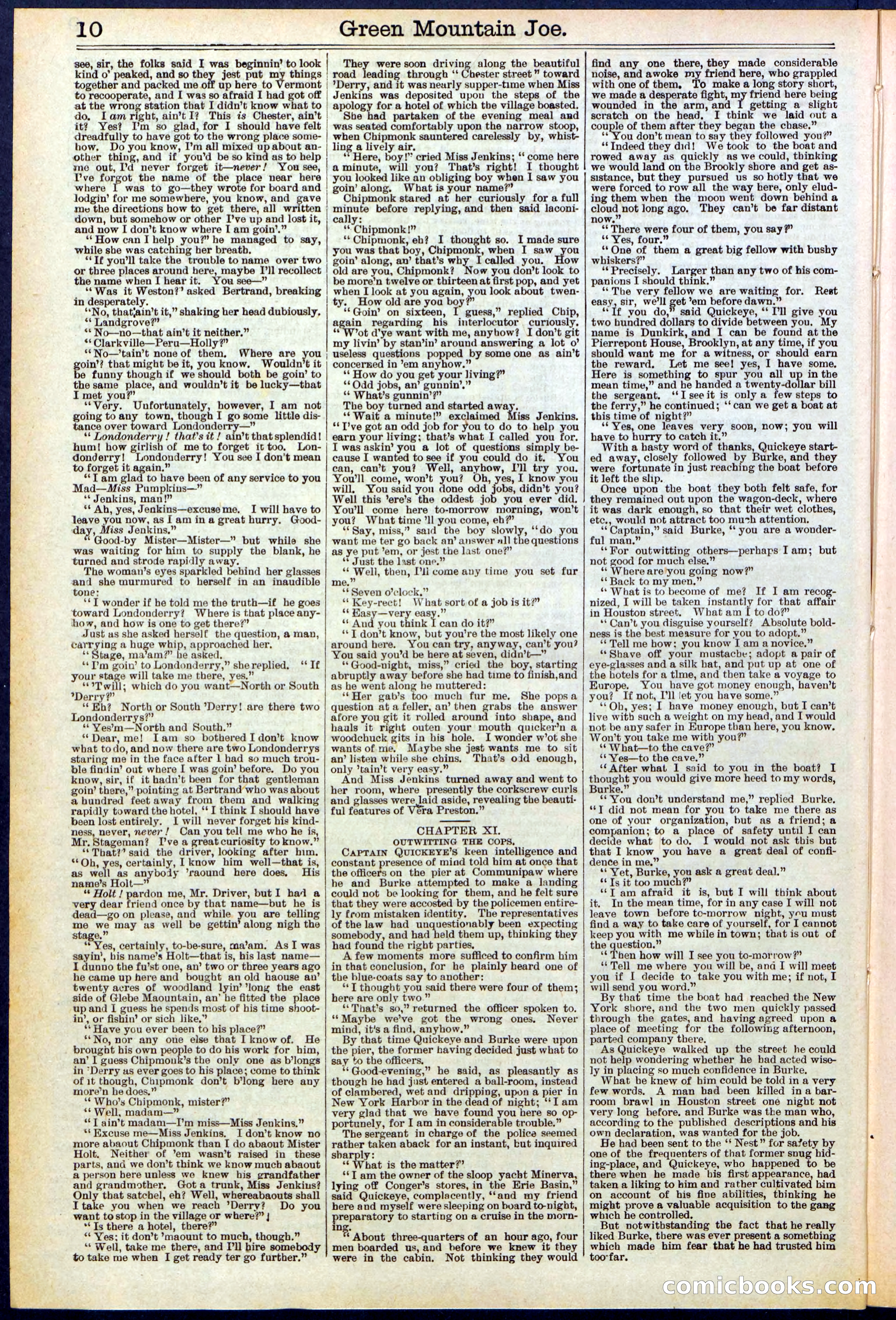
A restored page from Pulp Fiction, 1889. Page through the whole issue in the reader above.
📄 Transcribed text from this page (OCR, searchable)
Machine-transcribed from the original scan — historical spelling and the odd misread are preserved.
10 Green Mountain Joe. see, sir, the folks said I was beginnin’ to look kind 0” peaked, and so ney jest put together and packed me o at the wrong station that I didn’t know what to do. Lamright, ain’t I? This is Chester, ain’t my things | road leading through “ up here to Vermont | ’Derry, to recooperate, and I was so afraid I had got off | Jenkins was deposited upon the steps | The along the beautiful hester street ” toward and it was nearly supper-time when Me of the apology for a hotel of which the village boasted. Sbe had partaken of the evening meal and were soon drivin it? Yes? I’m so glad, for I should have felt | was seated comfortably upon the narrow stoop, dreadfully to have got to the wrong place some- how. Do you know, I’m all mixed up about an- other thing, and if you’d be so kind as to help me out, ’d never forget it—never! You see, ve sha ae the name of the place near here where I was to go—they wrote for board and lodgin’ for me somewhere, you know, and gave mv the directions how to get there, all written down, but somehow or other I’ve up and lost it, and now I don’t know where I am goin’.” ‘How can I help you?” he managed to say, while she was catching her breath. “*If you'll take the trouble to name over two or three places around here, maybe I'll recollect the name when [ hear it. You see—” ‘“*Was it Weston?’ asked Bertrand, breaking in desperately. **No, thatjain’t it,” shaking her head dubiously, ** Landgrove?” ** No—no—that ain’t it neither.” ** Clarkville—Peru—Holly?” **No—'tain’t none of them, Where are you pare! that might be it, you know. Wouldn’t it e funny though if we should both be goin’ to the same place, and wouldn’t it be lucky—tbat I met you?” ‘*Very. Unfortunately, however, I am not going to any town, though I go some little dis- tance over toward geri re sem ** Londonderry ! that’s it! ain’t that splendid! hum! how girlish of me to forget it too, Lon- donderry! Londonderry! You see I don't mean to forget it again.” **T am glad to have been of any service to you Mad—Miss Pumpkins—” ** Jenkins, man!” ** Ah, yes, Jenkins—excuseme, I will have to leave you now, asl am ina great hurry. Good- day, Miss Jenkins,” *Good-by Mister—Mister—” but while she was waiting for him to supply the blank, he turned and strode rapidly away. The woman’s eyes sparkled behind her glasses and she murmured to herself in an inaudible tone: ‘*T wonder if he told me the truth—if he goes toward Londonderry? Where is that place any- how, and how is one to get there?” Just us she asked herself the question, a man, carrying a huge whip, approached her, ‘* Stage, ma’am?” he asked, ‘*P’'m goin’ to Londonderry,” she replied, our stage will take me there, yes.” “Twill; which do you want—North or South *Derry?” ‘Eh? North or South "Derry! are there two Londonderrys?” ‘¢ Yes’m—North and South.” ‘*Dear, me! Iam so bothered I don’t know what todo, and now there are two Londonderrys staring me in the face after | had so much trou- ble findin’ out where I was goin’ before. Do you know, sir, if it hadn’t been for that gentleman goin’ there,” pointing at Bertrand who was about a hundred feet away from them and walking rapidly toward the hotel, ‘‘ I think I should have been lost entirely. I will never forget his kind- ness, never, never! Can you tell me who he is, Mr. Stageman? I’ve a greatcuriosity to know.” ‘*That?’ said the driver, looking after him. Oh, yes, certainly, I know him well—that is, as well as anybody ’raound here does, His name’s Holt—’ ** Holt ! pardon me, Mr. Driver, but I had a very dear friend once by that name—but he is dead—go on please, and while you are telling me we may as well be gettin’ along nigh the stage.” ** Yes, certainly, to-be-sure, ma’am. As I was sayin’, bis name’s Holt—that is, his last name— I dunno the fu’st one, an’ two or three years ago he came up here and bought an old haouse an’ twenty acres of woodland lyin’’long the east side of Glebe Maountain, an’ he fitted the place up and I guess he spends most of his time shoot- in’, or fishin’ or sich like,” ** Have you ever been to his place?” **No, nor any one else that Iknowof. He brought his own peepie to do his work for him, an’ I guess Chipmounk’s the only one as b’longs in ‘Derry us ever goes to his place; come to think of it though, Chipmonk don’t b’long here any more’n he does,” ‘* Who’s Chipmonk, mister?” ** Well, madam—” **T ain’t madam—I’m miss—Miss Jenkins.” ** Excuse me—Miss Jenkins, I don’t know no more abaout Chipmonk than I do abaout Mister Holt. Neither of ’em wasn’t raised in these parts, and we don’t think we know much abaout a person bere unless we knew his grandfather and grandmother. Gota trunk, Miss Jenkius? aly that satchel, eh? Well, whereabaouts shall I take you when we reach "Derry? Do you want to stop in the village or where?” | ‘‘ Ts there a hotel, there?” ** Yes; it don’t ’maount to much, though.” “ce If ‘* Well, take me there, and P’ll hire somebody to take me when I get ready ter go further.” ee when Chipmonk sauntered carelessly by, whist- ling a lively air. ‘* Here, boy!” cried Miss Jenkins; ‘‘ come here a minute, will you? That’s right! I thought you looked like an obliging boy when I saw you goin’ along. What is your name?” Chipmonk stared at her curiously for a full a is before replying, and then said laconi- cally: ** Chipmonk!” ** Chipmonk, eh? I thought so. I made sure you was that boy, Chipmonk, when I saw you goin’ along, an’ that’s why I called you. How old are you, Chipmonk? Now you don’t look to be more’n twelve or thirteen at first pop, and yet when I look at you again, Pa look about twen- ty. How old are you boy ‘*Goin’ on sixteen, I guess,” replied Chip, — regarding his interlocutor curiously, **'W’ot d’ye want with me, anyhow? I don’t git my livin’ by stan’in’ around answering a lot o’ useless questions popped by some one as ain’t concerned in ’em anyhow.” ‘* How do you get your living?” ** Odd jobs, an’ gunnin’,” ** What’s gunnin’?” The boy turned and started away, ‘Wait a minute!” exclaimed Miss Jenkins. ‘‘T’ve got an odd job for you to do to help you earn your living; that’s what I called you for. I was askin’ you a lot of questions simply be- cause I wanted to see if you could do it. You can, can’t you? Well, anyhow, I'll try you. You'll come, won’t you? Oh, yes, I know you will, You said you done odd jobs, didn’t you? Well this ’ere’s the oddest job you ever did. You'll come here to-morrow morning, won’t you? What time ’ll you come, eh?” ‘* Say, miss,” said the boy slowly, ‘‘do you want me ter go back an’ answer all the questions as ye put ’em, or jest the last one?” ** Just the last one.” *“* Well, then, Pli come any time you set fur me.” ** Seven o’clock,” ** Key-rect! What sort of a job is it?” ‘* Hasy—very easy.”’ ** And you think I can do it?” ‘** 7 don’t know, but you're the most likely one around here. You can try, anyway, can’t you? You said you’d be here at seven, didn’t—” **Good-night, miss,” cried the boy, starting abruptly away before she had time to finish,and as he went along he muttered: ‘Her gab’s too much fur me, She popsa question at a feller, an’ then grabs the answer afore you git it rolled around into shape, and hauls it right outen your mouth quicker’n a woodchuek gits in his hole. I wonder w’ot she wants of me, Maybe she jest wants me to sit an’ listen while she chins, That’s old enough, only ’tain’t very easy.” And Miss Jenkins turned away and went to her room, where presently the corkscrew curls and glasses were laid aside, revealing the beauti- ful features of Vera Preston.” CHAPTER XI. OUTWITTING THE COPS, CAPTAIN QUICKEYE’S keen intelligence and constant presence of mind told him at once that the officers on the pier at Communipaw where he and Burke attempted to make a landing could not be looking for them, and he felt sure that they were accosted by the policemen entire- ly from mistaken identity. The representatives of the law had unquestionably been expecting somebody, and had held them up, thinking they had found the right parties, A few moments more sufficed to confirm him in that conclusion, for he plainly beard one of the blue-coats say to another: **T thought you said there were four of them; here are only two.” ‘*That’s so,” returned the officer spoken to. ** Maybe we've got the wrong ones. Never mind, it’s a find, anyhow.” By that time Quickeye and Burke were upon the pier, the former having decided just what to say to the officers, ** Good-evening,” he said, as pleasantly as though he had just entered a ball-room, instead of clambered, wet and dripping, upon a pier in New York Harbor in the dead of night; ‘‘ lam very glad that we have found you here so op- portunely, for I am in considerable trouble.” The sergeant in charge of the police seemed rather taken aback for an instant, but inquired sharply: ‘What is the matter?’ ‘*T am the owner of the sloop yacht Minerva, lying off Conger’s stores, in the Erie Basin,” said Quickeye, complacently, ‘‘and my friend here and myself were sleeping on buard to-night, propareeony to starting on a cruise in the morn- D © About three-quarters of an hour ago, four men boarded us, and before we knew it they were in the cabin. Not thinking they would se tee find any one there, they made considerable noise, and awoke my friend here, who grappled with one of them, To make a long story short, we made a aepernt fight, friend here being wounded in the arm, and 1 getting a slight scratch on the head, I think we laid out a couple of them after they began the chase,” ‘** You don’t mean to say they followed you?” ‘* Indeed they did! We took to the boat and rowed away as quickly as we could, thinking we would land on the Brookly shore and get as- sistance, but they pursued us so hotly that we were forced to row all the way here, only elud- ing them when the moon went down behind a cloud not long ago. They can’t be far distant now. ‘* There were four of them, you say?” ‘* Yes, four.” ‘*One of them a great big fellow with bushy whiskers?” ‘*Precisely. Larger than any two of his com- panions I should think.” ‘*The very fellow we are waiting for. Rest easy, sir, we'll get ’em before dawn.” “Tf vou do,” said Quickeye, ‘' I'll give you two hundred dollars to divide between you. My name is Dunkirk, and I can be found at the Pierrepont House, Brooklyn, at any time, if you should want me for a witness, or should earn the reward, Let me see! yes, I have some, Here is something to spur you all up in the mean time,” and he handed a twenty-dollar bill the sergeant. ‘‘I seeit is only a few steps to the ferry,” he continued; ‘‘ can we get a boat at this time of night?” ‘* Yes, one leaves very soon, now; you will have to hurry to catch it.” With a hasty word of thanks, Quickeye start- ed away, closely followed by Burke, and they were fortunate in just reaching the boat before it left the slip. Once upon the boat they both felt safe, for they remained out upon the wagon-deck, where it was dark enough, so that their wet clothes, etc., would not attract too much attention. ‘*Captain,” said Burke, ‘‘ you are a wonder- ful man.” ‘*For outwitting others—perhaps Iam; but not good for much else,” ‘Where are you going now?” ‘Back to my men,” “What is to become of me? If I am recog- nized, I will be taken instantly for that affair in Houston street. What am I to do?” ‘**Can’t you disguise yourself? Absolute bold- ness is the best measure for you to adopt.” ‘¢ Tell me how: you know I am a novice,” “Shave off your mustacbe; adopt a pair of eye-glasses and a silk hat, and put up at one of the hotels for a tlme, and then take a voyage to Europe. You have got money enough, haven't you? If not, I'll let you have some,” ‘‘Ob, yes; I have money enough, but I can’t live with such a weight on my head, and I would not be any safer in Europe than here, you know. Won’t you take me with you?” ‘* What—to the cave?” ‘¢ VYes—to the cave.” ‘‘ After what 1 said to you in the boat? I thought you would give more heed to my words, Burke.” ‘‘-You don’t understand me,” replied Burke. ‘*] did not mean for you to take me there as one of your organization, but as a friend; a companion; to a place of safety until I can decide what to do. I would not ask this but that I know you have a great deal of confi- dence in me,” ‘‘ Yet, Burke, you ask a great deal,” ** Ts it too much?” ‘“T am afraid it is, but I will think about it. In the mean time, for in any case I will not leave town before to-morrow night, you must find a way to take care of yourself, for I cannot keep you with me while in town; that is out of the question.” ‘* Then how will I see you to-morrow?” ‘‘ Tell me where you will be, ana I will meet you if I decide to take you with me; if not, I will send you word.” By that time the boat had reached the New York shore, and the two men quickly passed through the gates, and having agreed upon a place of meeting for the following afternoon, parted company there, As Quickeye walked up the street he could not help wondering whether he bad acted wise- ly in placing so much confidence in Burke. What he knew of him could be told in a very few words. A man had been killed in a bar- room brawl in Houston street one night not very long before. and Burke was the man who, according to the published descriptions and his own declaration, was wanted for the job. He had been sent to the ‘t Nest” for safety b one of the frequenters of that former snug hid- ing-place, and Quickeye, who happened to be there when he made bis first appearance, had taken a liking to him and rather cultivated him on account of his five abilities, thinking he might prove a valuable acquisition to the gang which he controlled. But notwithstanding the fact that he really liked Burke, there was ever present a something es made him fear that he had trusted him oovfar. Gomichboo <S * — Se 2, ihe