
Pulp Fiction, 1888 · page 15 of 32
Beadle's New York Dime Library No. 513 — page 15: what you’re looking at
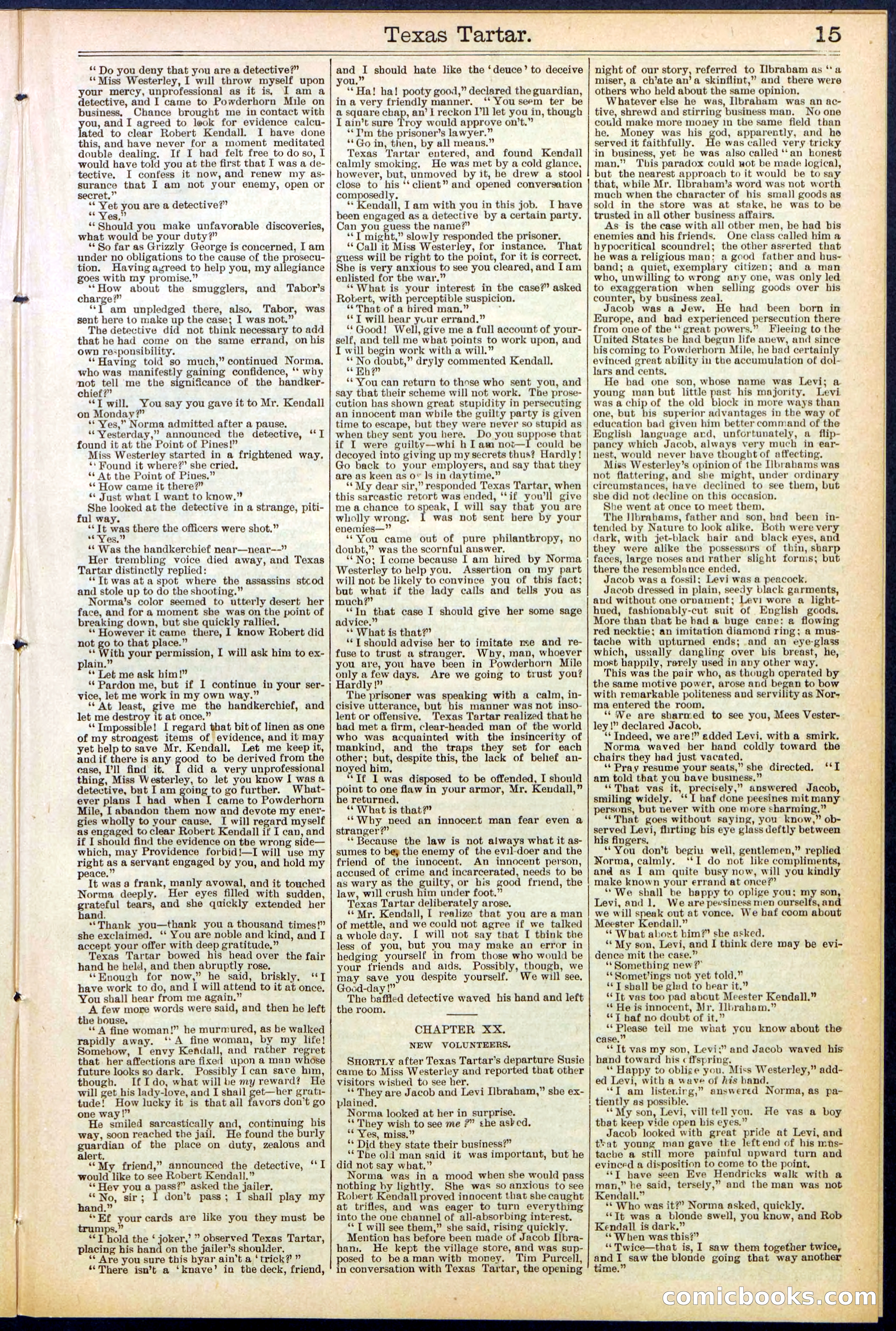
A restored page from Pulp Fiction, 1888. Page through the whole issue in the reader above.
📄 Transcribed text from this page (OCR, searchable)
Machine-transcribed from the original scan — historical spelling and the odd misread are preserved.
‘* Do you deny that you are a detective?” ‘*Miss Westerley, I will throw myself upon your mercy, unprofessional as it is, I am a detective, and I came to Powderhorn Mile on business. Chance brought me in contact with ou, andI agreed to leok for evidence calcu- ated to clear Robert Kendall. I bave done this, and have never for a moment meditated double dealing, If I had felt free to doso, I would have told you at the first that I was a de- tective. I confess it now, and renew my as- surance that 1 am not your enemy, open or secret,” “* Yet you are a detective?” ee? ‘*Should you make unfavorable discoveries, what would be your duty?” ** So far as Grizzly George is concerned, I am under no obligations to the cause of the prosecu- tion. Having ayreed to help you, my allegiance goes with my promise.” ‘*How about the smugglers, and Tabor’s charge?” ‘*] am unpledged there, also, Tabor, was sent here to make up the case; 1 was not.” The detective did not think necessary to add that he had come on the same errand, on his own responsibility. ‘‘ Having told so much,” continued Norma, who was manifestly gaining confidence, ‘* why not tell me the significance of the handker- chief?” ‘“T will, You say you gave it to Mr. Kendall on Monday?” ‘* Yes,” Norma admitted after a pause. ‘‘ Yesterday,” announced the detective, ‘I found it at the Point of Pines!” Miss Westerley started in a frightened way. ‘‘ Found it where?” she cried. ** At the Point of Pines.” ** How came it there?” * Just what | want to know.” She looked at the detective in a strange, piti- ful way. ‘* Tt was there the officers were shot,” oc Yes.” ‘* Was the handkerchief near—near-~” Her trembling voice died away, and Texas Tartar distinctly replied: ‘Tt was ata spot where the assassins stcod and stole up to do the shooting.” Norma’s color seemed to utterly desert her face, and for a moment she was on the point of breaking down, but she quickly rallied. *“* However it came there, 1 know Robert did not go to that place.” és ‘ith your permission, I will ask him to ex- lain. pn Let me ask him!” ‘‘ Pardon me, but if 1 continue in your ser- vice, let me work in my own way.” ‘At least, give me the handkerchief, and let me destroy it at once.” ‘‘Tmpossible! I regard that bit of linen as one of my strongest items of evidence, and it may yet help to save Mr. Kendall. Let me keep it, and if there is any Ger to be derived from the case, Pll find it. did a very unprofessional thing, Miss Westerley, to let you know I was a detective, but Iam going to go further. What- ever plans I had when I came to Powderhorn Mile, [abandon them now and devote my ener- gies wholly to your cause, I will regard myself as engaged to clear Robert Kendall if I can, and if I should find the evidence on the wrong side— which, may Providence forbid!—I will use my right as a servant engaged by you, and hold my eace. . It was a frank, manly avowal, and it touched Norma deeply. Her eyes filled with sudden, grateful tears, and she quickly extended her hand. ‘“‘Thank you—thank you a thousand times!” she exclaimed. ‘‘ You are noble and kind, and I accept your offer with deep gratitude,” Texas Tartar bowed his head over the fair hand he held, and then abruptly rose, ‘Enough for now,” he said, briskly, ‘“T have work to do, and I will attend to it at once, You shall hear from me again.” A few more words were said, and then he left the house, ‘‘ A fine woman!” he murmured, as he walked rapidly away. ‘A fine woman, by my life! Somehow, I envy Kefidall, and rather regret that her affections are fixed upon a man whose future looks so dark. Possibly I can save him, though. If Ido, what will be my reward? He will get his lady-love, and I shall get—her grati- tude! How lucky it is that all favors don’t go one way!” : He smiled sarcastically and, continuing his way, soon reached the jail. He found the burly guardian of the place on duty, zealous and alert. ‘“My friend,” announced the detective, “I would like to see Robert Kendall.” ‘* Hey you a pass?” asked the jailer. “No, sir; I don’t pass; I shall play my hand.” “Ef your cards are like you they must be trumps.” **T hold the ‘ joker,’ ” observed Texas Tartar, placing his hand on the jailer’s shoulder. ** Are you sure this hyar ain't a ‘trick? ” “There isn’t a ‘knave’ in the deck, friend, Texas Tartar. and a should hate like the ‘deuce’ to deceive ou. ‘* Ha! ha! pooty good,” declared the guardian, in a very friendly manner. ‘‘ You seem ter be a square chap, an’ I reckon Ill let you in, though I ain’t sure Troy would approve on’t.” ‘*1’m the prisoner’s lawyer.” ‘*Go in, then, by all means.” Texas Tartar entered, and found Kendall calmly smoking, He was met by a cold glance, however, but, unmoved by it, he drew a stool close to his ‘‘ client” and opened conversation composedly, ** Kendall, Iam with you in this job. I have been engaged as a detective by a certain party. Can you guess the name?” ‘‘T might,” slowly responded the prisoner. ‘* Call it Miss Westerley, for instance. That guess will be right to the point, for it is correct. She is very anxious to see you cleared, and I am enlisted for the war.” ‘‘What is your interest in the case?’ asked Robert, with perceptible suspicion. ** That of a bired man,” **T will bear ycur errand.” **Good! Well, give me a full account of your- self, and tell me what points to work upon, and I will begin work with a will.” ** No doubt,” dryly commented Kendall. ts Bh 9) ‘**' You can return to those who sent you, and say that their scheme will not work. The prose- cution has shown great stupidity in persecuting an innocent man while the guilty party is given time to escape, but they were never so stupid as when they sent you here. Do you suppose that if I were guilty—whi hI am noit—I could be decoyed into giving up my secrets thus? Hardly! Go back to your employers, and say that they are as keen as ov Js in daytime.” ‘My dear sir,” responded Texas Tartar, when this sarcastic retort was ended, “if you'll give me a chance to speak, I will say that you are wholly wrong. was not sent here by your enemies—”’ ‘‘ You came out of pure philanthropy, no doubt,” was the scornful answer, ‘No; I come because I am hired by Norma Westerley to help you. Assertion on my part will not be likely to convince you of this fact; but what if the lady calls and tells you as much?” ‘‘In that case I should give her some sage advice.” ‘* What is that?” ‘T should advise her to imitate mie and re- fuse to trust a stranger. Why, man, whoever you are, you have been in Powderhorn Mile only a few days. Are we going to trust you? Hardly !” The prisoner was speaking with a calm, in- cisive utterance, but his manner was not inso- lent or offensive. Texas Tartar realized that he had met a firm, clear-headed man of the world who was acquainted with the insincerity of mankind, and the traps they set for each other; but, despite this, the lack of belief an- noyed him. ‘*Tf I was disposed to be offended, I should por to one flaw in your armor, Mr. Keudall,” e returned. ** What is that?” ‘Why need an innocent man fear even a stranger?” ‘* Because the law is not always what it as- sumes to bey the enemy of the evil-doer and the friend of the innocent. An innocent person, accused of crime and incarcerated, needs to be as wary as the guilty, or his good friend, the law, will crush him under foot.” Texas Tartar deliberately arose. ‘‘ Mr. Kendall, I realize that you are a man of mettle, and we could not agree if we talked a whole day. I[ will not say that I think the less of you, but you may make an error in hedging yourself in from those who would be your triends and aids, Possibly, though, we may save you despite yourself. We will see. Good-day !” The baffled detective waved his hand and left the room. CHAPTER XX. NEW VOLUNTEERS, Snortiy after Texas Tartar’s departure Susie came to Miss Westerley and reported that other visitors wished to see her, ‘‘ They are Jacob and Levi Ilbraham,” she ex- plained. ; Norma looked at her in surprise. “They wish to see me ?” she asked. ** Yes, miss.” ‘* Did they state their business?” ‘“The old man said if was important, but he did not say what,” Norma was in a mood when she would pass nothing by lightly. She was so anxious to see Robert Kendall proved innocent that she caught at trifles, and was eager to turn everything into the one channel of all-absorbing interest. ** T will see them,” she said, rising quickly. Mention has before been made of Jacob [lbra- ham. He kept the village store, and was sup- posed to beaman witb money. Tim Purcell, in conversation with Texas Tartar, the opening a a : he Ne hal ah ed Ld oy SS 0 « 42 0% ‘; J ee ey a * ows es Ke. 15 ‘—— ~_—— night of our story, referred to [lbrabam as ‘a miser, a ch’ate an’a skinflint,” and there were , > others who held about the same opinion, Whatever else he was, Ilbraham was an ac- tive, shrewd and stirring business man. No one could make more money in the same field than he. Money was his god, apparently, and ho served it faithfully. e was called very tricky in business, yet he was also called ‘‘an honest man,.”” This paradox could wot be made logical, but the nearest approach to it would be to say that, while Mr. Ubraham’s word was not worth much when the character of his small goods as sold in the store was at stake, be was to be trusted in all other business affairs. As is the case with all other men, he had bis enemies and his friends. One class called him a hypocritical scoundrel; the other asserted that he was a religious man: a good father and bus~ band; a quiet, exemplary citizen; and a man who, unwilling to wrong any one, was only led to exaggeration when selling goods over his counter, by business zeal. Jacob was a Jew. He had been born in Europe, and had experienced persecution there from one of the ‘‘ great powers.” Fleeing to the United States be had begun life anew, and since his coming to Powderhorn Mile, he bad certain! evinced great ability in the accumulation of dol- lars and cents. He had one son, whose name was Levi; a young man but little past his majority. Levi was achip of the old block in more ways than one, but bis superior advantages in the way of education bad given him better command of the English language and, unfortunately, a_ flip- pancy which Jacob, always very much in ear- nest, would never have thought of affecting. Miss Westerley’s opinion of the [ibrahams was not flattering, and she might, under ordinary circumstances, have declined to see them, but sbe did not decline on this occasion. She went at once to meet them. The Ilbrabams, father and son, had been in- tended by Nature to look alike. Both were very dark, with jet-black hair and black eyes, and they were alike the possessors of thin, sharp faces, large noses and rather slight forms; but there the resemblance ended. Jacob was a fossil; Levi was a peacock. Jacob dressed in plain, seedy black garments, and without one ornament; Levi wore a light- hued, fashionably-cut suit of English goods. More than that be had a buge cane: a flowing red necktie; an imitation diamond ring; a mus- tache with upturned ends; and an eye-glass which, usually dangling over his breast, he, most happily, rerely used in any other way. This was the pair who, as though operated by the same motive power, arose and began to bow with remarkable politeness and servility as Nor- ma entered the room, ‘‘ We are sharmed to see you, Mees Vester- ley |” declared Jacob. ‘* Indeed, we are!” added Levi, with a smirk. Norma waved her hand coldly toward the chairs they had just vacated. ‘‘ Pray resume your seats,” she directed. ‘‘I am told that you bave business.” “That vas it, precisely,” answered Jacob, smiling widely. ‘‘ I haf done peesines mit many persons, but never with one more sharming.” ‘““That goes without saying, you know,” ob- served Levi, flirting his eye glass deftly between his fingers, ‘You don’t begiu well, gentlemen,” replied Norma, calmly. ‘‘I do not like compliments, and as I am quite busy now, will you kindly make known your errand at once?” ‘‘ We shall be happy to oplige you; my son, Levi, andl, Weare peesiness men ourselfs, an we will speak out at vonce. We haf coom about Meester Kendall.” ‘* What abort him?” she asked. ‘“ My son, Levi, and I think dere may be evi- dence mit the case.” ‘*Something new? ““Somet'ings not yet told.” ‘«T shall be glud to hear it,” ‘Tt vas too pad about Meester Kendall.” ‘* He is innocent, Mr. Ilbraham.” **T haf no doubt of it.” . > Please tell me what you know about the case. ‘* Tt vas my son, Levi;” and Jacob waved his hand toward his ¢ ffspring. ‘* Happy to oblige you. Miss Westerley,” add- ed Levi, with a wave of his hand. ‘‘T am listenirg,” answered Norma, as pa- weg as possible. ‘My son, Levi, vill tell you. that keep vide open bis eyes.” Jacob looked with great pride at Levi, and that young man gave the leftend of his mts- tacbe a still more painful upward turn and evinced a disposition to come to the point. ‘““T have seen Eve Hendricks walk with a man,” he said, tersely,” and the man was not Kendall.” ‘¢ Who was it?” Norma asked, quickly. ‘“‘Tt was a blonde swell, you knuw, and Rob Kendall is dark.” ‘* When was this?” “Twice—that is, I saw them together twice, se T saw the blonde going that way another me. : He vas a boy ee ee 7... ee ee Pa, wre 2G. = . ae ya ¥ 4 yy of aMlicelexeye) (C ‘SS | a oa ; UL wv Vn fi a * » 1977 . Sees ae ha