
Pulp Fiction, 1878 · page 9 of 44
Beadle's Dime Library No. 51: Red Rob, The Boy Road-Agent — page 9: what you’re looking at
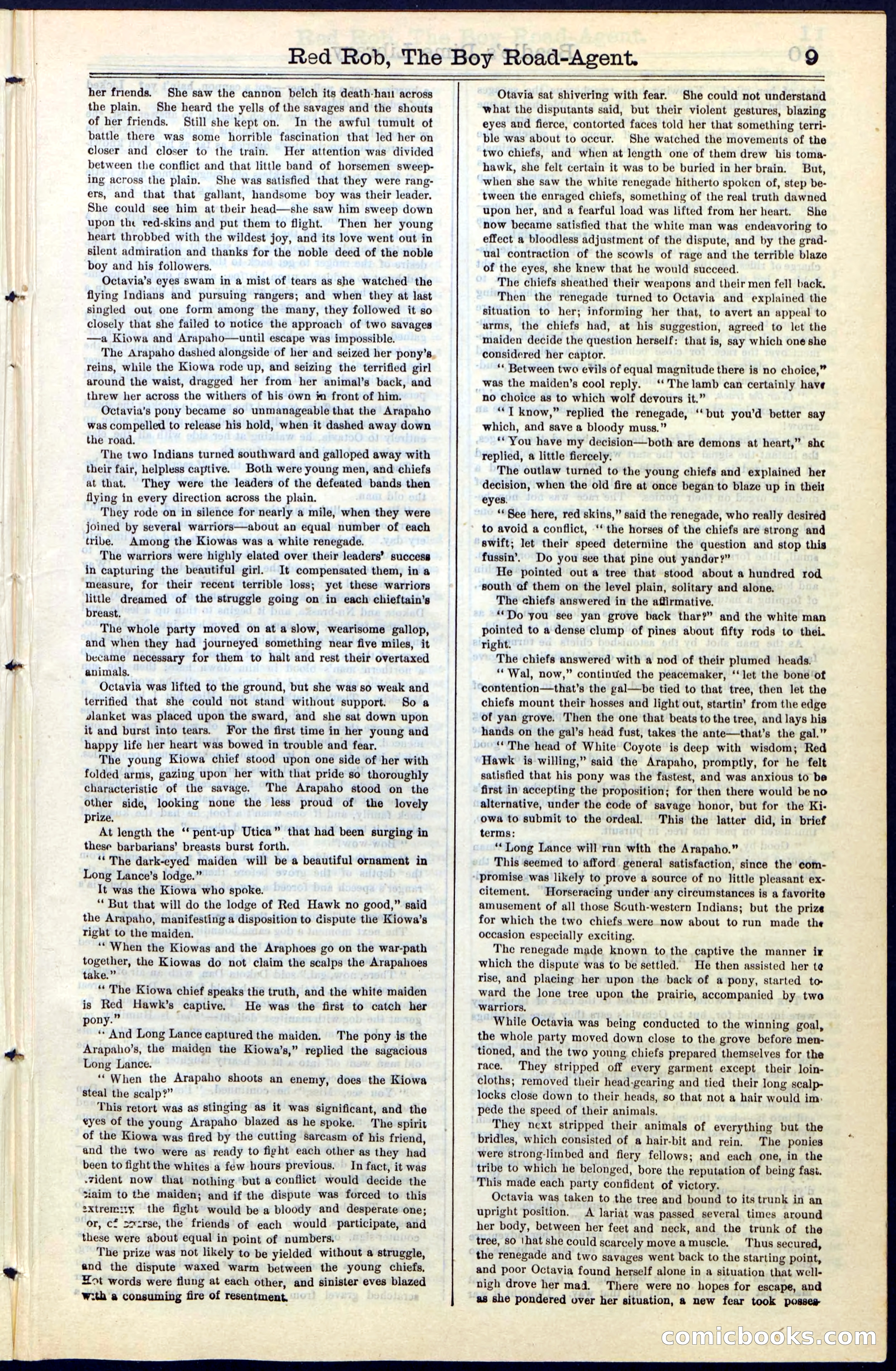
A restored page from Pulp Fiction, 1878. Page through the whole issue in the reader above.
📄 Transcribed text from this page (OCR, searchable)
Machine-transcribed from the original scan — historical spelling and the odd misread are preserved.
Red Rob, The Boy Road-Agent. 9 her friends. She saw the cannon belch its death-hai across the plain. She heard the yells of the savages and the shouts of her friends. Still she kept on. In the awful tumult of battle there was some horrible fascination that led her on closer and closer to the train. Her attention was divided between the conflict and that little band of horsemen sweep- ing across the plain. She was satisfied that they were rang- ers, and that that gallant, handsome boy was their leader. She could see him at their head—she saw him sweep down upon the red-skins and put them to flight. Then her young heart throbbed with the wildest joy, and its love went out in silent admiration and thanks for the noble deed of the noble boy and his followers. Octavia’s eyes swam in a mist of tears as she watched the flying Indians and pursuing rangers; and when they at last singled out one form among the many, they followed it so closely that she failed to notice the approach of two savages —a Kiowa and Arapaho—until escape was impossible. The Arapaho dashed alongside of her and seized her pony’s, reins, while the Kiowa rode up, and seizing the terrified girl around the waist, dragged her from her animal’s back, and threw her across the withers of his own im front of him. Octavia'’s pony became so unmanageable that the Arapaho was compelled to release his hold, when it dashed away down the road. The two Indians turned southward and galloped away with their fair, helpless captive. Both were young men, and chiefs at that. They were the leaders of the defeated bands then flying in every direction across the plain. They rode on in silence for nearly a mile, when they were joined by several warriors—about an equal number of each tribe. Among the Kiowas was a white renegade. The warriors were highly elated over their leaders’ success in capturing the beautiful girl. It compensated them, in a measure, for their recent terrible loss; yet these warriors little dreamed of the struggle going on in each chieftain’s breast. The whole party moved on at a slow, wearisome gallop, and when they had journeyed something near five miles, it became necessary for them to halt and rest their overtaxed animals. Octavia was lifted to the ground, but she was so weak and terrified that she could not stand without support. So a vlanket was placed upon the sward, and she sat down upon it and burst into tears. For the first time in her young and happy life her heart was bowed in trouble and fear. The young Kiowa chief stood upon one side of her with folded arms, gazing upon her with that pride so thoroughly characteristic of the savage. The Arapaho stood on the Other side, looking none the less proud of the lovely prize. At length the ‘‘ pent-up Utica” that had been surging in these barbarians’ breasts burst forth, ‘‘The dark-eyed maiden will be a beautiful ornament in Long Lance’s lodge.” It was the Kiowa who spoke. ‘“* But that will do the lodge of Red Hawk no good,” said the Arapaho, manifesting a disposition to Gispute the Kiowa’s right to the maiden. ‘* When the Kiowas and the Araphoes go on the war-path together, the Kiowas do not claim the scalps the Arapahoes take.” “The Kiowa chief speaks the truth, and the white maiden is Red Hawk’s captive. He was the first to catch her pony.” ‘* And Long Lance captured the maiden. The pony is the Arapaho’s, the maiden the Kiowa’s,” replied the sagacious Long Lance. ‘‘ When the Arapaho shoots an enemy, does the Kiowa Steal the scalp?” This retort was as stinging as it was significant, and the eyes of the young Arapaho blazed as he spoke. The spirit of the Kiowa was fired by the cutting Sarcasm of his friend, and the two were as ready to fight each other as they had been to fight the whites a few hours previous. In fact, it was -vident now that nothing but a conflict would decide the siaim to the maiden; and if the dispute was forced to this 2xtremity, the fight would be a bloody and desperate one; or, ct cxcrse, the friends of each would participate, and these were about equal in point of numbers. The prize was not likely to be yielded without a struggle, and the dispute waxed warm between the young chiefs, ot words were flung at each other, and sinister eves blazed w:th a consuming fire of resentment, Otavia sat shivering with fear. She could not understand what the disputants said, but their violent gestures, blazing eyes and fierce, contorted faces told her that something terri- ble was about to occur. She watched the movements of the two chiefs, and when at length one of them drew his toma- hawk, she felt certain it was to be buried in her brain. But, when she saw the white renegade hitherto spoken of, step be- tween the enraged chiefs, something of the real truth dawned upon her, and a fearful load was lifted from her heart. She now became satisfied that the white man was endeavoring to effect a bloodless adjustment of the dispute, and by the grad- ual contraction of the scowls of rage and the terrible blaze of the eyes, she knew that he would succeed. The chiefs sheathed their weapons and their men fell back. Then the renegade turned to Octavia and explained the situation to her; informing her that, to avert an appeal to urms, the chiefs had, at his suggestion, agreed to let the maiden decide the question herself: that is, say which one she considered her captor. ‘* Between two evils of equal magnitude there is no choice,” was the maiden’s cool reply. ‘‘ The lamb can certainly have no choice as to which wolf devours it.” ‘“‘I know,” replied the renegade, ‘‘but you’d better say which, and save a bloody muss.” *“ You have my decision—both are demons at heart,” she replied, a little fiercely. The outlaw turned to the young chiefs and explained her decision, when the old fire at once began to blaze up in their eyes. ‘See here, red skins,” said the renegade, who really desired to avoid a conflict, ‘‘ the horses of the chiefs are strong and swift; let their speed determine the question and stop this fussin’. Do you see that pine out yander?” He pointed out a tree that stood about a hundred rod south af them on the level plain, solitary and alone. The chiefs answered in the affirmative. ‘*Do you see yan grove back thar?” and the white man pointed to a dense clump of pines about fifty rods to thei. right. The chiefs answered with a nod of their plumed heads. ‘Wal, now,” continued the peacemaker, ‘‘let the bone of contention—that’s the gal—be tied to that tree, then let the chiefs mount their hosses and light out, startin’ from the edge of yan grove. Then the one that beats to the tree, and lays his hands on the gal’s head fust, takes the ante—that’s the gal.” ‘The head of White Coyote is deep with wisdom; Red Hawk is willing,” said the Arapaho, promptly, for he felt satisfied that his pony was the fastest, and was anxious to be first in accepting the proposition; for then there would be no alternative, under the code of savage honor, but for the Ki- owa to submit to the ordeal. This the latter did, in brief terms: ‘Long Lance will run with the Arapaho.” This seemed to afford general satisfaction, since the eom- promise was likely to prove a source of no little pleasant ex- citement. Horseracing under any circumstances is a favorite amusement of all those South-western Indians; but the prize for which the two chiefs were now about to run made the occasion especially exciting. The renegade made known to the captive the manner ir which the dispute was to be settled. He then assisted her te rise, and placing her upon the back of a pony, started to ward the lone tree upon the prairie, accompanied by two warriors, While Octavia was being conducted to the winning goal, — the whole party moved down close to the grove before men- tioned, and the two young chiefs prepared themselves for the race. They stripped off every garment except their loin- cloths; removed their head-gearing and tied their long scalp- locks close down to their heads, so that not a hair would im. pede the speed of their animals. They next stripped their animals of everything but the bridles, which consisted of a hair-bit and rein. The ponies were strong-limbed and fiery fellows; and each one, in the tribe to which he belonged, bore the reputation of being fasi. This made each party confident of victory. Octavia was taken to the tree and bound to its trunk in an upright position. A lariat was passed several times around her body, between her feet and neck, and the trunk of the tree, so |hat she could scarcely move amuscle. Thus secured, the renegade and two savages went back to the starting point, and poor Octavia found herself alone in a situation that well- nigh drove her mad. There were no hopes for escape, and as she pondered over her situation, a new fear took posses Gomichbooks E®) >