
Pulp Fiction, 1878 · page 6 of 44
Beadle's Dime Library No. 51: Red Rob, The Boy Road-Agent — page 6: what you’re looking at
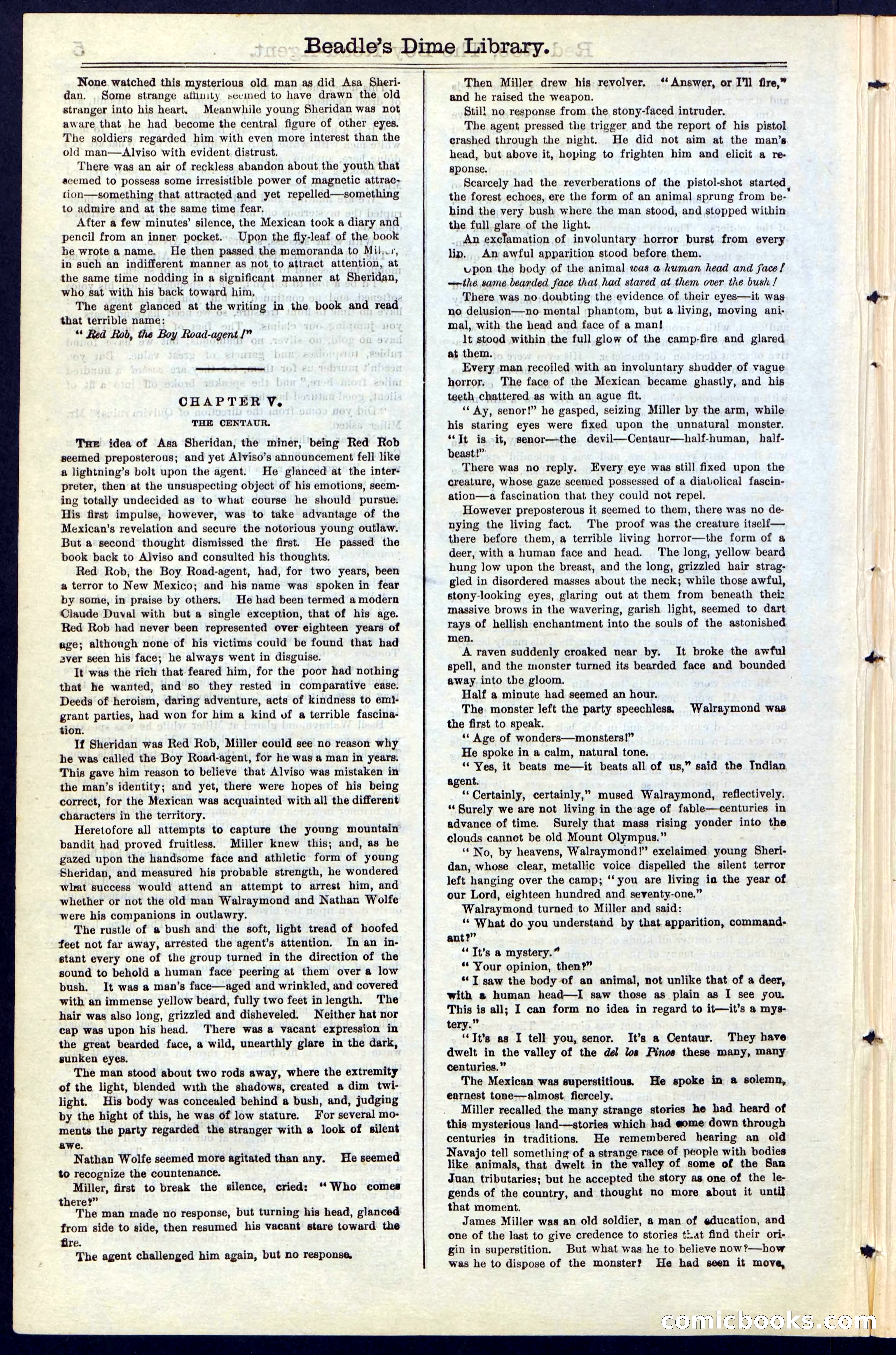
A restored page from Pulp Fiction, 1878. Page through the whole issue in the reader above.
📄 Transcribed text from this page (OCR, searchable)
Machine-transcribed from the original scan — historical spelling and the odd misread are preserved.
3 3 --» Beadle’s. Dime Library. ' None. watched this mysterious old man as did Asa Sheri- dan. _ Some strange atluity seemed to have drawn the old stranger into his heart. Meanwhile young Sheridan was not aware that he had become the central figure of other eyes. The soldiers regarded him with even more interest than the old man—Alviso with evident. distrust. There was an air of reckless abandon about the youth that acemed to possess some irresistible power of magnetic attrac; tion—something that attracted and yet repelled—something to admire and at the same time fear, After a few minutes’ silence, the Mexican took a diary and pencil from an inner pocket. Upon the fly-leaf of the book he wrote a name. He then passed the memoranda to Mil,.:, in such an indifferent manner as not to attract attention, at the same time nodding in a significant manner at Sheridan, who sat with his back toward him, . The agent glanced at the writing in the book and read that terrible name: “ Red Rob, the Boy Road-agent /” CHAPTER V, THE CENTAUR. Tur idea of Asa Sheridan, the miner, being Red Rob seemed preposterous; and yet Alviso’s announcement fell like a lightning’s bolt upon the agent. He glanced at the inter- preter, then at the unsuspecting object of his emotions, seem- ing totally undecided as to what course he should pursue. His first impulse, however, was to take advantage of the Mexican’s revelation and secure the notorious young outlaw. But a second thought dismissed the first. He passed the book back to Alviso and consulted his thoughts. Red Rob, the Boy Road-agent, had, for two years, been a terror to New Mexico; and his name was spoken in fear by some, in praise by others. He had been termed a modern Claude Duval with but a single exception, that of his age. Red Rob had never been represented over eighteen years of age; although none of his victims could be found that had zver seen his face; he always went in disguise. It was the rich that feared him, for the poor had nothing that he wanted, and so they rested in comparative ease. Deeds of heroism, daring adventure, acts of kindness to em}- grant parties, had won for him a kind of a terrible fascina- tion. If Sheridan was Red Rob, Miller could see no reason why he was called the Boy Road-agent, for he was a man in years. This gave him reason to believe that Alviso was mistaken in the man’s identity; and yet, there were hopes of his being correct, for the Mexican was acquainted with all the different characters in the territory. Heretofore all attempts to capture the young mountain bandit had proved fruitless. Miller knew this; and, as he gazed upon the handsome face and athletic form of young Sheridan, and measured his probable strength, he wondered what success would attend an attempt to arrest him, and whether or not the old man Walraymond and Nathan Wolfe were his companions in outlawry. The rustle of a bush and the soft, light tread of hoofed feet not far away, arrested the agent’s attention. In an in- stant every one of the group turned in the direction of the sound to behold a human face peering at them over a low bush. It was a man’s face—aged and wrinkled, and covered with an immense yellow beard, fully two feet inlength. The hair was also Jong, grizzled and disheveled. Neither hat nor cap was upon his head. There was a vacant expression in the great bearded face, a wild, unearthly glare in the dark, sunken eyes. The man stood about two rods away, where the extremity of the light, blended with the shadows, created a dim twi- light. His body was concealed behind a bush, and, judging by the hight of this, he was of low stature. For several mo- ments the party regarded the stranger with a look of silent awe. Nathan Wolfe seemed more agitated than any. He seemed to recognize the countenance. Miller, first to break the silence, cried: there?” The man made no response, but turning his head, glanced from side to side, then resumed his vacant stare toward the fire. The agent challenged him again, but no response, “Who comes Then Miller drew his revolver. ‘‘ Answer, or I'll fire,” and he raised the weapon. Still no response from the stony-faced intruder. The agent pressed the trigger and the report of his pistol crashed through the night. He did not aim at the man’s head, but above it, hoping to frighten him and elicit a re- sponse, Scarcely had the reverberations of the pistol-shot started, the forest echoes, ere the form of an animal sprung from be- hind the very bush where the man stood, and stopped within the full glare of the light. An exclamation of involuntary horror burst from every lip. An awful apparition stood before them. upon the body of the animal was a human head and face! ——the same bearded face that had stared at them over the bush / There was no doubting the evidence of their eyes—it was no delusion—no mental phantom, but a living, moving ani- mal, with the head and face of a man! lt stood within the full glow of the camp-fire and glared at them. Every man recoiled with an involuntary shudder of vague horror. . The face of the Mexican became ghastly, and his teeth chattered as with an ague fit. ‘‘ Ay, senor!” he gasped, seizing Miller by the arm, while his staring eyes were fixed upon the unnatural monster. “Tt is it, senor—the devil—Centaur—half-human, half- beast!” There was no reply. Every eye was still fixed upon the creature, whose gaze seemed possessed of a diabolical fascin- ation—a fascination that they could not repel. However preposterous it seemed to them, there was no de- nying the living fact. The proof was the creature itself— there before them, a terrible living horror—the form of a deer, with a human face and head. The long, yellow beard hung low upon the breast, and the long, grizzled hair strag- gled in disordered masses about the neck; while those awful, stony-looking eyes, glaring out at them from beneath theiz massive brows in the wavering, garish light, seemed to dart rays of hellish enchantment into the souls of the astonished men. A raven suddenly croaked near by. It broke the awful spell, and the monster turned its bearded face and bounded away into the gloom. Half a minute had seemed an hour. The monster left the party speechless, Walraymond was the first to speak. ‘‘ Age of wonders—monsters!” He spoke in a calm, natural tone. ‘Yes, it beats me—it beats all of us,” said the Indian agent. ‘‘ Certainly, certainly,” mused Walraymond, reflectively. ‘Surely we are not living in the age of fable—centuries in advance of time. Surely that mass rising yonder into the clouds cannot be old Mount Olympus.” ‘No, by heavens, Walraymond!” exelaimed young Sheri- dan, whose clear, metallic voice dispelled the silent terror left hanging over the camp; ‘‘you are living io the year of our Lord, eighteen hundred and seventy-one,” Walraymond turned to Miller and said: ‘“‘ What do you understand by that apparition, command: ant?” ‘“‘ It’s a mystery.” ** Your opinion, then?” “I saw the body of an animal, not unlike that of a deer, with a human head—I saw those as plain as I see you. This is all; I can form no idea in regard to it—it’s a mys- tery.” ‘““Tt’s as I tell you, senor. It’s a Centaur. They have dwelt in the valley of the del ls Pinos these many, many centuries.” The Mexican was superstitious. earnest tone—almost. ficrcely. Miller recalled the many strange stories he had heard of this mysterious land—stories which had eome down through centuries in traditions. He remembered hearing an old Navajo tell something of a strange race of people with bodies like animals, that dwelt in the valley of some of the San Juan tributaries; but he accepted the story as one of the le- gends of the country, and thought no more about it until that moment. James Miller was an old soldier, a man of education, and one of the last to give credence to stories tt.at find their ori- gin in superstition. But what was he to believe now?—how was he to dispose of the monster? He had seen it move, He spoke in a solemn, Gomichoo S) (C (0) : ;